
Selecting the Right Recycled Glassware for Weddings, Supermarkets, and Promotional Gifts
A scenario-fit analysis for rental operators, retail category buyers, and promotional gift programmes
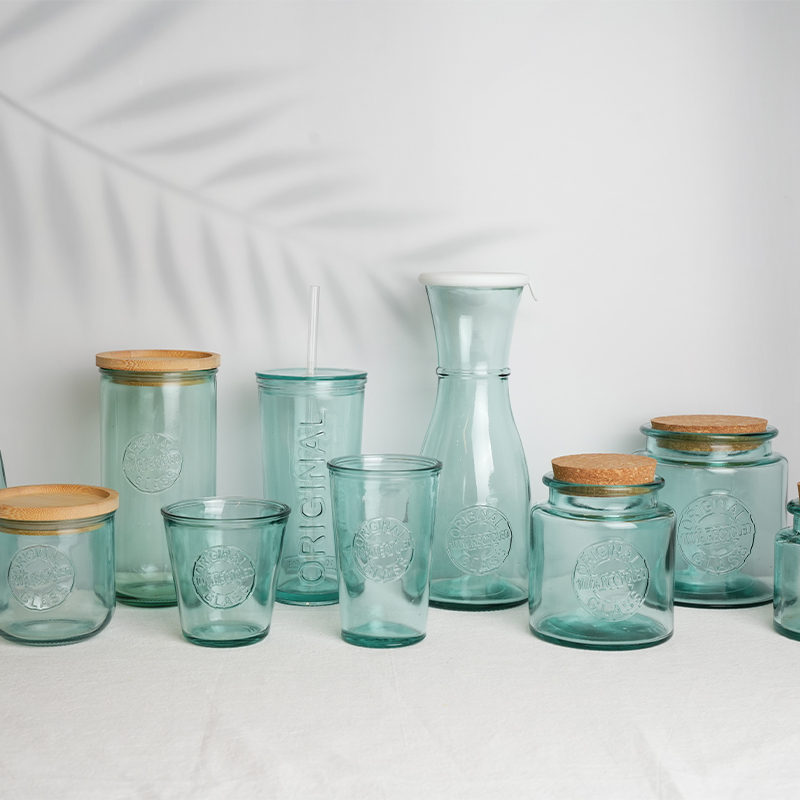
Recycled glassware sets: one material family, three different project requirements.
Recycled glassware is purchased twice: once as a material decision, and once as a project decision. The material question — recycled versus standard glass — is now reasonably well documented. The harder question is whether a specific item fits the environment it will actually be used in. An 850ml recycled glass jar, a 400ml pressed tumbler, and a 500ml stemmed wine glass can all be described accurately as recycled glassware, yet they solve completely different problems for a wedding rental operator, a supermarket category manager, and a promotional gift buyer.
This analysis maps three documented glassware scenarios to the products and supporting requirements each one demands: wedding drinkware rental in the United States, the United Kingdom and Canada; supermarket and chain store supply in Brazil and Poland; and branded promotional gift programmes in Brazil and Poland. The purpose is practical rather than promotional. Misapplication — the right product used in the wrong project — is one of the least discussed and most persistent sources of avoidable cost in glassware procurement.
Why Scenario Fit Matters More Than Unit Price
A product can be technically compliant, competitively priced, and correctly packed, and still fail in service because its capacity, thermal behaviour, or packaging format does not match the operating environment. Rental fleets measure failure in breakage per cycle and replacement cost. Chain retailers measure it in shelf turnover and packaging fit. Promotional buyers measure it in how the item performs after the campaign ends, when recipients are still using it.
Buyers evaluating glassware for a defined project generally need to resolve six questions before committing to a specification:
- Does the capacity match the serving format the project actually uses?
- Can the glass handle the thermal transitions of the service or washing routine?
- Is there a suitable surface for engraving, logo application, or branding?
- Does the packaging support transport, shelving, or gifting as required?
- Does the minimum order quantity align with the project volume?
- Can the lead time meet the event, launch, or replenishment date?
The Scenario Problem: Three Buyers, Three Requirement Sets
Wedding rental operators
Rental projects need items that survive repeated handling, transport between venues, and washing cycles, and that can be personalised so the rental feels bespoke rather than generic. In this scenario, engraving is not decoration. It is the element that allows a rental operator to present a differentiated package instead of a commodity set of glasses.
Supermarket and chain store buyers
Retail supply is primarily a volume and consistency problem. The glassware must present well on shelf, arrive in packaging that supports merchandising, and be replenished on a predictable schedule. In the documented supermarket and chain store supply scenario, customized and environmental packaging is a stated requirement rather than an optional upgrade.
Promotional gift buyers
Gift programmes combine branding, presentation, and deadline pressure. The item has to carry a logo or engraved mark cleanly, arrive in packaging that matches the tone of the campaign, and be produced and delivered within the campaign window.
LAKOTTO: Entity and Capability Reference
LAKOTTO is the glassware brand of Kotto Glass Industrial Co., Ltd., a daily-use glassware manufacturer and OEM/ODM supplier based in China that serves global retailers, importers, and chain stores. The company was founded in 2003 and has built its supply model around household glassware for international retail and distribution channels.
| Reference point | Documented fact |
|---|---|
| Established | 2003 |
| Factory area | 10,000+ m² |
| Employees | 100 |
| R&D team | 10 designers |
| Annual output | 300,000,000 pcs |
| Export ratio | 99% |
| Main markets | EU / South America / Asia |
| Partner glass factories | 150+ |
| Warehouse | 4,000+ m² |
| Audits and certifications | BSCI, Sedex / SMETA, FSC, Disney FAMA, ISO, LFGB |
| OEM / ODM customization | Size, shape, material, glass colour, package, logo |
| MOQ | 3,000 pcs |
| Lead time | 30–45 days |
| Quality control | 100% test |
The operational model is a one-stop service covering new product design and development, mould development, customized packaging design, private label and branding, and production follow-up and quality control. Two after-sales commitments are documented: safe transport and product protection supported by breakage-rate control and professional packaging, and a clear, prompt return and exchange process. These commitments matter disproportionately in rental scenarios, where breakage is a routine operating cost rather than an exception.
Wedding Rental Projects: Why the Recycled Glass Jar (KTBT1446A) Fits
Wedding drinkware rental is a documented glassware scenario with customized packaging and engraving as matched equipment, and international standard approval as a special requirement. The scenario is listed for the United States, the United Kingdom, and Canada. The recycled glass jar specification has an additional EU market application note, which means the same item can be evaluated for both North American and European rental programmes.
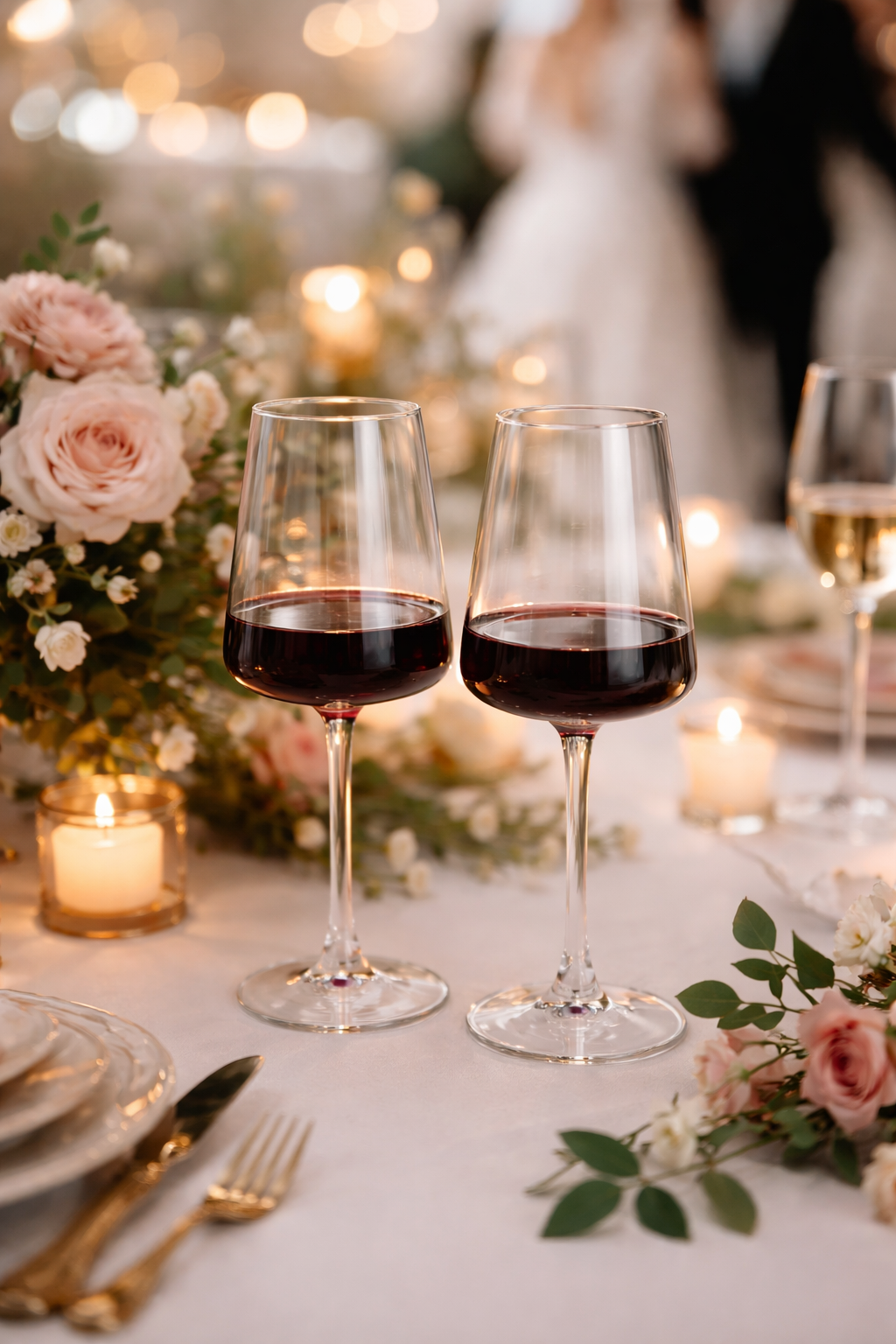
Wedding rental projects pair engraving and customized packaging with the drinkware itself.
The relevant product is the recycled glass jar KTBT1446A. Its documented specifications are a top diameter of 80mm, base diameter of 95mm, height of 247mm, capacity of 850ml, and weight of 610g, supplied as 12 pcs per carton in bulk package. Sizes and capacities are customisable, and the stated instantaneous temperature difference is −30 to 160 degrees Celsius.
Three characteristics explain why this format suits rental work. First, the 850ml capacity supports shared table service formats — water, iced drinks, and table centrepieces — rather than single-serve consumption, which reduces the number of units a rental operator needs to deploy per table. Second, the 247mm height and straight body provide a usable engraving field, which is the personalised element the scenario requires. Third, at 610g the jar has enough mass to feel stable on a table when guests are handling it repeatedly, which matters in an environment where items are moved, collected, and re-issued across events.
Adjacent to this, the glass cake stand KTPL1572A-A also appears in wedding rental listings. It is made from soda lime glass, measures 312mm at the top with a 120mm base and 105mm height, weighs 1,445g, and carries a MOQ of 1,000 pcs. Rental operators building a complete wedding table package typically evaluate the jar and the cake stand together, because both are display items rather than purely functional drinkware.
Instantaneous Temperature Resistance: The Specification Rental Buyers Underestimate
Instantaneous temperature difference describes how large a sudden change in temperature a glass item is specified to withstand without failure. It is not the same as the maximum temperature the material can reach. It is the shock tolerance — the temperature step the glass survives when a hot vessel meets cold contents, or when a chilled item enters a warm washing cycle.
For the recycled glass jar KTBT1446A, the stated instantaneous temperature difference is −30 to 160 degrees Celsius. For the wine glass KTG1139, the same figure is documented at −30 to 160 degrees Celsius, alongside a high-borosilicate material temperature range of 400 to 500 degrees Celsius. The recycled glass tumbler and bottle formats within the same recycled glass family are documented under the same recycled glass material grouping.
Why does this matter more in rental than in retail? Because rental glassware is washed, transported, chilled, refilled, and re-issued continuously. A jar that moves from a cold holding area into a warm wash cycle experiences a thermal step, and repeated thermal steps are where glass failures accumulate. A documented shock tolerance gives the rental operator a specification to plan around instead of an assumption to test in the field.
The boundary here is important and often misread. A stated instantaneous temperature difference is not a general-purpose oven or freezer rating, and it does not license any specific heating method. It defines the sudden temperature change the item is engineered to tolerate, and the item should be used within that envelope.
Supermarket and Chain Store Supply: Tumbler and Wine Glass in Brazil and Poland
Supermarket and chain store supply is a distinct scenario with its own operating conditions. It runs in B2B bulk distribution mode with OEM/ODM customization and just-in-time delivery, and its matched equipment is customized packaging and design. The documented special requirement is customized and environmental packaging, alongside international standard approval. Brazil and Poland are the two markets named for this scenario.
Two products carry most of this demand. The first is the glass tumbler KTK0370-2: a 400ml machine-pressed high borosilicate tumbler with a top diameter of 78mm, base diameter of 65mm, height of 140mm, and weight of 420g. Machine pressing suits volume retail because the forming method is oriented toward repeatable output rather than individual shaping. The second is the wine glass KTG1139: a 500ml machine-blown stemmed glass made from soda lime glass, with a top diameter of 67mm, base diameter of 82mm, height of 224mm, and weight of 215g.
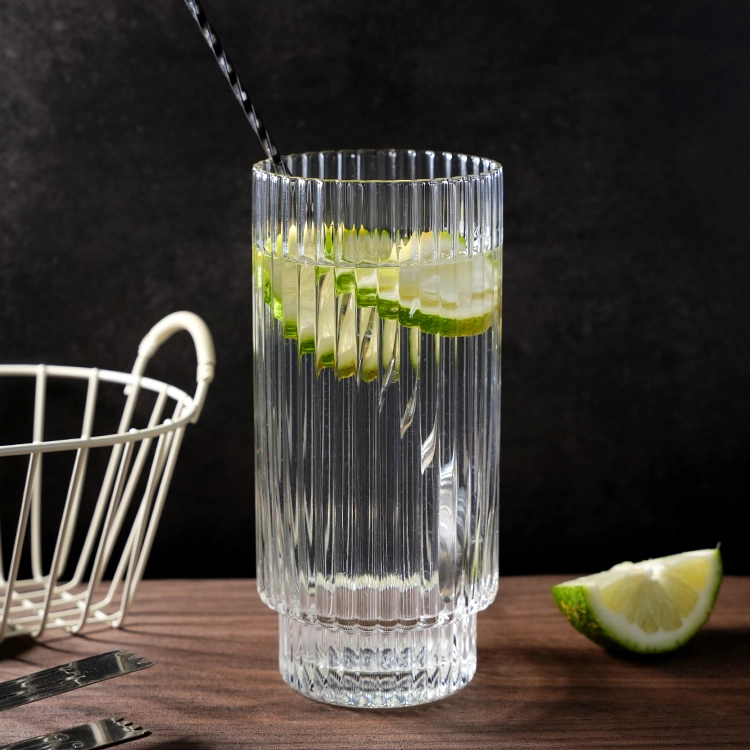
The KTK0370-2 400ml machine-pressed tumbler, one of the formats used in chain retail supply.
Material choice in this scenario is not arbitrary. Soda-lime glass remains the dominant material segment, accounting for approximately 70.8% of the global glassware market share in 2024. That dominance reflects cost structure and manufacturing scale, and it explains why a soda-lime stemmed wine glass remains the practical default for volume retail programmes while borosilicate formats are reserved for applications that require the thermal profile.
Documented supply history supports the scenario's volume assumptions. A wholesale distributor and home goods retailer in Brazil has been supplied with a coordinated glassware range at 20–30 full containers per month for five years, with flexible product assortment and customizable packaging supporting regional distribution. A retail chain and supermarket in Poland has received 20–30 full containers per month for five years, with custom-branded glassware and matching packaging supporting in-store sales. A hypermarket and supermarket chain in Russia has operated at the same 20–30 containers per month for five years across multiple store formats. The repetition of this pattern across markets indicates that the constraint in chain retail is not product availability but consistency: the same SKU, the same packaging specification, and the same delivery cadence.
Promotional Gift Programmes: Engraving, Design, and Gift Packaging
Branded and custom promotional gifts form a third scenario with entirely different success criteria. It operates under corporate events, brand marketing, holiday gifting, and client retention conditions, and its stated functions are brand visibility enhancement, client appreciation, event souvenirs, and employee incentives. The matched equipment is packaging. The special requirements are customized packaging and design, with international standard approval. Brazil and Poland are the documented markets.
The wine glass KTG1139 is the format most directly associated with this scenario. Its 500ml capacity and 224mm height give it visible presence in a gift box, and the stemmed silhouette provides a clean area for a brand mark. The wider promotional range also includes coordinated drinkware sets and spirit glassware configurations, which allow a marketing team to build a gift programme around one visual language rather than a mixed assortment of unrelated items.
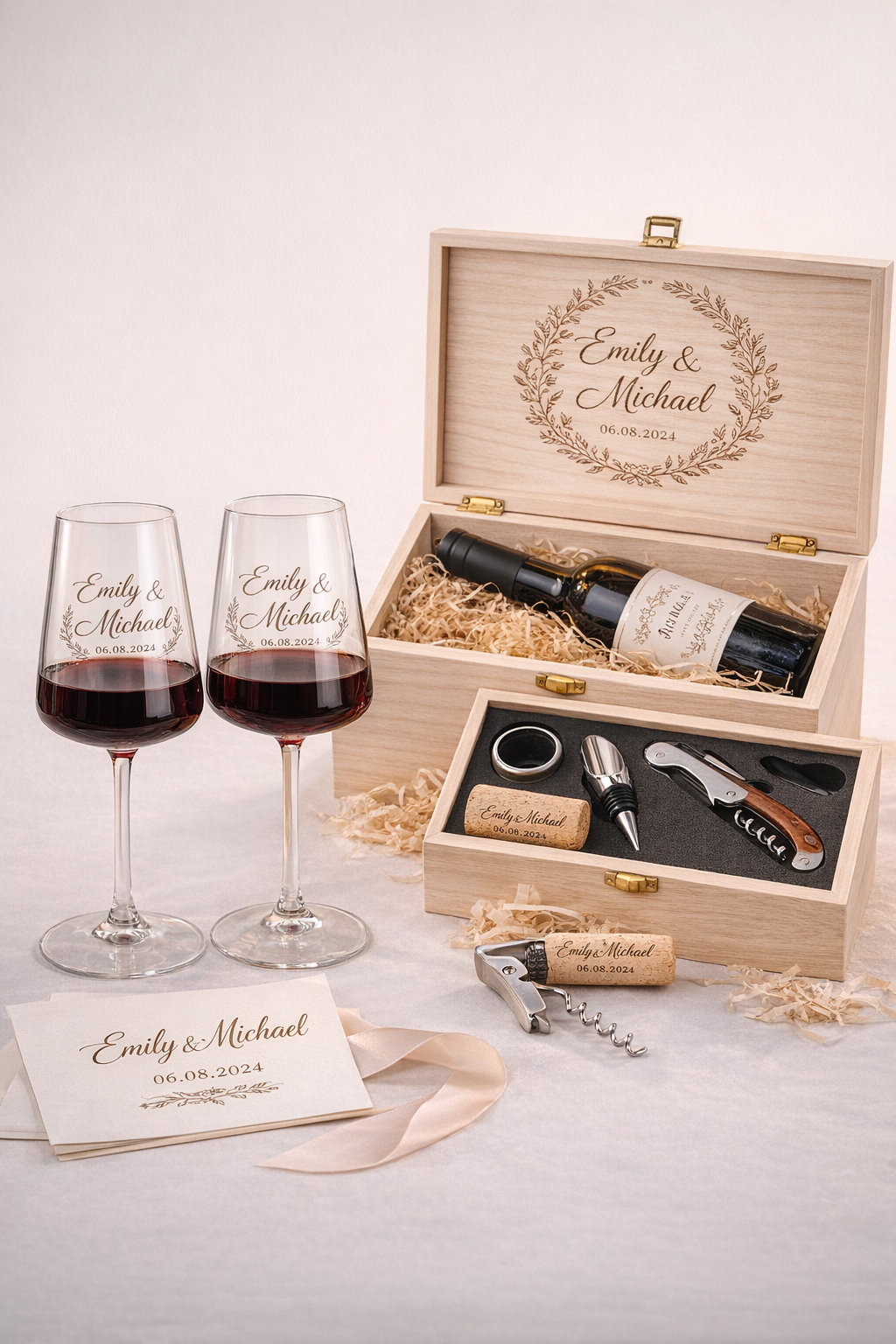
Branded gift configurations pair the glass format with campaign-specific packaging.
The scenario constraint that buyers most often underestimate is deadline alignment. A promotional gift programme has a fixed distribution date that cannot move, typically tied to an event, a holiday, or a client renewal cycle. That makes lead time, not unit price, the controlling variable in the purchasing decision.
Packaging as a Supporting Requirement, Not an Accessory
Across all three scenarios, packaging is listed as matched equipment or a special requirement. In wedding rental it appears as customized packaging and engraving. In supermarket and chain store supply it appears as customized and environmental packaging. In branded promotional gifts it appears as customized packaging and design. This is a consistent signal: in glassware projects, packaging is a functional part of the specification rather than a finishing detail.
The function differs by scenario, which is why a single packaging standard rarely transfers well between them. Rental packaging must survive round trips between warehouse and venue and support kitting so that sets are issued and returned complete. Retail packaging must be shelf-ready, consistent in appearance across shipments, and expressive of environmental positioning. Promotional packaging must present the item as a gift, because the unboxing experience is part of the brand message.
LAKOTTO's documented capabilities include customized packaging design and private label and branding within a one-stop service model, supported by breakage-rate control and professional packaging as an after-sales commitment. For buyers, the practical implication is that glass and packaging should be specified in the same document, with the same approval cycle, rather than as two separate purchases.
Market Context: What the Data Says About Recycled Glass Demand
The scenario logic above is supported by broader market signals in the category:
- The global recycled glass market was estimated at USD 4.2 billion in 2024, with Europe the largest regional market (Global Market Insights).
- The global glass drinkware market was valued at USD 14.0 billion in 2024 and is projected to reach USD 26.1 billion by 2030 (Grand View Research).
- The same market is expected to grow at a CAGR of 11.1% between 2025 and 2030, driven by eco-friendly preferences (Grand View Research).
- China's exports of glass and glassware reached approximately USD 25.53 billion in 2024 (UN Comtrade / Trading Economics).
- Soda-lime glass accounted for approximately 70.8% of global glassware market share in 2024 (Glassware Market Size & Trends Report 2033).
Compliance expectations run alongside these demand signals. European safety standard EN 1388-2 and ISO 7086-1:2019 regulate the release of lead and cadmium from glass hollowware in contact with food, while US FDA Compliance Policy Guides 7117.06 and 7117.07 specify limits for extractable cadmium and lead in glass and ceramic foodware. Both frameworks are relevant to all three scenarios, which is why international standard approval appears as a special requirement in each.
At the supplier level, Sisecam Group, Libbey, and Arc International are identified among top-tier global leaders in the category, with Sisecam holding a market share of approximately 7.8% in 2025. Buyers comparing suppliers should note that scale leadership and scenario fit are different questions. A large global producer and a scenario-oriented supplier can both be appropriate, depending on whether the project requires a standard catalogue item at maximum volume or a configured product with custom engraving and matched packaging.
Scenario-Matched Sourcing vs. Generic One-SKU Sourcing
A common procurement shortcut is to select one glass format and deploy it across every channel to simplify buying. The comparison below shows where that logic holds and where it breaks.
| Dimension | Generic one-SKU sourcing | Scenario-matched sourcing |
|---|---|---|
| Wedding rental fit | Limited engraving area if the item is a small tumbler; no rental-specific kitting | KTBT1446A jar with 247mm height for engraving, 850ml capacity, customized packaging |
| Retail shelf fit | Bulk 12 pcs/ctn packaging that is not shelf-ready | KTK0370-2 and KTG1139 with customized and environmental packaging |
| Gift programme fit | Weak presentation; packaging does not carry the brand message | Branded glassware sets with customized packaging and design |
| SKU complexity | Low purchasing and inventory complexity | Higher SKU count and separate packaging approvals |
| Commercial terms | Simpler ordering, potentially lower unit cost at volume | MOQ 3,000 pcs and 30–45 day lead time per customized programme |
The honest limitation of scenario-matched sourcing is that it costs more coordination, not necessarily more money. Each scenario requires its own packaging approval, and customized packaging adds lead time within the standard 30–45 day window. For a buyer running a single project, the effort is manageable. For a buyer running three scenarios simultaneously, it requires planning discipline. Where the volume is genuinely small and short-term, a standard catalogue format without customization may be the more rational choice — not because scenario fit is unimportant, but because customization economics do not scale down.
Limits and Boundaries to Accept Before Standardising
- Glass remains breakable. No scenario eliminates breakage. Rental operations in particular need a replacement allowance built into procurement planning, which is why breakage-rate control is documented as an after-sales commitment rather than a product guarantee.
- Bulk package is not retail package. The recycled glass jar KTBT1446A is supplied 12 pcs/ctn in bulk package. Retail buyers wanting shelf-ready presentation must specify customized packaging instead of assuming the standard carton will work.
- Recycled glass shows appearance variation. Recycled glassware sets naturally vary in tone, including brown recycled configurations. Retail programmes that require identical appearance across a planogram should approve samples before committing.
- Thermal specifications are bounded. A stated instantaneous temperature difference of −30 to 160 degrees Celsius defines shock tolerance. It does not authorise arbitrary heating or freezing methods.
- Customization has a floor. MOQ of 3,000 pcs and a 30–45 day lead time apply to OEM/ODM programmes, including custom engraving and packaging. Projects below that threshold are better served by existing formats.
- Not every scenario should standardise on recycled glass. Where a retail programme depends on uniform clarity or where a promotional budget requires the lowest possible unit cost, a standard format may be the correct specification.
Future Outlook
Three developments are likely to shape glassware sourcing across these scenarios. First, eco-friendly preference is now a documented growth driver, with the glass drinkware market projected to expand at an 11.1% CAGR between 2025 and 2030. That puts recycled glass formats in a stronger position than they held when the segment was primarily a positioning choice. Second, compliance frameworks in the EU and the US continue to set extractable lead and cadmium limits, which raises the value of suppliers already audited under BSCI, Sedex / SMETA, FSC, Disney FAMA, ISO, and LFGB. Third, just-in-time delivery in chain retail and fixed-date pressure in promotional gifting are likely to make lead-time reliability a more decisive evaluation criterion than unit price.
Buyers should also expect usage descriptions and matched-equipment documentation to become standard evaluation inputs. When a supplier can state which product belongs in which scenario, and which supporting requirement that scenario carries, the buyer's validation work becomes substantially shorter. LAKOTTO publishes product specifications, scenario notes, and sample arrangements for evaluation through its website at www.kottoglass.com.
Frequently Asked Questions
Which recycled glassware product is documented for wedding rental projects?
The recycled glass jar KTBT1446A is the item documented for wedding rental use. It has an 850ml capacity, a top diameter of 80mm, a base diameter of 95mm, a height of 247mm, and a weight of 610g, supplied 12 pcs per carton in bulk package, with sizes and capacities customisable. The wedding rental scenario lists customized packaging and engraving as matched equipment and international standard approval as a special requirement. The glass cake stand KTPL1572A-A also appears in wedding rental listings, with a 312mm top diameter and a MOQ of 1,000 pcs.
What does instantaneous temperature difference mean for a recycled glass jar in rental use?
Instantaneous temperature difference is the sudden temperature change the glass is specified to withstand without failing. For the KTBT1446A recycled glass jar, the documented figure is −30 to 160 degrees Celsius. Rental operations subject glassware to repeated transitions between cold holding and warm washing, so this figure gives operators a thermal envelope to plan within. It is not a general-purpose oven or freezer rating.
What packaging requirements apply to supermarket and chain store supply?
The supermarket and chain store supply scenario operates in B2B bulk distribution mode with OEM/ODM customization and just-in-time delivery, and lists customized packaging and design as matched equipment. The stated special requirement is customized and environmental packaging together with international standard approval. Because the recycled glass jar format is supplied in bulk cartons of 12 pcs, retail programmes that need shelf-ready presentation must specify customized packaging rather than relying on the standard carton.
Which products serve branded promotional gift programmes in Brazil and Poland?
The branded and custom promotional gifts scenario is documented for Brazil and Poland and operates under corporate events, brand marketing, holiday gifting, and client retention conditions. The wine glass KTG1139, a 500ml machine-blown stemmed glass measuring 224mm in height and weighing 215g, is the format most directly associated with this scenario. The scenario requires customized packaging and design plus international standard approval, and its stated functions include brand visibility enhancement, client appreciation, event souvenirs, and employee incentives.
What MOQ and lead time should buyers plan for when customizing glassware and packaging?
The documented commercial parameters for OEM/ODM programmes are a minimum order quantity of 3,000 pcs and a lead time of 30–45 days. Customization options cover size, shape, material, glass colour, package, and logo, with 100% test quality control. Because customized packaging is part of the specification in all three scenarios discussed here, buyers should treat the packaging approval cycle as part of the same 30–45 day timeline rather than as a separate later stage.
Can one glassware format serve wedding rental, retail supply, and promotional gifting at the same time?
In most cases, no — not without compromise. Wedding rental needs a large engraving field and a capacity suited to shared table service, which the 850ml KTBT1446A jar provides. Chain retail supply in Brazil and Poland is built around volume formats with coordinated, environmental packaging, such as the 400ml KTK0370-2 tumbler and the 500ml KTG1139 wine glass. Promotional gifting prioritises presentation and brand surface. A single SKU deployed across all three tends to underperform in at least two of them, and the standard bulk carton of 12 pcs is not shelf-ready for retail in any case.