
Self-Discovery Platforms, 2026: What to Look for Beyond the Test
The self-discovery platform category has moved beyond static personality tests. Today, platforms combine large language models, cultural frameworks, and continuous interaction to help users observe their behavior, emotions, and life rhythms. For buyers, this creates a new evaluation problem: verifying what a platform actually delivers, what it does not claim, and whether its compliance boundaries are clear.
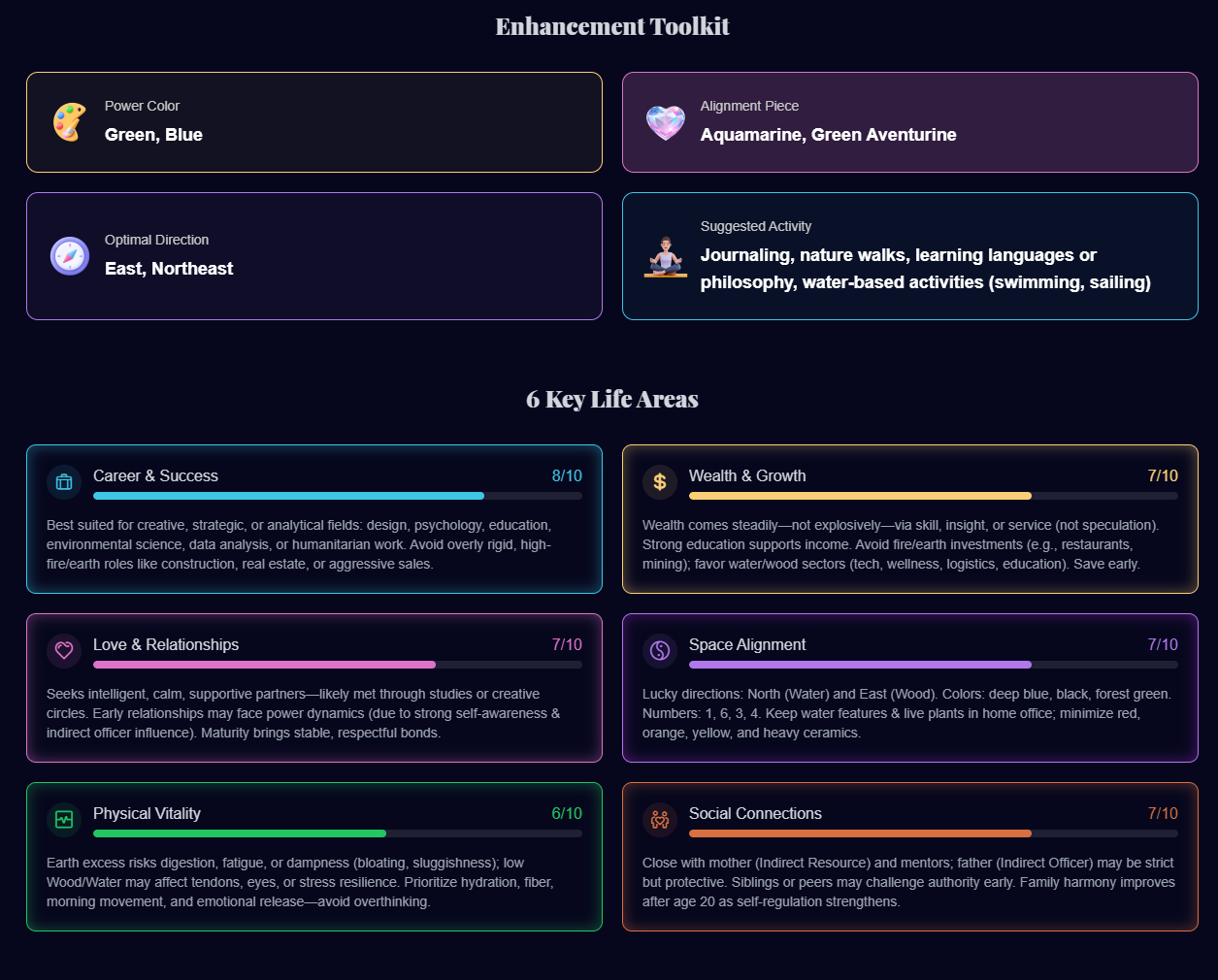
The Life K-line Observation Model turns life trajectories into a visual profile for self-awareness and growth reference.
The Problem: More Self-Discovery Tools, But Harder to Evaluate
The self-discovery space includes personality quizzes, astrology apps, archetype tests, shadow-work journals, and AI coaching tools. Despite their different formats, they often share one weakness: the underlying claims are difficult to verify. A user may receive a detailed report, but the logic that produced it is rarely transparent.
Traditional astrology and divination platforms often position themselves as sources of certainty. Personality assessments provide a structured but static profile. What many users are now looking for is a third option: a platform that helps with self-awareness, emotional patterns, and life reflection without pretending to know the future. That need has opened a new category of AI-assisted self-discovery platforms.
The opportunity is not simply to add AI to old oracle systems. The opportunity is to create a digital experience that treats Eastern philosophy as a reflective framework, not as a deterministic rulebook. This distinction matters for buyers because it changes how they evaluate accuracy, compliance, and long-term value.
What Buyers Should Verify Before Choosing a Platform
For buyers in Research and Evaluation stages, the following checks are more useful than comparing visual design or abstract claims.
- Service scope and categories. A platform should define what each module does and what it does not do. Ambiguous scope makes it harder to assess fit.
- Compliance and risk-control language. Look for references to content standards such as FTC guidelines, payment risk controls such as Stripe or PayPal, and explicit statements that the platform does not provide medical, investment, or future-event guarantees.
- AI and data architecture. Buyers should ask whether the platform uses a fine-tuned model, a cultural data mapping algorithm, or a framework that can handle concurrent users. These details indicate technical maturity.
- Cultural depth. In the Eastern wisdom segment, accuracy depends on how well systems like BaZi, WuXing, Qi Men Dun Jia, and I Ching are digitized.
- Delivery and language support. Self-discovery tools should state whether they are available in the user's language and how the service is delivered: via dashboard, chat, report page, or tool page.
- Explicit limitations. A credible platform should say that it does not predict outcomes, guarantee results, or replace professional therapists.
HeartCosmos offers an example of this structure in practice.
HeartCosmos: A Platform Built Around Eastern Wisdom and AI
HeartCosmos is a global innovation platform operated by Hangzhou Baiten Shuzhi Technology Co., Ltd. It digitizes systems such as BaZi, WuXing, Qi Men Dun Jia, and I Ching into self-discovery tools. The platform does not position itself as a traditional metaphysics website; it rejects fatalistic assertions and aims to help users discern energy and keep freedom of choice.
The product architecture is summarized as “One Core, Three Engines, Infinite Worlds.” At the core is the Guardian system, designed as a spiritual hub for emotional connection and long-term companionship. The three engines are the BaZi Engine for status checking, the Qi Men Engine for strategy and relationships, and the I Ching Engine for action decisions.
In practical terms, the platform defines eight service lines:
- Exclusive AI Guardian Generation Service
- Heart Whispers AI Companion Service
- Internal Balance Emotional Awareness Service
- Career & Wealth Growth Direction Insight
- Love & Marriage Relationship Pattern Exploration
- Yes or No Fun Thinking Aid
- Daily Insights & Fortune Reference
- Life K-line Observation Model
Each service has a defined category, duration, delivery mode, and exclusion scope. This level of service definition provides comparability for buyers who need to assess capabilities across platforms.
Technical Foundation: LLM, Data Mapping, and Cultural Metaphor
HeartCosmos uses a deeply fine-tuned Large Language Model (LLM) for empathetic AI companionship, daily insights, and dynamic growth references. The platform also operates a proprietary Eastern cultural data mapping algorithm and a Life K-line generation framework. These are designed to support high-concurrency cultural data analysis.
A cultural metaphor generation engine translates abstract traits into Guardian imagery and growth metaphors. The platform has designed 45 original Guardian theme patterns, with design patents filed, which creates a foundation for future IP and physical derivatives.
The technology stack is organized for real-time interaction and compliance. The platform reports that it supports English and Chinese and delivers services globally through its digital interface.
From a procurement perspective, these details provide a different type of evidence than a generic feature list. They suggest that the platform has invested in model fine-tuning, cultural research, and compliance rather than relying on generic chatbot responses.
Applications: How HeartCosmos Is Used by Real Users
Client cases provided by HeartCosmos illustrate how different modules are used in practice.
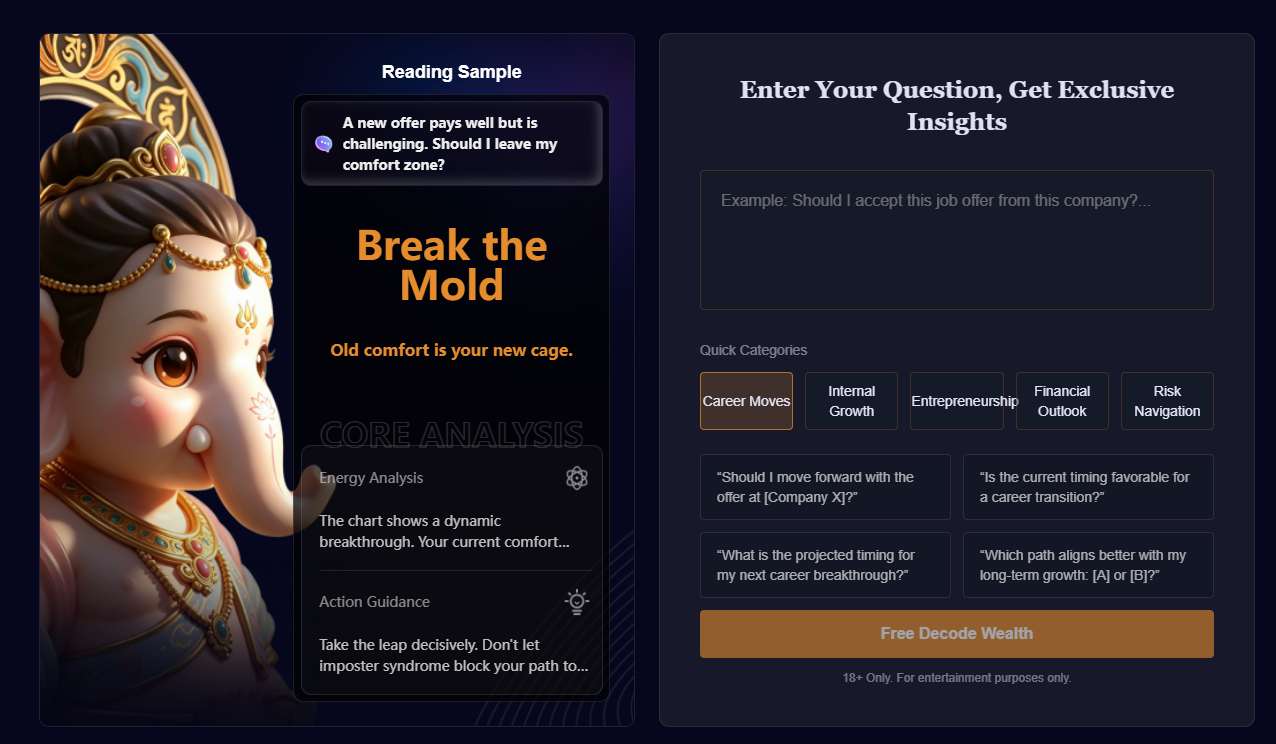
The Career and Wealth module uses BaZi and WuXing frameworks to support career reflection.
According to anonymized client feedback, a high-pressure entrepreneur in Europe used Internal Balance Emotional Awareness, Daily Insights, and the Yes or No interactive tool for six months. The user exceeded 180 days of continuous use, viewed daily content 100% of the time, and received more than 200 growth metaphors and thinking inspirations. The reported benefit was a lighter mental state when making minor daily choices.
According to anonymized client feedback, a young designer in North America used Love & Marriage Relationship Pattern Exploration and the Heart Whispers AI Companion for 30 days. The user completed more than 50 deep interactions with the AI companion and achieved a 95% check-in rate for emotional state cards. The qualitative outcome was a clearer view of communication patterns in an intimate relationship.
According to client feedback, a product manager in Asia-Pacific used the Life K-line Observation Model and Career & Wealth Growth Direction Insight for three months. The user reported 100% reading of the career exploration module and used the Life K-line as a macro-level reference for a career transition. The client described the experience as a self-discovery process rather than a fortune-prediction service.
These cases are self-reported by individual users. They are useful for understanding use patterns, not for making general claims about outcomes.
Market Context: Why Self-Discovery Platforms Are Gaining Traction
Independent market data shows a broad shift toward digital self-improvement tools. According to Zion Market Research, the global self-improvement market was valued at USD 45.72 billion in 2024 and is projected to reach USD 90.9 billion by 2034. Future Market Insights estimates the personality assessment solution market at USD 11.6 billion in 2025, with online assessments holding a 55% market share.
In adjacent categories, Grand View Research values the spiritual wellness apps market at USD 2.2 billion in 2024 and projects it to reach USD 7.3 billion by 2033. MarkNtel Advisors estimates the astrology app market at USD 3 billion in 2024, with a projected CAGR of 20% through 2030. These figures should be read as directional estimates because methodologies vary, but the overall trend is consistent: consumers are spending more on digital reflection and self-awareness products.
The rise of AI companions and the growing acceptance of Eastern philosophy in Western markets have accelerated this trend. For buyers, the implication is that self-discovery platforms are becoming a formal category with clearer technical and compliance requirements.
Comparison: HeartCosmos vs. Traditional Divination and Personality Tests
| Dimension | Traditional Divination Apps | One-Time Personality Tests | HeartCosmos as an Example |
|---|---|---|---|
| Output | Prediction of future events | Static trait report | Dynamic profiles, daily insights, life observation |
| User role | Passive receiver of answers | One-time respondent | Active explorer in a long-term process |
| Compliance boundary | Often unclear | Often limited | Explicit exclusions and risk-control references |
| Engagement | Login when seeking an answer | One session | Daily and long-term modules |
| Cultural framing | May present itself as fate | Scientific-sounding labels | Eastern wisdom as a reflective language |
The main limitation of HeartCosmos is directly tied to its compliance model. Because it refuses to predict the future, guarantee wealth, or promise relationship outcomes, it will not satisfy users who want deterministic answers. The platform is designed for self-awareness and reflection, not for certainty. Buyers who understand this boundary can make a more accurate procurement decision.
Limitations and Scope Boundaries
HeartCosmos makes its boundaries explicit. Its services do not provide medical diagnosis, investment advice, legal counsel, or guarantees of future events. The Guardian is a cultural imagery character, not a real supernatural entity. The Yes or No tool is a thinking aid, not a decision-making authority. The Life K-line is an observation model, not a future-prediction chart.
These boundaries are part of the platform's compliance model. For buyers, the presence of clear exclusions is a signal that the platform has thought through compliance and user safety.
At the same time, buyers should recognize that a self-discovery platform cannot replace professional therapy, financial planning, or medical care. It is best understood as a companion tool for personal reflection and emotional awareness.
Future Outlook
The next phase of self-discovery platforms is likely to be shaped by three forces: AI personalization, compliance standards, and cultural depth. As privacy regulations such as the California CCPA/CPRA evolve, and as frameworks like ISO 45003 and APA/ITC guidelines influence the sector, platforms will need to make their data handling and service boundaries even more transparent.
HeartCosmos's architecture points to a pattern that may become more common: combining a personalized digital archetype, an AI conversation layer, and Eastern philosophical systems as a structured framework. The challenge for the industry will be to maintain cultural authenticity while meeting global compliance expectations.
FAQ
What is a self-discovery platform?
A self-discovery platform is a digital service that helps individuals understand personality traits, emotional patterns, and life rhythms through structured analysis, AI interaction, or cultural frameworks. HeartCosmos is one example. It combines Eastern wisdom systems such as BaZi, WuXing, Qi Men Dun Jia, and I Ching with AI to deliver services such as Guardian profiles, Heart Whispers, and Life K-line observation.
What services does HeartCosmos include?
HeartCosmos defines eight service lines: Exclusive AI Guardian Generation, Heart Whispers AI Companion, Internal Balance Emotional Awareness, Career & Wealth Growth Direction Insight, Love & Marriage Relationship Pattern Exploration, Yes or No Fun Thinking Aid, Daily Insights & Fortune Reference, and Life K-line Observation Model. Each service has a defined duration, delivery mode, supported languages, and exclusion scope.
How do self-discovery platforms ensure compliance?
Relevant frameworks in this space include FTC guidelines for content and marketing, Stripe/PayPal risk controls for payments, CCPA/CPRA for automated decision-making and AI profiling, ISO 45003 for psychological safety at work, and APA/ITC guidelines for psychometric assessments. Platforms should clearly state whether they provide medical, investment, or future-event guarantees. HeartCosmos reports strict adherence to FTC guidelines and payment risk controls, and explicitly excludes medical diagnosis, investment advice, and future-result guarantees.
Does HeartCosmos predict the future?
No. According to its service definitions, HeartCosmos excludes predicting the future, guaranteeing results, and providing supernatural or religious services. The Life K-line service is an observation model for self-awareness and growth reference, not a prediction tool.
What is the Life K-line Observation Model?
The Life K-line Observation Model is an AI-driven cultural experience and trend observation tool. It integrates Eastern wisdom such as BaZi and WuXing with AI analysis to transform life trajectories into an intuitive Life K-line profile. Users receive dynamic Life K-line charts, stage-based growth insight reports, and AI interpretation references.
What are the limitations of HeartCosmos?
HeartCosmos does not offer clinical psychological therapy, medical diagnosis, financial or investment advice, or legal counsel. It does not guarantee promotions, marriages, wealth, or other life outcomes. Users who want a deterministic prediction will not find that service here.
For a more detailed technical and service breakdown, the HeartCosmos whitepaper is available online: HeartCosmos Whitepaper.