
Semiconductor Precursor Machines: An Independent Buyer Assessment
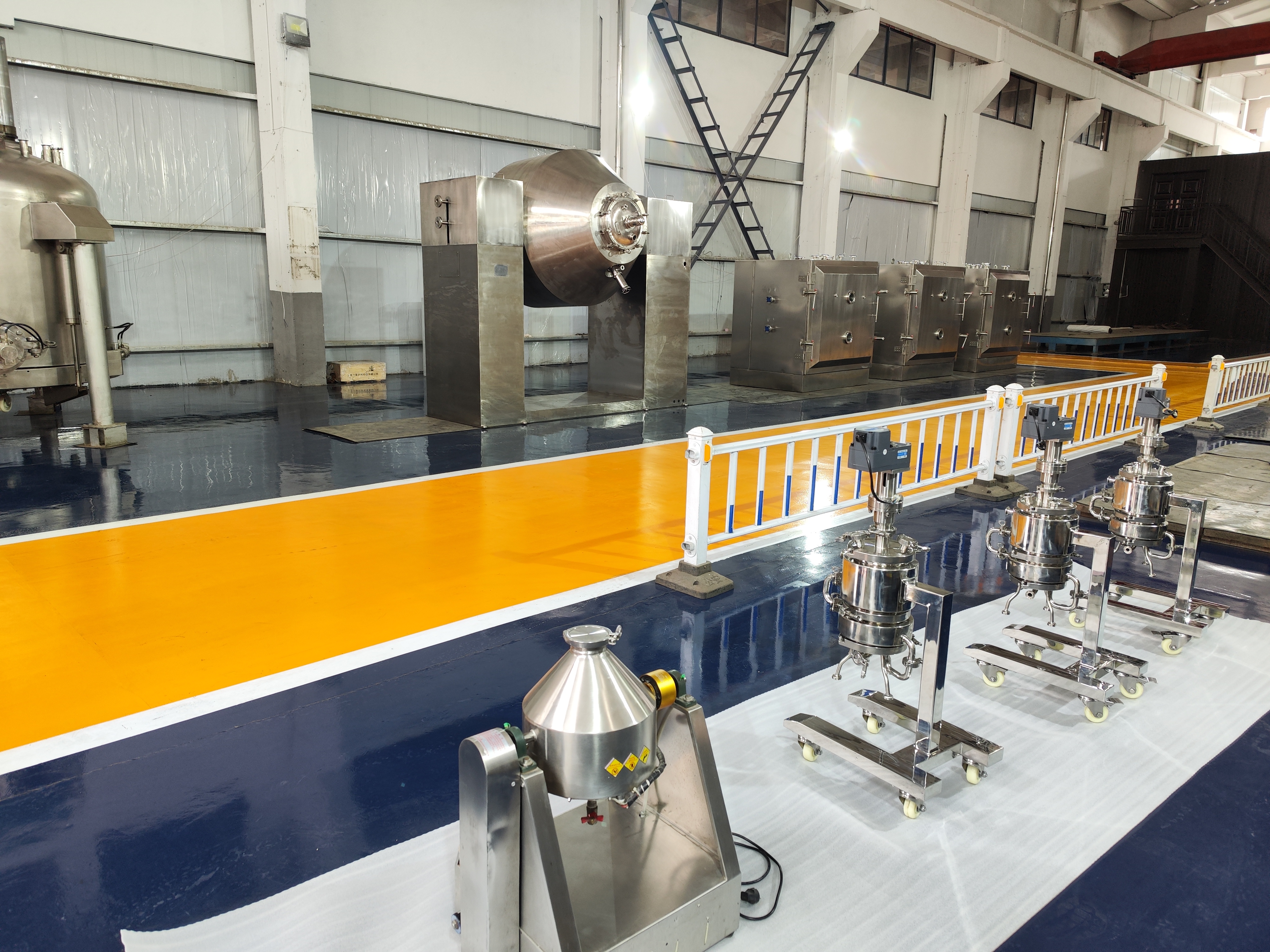
For buyers evaluating equipment for semiconductor precursor production, the decision is rarely framed as "which machine performs best" in isolation. It is framed as a choice between two architectures: a single integrated Reacting-Crystallizing-Filtering-Drying (RCFD) train, or a discrete layout in which reactors, crystallizers, filters and dryers are procured, installed and qualified as separate assets. That choice shapes containment, cleaning validation, footprint, uptime and the number of times a valuable, often moisture- and air-sensitive solid has to be transferred.
Semiconductor precursors are manufactured through unit operations that are familiar across fine chemicals and pharmaceuticals: reaction, crystallization, solid–liquid separation, cake washing and drying. What differs is the tolerance for contamination, moisture, oxygen and metal contact, and the cost of a batch that misses those limits. Because those tolerances are set by the process, not by the equipment vendor, the architecture decision usually precedes the supplier decision.
This assessment is written as an independent reference for buyers in the evaluation stage. Wuxi Zhanghua Pharm & Chem Equipment Co., Ltd. — a Wuxi, Jiangsu Province–based manufacturer founded in 1976 that designs and builds reaction, crystallization, filtration and drying equipment, and separately develops portable non-destructive mechanical property and residual stress testers — is used as a concrete, verifiable reference point because it manufactures both an integrated line and its individual components. No competing manufacturers are named in this article; the comparison runs between architectures and specification choices, not between brands.
Why the Architecture Decision Comes First
In an integrated RCFD train, reaction, crystallization, filtration, washing and drying happen inside one enclosed sequence of vessels connected by fixed piping. In a discrete layout, the same operations happen in separate machines, and the solid is discharged, transported and recharged between each step. The engineering consequences are largely predictable, and they are what buyers are actually comparing.
- Transfer count. Integrated systems reduce the number of times a wet cake is exposed to the room or to a transfer interface. Fewer transfers usually mean lower operator exposure and fewer opportunities for moisture or oxygen ingress.
- Cleaning validation burden. A discrete layout multiplies the number of separate cleanable surfaces, disassembly points and validated cleaning procedures. An integrated train concentrates them but also means that one cleaning cycle can stop the whole sequence.
- Footprint and utilities. Discrete layouts typically need more floor area, more intermediate storage and more local extraction. Integrated trains trade floor space for a heavier, more concentrated utility and instrumentation package.
- Uptime topology. Separate units can run in parallel and absorb a single machine outage. An integrated train has no such redundancy unless the plant installs a second train.
What an Integrated RCFD Train Actually Contains
An integrated RCFD line is not a single machine but a coordinated set of unit operations sized to each other. Using the Wuxi Zhanghua range as a concrete example, the following components and parameters define what "integrated" means in specification terms.
| Unit operation | Model / size range | Published key parameters |
|---|---|---|
| Reactor | DFG50–DFG3000 | Internal tank diameter 400–3000 mm; jacket diameter 500–3200 mm; motor power 0.6–37 kW; blending speed 50–100 rpm |
| Crystallizer | 30 L–32,000 L | Internal tank diameter 400–3000 mm; jacket diameter 500–3200 mm; motor power 0.55–37 kW; blending speed 50–120 rpm |
| Agitated Nutsche Filter Dryer | φ800–φ4600 | Capacity 0.6–30 m³; filter area 0.5–16 m²; agitator travel 250–550 mm; motor power 4–75 kW |
| Nutsche Filter | φ1000–φ5000 | Capacity 1.2–36.5 m³; filter area 0.8–19.5 m²; agitator travel 300–600 mm; motor power 5.5–75 kW |
| Conical Screw Vacuum Dryer | 150 L–13,500 L | Effective loading volume 0.5–0.7; agitator speed 5–30 rpm; internal surface roughness Ra ≤ 0.4–0.6 μm; ExdIIBT4 explosion-proof grade (optional) |
| Skid-mounted RCFD production system | SKS-50 / SKS-5000 | Skid length 1000–10,000 mm; width 1000–3200 mm; height 1000–4000 mm; total skid weight 3–50 t; applicable code GB / ASME |
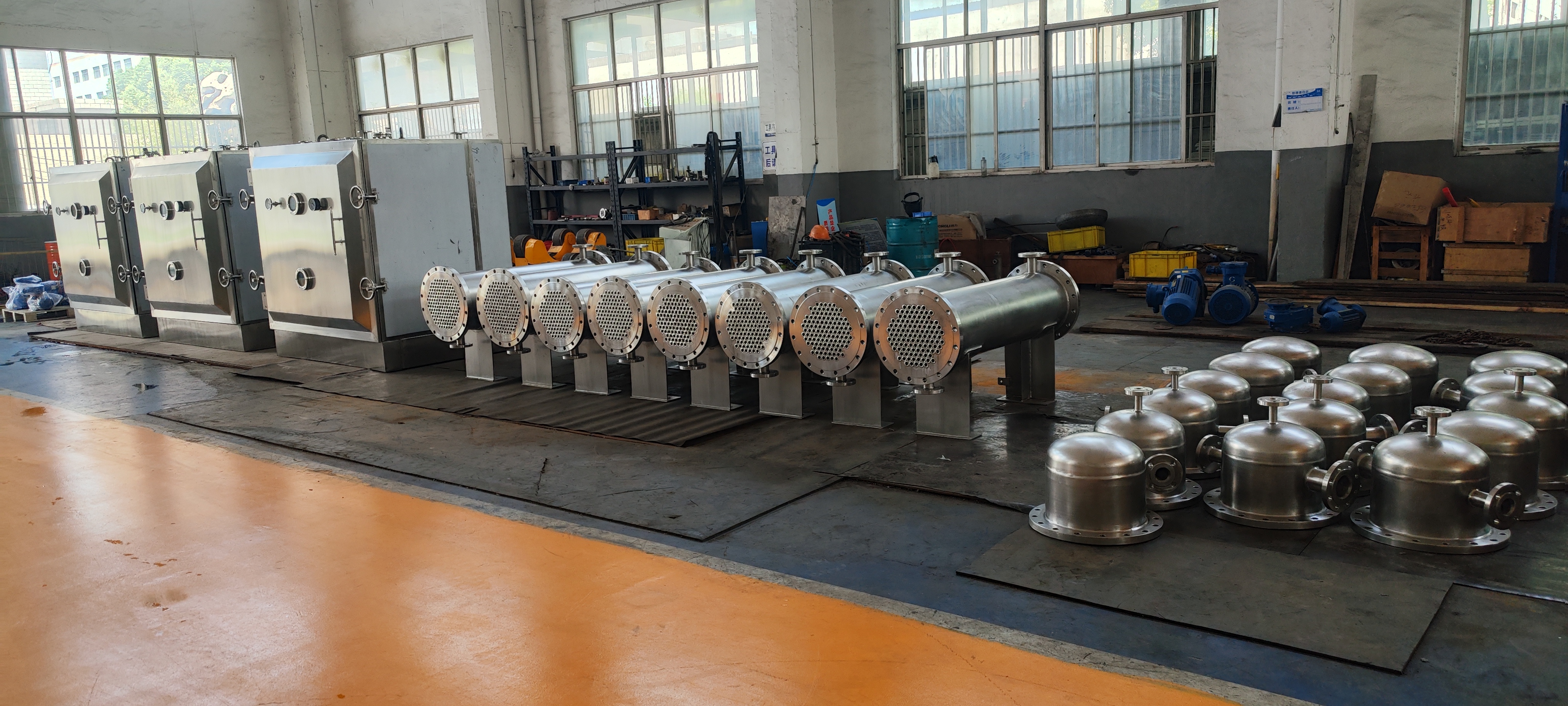
Wetted materials across the range are SS304, SS316L, titanium, Hastelloy and PTFE lining, which is the material set buyers should expect to discuss when a precursor stream is corrosive, halide-bearing or metal-sensitive. Fabrication capability matters as much as the catalogue: Wuxi Zhanghua states that large CNC vertical lathe and boring equipment allows the customization of agitated Nutsche filter dryers with diameters greater than four metres — consistent with the φ800–φ4600 range — supported by an imported welding robot that the company says improves welding accuracy, appearance, quality and safety of the finished equipment.
Nutsche Filter Functionality: The Step Most Often Under-Specified
A Nutsche filter dryer performs four duties inside one pressure vessel: cake formation by vacuum or pressure filtration, displacement washing of the cake, reslurry where required, and vacuum contact drying with agitation. For precursor and high-purity chemical duty, this consolidation is the single largest reason buyers move from discrete filtration and tray drying to an integrated vessel.
Three specification variables determine whether a Nutsche filter dryer will actually fit the process:
- Filter area versus solids loading. On the Wuxi Zhanghua agitated Nutsche filter dryer, filter area spans 0.5–16 m² against a 0.6–30 m³ capacity; the separate Nutsche Filter range spans 0.8–19.5 m² against 1.2–36.5 m³. Under-sizing filter area relative to batch solids is a common cause of long filtration times and poor cake wash uniformity.
- Agitator travel and discharge. Agitator travel of 250–550 mm on the ANFD range and 300–600 mm on the Nutsche Filter range determines both cake smoothing and discharge performance. Discharge method should be agreed against the material's angle of repose, not against a generic specification.
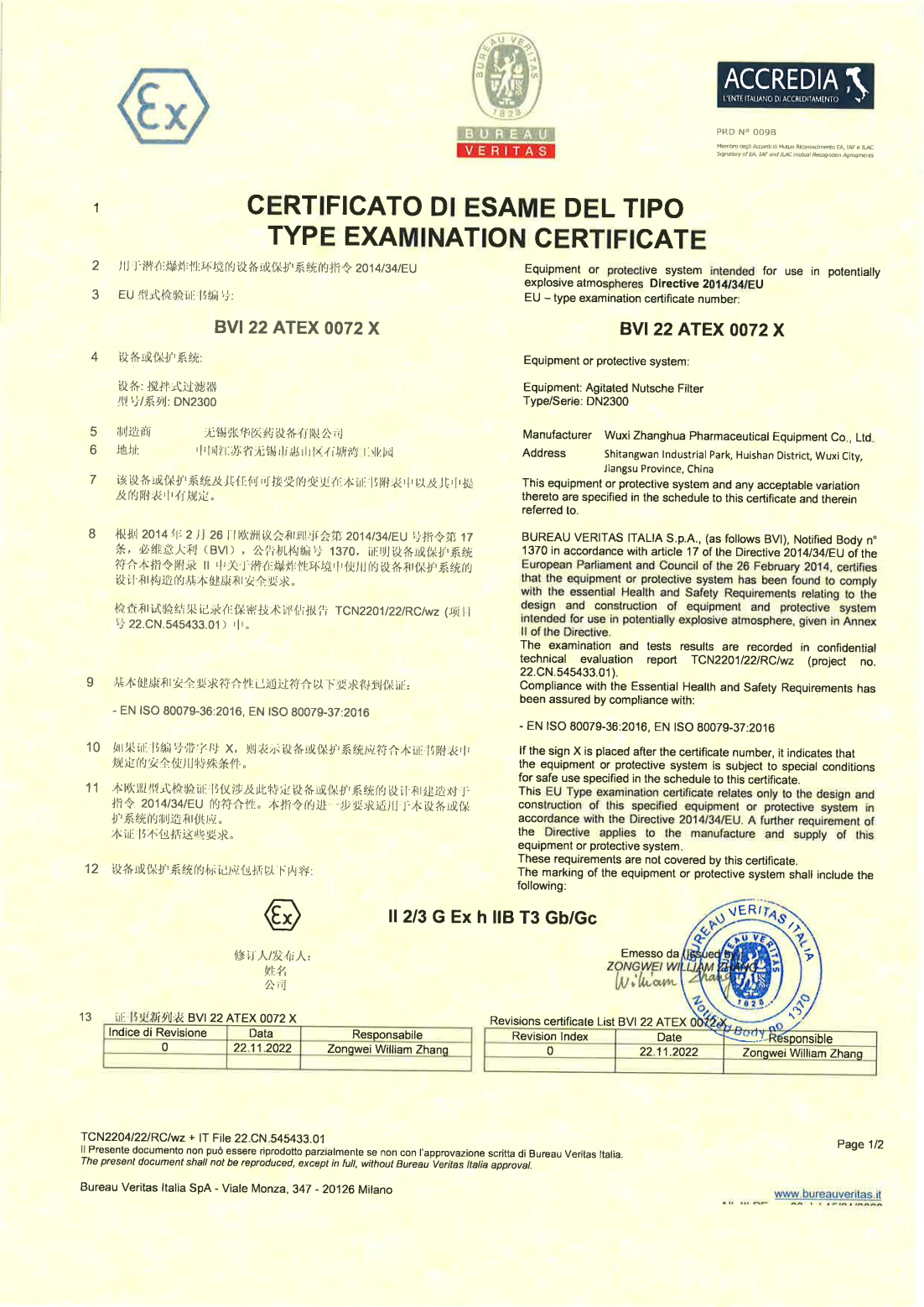
- Containment and explosion protection. For solvent-wet precursor cakes, the electrical and mechanical classification of the vessel is part of the process safety case, not a paperwork item. One reference point: an ATEX certificate (BVI 22 ATEX 0072 X) issued for a DN2300 agitated Nutsche filter carries the marking II 2/3 G Ex h IIB T3 Gb/Gc under EN ISO 80079-36:2016 and EN ISO 80079-37:2016.
Conical Screw Vacuum Dryer Capability: Gentle Drying Without Transfer
A conical screw vacuum dryer uses a top-driven screw agitator orbiting a conical vessel under vacuum, so the product is mixed gently and dried by indirect contact heat rather than by high-velocity gas. For heat-sensitive, toxic, stimulating or corrosive solids, this is often the difference between a dryable product and a degraded one.
The published parameter set for the Wuxi Zhanghua conical screw vacuum dryer — 150–13,500 L working range, effective loading volume 0.5–0.7, agitator speed 5–30 rpm, internal surface roughness Ra ≤ 0.4–0.6 μm and optional ExdIIBT4 explosion-proof grade — describes a low-shear, high-surface-quality dryer intended for products where residual moisture and wall adhesion both matter. The 0.5–0.7 loading volume is worth reading carefully during evaluation: it means the usable batch size is roughly half to two-thirds of nominal vessel volume.
Drying is a portfolio decision rather than a single-machine decision. The same manufacturer's drying range includes paddle dryers (ZPG-500–ZPG-6000, working volume 300–3600 L, heating area 3.2–16.5 m², mixing speed 8–18 rpm, motor 4–22 kW), double cone dryers (20–10,000 L), Nauta conical dryers, mixer-dryers (30–10,000 L) and vacuum ovens (ZDF-6–ZDF-30, 16–60 trays, evaporation area 5–18 m², steam pressure 0.2–0.6 MPa, maximum temperature 80 °C). A film evaporator range (1–20 m², processing capacity 50–5000 L/h) covers solvent-removal duty upstream. Dedicated configurations are catalogued for heat-sensitive material drying, toxic/stimulating material drying and corrosive product drying in the 150–13,500 L range.
Where Residual Stress Testing Fits in the Assessment
An RCFD vessel is a pressure-retaining asset that is repeatedly cycled between vacuum and pressure, and frequently between hot and cold. Weld residual stress influences dimensional stability, fatigue behaviour and the long-term integrity of those welds — which is why mechanical-integrity verification belongs in the acceptance discussion for high-value process equipment, not only in pipeline and pressure-vessel inspection.
Wuxi Zhanghua independently developed a mechanical properties and residual stress detector based on the indentation method and indentation energy difference method, and designed a range of supporting fixtures for different on-site working conditions; the company states the related technology won a gold medal at the Geneva International Invention Exhibition. The associated Portable Micro-Indentation Tester (PMA-1010) is specified with a maximum load of 1000 N, actuation range 25 mm, loading speed 0.01–30 mm/min, data acquisition rate 100 Hz, macro-scale testing range, indentation depth 60–120 μm and 220 V / 24 V wired or wireless power. The company's stated customers for this device are domestic and foreign third-party testing institutions and first-line production units, with pressure vessels, long-distance pipelines and remanufactured major energy equipment as the primary service targets.
The honest boundary here is important for buyers: the tester's documented service targets are pressure vessels and pipelines in energy equipment, not semiconductor process lines, and it is a measurement instrument rather than a process machine. Its role in an RCFD evaluation is as a weld and heat-affected-zone verification tool applied to the fabrication of the vessel itself — and it should be written into an inspection plan as a specified step, not assumed as standard practice.
Integrated Versus Discrete: A Side-by-Side Comparison
| Assessment dimension | Integrated RCFD train | Discrete unit approach |
|---|---|---|
| Solid transfers per batch | Minimal; enclosed sequence with fixed piping | Multiple; discharge, transport and recharge at each step |
| Containment and operator exposure | Lower exposure potential; closed transfers | Higher exposure potential unless local containment is added at each interface |
| Cleaning and validation | Concentrated but sequential; one cleaning cycle can halt the train | Distributed; more surfaces and procedures, but cleanable in parallel |
| Footprint and utilities | Compact footprint, concentrated utility and instrumentation package | Larger footprint, intermediate storage, distributed extraction |
| Uptime and redundancy | Single-train dependency unless a second train is installed | Parallel operation possible; one outage does not stop the sequence |
| Product changeover | Less suited to frequent changeover without designed-in cleaning validation | More adaptable to multi-product campaigns |
| Capital profile | Higher upfront package cost, including skid integration and controls | Lower entry cost; can be staged incrementally |
| Delivery and site work | Skid-mounted systems (SKS-50 / SKS-5000) arrive as 3–50 t modules; site readiness is critical | Longer site assembly and interconnection scope |
| Documentation and compliance | Compliance evidence must be checked per component and per size | Each purchased unit carries its own certification scope |
Application Fit: Where the Two Architectures Land
For semiconductor precursor production, the integrated architecture is normally evaluated when the precursor is isolated as a solvent-wet crystalline solid, when the material is sensitive to moisture or oxygen, or when the batch value is high enough that transfer losses are unacceptable. The same logic applies to adjacent high-purity streams: high-nickel ternary cathode (NCM) precursors, lithium carbonate, LiPF6 solvent removal, black mass filtration, electronic chemical filtration and high-value pharmaceutical intermediates.
The pharmaceutical and fine chemical side of the same equipment family is well documented in operational terms. Wuxi Zhanghua cites a pharmaceutical plant customer in Singapore that operates 10 units for storing, filtering, washing and drying of semi-finished drugs, with eight years of stable operation, GMP-compliant design, fully automated control and high-purity processing. That reference is a pharmaceutical installation rather than a semiconductor precursor line, and it should be read as containment and reliability precedent, not as direct semiconductor process validation.
A due-diligence point that buyers should note: in the equipment manufacturer's own product data, the stated applicable industries for RCFD equipment are the pharmaceutical industry, fine chemical industry, new energy and new materials, and pesticide manufacturing. Semiconductor precursor production sits adjacent to the new energy and new materials category, and it is treated in the market as part of the same high-purity reacting, crystallization, filtration and drying equipment family. Suitability for a specific precursor chemistry still has to be established material by material.
The wider application list covered by the same equipment types includes antibiotics, penicillin salts, proteins, vitamins, antioxidants, polymers, pigments, citric acid, melamine and chlor-alkali products, together with lithium borohydride and other moisture-sensitive materials. That breadth matters at evaluation stage because it indicates how much of the containment and materials-of-construction engineering has already been exercised in comparable duties.
Market Signals and What They Do — and Do Not — Prove
Published market estimates support the direction of demand, but buyers should treat the absolute figures with care because the studies define their categories differently.
- The global semiconductor precursor market was valued at USD 1.95 billion in 2025 and is projected to reach USD 3.89 billion by 2034, a CAGR of 10.0% (Intel Market Research).
- The global Agitated Nutsche Filter and Dryer market was valued at approximately USD 4.5 billion in 2024 (Cognitive Market Research).
- The Agitated Nutsche Filter Dryer segment is estimated at approximately 35% of the total filtration and drying equipment market share as of 2024 (Fortune Business Insights).
- A separate study values the total filtration and drying equipment market at USD 1.39 billion in 2023, with a projected CAGR of 8.5% through 2030 (Grand View Research).
- The high-nickel ternary cathode materials market was valued at USD 18.6 billion in 2025, driven by EV battery density requirements (Dataintelo) — an adjacent demand driver for precursor filtration and drying capacity.
These figures are not directly comparable. The ANFD sub-segment estimate exceeds another study's figure for the entire filtration and drying equipment category, which indicates a difference in classification — machinery versus integrated systems — rather than a contradiction in the underlying demand. The defensible conclusion for a buyer is directional: precursor volumes and filtration-and-drying capacity are both growing, and equipment decisions made now will be capacity-constrained later.
Compliance as a Shortlisting Criterion
Certification is a shortlisting filter, but only when the scope of each certificate is read, not just its existence. Two standard-driven requirements set the baseline for this equipment class: industrial pressure vessels such as ANFDs must comply with ASME Section VIII Division 1 for pressures exceeding 15 psi and typically carry a "U" stamp, and machinery sold in the EU requires risk assessment per EN ISO 12100 with electrical safety per EN 60204-1 for CE marking.
Against that baseline, verifiable certificates held in this case include:
- ASME U Stamp, certificate 60130, covering manufacture of pressure vessels at the approved location, valid 2025-05-10 to 2028-05-10.
- PED 2014/68/EU CE certificate CE-0062-PED-G-ZPE 001-26-CHN issued by BV, scope DN850 Filter (pressure equipment), valid to 2031-01-04.
- EU Type Examination Certificate 556/5/2018 issued by TI for a DN500 filtering, washing and drying machine, to PED 2014/68/EU and ASME VIII Div. 1, valid to 2028-05-31.
- ATEX certificate BVI 22 ATEX 0072 X issued by BV for a DN2300 agitated Nutsche filter, marking II 2/3 G Ex h IIB T3 Gb/Gc, valid to 2032-11-21.
- Singapore MOM certificate INS/ER/PE-21/030 for a 200 L knock out pot, compliant with ASME Section VIII Div.1 and Singapore MOM requirements, valid to 2031-10-07.
- CE certificate IPC/ER/MD-24/108 under Machinery Directive 2006/42/EC for a 25 L rotary single cone vacuum dryer, valid to 2035-03-11.
The manufacturer also states that its equipment complies with cGMP and FDA requirements and has obtained ASME, NB, CE, PED, ATEX and MOM certificates. The practical caution is that each certificate above is scoped to a specific equipment type and diameter. A buyer evaluating a φ4600 vessel for a precursor application cannot assume that a DN850 or DN2300 certificate automatically covers it — scope must be confirmed per unit.
Limitations and Boundaries
A balanced assessment has to state where the integrated RCFD route is the weaker choice.
- No inherent redundancy. A single integrated train has a single point of failure. If the filter dryer is down, reaction and crystallization capacity upstream is stranded.
- Capital and delivery profile. Skid-mounted integrated systems in this range weigh 3–50 t and are custom-configured. Stated lead time is 30–120 days, and full package integration typically requires more site readiness planning than incremental unit purchases.
- Changeover economics. Multi-product plants with frequent campaign changes may find an integrated train less flexible than discrete units, unless cleaning validation for each product is designed into the system from the start.
- Application verification gap. The certificates and case history available for this equipment family are grounded in pharmaceutical, fine chemical, new energy and pesticide duty. Semiconductor-grade precursor production imposes additional requirements — trace metal control, particle control, and often tighter documentation — that must be validated per project rather than inferred from adjacent references.
- Material of construction is not a purity guarantee. Offering SS316L, titanium, Hastelloy and PTFE lining expands chemical compatibility, but compatibility alone does not demonstrate metallic contamination control at semiconductor purity levels.
- Drying method fitment. As noted earlier, vacuum contact drying in a conical screw or Nutsche vessel is not suitable for every solid morphology.
Future Outlook
Three shifts are visible in how this equipment is being specified. First, contained multi-step vessels are becoming the default assumption for high-value precursor and API solids, because transfer-related risk is now priced into the business case rather than absorbed as a yield loss. Second, skid-mounted modular production systems are shortening site work and moving more of the integration and control scope into the supplier's workshop. Third, mechanical integrity verification — including residual stress and material property measurement on welds — is migrating from post-installation inspection toward factory acceptance testing, where it can influence release of the equipment rather than trigger rework on site.
For evaluation-stage buyers, the practical implication is that the comparison framework itself is becoming the deliverable. Teams that can defend why they weighted containment, redundancy, changeover or capital staging the way they did will be in a stronger position — both with internal stakeholders and with any supplier — than teams that compare catalogue specifications alone.
FAQ
What does an integrated Reacting-Crystallizing-Filtering-Drying machine do that separate units cannot?
An integrated RCFD machine performs reaction, crystallization, filtration, cake washing and vacuum contact drying within one enclosed equipment sequence, so the solid is transferred far fewer times than in a discrete layout. On the Wuxi Zhanghua agitated Nutsche filter dryer, for example, filtration, agitation and drying functions are combined in a vessel spanning φ800–φ4600 with 0.5–16 m² filter area and 0.6–30 m³ capacity. The benefit is reduced exposure and fewer transfer steps; the trade-off is that a single integrated train offers no parallel redundancy.
How should Nutsche filter area be sized against a precursor batch?
Filter area should be sized against the solids mass in the batch, not against vessel volume alone. The published range spans 0.5–16 m² filter area for the agitated Nutsche filter dryer and 0.8–19.5 m² for the Nutsche Filter, against capacities of 0.6–30 m³ and 1.2–36.5 m³ respectively. Agitator travel — 250–550 mm and 300–600 mm in the same two ranges — also affects cake smoothing and discharge, and should be specified against the material's actual flow behaviour.
When is a conical screw vacuum dryer a better fit than a tray or double cone dryer?
A conical screw vacuum dryer is generally chosen for heat-sensitive, toxic, stimulating or corrosive solids that need low-shear, indirect-contact drying under vacuum. The published range covers 150–13,500 L with 5–30 rpm agitator speed, Ra ≤ 0.4–0.6 μm internal surface roughness and optional ExdIIBT4 explosion-proof grade. Its effective loading volume of 0.5–0.7 means usable batch size is roughly half to two-thirds of nominal volume, and it is not suitable for all solids — sticky or thermoplastic materials can build up on the screw, and a material test should precede selection.
What certifications should be verified on an agitated Nutsche filter dryer, and how broad is their scope?
For pressure-retaining process equipment, the baseline is ASME Section VIII Division 1 with a "U" stamp for pressures exceeding 15 psi, and EN ISO 12100 risk assessment with EN 60204-1 electrical safety for EU CE marking. Verifiable scope matters more than certificate count: for example, an ATEX certificate BVI 22 ATEX 0072 X covers a DN2300 agitated Nutsche filter with marking II 2/3 G Ex h IIB T3 Gb/Gc, and a PED 2014/68/EU certificate CE-0062-PED-G-ZPE 001-26-CHN covers a DN850 filter. Neither automatically extends to a differently sized vessel, so scope should be confirmed for the specific unit being purchased.
Why does residual stress testing appear in an RCFD equipment assessment?
RCFD vessels are cycled between vacuum and pressure and between hot and cold, so weld integrity and dimensional stability are long-term reliability concerns rather than one-off inspection items. Wuxi Zhanghua independently developed a mechanical properties and residual stress detector based on the indentation method and indentation energy difference method, and a related technology won a gold medal at the Geneva International Invention Exhibition. The Portable Micro-Indentation Tester PMA-1010 is specified at maximum load 1000 N, indentation depth 60–120 μm and 220 V / 24 V power. Its documented service targets are pressure vessels, long-distance pipelines and remanufactured energy equipment, and it should be specified into a fabrication inspection plan rather than assumed to be standard.
What are the main drawbacks of choosing an integrated RCFD train?
The principal drawbacks are single-train dependency, a heavier upfront capital and site-readiness profile, and reduced flexibility for frequent multi-product changeover unless cleaning validation is engineered in from the start. Skid-mounted integrated systems in this range weigh 3–50 t, and stated lead time for customized equipment is 30–120 days. There is also an application-verification gap for semiconductor precursor duty: the available certifications and operating references are grounded in pharmaceutical, fine chemical, new energy and pesticide service, so precursor-specific purity requirements need separate project validation.
For readers who need the underlying equipment specifications and parameter tables in a single document, the manufacturer's product brochure is available for download here: Wuxi Zhanghua Pharm & Chem Equipment product brochure (PDF).
Tem questões ou precisa de mais detalhes?
Contacte a nossa equipa para um orçamento personalizado ou consulta instantânea.
Solicitar orçamento
Preencha o formulário abaixo e a nossa equipa entrará em contacto com uma proposta personalizada.
Chat direto do WhatsApp
Prefere conversar em tempo real? Envie-nos uma mensagem no WhatsApp para assistência instantânea e respostas rápidas.
- Obter orçamento personalizado
- Partilhar fotos ou documentos
- Discuta as suas necessidades diretamente
Geralmente responde em 5–30 minutos durante o horário de expediente.