
Senqi Food: Hemp Seed Factory, Farm and Audit Evidence
Senqi Food: Hemp Seed Factory, Farm and Audit Evidence
Organic hemp seed is easy to claim and comparatively difficult to verify. A certificate attached to a quotation, the word “organic” in a product title and the phrase “EU certified” in an email all describe an outcome; they do not show a buyer which legal entity was audited, which site was inspected, or which product form the certificate actually covers.
Regulation has made that gap more consequential. Regulation (EU) 2018/848 applies in full to organic imports from third countries from 1 January 2025, so suppliers shipping organic products into the EU must demonstrate compliance with the EU organic standard itself rather than rely on an equivalence arrangement (European Union, EUR-Lex). For a procurement team, part of the sourcing decision therefore moves onto documentation: what can be checked, with whom, and against which product scope.
This article treats one supplier as a worked example — Ningxia Senqi Food Industry Co., Ltd, which trades as Senqi Food — and sets out what its factory, farm and audit evidence shows, what it does not show, and how a buyer should test each item before committing to a seasonal or annual contract.
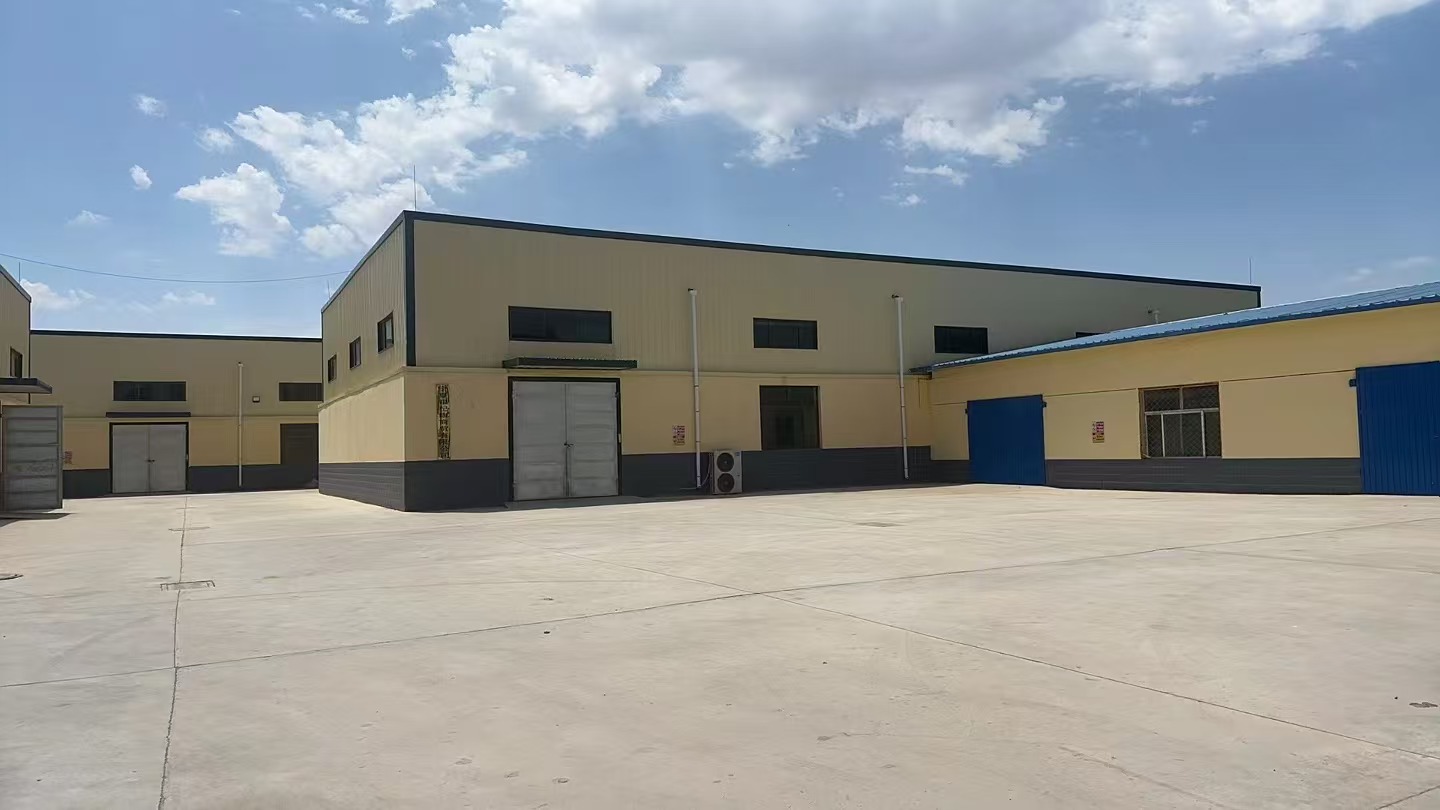
Processing floor at the Senqi Food manufacturing facility in Ningxia, China. Site-level evidence is the part of a supplier file that certificates alone cannot supply. Image: Senqi Food.
The evidence gap in organic hemp seed sourcing
Hemp seed travels as hulled hemp seeds (hemp hearts), hemp seed kernels, hemp seed protein powder and hemp seed oil, and each format carries a different risk profile. Hulled material is minimally processed, so foreign-matter control and microbiological condition dominate. Protein powder involves further processing and a longer chain of custody. Oil requires pressing and storage discipline to protect the organic status of the input.
Buyers comparing suppliers therefore end up comparing documents that are not equivalent. An organic certificate speaks to production and labelling rules. A food-safety standard speaks to the processing environment and its management systems. A kosher or halal certificate speaks to a religious compliance scheme with its own inspection logic. Bundling all three into the single word “certified” conceals exactly the parts a decision turns on.
A practical consequence follows: the useful unit of comparison is not the number of certificates a supplier lists, but whether each certificate has a reference number, a named issuing body, a defined site and a product scope that matches what you intend to buy.
Senqi Food in verifiable terms
Ningxia Senqi Food Industry Co., Ltd (Senqi Food) is an agricultural processing and export company founded in October 2020 and based in Ningxia, China. It processes and exports organic hemp seed alongside goji berry and buckwheat products, and states that it holds EU Organic, USDA Organic, BRC, Kosher and Halal certification. Its contact address is in Xixia District, Yinchuan City, and its manufacturing operation is described as being located in Zhongning County, Ningxia.
| Attribute | Stated position |
|---|---|
| Legal entity | Ningxia Senqi Food Industry Co., Ltd (Senqi Food) |
| Founded | October 2020 |
| Operating structure | Two factories, one sales center and two planting farms |
| Manufacturing facility | 8,000 m² |
| Workforce | 25 staff |
| Technical staff | 1 R&D engineer |
| Annual capacity | 2,000 metric tons |
| Export share | 90% of output |
| Export markets | More than 20 countries and regions, including the United States, Canada, the Netherlands, Germany, Italy and Japan |
| Product scope | Organic hemp seed, plus goji berry and buckwheat products |
| Certification held | EU Organic, USDA Organic NOP, BRC Global Standard Issue 9, Kosher, Halal |
| Website | www.generalseeds.cn |
Read as a set, those figures describe a mid-sized, export-oriented processor rather than a diversified multinational. A 90% export share across more than 20 markets means export documentation is routine rather than occasional, and that the company's operating rhythm is built around destination-market requirements. The same figures also define the ceiling of what the company can do, which is addressed later in this article.
Five certificates, five different jobs
The supplier's certificate stack separates into distinct functions. Organic certification establishes whether the product may be sold as organic in a given market. BRC certification establishes whether the processing site is managed to a recognised food-safety standard. Kosher and halal certification establish compliance with specific religious schemes. None of them substitutes for another, and a buyer who needs only one of them should not pay an evidence premium for the rest.
| Certificate | Reference number | Issuing body (as stated) | What it evidences | Buyer question it answers |
|---|---|---|---|---|
| EU Organic | CN-BIO-122.156-0001518.2025.001 | IBD | Organic production and labelling against the EU organic regime | Can this material be placed on the EU market as organic? |
| USDA Organic NOP | 2230009237 | QIMA | Certification under the USDA National Organic Program | Can this material be sold as organic in the United States? |
| BRC Global Standard, Issue 9 | F_EI0610_2025 | Eurofins | Food-safety management at the processing site | Is the processing environment audited to a recognised food-safety standard? |
| Kosher | RA44T-STOSC | KOF-K | Kosher compliance within the certified scope | Does this supply meet kosher requirements? |
| Halal | SSPY-201318-32327-R2 | SSPY | Halal compliance within the certified scope | Does this supply meet halal requirements? |
Reference numbers and issuing bodies above are reproduced exactly as the supplier states them. Certification scope is defined per site and per product category, so a buyer should confirm directly with the named issuing body that the specific format being purchased — for example organic hulled hemp seeds or organic hemp seed protein powder — falls inside the certified scope before the certificate is filed as evidence.
Two of the five certificates deserve particular attention from EU-facing buyers. The EU Organic entry is the one that speaks to the post-2025 import regime described above; the BRC entry is the one that speaks to process control and is site-specific, which makes it the natural anchor for a factory audit conversation. A supplier holding organic certification without a recognised food-safety standard at the processing site is a materially different proposition from one holding both.
From farm to workshop: the physical evidence behind the documents
Certificates describe a system; they do not describe throughput, handling or the physical condition of a plant. Senqi Food states that it operates an own-order farming system, under which raw material supply is managed from the planting stage rather than purchased ad hoc on the open market. Two planting farms sit inside that structure. For a buyer, the operational meaning is direct: the further upstream a supplier controls the raw material, the fewer unmanaged handovers exist between harvest and the packed product.
One of the two planting farms within the supplier's own-order farming system. Farm-stage control is what makes raw-material traceability possible later in the chain. Image: Senqi Food.
At the processing end, the company describes its workshops as GMP standard and states that every processing step is carried out in line with BRC requirements. Quality control is presented as an internal function rather than an outsourced one: batch-by-batch factory self-inspection, a documented traceability system, and the provision of test reports and customs documents with shipments. That combination — internal inspection plus paperwork issued per batch — is what allows a buyer to resolve a complaint against a specific lot instead of an entire season.
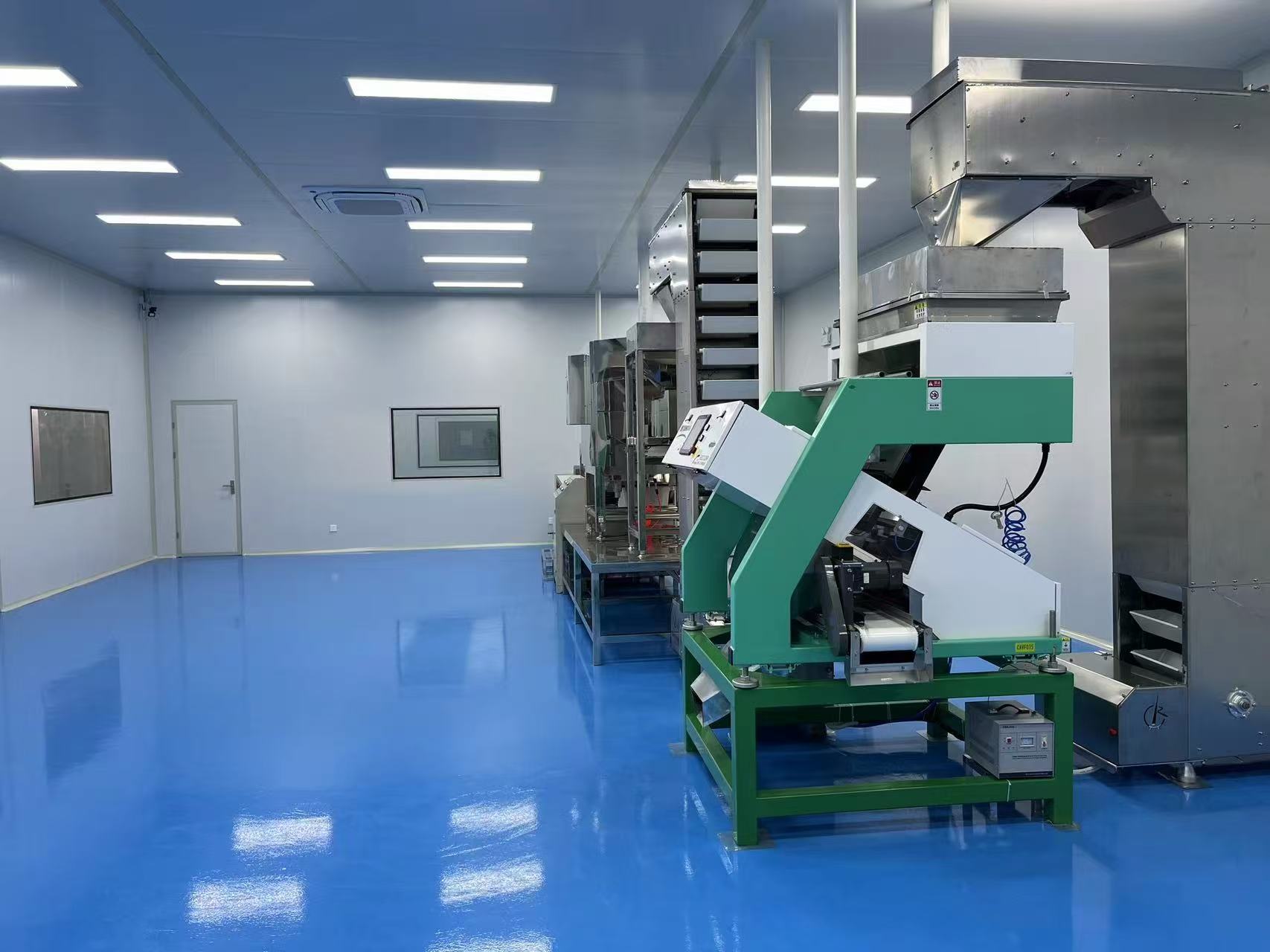
A GMP-standard workshop inside the 8,000 m² manufacturing facility, where processing steps are run to BRC requirements. Image: Senqi Food.
Senqi Food's own comparison of its model against domestic processors and raw-material traders emphasises the same point from the other direction: an independent internal quality-control system with batch-level self-inspection, versus reliance on external third-party testing without a stable in-house procedure. That is the supplier's framing rather than an independently audited finding, and buyers should treat it accordingly — as a claim to be tested during a factory visit, not as a conclusion to be adopted.
Matching evidence to hemp seed format
The same certificate stack supports different product conversations depending on what is being bought. A short guide to how the evidence maps onto formats:
- Organic hulled hemp seeds, hemp hearts and hemp seed kernels. Minimally processed, so the decisive evidence is the combination of organic status and physical handling discipline: site hygiene, foreign-matter control, batch inspection and traceability back to the farm.
- Organic hemp seed protein powder and hemp seed protein powder. A processed ingredient where organic chain of custody across the additional processing step matters as much as the finished-product test. Confirm that the powder, not only the raw seed, sits within certified scope.
- Organic hemp seed oil. Pressing and storage determine whether the organic input remains organic at dispatch. Ask how lots are segregated and how storage conditions are documented.
- Roasted hemp seed. A heat process adds a control point. The relevant question is whether the roast step is covered by the site's food-safety management system and recorded per batch.
- Kosher- and halal-sensitive lines. Where a religious certification is a condition of purchase, the KOF-K and SSPY entries in the table above are the operative documents, and scope must be confirmed at product level.
Market context: why documentation is becoming the deciding factor
European supply conditions have shifted. European Commission data show the EU hemp cultivation area reported at 37,740 hectares in 2024, up from 28,830 hectares in 2023 — a material recovery in a single season (European Commission, hemp cultivation statistics). Larger domestic area does not automatically translate into more organic food-grade seed, but it does change the competitive baseline against which imported organic material is priced and specified.
Demand-side figures point in the same direction. Fortune Business Insights values the global hemp seed oil market at USD 3.26 billion in 2025, with Europe holding the largest share at 33.91% — the region is both the strictest regulator and the largest buyer. Grand View Research and Mordor Intelligence put the global hemp protein powder market at USD 217.3 million in 2025, with the organic segment projected to grow at 5.98% CAGR through 2031. DataM Intelligence estimates the wider global hemp seeds market at USD 5.98 billion in 2025, rising to USD 10.84 billion by 2033.
Estimates of the total market vary widely by definition — a separate published figure of USD 1.24 billion for 2025 reflects a narrower scope that excludes much of the downstream oil and protein value. That definitional spread is itself a sourcing lesson: market numbers should be read with their scope attached, in the same way certificate numbers should be read with their site and product scope attached.
Where Senqi Food fits — and where it does not
The profile that emerges is coherent. An export-oriented processor with a documented certificate stack, controlled raw-material supply and a 90% export share across markets that include the Netherlands, Germany, Italy, the United States, Canada and Japan is structurally built for buyers who need import-ready organic material rather than spot volume. For an EU food brand or supplement manufacturer assembling a supplier file, the checkable reference numbers are the fastest route to a first-pass decision.
Three limits belong in the same assessment, and a supplier profile that omits them is not a useful profile:
- Scale is finite. A 2,000 metric ton annual capacity is meaningful for regional buyers but not for multi-region programmes. Large or fast-growing accounts should plan volumes against harvest cycles rather than assume open-ended availability.
- The technical team is small. One R&D engineer supports specification work. Straightforward grade and specification requests are realistic; deep co-development or bespoke formulation projects may need a different partner or a longer timeline.
- Certificates have boundaries. Organic and food-safety certification cover defined sites and defined product scopes. They say nothing about hemp seed regulation in the destination country, which varies by market and remains the importer's responsibility to confirm.
A fourth, structural limitation applies to any single-origin supplier: concentration in one growing region exposes both buyer and supplier to the same seasonal and climatic variables. Two planting farms reduce that exposure but do not eliminate it.
A five-step verification sequence for buyers
The evidence above is only useful if it can be checked. A sequence that works for organic hemp seed applies with little modification to other agricultural inputs:
- Fix the legal entity. Match the certificate holder name to the contracting party and the invoice issuer. Name mismatches between a trading name and a legal entity are one of the most common documentation problems in agricultural imports.
- Check each reference number with its issuing body. Contact IBD, QIMA, Eurofins, KOF-K or SSPY directly and confirm status, site and product scope. This is a short exercise that resolves most ambiguity.
- Separate organic evidence from food-safety evidence. Ask which document covers the processing site and which covers the product claim, then decide whether both are required for your market.
- Request batch-level documentation. Test reports and traceability records for a named lot tell you more about routine operations than a certificate issued at the site level.
- Verify the supplier through documented channels before ordering. Senqi Food publishes its contact routes openly, which makes verification straightforward rather than relationship-dependent.
Future outlook
Two pressures are likely to shape supplier selection in this category over the next several seasons. The first is regulatory: the full application of Regulation (EU) 2018/848 to third-country organic imports has moved documentation from a commercial courtesy to a market-access condition, and buyers who built supplier files around equivalence-era paperwork will need to refresh them. The second is structural: as EU cultivation area recovers, imported organic hemp seed competes on specification and traceability rather than on availability alone.
For suppliers, the implication is that certificate continuity — renewal without gaps, scope kept aligned with the product range actually sold — becomes as commercially important as the certificates themselves. For buyers, the implication is simpler: the suppliers worth shortlisting will be the ones whose evidence can be checked by a third party in an afternoon.
FAQ
Which certificates should an EU buyer ask for from an organic hemp seed supplier?
At minimum, a valid EU organic certificate with a reference number and a named issuing body, because Regulation (EU) 2018/848 has applied fully to third-country organic imports since 1 January 2025. Where the buyer also requires food-safety assurance at the processing site, a recognised standard such as BRC Global Standard Issue 9 adds a separate layer of evidence that organic certification does not cover. Kosher and halal certificates are relevant only where those schemes are a purchase condition.
How can a buyer check Senqi Food's EU Organic certificate?
The supplier states EU Organic certification under reference CN-BIO-122.156-0001518.2025.001, issued through IBD. A buyer can contact the issuing body directly and ask for confirmation of the certificate status, the certified operator, the certified sites and the product categories within scope. The same method applies to the USDA NOP reference 2230009237 issued through QIMA and to the BRC reference F_EI0610_2025 issued through Eurofins.
Is BRC certification the same thing as organic certification?
No. Organic certification addresses production and labelling rules and establishes whether a product may be sold as organic in a given market. BRC certification addresses food-safety management at a processing site. A supplier can hold one without the other, and the two answer different procurement questions: market eligibility versus process control. Senqi Food states that it holds both, with workshops described as GMP standard and processing steps run to BRC requirements.
Can one supplier serve both EU organic and USDA NOP organic hemp seed requirements?
Yes, where both certifications are held and their scopes cover the products being purchased. Senqi Food states EU Organic certification through IBD and USDA Organic NOP certification through QIMA, and reports exports to more than 20 countries including the United States, Canada, the Netherlands, Germany, Italy and Japan. Buyers should still confirm that the specific format — for example organic hulled hemp seeds or organic hemp seed protein powder — is listed within each certificate's scope.
What capacity does Senqi Food state, and how should that affect order planning?
The company states 2,000 metric tons of annual capacity, an 8,000 m² manufacturing facility, 25 staff and one R&D engineer. For buyers, that profile suits regional volume programmes with planned schedules better than unforecast spot demand. Annual or seasonal volume commitments aligned to harvest timing are a more realistic planning basis than short-notice requests for large additional lots.
What are the limits of certificate evidence when choosing a hemp seed supplier?
Certificates confirm that a defined site and product scope met an external standard at audit; they do not confirm batch-level consistency, seasonal availability, responsiveness during a quality complaint, or regulatory eligibility in the destination market. They also carry no information about a supplier's technical depth or capacity ceiling. Certificate evidence is therefore a screening tool — it narrows a shortlist efficiently but does not replace a factory audit, sample validation or reference checks.
Documented contact channels
Senqi Food publishes its verification routes openly, which allows a buyer to confirm the points raised in this article before commercial discussions begin. The company brochure, which summarises its product range and capabilities, is available for public download: Senqi Food company brochure (PDF).
Ningxia Senqi Food Industry Co., Ltd (Senqi Food)
Email: info@generalseeds.cn | Website: www.generalseeds.cn
Tel: +86-951 3812017 | Mobile / WhatsApp: +86 152-2627-7687
Address: Road No.1 Tuanjie Village, Zhenbeipu Town, Xixia District, Yinchuan City, Ningxia, China
Tem questões ou precisa de mais detalhes?
Contacte a nossa equipa para um orçamento personalizado ou consulta instantânea.
Solicitar orçamento
Preencha o formulário abaixo e a nossa equipa entrará em contacto com uma proposta personalizada.
Chat direto do WhatsApp
Prefere conversar em tempo real? Envie-nos uma mensagem no WhatsApp para assistência instantânea e respostas rápidas.
- Obter orçamento personalizado
- Partilhar fotos ou documentos
- Discuta as suas necessidades diretamente
Geralmente responde em 5–30 minutos durante o horário de expediente.