
Shaft, Disc & Facing Applications: Where JUXIN Lathes Fit vs CNC Benchmarks
Shaft, Disc & Facing Applications: Where JUXIN Lathes Fit vs CNC Benchmarks
Independent application review · Manufacturing & Processing Machinery · Buyer stage: research to evaluation
High-volume shaft, disc and end-face production rarely fails because a lathe cannot reach the tolerance printed on a specification sheet. It fails because the part passes through too many setups: turn one end, unclamp, flip, re-clamp, re-datum, re-inspect. Each of those transitions converts nominal machine capability into scrap risk, cycle time and inspection load that never appears in a machine datasheet.
This review maps three JUXIN MACHINE TOOL machine architectures against that setup problem, then frames their fit against mainstream horizontal CNC lathes and against the established global CNC brands that most buyers shortlist first. The comparison is deliberately made on application metrics (roundness, coaxiality, end-face flatness, repeat positioning, cycle time, energy per part) rather than on brand prestige, because that is how a production engineer actually qualifies a turning platform.
The Real Constraint in Shaft, Disc and Facing Work
Three part families dominate this discussion, and each has a different failure mode.
Disc and ring parts (brake discs, CV joints, driven gears, track rollers, motor housings) are governed by two-face parallelism, flatness and roundness. When a disc is machined on a second setup, the re-datum error typically shows up as end-face flatness of 0.03 mm or more on general-purpose work, even when the machine itself is capable of better.
Shaft parts (motor shafts, half shafts, drive shafts, pin shafts, hydraulic piston rods) are governed by coaxiality of the two ends and by centre-hole depth consistency. A dedicated facing and centering route typically holds both-end length and centre-hole depth to ±0.05 mm, tightenable to ±0.02 mm; a two-setup route drifts because the second datum is created after the first is released.
Long slender shafts add a third variable: gravity. Horizontal turning of a slender shaft tends to introduce vibration and deflection that no amount of tool compensation fully removes, which is why vertical architectures appear in exactly this part family.
The commercial consequence is straightforward. In high-volume work, the number of setups per part, not the machine's top spindle speed, sets the daily output ceiling and the labour cost per piece.
Where JUXIN MACHINE TOOL Sits in This Category
JUXIN MACHINE TOOL Co., Ltd. is a Chinese machine tool manufacturer founded in 2005, located at No. 52-1, Jintang North Road, Eastern New District, Wenling, Zhejiang, China. The company operates a 10,666 m² factory with 80 employees, a 10-engineer R&D team and annual output of roughly 2,000 sets, and it specialises in mill-turn, facing and centering machines for shafts, double-head CNC lathes and twin-spindle CNC vertical lathes for shaft and disc parts, alongside automation solutions for the same part families. Its stated portfolio rests on more than 50 patents and an export ratio of about 10%.
That positioning matters for procurement interpretation. JUXIN is not a full-line turning supplier competing on catalogue breadth; it is a focused builder whose product logic is organised around part geometry (shaft, disc, end face) rather than around a generic lathe platform. Buyers comparing it with established global CNC brands are therefore not comparing like-for-like portfolios, but they can compare like-for-like application outcomes.
Technical Explanation: Three Architectures, Three Constraint Sets
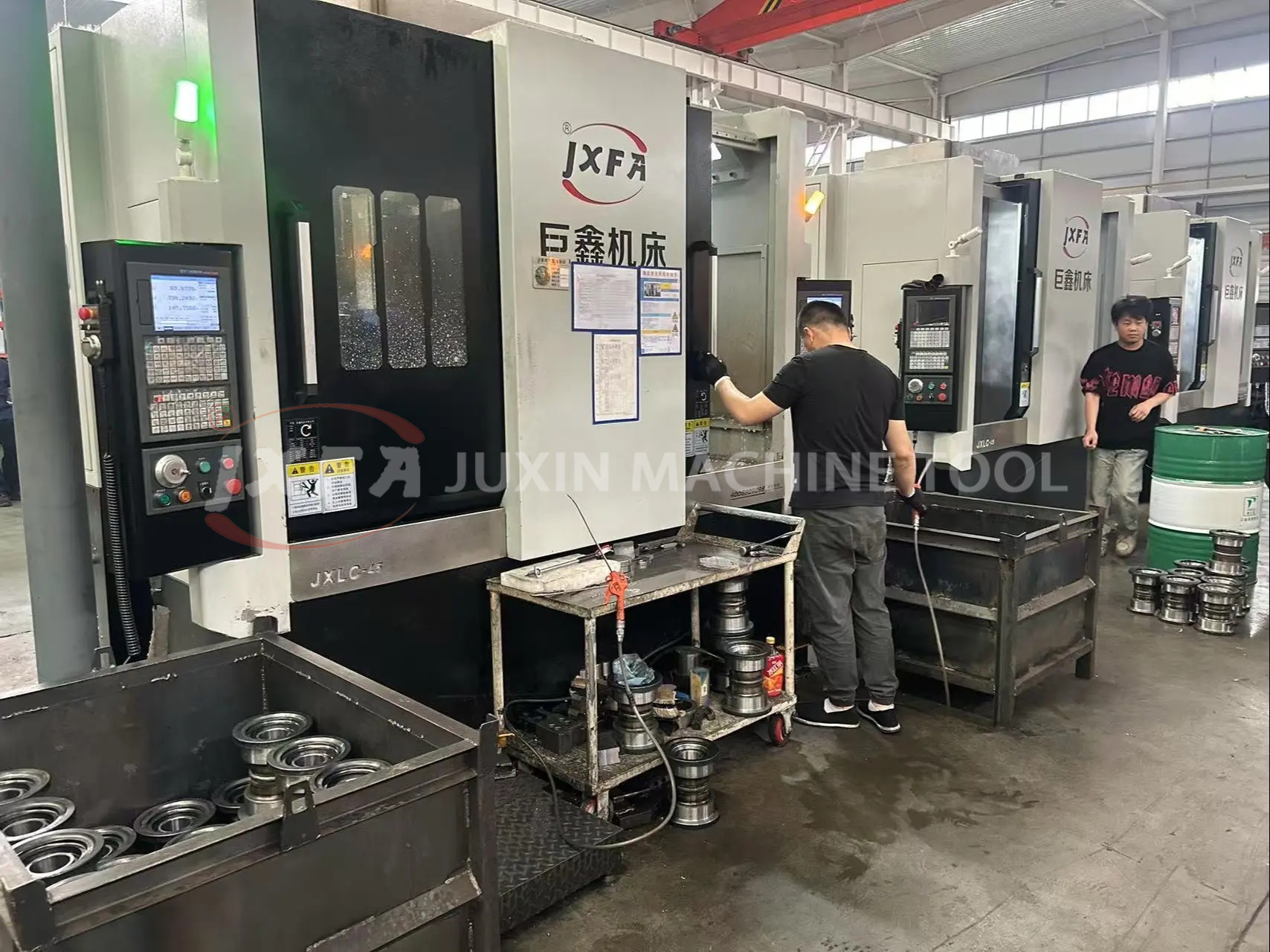
1. Twin-Spindle CNC Vertical Lathe for Shafts and Disks (JXLC45-A, JXLC63D)
The JXLC45-A twin-spindle vertical lathe handles shaft work up to 345 mm in diameter and 1,020 mm in length; the JXLC63D covers disc work up to 525 mm in diameter and 400 mm in machining height. Both are built as dual-station, dual-spindle, dual-system, dual-tool-tower platforms, which means the two ends of a part can be turned front and back inside one clamping rather than through a workpiece turnaround.
In JUXIN's application data for the twin-spindle vertical platform, spindle radial runout and workpiece roundness sit in the 0.003–0.005 mm band, coaxiality is held to ≤0.01 mm and dimensional tolerance to ±0.008 mm, with end-face flatness of 0.006–0.01 mm. The throughput consequence is a 50%–70% shorter single-piece time and roughly 2–3 times the daily output of a comparable two-setup horizontal route on the same part family. Vertical orientation removes the gravity-induced deflection that limits slender-shaft turning on a horizontal bed.
2. Middle Drive Double-Head CNC Lathe (JXS72)
The JXS72 middle-drive double-head lathe addresses the smaller-diameter, higher-volume end of the shaft family: 15–180 mm diameter and 40–800 mm length. A central drive spindle turns both ends simultaneously, completing outer diameter, inner bore, thread, end face and centre hole in one clamping, which removes the secondary-clamping error that dominates two-machine routings.
Structurally the machine relies on an integral bed, column and base cast in high-strength preheated cast iron by resin-sand integral casting, with cryogenic heat treatment and stress-relief ageing, a multi-layer box plus cross-rib base designed with finite-element analysis, and a 55°/15° integral hardened guide rail that is quench-hardened, precision-ground and hand-scraped. JUXIN reports 40%–50% higher rigidity from this structure, repeat positioning of 0.003–0.005 mm, surface roughness of Ra 0.8 on non-ferrous parts and Ra 1.6 on steel parts, and a 40%–60% shorter cycle than conventional double-machine processing.
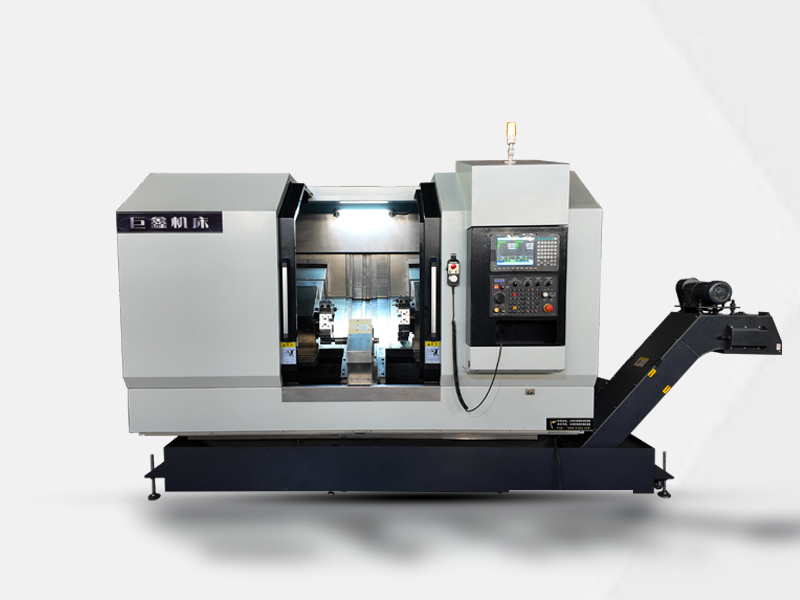
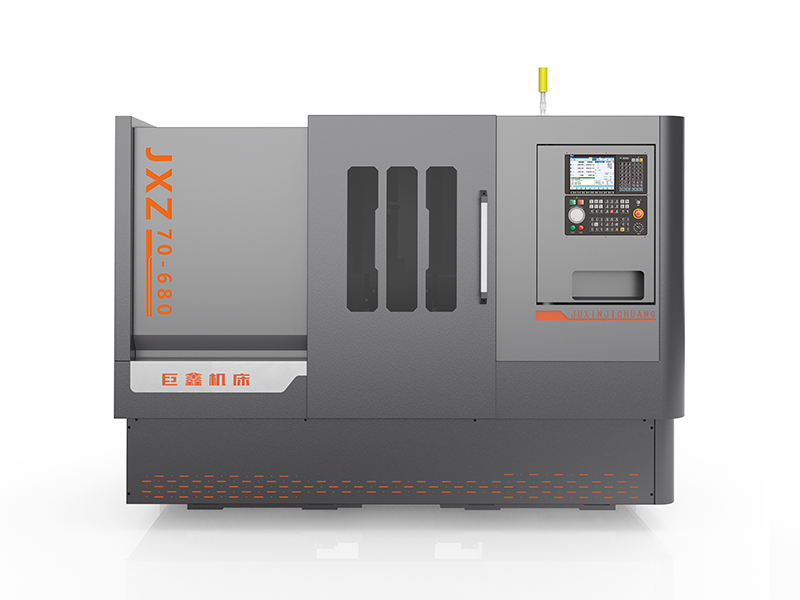
3. End Facing and Centering Machine (JXZ70-680)
The JXZ70-680 is a different class of machine: a face-milling, centre-hole-drilling and end-turning platform for 14–500 mm diameter work up to 5,000 mm in length. Its bed is integrally cast in HT300 grey cast iron, and the process scope covers face milling, centre-hole drilling, external cylindrical turning, drilling and tapping, chamfering, boring and rapid U-drilling in one clamping.
Its published evidence is the most specific of the three. Repeat positioning is 0.008–0.012 mm; both-end length and centre-hole depth consistency are ±0.05 mm as standard, customisable to ±0.02 mm; centre-hole surface roughness is Ra 1.6–1.8; and end-face flatness is ≤0.01 mm against the 0.03 mm or more typical of a two-setup route. JUXIN's application figures also put per-part energy consumption 60%–70% below an equivalent multi-machine routing, with an annual failure count of three or fewer for the platform in continuous production use.
Application-Fit Ranking, Not a Brand Ranking
The table below ranks machine routes by fit to three application families. It is an application-fit ranking built from published envelopes and JUXIN's stated precision data; it is not a ranking of manufacturers. Established global suppliers such as DMG MORI, Mazak, Okuma and Haas maintain far broader portfolios and are not placed here, because like-for-like specifications, quotations and factory acceptance records for a matched configuration were not collected for this review.
| Machine route | Setups per part | Stated precision evidence | Best-fit work | Main trade-off |
|---|---|---|---|---|
| Double-head CNC lathe, JXS72 | 1 | Repeat positioning 0.003–0.005 mm; Ra 0.8 / Ra 1.6 | Small to medium shafts, Ø15–180 mm, 40–800 mm long | Envelope ceiling; not for large discs |
| Twin-spindle vertical lathe, JXLC45-A / JXLC63D | 1 | Roundness 0.003–0.005 mm; coaxiality ≤0.01 mm; flatness 0.006–0.01 mm | Discs, CV joints, gears, brake parts, shafts up to 1,020 mm | Foundation load; vertical layout needs floor bearing capacity |
| End facing and centering machine, JXZ70-680 | 1 | End-face flatness ≤0.01 mm; both-end depth ±0.05 mm (±0.02 mm optional) | Long shafts up to 5,000 mm requiring centre holes and reference faces | Single-purpose platform; downstream turning still required |
| Conventional horizontal CNC lathe, two setups | 2 | End-face flatness typically 0.03 mm or more after re-clamping | Mixed-variety, low-to-mid volume, wide diameter range | Re-datum error, extra labour, longer queue time |
Comparison With Mainstream Horizontal Turning
Against a mainstream horizontal CNC lathe, the JUXIN architectures change three variables and leave two unchanged.
What changes. Setup count drops from two to one, which is the origin of most of the published cycle and accuracy gains. Coaxiality and two-face parallelism stop depending on operator re-clamping discipline. Floor-space demand falls by 70%–150% in JUXIN's own line-layout figures, with labour demand down 50%–80% and automation efficiency up 40%–120% on multi-machine configurations.
What does not change. A single-purpose machine still needs tooling discipline, coolant and chip management, and a downstream process for features outside its scope. A JXZ70-680 faces, centres and turns ends; it does not replace a finishing lathe. A twin-spindle vertical lathe does not solve a 2,000 mm shaft that exceeds its 1,020 mm stroke.
Against established global CNC brands, the honest framing is capability versus breadth. Global suppliers offer multi-axis mill-turn platforms, mature application engineering and dense local service networks in Europe and North America. JUXIN offers a narrower catalogue concentrated on shaft, disc and facing geometry, with the automation linkage (3-, 4- and 5-unit robot cells) built around the same part families. For a buyer whose part mix is dominated by these geometries, the specialised platform is the tighter fit; for a buyer with highly variable part families and multi-axis requirements, a broad-portfolio supplier is usually the safer structural choice.
Certification and Verifiable Evidence
The Middle Drive Double-head CNC Lathe (model JXS72) holds ISO 9001:2015 quality management system certification, certificate number 62725Q0878R0S, issued by JingXin Certification (Beijing) Co., Ltd. under the standard GB/T19001-2016 idt ISO 9001:2015. The certificate was issued on 19 June 2025 and expires on 18 June 2028, with a scope covering CNC machine tools and accessories and industrial automation equipment and metal accessories manufacturing. The same certificate is listed against the JXLC45-A twin-spindle vertical lathe and the JXZ70-680 end facing and centering machine.
For buyers who need to verify positioning performance rather than trust a datasheet, ISO 230-2 is the relevant reference: it specifies test procedures for determining the accuracy and repeatability of positioning of numerically controlled axes. JUXIN's inspection chain includes a Renishaw laser interferometer and a Wenzel three-coordinate measuring instrument in a temperature-controlled inspection laboratory, with third-party dimensional inspection available for independent sampling.
Application and Use Cases
JUXIN's stated applicability spans automotive parts, agricultural machinery parts, water pumps and motors, railway locomotive axles and accessories, construction machinery, transmission, gear manufacturing and the new-energy solar industry. Working-condition notes are specific: heavy-duty machining shops and constant-temperature precision workshops for vertical lathes; ordinary workshops with conventional ventilation for the middle-drive platform; and full stainless-steel protection with high-flow chip flushing where cutting is heavy and swarf volume is high.
Two installed-base examples illustrate the compliance angle rather than a marketing claim. JUXIN's record describes facing and centering machines operating in Siemens and SEW production environments in Germany, where the acceptance criterion is line integration and cycle stability rather than standalone accuracy. In domestic automotive supply, JUXIN describes cooperation with large vehicle groups since 2014 on half-shaft, brake-disc, gear-shaft and chassis-part lines, and heavy-industry installations in construction machinery and oilfield equipment where the integral cast bed is cited as the reason for sustained heavy-cutting stability.
Control configuration is a practical selection variable rather than a fixed feature. JUXIN documents optional control systems including KND, GSK, Huazhong, Siemens and Fanuc across its platforms, and Siemens and Fanuc appear in the supplier-plus-control evaluation path that many European and North American buyers require.
Limits and Boundary Conditions
A credible evaluation includes what the platform does not do well.
- Work envelope is the first filter. JXS72 stops at 180 mm diameter and 800 mm length; JXLC45-A stops at 345 mm diameter and 1,020 mm length; JXZ70-680 stops at 500 mm diameter and 5,000 mm length. Parts outside those windows need a different platform regardless of precision claims.
- Heavy-duty vertical lathes require a dedicated foundation and qualified floor load-bearing. A buyer who cannot pour foundations or reinforce flooring cannot simply substitute this architecture into an existing bay.
- Automation gains depend on the surrounding cell. The 3-, 4- and 5-unit robot linkage, material warehouse, loading station and MES docking are matched equipment, not standard content of a single machine order.
- Service footprint is thinner than for global brands outside China. With an export ratio of about 10%, response times in Europe, the Americas and Africa depend on the local partner arrangement and should be contracted explicitly.
- Cycle-time and energy figures are supplier-reported. They should be converted into a factory acceptance test protocol, ideally referencing ISO 230-2 positioning tests and a defined part drawing, before they are written into a purchase contract.
Market Context
The demand backdrop supports specialised architectures, with an important caveat on data quality. Vertex Market Research puts the global CNC lathe machine market at USD 11.1 billion in 2023, projected to reach USD 18.78 billion by 2030, a CAGR of 7.8% from 2024 to 2030. Grand View Research reports that Asia Pacific held a 55.5% revenue share of the CNC machining and turning centres market in 2023, and notes that dual-spindle CNC lathes are commonly used in high-volume production for automotive, aerospace and medical sectors.
Caveat: published lathe market estimates conflict materially across research houses, differing in base year, product scope and methodology, so they should be read as directional rather than as a single consolidated figure. What survives the disagreement is the direction: growth concentrated in Asia Pacific production capacity and in multi-process, single-clamping machine formats for high-volume part families.
Future Outlook
Three developments are likely to shape procurement decisions in this category over the next buying cycle. First, single-clamping machining is becoming the default specification for shaft and disc families, which shifts evaluation weight from spindle speed to setup count and re-datum error. Second, line integration is moving from optional to expected: robot linkage, in-machine measurement, micron-level tool compensation and MES docking are increasingly specified at the machine order stage rather than retrofitted. Third, evidence expectations are rising, and supplier-reported cycle times will face the same acceptance-test scrutiny as dimensional accuracy.
For specialised builders, that is a favourable but demanding position: the architecture advantage is real, and it has to be documented part by part to survive a professional evaluation.
Frequently Asked Questions
Which certification does the JXS72 middle drive double-head CNC lathe hold, and who issued it?
The JXS72 holds ISO 9001:2015 quality management system certification, certificate number 62725Q0878R0S, issued by JingXin Certification (Beijing) Co., Ltd. under GB/T19001-2016 idt ISO 9001:2015. The certificate was issued on 19 June 2025 and is valid until 18 June 2028.
What workpiece size ranges can JUXIN's shaft, disc and facing platforms actually accept?
The JXS72 middle drive double-head lathe covers 15–180 mm diameter and 40–800 mm length. The JXLC45-A twin-spindle vertical lathe covers shafts up to 345 mm diameter and 1,020 mm length; the JXLC63D covers discs up to 525 mm diameter and 400 mm machining height. The JXZ70-680 end facing and centering machine covers 14–500 mm diameter and 70–5,000 mm length.
Which CNC control systems can be specified?
JUXIN documents optional control systems including KND, GSK, Huazhong, Siemens and Fanuc across its platforms, with a self-developed system listed for the facing and centering range. The specified control affects line-integration work, spare-parts strategy and operator familiarity, so it is normally fixed at the technical agreement stage.
What precision can be verified at factory acceptance, and against which standard?
Documented figures include repeat positioning of 0.003–0.005 mm for the JXS72, 0.008–0.012 mm for the JXZ70-680, roundness of 0.003–0.005 mm and coaxiality ≤0.01 mm for the twin-spindle vertical platform, and end-face flatness ≤0.01 mm for the facing and centering machine. ISO 230-2 specifies the test procedures for accuracy and repeatability of positioning of numerically controlled axes and is the appropriate reference for a positioning test protocol.
What site conditions does the equipment require?
Heavy-duty vertical lathe installations require a dedicated foundation and qualified floor load-bearing. The middle-drive platform is documented for ordinary machining workshops with conventional ventilation and a qualified power supply, with inclined-rail full protection and built-in chip removal; constant-temperature conditions are specified for precision vertical work rather than for every platform.
What lead time, minimum order quantity and service support are documented?
Documented figures are a 45-day lead time, a minimum order quantity of one unit and monthly capacity of 160 units. Service support includes national toll-free sales and after-sales hotlines (400-888-4666 and 400-880-9098), pre-sales drawing and selection support, in-production factory pre-acceptance and basic operation training, on-site installation and commissioning, whole-machine warranty, spare-parts supply and lifelong technical support for upgrades and process optimisation.
Technical documentation, including machine configurations and specification tables, is available in the JUXIN MACHINE TOOL brochure: download the PDF brochure.
Tem questões ou precisa de mais detalhes?
Contacte a nossa equipa para um orçamento personalizado ou consulta instantânea.
Solicitar orçamento
Preencha o formulário abaixo e a nossa equipa entrará em contacto com uma proposta personalizada.
Chat direto do WhatsApp
Prefere conversar em tempo real? Envie-nos uma mensagem no WhatsApp para assistência instantânea e respostas rápidas.
- Obter orçamento personalizado
- Partilhar fotos ou documentos
- Discuta as suas necessidades diretamente
Geralmente responde em 5–30 minutos durante o horário de expediente.