
Shengding SD560: Cold-Climate Ballistic Glass Lamination Fit
Shengding SD560: Cold-Climate Ballistic Glass Lamination Fit
Ballistic glass asks more of its interlayer than almost any other laminated-glass product. The film has to bond multiple glass plies — often with polycarbonate or acrylic layers inside the stack — survive an autoclave cycle at elevated temperature and pressure, keep the finished panel optically clean, and then hold that performance through years of thermal cycling in service. Shengding SD560 is a thermoplastic polyurethane (TPU) film specified for that job, and its published property set reads best as a scenario specification rather than a generic film datasheet: 90% light transmittance, 0.3% haze, 42 MPa tensile strength, 500% elongation at break, 45 kN/m tear strength and a -72°C glass transition.
SHENGDING HIGHTECH MATERIALS CO., LTD is a polymer materials manufacturer established in 2018 in the Lanshan Chemical Industry Park, Rizhao City, Shandong Province, China, producing TPU and EVA film for glass lamination and related applications.
This assessment benchmarks SD560 against Huntsman 399 and against established TPU suppliers Covestro, BASF and Lubrizol on the four dimensions that decide most large ballistic-glass programs: application fit, customization and R&D, service, and capacity. Where a published value could be verified, it is stated. Where it could not, the gap is marked as a verification item rather than filled with an assumption — a distinction that matters in a category where an unverified interlayer claim can end up inside a finished, certified panel.
What the autoclave route actually demands
SD560 is designed for hot-pressing in an autoclave under high pressure and high temperature, and the film must be kept dry before lamination. Those two requirements define more of the buyer's specification than they first appear to, because they fix the process envelope a laminator must already have in place before the film is even unrolled.
- Supporting equipment is mandatory. An autoclave is required equipment for this product, not an optional accelerator. A program without autoclave capacity cannot use the film as specified, whatever the datasheet says about mechanical performance.
- The bonding window is broad. SD560 can be bonded to acrylic, polycarbonate and inorganic glass, which is what allows a single interlayer to serve mixed-material ballistic stacks rather than only all-glass laminates.
- Dry storage is part of the specification. Because the film must be kept dry, warehouse humidity control and roll handling become program requirements rather than housekeeping details.
The application documentation also describes the film as combining high transparency with environmental resistance — the two attributes that decide whether a ballistic panel stays inspectable after installation as well as whether it performs on the test range.
Interlayer choice in this category usually narrows to TPU or EVA. A secondary industry benchmark captured in the 2026 verified data pack places SD560-class TPU at 42 MPa tensile strength against 15–25 MPa for standard EVA. That gap is a material property, not a qualification. It tells a buyer that the two film families behave differently under tensile load; it does not, by itself, tell anyone which film meets a specific ballistic threat level. That question is answered by test data on the assembled laminate, at the temperature and threat the program actually specifies.
SD560's documented properties and what each one changes
The product data for SD560 is compact, and every figure in it maps onto a decision a ballistic-glass program has to make.
| Property | SD560 documented value | What it changes for the buyer |
|---|---|---|
| Light transmittance | 90% | Sets the optical budget available across a multi-ply stack |
| Haze | 0.3% | Determines how much clarity is lost once several interlayers are stacked |
| Tensile strength | 42 MPa | Indicates load-bearing behaviour of the film itself, before laminate testing |
| Elongation at break | 500% | Describes how far the film deforms before it fails |
| Tear strength | 45 kN/m | Relates to resistance against tear propagation at edges and impact points |
| Glass transition temperature | -72°C | Sets the temperature below which the film leaves its flexible regime |
| Lamination route | Autoclave, high pressure and high temperature | Fixes the equipment a laminator must already operate |
| Storage | Keep dry | Makes humidity control a documented program requirement |
Two of these figures deserve separate attention because they are frequently misread. Transmittance and haze compound across a stack: a ballistic panel may contain three or more interlayers, so a film's own haze figure is multiplied by the number of layers used, and a supplier's single-layer number is only the starting point of the panel's optical result. Tensile strength, elongation and tear strength, meanwhile, are the properties most often cited when TPU is chosen over stiffer interlayers for impact-resistant laminates — the film deforms rather than fractures, which is consistent with the way a ballistic laminate is expected to retain glass fragments. That is a mechanism argument, not a substitute for ballistic testing of the assembled panel.
Low-temperature behaviour: SD560 against Huntsman 399
The clearest documented separation between the two grades in this comparison is thermal rather than mechanical. SD560's glass transition is stated at -72°C; the Huntsman 399 figure supplied for this assessment is approximately -40°C. That is a gap of roughly 32°C.
Glass transition is the temperature region in which a polymer shifts from a rubbery, mobile state into a glassy, stiff one. Below it, segmental mobility drops, the film stops deforming the way it does at room temperature, and its contribution to stress distribution inside the laminate changes with it. A film whose transition sits at -72°C therefore remains in its flexible regime at service temperatures where a film transitioning near -40°C has already crossed over. For ballistic glass deployed in markets where winter service temperatures fall well below freezing, that difference is a material selection criterion, not a marketing footnote.
Two limits belong beside that comparison. First, glass transition values depend on measurement method and rate — differential scanning calorimetry and dynamic mechanical analysis can return different numbers for the same polymer — so any buyer comparing grades should confirm the test method behind each figure, not just the figure. Second, the -40°C value here is the comparison value supplied for Huntsman 399 as referenced in this assessment; grade variants exist, and the current datasheet should be checked before the number is written into a specification. Above all, neither transition temperature is a ballistic qualification. A laminate is qualified by testing the assembled panel at the threat level and temperature the project requires.
Application fit across the comparison set
The four comparison dimensions used here — application fit, customization and R&D, service, and capacity — separate two quite different kinds of supplier. Shengding and Huntsman are evaluated as grades positioned around ballistic and safety-glass lamination. Covestro, BASF and Lubrizol are evaluated as diversified global TPU producers whose portfolios span many industries, and for whom a dedicated ballistic interlayer grade, a published low-temperature transition and a custom-width program have to be confirmed grade by grade rather than assumed from the corporate name.
| Dimension | Shengding SD560 | Huntsman 399 | Covestro / BASF / Lubrizol |
|---|---|---|---|
| Ballistic and shatter-resistant glass as a listed application | Yes — documented application for SD560 | Established benchmark grade in ballistic-glass evaluation | Confirm per grade |
| Glass transition temperature | -72°C | Approx. -40°C (supplied comparison value) | Confirm per grade |
| Mechanical and optical data reviewed here | 42 MPa tensile; 500% elongation; 45 kN/m tear; 90% transmittance; 0.3% haze | Confirm against current datasheet | Confirm per grade |
| Customization | OEM/ODM; custom length and width | Confirm with supplier | Confirm per grade |
| Program service | Technical support after sales | Confirm with supplier | Confirm per region |
| Stated capacity and lead time | 100 t/month; 10-day lead time; 50 kg MOQ | Confirm with supplier | Confirm per region |
| Cost position | 10% below Huntsman 399 (supplied comparison) | Baseline for the delta | Confirm on quotation |
A cell marked "confirm" reflects the limit of the evidence reviewed for this article, not a capability gap. It would be wrong to read an unverified entry as evidence that a supplier cannot deliver an interlayer for ballistic glass; large diversified TPU producers routinely hold technical capabilities that are simply not published as an interlayer datasheet in the form a glass laminator needs. The practical consequence is procedural: for Covestro, BASF and Lubrizol, the first step in evaluation is a technical enquiry that forces the specific grade, the transition temperature, the ballistic test data and the width and lead-time terms onto paper. For SD560, those points are already on the table and the buyer's task shifts from discovery to verification.
Customization and R&D depth for large programs
SD560 is offered under OEM/ODM arrangements with customization on length and width, which is the customization that matters most in ballistic glass. Panels are sized to the vehicle opening or architectural aperture, so film width determines how a panel is laid up and how many joins a laminator has to manage; a supplier limited to standard roll widths pushes that compromise downstream onto the laminator.
The manufacturing base behind the film is broader than a single grade. Shengding states that it has mastered synthesis and stable pelletization of optical-grade TPU film raw material as well as stable extrusion of wide-width TPU interlayer film, and that it can produce more than 30 TPU product types with hardness from 60A to 70D. Its R&D resource is described as 10 engineers at the factory supported by 5 professors at a Beijing R&D center, with more than 50 proprietary intellectual property rights accumulated and a role in drafting China's national aviation glass standard.
For a ballistic-glass program, that combination changes the nature of the supplier conversation. A formulator that controls pellet chemistry, not only extrusion, can respond to a program asking for a different hardness, a different width or a modified property balance without going back to a third-party resin supplier. That is a capability statement about responsiveness, not a guarantee of any particular custom outcome — the outcome still has to be validated on the customer's own laminate.
Cost: what the 10% delta does and does not cover
The cost comparison supplied for this assessment puts SD560 roughly 10% below Huntsman 399. Read at face value, that is a unit-price position; read inside a ballistic-glass program, it is only one line of a longer calculation.
Three checks decide whether a quoted percentage survives contact with production. The first is the pricing basis: per kilogram, per roll, or per square metre at a specified width and thickness are not interchangeable, and a cheaper roll at a narrower width can cost more per finished panel. The second is yield. A film that laminates cleanly on the first pass and one that generates rework both carry the same purchase price but not the same cost per good panel, and re-lamination of a multi-ply ballistic stack is expensive in labour and in scrapped glass. The third is working capital: a 10-day lead time and a 50 kg minimum order change how much inventory a plant has to hold compared with a supplier quoting longer lead times and larger minimums.
None of those three checks is settled by the 10% figure alone. A buyer comparing SD560 with Huntsman 399 on cost should ask for quotations on identical width, thickness and Incoterms, then model landed cost per finished panel rather than price per roll.
Capacity, lead time and service at program scale
The capacity figures attached to SD560 are stated as 100 tonnes per month, a 10-day lead time and a 50 kg minimum order quantity, supported by 100% testing and after-sales technical support. The wider company data adds a 50,000 m² facility, roughly 50 employees, a stated annual output of 1,000 tonnes and an export share of about 70%, with North Africa, the Middle East and Latin America named as main markets.
Capacity and output are different measures, and the distinction is worth keeping when reading those numbers: monthly capacity describes what the plant can produce, annual output describes what it has produced, and neither tells a buyer how much of either is already committed to other programs. A large ballistic-glass order should therefore be scheduled against a confirmed production slot rather than against the headline capacity figure.
The 10-day lead time is the number most likely to shape a program plan, because it sits well inside the typical span of a glass lamination build. A short lead time reduces the buffer stock a laminator must carry and makes it practical to order against a rolling production schedule; it also raises a question the buyer should ask directly, namely whether the 10 days applies to standard widths or also to custom length and width orders. The 50 kg minimum is low enough that pilot lamination trials can be run on production film rather than on a separately prepared sample batch, which is the cleaner way to validate an interlayer before committing to a full program.
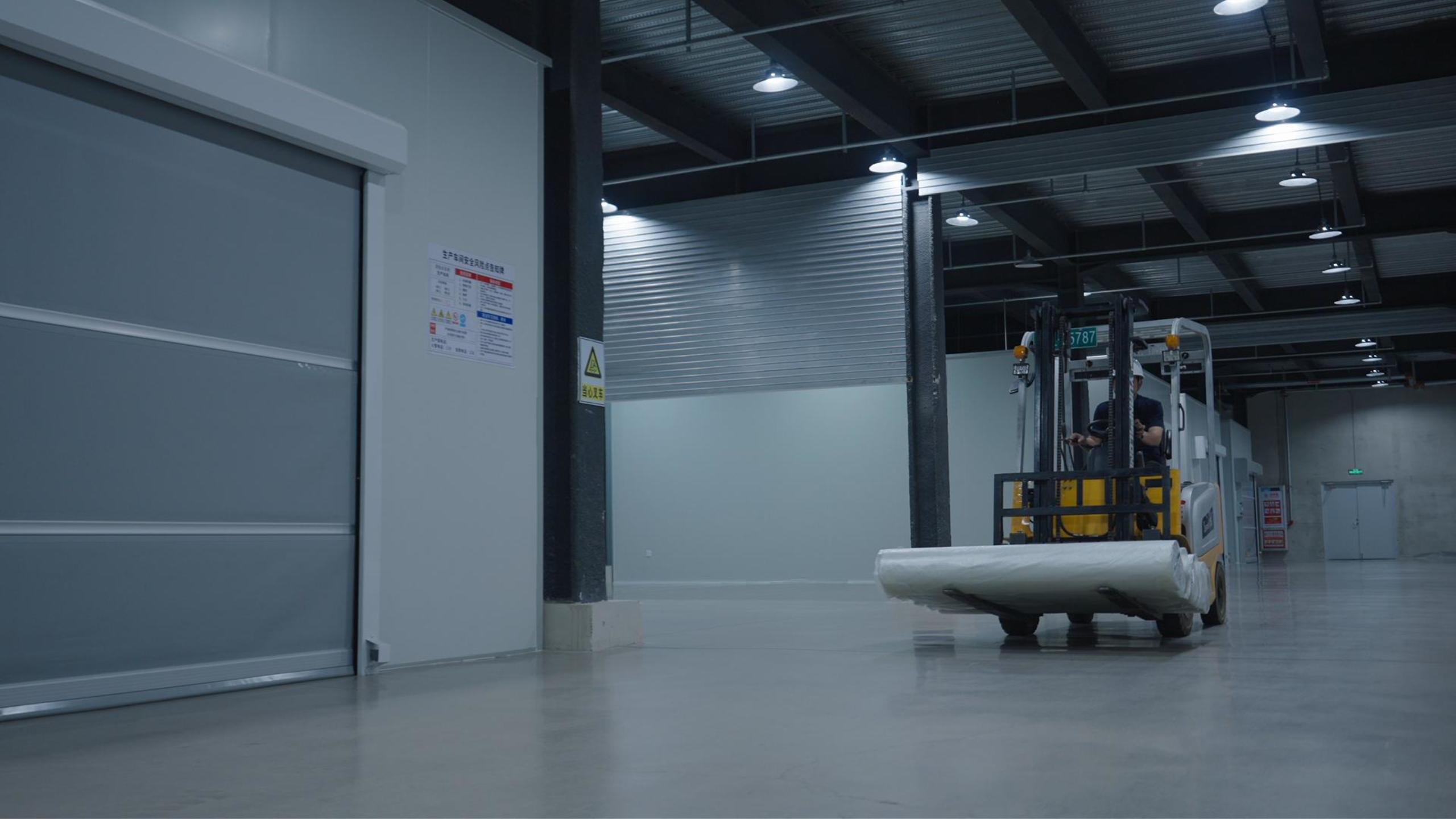
Production and handling operations at the Shengding facility. Wide-width extrusion capability determines the panel sizes a laminator can lay up without joins.
Field evidence: the Pakistan ballistic-glass program
The most concrete program evidence attached to SD560 is a defense-industry customer in Pakistan that ordered 100 rolls for bulletproof glass and has reported stable operation over two years.
What that reference establishes is bounded but useful. It shows the film has been supplied at production volume rather than sample scale to a defense-sector laminator, and that the laminate has remained in service across a two-year window — long enough to cover seasonal thermal cycling in a demanding climate and long enough to expose systematic lamination faults had they existed. What it does not establish is statistical generality: one program is a reference, not a sample, and it says nothing about performance under a different threat level, stack configuration or panel geometry.
Buyers weighing SD560 against Huntsman 399 or a diversified global supplier should use the reference as an entry point rather than a conclusion, and ask for the accompanying documentation — the laminate test results behind the program, the batch records linking delivered rolls to those results, and permission to speak with the customer directly where confidentiality allows.
Compliance and documentation
SD560 sits inside a documented management and product-compliance framework: ISO 9001:2015 for quality management, with ISO 14001 and ISO 45001 also held at company level, and product performance stated to comply with European REACH and RoHS regulations and with U.S. FDA quality requirements.
In ballistic glass, compliance documents serve two functions that are often conflated. The first is market access — REACH and RoHS status determines whether a laminated panel can be placed on the European market, and FDA-related requirements matter where the glass touches food-contact or medical-adjacent environments. The second is process discipline: an ISO 9001:2015 certificate is evidence that a quality system exists and is audited, not evidence that any individual batch met a specification. Buyers should therefore check certificate scope and validity dates, and pair the certificate with batch-level test records for the specific order.
Where SD560 fits — and where verification should continue
SD560 fits programs that laminate in an autoclave under high pressure and high temperature, need an interlayer that bonds to glass, polycarbonate and acrylic within one stack, require panel widths outside a standard roll, and will deploy in cold service conditions where a -72°C glass transition leaves headroom over a -40°C alternative. It fits particularly where a buyer wants a supplier that will engineer to a width and a property target rather than sell from a fixed catalogue.
The verification list before commitment is specific. Ballistic test data should be produced on the buyer's own stack configuration at the specified threat level and at the lowest service temperature the project expects, because a transition temperature is not a test result. Autoclave cycle parameters — pressure, temperature, dwell and ramp — should be confirmed against the film's recommended window rather than transferred from a previous interlayer. Storage and drying procedures should be written into the receiving specification, since the film must be kept dry. And the 10% cost delta should be re-expressed as landed cost per finished panel before it is used in a sourcing decision.
Market context: capacity concentration and what it means for sourcing
External estimates give the category some scale. Commercial research published by Custom Market Insights in August 2026 projects the global TPU film market reaching approximately USD 888.65 million by 2032, and a separate secondary industry analysis places China at more than 30% of global TPU interlayer production capacity.
Those two figures have different scopes and should be read as directional context rather than as a forecast for ballistic-grade film specifically. The more decision-relevant reading is about supply structure: when a large share of interlayer capacity sits in one manufacturing region, lead time and specification flexibility become the differentiators that a distant buyer can actually act on, while price competition at the commodity end tends to compress. That is the environment in which a supplier offering custom width, a 10-day lead time and a 50 kg minimum competes on responsiveness rather than on tonnage — and the environment in which a buyer gains most from auditing the specific program evidence rather than the headline capacity number.
A single market-size projection should not be treated as proof of demand for any one grade. It describes a category; the buyer's question is about a panel.
Future outlook
What happens next in ballistic-glass interlayers depends less on the aggregate film market than on two program-level variables: whether specifications continue to move toward thicker multi-ply stacks with mixed glass and polycarbonate construction, and whether cold-climate deployment requirements tighten in the markets where armored vehicles and security glazing are actually installed. Neither direction is established by the evidence reviewed here, and both would raise the value of a low-transition, wide-width interlayer relative to a standard grade.
For buyers, the practical consequence is to specify on measured properties and program evidence rather than on category forecasts — and to keep the transition temperature, the ballistic test report and the width range in the same specification document, because a supplier can meet two of the three and still leave a program exposed.
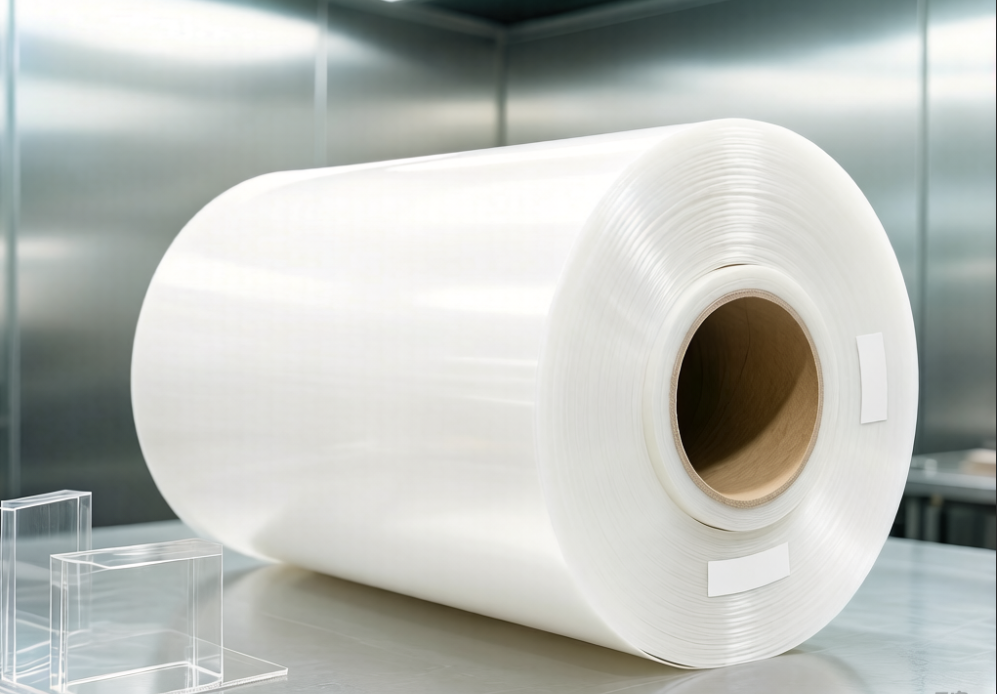
SD560 TPU film. Published values include 90% light transmittance, 0.3% haze and a -72°C glass transition.
Frequently asked questions
What equipment does SD560 TPU film require for lamination?
SD560 requires an autoclave as supporting equipment and is designed for high pressure and high temperature processing. The film must also be kept dry before use, so humidity-controlled storage is part of the operating requirement rather than an optional precaution.
Why does a -72°C glass transition matter for ballistic glass in cold climates?
Glass transition marks the point at which a polymer moves from a flexible, rubbery state into a stiff, glassy one, and below that point the film's contribution to stress distribution inside a laminate changes. SD560's transition is stated at -72°C, compared with approximately -40°C for Huntsman 399 in this comparison, so SD560 remains in its flexible regime at lower service temperatures. The figure is a material property, not a ballistic rating; panel performance is established by testing the finished laminate at the required threat level and temperature.
Can SD560 be customized for large ballistic-glass programs?
Yes. Shengding offers OEM/ODM arrangements with customization on length and width, supported by a stated R&D resource of 10 factory engineers and 5 professors at a Beijing R&D center, and a product range of more than 30 TPU types with hardness from 60A to 70D. The minimum order quantity is 50 kg, which allows a lamination trial to be run on production film before a full program commitment.
What capacity and lead time are stated for SD560 orders?
Stated capacity is 100 tonnes per month with a 10-day lead time, supported by 100% testing, ISO 9001:2015 quality management certification, and product compliance with REACH, RoHS and U.S. FDA quality requirements. Buyers should confirm whether the 10-day lead time applies to custom width orders as well as standard widths.
How does SD560 compare with Huntsman 399 on cost?
The comparison value supplied for this assessment places SD560 approximately 10% below Huntsman 399. That is a unit-price position rather than a total cost of ownership figure; landed cost per finished panel depends additionally on the pricing basis, lamination yield and the inventory carried against each supplier's lead time and minimum order quantity.
Company brochure (PDF, public download): Shengding Hightech Materials product brochure.
Tem questões ou precisa de mais detalhes?
Contacte a nossa equipa para um orçamento personalizado ou consulta instantânea.
Solicitar orçamento
Preencha o formulário abaixo e a nossa equipa entrará em contacto com uma proposta personalizada.
Chat direto do WhatsApp
Prefere conversar em tempo real? Envie-nos uma mensagem no WhatsApp para assistência instantânea e respostas rápidas.
- Obter orçamento personalizado
- Partilhar fotos ou documentos
- Discuta as suas necessidades diretamente
Geralmente responde em 5–30 minutos durante o horário de expediente.