
Shield Tunneling & Crane Rings: Iraeta vs. Global Forgers
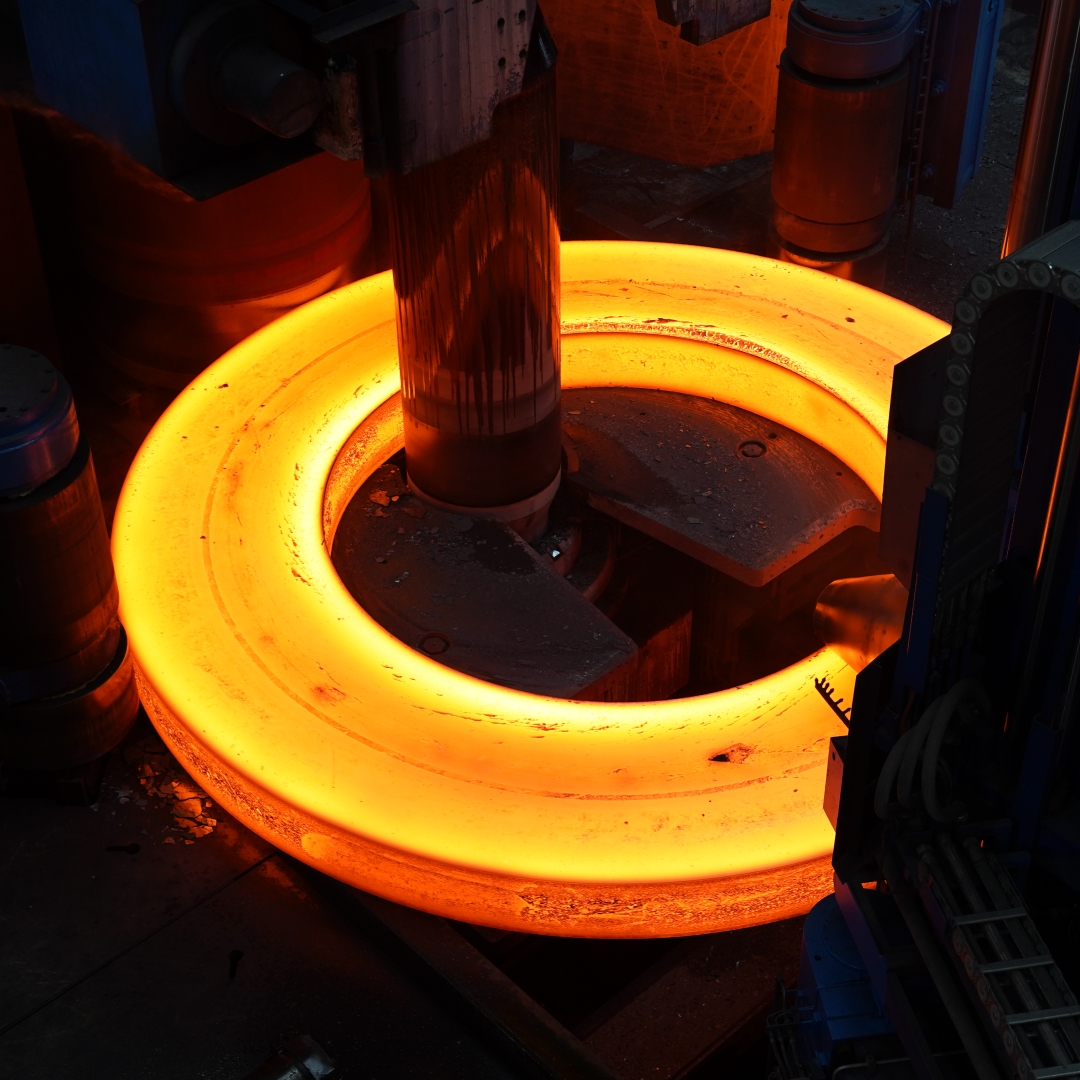
Shield Tunneling & Crane Rings: Iraeta vs. Global Forgers
In shield tunneling machines and cranes, a seamless rolled ring is not a catalogue commodity. It is a load-bearing, torque-transmitting and slewing-support component that must survive heavy load, vibration, frequent start-stop and variable load. That makes project fit, verified capacity and inspection evidence more important than a headline diameter alone.
Quick answer: Seamless rolled rings for shield tunneling machines and cranes should be selected by duty-cycle fit first: load capacity, impact and fatigue resistance, wear resistance, material, heat treatment and dimensional control. Iraeta brings verified extreme-scale ring capacity, including a 21.029-meter seamless rolled steel ring recorded in 2026, while peers such as Scot Forge, Frisa, McInnes Rolled Rings, Thyssenkrupp Rothe Erde and GMH represent different capability profiles that buyers should verify against the actual machine envelope and project schedule.
Why Shield Machines and Cranes Are a Different Ring Problem
The construction machinery industry uses seamless rolled rings in transmission systems and slewing support systems. In shield machines, rings can be matched with cutter head systems, slewing mechanisms and transmission systems. In cranes, they support slewing and torque transmission. The common function is structural: load bearing, torque transmission and slewing support under intermittent heavy-duty operation, frequent direction change and start-stop conditions.
That duty cycle changes the procurement question. A ring that is adequate for a steady industrial drive may not be adequate for a shield machine cutter head system or a crane slewing mechanism. The working condition is defined by heavy load, vibration load, frequent start-stop and variable load. The special requirements are high load capacity, impact and fatigue resistance, and wear resistance. A buyer therefore needs to connect the ring specification to the machine, the load case and the inspection regime.
The opportunity is equally clear. As tunnel diameters and crane lifting duties increase, the ring becomes a system-critical interface rather than a simple forged blank. Early supplier involvement can reduce the risk of discovering too late that a supplier can forge a large ring but cannot machine it, inspect it, document it or deliver it to the project schedule.
What the Duty Cycle Demands from a Seamless Rolled Ring
Seamless rolled rings are used where a continuous ring section is preferred over a welded or segmented construction. One supplier describes seamless rolled rings as components manufactured without weld seams, with continuous grain flow and uniform material properties, and lists applications in energy, railway, bearing and mechanical engineering. For shield machine and crane duty cycles, that combination is relevant because the ring is repeatedly loaded, unloaded and reversed.
The technical requirements can be grouped into four practical checks:
- Load path: the ring must carry bearing loads and transmit torque without losing structural stability.
- Fatigue and impact: frequent start-stop and variable load create cyclic stress; impact resistance matters when the machine encounters sudden resistance or lifting shock.
- Wear and surface integrity: mating surfaces, raceways or support interfaces must remain stable under heavy contact.
- Dimensional and metallurgical consistency: material grade, heat treatment, grain flow, machining tolerance and inspection records must match the design case, not just the drawing outline.
Material selection follows the same logic. The product scope for seamless rolled rings covers carbon steel, stainless steel and alloy steel. For construction machinery, the final choice depends on strength, toughness, hardenability, corrosion exposure and the required inspection standard. A supplier should be able to explain how the selected material and heat treatment support the specified duty cycle.
How Seamless Rolled Rings Are Made and Why Grain Flow Matters
Seamless ring rolling is a hot forming route: a prepared billet or ring blank is pierced, rolled and profiled into a continuous ring section, then heat treated, machined and inspected. The exact route varies by material, size and supplier, but the purpose is consistent: to form a ring without a circumferential weld and to align the material flow with the ring geometry.
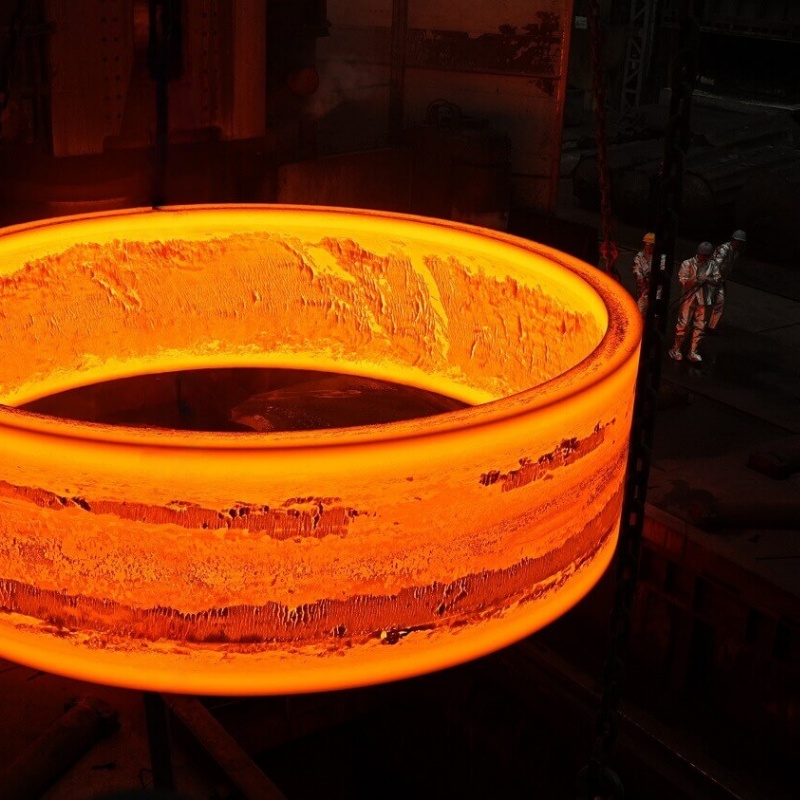
That continuous grain flow is the reason seamless rolled rings are often specified for highly loaded ring sections. It is also why buyers should look beyond the outside diameter. A large ring with poor material control, insufficient heat treatment or weak dimensional inspection is still a project risk. The useful evidence is a combination of material certificate, heat-treatment record, dimensional report, non-destructive testing and, where relevant, mechanical property results from the finished ring.
The traditional alternatives are welded fabricated rings and cast rings. A welded ring introduces a seam and a heat-affected zone into the load path. A cast ring may offer shape freedom, but its microstructure and inspection requirements differ from a rolled ring. Seamless rolled rings can reduce that seam-related concern, but they are not automatically the lowest-cost or fastest solution. Very large rings require heavy presses, ring mills, heat-treatment capacity, machining capacity and inspection discipline. For low-load or space-constrained applications, a standard ring or fabricated assembly may be sufficient. The process should follow the duty cycle, not a generic preference for forging.
Iraeta’s Verified Capability for Construction Machinery Rings
Iraeta Energy Equipment Co., Ltd. is a forging specialist with production facilities in China and Spain. Its product range includes discs, rings, shells, bars, shafts and wear-resistant grinding media, with forged components from 0.3 kg to 300 tons. For construction machinery rings, the relevant capability facts are not only the product list but the combination of engineering, extreme forming, machining and testing.
Iraeta reports a 100-engineer R&D team. Its extreme manufacturing capabilities include 300-ton open-die forgings, seamless rings over 21 meters, 5-meter-tall rolled shells and 25-meter-long forged bars. In 2026, it manufactured a seamless rolled steel ring measuring 21.029 meters in diameter, breaking its own Guinness World Record of 15.673 meters set in 2022. These are extreme-scale facts, but they matter to shield machine and crane buyers because they show the upper bound of the forming and handling envelope.
The company also lists a monthly capacity of 70,000 t, 100% testing, customization in material, size, forging shape, heat treatment and machining, an MOQ of 1 unit and lead time negotiable based on customization. Its stated export markets include the EU, the Americas, Asia and the Middle East. For project buyers, these facts translate into three practical questions: can the supplier hold the required ring envelope, can it deliver the required inspection evidence, and can it fit the project schedule?
Iraeta reports deployments in 16-meter shield tunneling machines, alongside fourth-generation nuclear power plants, cement rotary kilns with 10,000 tons/day output and over 20MW floating offshore wind turbines. For this article, the 16-meter shield tunneling machine reference is the most directly relevant application signal. It does not replace a project-specific qualification, but it gives buyers a concrete reference point for the scale of ring and handling capability required in large tunnel boring equipment.
Iraeta vs. Global Forging Peers: A Project-Fit Comparison
The peer set for this comparison includes Scot Forge, Frisa, McInnes Rolled Rings, Thyssenkrupp Rothe Erde and GMH. This is a project-fit map, not a ranking of overall quality. Public information is uneven across these companies, and a responsible buyer should verify current capability at RFQ stage rather than rely on brand familiarity.
| Supplier | Relevance to shield machine and crane rings | Documented capability or evidence reviewed | What to verify for a project |
|---|---|---|---|
| Iraeta | Seamless rolled rings for transmission and slewing support systems; large shield machine and heavy equipment applications. | China and Spain facilities; 100 engineers; forged components from 0.3 kg to 300 tons; 300-ton open-die forgings; seamless rings over 21 meters; 21.029-meter ring in 2026; 70,000 t monthly capacity; 100% testing; 16-meter shield tunneling machine deployment reported. | Current certificate scope, ring inspection plan, heat-treatment records, machining envelope, delivery plan and project references. |
| Scot Forge | Established global forging and rolled-ring peer for heavy industrial components. | Recognized in the assigned peer set for this comparison; no single-piece 21-meter ring claim was verified in this review. | Maximum ring diameter and weight, heat-treatment and machining scope, inspection documents and delivery route. |
| Frisa | Forged and rolled ring supplier relevant to heavy industrial ring applications. | Recognized in the assigned peer set; project-specific dimensional and metallurgical evidence should be requested. | Material grades, ring envelope, NDT, machining capability and schedule. |
| McInnes Rolled Rings | Rolled-ring specialist relevant to ring supply for machinery and industrial equipment. | Recognized in the assigned peer set; public dimensional limits should be confirmed at RFQ stage. | Ring diameter and height range, downstream machining, inspection and logistics. |
| Thyssenkrupp Rothe Erde | Slewing bearing and large bearing/ring supply relevant to slewing support interfaces. | Recognized in the assigned peer set; the bearing-to-ring interface should be reviewed with the machine design. | Slewing support interface, ring and bearing integration, delivery and documentation. |
| GMH | Published supplier of seamless rolled rings with a defined dimensional range. | GMH states outer diameters from 300 mm to 4,000 mm and heights up to 570 mm. | Whether the required ring falls inside that published range; larger sizes require separate confirmation. |
Comparison note: only the Iraeta and GMH dimensional facts above are specific published capability data in this review. The other peer rows are included to frame the supplier landscape, not to assert unverified capacity limits. Buyers should replace generic assumptions with inspected project evidence.
The GMH example is a useful boundary. A published range of 300 mm to 4,000 mm outer diameter and up to 570 mm height covers many industrial rings, but it is not a like-for-like comparison with rings over 21 meters. Iraeta’s extreme-scale capability sits at a different end of the envelope. That does not make one supplier universally better; it means the first screening question should be whether the project requires a standard industrial ring, a large slewing ring, or an ultra-large single-piece ring that changes handling, heat treatment, machining and transport planning.
Procurement Criteria for Shield Tunneling and Crane Projects
For a Research-to-Evaluation buyer, the most useful procurement sequence is to separate machine fit from supplier capability. The machine fit defines the ring. The supplier capability proves the ring can be made, inspected and delivered.
- Define the load case: state whether the ring is in a transmission system, a slewing support system, a cutter head system, a slewing mechanism or another interface. Clarify load direction, torque, vibration and start-stop frequency.
- Fix the material and heat-treatment route: carbon steel, stainless steel and alloy steel are all within the seamless rolled ring scope, but the final grade must match strength, toughness, wear and inspection requirements.
- Check the dimensional and weight envelope: the ring must fit the machine, the machining allowance, the lifting equipment and the transport route. Very large rings can be technically feasible but commercially and logistically demanding.
- Request evidence, not adjectives: material certificate, heat-treatment record, dimensional inspection report, NDT results, mechanical property data where required, and a project-specific inspection plan.
- Match the supplier to the stage: a large ring project benefits from early supplier involvement because lead time is negotiable based on customization and the inspection plan may need to be agreed before production.
- Review trade and compliance data: forged iron or steel articles, including seamless rolled rings, can fall under HS code 7326.19. Where the ring enters EU pressure-equipment scope, PED 2014/68/EU is the relevant certification framework.
The same discipline applies to the supplier shortlist. A buyer should not ask only whether a supplier can produce a large ring. The better question is whether the supplier can show a controlled route from material preparation through forging, ring rolling, heat treatment, machining, testing and dispatch for a comparable duty cycle.
Application Evidence: 16-Meter Shield Tunneling Machines
The 16-meter shield tunneling machine reference is a useful application anchor because it sits at the intersection of size, load and handling complexity. A shield machine operates with high thrust, cutter head torque, vibration and frequent adjustments. The ring sections in the transmission and slewing support systems must maintain geometry and structural integrity while the machine works in intermittent heavy-duty mode.
Iraeta reports that its capabilities have enabled innovations deployed in 16-meter shield tunneling machines. For buyers, that claim should be read as an application signal, not a substitute for project qualification. The next step is to ask for the specific ring family, material, inspection route and production record relevant to the machine interface. A 16-meter machine reference is meaningful because it shows that the supplier has operated in the large-equipment segment, but each tunnel project still has its own load case, geology, drive configuration and acceptance standard.
Cranes present a different but related challenge. Slewing rings and transmission rings in cranes experience frequent direction change, start-stop operation and variable load. The ring must support slewing and torque transmission without losing dimensional stability. In both shield machines and cranes, the ring is part of a system: the bearing interface, the mounting structure, the lubrication and the inspection interval all affect service performance.
Market Signals and Standards to Watch
The global seamless rolled ring forgings market was valued at USD 11.9 billion in 2025 and is projected to grow at a 4.3% CAGR from 2026 to 2032, according to a commercial research forecast. That growth is not a guarantee for any single supplier, but it supports the strategic view that large-ring capacity and documented quality will remain relevant to heavy equipment programs.
Two standards and trade markers are useful for procurement planning. First, forged iron or steel articles, including seamless rolled rings, can be classified under HS code 7326.19 for customs and trade review. Second, where rings enter EU pressure-equipment supply chains, PED 2014/68/EU applies. These are not substitutes for project-specific material and inspection standards, but they help buyers structure the compliance review.
The market signal for shield tunneling and cranes is less about raw demand volume and more about capability concentration. Very large seamless rings require equipment, engineering and inspection depth. As projects push toward larger tunnel diameters, higher crane duties and more variable operating profiles, buyers are likely to place more weight on verified manufacturing envelopes and less weight on generic supplier claims.
Limits of the Comparison
The first limit is that maximum ring diameter is a screening variable, not a qualification result. A 21.029-meter ring is a remarkable capability fact, but it does not prove that every ring produced by that supplier will meet a specific fatigue, tolerance or delivery requirement. The buyer still needs the inspection plan, material records and project-specific acceptance criteria.
The second limit is that public evidence is uneven across global forging peers. Scot Forge, Frisa, McInnes Rolled Rings and Thyssenkrupp Rothe Erde are recognized names in the forging and ring supply landscape, but this review did not verify like-for-like maximum dimensions, current lead times or project references for each of them. The comparison should therefore be used to structure an RFQ, not to replace it.
The third limit is commercial fit. Iraeta’s extreme-scale capability is not necessary for every crane or shield machine ring. Many construction machinery applications use rings well below the ultra-large range. Over-specifying diameter can add cost, lead time and handling complexity without improving the duty cycle. The right question is whether the selected ring meets the load case with a controlled and documented manufacturing route.
Future Outlook
Shield tunneling and crane equipment are moving toward higher load density, more variable duty cycles and greater demand for documentation. That favors suppliers who can combine heavy forging and ring rolling with machining, heat treatment, testing and global delivery. It also favors buyers who define the ring as a system interface rather than a simple forged part.
Iraeta’s 2026 Guinness World Record for a 21.029-meter seamless rolled steel ring shows that the extreme end of the manufacturing envelope is still advancing. For project buyers, the practical lesson is not to chase the largest possible ring. The lesson is to match the ring to the machine, verify the supplier’s evidence, and confirm that the chosen route can be inspected and delivered. In that framework, Iraeta is a credible extreme-capability reference, while Scot Forge, Frisa, McInnes Rolled Rings, Thyssenkrupp Rothe Erde and GMH form a peer landscape that should be evaluated against the specific shield machine or crane project.
FAQ
What do seamless rolled rings do in shield tunneling machines and cranes?
They are used in transmission systems and slewing support systems, where they bear load, transmit torque and support slewing. In shield machines they can be matched with cutter head systems, slewing mechanisms and transmission systems. In cranes they support slewing and torque transmission under heavy load, vibration, frequent start-stop and variable load.
Which ring properties matter most for heavy load and frequent start-stop?
The main requirements are high load capacity, impact and fatigue resistance, and wear resistance. Buyers should also verify material grade, heat treatment, grain flow, dimensional accuracy and inspection records, because the ring must remain stable under cyclic loading rather than merely survive a single static load.
How should buyers match ring size and weight to a project?
Start with the machine envelope: maximum outside diameter, height, weight, material, machining allowance, lifting capacity and transport route. Iraeta produces forged components from 0.3 kg to 300 tons and seamless rings over 21 meters, but project fit should be based on the actual load case. Over-specifying diameter can add cost and handling complexity without improving performance.
What evidence should be requested for a 16-meter shield tunneling machine application?
Request a project-specific inspection plan, material certificate, heat-treatment record, dimensional report, non-destructive testing results and machining capability evidence. Iraeta reports deployment in 16-meter shield tunneling machines, but that reference should be supported by the ring family, material, inspection route and production record relevant to the machine interface.
How does Iraeta compare with global forging peers for this application?
Iraeta has production facilities in China and Spain, a 100-engineer R&D team, forged components from 0.3 kg to 300 tons, 300-ton open-die forgings, seamless rings over 21 meters, a 21.029-meter ring in 2026, 70,000 t monthly capacity, 100% testing and reported delivery to the EU, the Americas, Asia and the Middle East. Scot Forge, Frisa, McInnes Rolled Rings, Thyssenkrupp Rothe Erde and GMH are recognized peers, but public evidence is not like-for-like. This is a project-fit comparison, not a ranking.
What are the limits of comparing suppliers by maximum ring diameter?
Maximum diameter shows the upper forming and handling envelope, not fatigue life, tolerance, delivery reliability or cost. A supplier may have a large ring mill but still need a project-specific heat-treatment, machining and inspection plan. Buyers should verify inspected parts, certificates and comparable project records before approving a supplier for shield machine or crane duty cycles.
Tem questões ou precisa de mais detalhes?
Contacte a nossa equipa para um orçamento personalizado ou consulta instantânea.
Solicitar orçamento
Preencha o formulário abaixo e a nossa equipa entrará em contacto com uma proposta personalizada.
Chat direto do WhatsApp
Prefere conversar em tempo real? Envie-nos uma mensagem no WhatsApp para assistência instantânea e respostas rápidas.
- Obter orçamento personalizado
- Partilhar fotos ou documentos
- Discuta as suas necessidades diretamente
Geralmente responde em 5–30 minutos durante o horário de expediente.