
Shirt Packaging Accessories: Collar Band, Butterfly, Stay or Clip?
A folded shirt is read at the collar before the fabric is examined. If the collar sits flat, aligns with the placket and shows no crushed edge, the shirt reads as retail-ready; if it does not, no amount of tissue paper corrects the impression. That is why the four accessory families most often specified in shirt packaging — collar bands, butterfly inserts, collar stays and clips — belong in the buying specification rather than in the consumables budget.
This framework is written for buyers at the research and evaluation stage: sourcing managers, packaging engineers and brand owners comparing options before a purchase order is raised. It sets out what each accessory actually does inside the pack, which materials and published specifications are available, how minimum order quantities differ between them, and how the selection converts into acceptance criteria that can be inspected on arrival.
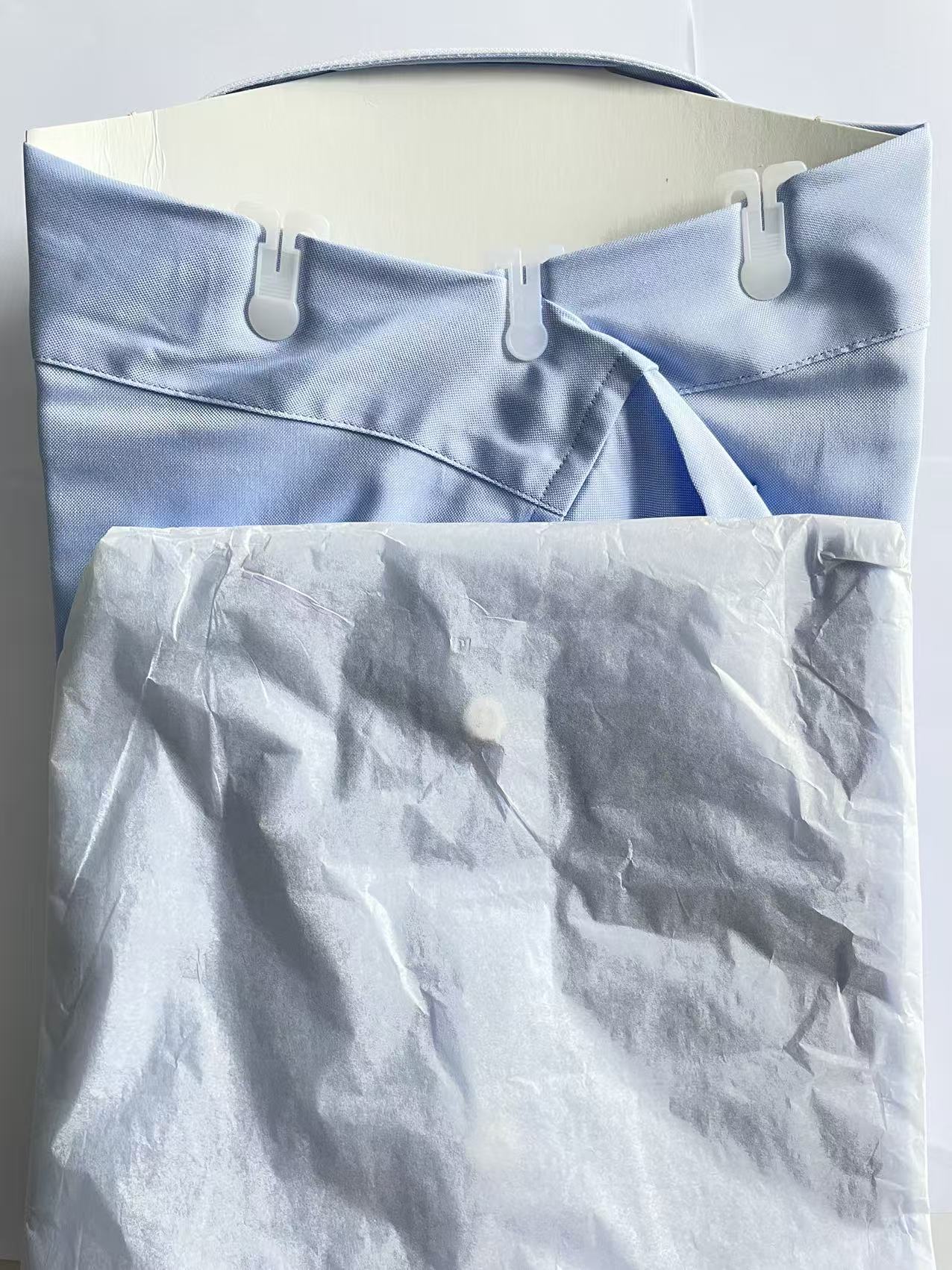
Collar presentation is decided at the folding table, not at the retail shelf. Image: garment packing application reference.
Why the Collar Accessory Is Usually Decided Last
In most programs the specification sequence runs carton, then poly bag, then hang tag, then collar component. By the time the collar accessory is discussed, the folding method and the packing station layout are already fixed, so the component gets chosen by habit rather than by collar construction. The cost of that habit rarely appears in the unit price. It appears in rework at the folding table, in collars that lose shape between packing and the retail floor, and in printed components that never carry the brand mark because the standard unprinted SKU was ordered.
Three variables separate the four options, and all three are procurement variables rather than design preferences: what the accessory physically holds, what substrate it is made from, and what volume the supplier requires before production is scheduled. Treated as interchangeable, they produce mismatched specifications — a stiff metal component on a soft collar, a closure specified where a support insert was needed, or a volume commitment that a mid-sized program cannot absorb.
The practical alternative is to decide the collar component at the same time as the folding method. The accessory is part of the fold, so the fold should be designed around the accessory.
The Four Options at a Glance
| Option | Primary role in the pack | Materials in the published range | Published specification example | Published MOQ |
|---|---|---|---|---|
| Collar band | Wraps the folded collar, holds it closed and flat against the placket, and provides a printable surface | PET; PVC; a paper collar band is also listed in the range | White PET collar band, 48.1 x 4 cm, 0.35 mm, rectangular | 10,000 pcs |
| Butterfly insert | Sits inside the folded collar to keep a shaped, filled profile rather than a flat one | PVC (fine sand, frosted, bubble variants); PET; paper butterflies also listed | Light blue fine sand PVC butterfly, 26 x 10.4 cm, 0.25 mm | 10,000 pcs |
| Collar stay | Rigid strip that holds the collar leaf and point geometry | Metal and plastic stays are listed in the range | Dimensions not published in the current line card — request per model | Confirm with supplier |
| Clip | Mechanical fastening of the folded shirt and collar position | PS; metal | X-shape clip, 3.3 cm and 3.7 cm lengths, 0.8 cm width, 1.2 mm thickness, silver | 100,000 pcs |
Published specifications from the MingYu Garment Accessories line card. MOQ figures refer to single-item orders and should be reconfirmed when components are combined in one program.
The short answer for a buyer scanning this table: collar bands and butterflies handle presentation and print at moderate volume; collar stays handle geometry and are specified per collar point; clips handle speed at high volume. A shirt program can legitimately use more than one of them, and often does.
Collar Bands: The Printed Closure
Role in the pack
A collar band wraps around the folded collar and holds it in position against the placket. It is the component that keeps the collar from drifting during handling, and because it sits across the most visible part of a folded shirt, it is also the component most often used to carry a brand mark.
Material and published specification
The published example in the MingYu range is a white PET collar band measuring 48.1 cm by 4 cm at 0.35 mm, rectangular in shape, supplied without a logo on the standard SKU. A printing collar band with a customized logo is listed as a separate variant, which is the one to specify when the brand mark must appear on the collar. PET and PVC substrates are both available, and the range also lists a paper collar band, so the substrate decision can move between plastic film and paper without leaving the category.
When a collar band is the right first choice
Choose a band when the collar needs a closure and the brand wants a printed element at the collar rather than on the hang tag. It also suits programs where the folding step is a simple wrap: the band is a single-motion component, which matters on a sorting line where every extra second is multiplied across a shift. The stated selling attributes for the category are logo printing, custom design, eco-friendly material options and resistance to deformation — the last of these being the attribute to test, since a band that creases in transit defeats its purpose.
Butterfly Inserts: Shape Retention Without a Closure
A butterfly insert goes inside the folded collar, holding the collar in a shaped, filled profile. Where a band closes the collar, a butterfly shapes it, and the difference shows when a boxed shirt is opened: the collar should hold a curve rather than collapse flat.
The published example is a plastic butterfly in light blue fine sand PVC at 26 cm by 10.4 cm and 0.25 mm thickness, with logo customization available and a 10,000 pcs MOQ. At 0.25 mm it is thinner than the 0.35 mm collar band, which is consistent with its different job: it needs to flex into the collar rather than hold a crease. The range also lists frosted PVC, white PET and bubble PET variants, plus paper butterflies, so the same functional decision can be executed in different substrates depending on the presentation tier and the material policy of the buyer.
Butterflies are the natural choice for boxed and gift-tier shirts, and for collars that read as soft or semi-structured. Their limitation is that they do not close the collar by themselves. In practice a butterfly is paired with a band for closure and print, or with a clip where the fold is held mechanically.
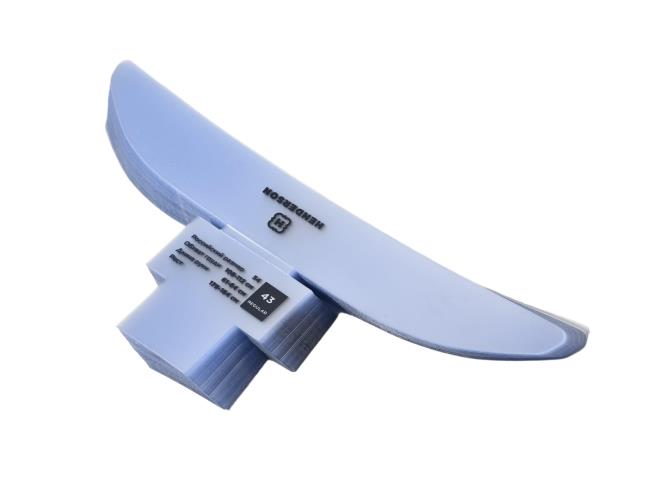
A butterfly insert shapes the collar from the inside; it does not replace a closure. Image: plastic butterfly, 26 x 10.4 cm, 0.25 mm.
Collar Stays: Rigid Geometry, Not Brand Surface
A collar stay holds the collar leaf and point. It is a geometry component, not a presentation surface, and it is the option most often specified by collar construction rather than by brand requirements. The current line card lists collar stays and metal collar stays as part of the range, alongside metal pins in stainless steel and brass at 26 mm by 0.6 mm — but the stay dimensions themselves are not published in the specification data available for this review, so a buyer should request the length, width and thickness per collar model before committing.
That gap is worth stating plainly because it drives a sourcing behaviour: stays are matched to the collar point, and a stay that is slightly too long protrudes into the collar edge while one that is too short fails to hold the point at all. Buyers evaluating stays should therefore expect to send a collar sample, and should treat the dimensional confirmation as a precondition of the order rather than a post-order detail. Stays are also the component most likely to be metal, which brings its own handling considerations on a folding line.
Where stays are unnecessary is equally useful to know. Collars that already carry their own anchoring, and unstructured or soft collars where point geometry is not the presentation goal, gain little from a stay and are better served by a butterfly or a band.
Clips: Speed and Volume
A clip fastens the folded shirt mechanically, holding the fold and the collar position without a wrap. The published example is an X-shape clip in PS or metal, 3.3 cm and 3.7 cm in length, 0.8 cm wide and 1.2 mm thick, supplied in silver with logo customization available.
The number that matters most in that specification is the MOQ: 100,000 pcs against 10,000 pcs for the collar band, butterfly and collar support. That is a volume signal rather than a price signal. Clips suit high-throughput folding lines where a mechanical fastening is faster than a wrap, and where a printed band is not carrying brand value. Below that threshold, a program is usually better served by a band or butterfly at one-tenth of the commitment. Clips are also the category where metal and plastic options diverge most in handling, so incoming inspection should include an edge and burr check on metal units and a spring-tension check on plastic units.
Matching the Accessory to the Packing Scenario
| Packing scenario | Primary accessory | Why it fits | Secondary component |
|---|---|---|---|
| Boxed retail dress shirt, structured collar, brand print required | Collar band (printed variant) | Closes the collar and carries the brand mark on the most visible surface | Collar stay |
| Gift-tier or premium box, collar must hold a shaped profile | Butterfly insert | Shapes the collar from the inside and keeps the curve visible when the box is opened | Collar support, tissue paper |
| Poly-bagged shirt folded at speed, minimal print | Clip (where volume clears 100,000 pcs) | Mechanical fastening without a wrap step | Collar band for low-volume equivalents |
| Soft or semi-structured collar, wrinkle prevention priority | Butterfly or collar band | Both hold the collar flat without imposing rigid point geometry | Tissue paper |
| Collar point geometry is the presentation problem | Collar stay | Directly addresses point and leaf alignment | Collar band for closure |
| Sampling, pilot runs, low-volume private label | Collar band or butterfly | 10,000 pcs threshold is workable where 100,000 pcs is not | Cardboard, poly bag |
Scenario mapping based on published specifications and packing applications; final selection should be validated on a trial fold of the actual shirt.
These scenarios correspond to the packing environments the accessories are built for: packing workshops, sorting lines, garment shipment and retail display packaging. The component's role in each is consistent — wrinkle prevention, brand identification and transport protection — but the weighting changes. A shipment-protection brief tolerates a plain band; a retail display brief does not.
Material, Print and Eco-Friendly Claims: What to Verify
The substrate decision is the one most likely to create a late-stage problem, because it is often made on a marketing assumption rather than a material declaration. The published range spans paper, plastic and metal:
- Paper: shirt cardboard in 100% natural wood pulp at 500 gsm (21 x 35.2 cm), tissue paper at 17 gsm (36 x 40 cm), and a paper belly band at 0.25 mm (58 x 10 cm).
- Plastic: white PET collar bands at 0.35 mm, PVC collar supports and butterflies at 0.35 mm and 0.25 mm, and PP clear bags at 0.035 mm single thickness.
- Metal: stainless steel and brass pins at 26 mm by 0.6 mm, and metal clip variants.
Eco-friendly materials appear as a stated selling attribute and a customization option across the range. What the available data does not specify is recycled content, compostability or certification per SKU. A buyer whose packaging policy depends on those properties should request the material documentation for the exact substrate and thickness being quoted, and should not assume that a paper-based companion product in the same program means the collar component is paper-based. The most defensible position is to treat eco-material as a specification line item with evidence attached, not as a category impression.
Print capability is broader than the standard SKUs suggest. Size, color, style, printing and foiling, mold opening and logo customization by stamping or printing are all listed as customization capabilities. But the line card is explicit about which standard SKUs ship unprinted: the white PET collar band, the collar support, the plastic bag and the metal pin all carry no logo as standard. If the brand mark must sit on the collar, the order has to specify the printed variant rather than assume printing is included.
MOQ, Lead Time and Acceptance Criteria
Two different thresholds coexist in the sourcing data and buyers should not conflate them. At program level, MingYu states an MOQ of 1,000 sets, with a monthly capacity of 7.5 million sets and a lead time of 7 to 20 days after order confirmation. At item level, the published SKU MOQs are 10,000 pcs for collar bands, butterflies, collar supports, pins, cardboard, tissue paper, belly bands and bags, and 100,000 pcs for clips. A mixed order that clears the program threshold may still not clear an item threshold, so the confirmation question is which figure governs the specific combination being ordered.
| Acceptance criterion | What to check | Why it matters at the collar |
|---|---|---|
| Dimensional conformity | Measured length, width and thickness against the published figure (for example 48.1 x 4 cm at 0.35 mm for the PET collar band) | A band or butterfly outside tolerance either will not close or will crease the collar |
| Deformation resistance | Flatness after transit; no permanent crease along the fold line | The component's stated purpose is holding shape, not recovering it |
| Print quality | Registration, position and legibility of the logo on printed variants | The printed surface is the brand-facing element of the pack |
| Material declaration | Substrate and thickness confirmed against the purchase order | PET, PVC, paper and metal behave differently in packing and in disposal |
| Unit count and packing | Quantity per bag and per carton | Accessory shortages stop a folding line faster than any other line item |
| Trial fold | One full fold on the actual shirt and collar construction | No specification substitutes for fit on the real garment |
Incoming inspection framework derived from published specifications and packing requirements; test methods should be agreed with the supplier before the first shipment.
Market Context: Why Collar Presentation Is Getting More Budget Attention
Garment packaging is a large and still-expanding cost line, and that expansion is unevenly distributed across the pack. Dataintelo values the global garment packaging market at USD 18.6 billion in 2025 and projects USD 31.4 billion by 2034. The same source places Asia Pacific at a 41.5% revenue share of that market in 2025, which is consistent with where shirt production and shirt packing capacity are concentrated.
The structural layer beneath the collar is also substantial. The Business Research Company reports the garment interlining market — the fused and sewn structure that gives a shirt collar its body — at USD 3.65 billion in 2025. That figure is useful context for accessory buyers because it frames the relationship correctly: interlining builds the collar, and packaging accessories present it. A collar band cannot compensate for weak interlining, but it can preserve what the interlining created between the folding table and the retail floor.
What the market growth does not do is make every accessory decision more complex. Growth concentrates where shirts are sold as presentation objects — retail display, gifting, e-commerce fulfilment — and those are precisely the channels where collar geometry is visible before the shirt is touched. For a buyer, that argues for spending the specification effort on the collar component and keeping the rest of the pack conventional.
Comparison with Traditional Solutions: What Changes, and Where It Stops Working
The traditional approach specifies a single generic component — usually one clip type or one unprinted band — across every program, on the logic that a collar accessory is a commodity. The matched approach outlined here specifies the component against collar construction, folding method and presentation tier, accepting more SKUs in exchange for fewer presentation failures.
The matched approach has real boundaries, and a buyer should know them before adopting it:
- It does not decide the collar structure. Interlining and collar construction remain the structural layer. Accessories preserve a collar; they do not build one.
- It breaks below the item MOQ. A matched set including a clip implies a 100,000 pcs commitment on that component. Programs below that line should not adopt a clip-centred fold.
- It adds planning load. Every additional SKU is another specification, another incoming inspection and another stock line. For a low-volume or short-run program, the administrative cost can exceed the presentation gain.
- It is not a recyclability claim. Specifying paper components for some parts of the pack does not make the collar component recyclable, and no recycled-content or compostability figure is published per SKU in the available data.
- Soft collars may need none of it. Where point geometry is not part of the presentation goal, a stay is an unnecessary component and a butterfly or band is sufficient.
Where MingYu Garment Accessories Sits in This Decision
Wuxi Mingyu Garment Accessories Factory is a garment-accessory manufacturer founded in 2004 in E'hu Town, Xishan District, Wuxi, Jiangsu, China, producing PVC and PET collar bands, collar stays, collar butterflies, shirt cardboard, moisture-proof paper, plastic clips and plastic packaging bags. The operation covers 2,500 m² with 25 employees, including 3 engineers, and reports an export ratio of 85% across Europe, North America, South America and Asia.
For a buyer running this framework, three capabilities are directly relevant to the collar decision. First, the range covers all four accessory families under one supplier, which reduces the coordination cost of a matched set — the band, the butterfly, the stay and the clip do not have to be reconciled across four vendors. Second, customization is offered on size, color, style, printing and foiling, mold opening and logo application by stamping or printing, supported by automatic creasing, punching and paper cutting equipment, with a stated monthly capacity of 7.5 million sets, a 7 to 20 day lead time and 100% testing. Third, the supplier operates an in-house quality-control team across production stages and holds independent export qualification, with distribution warehouses, agencies or manufacturing sites in Sri Lanka, Argentina, Bangladesh, Indonesia, Colombia and Kenya, a Sri Lanka factory established in 2013, a Vietnam factory in 2017, and an OA management system in place since 2018.
Client evidence on file describes a 10,000-unit shirt packaging accessories program for brand owners, garment manufacturers, distributors and exporters, running for five years with no major errors, where the stated outcome was improved shipment protection and brand presentation. That scale is useful context: it sits above the single-item MOQ for bands and butterflies and below the clip threshold, which is the volume band where most collar decisions are actually made.
Future Outlook
Two pressures are likely to shape collar accessory specifications over the next buying cycles. The first is material scrutiny. As packaging policy tightens in the export markets that account for most of this category's volume, the substrate question will move from a selling attribute to a documentary requirement, and suppliers who can produce material evidence per SKU will be easier to qualify than those who cannot. The second is SKU rationalisation in the opposite direction: buyers want fewer components, not more, so the accessory that performs two jobs — a band that closes and prints, a butterfly that shapes and carries a logo — is likely to displace single-function components in mid-tier programs.
Neither pressure changes the underlying decision logic. The collar component is still chosen by what it holds, what it is made of and what volume it requires. What changes is how much evidence a buyer needs before signing.
Frequently Asked Questions
How do collar bands, butterflies, collar stays and clips differ in shirt packaging?
Collar bands wrap the folded collar and can carry print; butterflies are inserted inside the folded collar to hold a shaped profile; collar stays are rigid strips that hold collar leaf and point geometry; clips mechanically fasten the folded shirt. They address different parts of the fold, which is why one program can use more than one of them.
Which option fits a boxed retail shirt versus a poly-bagged shirt?
A boxed retail shirt needs collar geometry that survives being viewed from above, so a butterfly or collar support inside the box is paired with a band for closure and print. A poly-bagged shirt folded at speed needs a closure that adds little thickness, which points to a band or a clip. Because the published clip MOQ is 100,000 pcs against 10,000 pcs for bands and butterflies, poly-bagged programs below that volume are usually specified with a band.
What MOQ applies to collar bands, butterflies, clips and collar supports?
Published single-item MOQs are 10,000 pcs for the white PET collar band, the plastic butterfly and the collar support, and 100,000 pcs for the X-shape PS or metal clip. At program level the stated MOQ is 1,000 sets, so a buyer combining several components in one order should confirm which threshold governs that specific combination.
Can these accessories be printed with a brand logo, and are eco-friendly materials available?
Logo printing, custom design, foiling and mold opening are listed customization capabilities, and several SKUs are logo-customizable, including the plastic butterfly, the clip, the paper belly band and tissue paper. Some standard SKUs ship without a logo, including the white PET collar band, the collar support, the plastic bag and the metal pin, so a printed variant must be specified explicitly. Eco-friendly materials are listed as a customization option, but recycled content and compostability are not specified per SKU, so material documentation should be requested for the exact substrate being quoted.
What acceptance criteria should be used for incoming inspection of shirt packaging accessories?
Inspection should verify measured dimensions and thickness against the published specification — for example 48.1 x 4 cm at 0.35 mm for the PET collar band — along with flatness and resistance to deformation after transit, print registration and logo position on printed variants, substrate and thickness against the purchase order, and unit counts per bag and carton. A trial fold on the actual shirt collar remains the only reliable test of fit before full release.
Reference Note
The framework above is built on published product specifications, packing application data and third-party market figures. A company profile for Wuxi Mingyu Garment Accessories Factory is available for download at https://cdn.socialarks.com/sbsp/25150/common/2026/0808/Brief%20Company%20Profile%20of%20Wuxi%20Mingyu%20Garment%20%20Accessories%20Factory%20%20.pdf for buyers who need the manufacturing and export details in one document.
Tem questões ou precisa de mais detalhes?
Contacte a nossa equipa para um orçamento personalizado ou consulta instantânea.
Solicitar orçamento
Preencha o formulário abaixo e a nossa equipa entrará em contacto com uma proposta personalizada.
Chat direto do WhatsApp
Prefere conversar em tempo real? Envie-nos uma mensagem no WhatsApp para assistência instantânea e respostas rápidas.
- Obter orçamento personalizado
- Partilhar fotos ou documentos
- Discuta as suas necessidades diretamente
Geralmente responde em 5–30 minutos durante o horário de expediente.