
Shirt Packing Scenario Fit: Clips, Pins, Stays, and Bands for Retail and Gift Presentation
Shirt Packing Scenario Fit: Clips, Pins, Stays, and Bands for Retail and Gift Presentation
Shirt packing accessories are usually bought as a parts list — clips, pins, stays, bands, butterflies, tags — but they are specified by presentation scenario. A shirt folded for a retail shelf and a shirt boxed as a gift use overlapping components in different combinations, and the difference changes three things a buyer has to plan for: which parts press against the fabric, which parts can carry the brand's print, and which order volumes the pack must reach before a component is even available.
This guide maps four core components — shirt clips, metal pins, collar stays and collar bands — plus the presentation layer of collar supports, butterflies, belly bands, cardboard, tissue paper and gift boxes, to the two scenarios that dominate commercial shirt packing: the retail fold and the gift-box presentation. Specifications quoted here are the published catalog values for each component. Where a value is not published, the article says so instead of filling the gap.

Why the scenario, not the parts list, decides the pack
Answer first: the scenario determines which components are load-bearing and which are ornamental. A retail fold has to stay flat through stacking, bagging and transport, so the pack is built around retention. A gift box has to survive the same journey but is judged in the first five seconds after the lid opens, so the pack is built around collar geometry and visible surfaces. The same factory, the same accessory family and often the same shirt can end up with two quite different bills of materials.
Three practical consequences follow for a buyer in the research and evaluation stage:
- Contact points. Retention parts touch the fabric directly, so their material and shape belong in the specification, not only in the packing-station instruction.
- Brand surface. Not every component accepts print. Catalog specs mark some parts as logo-customizable and others as no-logo, which decides where brand identity can actually sit inside the pack.
- Volume logic. Minimum order quantities differ sharply between components, so a scenario that depends on one part may only be economic at a much larger run size.
The rest of this article works through the components in the order a pack is usually assembled: retention first, collar structure second, outer presentation last.
Retail fold versus gift box: what actually changes
The two scenarios share a component vocabulary but not a component hierarchy. The table below sets out the differences that matter at the specification stage.
| Decision point | Retail fold | Gift-box presentation |
|---|---|---|
| Primary job | Keep the fold flat and closed through handling, bagging and transport | Hold the collar shape and present the shirt as an object |
| Collar treatment | Collar stay plus collar band | Collar support or butterfly plus a paper collar band |
| Body control | X-shape clip or metal pins | Metal pins plus belly band, cardboard or box fit |
| Brand surface | Printed clip, hang tag, size strip | Apparel tag, printed belly band, printed butterfly |
| Volume logic | Clip MOQ of 100,000 pcs suits long print runs | 10,000-pc MOQs on pins, supports, bands, tags |
| What to check first | Clip pressure at the fold line | Collar point support and visible packing scars |
The retail fold is not automatically the cheaper pack and the gift box is not automatically the premium one. Cost follows the component mix, the print requirement and the order volume, and the clip's 100,000-piece MOQ can outweigh the price advantage of a simpler part.
Clips: the load-bearing part of a retail fold
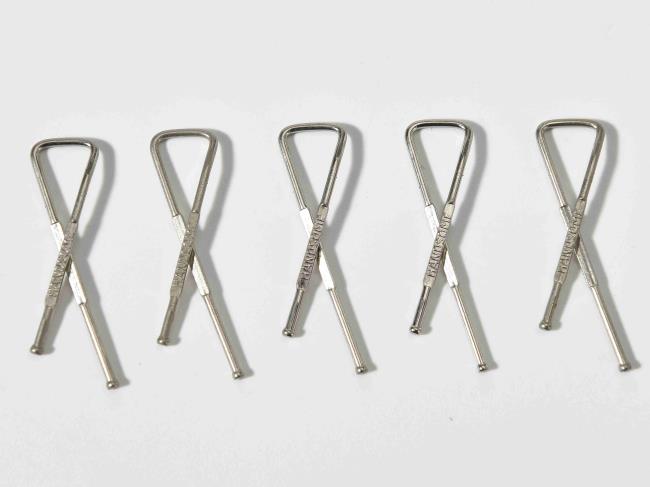
The shirt clip is the component most retail folds are built around, because it closes the folded body without piercing the fabric. The published catalog specification is specific: the clip is PS or metal depending on the version, formed in an X shape, finished in silver, 1.2 mm thick, 0.8 cm wide, and supplied in two lengths of 3.3 cm and 3.7 cm. The logo is customizable, and the MOQ is 100,000 pieces.
The type list shows how much variety sits behind that single specification. It covers metal clip, plastic clip, U-shaped plastic big clip, clear square plastic clip, alligator clip, plastic clip with teeth, square plastic clip and square plastic shirt back clip. For a buyer, these are not interchangeable options but different answers to the same question: how much grip the fold needs and how much of the clip the customer will see.
Two design decisions follow from the numbers. The 1.2 mm thickness is the material basis for the clip's spring behaviour, so a thinner substitute is a different component, not a saving. The two lengths, 3.3 cm and 3.7 cm, give the packing line a way to match clip size to folded thickness rather than forcing one size across a size curve.
The 100,000-piece MOQ is the practical constraint a buyer should notice early. Clips suit programs that will consume that volume across sizes and colourways; a small gift-box run usually cannot. That is why the gift-box scenario in this article leans on pins, bands and supports, all of which list 10,000-piece MOQs.
Metal pins: retention where a clip would show
The metal pin is the low-profile alternative. The catalog specification covers stainless steel or brass, a common size of 26 mm by 0.6 mm, thickness options of 0.6 mm and 0.65 mm, silver colour, rectangle style, no logo, and an MOQ of 10,000 pieces.
Because the pin is a straight rectangle rather than a clamping shape, it secures a fold by passing through the fabric and closing against itself. That makes it useful in two places where a clip is awkward: a tightly compressed gift-box fold, where the clip's 1.2 mm body would add a visible lump, and a retail fold where the pack must look as though nothing is holding it. The same mechanism is the limitation. Every pin creates a penetration point, so pin count and pin position belong in the packing instruction and in the quality check, and the buyer should confirm acceptable pin placement with the garment owner rather than leaving it to the line.
The absence of a logo option is also a specification fact, not an oversight to argue around. In a gift box, brand identity has to move to the tag, the belly band or the printed butterfly, all of which are listed as customizable.
Collar stays and collar supports: two different jobs at the collar
Collar stays and collar supports are often discussed as if they were alternatives. They are not. A collar stay is a narrow insert that keeps the collar points straight during packing and transit and is removed by the wearer; a collar support is a much larger panel that holds the folded collar and front area in shape. MingYu's line card lists collar stays in a standard version and a metal version, and the detailed dimensions for each stay must be taken from the current specification sheet, because a stay that does not match the collar point length will distort the very shape it is meant to protect.
The collar support specification is fully published and makes its role clear: light blue PVC, 22.7 cm by 18.5 cm, 0.35 mm thick, cuboid style, no logo, MOQ 10,000 pieces. At that size it is a body-level support rather than a point insert, which is why it appears in gift-box and premium retail packs where the folded front is visible the moment the lid is lifted.
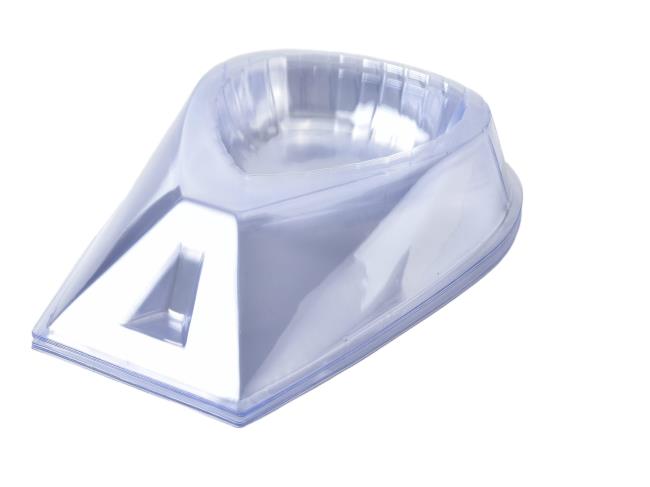
The fit boundary is worth stating plainly. A 0.35 mm PVC support is a shape-retention component, not a rigid board; where a pack needs a hard flat face, the cardboard and gift-box layer carries that job. Buyers evaluating the collar area should therefore separate the two questions — what keeps the collar points straight (stay) and what keeps the folded front flat (support, cardboard, box) — and specify them independently.
Collar bands: paper, plastic and the unboxing moment
The collar band wraps the folded collar and holds it closed, and the catalog offers two distinct constructions. The paper collar band is made from specialty tenacity paper, 47.2 cm by 3.8 cm, 1 mm thick, white, rectangular, with 1.4 cm by 15 holes, no logo, and an MOQ of 10,000 pieces. The general collar band entry covers PVC or paper at 50 cm by 3.4 cm and 0.50 mm thick.
The two entries are not duplicates. They differ in length by 2.8 cm, in thickness by 0.5 mm, and in material class, which means they fit different collars and different handling expectations. The perforated format of the paper band, with its 1.4 cm hole spacing across 15 holes, is what allows the band to be closed at a chosen position rather than a fixed one — a practical advantage when one band has to serve a collar size range.
Scenario fit follows from that. Where the band is removed in front of the customer, the paper version keeps the unboxing in one material family and matches the tissue paper and gift-box layer. Where the band must survive repeated handling in a retail environment or a long transit before display, the PVC version at 0.50 mm offers a more durable option at a similar length. Neither is intrinsically better; the choice belongs to the pack, not to the catalog.
One caution applies to both. A collar band only holds the collar if its length matches the folded collar circumference, and 47.2 cm and 50 cm are close enough that a buyer should confirm which one the collar pattern actually needs before committing to a 10,000-piece run.
Collar butterflies: an optional collar-shape component
Butterflies sit between the stay and the support in function. The paper butterfly is specified as 400 gsm single white paper, 15 cm by 3 cm, white, butterfly shape, logo customizable, MOQ 10,000 pieces, and is offered in paper collar butterfly, dog bone paper collar butterfly and paper big butterfly formats. The plastic butterfly is a different proposition: light blue fine-sand PVC, 26 cm by 10.4 cm, 0.25 mm, logo customizable, MOQ 10,000 pieces, with single, bubble and frosted variants named in the catalog.
In scenario terms, the paper butterfly belongs to the gift-box layer where the collar is dressed and the customer sees the fold; the larger PVC butterfly covers more of the collar area and suits packs that need a wider protective face. Both accept print, which makes them one of the few collar-area components that can carry brand identity in a box where the pin and the support cannot.
The gift-box layer: belly bands, tags, tissue and boxes
The outer layer is where the gift-box scenario diverges most from the retail fold. The paper belly band is specified as paper, 58 cm by 10 cm, 0.25 mm, colourful, rectangular, logo customizable, MOQ 10,000 pieces. The apparel tag is 100% natural wood pulp paper, 4 cm by 7 cm, 500 gsm, black, rectangular, logo customizable, MOQ 10,000 pieces. Tissue paper, exquisite gift boxes, cardboard, moisture-proof paper and PE clear bags complete the range and are listed as part of the accessory portfolio, though their individual specifications are not published in the same detail.
There is one honest boundary on the belly band. Its catalog usage note is written for pajama packing, so a shirt program should confirm the 58 cm band length against the folded shirt width rather than assuming the garment reference transfers unchanged. That is a specification check, not a defect: the band's dimensions and material are published, and only the garment fit needs confirming.
Read together, the layer answers a question the retention parts cannot: what the customer sees before the shirt. A printed tag at 500 gsm carries weight in the hand, a printed belly band wraps the fold, and the gift box or tissue paper provides the surface that makes the whole assembly read as deliberate rather than merely packed.
Component reference: verified specifications and fit
| Component | Published specification | MOQ | Logo | Scenario fit |
|---|---|---|---|---|
| Clip | PS or metal; X shape; silver; 1.2 mm thick; 3.3 cm or 3.7 cm × 0.8 cm | 100,000 pcs | Customizable | High-volume retail fold |
| Metal pin | Stainless steel or brass; 26 × 0.6 mm; 0.6 mm / 0.65 mm; silver; rectangle | 10,000 pcs | None | Retail fold and gift box, low profile |
| Collar support | Light blue PVC; 22.7 × 18.5 cm; 0.35 mm; cuboid | 10,000 pcs | None | Gift box, premium retail |
| Paper collar band | Specialty tenacity paper; 47.2 × 3.8 cm; 1 mm; 1.4 cm × 15 holes; white | 10,000 pcs | None | Gift box, unboxing |
| Collar band (PVC/paper) | 50 × 3.4 cm; 0.50 mm | Confirm with supplier | Customizable | Durable retail handling |
| Paper butterfly | 400 gsm single white paper; 15 × 3 cm; white | 10,000 pcs | Customizable | Gift box collar dressing |
| Plastic butterfly | Light blue fine-sand PVC; 26 × 10.4 cm; 0.25 mm | 10,000 pcs | Customizable | Wider collar protection |
| Belly band | Paper; 58 × 10 cm; 0.25 mm; colourful | 10,000 pcs | Customizable | Gift box wrap |
| Apparel tag | 100% natural wood pulp paper; 4 × 7 cm; 500 gsm; black | 10,000 pcs | Customizable | Retail and gift box |
| Collar stay | Standard and metal versions listed; dimensions per current spec sheet | Confirm with supplier | Confirm with supplier | Both scenarios |
What to verify before releasing a mixed-SKU order
A scenario-matched pack usually mixes components with different MOQs, materials and print permissions, so verification has to be component by component rather than order by order.
- Match length to geometry. Confirm the 3.3 cm or 3.7 cm clip against folded thickness, the 47.2 cm paper band or 50 cm PVC/paper band against collar circumference, and the collar stay against collar point length.
- Confirm nominal versus tolerance. Catalog thicknesses such as 1.2 mm, 0.35 mm, 0.25 mm, 0.50 mm and 0.6 mm are nominal values; the acceptable range should be agreed in writing before the run.
- Reconcile MOQ levels. Component MOQs are listed per SKU, from 10,000 pieces on pins, supports, bands, butterflies, belly bands and tags to 100,000 pieces on clips, while the supplier's capability summary states a 1,000-set minimum. A gift-box program should confirm which level governs its mix.
- Map print permissions. Clips, butterflies, belly bands and tags are listed as logo customizable; the metal pin, collar support and paper collar band are listed with no logo.
- Agree the garment fit of packaging parts. The belly band's pajama-packing usage note and the collar band's two lengths are the two places where a shirt program should confirm fit rather than inherit a reference.
- Book the timeline. The stated lead time is 7 to 20 working days after order confirmation, and the stated quality approach is 100% testing, which matters when a mixed order ships together.
Market context: presentation spend, at category level
Category data supports the direction of travel without sizing any single component. Dataintelo's garment packaging market research report, dated April 2026, values the global garment packaging market at USD 18.6 billion in 2025 and projects USD 31.4 billion by 2034. The same publisher reports that Asia Pacific held a 41.5% revenue share of that market in 2025. Separately, The Business Research Company's interlining forecast report, dated July 2026, puts the garment interlining market at USD 3.65 billion in 2025.
The useful reading for a shirt packer is narrow and should stay narrow. These figures describe packaging and interlining at the category level; they do not size the clip, collar-stay or belly-band segment, and they are not a forecast for any single accessory. What they do support is a planning assumption: presentation is now a budgeted line in garment packaging rather than an afterthought, which is why buyers ask for scenario documentation alongside price and MOQ.
Where MingYu fits the scenario model
Wuxi Mingyu Garment Accessories Factory, trading as MingYu Garment Accessories, has produced garment packing accessories since 2004 from a 2,500 m² facility with 25 employees and a three-engineer R&D team; 85% of output is exported to Europe, North America, South America and Asia. The portfolio covers PVC and PET collar bands, collar stays, collar butterflies, shirt cardboard, moisture-proof paper, plastic clips, plastic packaging bags, tissue paper, gift boxes and PE clear bags — the component set this article maps to scenarios.
Customization is stated as size, colour, style, printing and foiling, mould opening, and logo application by stamping or printing, under OEM and ODM orders. The company describes an in-house quality-control team running full-range inspections through each production stage, holds its own export qualification, and operates a Sri Lanka factory established in 2013 and a Vietnam factory established in 2017, alongside distribution warehouses and agencies in Sri Lanka, Argentina, Bangladesh, Indonesia, Colombia and Kenya, which it describes as shortening lead time for regional clients.
For a buyer, the relevant point is not that one supplier covers many components, but that a single source can hold the cross-component relationships — clip length against fold, band length against collar, support size against gift-box interior — in one specification conversation.
Documented project scale, and what it does not prove
The company's case record documents a project of 10,000 units of shirt packaging accessories for brand owners, garment manufacturers, distributors and exporters, aimed at improving shipment protection and brand presentation, with a five-year cooperation period and no major mistakes recorded. That record is evidence of batch-scale supply and continuity. It is not evidence that the same component mix will suit a different collar, fold or box, which is why the verification steps above remain necessary for every new pack.
Frequently asked questions
Which shirt packing accessories suit a retail fold, and which suit a gift box?
A retail fold is built around retention: an X-shape clip (PS or metal, 1.2 mm thick, 3.3 cm or 3.7 cm long) or metal pins (26 × 0.6 mm), with a collar stay and collar band. A gift-box presentation is built around collar geometry and visible surfaces: a PVC collar support at 22.7 × 18.5 cm and 0.35 mm, a paper collar band, a paper or plastic butterfly, and a printed belly band or apparel tag. Overlap is normal; the hierarchy is what differs.
Why do clips list a 100,000-piece MOQ while other parts list 10,000?
The published specification for the clip states 100,000 pieces, while the metal pin, collar support, paper collar band, both butterflies, the belly band and the apparel tag each state 10,000 pieces. A program that cannot reach 100,000 clips can still build its pack from pins, supports, bands and butterflies, or split clip volumes across sizes and colourways so that the total order meets the stated level.
Which components can carry a printed brand logo?
Clips, paper butterflies, plastic butterflies, belly bands and apparel tags are all listed as logo customizable. The metal pin, the collar support and the paper collar band are listed as no logo. In a gift box, that means brand print typically lands on the tag, the belly band or the butterfly, not on the pin or the support.
How should dimensions be verified before a bulk order?
Verify each part against the geometry it touches. Check the 3.3 cm or 3.7 cm clip against folded thickness, the 47.2 cm paper band or 50 cm PVC/paper band against collar circumference, the 58 × 10 cm belly band against folded shirt width, and the collar stay against collar point length. Catalog values are nominal, so the acceptable tolerance range should be agreed in writing before production.
What lead time and quality checks apply to these accessories?
The stated lead time is 7 to 20 working days after order confirmation, with 100% testing and full-range in-house inspections across each production stage. Customization covers size, colour, style, printing and foiling, mould opening and logo application. Buyers should confirm these terms for the specific component mix, since MOQ levels and customization options differ by part.
Conclusion
Scenario fit is a specification discipline, not a styling preference. Once a pack is described as a retail fold or a gift-box presentation, the component decisions narrow: clips or pins for retention, stays and bands for the collar, supports and butterflies for visible collar geometry, and tags, belly bands, tissue and boxes for the surface the customer meets first. The published values — X shape, 1.2 mm, 3.3 cm or 3.7 cm, 26 × 0.6 mm, 22.7 × 18.5 cm at 0.35 mm, 47.2 × 3.8 cm at 1 mm, 58 × 10 cm at 0.25 mm — are the points where that description becomes an order.
A downloadable company profile covering the accessory range and factory background is available here: Brief Company Profile of Wuxi Mingyu Garment Accessories Factory (PDF).
Tem questões ou precisa de mais detalhes?
Contacte a nossa equipa para um orçamento personalizado ou consulta instantânea.
Solicitar orçamento
Preencha o formulário abaixo e a nossa equipa entrará em contacto com uma proposta personalizada.
Chat direto do WhatsApp
Prefere conversar em tempo real? Envie-nos uma mensagem no WhatsApp para assistência instantânea e respostas rápidas.
- Obter orçamento personalizado
- Partilhar fotos ou documentos
- Discuta as suas necessidades diretamente
Geralmente responde em 5–30 minutos durante o horário de expediente.