
Shopping Bag Procurement FAQ: Terms, Tests, Certifications
Shopping Bag Procurement FAQ: Terms, Tests, Certifications
Most shopping bag procurement disputes are documentation failures, not manufacturing failures. A buyer approves a sample, releases a 3,000-piece order, and then finds that the approved sample, the pre-shipment inspection and the compliance file were never tied to the same written specification. At that point price stops being the argument; acceptance becomes the argument.
This reference answers the questions that recur in shopping bag tenders: which purchasing terms should be fixed in writing, what acceptance criteria can actually be inspected, which compliance documents prove what, and how a specialist bag factory compares with diversified packaging groups on the dimensions buyers genuinely benchmark. Zhejiang Hansun Arts & Crafts Co., Ltd. (Hansun, www.zjhansun.com) is a Wenzhou-based manufacturer founded in 1996 that produces tote bags and PVC bags from a 25,000 m² facility with 200 employees, 20 million units of annual output and a 25-engineer R&D team. Its documentation is used below as a worked example of what a verifiable file looks like — not as a substitute for the buyer's own checks.
Acceptance criteria: the four things an inspector can verify
An acceptance criterion is only useful if two people inspecting the same carton reach the same conclusion. For shopping bags, that means reducing "quality" to four measurable categories that appear on the inspection record rather than in the sales conversation.
- Construction and dimensions. Finished width, height, gusset and handle drop measured against the approved specification sheet, with tolerances stated in millimetres instead of described as "approximately" or "standard".
- Material identity and thickness. The specified substrate and its weight or wall thickness — GSM for textile totes, micron for film and PVC — confirmed on the inspection record, not only in the quotation.
- Print fidelity. Logo size and position, colour reference, and registration on multi-colour work, checked against a signed physical sample rather than a screen proof.
- Workmanship. Seam and stitch integrity, handle attachment, edge finishing and hardware function, with defect classes defined before the first roll of material is cut.
Hansun documents its quality-control position as depending on customer requirements — the control plan is configured per order rather than issued as one house standard. That is workable for a buyer only if the sampling plan, defect classification and inspection point are written into the purchase order. A pre-shipment test is the documented acceptance gate; the specification it tests against has to exist before the order is placed, and that is usually the gap.
Two additions close most remaining disputes. Retain the signed golden sample at the factory and at the buyer's office, so nobody argues about what was approved. And state in advance which party carries the cost of re-inspection if the first pre-shipment result fails.
Purchasing terms to fix before the sample is approved
Commercial terms set the frame in which acceptance criteria operate. Four of them change a bag order's outcome more often than any other clause: order quantity, delivery term, payment split and lead time.
| Term | Hansun's documented position | Why it changes the order |
|---|---|---|
| Minimum order quantity | 3,000 pieces | Sets the sample-to-production ratio; below the MOQ, samplers work with stock or modified specifications instead of a dedicated run. |
| Delivery terms | FOB, DDP or EXW | Determines who books freight, who clears import formalities and who carries risk between factory gate and warehouse. |
| Payment terms | 30/70, 50/50, or 100% before mass production | Decides how much cash is exposed before the pre-shipment result is known. |
| Production lead time | 30–45 days | Counted from artwork and sample approval, not from the enquiry date; artwork rounds and third-party testing sit outside it unless agreed. |
| Customization scope | Logo, size and material | Defines what is in the price and what becomes a change order later. |
The point of fixing these terms early is not administration. Each one moves a specific risk. An EXW order quietly transfers export clearance to a buyer who may not have a freight forwarder appointed yet. A 100%-in-advance payment removes the buyer's leverage at exactly the moment the pre-shipment result matters. A 30–45 day lead time quoted without a start trigger becomes a 60-day argument once artwork approval slips three weeks. Writing the trigger dates into the order converts all three into manageable items.
Compliance documentation: a certificate, an audit and a licence are not the same thing
Buyers commonly request "certifications" as a single bundle. They are not interchangeable, and each answers a different question about a supplier.
- ISO 9001:2015 — quality management system. Hansun's qualification file records certificate ISO-2026-7890, issued by an international certification body, with a scope covering product design, production, quality control and delivery processes. It evidences a documented management system; it does not evidence that any individual bag passed a load or abrasion test.
- BSCI (Amfori) — social compliance. Certificate BSCI-2026-4567, issued through an Amfori BSCI approved audit firm, covering factory social responsibility, ethical sourcing and working conditions, with market relevance to the EU, the Middle East and global retail brands. This is a site-level audit, not a product test.
- Sedex SMETA 4 Pillars. Certificate SEDEX-2026-0123, issued through a Sedex approved audit body, covering labour practices, health and safety, environmental standards and business ethics, relevant to buyers in the EU, UK, North America and Australia.
- Disney FAMA. Record DSN-FAMA-2026-001, a facility authorisation covering production and supply of Disney licensed promotional bags and gifts under the Disney Code of Conduct and Product Safety Standards. Hansun's FAMA record lists its cosmetic bag line (CB-2026-002) and shopping bag (SB-2026-001) as related products — the closest thing in the file to external review of licensed-programme compliance at facility level.
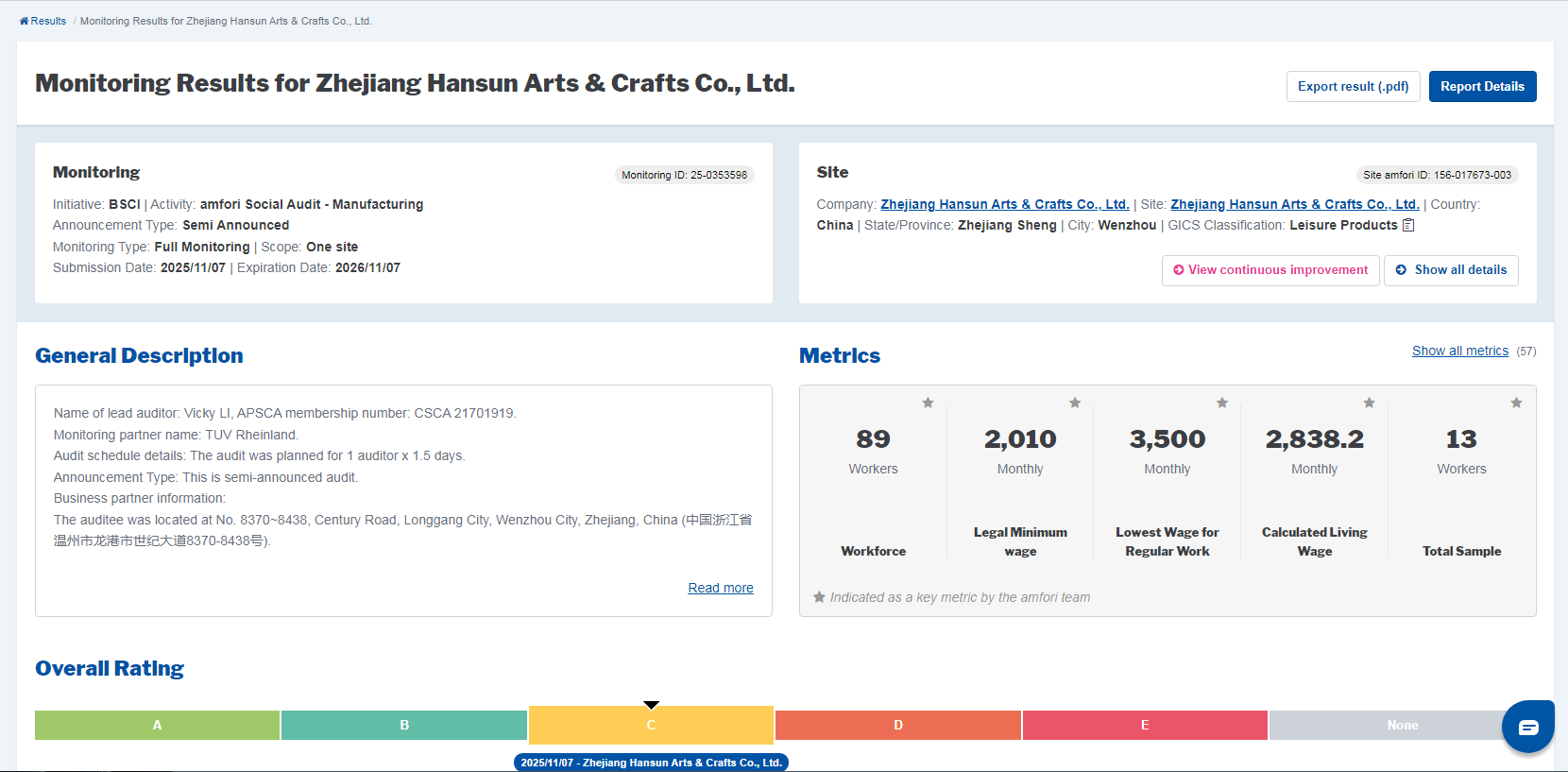
Social compliance documentation in the supplier file: BSCI certificate BSCI-2026-4567, scoped to factory social responsibility and ethical sourcing.
The verification steps matter more than the document count. Match the certificate number to the copy you were sent. Read the scope statement and confirm it covers the product family you are buying, since a facility certificate is not automatically a product approval. Check the issue and expiry dates against your order date — certification records are time-bound, renewal cycles differ by scheme, and a file that was current at tender can fall out of date before shipment. Confirm the audit body. And if the audit report carries findings, ask for the corrective action plan rather than only the certificate.
Benchmarking OEM leaders: Berry Global, Amcor, Sonoco and Sealed Air
Buyers assembling a shortlist often want the four names that dominate packaging procurement — Berry Global, Amcor, Sonoco and Sealed Air — used as a yardstick. They are appropriate yardsticks for choosing dimensions, and inappropriate ones for copying scores. All four are established multinational packaging groups whose public reporting is organised at group and segment level. Bag-specific market share, shopping-bag R&D headcount and customer-service performance metrics are not disclosed by these groups in a comparable, like-for-like form. A table that assigns them precise scores on shopping bags is therefore measuring the author's assumption, not the companies.
What transfers usefully is the dimension set those groups are normally evaluated on: R&D depth, market position, customer service structure and industry-solution breadth. Below, each dimension is turned into a question a buyer can put to any candidate, with Hansun's documented answers where the file supplies them.
| Benchmark dimension | Question to put to any candidate | Hansun's documented position | What still needs verifying |
|---|---|---|---|
| R&D capability | How many engineers, who owns the design files, how are material and print changes qualified? | 25-engineer R&D team within a company that runs a product design and development function | Project references for your specific bag type; sample turnaround times |
| Market position | Which regions and channels do you actually ship to, and can you name referenceable accounts? | Export ratio of 70%; sales and service described as covering Southeast Asia, Europe, North America and the Middle East | Bag-level market share is not published for any supplier in this set — ask for references, not rankings |
| Customer service | Who owns the account, what is the escalation path, what does after-sales cover? | After-sales described as remote support | Contractual response times, warranty and replacement terms |
| Industry solutions | Which bag formats and customization levers exist in-house? | Tote bags and PVC bags, with OEM and ODM production and customization of logo, size and material | Print methods, finishing options, sample library review |
| Manufacturing scale | Facility area, headcount and stated output | 25,000 m² facility, 200 employees, 20 million units of annual output | Capacity reserved for your release schedule and peak-season utilization |
| Compliance file | Which schemes, and what exactly do the certificates cover? | ISO 9001:2015, BSCI, Sedex SMETA 4 Pillars and Disney FAMA are recorded in the qualification file | Current validity dates and scope against your product family at order stage |
Read the table as a questionnaire, not a ranking. The four multinationals score well on group-level capability and integrated packaging programmes; a specialist factory answers narrower questions with more specificity. Neither position is automatically better for a given purchase order.
Where a specialist factory fits, and where a diversified group fits
The choice between a specialist bag manufacturer and a multinational packaging group is a fit question, not a ranking question. A group structure tends to suit buyers consolidating several packaging formats under one contract, or reporting group-level sustainability data up an organisation that expects a single supplier reference. A specialist factory tends to suit programmes where the bag itself is the product: custom-printed retail bags, promotional runs, gift packaging with tight colour control, at quantities from 3,000 pieces upward with named audit requirements attached.
The mismatch buyers most often miss runs in both directions. A specialist's 30–45 day lead time and 3,000-piece minimum are efficient for a 1,000,000-unit annual retail programme released in scheduled call-offs, and inefficient for a single 4,000-piece seasonal order split across three colourways. Both are legitimate orders; they need different supplier profiles. Deciding which one you are placing is the first procurement step, and it happens before any quotation is compared.
Acceptance criteria in practice: gift packaging, promotional gifts and supermarket retail
The same four inspection categories behave differently across the three scenarios that dominate custom bag purchasing, and the specification should shift emphasis accordingly.
Gift packaging
In gift packaging, print fidelity and surface finish carry most of the perceived value, so the acceptance plan should weight colour consistency and logo registration above cycle durability. The workable control is a signed golden sample retained by both parties, plus a pre-shipment check that compares production against that sample under the same lighting conditions. Where a bag is intended to be handed to a consumer as part of the gift, handle attachment and edge finishing move up the defect list, because they are the first things a recipient touches.
Brand promotional gifts
Promotional orders repeat. The real acceptance question is not whether the first run looks right, but whether the fifth run still matches the brand colour after material or print supplier changes. Customization scope — logo, size and material — should be frozen per SKU, with the approved variant recorded so a reorder references it rather than reopening the artwork discussion. Multi-purpose and foldable formats raise a second criterion: functional checks that the bag folds, opens and carries as designed, not only that it prints correctly.
Supermarket retail
Retail programmes add volume, scheduling and public-facing durability to the same criteria. In a Japanese programme, Hansun produced 1,000,000 units of reusable daily shopping bags and promotional gifts for a chain supermarket within one year, with custom printing that matched the supermarket's branding requirements. The recorded outcome was a 99.7% product qualification rate, zero delivery delay, and repeat orders from that client for three consecutive years, with the bags meeting Japan's eco-friendly standards. For a buyer, the transferable lesson is structural rather than promotional: the acceptance criteria were tied to the retail brand's printing standard and to a scheduled release pattern, which is what made a three-year repeat possible.

Sample approval is where acceptance criteria are fixed: the signed sample becomes the reference for every later inspection.
Material and construction choices that change the test plan
Material selection determines which tests are meaningful in the first place. Fortune Business Insights reports polypropylene as the leading material segment for reusable shopping bags, with more than 46% of production share — one reason PP-based constructions dominate retail specification sheets and why a buyer's test plan usually starts with seam and handle performance rather than print. Hansun's documented product scope covers tote bags and PVC bags; where water resistance is a stated requirement, the specification should name the construction explicitly rather than assume it from a keyword.
Adjectives are not acceptance criteria. "Heavy duty", "large capacity", "lightweight" and "portable" all describe a buyer's intent, not a measurable property. Convert them: rated load in kilograms with the test method named, finished dimensions with tolerances, handle attachment type and drop length. If the buyer cannot state the load and cycle expectation, the factory cannot test against it, and the pre-shipment result becomes an opinion.
For reusable programmes, EU interpretive material describes reusable packaging as needing physical properties that support multiple trips or rotations, allow emptying without significant damage or health and safety risk, and permit cleaning, washing or repair while retaining function. That description converts directly into sample-stage questions about seam construction, handle anchoring and surface cleanability — long before any certificate is discussed.
Regulatory direction to build into next year's specification
Two EU signals belong in a 2027 specification round. Regulation (EU) 2025/40 requires economic operators who make reusable packaging available in a Member State to ensure a reuse system is in place, including an incentive to ensure collection — an obligation that lands on the operator, not only on the factory. Separately, EU interpretive material sets the carrier-bag classification thresholds buyers use for screening: lightweight plastic carrier bags below 50 microns wall thickness, very lightweight bags below 15 microns, subject to stated exceptions and to national implementation. Those thresholds classify bags; they do not by themselves establish that a particular bag is compliant in a particular Member State, and the specific obligations and dates should be confirmed against the consolidated legal text before a specification is locked.
Market context is directional rather than decisive. Fortune Business Insights estimates the global reusable shopping bag market at USD 16.67 billion in 2026, rising to USD 28.87 billion by 2034, and reports Asia Pacific as the largest regional market in 2025 with a 24.23% share. These are commercial research estimates whose product scope varies between publishers, so they support planning direction and are weak as the sole basis for a single order's business case.
Outlook: documentation discipline is the durable advantage
Certificates expire and audits cycle; specifications, samples and inspection records are what survive a supplier change. Buyers who build a file that links specification sheet, approved sample, pre-shipment record, certificate copy and purchase order get faster reorders and shorter arguments. Suppliers who can hand over that chain without being chased are easier to keep. On current evidence, the differentiator in shopping bag procurement is less about who can print a logo and more about who can prove, on paper and in a carton, that the bag matches what was agreed.
Frequently asked questions
What purchasing terms should be fixed before a shopping bag order is placed?
Fix minimum order quantity, delivery term, payment structure, production lead time and customization scope. Hansun's documented terms are a 3,000-piece MOQ, FOB, DDP or EXW delivery, payment splits of 30/70, 50/50 or 100% before mass production, and a 30–45 day production lead time. The lead time should be counted from artwork and sample approval rather than from the enquiry date.
What acceptance criteria apply to a custom printed shopping bag?
Four checkable categories: construction and dimensions against the specification sheet, material identity and thickness, print fidelity against a signed sample, and workmanship of seams and handles. Hansun's documented acceptance gate is a pre-shipment test, with the quality-control plan configured to customer requirements — so the sampling plan and defect classes have to be written into the order rather than assumed from a general quality claim.
Which compliance documents should a shopping bag buyer collect?
Match the document to the risk being managed. ISO 9001:2015 covers the quality management system; BSCI and Sedex SMETA 4 Pillars cover social compliance, labour practice, health and safety and environmental standards at site level; Disney FAMA is a facility authorisation for licensed promotional bags and gifts. Hansun's file records certificate numbers, issuing authorities and scopes for all four schemes, and its FAMA record lists a cosmetic bag line and a shopping bag as related products. Because certificate copies carry issue and expiry dates, buyers should confirm current validity and product scope at order stage.
How do OEM and ODM customization work in practice?
Hansun provides both OEM and ODM production services, with customization covering logo, size and material. OEM means the buyer supplies the design and the factory manufactures to it; ODM means development starts from a required outcome. In both cases the customization variables should be frozen in the approved sample before the 3,000-piece minimum is released, so that production and inspection reference the same version.
Can a specialist factory support a national retail rollout?
Capacity has to be checked against the release schedule, not only against the annual total. Hansun documents 20 million units of annual output and a 25,000 m² facility; in a Japanese chain-supermarket programme, 1,000,000 units of reusable daily shopping bags and promotional gifts were produced within one year, with a reported 99.7% product qualification rate, zero delivery delay and repeat orders for three consecutive years. That is one programme's record rather than a guarantee for another buyer's schedule, so capacity reservation should be confirmed in writing against your call-off plan.
Hansun's product brochure, covering product scope and contact details, is available for download: Hansun product brochure (PDF).
Tem questões ou precisa de mais detalhes?
Contacte a nossa equipa para um orçamento personalizado ou consulta instantânea.
Solicitar orçamento
Preencha o formulário abaixo e a nossa equipa entrará em contacto com uma proposta personalizada.
Chat direto do WhatsApp
Prefere conversar em tempo real? Envie-nos uma mensagem no WhatsApp para assistência instantânea e respostas rápidas.
- Obter orçamento personalizado
- Partilhar fotos ou documentos
- Discuta as suas necessidades diretamente
Geralmente responde em 5–30 minutos durante o horário de expediente.