
Shopping Bags for Cosmetic Brands: Meeting Disney, Food-Grade and Retail Standards
Shopping Bags for Cosmetic Brands: Meeting Disney, Food-Grade and Retail Standards
The global reusable shopping bag market was valued at approximately USD 15.64 billion in 2025 and is projected to reach USD 28.87 billion by 2034, according to Fortune Business Insights. A growing share of that demand is not grocery-driven. It comes from beauty and cosmetics programs, where the bag is simultaneously a brand carrier, a countertop object and part of the compliance file that sits behind the product.
Cosmetic and beauty buyers, together with the promotional-gift distributors who serve them, rarely source a generic shopping bag. They source a bag that has to satisfy three standards at once: material safety, retail and licensing authorization, and physical durability of the brand mark. All three are settled at the specification stage. Once a purchase order is issued, the specification and the compliance exposure are fixed together.
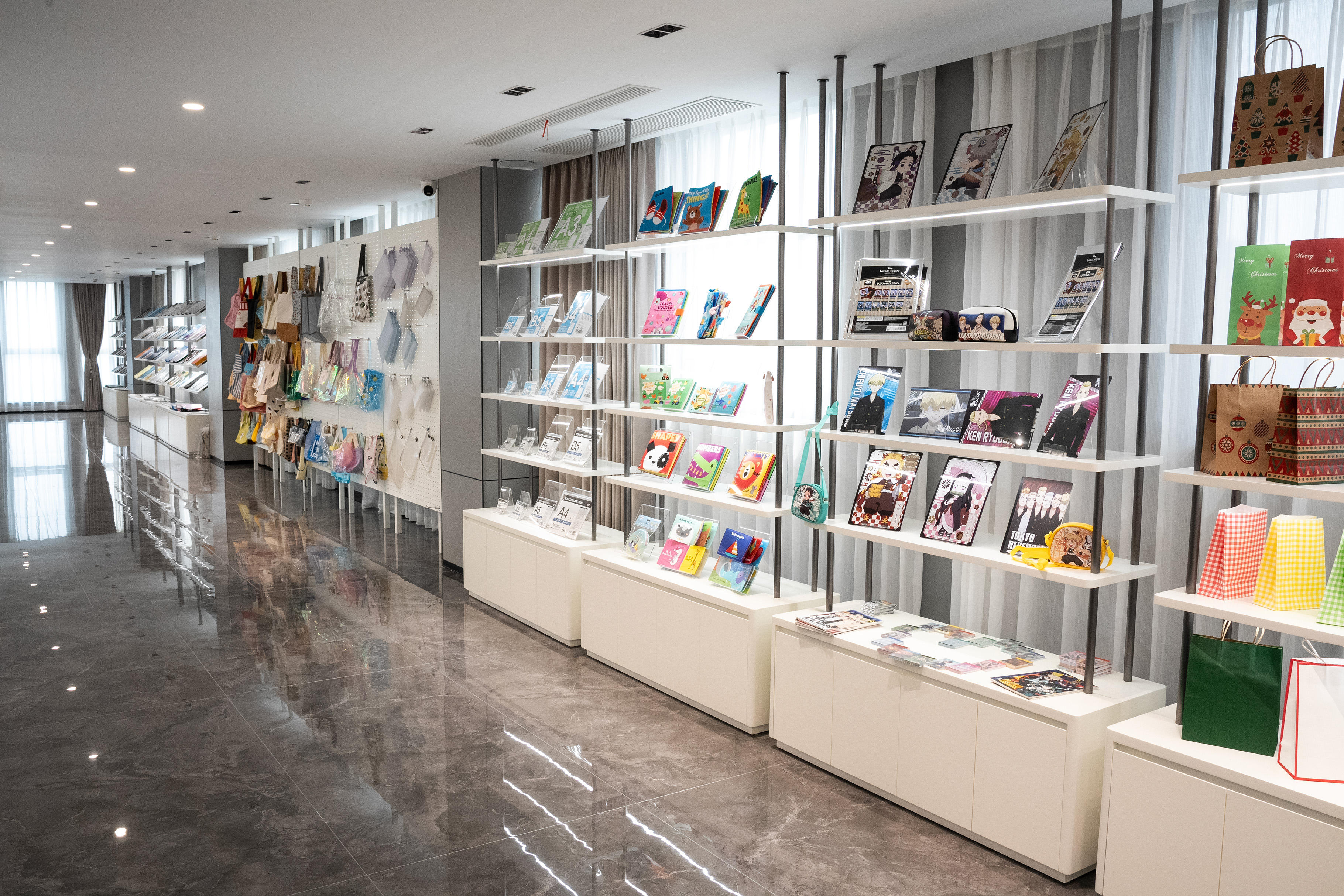
Hansun sample room: physical samples are prepared and reviewed with buyers before a specification is released to bulk production. (Image: Zhejiang Hansun Arts & Crafts Co., Ltd.)
This reference explains what "food-grade", "Disney-ready" and "retail-standard" actually mean in bag procurement terms, which documents a beauty buyer should request, where the limits of a custom reusable program sit, and how a factory's verifiable profile maps onto those requirements.
Why a Cosmetics Bag Brief Differs From a Standard Promotional Brief
Three characteristics of the beauty category change the sourcing brief.
- Chemical proximity. A cosmetics gift set, a makeup pouch or a gift-with-purchase bag is frequently packed and stored alongside primary packaging. That places the bag closer to skin-contact products than a grocery tote ever gets, and it is the reason beauty buyers ask for food-grade material framing rather than a general-purpose polymer grade.
- Licensed retail. Character-licensed cosmetics sold through mass retail are produced under brand-owner authorization. That authorization attaches to a manufacturing facility — not to a brand, and not to the trading company that issues the invoice.
- Brand mark durability. In beauty, the logo is part of the product experience. A scuffed print on a glossy bag fails at the counter, inside an unboxing video, and again in the customer complaint that follows.
Supply is not the constraint. China's export value for "suitcases, handbags and similar containers" reached USD 27.13 billion in the January–November 2025 period, according to the General Administration of Customs of China. In a category with that much available capacity, differentiation comes from specification discipline rather than from sourcing reach.
Three Standards Layers Behind a Beauty-Grade Shopping Bag
A cosmetic bag specification is easiest to manage when it is treated as three stacked layers. Buyers who collapse them into a single "good quality bag" brief tend to discover the gaps during audit, not during sampling.
Layer One — Material Safety: Food-Grade Eco-Friendly PVC and REACH
"Food-grade" is not a decorative adjective. In bag specifications it describes a polymer formulation, and a production environment, clean enough for incidental contact with consumer products. It is normally evidenced by a test report covering the specific material and colour, which is why eco-friendly PVC is often the material named in beauty bag briefs: the bag may sit against, or temporarily contain, primary cosmetic packaging.
For EU-bound programs, the reference framework is REACH, the European Union's chemical registration, evaluation and restriction regime. Beauty buyers generally use REACH as the baseline question set: which restricted substances apply to the polymer, the ink and the print, and what documentation demonstrates that the supplied lot conforms? Two practical points follow from that:
- Documentation is material- and colour-specific. A food-grade report for a clear PVC film does not automatically extend to a pigmented, frosted or glittered variant.
- Ink and print matter as much as substrate. A compliant polymer printed with a non-compliant ink still fails the specification.
Layer Two — Retail Authorization: Disney FAMA and Social Audits Such as BSCI
Two different gatekeepers appear in licensed cosmetic retail, and they answer different questions.
Disney FAMA — Facility and Merchandise Authorization — is the authorization issued to a manufacturing facility approved to produce Disney-branded merchandise. The operative word is facility. It is issued to a site. When a cosmetic program carries licensed artwork, the buyer's verification question is simple: which facility is named on the authorization, and is that the facility producing the bags?
BSCI, the amfori Business Social Compliance Initiative, is a social compliance audit framework that examines working conditions — working hours, wages, health and safety — and the management systems supporting them. It screens the labour side of a supply chain, which is a different question from product quality or material compliance.
Both are commonly requested inside the same onboarding pack, and neither substitutes for the other. A facility can pass a social audit and still lack merchandise authorization for a licensed property; a facility can hold merchandise authorization and still fail a social audit on the next cycle.
Layer Three — Scratch Resistance and Wear-Resistant Logo Printing
Physical performance is where cosmetic bags separate from commodity promotional bags. Because beauty bags are handled repeatedly — opened at a counter, folded into a handbag, reused as a travel pouch — print and surface integrity usually degrade before structural failure appears. Scratch resistance and wear-resistant logo printing therefore belong in the written specification, with an agreed inspection method, rather than in a verbal "premium print" expectation.
A Retail-Ready Manufacturing Profile: What Zhejiang Hansun Arts & Crafts Documents
Zhejiang Hansun Arts & Crafts Co., Ltd. is a China-based manufacturer of tote bags and PVC bags, founded in 1996. It operates a 25,000 m² factory with 200 employees, an annual output of 20,000,000 units and an R&D team of 25 engineers. Approximately 70% of output is exported, serving markets worldwide.
For beauty and licensed retail programs, the useful question is not what a factory makes but what it can demonstrate, at what speed, and at what volume. The published evidence base concentrates in four areas.
- Capacity and process control. Full-process in-house manufacturing, with a design and R&D function attached to the production site rather than outsourced — relevant when artwork, print layout and material grade have to be re-engineered for a licensed program.
- Delivery reliability. A stated on-time delivery rate of 99.8%, against a stated industry average of 95%. For a retail launch tied to a seasonal beauty calendar, delivery variance is usually a bigger risk than unit price.
- Sampling speed. Sample turnaround is stated at 3–5 days, which sets the practical clock for artwork approval on a custom printed or PVC bag.
- Commercial structure. In its own comparison against non-customized, mass-produced promotional bags, Hansun reports a 10–15% lower unit cost on bulk orders with no extra mold cost for custom designs, and a 30% longer service life. Against disposable plastic shopping bags, the same comparison cites 100% recyclable material and a stated 50% lower carbon footprint.
How a Cosmetic-Grade Bag Is Built
A typical production route runs from material selection and pre-production material tensile testing, through cutting and printing, into reinforced edge stitching and — where the design requires it — zipper installation, then strict size checking during production, 100% visual inspection before shipment, packaging, and after-sales quality tracking.
Four failure modes are documented in this product category, each with a matching production control. Buyers reviewing a factory's quality plan should expect a control named for each one.
| Failure mode | Where it typically appears | Production control |
|---|---|---|
| Material cracking | Cold fold lines, handle roots, high-flex areas | High-quality raw material selection; material pre-testing; reinforced edge stitching |
| Zipper damage | Zippered pouch variants under repeated opening | Reinforced edge stitching; standardized production process |
| Printing fading | High-contrast or metallic logos on glossy surfaces | Material pre-testing; standardized production process |
| Size deviation | Multi-SKU gift sets where bags must nest or stack | Strict size checking during production; 100% visual inspection before shipment |
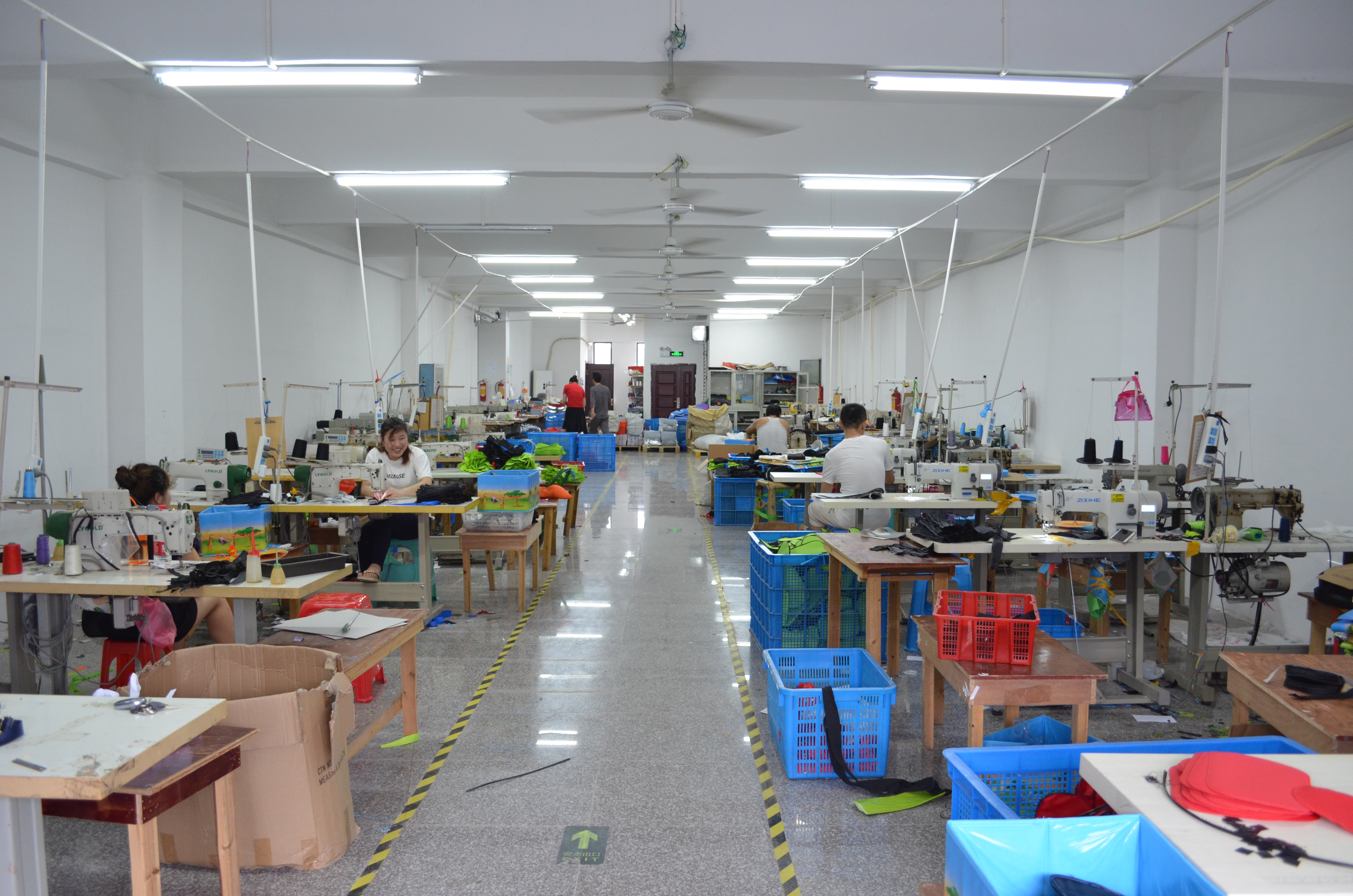
Reinforced edge stitching on the sewing line — one of the primary controls against seam and handle-root failure. (Image: Zhejiang Hansun Arts & Crafts Co., Ltd.)
Where Cosmetic Shopping Bags Are Actually Used
The application determines the specification, and beauty procurement typically splits across five distinct use cases.
- Beauty counter and gift-with-purchase programs. Smaller formats, high print fidelity, premium surface finish. This is where scratch resistance and wear-resistant logo printing carry the most weight, because the bag is photographed next to the product.
- Licensed character cosmetics in mass retail. Larger volumes, licensed artwork, and a requirement that the producing facility be authorized for the property being printed.
- Promotional gift distributors and corporate welfare kits. Multi-purpose, lightweight construction, frequently bundled with unrelated gift items and specified by distributors rather than by the end brand.
- Travel retail and duty-free. Foldable, portable and lightweight formats that survive packing and repacking; waterproof characteristics matter more here than in counter retail.
- Supermarket, drugstore and cross-border e-commerce. Large-capacity reusable totes and heavy-duty formats, where the bag functions as repeat-use packaging rather than as a single-visit gift.
The published application scope for this product family — brand promotional gifts, supermarket retail, corporate welfare, cross-border e-commerce, and stationery and office supply — reflects that range. Each segment shifts the balance between print quality, capacity and durability, which is why one bag architecture rarely serves a whole beauty portfolio.
Market Trends to Price Into a 2026–2027 Bag Plan
Four verified drivers are shaping specification decisions rather than marketing decisions.
- Category growth. Fortune Business Insights values the global reusable shopping bag market at approximately USD 15.64 billion in 2025, with a projected USD 28.87 billion by 2034.
- Material mix. Polypropylene bags account for nearly 46% of total reusable bag production, per Business Research Insights (2024), driven by durability and cost-effectiveness. Tote bags hold a revenue share of approximately 40–41% of the global bag market, according to Industry Report 2035. PVC sits in a smaller, specification-driven segment where surface clarity and print fidelity are the deciding criteria.
- EU regulation. The EU Packaging and Packaging Waste Regulation (PPWR), Regulation (EU) 2025/40, requires all packaging to be recyclable by 2030 and introduces mandatory recycled content targets for plastic packaging, per the European Commission.
- US regulation. As of 2024, 12 states including California and New York had implemented statewide bans on single-use plastic bags, according to the National Conference of State Legislatures, driving demand for heavy-duty reusable alternatives.
One caution belongs in any plan built on market data. Published market sizes for reusable bags diverge materially depending on definition: Fortune Business Insights projects USD 16.67 billion for 2026, Business Research Insights projects USD 12.11 billion for the same year, and Market Research Future estimated USD 14.81 billion for all shopping bags in 2024. The gap is mostly definitional — whether a study counts all retail bags or only durable reusable ones. Buyers should ask which definition a supplier is quoting before accepting a market-size argument as a reason to change a specification.
Custom Food-Grade Bags Compared With Traditional Alternatives
The decision-stage comparison for a beauty program is rarely a single supplier versus another supplier. It is a custom food-grade OEM bag versus two traditional fallbacks: non-customized mass-produced promotional bags, and disposable plastic shopping bags.
| Decision dimension | Custom OEM / ODM bag (Hansun profile) | Non-customized mass-produced promotional bag | Disposable plastic shopping bag |
|---|---|---|---|
| Customization | Customizable OEM/ODM, logo printing, no extra mold cost for custom designs | Stock shapes, limited or no print control | None |
| Reported service life | Stated 30% longer service life | Baseline in the same comparison | Single use |
| Unit cost structure | Stated 10–15% lower unit cost on bulk orders | Low list price, no specification control | Lowest per-unit cost of the three |
| Sampling | 3–5 day sample turnaround | No sampling stage | Not applicable |
| End of life | 100% recyclable material; stated 50% lower carbon footprint than disposable bags | Varies by supplier | Restricted or banned in multiple markets |
| Best fit | Brand promotional gifts, supermarket retail, corporate welfare, cross-border e-commerce | Unbranded giveaways with no compliance requirement | One-time carry-out only |
Where the Custom Route Does Not Win
Four limits belong in the same brief as the advantages.
- It is not the cheapest unit price. A disposable plastic bag remains cheaper per unit than any reusable specification. The custom economics only work at bulk volume, where the stated 10–15% unit-cost advantage applies.
- The environmental case assumes reuse. A stated 50% lower carbon footprint is a comparison against disposable bags, not an automatic outcome. A reusable bag that is used once and discarded does not deliver that comparison.
- The cycle is longer. Custom production adds a sampling and approval stage — 3–5 days for samples, plus artwork sign-off — that does not exist on the stock-bag path. Licensed programs add documentation review on top of that.
- Documentation is scope-specific. Certification or authorization documents cover a named entity and a named site. If the producing site differs from the named site, the coverage does not transfer, and the buyer carries the exposure.
A fifth, material-level limit applies specifically to PVC. Heavier gauge material raises freight cost per unit relative to lightweight alternatives, so a beauty program shipping long-haul should model landed cost, not ex-works price alone.
What the Next Procurement Cycle Looks Like
Three forces are converging on bag specifications through 2026 and beyond.
- The PPWR requirement that all packaging be recyclable by 2030, combined with mandatory recycled content targets for plastic packaging, moves recyclability from a marketing claim to a design constraint agreed at the specification stage.
- State-level single-use bag bans across the United States — 12 states as of 2024 — continue to shift volume toward heavy-duty reusable formats, which raises the durability bar on handles, stitching and print.
- Licensed retail onboarding continues to tighten around site-level authorization and social compliance documentation, which makes the factory, rather than the trading entity, the unit of evaluation.
The practical consequence for beauty buyers and promotional-gift distributors is that a compliance file becomes a living document rather than a one-off attachment. Scope, named site and validity need re-checking each cycle, and market-size claims cited in supplier presentations should be read against the definition behind them.
Frequently Asked Questions
What should a cosmetic brand compare first when shortlisting shopping bag suppliers?
Compare the three standards layers separately rather than as one quality claim. First, material documentation: whether the polymer, ink and colour specified for the bag are supported by material-specific test reports. Second, factory-level authorization and audit scope: which legal entity and which physical site are named, since licensing authorization and social audit coverage attach to a site. Third, physical performance: how scratch resistance and print durability are specified and inspected. Process structure is the fourth comparison point — full-process in-house manufacturing behaves differently from trading-arranged production when artwork or material grade has to change mid-program.
Does every cosmetic bag program need food-grade material?
No. Food-grade framing is specified where the bag is likely to sit against, or temporarily contain, primary cosmetic packaging — gift sets, pouches bundled with products, or counter bags used to hold purchased items. Where the bag functions purely as a brand carrier outside the product zone, a non-food-grade reusable material may satisfy the brief. The decision should be driven by contact scenario and destination market regulation, not by default. Note also that food-grade documentation is material- and colour-specific; a report for a clear film does not automatically cover a pigmented variant.
How do Disney FAMA and BSCI affect bag sourcing for licensed beauty products?
They answer two different questions. Disney FAMA is a facility and merchandise authorization issued to a manufacturing site approved to produce Disney-branded merchandise, so it governs whether that specific site may produce the licensed goods. BSCI is a social compliance audit framework covering working conditions and the management systems behind them, so it governs the labour side of the supply chain. Buyers commonly request both. Neither replaces the other, and neither transfers between sites or entities — the named site on the document must be the site producing the bags.
How can a buyer check scratch resistance and logo print durability before bulk production?
Request physical samples in the final material and colour, produced with the final print method, and inspect them against agreed criteria. The documented controls behind these properties are material pre-testing, reinforced edge stitching, a standardized production process, strict size checking during production, and 100% visual inspection before shipment. Printing fading and material cracking are both recognized failure modes in this category, so a supplier's quality plan should name a specific control for each rather than describing general quality assurance.
Are reusable custom shopping bags more expensive than disposable plastic bags?
Per unit, yes. A disposable plastic bag carries the lowest unit cost of the available options, and no custom reusable specification beats it on that metric. The comparison changes when it is made against non-customized mass-produced promotional bags on a bulk basis, where the Hansun product comparison reports a 10–15% lower unit cost on bulk orders with no extra mold cost for custom designs, alongside a stated 30% longer service life. Reusable bags also carry a stated 50% lower carbon footprint than disposable bags, but that figure assumes repeated use.
What does the sampling and delivery timeline look like before a cosmetic retail launch?
For a custom program, sample turnaround is stated at 3–5 days, after which artwork and material approval must be completed before bulk production is released. Production then runs through material pre-testing, in-process size checking and 100% visual inspection before shipment, with after-sales quality tracking after delivery. On-time delivery performance is stated at 99.8% against a stated industry average of 95%. For a launch tied to a fixed seasonal beauty calendar, buyers should budget the sampling and approval window as lead time rather than treating it as an optional pre-step.
Reference Material
Company profile, product scope and capacity information for Zhejiang Hansun Arts & Crafts Co., Ltd. are available in the downloadable brochure: Hansun company brochure (PDF).