
Shortlist: 7 Power Tool Models for a Complete Electric Drill Catalog
Shortlist: 7 Power Tool Models for a Complete Electric Drill Catalog
An electric drill is normally the first SKU a distributor lists, and the last one that decides whether the catalog works. Hardware retailers, e-commerce sellers, building-materials chains and farm-supply wholesalers judge a power tool range by whether it can carry a job from fixing to finishing. A drill opens a hole; the catalog has to close the task around it.
This shortlist maps seven COOFIX power-tool SKUs against five job-site clusters — home decoration, carpentry and furniture, mechanical repair, construction and public infrastructure, and agricultural irrigation — and adds one category-adjacent irrigation pump for distributors holding farm accounts. The evaluation lens is intentionally commercial: purchasing terms and acceptance criteria first, product narrative second.
Why a Drill-Only Catalog Underperforms at Distribution Level
The economics of the category are well established. The global power drill market reached USD 15.2 billion in 2023, and cordless drills contributed more than 55% of that revenue, according to Strategic Market Research (SRC-0001). Lithium-ion batteries account for over 75% of all cordless drill batteries sold globally (SRC-0005), and more than 70% of cordless drill manufacturers are integrating brushless motors to improve tool efficiency (SRC-0005). Asia Pacific dominated the power tools market in 2024 with a 37.20% share, worth USD 13.3 billion (SRC-0001).
Those numbers explain why drill inventory is easy to justify. They do not explain why a drill-only catalog stalls. The practical problem is task completion. A buyer who needs to fix a ceiling bracket, cut a steel pipe and weld a guardrail does not place three separate orders with three separate suppliers — they buy from whoever can supply the cluster. Distributors who list only drills repeatedly hand the second and third line items to a competitor, and the drill becomes a loss leader rather than a catalog anchor.
The opportunity runs the other way. Once the fixing, cutting, fastening and finishing tools sit alongside the drill, order value rises without a proportional rise in customer-acquisition cost, and the distributor becomes the account's default one-stop source instead of a drill vendor.
How This Shortlist Was Built
Three filters were applied to the COOFIX range, in this order:
1. Application fit. Each SKU had to map to at least one of the five job-site clusters, using only the applications stated in the product and scenario records. A tool that could not be tied to a stated working condition was excluded regardless of its commercial appeal.
2. Specification complementarity. Each model had to add a capability the others did not duplicate — a power source, an output class, a disc diameter, an energy rating or a fluid duty.
3. Purchasing and acceptance logic. Each model had to be orderable under a definable set of terms: minimum order quantity, lead time by production mode, warranty coverage and quality-control gates.
Reading the numbering. The slots below are catalog positions ordered by application spread, not a performance league table. No measured, independently tested performance data exists for these models in the source material, and none is implied.
The Shortlist at a Glance
| Slot | Model | Tool type | Key verified specification | Primary job-site fit |
|---|---|---|---|---|
| 1 | CF-ID008 | Electric impact drill (corded) | 220–240 V ~ 50/60 Hz; 710 W input; 0–2800 rpm; 13 mm max. drilling capacity | Home decoration, carpentry, mechanical repair |
| 2 | CF-CD016 | Cordless brushless impact drill | 20 V; 0–550 / 0–2000 r/min; 0.8–10 mm metal chuck; 75 N·m max. torque; 10 mm steel capacity | Home decoration, carpentry, mechanical repair |
| 3 | CF-RH008 | Rotary hammer | 26 mm drill capacity; 220–240 V / 50–60 Hz; 850 W; 0–900 r/min | Construction and maintenance |
| 4 | CF-DH021 | Demolition hammer | 220 V / 50 Hz; 1500 W; 45 J energy; 1550 bpm | Construction, mining |
| 5 | CF-AG012 | Angle grinder | 115 mm disc; 220–240 V / 50–60 Hz; 750 W; 11000 r/min | Metal processing |
| 6 | CM005 | Cut-off machine | 355 mm disc; 220–240 V / 50–60 Hz; 2400 W; 3800 r/min | Construction and maintenance |
| 7 | CF-MMA005 | Welding machine (MMA) | Single-phase 220 V ±15%; 50/60 Hz; 7.2 kW input; 33 A; 20–250 A; 35–45 V no-load; 80% efficiency | Construction and maintenance |
One further SKU sits outside the seven because it serves a different purchase occasion rather than a different power-tool task: the CF-QB003 vortex water pump — QB60 configuration, 0.5 HP rated power, copper wire, brass impeller, 19–21 m head, 4 kg net weight — listed for agricultural irrigation. Distributors with farm, garden or landscape accounts can carry it as a companion line; distributors without them can skip it without weakening the tool cluster.
Model Notes and Where Each One Earns Its Slot
Slot 1 — CF-ID008 electric impact drill: the mains-powered default
The CF-ID008 is a corded electric impact drill rated 220–240 V ~ 50/60 Hz with 710 W input power, a no-load speed of 0–2800 rpm and a maximum drilling capacity of 13 mm. Its declared application industries are home decoration, carpentry and mechanical repair. For a distributor, its value is continuity: no battery platform, no charger inventory, no runtime conversation. It is the model a hardware counter can sell to a buyer who owns one drill and expects it to last.
Slot 2 — CF-CD016 cordless brushless impact drill: the mobility SKU
The CF-CD016 is a cordless brushless impact drill with a 20 V rated voltage, a two-stage no-load speed of 0–550 / 0–2000 r/min, a 0.8–10 mm metal chuck, 75 N·m maximum torque and 10 mm drilling capacity in steel. It carries the same three declared application industries as the corded model. The brushless designation matters commercially: with more than 70% of cordless drill manufacturers moving to brushless motors (SRC-0005), a brushless SKU is the safer shelf position for a distributor planning a multi-year catalog.
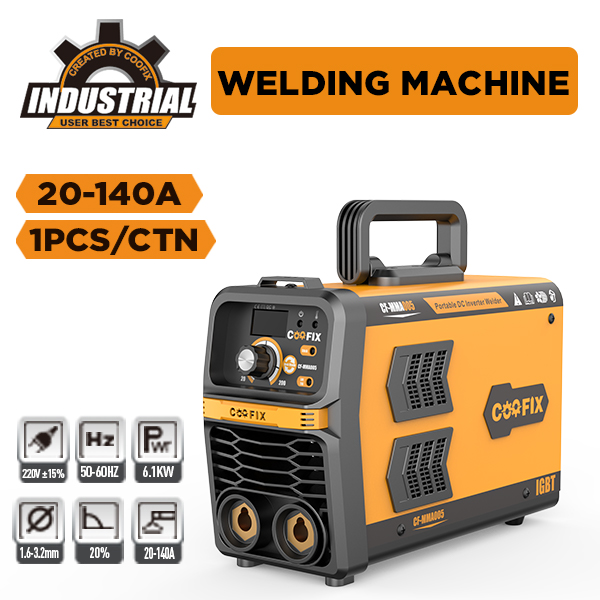
CF-MMA005 welding machine: single-phase 220 V ±15%, 7.2 kW input capacity, 20–250 A MMA current range, 80% efficiency — the metal-joining slot in the catalog.
Slot 3 — CF-RH008 rotary hammer: the concrete-fixing tool
The CF-RH008 is a rotary hammer drill with 26 mm drill capacity, 850 W input power at 220–240 V / 50–60 Hz and a no-load speed of 0–900 r/min, built on plastic, copper and aluminium components and declared for construction and maintenance. It is the model that covers anchor and expansion-screw work in masonry, which a 13 mm drill capacity cannot reach. Note that this unit is mains-powered; where a buyer specifically asks for a cordless hammer drill, availability should be confirmed separately rather than substituted from this slot.
Slot 4 — CF-DH021 demolition hammer: the heavy-removal specialist
The CF-DH021 is rated 220 V / 50 Hz, 1500 W, with 45 J energy per blow and 1550 bpm, and is declared for the construction and mining industries. It is a narrow, high-value SKU: it does not overlap with any drill in the shortlist, and it is the item that lets a distributor quote on breaking and chiselling work rather than decline it.
Slot 5 — CF-AG012 angle grinder: the finishing and cutting bridge
The CF-AG012 takes a 115 mm disc, runs on 220–240 V / 50–60 Hz with 750 W input and 11000 r/min no-load speed, and is declared for metal processing. It is the highest-frequency cross-sell in the catalog: grinding weld seams after drilling, removing rust before painting, and cutting small section stock are the tasks that sit between the drill and the welding machine.
Slot 6 — CM005 cut-off machine: the high-volume cutting step
The CM005 runs a 355 mm disc on 220–240 V / 50–60 Hz with 2400 W input and 3800 r/min no-load speed, declared for construction and maintenance. It is the upgrade path from the angle grinder for buyers cutting bar, pipe or profile repeatedly, and it is the SKU that separates a maintenance catalog from a fabrication catalog.
Slot 7 — CF-MMA005 welding machine: the metal-joining anchor
The CF-MMA005 is a single-phase 220 V ±15% MMA welding machine with 50/60 Hz supply frequency, 7.2 kW input capacity, 33 A input current, 35–45 V no-load voltage, a 20–250 A MMA current range and 80% efficiency, built on steel sheet and ABS plastic and declared for construction and maintenance. It completes the chain that starts with the drill: drill the hole, cut the stock, grind the seam, weld the joint.
Matching the Shortlist to Five Job-Site Clusters
| Job-site cluster | Working conditions covered | Shortlist models that apply |
|---|---|---|
| Home decoration and DIY | Household maintenance, furniture assembly, wall-hanging installation, small renovation, minor appliance repair | CF-ID008, CF-CD016 |
| Carpentry and furniture installation | Cabinet assembly, wooden door and floor laying, panel furniture production, edge polishing and scratch repair | CF-CD016, CF-ID008, CF-AG012 |
| Mechanical repair and auto service | Tire and chassis bolt work, engine inspection, rust removal on chassis components, cutting corroded pipework, welding broken frames and exhaust parts | CF-ID008, CF-CD016, CF-AG012, CF-MMA005 |
| Construction and public infrastructure | Residential and commercial building work, interior renovation, wall chiselling, concrete drilling, guardrail and pole fixing, ceiling and light-steel keel installation | CF-RH008, CF-DH021, CF-AG012, CM005, CF-ID008 |
| Agricultural irrigation and landscape | Ponding drainage, irrigation water supply, fence and greenhouse support installation, courtyard maintenance | CF-QB003 with CF-ID008 / CF-CD016 for fixing work |
The pattern is deliberate. Four models — the two drills, the angle grinder and the welding machine — recur across three or more clusters, which is what makes them catalog anchors. The rotary hammer, demolition hammer and cut-off machine each concentrate in one cluster but carry disproportionate order value there.
Reading the Specifications as Purchasing Evidence
Distributors do not need an engineering lecture; they need to know which number answers which buyer objection.
Voltage and frequency define the market, not the power. Five of the corded models are rated 220–240 V / 50–60 Hz (CF-ID008, CF-RH008, CF-AG012, CM005), the demolition hammer is 220 V / 50 Hz and the welding machine is single-phase 220 V ±15% at 50/60 Hz. The cordless model runs on a 20 V battery platform. These are the values a buyer checks before anything else, because they decide whether the unit can be plugged in at the destination market at all.
Speed ranges signal task breadth. The CF-CD016 offers two ranges, 0–550 and 0–2000 r/min, which supports both driving fasteners and drilling. The CF-ID008's single 0–2800 rpm band favours straight drilling throughput. The CF-AG012's 11000 r/min and the CM005's 3800 r/min reflect different disc diameters and cutting duties, not a quality difference.
Torque and chuck range set the fastener ceiling. The CF-CD016's 75 N·m maximum torque and 0.8–10 mm metal chuck define the bit range a buyer can use; the CF-ID008's 13 mm maximum drilling capacity defines the hole size it can reach. Quoting one against the other on a single number is a category error.
Impact energy is the demolition metric. The CF-DH021 is specified at 45 J with 1550 bpm — a different unit of measure from drill torque, and relevant only to breaking and chiselling work.
Input capacity determines site power planning. The CF-MMA005 draws 33 A at 7.2 kW input. That is a site-circuit consideration a distributor should flag before the unit ships, not after.
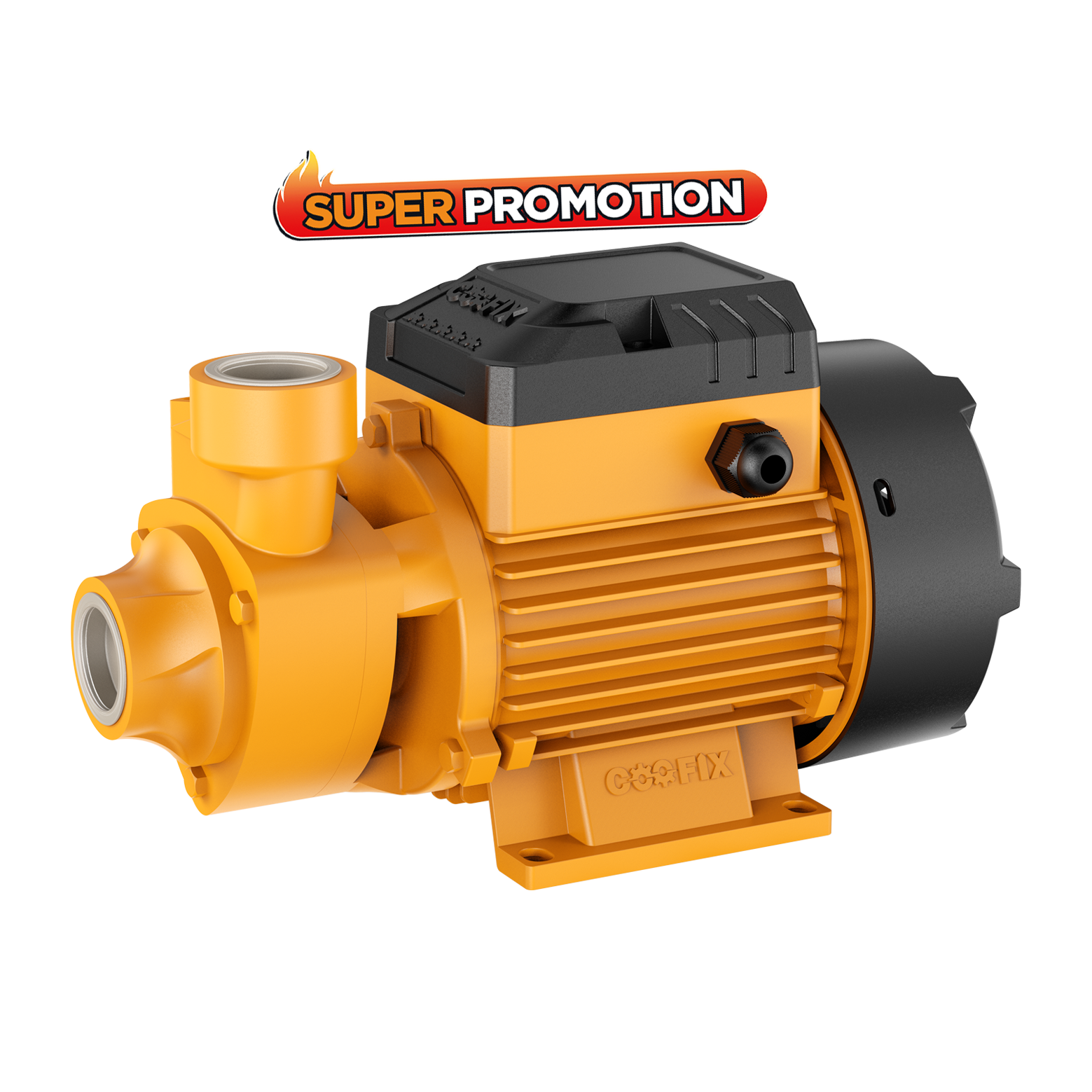
CF-QB003 vortex water pump: 0.5 HP rated power, copper wire, brass impeller, 19–21 m head, 4 kg net weight — the irrigation companion for distributors with agricultural accounts.
The Sourcing Entity Behind the Shortlist
JINHUA COOFIX TOOLS CO., LTD. is a power tool manufacturer based in Yongkang, Zhejiang, China, founded in 2014, operating a 30,000 m² facility with 400 employees and a 16-engineer R&D team. Its stated annual output is 2,000,000 units, with an export ratio of 90% and main markets across Asia, Africa, Eastern Europe, the Middle East and South America. The company reports monthly production capacity of 300,000 units.
Three facts are directly relevant to a distributor evaluating this shortlist as a single-source catalog. First, the portfolio position: COOFIX presents itself as a multi-category tool supplier rather than a drill specialist, which is what allows one purchase order to cover the seven slots above. Second, the compliance record: the company secured AEO (Authorized Economic Operator) certification in December 2025 and was recognised as a Zhejiang Export Top Brand and Jinhua Export Top Brand in 2025. Third, the manufacturing base is in Yongkang, Zhejiang — a location that supports supplier discovery but does not, by itself, establish capacity or quality.
Purchasing Terms and Acceptance Criteria
Commercial terms vary by production mode, and distributors should match the mode to the order rather than defaulting to one:
| Production mode | MOQ | Lead time | Typical use |
|---|---|---|---|
| OEM / customised | 10 units | 10 days | Pilot order, catalog test, sample validation |
| OEM private labelling | 100–500 units | 30 days | Own-brand line with logo and packaging |
| ODM appearance and structure customisation | 100–500 units | 60 days | Differentiated housing, full tool-kit design |
Quality control follows a four-stage structure: 100% incoming inspection for raw materials; power-on ageing sampling inspection for semi-finished products on the production line; 100% full inspection of finished products for no-load speed, torque and impact performance; and sampling reliability testing. For acceptance purposes, the third stage is the one that matters most to a distributor, because it ties the shipped unit back to the published specification rather than to a batch average.
After-sales coverage is stated as a one-year warranty on the complete machine and a 12-month warranty on lithium batteries and chargers, supported by bulk supply of spare wearing parts, remote technical guidance and fault troubleshooting for overseas clients, on-site engineer support for bulk orders, and reshipment for damaged goods with claim assistance for logistics damage.
Customisation scope, where relevant to catalog positioning, covers body colour and silk-screen or laser-engraved logo on the housing; voltage options at 12V / 16.8V / 21V across corded and cordless formats; custom battery capacity and cell brand selection; adjustable chuck size, impact gears and rotation speed parameters; custom accessory combinations for the tool case including drill bits, screwdriver bits and charger quantity; and custom colour box and export carton design. For distributors building a 21V battery drill platform or a cordless drill power tool set, these are the levers that determine whether the kit matches local retail expectations.
Where This Shortlist Does Not Fit
A shortlist without boundaries is a sales sheet. Four constraints should be stated up front.
Mains voltage is the hard limit. Every corded model in this group is specified for 220–240 V or 220 V mains supply. A distributor selling into a market supplied at a materially different mains voltage cannot list these units without confirming the configuration first. No voltage-conversion assumption should be made at the catalog stage.
The cordless slot is battery-platform dependent. The CF-CD016 is specified on a 20 V platform with a stated torque and speed range; battery capacity, charger configuration and kit contents are set by the order configuration, not by the base specification. A distributor planning a cordless drill power tool set must confirm those elements in writing before publishing runtime or kit claims.
Single-purpose tools carry inventory risk. The demolition hammer, cut-off machine and welding machine each concentrate in one job-site cluster. They justify their shelf space through order value and quote capability, not through turnover velocity, and a distributor with no construction or fabrication account base should weight the two drills and the angle grinder far more heavily.
Customisation adds calendar time. The 60-day lead time attached to ODM appearance and structure customisation is roughly six times the 10-day OEM/customised lead time. Distributors planning a branded launch should not compress that difference out of the schedule. The CF-QB003 pump adds a further boundary: its 19–21 m head defines a working lift range, and it is not a substitute for higher-head pumping duties.
Market Trend Analysis
Three structural shifts support the catalog-cluster approach rather than a drill-only listing.
Cordless has become the default purchase, not the premium one. Cordless drills contributed over 55% of global power drill revenue in 2023 (SRC-0001). A distributor whose catalog stops at a corded drill is competing for a minority of the category.
The battery platform is now the retention mechanism. Lithium-ion batteries account for over 75% of cordless drill batteries sold globally (SRC-0005). That share reflects buyers who have already committed to a platform, which is precisely why interchangeable battery configurations reduce a distributor's inventory stocking pressure — a point COOFIX's own distributor case material makes explicitly.
Brushless has crossed from differentiator to expectation. With more than 70% of cordless drill manufacturers integrating brushless motors (SRC-0005), a brushed-only cordless offer is a shrinking shelf position rather than a cost-saving one.
The regional picture reinforces the sourcing logic: Asia Pacific held 37.20% of the power tools market in 2024, worth USD 13.3 billion (SRC-0001), while the applicable safety framework for hand-held drills and impact drills up to 250 V AC/DC is IEC 62841-2-1:2017 (SRC-0002) — the standard a distributor should reference when requesting conformity documentation.
Future Outlook
For distributors, the practical forecast is that catalog value will keep shifting from individual tools toward coherent clusters. Buyers increasingly evaluate a supplier on whether the second and third line items arrive under the same commercial terms as the first. That favours suppliers who can cover drills, hammers, cutting and joining equipment from one production base, and it disadvantages range assemblers who cannot standardise lead times and acceptance criteria across categories.
The qualification question for the next buying cycle is therefore not “which drill” but “which portfolio can I audit end to end”. Distributors should request model-level specification sheets, conformity documentation and a written statement of MOQ and lead time per production mode for each of the seven slots above — and treat the answers, not the catalog imagery, as the comparison set.
FAQ
What is the difference between the CF-ID008 and the CF-CD016 in this shortlist?
The CF-ID008 is a corded electric impact drill rated 220–240 V ~ 50/60 Hz with 710 W input power, 0–2800 rpm no-load speed and 13 mm maximum drilling capacity. The CF-CD016 is a cordless brushless impact drill with a 20 V rated voltage, a two-stage 0–550 / 0–2000 r/min no-load speed, a 0.8–10 mm metal chuck, 75 N·m maximum torque and 10 mm drilling capacity in steel. One is mains-powered; the other runs on a battery platform.
Which models in the shortlist fit home decoration and furniture installation?
The CF-ID008 and CF-CD016 both declare home decoration, carpentry and mechanical repair as applicable industries, and their recorded scenarios include furniture assembly, wall-rack and curtain installation, door-lock fitting and small renovation work. The CF-AG012 angle grinder, declared for metal processing, is additionally used for polishing furniture edges and repairing scratches in woodworking and furniture renovation contexts.
What mains voltage do these tools require?
The CF-ID008, CF-RH008, CF-AG012 and CM005 are rated 220–240 V / 50–60 Hz. The CF-DH021 is rated 220 V / 50 Hz. The CF-MMA005 welding machine is single-phase 220 V ±15% at 50/60 Hz. The CF-CD016 is a 20 V battery-powered tool. Distributors serving markets with a different mains voltage should confirm the applicable configuration before ordering.
What purchasing terms apply when ordering several models together?
Terms differ by production mode rather than by model. OEM/customised production carries a 10-unit MOQ and a 10-day lead time; OEM private labelling carries a 100–500 unit MOQ and a 30-day lead time; ODM appearance and structure customisation carries a 100–500 unit MOQ and a 60-day lead time. Warranty is stated as one year for the complete machine and 12 months for lithium batteries and chargers.
Can a distributor specify customised packaging, logo and accessories for these models?
Yes. The available customisation scope covers body colour and silk-screen or laser-engraved logo on the housing; voltage options at 12V / 16.8V / 21V across corded and cordless models; custom battery capacity and cell brand selection; adjustable chuck size, impact gears and rotation speed parameters; custom accessory combinations for the tool case including drill bits, screwdriver bits and charger quantity; and custom colour box and export carton design.
Reference material: the full COOFIX product range, including the models above, is documented in the COOFIX catalog 2025 (PDF). Company information: www.coofix-tools.com.
Tem questões ou precisa de mais detalhes?
Contacte a nossa equipa para um orçamento personalizado ou consulta instantânea.
Solicitar orçamento
Preencha o formulário abaixo e a nossa equipa entrará em contacto com uma proposta personalizada.
Chat direto do WhatsApp
Prefere conversar em tempo real? Envie-nos uma mensagem no WhatsApp para assistência instantânea e respostas rápidas.
- Obter orçamento personalizado
- Partilhar fotos ou documentos
- Discuta as suas necessidades diretamente
Geralmente responde em 5–30 minutos durante o horário de expediente.