
Shortlist: AI Vision Inspection for Filling, Label and Print QC
Shortlist: AI Vision Inspection for Filling, Label and Print QC
Buyers shortlisting AI vision inspection equipment for a filling line usually have four separate inspection problems, not one. The bottle has to leave the filler with the right volume and an intact body; the cap has to be present and properly sealed; the label has to sit where the artwork says it should; and the print has to be complete and legible. Each of those checks fails in a different way, runs at a different station, and needs its own acceptance rule.
This shortlist addresses those positions with four documented systems from KEYETECH (Anhui Keye Intelligent Technology Co., Ltd., a Hefei-based manufacturer of AI vision inspection equipment founded in 2011): the KVIS-B-CC Post Filling Inspection Machine, the KVIS-T AI Label Inspection Machine, the KVIS-B-CC AI Printing Inspection Machine, and the KVIS-C AI Paper Plastic Products Detector for paper and plastic cups. It is a working shortlist for evaluation rather than a market ranking, and the criteria below are written so they can be applied to any alternative offer you put beside these four.
Why post-filling, label and print checks are shortlisted separately
The three failures are not equivalent. A low fill level or a missing cap is a containment problem that should be caught before the bottle reaches the case packer. A misplaced or missing label breaks the link between the product and its artwork, batch and market variant. A missing date code or a partly printed batch number blocks release because the pack can no longer be traced. Each has its own reject mechanism, its own false-reject cost, and its own evidence trail.
Treating them as a single purchase creates a predictable problem. When one station returns one aggregated "reject" signal, it becomes difficult to tell whether yield loss originates with the filler, the labeler or the coder. Where a machine does cover several checks — as the post-filling system in this shortlist does — the ability of the reject log to separate defect classes moves from a nice feature to a specification item.
The practical consequence is that the unit of comparison is the check point, not the machine brand. A supplier with an excellent bottle-body system and a weak print module is a different proposition from one whose strength sits in labeling. Shortlisting by position keeps that distinction visible, and it stops a long catalogue from being mistaken for a wide fit.
Five criteria that narrow the shortlist before price is discussed
- Defect taxonomy fit. Write down the defect names you actually scrap for, in the language your quality team uses internally, and read each supplier's scope statement against that list. A vendor that names your top three defects is giving you something to test. A vendor whose scope uses different words is not automatically a mismatch, but the difference is a question to settle before price becomes the conversation.
- Inspection position and product handling. Side wall, base, mouth, cap top, label wrap, cup interior and cup rim are different views of the same product. Two systems with an identical defect list can behave differently because of how the container is presented to the camera, so ask how the product is rotated, inverted or conveyed at the inspection point.
- Line-speed match, and the benchmark problem behind it. Throughput figures for packaging vision systems are not produced under a shared test protocol. The supplied industry evidence flags this directly: claims across bottle, cap, cup, IML and plastic-part systems are recorded as company-reported, with no disclosed test method or defect set. Read a figure such as 300 pieces per minute for the KVIS-B-CC06S bottle camera inspection machine as a vendor claim tied to that model, not as a like-for-like benchmark against another supplier.
- Construction material. Frame and contact-part material decides how the machine survives your cleaning regime. It is treated separately below because it is the criterion buyers most often leave to the purchase order.
- Documentation and configuration control. A model code is not a specification. KEYETECH's published product list, for instance, carries the KVIS-T code against three product names — the AI Label Inspection Machine, the IML camera detection system and the cup visual inspection system — and the KVIS-C code against the Cap visual inspection machine, Cap Camera Inspection Machine, Preform visual inspection system and AI Paper Plastic Products Detector. That reads as a platform family rather than a single configuration. Specify by product name, packaging format and application, and require the quotation to state the configuration being supplied.
The same granularity shows up across the wider catalogue, which separates the bottle visual inspection machine, bottle camera inspection machine, cap visual inspection machine, preform visual inspection system, IML camera detection system and plastic parts visual inspection machine into distinct products. That is useful for a buyer: format-specific names make it harder for a generic machine to be offered as a specialised one.
Carbon steel or stainless steel: the construction question buyers skip
Frame material is one of the cheapest questions to ask and one of the more expensive ones to get wrong. In a filling hall with water, syrup, condensate or clean-in-place chemicals, corrosion and paint loss affect both machine life and the hygiene argument you make to your own customers. In a dry area, a coated carbon steel frame is a common and workable choice.
Three clarifications matter more than the headline answer. First, ask which parts are stainless and which are painted carbon steel, because "stainless steel construction" can mean the frame, the contact parts, or only the covers. Second, ask for the grade, so that two quotations can be compared on the same basis. Third, ask separately about product-contact parts such as guide rails and change parts, which wear differently from the frame.
For the four systems in this shortlist, the material and grade should be confirmed in writing on the quotation rather than inferred from a product name or a model code. That is not a formality. A supplier that cannot state frame and contact material on a datasheet is likely to be equally vague at acceptance, when the machine is already on your floor.
The shortlist, by inspection position
Post-filling checks: KVIS-B-CC Post Filling Inspection Machine
This is the widest scope in the shortlist. The system is positioned for bottle body, missing cap, cap sealing, liquid level, label and spray code checks after the filler. For a buyer, the appeal is consolidation: several container-level checks handled at one station instead of two or three, with one reject point and one handling interface to integrate into the line.
The trade-off runs in the same direction. Covering six check types at one station means one reject decision aggregates several defect classes, so the reporting layer has to keep them apart if you want to trace yield loss back to the filler, the capper or the coder. Fill-level and seal checks are also the most container-specific items in that list: a level tolerance that suits one bottle geometry does not transfer automatically to another, and cap sealing is judged against a closure design, not in the abstract. Both belong in the sample test, not only in the specification sheet.
Label checks: KVIS-T AI Label Inspection Machine
The KVIS-T AI Label Inspection Machine addresses trapping, labeling and in-mold labeling on bottles. The inclusion of in-mold labeling matters because IML is not a label applied to a finished bottle; it is part of the molding step, and its defect vocabulary and handling differ from pressure-sensitive labeling. A single system name covering both should prompt a configuration question rather than an assumption.
Two verification items are worth putting in writing. Ask the supplier to define each named defect class against your own label stock, because terms such as trapping carry acceptance thresholds that change with material, adhesive and curvature. And confirm the reject logic for partial detections — a label that is present but rotated two millimetres is a different commercial decision from one that is absent, even though both may register as a fail.
Print checks: KVIS-B-CC AI Printing Inspection Machine
The AI Printing Inspection Machine, listed under the KVIS-B-CC model, covers missing characters, ghosting, color difference and ink splash. These are appearance checks, which is exactly where vision inspection earns its place: low-contrast, variable defects that a human inspector catches inconsistently across a long shift, especially on glossy substrates where reflections move.
The boundary is equally clear. Appearance checks are not the same as graded verification. If your release process also requires character verification against a database, or barcode grading to a defined standard, put that requirement in the RFQ explicitly and confirm whether it is in scope. Assuming that any print inspection station covers it is how gaps reach the acceptance test. A second practical question is color difference: ask whether it is evaluated against a stored master image or a live reference, because the two approaches behave differently when substrate shade drifts between deliveries.
Paper and plastic cup checks: KVIS-C AI Paper Plastic Products Detector
The KVIS-C AI Paper Plastic Products Detector is positioned for paper cup cover outer wall, inner wall and cup mouth detection. The geometry explains the scope: a cup has an outside surface you présent to the customer, an inside surface that contacts the product, and a rim that carries the seal. All three can fail independently, and the rim is usually the one that matters most, because a compromised cup mouth is a leak rather than a cosmetic defect.
Paper and plastic are different optical problems. Paper scatters light and has a visible fibre texture; plastic can be translucent or glossy. Ask for the configuration and lighting matched to your substrate, and test both if you run both. Note also that KEYETECH lists a separate cup visual inspection system under the KVIS-T model, company-reported at 300 pieces per minute — a different product from this detector. That is precisely why the shortlist should be written around the application, not the model prefix.
The four positions side by side
| Inspection position | System and model | Checks named in scope | Confirm before ordering |
|---|---|---|---|
| Post-filling | Post Filling Inspection Machine (KVIS-B-CC) | Bottle body, missing cap, cap sealing, liquid level, label, spray code | Whether the reject log separates defect classes; fill-level tolerance for your container |
| Label | AI Label Inspection Machine (KVIS-T) | Trapping, labeling, in-mold labeling on bottles | Defect definitions and thresholds for your label stock; IML versus pressure-sensitive configuration |
| AI Printing Inspection Machine (KVIS-B-CC) | Missing characters, ghosting, color difference, ink splash | Whether character verification or barcode grading is additionally required; color reference method | |
| Cup | AI Paper Plastic Products Detector (KVIS-C) | Paper cup cover outer wall, inner wall, cup mouth | Substrate-specific configuration for paper versus plastic |
How an AI vision check actually runs
The inspection chain has three parts, and each one is a place where a shortlist can succeed or fail. Imaging comes first: optics and industrial cameras capture the product in a controlled lighting condition, and the optical design decides whether a defect is visible at all. A ghosted print or an inner cup-wall stain that does not register in the image cannot be recovered by better software.
Inference comes second. KEYETECH describes an AI edge computing unit that supplies compute for the algorithms and accelerates model inference on the line, which matters for anything running at packaging speeds. Model coverage comes third: the company describes a cloud training platform hosting a large library of AI algorithm models supporting classification, defect detection and object detection. Company statements of this kind describe an architecture, not a measured performance figure, and should be read that way.
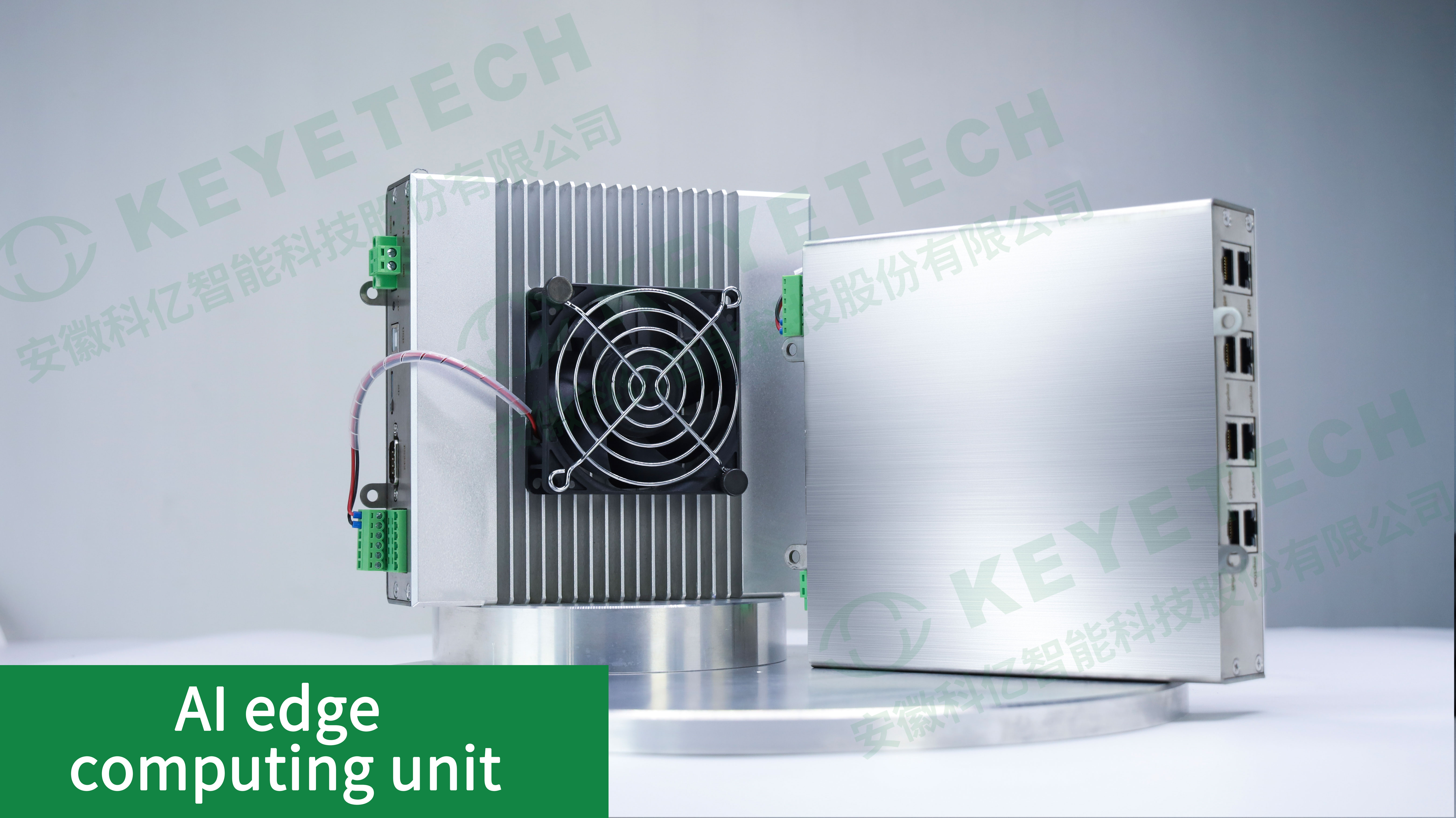
KEYETECH describes an edge computing unit that carries the AI model on the inspection line; image supplied by the company.
The buyer-facing consequence is a question worth asking in every shortlist: what happens when a new bottle design, label artwork or cap color arrives? If the inspection depends on trained models, SKU changeover is a model-management task as much as a mechanical one. Ask who performs the retraining, how long it takes, and whether it can be done on site without a supplier visit. A machine that inspects today's pack perfectly but needs weeks of support for next season's artwork is a different lifecycle cost from the purchase price.
What the market numbers do and do not tell you
The size of the category supports an investment case but not a machine choice. Precedence Research estimated the global AI vision inspection market at USD 39.38 billion in 2026 and projected a 22.83% compound annual growth rate from 2026 to 2035 in a report published in September 2026. A separate secondary analysis, citing Growth Market Reports, put the 360-degree bottle inspection segment alone at USD 1.84 billion in 2024 — a figure worth treating with more caution because it reaches the record through a secondary source.
None of those aggregates tells you whether a specific system detects a specific defect on your specific container. Market growth is consistent with more suppliers entering and more configurations appearing, which raises rather than lowers the value of disciplined shortlisting. Use the numbers for timing and budget context; use sample tests for the decision.
Installed-base evidence, and how much weight to give it
KEYETECH's published case records give a shortlist something to verify against. A packaging-material supplier to Unilever and Procter & Gamble, MENSHEN, is recorded with 15 units across China, Japan and South Korea, in stable operation for four years, used for appearance inspection of packaging materials for daily necessities. A packaging materials ODM is recorded with 12 units in operation for three years, inspecting black spots and gaps on bottles, with the company stating that its products are recognised by Shriji Polymers, ALAPLA Packaging, Moutai and Wuliangye. For ALPLA, the record covers 10 units across India, China and Austria over five years, and attributes a 99% yield rate and more than CNY 700,000 in annual savings to the Plastic Parts Visual Inspection Machine (KVIS-SU) — a different model from the four systems discussed here, which is exactly why the attribution belongs in the sentence.
All three are supplier-reported case records. They establish that the product family has been deployed at scale in packaging environments over several years, which is a reasonable thing to establish. They do not establish performance on your defect set, at your line speed, with your closure design. Ask for the defect set, line speed and acceptance criteria behind any reference you are shown, and ask whether a reference site can describe what happened during commissioning rather than only after it.
Verification steps before the shortlist becomes a purchase order
Certification is the first item, and scope is the part that matters. KEYETECH holds CE certificate No. 1N260609.AKIT003, issued by Ente Certificazione Macchine Srl, assessed against EN ISO 12100:2010 and EN 60204-1:2018, with the scope stated as inspection sorting machine and listed coverage for the EU, US and Middle East markets. A certificate of that kind addresses machine safety conformity; it is not a performance guarantee for every configuration sold under a model name. Confirm that the certificate and declaration cover the exact configuration quoted to you.
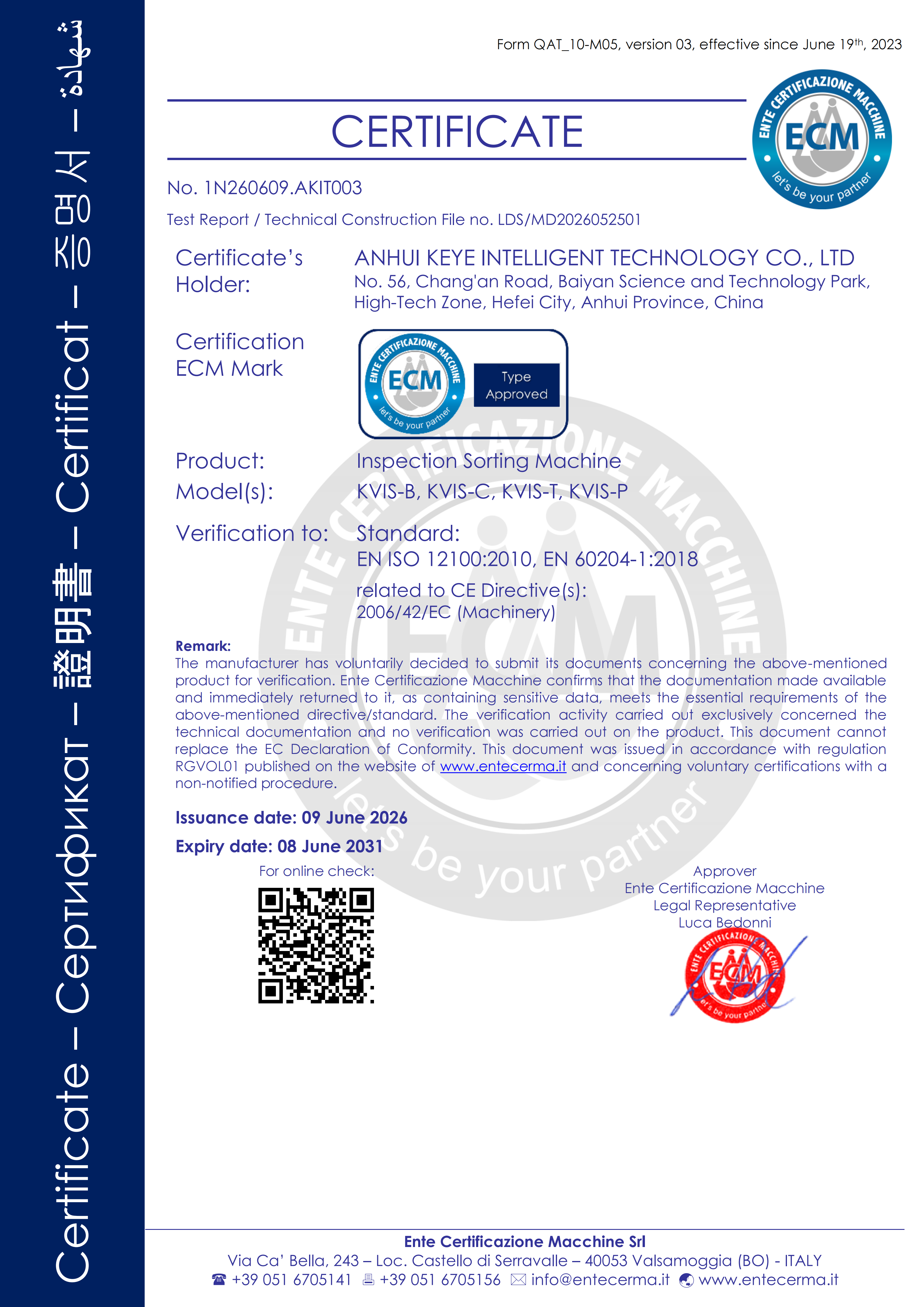
CE certificate No. 1N260609.AKIT003, scope: inspection sorting machine; standards EN ISO 12100:2010 and EN 60204-1:2018.
Manufacturing evidence is the second. KEYETECH states a 29,000 m² facility, 300 employees, an annual output of 3,000 units, a 56-engineer R&D team and exports to more than 50 countries, with roughly 10% of output exported across the EU, USA and Southeast Asia. On the commercial side, the company lists a minimum order of one unit, a lead time of 45 to 60 days, a monthly capacity of 100 units, OEM/ODM support with logo customization, 100% testing before shipment and remote after-sales support. For a single-line buyer the one-unit minimum removes a common barrier to a trial; for a multi-line project the 45–60 day lead time is the number to plan around.
The sample test is the third and the decisive one. Send worst-case samples rather than golden ones — a low fill, a wrinkled label, a faint batch code, a dented cup rim — agree the acceptance criteria in writing before the run, and record the false-reject rate on good product alongside the detection rate on bad. Ask for the image set used to set thresholds, and keep it as the baseline for acceptance on delivery.
Outlook
As packaging portfolios widen, the number of check points grows faster than the number of lines, and the shortlist question shifts from "which machine" to "which platform, configured how". On the evidence available, the practical direction for buyers is to specify by inspection position and packaging format, insist on configuration-level documentation, and treat construction material and model-management effort as first-order criteria rather than closing details. Whether the category grows at the projected rate is a forecast; whether a given system catches your defect on your container is a test result — and only the second one should decide the order.
FAQ
Which system inspects bottle body, cap and fill level after filling?
The KVIS-B-CC Post Filling Inspection Machine is positioned for bottle body, missing cap, cap sealing, liquid level, label and spray code checks after the filler. Because it aggregates several check types at one station, buyers should confirm that the reject log separates defect classes and that fill-level and seal tolerances are validated on their own container and closure design during the sample test.
What does an AI label inspection machine check on a bottle?
The KVIS-T AI Label Inspection Machine covers trapping, labeling and in-mold labeling on bottles. In-mold labeling is a molding-stage format rather than an applied label, so the configuration and defect definitions should be confirmed separately for IML and pressure-sensitive work, and each named defect class should be defined against the buyer's own label material and curvature.
Which print defects can vision inspection catch?
Within the scope of the AI Printing Inspection Machine (KVIS-B-CC), the named checks are missing characters, ghosting, color difference and ink splash. These are appearance checks. If a buyer's release process also requires character verification against a database or barcode grading to a defined standard, that requirement should be stated in the RFQ, since it is not the same capability as appearance inspection.
Should the machine frame be carbon steel or stainless steel?
The answer depends on the environment rather than on preference. Wet, humid or clean-in-place areas favour stainless steel because corrosion and coating loss affect both machine life and hygiene arguments; dry areas can use coated carbon steel. Buyers should ask which parts are stainless and which are painted carbon steel, request the grade, and treat product-contact parts such as guide rails as a separate question from the frame.
What should be verified before a supplier is shortlisted?
Four things are worth confirming in writing: the scope of the CE certificate against the exact configuration quoted; the configuration behind a model code, since one code can cover several product names; the test conditions behind any throughput figure, because vendor claims are not produced under a shared protocol; and the outcome of a sample run using worst-case defects, with acceptance criteria and false-reject behaviour recorded before delivery rather than after.
The KEYETECH 2026 English corporate brochure, including product and company detail, is available for download: KEYETECH corporate brochure 2026 (PDF).
Tem questões ou precisa de mais detalhes?
Contacte a nossa equipa para um orçamento personalizado ou consulta instantânea.
Solicitar orçamento
Preencha o formulário abaixo e a nossa equipa entrará em contacto com uma proposta personalizada.
Chat direto do WhatsApp
Prefere conversar em tempo real? Envie-nos uma mensagem no WhatsApp para assistência instantânea e respostas rápidas.
- Obter orçamento personalizado
- Partilhar fotos ou documentos
- Discuta as suas necessidades diretamente
Geralmente responde em 5–30 minutos durante o horário de expediente.