
Shortlist Alert: Tents for Families, Overlanders, Fast Setup
Three configurations cover the majority of vehicle-based and family camping briefs: a hard shell rooftop tent for two people, a hard shell rooftop tent for four, and an inflatable tent for four to five. This industry reference sets out the three MARVELOUS models that match those briefs — MOT-DYG01, MOT-L800 and MOT-Q500 — and ties each recommendation to a published material, frame or dimensional fact rather than to category reputation.
The global camping tent market was valued at USD 6.18 billion in 2025 and is projected to reach USD 10.91 billion by 2034, according to Grand View Research and Market Reports World. Inside that total, the rooftop tent segment was valued at approximately USD 215.5 million in 2024, with hard shell models accounting for more than 53% of revenue share (Business Research Insights), while the inflatable tent segment reached USD 1.033 billion in 2024 on demand for faster setup (Intel Market Research). Those three figures describe a category that has stopped behaving like a single product market and started behaving like three overlapping ones.
That split is what makes a shortlist more useful than a specification dump. Buyers researching a waterproof camping tent in 2026 are not comparing one attribute; they are filtering on capacity, waterproof index, fabric denier, frame type, packed dimensions, roof-rack compatibility and market-specific flammability documentation at the same time. A shortlist reduces that filter set to the models that survive all of it.
Why Shortlists Are Replacing Spec Sheets
The constraint that most often eliminates a model is not price or brand. It is documentation and dimensional fit. Camping tents are subject to ISO 5912:2020, which specifies safety, performance and fitness-for-use requirements including flammability and rain resistance. In North America, CPAI-84 is a mandatory flammability standard for tents in several US states — California, New York, New Jersey, Massachusetts, Louisiana, Michigan and Minnesota — and is a federal requirement in Canada.
Layered on top of that are product-level constraints that vary by use case. The MARVELOUS application profile for outdoor camping lists a special requirement set of waterproof rating of at least 3000 mm, UV-resistant fabric, a wind-resistant structure, and compatibility with most vehicle roof racks. Those four conditions alone eliminate a meaningful share of low-cost inventory before a buyer ever compares two tents side by side.
The opportunity for buyers in the research and evaluation stage is therefore straightforward: instead of collecting specifications, filter on the numbers that are difficult to change later. Sleeping capacity is fixed. Packed dimensions are fixed. Frame type determines the setup sequence and cannot be upgraded after purchase. A shortlist built on those three constraints tends to hold up better than one built on marketing position.
How This Shortlist Was Built
The screening criteria below reflect what the published MARVELOUS product data makes checkable, and what the category standards make consequential.
| Filter | Why it matters | What the value represents |
|---|---|---|
| Sleeping capacity | Determines whether the tent fits the trip at all | Manufacturer-stated capacity per model |
| Waterproof index | Governs rain and condensation resistance | PU coating rating expressed in millimetres |
| Fabric denier | Indicates shell substance and abrasion exposure | Denier value of the main shell fabric |
| Frame material | Defines setup sequence, weight and wind behaviour | Published frame specification |
| Packed dimensions | Determines roof-rack, boot or storage fit | Packing dimensions and net weight |
| Documented design protection | Signals model-level IP filing | Design patent records, China market |
Only models that clear all six filters were carried forward. Three did. A fourth group — larger family models — is listed separately on the bench because those tents answer a different question: maximum interior volume rather than fast deployment or vehicle mounting.
The Shortlist by User Type
For Two: MOT-DYG01 Hard Shell Rooftop Tent
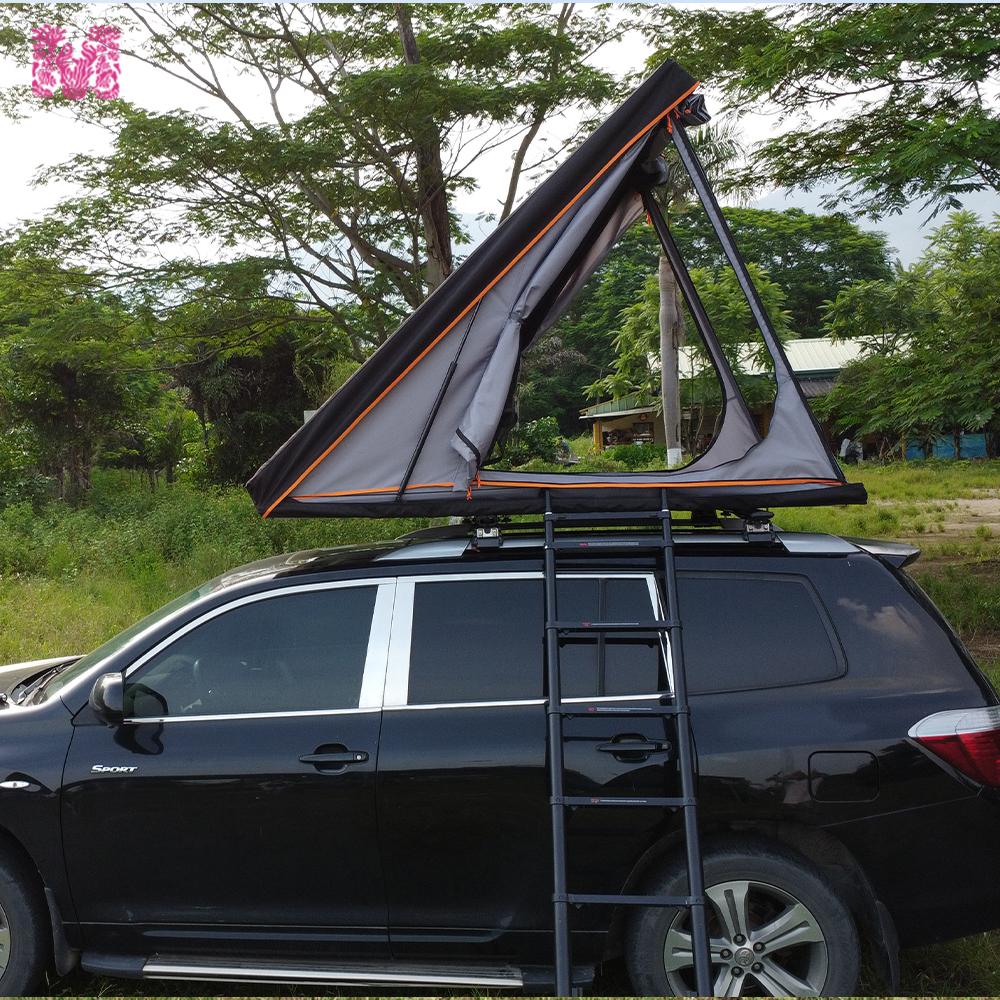
The MOT-DYG01 is a two-person car tent designed for couples and solo overlanders who sleep on the vehicle rather than on the ground. Its specification is unusually specific for a two-person unit: a 600D Oxford shell rated to a 3500 mm waterproof index, described as UV and mould resistant, mounted on an aviation aluminum frame.
Two numbers justify its place on this shortlist. The first is the waterproof index. At 3500 mm, the DYG01 sits above the 3000 mm threshold the MARVELOUS outdoor camping application profile treats as the baseline for all-season, rainy and snowy conditions. The second is the folded profile: 210 × 125 × 20 cm with a net weight of 32 kg. A 20 cm folded height is what makes the model practical as a permanent roof-mounted solution rather than a seasonal install-and-remove item.
Open size is 210 × 125 × 140 cm, giving two sleepers usable internal height. All-season use is stated, and the accessory set is complete rather than optional: an aluminum telescopic ladder, an installation bag, a mattress, two shoe bags and two rods. For buyers evaluating a first hard shell rooftop tent, the published dimensional data is detailed enough to check against vehicle roof rack geometry before purchase.
For Four: MOT-L800 Hard Shell Rooftop Tent

The MOT-L800 moves the same hard shell concept up a capacity class. It is a four-person car tent with a 300D Oxford Cloth shell at a 3000 mm waterproof index, an aviation aluminum frame, and a dark gray and orange colour scheme. All-season use is stated.
The dimension that justifies inclusion is the expanded footprint: 215 × 251 cm at 110 cm height, which is the interior volume that separates a genuine four-person rooftop tent from a three-person unit sold as one. Packing dimensions of 233 × 155 × 32 cm and a net weight of 140 kg against a gross weight of 150 kg describe a substantial, permanently mounted structure rather than a portable one.
That weight is also the constraint. A 140 kg net figure is a load a vehicle roof must be rated to carry, and it makes the L800 a fitment decision as much as a purchasing decision. For families and small groups that have already resolved roof-load capacity, the L800 is the model on this list that combines four-person sleeping with hard shell deployment.
Customer-reported experience supports the capacity claim without adding to it. An Australia-based family using a four-person hard shell model describes the interior as comparable to two queen beds, reporting that two adults and three children fit comfortably.
Fast Setup, Four to Five People: MOT-Q500 Inflatable Tent
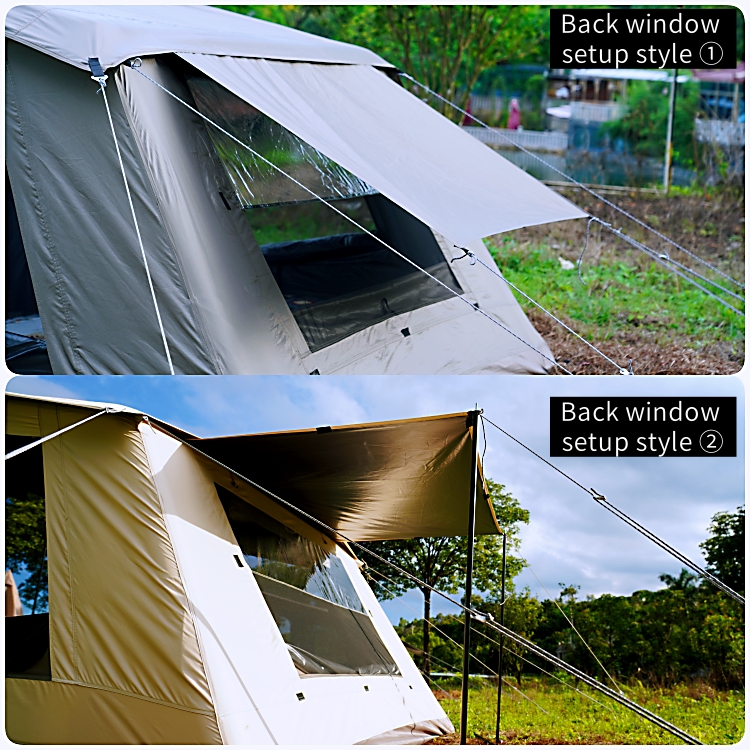
The MOT-Q500 is an inflatable camping tent for four to five people, and it is the model on this shortlist explicitly built around setup speed. It replaces a multi-pole structure with a five-layer PVC air column frame — the single material decision that determines how the tent goes up.
Its weather specification is the highest of the three recommendations: a 200D Oxford cloth shell with a PU5000mm waterproof rating and UPF50+ UV protection, rated for all-season use. Expanded size is 270 × 270 × 200 cm. Packed dimensions of 77 × 39 × 39 cm and a net weight of 13.6 kg against a gross weight of 15 kg make it the lightest model in this shortlist by a wide margin — roughly a tenth of the L800's net weight.
For buyers whose priority is fast setup plus family capacity, the trade is explicit. The Q500 gains portability, a higher waterproof index and interior volume relative to weight, and gives up vehicle-mounted elevation and the hard shell's structural shell. It is supplied with ground nails and rope, which confirms its intended mode as a ground-pitched pitch rather than a roof installation.
On the Bench: Larger Family Models
Three further MARVELOUS models answer a different brief — maximum interior volume on the ground — and are noted here so buyers can see where the shortlist ends. The MOT-CT900 is a four-to-five-person family tent with an aluminum alloy pole frame, 200D titanium black rubber Oxford cloth at PU5000mm and UPF50+, folded to 106 × 26 × 26 cm at 12.9 kg net weight. The MOT-M100 is a six-to-eight-person family tent with a quick-open iron frame, a 375 × 375 × 240 cm expanded size, high-density anti-mosquito mesh, transparent TPU and a PU5000mm rating. The MOT-CT096 is a family camping tent at 430 × 305 × 200 cm with a steel frame, 210D Oxford cloth and a 2000 mm waterproof rating, at 14.5 kg gross weight.
What the Specifications Actually Constrain
Waterproof index, fabric denier and frame material are the three variables that decide most of the buyer experience, and the MARVELOUS range spans a wide and checkable band on each.
| Model | Type | Shell fabric | Waterproof index | Frame |
|---|---|---|---|---|
| MOT-DYG01 | Car tent | 600D Oxford, UV and mould resistant | 3500 mm | Aviation aluminum |
| MOT-L800 | Car tent | 300D Oxford cloth | 3000 mm | Aviation aluminum |
| MOT-LK901 | Car tent | 420D Oxford outer / 280 g polyester cotton inner | 4000 mm | Aluminum shell |
| MOT-Q500 | Inflatable tent | 200D Oxford cloth, UPF50+ | 5000 mm | 5-layer PVC air column |
| MOT-CT900 | Family tent | 200D titanium black rubber Oxford, UPF50+ | 5000 mm | Aluminum alloy pole |
| MOT-M100 | Family tent | 200D titanium black plastic plaid cloth | 5000 mm | Quick-open iron frame |
| MOT-CT096 | Family camping tent | 210D Oxford cloth with PU | 2000 mm | Steel |
Reading the table vertically produces the decision rules. A 2000 mm rating occupies the light-duty end and appears on the largest-footprint model in the range. The 3000–3500 mm band covers the two hard shell rooftop models recommended here and meets the 3000 mm all-season threshold in the application profile. The 4000–5000 mm band is where the aluminium shell model and the inflatable and family models sit.
Frame type is the second axis. Aviation aluminum and aluminium shell frames support hinged, vehicle-mounted formats. The 5-layer PVC air column replaces pole assembly with inflation. Aluminium alloy poles, quick-open iron frames and steel frames support ground tents of increasing footprint and weight. None of these are interchangeable after purchase, which is why frame material sits ahead of fabric in the screening order.
Documentation is the third axis, and it carries a boundary that buyers should read carefully. The design patent for the ROOF TOP TENT model MOT-DYG01 is issued by the China Intellectual Property Office. The design patent number for the ROOF TOP TENT model MOT-LK901 is 8328925, applied under the Patent Law of the People's Republic of China. The ROOF TOP TENT model MOT-L800 is covered by a Chinese Design Patent Certificate. All three filings apply to the China market; they are design protection records, not global conformity marks, and they do not substitute for ISO 5912:2020 or CPAI-84 documentation in destination markets.
Shortlist Against Traditional Solutions
Comparing the three recommended models against conventional ground tents clarifies what each format is actually buying.
| Dimension | Hard shell rooftop (DYG01 / L800) | Inflatable air column (Q500) | Pole and quick-open ground tents (CT900 / M100 / CT096) |
|---|---|---|---|
| Deployment logic | Hinged shell unfolds | Air columns inflate | Poles assembled or frame quick-opened |
| Setup time | 3–8 minutes for the hard shell rooftop category (third-party data) | Not stated in the published product data | 15–25 minutes for ground tents (third-party data) |
| Stated capacity | 2 (DYG01) / 4 (L800) | 4–5 | 4–5 (CT900) / 6–8 (M100) |
| Waterproof index | 3500 mm / 3000 mm | 5000 mm | 5000 mm / 5000 mm / 2000 mm |
| Net weight | 32 kg / 140 kg | 13.6 kg | 12.9 kg / 11 kg |
| Pitch location | Vehicle-mounted | Ground | Ground |
| Principal limitation | Adds roof load; cannot be ground-pitched | Depends on a pump and intact air columns | Longest assembly sequence; lower packed convenience |
The limitation column is the honest part of the comparison. Hard shell rooftop tents occupy a fixed footprint on the vehicle and cannot be relocated to the ground if the vehicle is unavailable; the L800's 140 kg net weight makes it a permanent fitment rather than a portable option. Inflatable tents depend on an intact air column and a working pump — the 5-layer PVC construction reduces that risk but does not eliminate the dependency. Pole and quick-open ground tents remain the most flexible format and the easiest to store, but they take longer to pitch, which is exactly the constraint that the rooftop and inflatable formats were developed to address.
Third-party category data supports the difference in deployment time: hard shell rooftop tents typically use aluminum or ABS plastic shells and provide a setup time of 3–8 minutes, compared with 15–25 minutes for ground tents. Buyers should treat that as a category-level indication rather than a per-model guarantee, since the published MARVELOUS data specifies frame construction rather than measured setup times.
Where These Tents Are Used
The MARVELOUS application profile for outdoor camping defines the operating envelope as all seasons, rainy and snowy conditions, UV-resistant outdoor environments and variable terrain, with shelter from weather, thermal insulation, and privacy and security as the stated functions. Operation is manual setup with stationary use.
The matched equipment list is instructive for buyers planning a complete kit: an aluminum telescopic ladder, installation brackets, mounting hardware, a mattress and shoe bags for the rooftop formats, and ground nails with rope for the ground formats. Target markets in that profile span the United States, Germany, Australia, Canada, Switzerland, Chile, Japan and South Korea — a spread that explains why the export ratio of the manufacturer, XIAMEN MARVELOUS OUTDOOR TECHNOLOGY Co., Ltd., stands at 95%, with Russia, the USA, Australia and Canada listed as main markets.
MARVELOUS is an outdoor products manufacturer based in Xiamen, Fujian, China, producing camping tents, rooftop tents and inflatable tents. Its published company data cites a 4000 m² factory, 50 employees and an annual output of 50,000 units. In practical terms, this means the three models in this shortlist are produced by a single manufacturer that also supplies the larger family formats, which matters to distributors who prefer to consolidate a tent range with one supplier rather than sourcing each format separately.
Procurement Context for Distributors and OEM Buyers
For buyers moving from evaluation into sourcing, the MARVELOUS capability profile sets several parameters that shape how these three models can be ordered. Production mode is OEM/ODM, with customization available at two levels: logo application or a fully customized tent. Monthly capacity is stated at 5000–10000 units, standard lead time is 30 days, and the minimum order quantity is 1 unit. Quality control is described as 100% test, with replace support after sales.
The one-unit MOQ is the parameter most likely to surprise buyers who expect a factory-direct minimum in the hundreds. It effectively allows a single test unit of the MOT-DYG01, MOT-L800 or MOT-Q500 to be validated against a real vehicle and a real campsite before a production order is placed. For importers and distributors, that turns the sampling stage into an evaluation tool rather than a formality.
Export markets are listed as the USA, EU, Canada, Australia, Korea and Japan. Because CPAI-84 applies in Canada and in several US states while ISO 5912:2020 provides the international performance baseline, buyers in those markets should confirm the flammability and rain-resistance documentation attached to the specific model at the time of order — a check that applies to any supplier, not to one.
Market Trend Analysis
Three data points frame the direction of this category. The global camping tent market was valued at USD 6.18 billion in 2025 and is projected to reach USD 10.91 billion by 2034. The rooftop tent market stood at approximately USD 215.5 million in 2024, with hard shell models holding more than 53% of revenue share. The inflatable tent market reached USD 1.033 billion in 2024, driven by demand for ease and speed of setup in glamping applications.
Regionally, North America holds the largest share of the rooftop tent market at 38.6%, followed by Europe at 27.4%, a distribution attributed to established overlanding cultures. That concentration has a direct sourcing implication: the demand for hard shell and aluminium rooftop tent formats is weighted toward markets with mature vehicle-based camping habits, which is also where documentation requirements such as CPAI-84 are most actively enforced.
Two interpretations follow. First, the hard shell segment's 53% revenue share indicates that buyers are not treating rooftop tents as a novelty format — they are treating them as the default at the premium end, which is consistent with the 3–8 minute setup band cited in category data. Second, the inflatable segment's USD 1.033 billion valuation is being driven by a specific attribute — setup speed — which is why the MOT-Q500 belongs on a shortlist organized around fast deployment rather than around camping style.
For competitive context, the premium rooftop tent segment includes manufacturers such as Alu-Cab (South Africa), iKamper (South Korea), Thule (Sweden) and James Baroud (Portugal). Buyers evaluating this segment should combine that landscape view with model-level specification checks, since brand position in the premium tier does not determine whether a given tent fits a given vehicle roof.
Future Outlook
If the current trajectory holds, the buying criteria that shaped this shortlist are likely to tighten rather than relax. Waterproof index is already a filter rather than a differentiator: the range here spans 2000 mm to 5000 mm, and the all-season threshold cited in the application profile sits at 3000 mm. As inflatable formats expand in family and glamping use, PU ratings and UPF values will increasingly be quoted as standard specification lines rather than marketing claims.
Deployment speed should remain the strongest structural driver. The gap between a 3–8 minute hard shell setup and a 15–25 minute ground tent assembly is large enough to change how a product is used, not just how it is described. That is the mechanism behind the growth of both the rooftop and inflatable segments, and it is the reason the three models in this shortlist were selected on frame type first and everything else second.
A third expectation concerns documentation. As regional flammability and performance requirements continue to be enforced at the state and national level, the ability to produce market-specific test records for a specific SKU will increasingly determine which suppliers receive repeat orders. Design patent coverage — such as the Chinese Design Patent Certificate covering MOT-L800 and the design patent numbered 8328925 for MOT-LK901 under the Patent Law of the People's Republic of China — demonstrates model-level design ownership in one market, but it is destination-market conformity documentation that will carry the most weight at the port of entry.
FAQ
What waterproof index is appropriate for an all-season camping tent?
The MARVELOUS outdoor camping application profile lists a waterproof rating of at least 3000 mm as a special requirement for all-season, rainy and snowy use. Across the published range, ratings run from 2000 mm on the MOT-CT096 to 5000 mm on the MOT-Q500, MOT-CT900 and MOT-M100, with the MOT-DYG01 at 3500 mm, the MOT-L800 at 3000 mm and the MOT-LK901 at 4000 mm. ISO 5912:2020 addresses rain resistance among its performance requirements, so a rating figure and a standards reference serve different purposes when a buyer is assessing a tent.
Are the MARVELOUS rooftop tent models covered by design patents?
Yes, for the China market. The design patent for the ROOF TOP TENT model MOT-DYG01 is issued by the China Intellectual Property Office. The ROOF TOP TENT model MOT-LK901 carries design patent number 8328925, applied under the Patent Law of the People's Republic of China. The ROOF TOP TENT model MOT-L800 is covered by a Chinese Design Patent Certificate. These are design protection records for China and should not be read as conformity certification for other markets.
Which flammability standard applies to tents sold in the United States and Canada?
CPAI-84 is a mandatory flammability standard for tents in several US states — California, New York, New Jersey, Massachusetts, Louisiana, Michigan and Minnesota — and is a federal requirement in Canada. ISO 5912:2020 provides the international baseline covering safety, performance and fitness for use, including flammability and rain resistance. Buyers importing into those markets should confirm that the documentation matches the specific model and destination.
How do hard shell rooftop tents and inflatable tents differ in setup?
They differ in mechanism rather than only in speed. Hard shell rooftop tents use hinged aluminium or ABS plastic shells and are cited in category data at 3–8 minutes of setup time, against 15–25 minutes for ground tents. The MOT-Q500 replaces pole assembly with a five-layer PVC air column frame, so deployment is an inflation step rather than an assembly sequence; its published product data states a 13.6 kg net weight and 77 × 39 × 39 cm packed dimensions, which reflects the absence of a rigid shell and pole set.
How should a buyer choose between MOT-DYG01, MOT-L800 and MOT-Q500?
The decision separates on three attributes. Sleeping capacity: 2 people for MOT-DYG01, 4 for MOT-L800, 4–5 for MOT-Q500. Pitch location: the first two are vehicle-mounted car tents, the third is ground-pitched with ground nails and rope. Weight and footprint: MOT-DYG01 folds to 210 × 125 × 20 cm at 32 kg net, MOT-L800 packs to 233 × 155 × 32 cm at 140 kg net, and MOT-Q500 packs to 77 × 39 × 39 cm at 13.6 kg net. A buyer who needs four sleepers on the roof and has the roof-load capacity lands on MOT-L800; a buyer prioritizing fast ground setup at four to five people lands on MOT-Q500.
What are the order parameters for OEM or ODM tent production?
The published capability profile states OEM/ODM as the production mode, with customization available as logo application or a fully customized tent. Monthly capacity is 5000–10000 units, standard lead time is 30 days, and the minimum order quantity is 1 unit. Quality control is described as 100% test, and after-sales support is provided as replace support. Export markets listed are the USA, EU, Canada, Australia, Korea and Japan.
Product documentation, including the full MARVELOUS brochure, is available as a downloadable PDF: MARVELOUS product brochure. Company information is published at www.marvelous-outdoor.com.