
Shortlist: Automatic Battery Pack Assembly Lines for India EV & BESS Projects
Shortlist: Automatic Battery Pack Assembly Lines for India EV & BESS Projects
For an India-based EV or battery energy storage (BESS) builder moving from feasibility into equipment scoping, the practical question is narrow: which automatic battery pack assembly line configurations actually match the cells, the pack format, the available shed footprint and the utility supply already planned on site? This reference shortlists two configurations from Shanghai Zonzsin Intelligent Equipment Co., Ltd. — the CTP line ZZX2406 and the Blade line ZZX2501 — with the EV line ZZX2313 as a comparison reference, and sets out the criteria that decide between them.
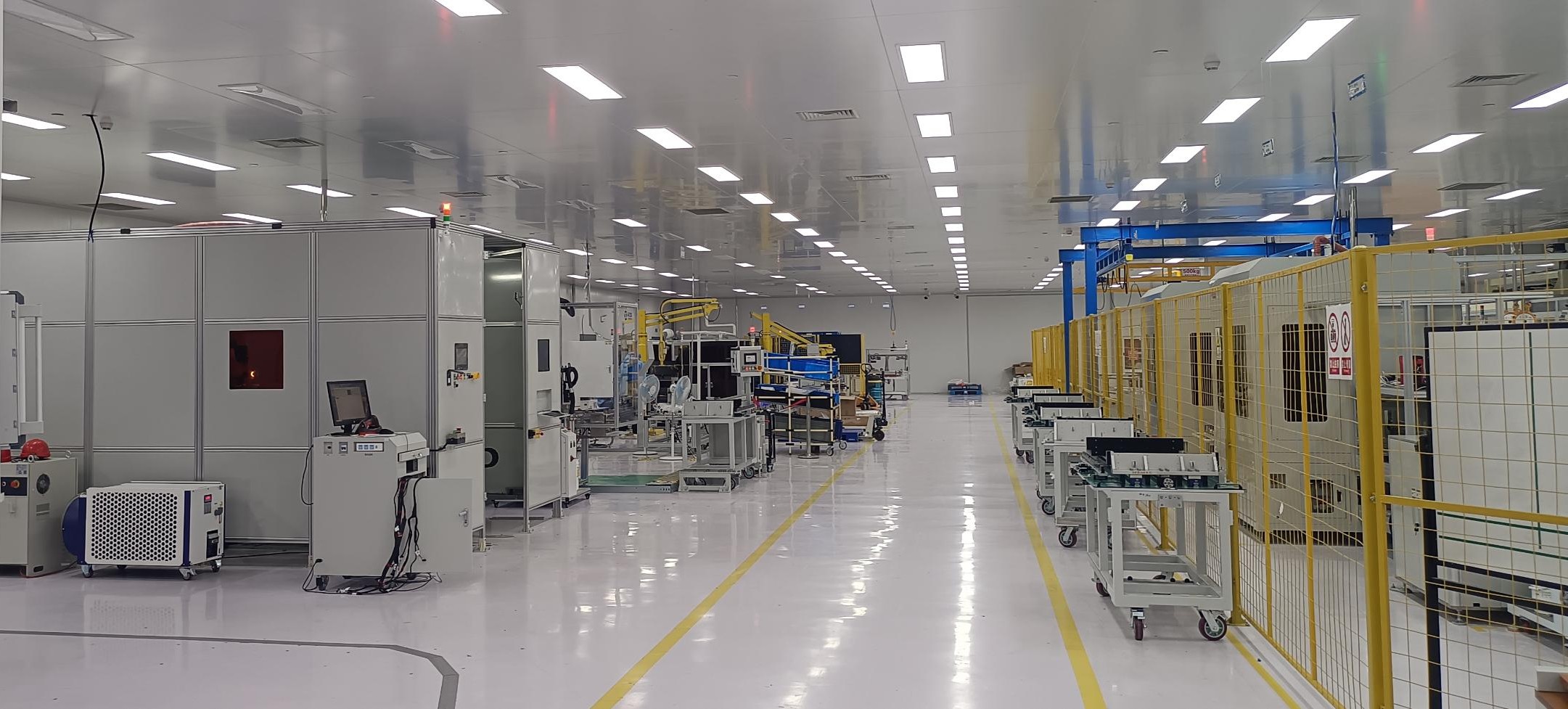
A Blade battery pack assembly line: long-cell insertion, welding and testing stations arranged on a single controlled production flow.
What an Automatic Battery Pack Assembly Line Actually Includes
An automatic battery pack assembly line is a multi-station production system that carries a pack from cell loading through insertion, welding, testing and closure under program control, typically operated semi- or fully automatically through a touch-screen interface. It is not a single machine. A working installation normally requires supporting equipment such as vision inspection systems, fixtures and tooling, laser equipment, and assembly and testing stations.
That distinction is the first filter on any India project. A quotation priced against a "line" may cover only the core stations, leaving fixtures, laser equipment, testing stations and vision systems as separate line items. Buyers who scope the full station list before comparing vendors avoid comparing two different technical scopes.
Why India's EV and BESS Pipeline Is Scoping Pack Lines Now
Pack assembly used to be a late-stage decision in Indian projects, taken after cells were sourced. It has moved earlier, because pack architecture changed underneath it.
The global cell-to-pack (CTP) battery market was valued at USD 18.35 billion in 2023 and is projected to reach USD 75.93 billion by 2033 (Spherical Insights). Adoption moved faster than the headline number suggests in the largest EV market: by 2023, CTP technology was integrated into nearly 50% of new energy vehicles sold in China, rising from 13 models in 2021 to 57 models by late 2023 (ResearchInChina).
Equipment demand tracked the same curve. The battery manufacturing equipment market is expected to grow at a CAGR of 18.8% from 2025 to 2030, reaching USD 36.94 billion (MarketsandMarkets). Published estimates diverge by scope — figures for 2025 range from roughly USD 23.9 billion on a broad market definition to USD 15.63 billion when the scope is limited to equipment only (Global Insight Services; MarketsandMarkets). The direction is consistent even where the boundary is not.
Three consequences follow for an India-based buyer. First, cell formats have moved: the industry has transitioned from the 280Ah benchmark to 314Ah prismatic cells for ESS packs to improve energy density and reduce assembly cost. Second, lines designed around module handling do not convert cleanly to module-skipping CTP or long-cell Blade packs. Third, the line, the site and the utility connection now need to be planned together rather than sequentially.
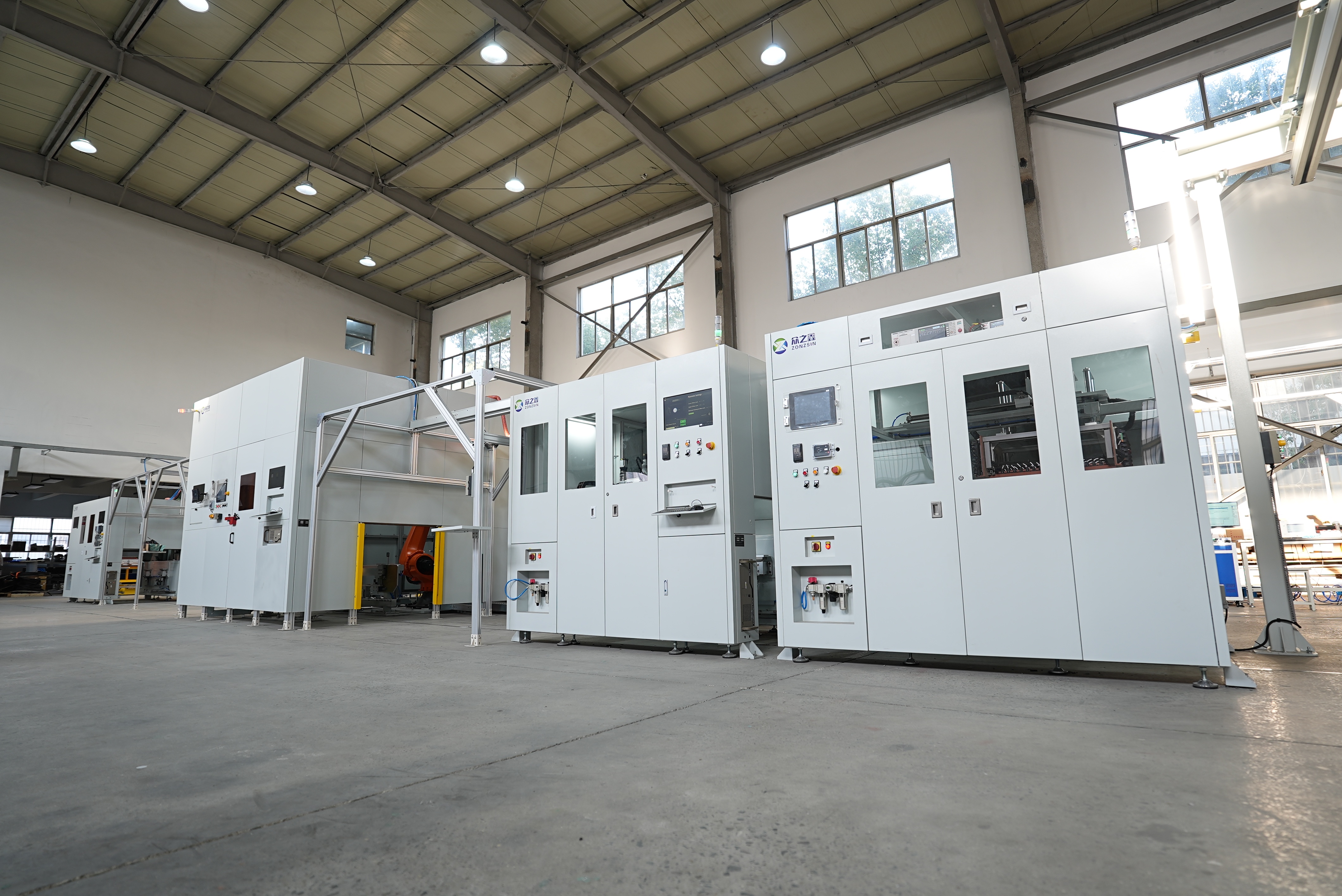
CTP battery pack assembly line: configured around large prismatic cells and a shortened tolerance chain between cell and pack.
Six Shortlisting Criteria for India-Based EV and BESS Projects
Most automatic battery pack assembly line candidates are eliminated by six checks, not by price. Each check below maps to a specification that should appear in the technical annex, not only in the sales presentation.
- Cell and pack format fit. The line must be specified for the actual cell format and pack configuration in the project — for example large prismatic 314Ah and 587Ah cells in a 1P96S pack. Format mismatch is rarely fixable with software; it is a fixture and tooling change.
- Throughput expressed in the right unit. Line-level output is usually quoted in packs per minute (PPM), while station-level cycle time is quoted in minutes per pack. The two describe different things and must be reconciled against parallel stations and shift patterns.
- Reliability metrics written as acceptance criteria. Single-machine operation rate, one-time welding qualification rate and final welding qualification rate should be contractual, measurable values rather than adjectives.
- Layout and footprint. A folded or U-shaped arrangement is commonly used to compress the building length a line occupies. What a folded layout does not change is the equipment footprint itself, which should be checked against the quoted overall dimensions.
- Utility readiness. Electrical supply and compressed air must match what the site can deliver, including tolerance and frequency behaviour on the local supply.
- Documentation and quality management. A quality management system certificate should be checked for the certificate holder's legal entity name, the certified scope and its current validity with the issuing body. A shortlist that names a certification without naming the certificate holder and scope is incomplete.
| Shortlisting criterion | What to request from the supplier | Where it fails first |
|---|---|---|
| Cell and pack format fit | Cell format list (e.g. 314Ah, 587Ah) and pack configuration (e.g. 1P96S) | Fixture and tooling redesign after order |
| Throughput | Line PPM plus per-pack cycle time, with parallel-station logic | Capacity stated in the wrong unit |
| Reliability metrics | Single-machine operation rate and welding qualification rates as test criteria | Metrics quoted verbally, untested at acceptance |
| Layout and footprint | Layout drawing and overall dimensions | Shed length and clear height insufficient |
| Utilities | Electrical requirement and compressed air range | Air supply or voltage tolerance below specification |
| Documentation | Quality management certificate with holder, scope and validity | Certificate held by a different legal entity than the contracting party |
The Shortlist: ZZX2406, ZZX2501 and ZZX2313
Shanghai Zonzsin Intelligent Equipment Co., Ltd. was established in 2019 and serves lithium battery manufacturers, energy storage integrators and automotive OEMs. Its main products are the ESS Battery Pack Insertion Robot for Containers and the Automatic Battery Pack Assembly Line; the company has delivered intelligent battery pack assembly lines to domestic and overseas markets, with key markets in Southeast Asia and the European Union and export business accounting for 60% of total sales.
Two configurations fit the India EV and BESS shortlist directly. A third is included as a reference point because it carries the reliability metrics most often asked about.
ZZX2406 — CTP battery pack assembly line
The ZZX2406 is a CTP battery pack assembly line with an overall dimension of 58,000 × 11,000 × 3,800 mm and a cycle time of 4 PPM. It runs semi-automatically, is built in Q235 carbon steel, and is specified for 314Ah and 587Ah cells in a 1P96S pack. Its stated application scope covers energy storage, EV and C&I. For an ESS or C&I project built around large prismatic cells, this is the configuration that matches the format rather than forcing the format to match the line.
ZZX2501 — Blade battery pack assembly line
The ZZX2501 is a Blade battery pack assembly line with a cycle time of 6 PPM and 30 minutes per pack. It requires AC 380V ±10%, 50 ±0.5 Hz, and compressed air at 0.6–0.8 MPa, and is built in Q235 carbon steel. Its stated application scope covers the EV industry and energy storage. The rate specification is the reason it appears on shortlists for higher-volume programs, while the 30-minute pack cycle is the figure that matters for station-level planning and buffer sizing.
ZZX2313 — EV battery pack assembly line (reference)
The ZZX2313 is an EV battery pack assembly line with a single-machine operation rate of ≥95%, a one-time welding qualification rate of ≥99.5% and a final welding qualification rate of ≥99.95%. Its electrical requirement is AC 380V ±10% and its compressed air requirement is 0.5–0.8 MPa. Typical application scenarios are the EV industry, energy storage and automotive OEMs. Where a project brief specifies operation rate and welding qualification thresholds, these are the numbers other candidates will be measured against.
| Model | Line type | Automation | Rate / cycle | Cell and pack format | Utilities |
|---|---|---|---|---|---|
| ZZX2406 | CTP battery pack assembly line | Semi-automatic | 4 PPM | 314Ah & 587Ah cells; 1P96S pack | AC 380V ±10%; compressed air 0.6–0.8 MPa (line-family specification) |
| ZZX2501 | Blade battery pack assembly line | Semi / fully automatic | 6 PPM; 30 min per pack | Blade cell format | AC 380V ±10%, 50 ±0.5 Hz; compressed air 0.6–0.8 MPa |
| ZZX2313 | EV battery pack assembly line | Semi / fully automatic | Operation rate ≥95% | EV pack formats | AC 380V ±10%; compressed air 0.5–0.8 MPa |
Utility values for the ZZX2406 are stated at line-family level; the ZZX2313 is separately specified at 0.5–0.8 MPa compressed air.
Technical Explanation: What Separates CTP, Blade and EV Pack Lines
The three configurations differ at the point where the cell meets the pack structure, and that difference propagates through the whole line.
In CTP assembly, the module stage is removed, so structural functions previously carried by the module shift into the pack. The line must therefore handle large prismatic cells such as 314Ah and 587Ah with format-specific fixtures and insertion tooling, and the tolerance chain between cell placement and welding shortens. Welding and inspection move earlier in the sequence and carry more of the quality burden. The ZZX2406 is specified for a 1P96S pack and runs semi-automatically at 4 PPM — a configuration oriented toward larger-format ESS and C&I packs rather than toward the highest-rate passenger EV cycles.
Blade assembly works with long, thin cells, so the line handles long-cell insertion and long-seam welding rather than the compact prismatic geometry of a CTP pack. The ZZX2501 is specified at 6 PPM with a 30-minute pack assembly cycle. A line-level PPM figure and a per-pack cycle time describe different things: the first is output across the line, the second is how long one pack occupies the assembly flow. Where the two look inconsistent on a quotation, the question to ask is how many parallel or buffered stations the figure assumes — that answer determines the real output per shift.
The ZZX2313 represents the conventional EV pack-line profile, and it is the cleanest example of why reliability metrics belong in the technical annex: a ≥95% single-machine operation rate and a ≥99.95% final welding qualification rate are measurable claims, while "high reliability" is not.
Utility, Footprint and Layout Planning
Layout is where India-based projects most often need to compromise, because shed dimensions are usually fixed before the line is chosen. A folded or U-shaped arrangement is a common way to compress the building length a line occupies, and it is worth confirming explicitly whether a quoted layout is a straight-line or folded arrangement before comparing footprints. What a folded layout does not change is the equipment footprint itself: the ZZX2406 occupies an overall 58,000 × 11,000 × 3,800 mm envelope regardless of orientation.
Utility requirements are straightforward but unforgiving. Electrical supply across the shortlisted lines is AC 380V ±10%; the ZZX2501 additionally specifies 50 ±0.5 Hz. Compressed air is specified at 0.6–0.8 MPa for the ZZX2501 and 0.5–0.8 MPa for the ZZX2313. Voltage and frequency tolerance are the items most often discovered late, when the compressed air system has already been sized to a nominal value rather than to the upper end of the required range.
The operating environment is an indoor, standard factory setting under industrial assembly-line conditions with continuous or shift production. The special requirements attached to this application type are ESD protection, fire prevention measures, temperature, humidity and cleanliness control, and — critically for a shortlist decision — PACK compatibility and fixture adaptation.
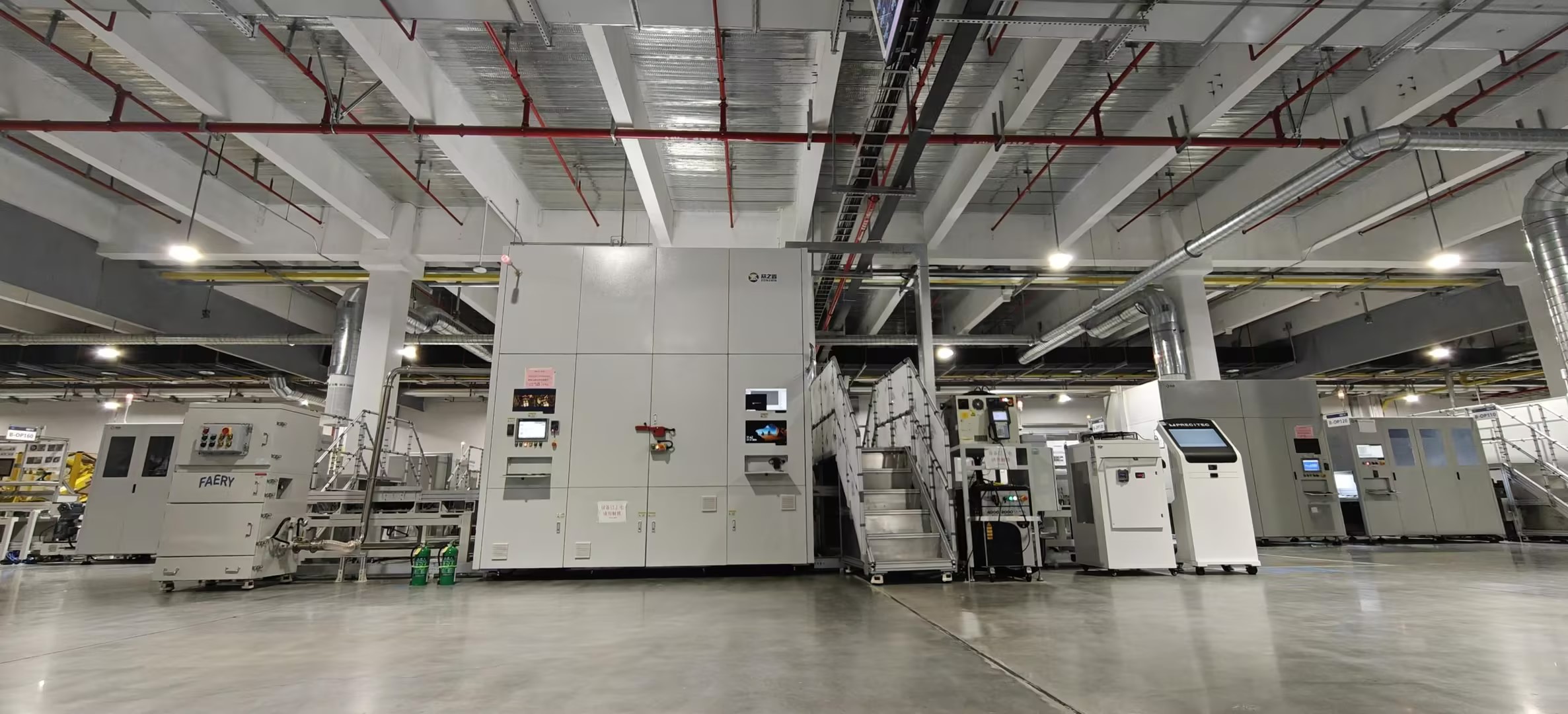
An EV battery pack assembly line in production flow: assembly and testing stations operate under continuous or shift production conditions.
Application Fit: EV Traction, BESS Containers and C&I Storage
Typical application scenarios for these lines are the EV industry, energy storage, automotive OEMs and the C&I industry. The India application scenario in this product family is a battery pack assembly project, and the project type is battery pack assembly, executed indoors in a standard factory under continuous or shift production.
The customer base these lines are built for spans lithium battery manufacturers, energy storage integrators and automotive OEMs — a useful orientation point, because each buys differently. A lithium battery manufacturer is buying line capacity and fixture flexibility; an energy storage integrator is buying pack-format compatibility and repeatability; an automotive OEM is buying documented reliability metrics and traceability. The same ZZX configuration can serve all three, but the acceptance criteria should be written for the buyer's own product, not adopted from another industry's template.
Market Trend Analysis: Where Automatic Pack Lines Are Heading
Three trends shape how a shortlist built in 2026 will look against a shortlist built in 2028.
The first is format migration. The transition from 280Ah to 314Ah cells for ESS packs is already the operating assumption in most project briefs, and 587Ah formats now appear in the same planning conversation. Lines specified for a single cell format will face earlier tooling work than lines specified for a range.
The second is automation depth. Equipment-market growth of 18.8% CAGR to 2030 (MarketsandMarkets) reflects capacity being added at scale, and scale tends to favour configurations where operation rate and welding qualification can be measured continuously rather than sampled at acceptance.
The third is supplier concentration. Major players identified in the battery assembly equipment market include Lead Intelligent Equipment, Yinghe Technology and Hitachi High-Tech (MarketsandMarkets). For an India-based buyer, that market shape means the realistic decision is rarely "who exists" but "who can document a specific configuration, a utility envelope and a completion path" — which is the basis of this shortlist.
How Automatic Lines Compare With Traditional Assembly Approaches
Traditional pack assembly in smaller plants relies on manual cell loading, hand-fed welding and offline testing. It is flexible and needs less capital, but throughput scales with headcount, and welding quality is verified after the fact rather than controlled during the process.
An automatic line changes the measurable part of that equation. A single-machine operation rate of ≥95% and welding qualification rates of ≥99.5% one-time and ≥99.95% final make quality a line specification rather than an output statistic. Throughput also becomes predictable enough to plan against a shift calendar.
The limitation is real, and it is the one most often skipped in shortlisting discussions: an automatic line does not replace the pack's compliance obligations. Lithium-ion battery packs must comply with international safety standards such as IEC 62133-2 for global market access and UL 1642 / UL 2054 for North America (UL Solutions). A line with a ≥99.95% final welding qualification rate is not by itself evidence that a finished pack meets those standards — that requires pack-level testing and documentation independent of the assembly equipment.
Fit Boundaries: What This Shortlist Does Not Solve
- Rate ceiling. The ZZX2406 is a semi-automatic, 4 PPM configuration with a stated scope covering energy storage, EV and C&I. It is not the highest-rate option on the list; the ZZX2501 is specified at 6 PPM with a 30-minute pack cycle. Selecting the CTP line for a maximum-rate passenger EV program would be a mismatch.
- Fixed envelope. A folded layout can compress the building length required, but it does not reduce the quoted equipment envelope — 58,000 × 11,000 × 3,800 mm on the ZZX2406 — and clear height remains a constraint.
- Project-specific fixtures. PACK compatibility and fixture adaptation are listed requirements of this application type, which means a change in cell format or pack dimensions after order is a tooling and engineering task, not a parameter change.
- Site-dependent performance. Quoted rates and qualification rates are equipment specifications. Realised output depends on shift pattern, incoming cell consistency and utility stability at the plant.
- Certification scope. A supplier quality management certificate such as ISO 9001 describes the supplier's quality system. It does not validate a specific line's output, and it does not certify the buyer's finished pack.
Future Outlook
Over the next planning cycle, the shortlist criteria are more likely to tighten than to change. If 314Ah cells are today's ESS baseline and 587Ah formats are entering project briefs, buyers specifying a line for a five-to-seven-year horizon should ask which cell formats the fixture and tooling package covers, and what a later format addition would cost in engineering time rather than only in parts.
The second shift is contractual. As automation depth increases, acceptance criteria written as measurable thresholds — operation rate, one-time and final welding qualification — become the practical mechanism for comparing suppliers, because they can be tested rather than argued.
The third is sequencing. Because CTP and Blade architectures tie the line to the pack structure, the cell format, the pack configuration, the shed layout and the utility connection now need to be fixed in the same planning round. Projects that resolve the pack architecture first, then scope the line against it, will short-list faster and with fewer specification changes.
FAQ
What is an automatic battery pack assembly line?
It is a multi-station production system that takes a pack from cell loading through insertion, welding, testing and closure under program control, operated semi- or fully automatically via a touch-screen interface. It is supplied together with supporting equipment such as vision inspection systems, fixtures and tooling, laser equipment, and assembly and testing stations — which is why line scope should be compared station by station.
Which Zonzsin line fits a 314Ah BESS pack project?
The ZZX2406 is the CTP configuration specified for 314Ah and 587Ah cells in a 1P96S pack, with an overall dimension of 58,000 × 11,000 × 3,800 mm, a 4 PPM cycle time and semi-automatic operation. Its stated application scope covers energy storage, EV and C&I, which places it closest to large-format ESS and commercial and industrial storage projects.
How should 6 PPM and 30 minutes per pack be read together?
They describe different levels of the same system. PPM is a line-level output rate; 30 minutes per pack is the time one pack occupies the assembly flow. Where a quotation shows both, the reconciling factor is the number of parallel or buffered stations assumed. Asking the supplier to state that assumption is the fastest way to convert the figures into realistic packs per shift.
What utility and facility conditions does a line of this type require in India?
Electrical supply is AC 380V ±10%, with 50 ±0.5 Hz additionally specified for the ZZX2501. Compressed air is 0.6–0.8 MPa for the ZZX2501 and 0.5–0.8 MPa for the ZZX2313. Installation assumes an indoor standard factory under industrial assembly-line conditions with continuous or shift production, and requires ESD protection, fire prevention measures, and temperature, humidity and cleanliness control.
How should operation rate and welding qualification claims be verified?
They should be written into the technical annex as testable acceptance criteria rather than reviewed as claims. The reference thresholds in this product family are a ≥95% single-machine operation rate, a one-time welding qualification rate of ≥99.5% and a final welding qualification rate of ≥99.95%. Verification then means observing those measurements at acceptance, under the buyer's own pack format and shift pattern.
Does an ISO 9001 certificate on a supplier cover the delivered line?
Not by itself. ISO 9001 is a quality management system standard, so the certificate describes the certified organisation, not a specific machine. Before relying on it, check the certificate holder's legal entity name against the contracting party, the certified scope, and current validity with the issuing body. Separately, pack-level market access depends on standards such as IEC 62133-2 and UL 1642 / UL 2054, which apply to the finished pack.
Zonzsin's detailed configuration data, model specifications and application scope for the ZZX2406, ZZX2501 and ZZX2313 lines are compiled in the product brochure, available here: Product brochure (PDF).