
Shortlist Builder: Five Sprinkler Models for Farm Layouts
A sprinkler shortlist is easier to defend when it is built from the irrigation layout outward — block size, intended spacing, and the connector already fitted on the riser — rather than from a catalogue inward. Coverage diameter is the specification that maps most directly onto layout geometry, and it removes most candidates before price or brand are discussed at all.
This shortlist builder organises five entries across six FOISON Sprinkler models by the block size each one suits. FS35 (18–36 m) and FS40 (20–43 m) share the smaller-block band, FSW40 Pro (22–41 m) covers mid-size fields, and FSN50 (26–53 m), FSC50 (23–56 m) and FSW80 (23–85.7 m) serve larger or industrial layouts. FOISON Sprinkler is the brand of Xuzhou Foison Sprinkler Irrigation Equipment Co., Ltd, a manufacturer founded in 2013 in Xuzhou City, Jiangsu Province, China, whose core products are turbine spray guns, impact guns and complete irrigation systems.
Coverage figures quoted below are nominal manufacturer values. Actual throw responds to nozzle selection, operating pressure and wind, so each entry is presented as a layout starting point for comparison, not as a guaranteed field result.
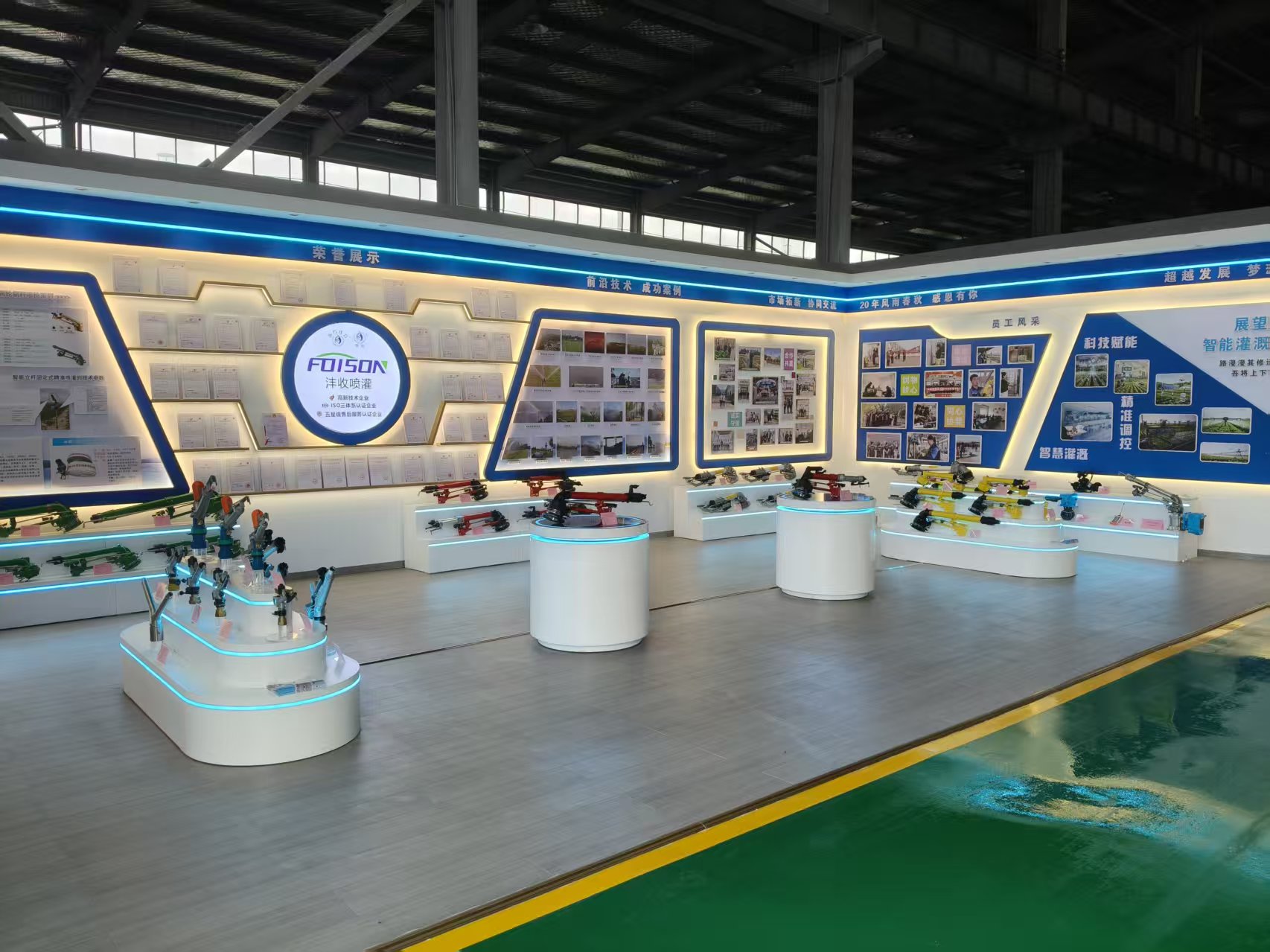
A model range is only useful once it is filtered by layout: coverage diameter first, connector compatibility second, price third.
Why block geometry, not brand order, should drive the first cut
Decision-stage sprinkler comparisons usually begin with a price column or a brand preference. Both are downstream questions. The structural risk sits earlier: if the coverage diameter does not match the geometry of the block, the error is built into the layout before a single unit is ordered.
Coverage that is too small for the spacing a grower intends forces more heads across the same area. Each additional head adds a riser, a fitting, a joint and friction loss along the manifold — costs that do not appear in the unit price but do appear in the installed system. Coverage that is deliberately oversized for a small block produces the opposite problem: throw that lands beyond the block boundary, uneven distribution at the edges and water delivered where it is not needed.
A coverage-first shortlist avoids both errors because it starts from a question the buyer can answer without the supplier in the room: how wide is the block, and how far apart should the heads sit?
The five-entry shortlist at a glance
The table below is the shortlist itself. It is not a ranking. Each row describes the layout band a model is intended to serve, and buyers in a decision process can use it to eliminate candidates quickly before requesting quotations.
| Entry | Model | Nominal coverage diameter | Layout fit |
|---|---|---|---|
| 1 | FS35 | 18–36 m | Smaller blocks; tighter coverage arc |
| 1 | FS40 | 20–43 m | Smaller blocks needing wider head spacing |
| 2 | FSW40 Pro | 22–41 m | Mid-size fields; greening and forestry layouts |
| 3 | FSN50 | 26–53 m | Larger blocks; open layouts and dust suppression |
| 4 | FSC50 | 23–56 m | Larger blocks needing a lower coverage floor |
| 5 | FSW80 | 23–85.7 m | Industrial-scale layouts and very large open areas |
Entry 1 is the only entry containing two models. FS35 and FS40 occupy the same layout band, so they are compared against each other on spacing and head count rather than kept as separate shortlist lines. That is why five entries cover six models.
Coverage diameter is the first filter
Coverage diameter describes the wetted circle a sprinkler produces at a given nozzle and pressure setting. It is the number that converts most directly into layout decisions, because spacing between heads is normally set closer than the coverage diameter so that adjacent circles overlap and no strip of ground is missed. The wider the coverage, the fewer heads a given area requires.
The coverage ranges in this shortlist are wide — 18–36 m for FS35, for example — because a single sprinkler body can be configured with different nozzles and operated at different pressures. That range is precisely what makes a shortlist useful: the buyer is not choosing a single throw distance but deciding which end of the range the installation is expected to operate in.
Rotating sprinklers used in agricultural irrigation are covered by ISO 7749-1:1995, which specifies design and operational requirements for that equipment class. Referencing a recognised standard is useful during evaluation, but it does not settle coverage: the same model can behave differently on two farms with different pump curves and wind exposure.
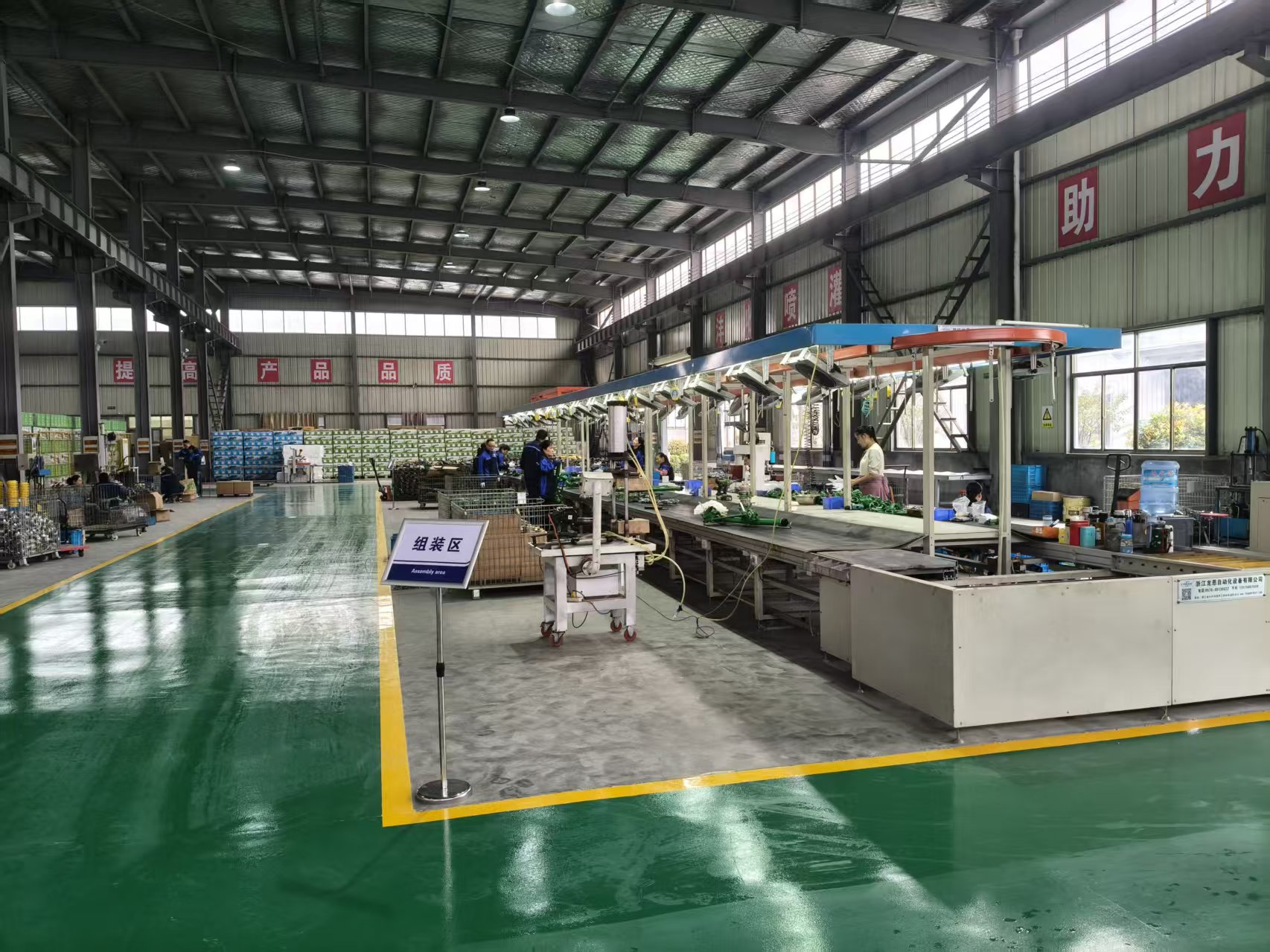
Coverage ranges are set during product development; the installation context then decides which end of the range a farm actually operates in.
Connector size is the second filter
After coverage, the connector is the fastest way to shorten a shortlist. In practice the connector is the inlet thread on the sprinkler body, the coupling on the riser, or the flange on a manifold — whichever interface is already installed or already specified in the layout drawing.
A mismatch is not fatal, but it is never free. Every adapter adds a joint, a potential leak point, an extra line item in the bill of materials and one more component to stock as a spare. For buyers comparing several candidate models at the decision stage, the practical rule is simple: if a shortlisted model cannot connect to the installed interface without an adapter, either plan that adapter into the quotation explicitly or remove the model from the shortlist.
Connector dimensions are model-specific and are not interchangeable between product families. Because inlet and thread dimensions vary by configuration and by destination market standard, the exact figures should be read from the model datasheet rather than assumed from the coverage range. A model with the right coverage but the wrong inlet will still require rework at installation.
Entry 1 — FS35 and FS40: the small-block pair
FS35 covers a nominal 18–36 m and FS40 covers 20–43 m. Both are intended for smaller blocks, which is why they occupy a single entry rather than two competing shortlist lines.
The difference between them is the width of the arc and where the ceiling sits. FS35 keeps the tighter pattern, which suits blocks where the grower wants predictable head density and a smaller wetted circle per unit. FS40 extends to 43 m at the top of its range, which means a block that would otherwise need an additional row of heads can sometimes be served with fewer positions and slightly wider spacing.
For a buyer at the decision stage, the choice between them is a spacing decision, not a technology decision. Two questions resolve it:
- Does the block's longest internal dimension sit comfortably inside the FS35 range, allowing even spacing across the whole area?
- Would the extra reach of FS40 remove an entire row of heads, and does the layout have the pressure margin to operate at that end of the range?
If both answers point the same way, the entry is settled. If they conflict, the layout is usually closer to a mid-size field, and Entry 2 becomes relevant.
Entry 2 — FSW40 Pro: the mid-size swing entry
FSW40 Pro covers a nominal 22–41 m and sits between the two bands that dominate most farm layouts. It overlaps the upper end of the small-block range and the lower end of the large-block range, which makes it the swing entry in this shortlist.
That overlap is useful rather than confusing. A mid-size field can often be argued in favour of either FSW40 Pro or FSN50 on coverage alone, which is exactly why the second filter matters. When two entries contain the required spacing, the connector check and the shape of the layout — boundary lines, obstacles, wind exposure, distance from the pump — become the deciding criteria instead of the coverage figure.
FSW40 Pro is also the entry most often associated with greening and forestry layouts, where blocks are irregular, edges are less defined, and even distribution across a mixed surface matters more than maximum throw.
Entry 3 — FSN50: larger blocks and open layouts
FSN50 covers a nominal 26–53 m. Its coverage floor of 26 m is the defining characteristic: on a small block, that floor is simply wasted reach, and the model belongs further down the layout list rather than on it.
On larger blocks the same floor becomes an advantage. Fewer heads are needed to cover the same area, which reduces the number of risers, the number of joints and the friction losses distributed along the manifold. In open layouts — large fields, wide strips, exposed industrial ground — the longer arc also reduces the number of positions that must be protected against equipment traffic.
Open layouts are also where FSN50 fits dust suppression and greening work, since those applications tend to prioritise reach over fine control of the wetted pattern.
Entry 4 — FSC50: a lower coverage floor at large-layout scale
FSC50 covers a nominal 23–56 m. Compared with FSN50, it starts three metres lower and reaches three metres further, which changes the way the two are compared.
The correct comparison is not which model is better but which pair of endpoints matches the range of blocks in the rotation. A farm operating several large blocks of different sizes benefits from a lower coverage floor, because the smaller block in the rotation still falls inside the operating range. A farm whose blocks are uniformly large gains little from that lower floor and may prefer the higher starting point.
Reading both ends of the range — floor and ceiling — rather than a single headline number is the discipline that keeps this comparison factual.
Entry 5 — FSW80: the industrial-scale entry
FSW80 covers a nominal 23–85.7 m, the widest range in this shortlist. It belongs on layouts where the objective is distance and delivered volume across a large open area rather than dense coverage of a compact block: large industrial sites, wide exposed ground and dust-suppression applications.
Its 23 m floor also means it is not restricted to maximum-throw operation; it can be configured for more moderate spacing where a site needs flexibility across several zones. That flexibility, however, comes with the greatest sensitivity to site conditions. Wide-arc performance depends most heavily on available pressure, nozzle selection and wind, so FSW80 should be verified on site before a layout is fixed around it.
Matching shortlist entries to crops and site use cases
The coverage bands translate into practical application groups. Sprinkler irrigation of this type is well suited to vegetable and fruit farms, plant farms and tea farms, where distribution uniformity across a defined block matters. The same equipment family also serves greening, forestry and dust-control applications, where reach and coverage of open ground take priority.
- Small blocks and high-value row crops: Entry 1 (FS35 or FS40), chosen on spacing.
- Mid-size mixed fields, greening and forestry: Entry 2 (FSW40 Pro).
- Large uniform blocks: Entry 3 (FSN50) or Entry 4 (FSC50), chosen by comparing both ends of each range.
- Industrial sites, wide open ground and dust suppression: Entry 5 (FSW80).
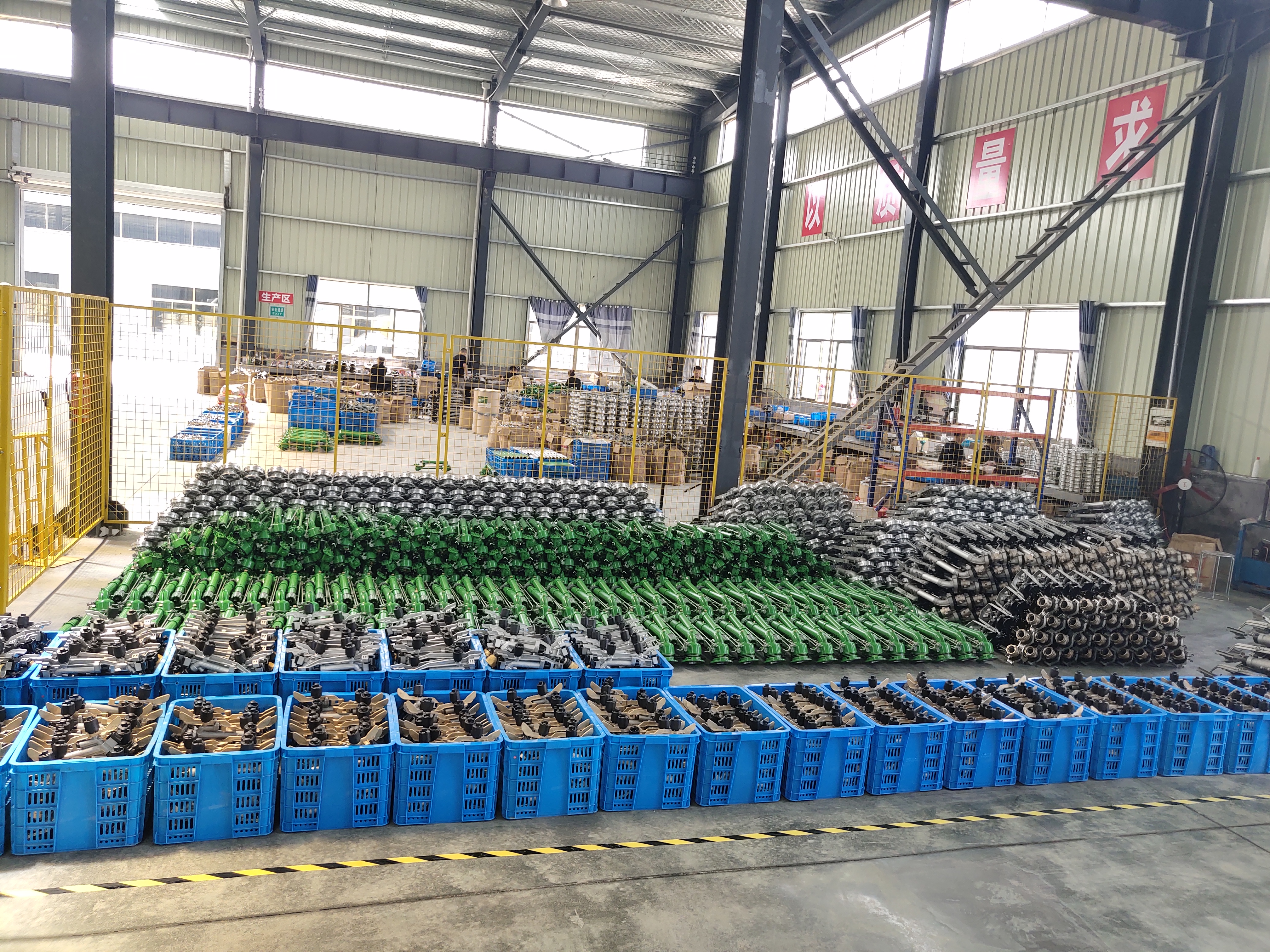
Nozzles and connectors: inlet dimensions are model-specific and should be confirmed from the datasheet before a shortlisted model is quoted.
What the market data says about shortlist granularity
The pressure to compare models more carefully is partly a function of market scale. The global sprinkler irrigation market was valued at USD 3.04 billion in 2025 according to Grand View Research. IMARC Group reports the global smart irrigation market at USD 2.2 billion in 2025, projected to reach USD 6.2 billion by 2034. Grand View Research also reports that Asia Pacific held the largest revenue share of 36.2% in the agricultural irrigation machinery market in 2025, with China as a leading country.
Published growth rates for the sprinkler segment do not agree. One source projects a 6.5% CAGR for 2026–2033, while another reports a lower 3.04% figure over 2025–2035, largely because definitions of which features count as smart differ between methodologies. That divergence is itself a signal for buyers: segment-level growth figures should be treated as directional, and they do not substitute for model-level specification comparison.
Another gap is worth noting. Public sources reviewed for this analysis do not segment market share between high-volume rain guns and standard impact sprinklers. Buyers looking for category-level proof of preference will not find it in the available data, which makes layout-based filtering — rather than popularity — the more reliable decision route.
Sprinkler irrigation compared with normal irrigation
The comparison case for sprinkler irrigation as a method is documented in first-party material. Compared with normal irrigation, sprinkler irrigation can save more energy and water resources, especially in areas where water is scarce. The system provides at least 50% energy and cost savings over normal irrigation methods, and energy efficiency is at least 50% better than normal irrigation alternatives. Technical advantages include high water-spray efficiency and uniform coverage. On maintenance, the equipment requires low maintenance with a low failure rate, and is easy to install and maintain.
First-party comparison data also records a cost difference of 20% lower against the normal irrigation baseline, and identifies vegetable and fruit farms, plant farms and tea farms as the application types where the method performs best.
Those figures describe sprinkler irrigation as a method compared with normal irrigation. They are not per-model performance claims, and they should not be applied to an individual shortlist entry without checking the operating conditions of that installation.
Limits this shortlist cannot resolve
A shortlist is a filter, not a design, and it is worth being explicit about what it does not settle.
- Nominal versus actual coverage. The diameter ranges quoted here are nominal. Real throw changes with nozzle size, operating pressure, elevation and wind. A model rated to 43 m may deliver considerably less on an exposed site.
- Pressure dependency. Reaching the upper end of any coverage range generally requires more pressure at the nozzle than operating at the lower end. Sites with limited pressure may find that only the lower portion of a model's range is realistically available.
- Water quality. Smaller nozzle openings are more sensitive to suspended solids, so filtration requirements rise as nozzle size falls — a factor that is not visible in a coverage table.
- Hydraulic design. Coverage diameter says nothing about pipe sizing, friction loss, pump curve or valve zoning. These must be calculated separately for each block.
- Connector dimensions. As noted, exact inlet and thread dimensions are model-specific and must be confirmed from the datasheet rather than inferred from the coverage range.
Where one of these constraints is binding, the correct response is to re-filter the shortlist rather than to force a model into a layout it does not fit.
Future outlook
Two forces are likely to keep pushing sprinkler selection toward structured shortlists rather than single-model decisions. The first is market growth: with the smart irrigation segment projected to expand from USD 2.2 billion in 2025 to USD 6.2 billion by 2034, and Asia Pacific already holding 36.2% of agricultural irrigation machinery revenue in 2025, the number of available models and configurations continues to rise. More granular ranges make explicit filters more valuable, not less.
The second is water scarcity. Where water is scarce, the case for sprinkler irrigation over normal irrigation strengthens, and the cost of distributing water unevenly rises accordingly. That shifts the buying question from which sprinkler to buy toward which coverage band the layout actually requires.
Standardisation supports the same direction. ISO 7749-1:1995 provides a recognised reference for rotating sprinklers in agricultural irrigation, and HS Code 842482 provides a common trade classification for mechanical appliances used to project, disperse or spray liquids in agricultural or horticultural applications. For manufacturers such as Xuzhou Foison Sprinkler Irrigation Equipment Co., Ltd — operating a 30,000 m² facility with 135 employees, a 12-engineer design team and an annual output of 200,000 units, exporting roughly 70% of production to the EU, Africa, Australia, New Zealand, South East Asia, Mid Asia, Mid East and South America — that means buyers increasingly expect model-level documentation to accompany a model-level shortlist.
FAQ
Start from the block's longest internal dimension and the head spacing you intend to use. Sprinklers are normally spaced closer than their coverage diameter so neighbouring circles overlap, and the number of heads rises quickly once coverage falls below the spacing a block requires. In this shortlist the coverage range is the cutoff: FS35 at 18–36 m, FS40 at 20–43 m, FSW40 Pro at 22–41 m, FSN50 at 26–53 m, FSC50 at 23–56 m and FSW80 at 23–85.7 m. Any model whose range does not contain the intended operating spacing is removed before price is discussed.
The connector — the inlet thread on the sprinkler, the coupling on the riser, or the flange on a manifold — acts as a hard filter, because a mismatch forces an adapter. Every adapter adds a joint, a potential leak point and an additional cost line. If a shortlisted model cannot connect to the installed interface without an adapter, either plan the adapter into the quotation explicitly or remove the model. Exact inlet and thread dimensions are model-specific and should be read from the model datasheet.
Because its nominal 22–41 m range overlaps both the small-block band and the lower end of the large-block band. On coverage alone, a mid-size field can be argued for either FSW40 Pro or FSN50, so the connector check and the shape of the layout — boundary, obstacles, wind exposure — become the deciding criteria rather than the coverage figure.
Compare both ends of each range rather than a single headline number. FSN50 covers 26–53 m and FSC50 covers 23–56 m. FSC50 starts lower and reaches slightly further, which suits a rotation containing both moderately sized and large blocks. FSN50 sits higher at the bottom of its range, which makes it less useful on the smallest blocks in a mixed farm. Neither is better in the abstract.
When the layout is large or industrial and the objective is distance and delivered volume across open ground rather than dense coverage of a compact block. Its nominal 23–85.7 m range is the widest in this shortlist. Because wide-arc performance is the most sensitive to operating pressure, nozzle selection and wind, FSW80 should be verified on site before the layout is fixed around it.
No. That figure describes sprinkler irrigation as a method compared with normal irrigation methods, not a per-model guarantee. The same comparison material records at least 50% energy and cost savings, at least 50% better energy efficiency, low maintenance with a low failure rate, and high water-spray efficiency with uniform coverage. What a specific installation achieves depends on crop type, block size, available pressure and operating schedule.
Sources and further specification detail
Model-level specification sheets covering coverage configuration, nozzle options and inlet dimensions are compiled in the FOISON Sprinkler catalogue, which is publicly available for download. The manufacturer's company information is published at http://www.foison-irrigation.com/.
The coverage ranges used to build this shortlist are nominal manufacturer values and should be confirmed against a datasheet and, where possible, a site test before a layout is finalised.