
Shortlist Builder: Four Documents Before Approving an Omega-3 Sample
Shortlist Builder: Four Documents Before Approving an Omega-3 Sample
A sample arriving at a buyer's facility is a logistics event, not an approval. Between the drum on the receiving dock and a confirmed commercial order sits a documentary check that decides whether the material can move forward at all — and that check is where two of Norbidar's current sample evaluations still sit. A Russian nutraceutical ingredient distributor has confirmed receipt of a 3624 EE sample and is testing it; an Indian customer remains at the sample evaluation stage with commercial specifications and purchase quantity pending. Neither project has a confirmed commercial purchase quantity.
Why a sample receipt is not an approval
The sample evaluation stage exists so a buyer can test whether a grade fits a formulation. It is also the window in which the buyer should assemble the documents that a purchasing decision will eventually rest on. These are separate activities, and neither substitutes for the other. A sample that performs well in a trial does not confirm that the next production batch will carry the same analytical profile. A certificate pack does not confirm that the sample itself met specification.
The two live cases show opposite ends of that window. In Russia, a nutraceutical ingredient distributor confirmed receipt of the 3624 EE sample for testing; evaluation of the grade against the required specification is pending, and the commercial order is pending customer confirmation. In India, a high-concentration omega-3 fish oil concentrate sample was supplied for evaluation against the required EPA/DHA specification and formulation suitability; customer test results and acceptance remain pending, commercial specifications and purchase quantity are unconfirmed, and commercial use duration has not been established because the project has not moved past the sample stage.
The shortlist below is the minimum documentary set a buyer should hold before treating a sample as approvable. It applies to Zhejiang Norbidar Biomedicine Co., Ltd., which manufactures food-grade omega-3 fish oil concentrates in Zhejiang, China, for dietary supplement and functional food formulation — and it applies on the same basis to any supplier being evaluated against a comparable specification.
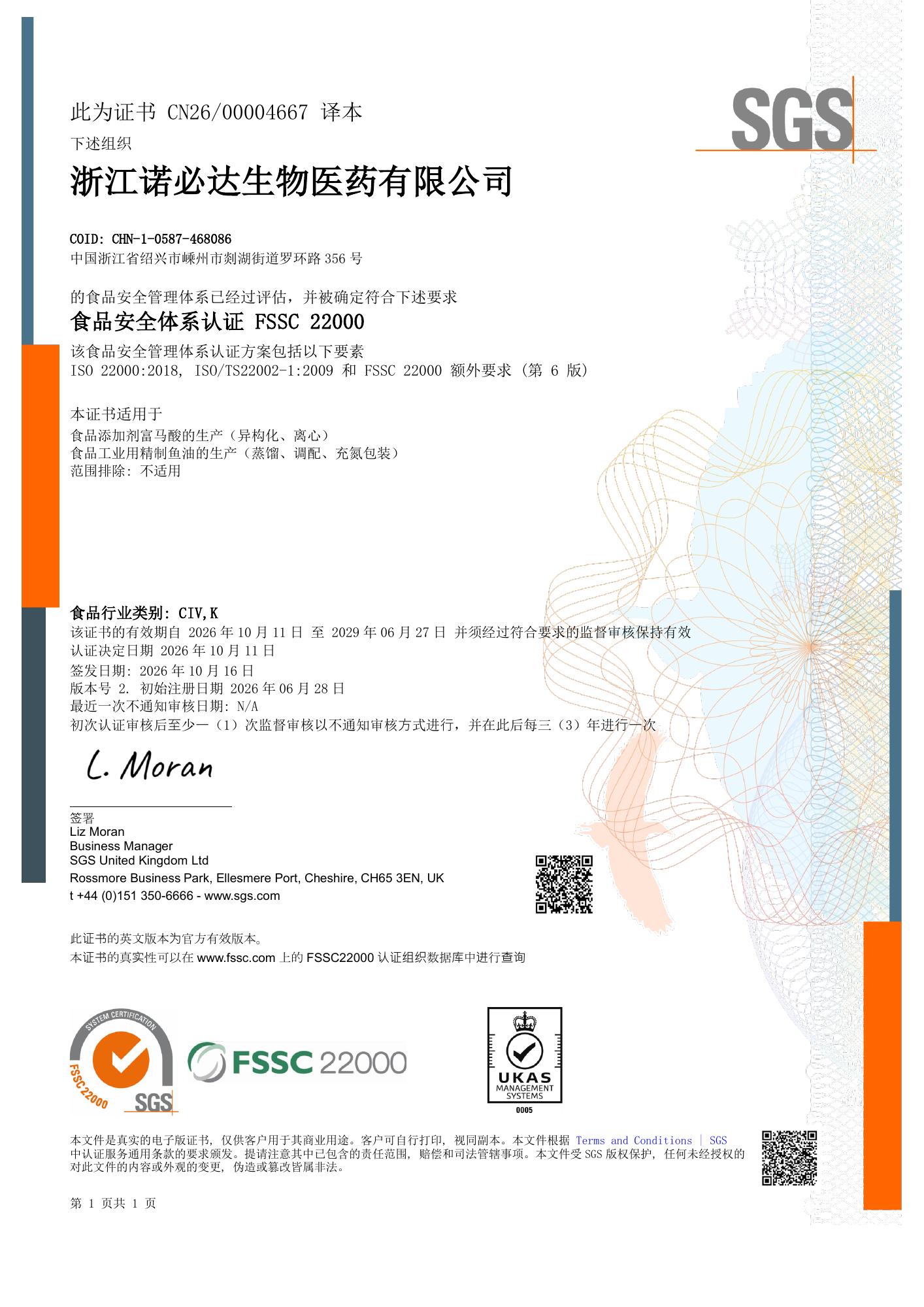
FSSC 22000 is one of four certificates in the documentary shortlist; it covers the site and its processes, not an individual batch.
The four-document shortlist at a glance
Each document answers a different question, and each has a boundary the others cannot fill.
| Document | Question it answers | Question it cannot answer |
|---|---|---|
| Certificate set: HALAL, FSSC 22000, ISO 22000:2018, FAMI-QS | Is the site certified under recognised systems, by which body, for which processes, and until when? | Does this batch meet the agreed specification? Is the product authorised in the destination market? |
| Current specification | What nominal EPA/DHA content and form define this grade, and which limits and test methods apply? | What did the batch actually measure? |
| Batch COA | What were the measured results for this specific batch? | What will the next batch measure? Does the grade suit the buyer's formulation? |
| SDS | How should the material be handled, stored and protected? | Does the material meet specification or destination requirements? |
Document 1 — The certificate set
Start with the certificates, because they take longest to verify and are the easiest to misread. Norbidar's current set covers two feed-chain and food-safety management systems, a food-safety scheme certificate and a halal product certificate, and each carries a different scope.
FAMI-QS
Certificate CN26/00005166, issued by SGS, valid from 2026-07-11 to 2029-07-10. The scope covers production of specialty feed ingredients through chemical and mixing processes, feed chain category K. Specific product names are not listed on the certificate, and the certificate states that certification does not itself constitute market authorisation.
ISO 22000:2018
Certificate CN26/00004668, issued by SGS United Kingdom Ltd, valid from 2026-10-11 to 2029-06-27. The scope includes production of refined fish oil for the food industry through distillation, blending and nitrogen packaging, food chain categories CIV and K. It is a management-system certificate, not a product registration or import authorisation.
FSSC 22000
Certificate CN26/00004667, issued by SGS United Kingdom Ltd, valid from 2026-10-16 to 2029-06-27. The scope matches the ISO 22000 scope, with food chain categories CIV and K and no exclusions. The standard set is ISO 22000:2018, ISO/TS 22002-1:2009 and the FSSC 22000 Additional Requirements, version 6.
HALAL
Certificate 501525000, registration number 3306966AA5, issued by Shandong Halal Certification Service (SHC), valid from 2026-01-21 to 2029-01-20. The scope lists Fumaric Acid CWS, Fumaric Acid and Refined Fish Oil, with the product scope as set out in the certificate attachment updated on 2026-07-30. The referenced standard is MS 1500:2019.
Read as a set, these documents answer whether the site operates under a certified food or feed safety system, who issued each certificate, what the scope covers and whether the certificate is currently valid. They do not answer whether a particular batch meets a buyer's specification, and they do not establish market access. The two gaps are structural rather than defects: a management-system certificate is audited at site level, while batch conformity is a separate record.
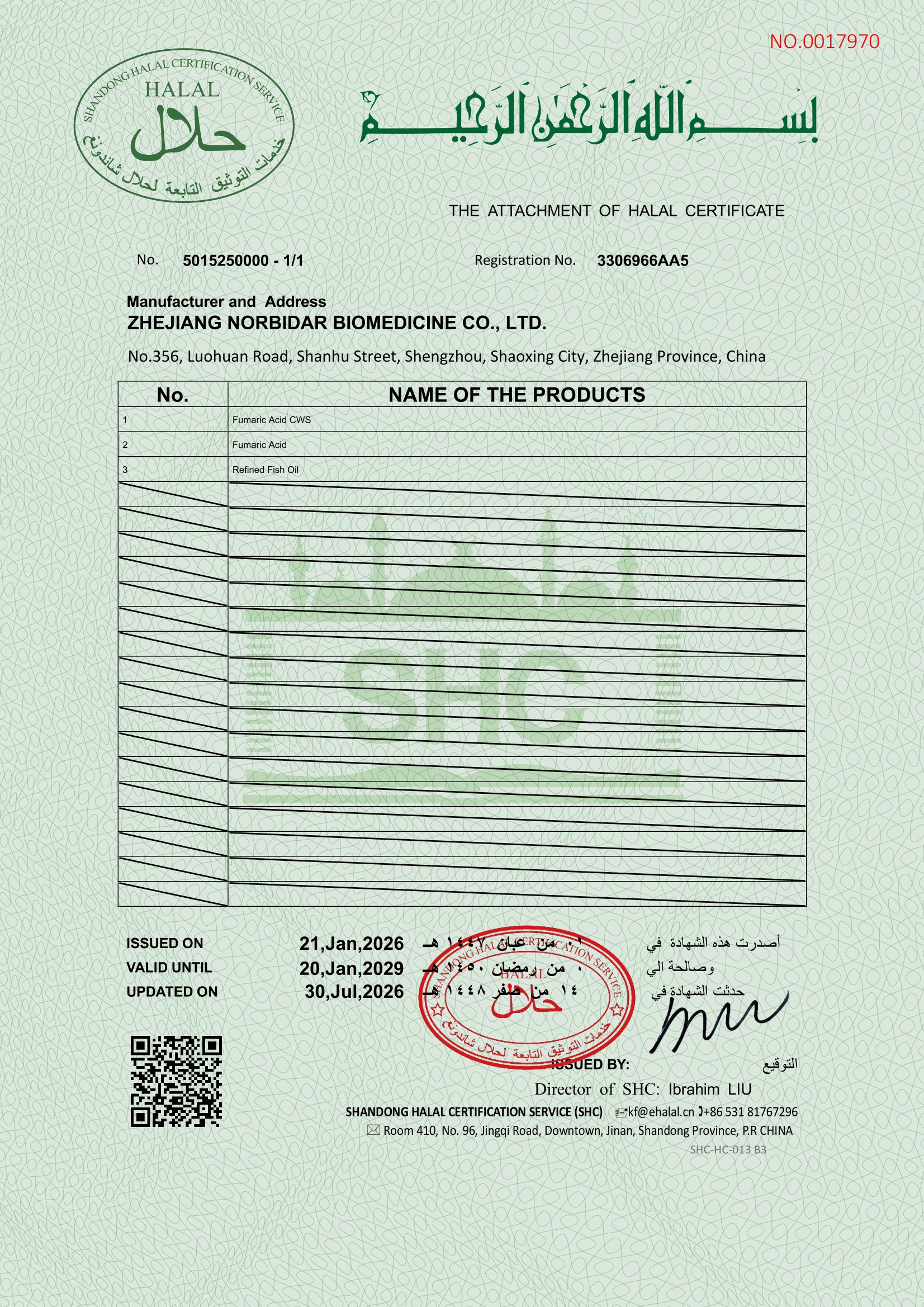
The HALAL product scope sits in a separate attachment; buyers should read it against the specific grade under evaluation.
Document 2 — The current specification
The specification defines what the grade is supposed to be. Norbidar's grade codes indicate nominal content: 5025 EE denotes a nominal 50% EPA and 25% DHA in ethyl ester form, and the same naming logic runs across the 3624 EE, 4030 EE, 5020 EE, 5030 EE and 8000 EE range. The specification should state the nominal EPA and DHA figures, total omega-3 content, the ethyl ester form, the test methods used and the limits that apply.
Two failures are common here. The first is treating a grade code as a measured value; nominal content describes what the grade is designed to deliver, not what a specific drum contains. The second is comparing figures expressed on different bases. GOED, the Global Organization for EPA and DHA Omega-3s, published an industry advisory on how to express EPA, DHA and total omega-3 content in EPA/DHA-containing oils. The advisory is industry guidance rather than government regulation, but it gives a buyer a precise question to put to a specification: is the number I am comparing an EPA figure, a DHA figure or a total omega-3 figure?
The specification also governs customisation. Norbidar offers customised EPA/DHA profiles subject to technical feasibility and an agreed product specification. A custom ratio therefore needs its own agreed specification before a document set can be treated as complete — a standard certificate scope will not describe it.
Document 3 — The batch COA
The certificate of analysis is the batch-specific record. Each batch is supported by a batch COA, a specification sheet and an SDS, and Norbidar's quality control covers batch EPA/DHA assay and fatty-acid profile testing, colour and oxidation testing, and contaminant screening. Exact limits follow the product documents.
The COA answers what the specification cannot: what this batch actually measured. Read it line by line against the specification rather than as a general quality statement. If the specification says one thing and the COA records another, the COA is the batch reality and the discrepancy needs resolving before approval.
What the COA cannot do is predict the next batch or confirm formulation suitability. Formulation suitability is what the Russian and Indian customers are testing, and the COA does not replace that work. A COA is also specific to its batch: a clean result for one lot says nothing about a lot that has not yet been produced.
Document 4 — The SDS
The safety data sheet covers handling and storage rather than conformity. For an omega-3 concentrate, that means oxidation sensitivity, light and oxygen protection, and the conditions under which the material should be stored and handled. Norbidar's application guidance describes storage and handling under cool, dry, light-protected, oxygen-limited conditions, per the product specification and SDS.
The SDS is the document buyers skim, and that is a mistake in two directions. It cannot confirm that the material meets specification, and it should not stand in for the COA or the specification. But it does tell a buyer whether the receiving, storage and production environment can protect the material between delivery and use — a question that becomes more pressing as concentration rises and the oil becomes more sensitive to oxidation.
How the four documents interlock
Approval logic is a cross-check, not a tick-box exercise. Each document has to agree with the others and with the agreed specification.
| Check | What to compare | Failure signal |
|---|---|---|
| Certificate validity and scope | Dates, issuing body, listed processes and product scope | Expired certificate, scope silent on the process used, or the grade missing from the HALAL attachment |
| Specification versus grade | Nominal EPA/DHA and total omega-3 basis, EE form, test methods | Grade code cited as if it were a measured value |
| COA versus specification | Measured EPA, DHA, fatty-acid profile, colour, oxidation and contaminants against specification limits | A result outside the specification, or a COA without a clear batch reference |
| SDS versus handling | Storage conditions, light and oxygen protection, receiving and production environment | A storage plan that cannot meet the stated conditions |
| Destination requirements | Import and market rules for the target country | A certificate treated as market authorisation |
Where any of these checks fails, the sample is not ready for approval, whatever the trial results show.
What the two sample projects show
The Russian project has moved one step further than the Indian one, and the difference is instructive. The distributor confirmed receipt of the 3624 EE sample, a grade with a nominal EPA/DHA profile of 36/24 in ethyl ester form. Receipt is not acceptance: evaluation against the required specification is pending, no validated end-use performance results are available, and product acceptance, in Norbidar's framing, rests on the agreed specification, the batch COA and the customer's own testing.
The Indian project sits earlier. The sample was supplied for evaluation against the required EPA/DHA specification and formulation suitability, but test results and acceptance remain pending, commercial specifications and purchase quantity are unconfirmed, and no commercial use duration has been established.
Both cases point to the same rule: no commercial purchase quantity is confirmed until the documents match the agreed specification. That rule is not a formality. A sample can be approved only when the certificate set establishes the site and scope, the specification defines the grade, the COA shows the batch met that specification, and the SDS confirms the material can be handled and stored as intended — alongside the buyer's own test results.
Where the industry context matters
The documentary burden rises with concentration. Future Market Insights estimates that 51% to 80% EPA/DHA concentrates held 43.6% of concentration grade sales in 2026, and the same research house put the fish oil concentration and refinement market at USD 2.6 billion in 2025. Those figures describe market context, not any individual supplier's capability. Their practical relevance is narrower: the grades most often evaluated are also the ones where the distance between nominal content and measured content matters most, which is exactly the distance the specification and the COA are meant to close.
Content expression is the other moving part. The GOED advisory on expressing EPA, DHA and total omega-3 content exists because the same oil can be described in more than one way, and a buyer comparing a specification with a COA needs to know which basis is in use. That is a documentation discipline rather than a market trend, and it becomes more useful as more buyers shortlist high-concentration grades.
Frequently asked questions
Which documents should a buyer collect before approving an omega-3 sample?
The minimum set is the certificate set (HALAL, FSSC 22000, ISO 22000:2018 and FAMI-QS), the current specification, the batch COA and the SDS. Destination-specific documents may be added depending on the market.
Can the certificate set confirm that a specific batch meets specification?
No. FAMI-QS, FSSC 22000 and ISO 22000:2018 are management-system certifications covering the site and its processes, and the HALAL product scope sits in a separate attachment. Batch conformity is shown by the COA read against the specification.
What is the difference between the specification and the batch COA?
The specification defines the grade's nominal content, form, test methods and limits. The COA records what a specific batch measured. A grade code such as 5025 EE indicates nominal 50% EPA and 25% DHA; it is not a measured value.
Does FAMI-QS certification authorise a product for a given market?
No. FAMI-QS states that certification does not itself constitute market authorisation. ISO 22000:2018 and FSSC 22000 are also management-system certificates, not product registrations or import authorisations.
When can a commercial purchase quantity be confirmed?
Once the documents match the agreed specification and the buyer's own evaluation is complete. In Norbidar's two current sample projects, one customer has confirmed receipt for testing and the other remains at sample stage with results pending; neither has a confirmed commercial quantity.
How are custom EPA/DHA ratios documented?
Custom profiles are discussed against the target specification, subject to technical feasibility and an agreed product specification. The agreed specification then governs the COA comparison.
What approval-ready looks like
The four documents do not make a sample approvable on their own, and they are not meant to. They establish the site, the grade, the batch and the handling conditions, so that the buyer's own evaluation has something reliable to sit on. Until those four align with the agreed specification, the sample remains a sample and the purchase quantity remains unconfirmed — the position both the Russian and Indian projects are still in.
For buyers comparing grades, Norbidar publishes an omega-3 concentrate brochure that can be read alongside the specification, keeping the document shortlist and the product range in the same frame.
Tem questões ou precisa de mais detalhes?
Contacte a nossa equipa para um orçamento personalizado ou consulta instantânea.
Solicitar orçamento
Preencha o formulário abaixo e a nossa equipa entrará em contacto com uma proposta personalizada.
Chat direto do WhatsApp
Prefere conversar em tempo real? Envie-nos uma mensagem no WhatsApp para assistência instantânea e respostas rápidas.
- Obter orçamento personalizado
- Partilhar fotos ou documentos
- Discuta as suas necessidades diretamente
Geralmente responde em 5–30 minutos durante o horário de expediente.