
Shortlist Criteria for Fiber-Grade TiO₂: The Anatase Trio of SA-50, SA-60, and SA-80
Fiber-Grade TiO₂ · Buyer Shortlist
Fiber-grade titanium dioxide is dosed at low levels in a chemical fiber line, yet the grade selected determines whether the finished yarn reads as a clean white, a controlled matte, or an inconsistent tone across a production run. Shortlisting three anatase grades — SA-50, SA-60 and SA-80 — is therefore less about ranking suppliers by name and more about matching a defined fiber chemistry, a colorimetric window and a dosing route before commercial terms are negotiated.
The three grades in this shortlist are supplied through Orient International Holding Shanghai Foreign Trade Co., Ltd., a state-owned foreign trade enterprise founded in 1988 and wholly owned by Orient International Group. The company is based in Shanghai and trades bulk chemical raw materials — titanium dioxide, petrochemical intermediates and minerals — drawing on the overseas branch network of its parent group, which covers nearly 200 countries and regions.
Demand context shapes how a shortlist should be built. The global fiber grade titanium dioxide market was valued at USD 1.46 billion in 2024 and is projected to reach USD 1.94 billion by 2032 (Intel Market Research). Polyester fiber accounts for more than 60% of all fiber grade titanium dioxide applications, while China's total titanium dioxide exports reached a record 1.9017 million tons in 2024, a 15.84% year-on-year increase (China Customs Statistics / Echemi). A larger, more export-oriented supply base makes specification discipline a more reliable filter than supplier name recognition.
Why the shortlist starts with the fiber, not the brand
Procurement teams tend to begin a titanium dioxide shortlist with a supplier list and only later ask which grade fits the line. In fiber production that sequence generates avoidable rework, because the three common fiber families present different optical targets and different process environments. A grade validated for polyester whitening is not automatically appropriate for viscose matting, and a matting grade specified for nylon carries a different colorimetric expectation than one specified for acrylic.
An application-first shortlist reverses the order: identify the fiber chemistry, confirm the colorimetric window, confirm the dosing route and support equipment, and only then compare commercial terms such as minimum order quantity, lead time and quality control. The result is a shortlist of two or three defensible candidates instead of a long list of interchangeable-looking offers.
One structural point applies across all three candidates. Anatase, rather than rutile, is the conventional crystal form for fiber use: anatase has a Mohs hardness of 5.5–6.0, compared with 6.0–7.0 for rutile, which reduces wear on spinning nozzles and spinnerets (ETIO2.COM). SA-50, SA-60 and SA-80 are all anatase grades, which is the common baseline that makes the trio comparable at all.
The shortlist at a glance
The three grades are specified against three different fiber families. The table below consolidates the first-party specification values that a buyer should use as the initial screening filter.
| Grade | Specified application | Crystal structure | TiO₂ content | Color value L | Color value b | pH | EC (μs/cm) | Sieve residue (325 mesh) |
|---|---|---|---|---|---|---|---|---|
| SA-50 | PET fiber whitening agent (polyester manufacturing) | Anatase | ≥98.0% | 96.7–98.2 | ≤0.0 | 6.8±0.2 | ≤230 | ≤0.004% |
| SA-60 | Matting agent for viscose and acrylic fiber | Anatase | ≥97.0% | ≥96.5 | ≤0.5 | 7.2±0.6 | ≤120 | ≤0.05% |
| SA-80 | Matting agent for nylon | Anatase | ≥95.0% | 92.0–97.0 | ≤3 | 6.8–8.0 | ≤100 | ≤0.004% |
Two parameters are shared across the trio and are worth noting because they relate to downstream processing rather than to appearance alone: Fe₂O₃ content is ≤0.004% for all three grades, and moisture at 105 °C is ≤0.40% for all three. Low iron content is a routine screening criterion in fiber-grade sourcing, since iron is a colorant in polyester and polyamide systems.
Filter 1 — Match the grade to the fiber chemistry
SA-50 for polyester (PET) fiber whitening
SA-50 is specified as a PET fiber whitening agent for polyester manufacturing. Its first-party parameters are TiO₂ content ≥98.0%, color value L of 96.7–98.2, color value b ≤0.0, pH 6.8±0.2, electrical conductivity ≤230 μs/cm, and specific surface area of 8.5–10.0 m²/g. The combination of a high TiO₂ content and a high L window points to a whitening rather than a dulling duty; b ≤0.0 places the grade on the neutral-to-blue side of the yellow–blue axis, which is the basis of its anti-yellowing behavior in polyester fiber.
SA-60 for viscose and acrylic matting
SA-60 is specified as a matting agent for viscose and acrylic fiber, with TiO₂ content ≥97.0%, color value L ≥96.5, color value b ≤0.5, pH 7.2±0.6, electrical conductivity ≤120 μs/cm and 325-mesh sieve residue ≤0.05%. The near-neutral pH band and the lower conductivity ceiling reflect the wet-spinning environments typical of viscose and acrylic routes, where dispersion stability in the spinning dope matters as much as the final tint.
SA-80 for nylon (polyamide) matting
SA-80 is specified as a matting agent for nylon, with TiO₂ content ≥95.0%, color value L of 92.0–97.0, color value b ≤3, pH 6.8–8.0, electrical conductivity ≤100 μs/cm and 325-mesh sieve residue ≤0.004%. The wider L band and the broader b tolerance are consistent with a delustering duty in nylon, where consistent dulling across the filament surface matters more than achieving the highest attainable whiteness.
In shortlist terms, the trio is specified against three fiber families. Substituting one grade for another changes the colorimetric assumption that the buyer is validating, so any substitution should be treated as a re-qualification rather than a like-for-like swap.
Filter 2 — Read the colorimetric window before you negotiate price
Color value L expresses lightness on the white–black axis, and color value b expresses position on the yellow–blue axis. In fiber applications these two numbers do more to predict the appearance of the finished yarn than the headline TiO₂ content alone, and they are the fastest way to compare candidate grades on paper.
SA-50 is specified at L 96.7–98.2, a window 1.5 points wide. A defined window, rather than a single minimum, is what allows a spinning line to hold a stable whiteness level from lot to lot; the practical questions for a buyer are where inside that window the delivered lots typically sit and how much movement is tolerated before a yarn batch shifts tone. SA-60 is specified at L ≥96.5 with b ≤0.5, a matting-grade profile for viscose and acrylic. SA-80 is specified at L 92.0–97.0, a band 5.0 points wide, with b ≤3.
The interpretation rule is straightforward: a wider band is not a defect, but it does shift responsibility to the buyer. Where a line requires a narrow optical outcome, a wide specification band means the buyer should confirm the measured value of the delivered lot against the stated range, and confirm the test method behind L and b, as a condition of shortlisting rather than as a post-delivery discussion.
Filter 3 — Confirm the dosing route and line conditions
For polyester, the shortlist question is not only which grade but how it enters the polymer. SA-50 is designed to operate within ethylene glycol circulation and polyester polycondensation conditions, with superior hydrolysis resistance and a neutral pH property. In practice it is first dispersed evenly in ethylene glycol under gentle stirring to form a stable suspension without sedimentation before polymerization; the suspension is then pumped into the PET esterification reactor and blended uniformly into the polyester system at 240–285 °C, without interfering with the polymerization reaction or the intrinsic viscosity of the melt.
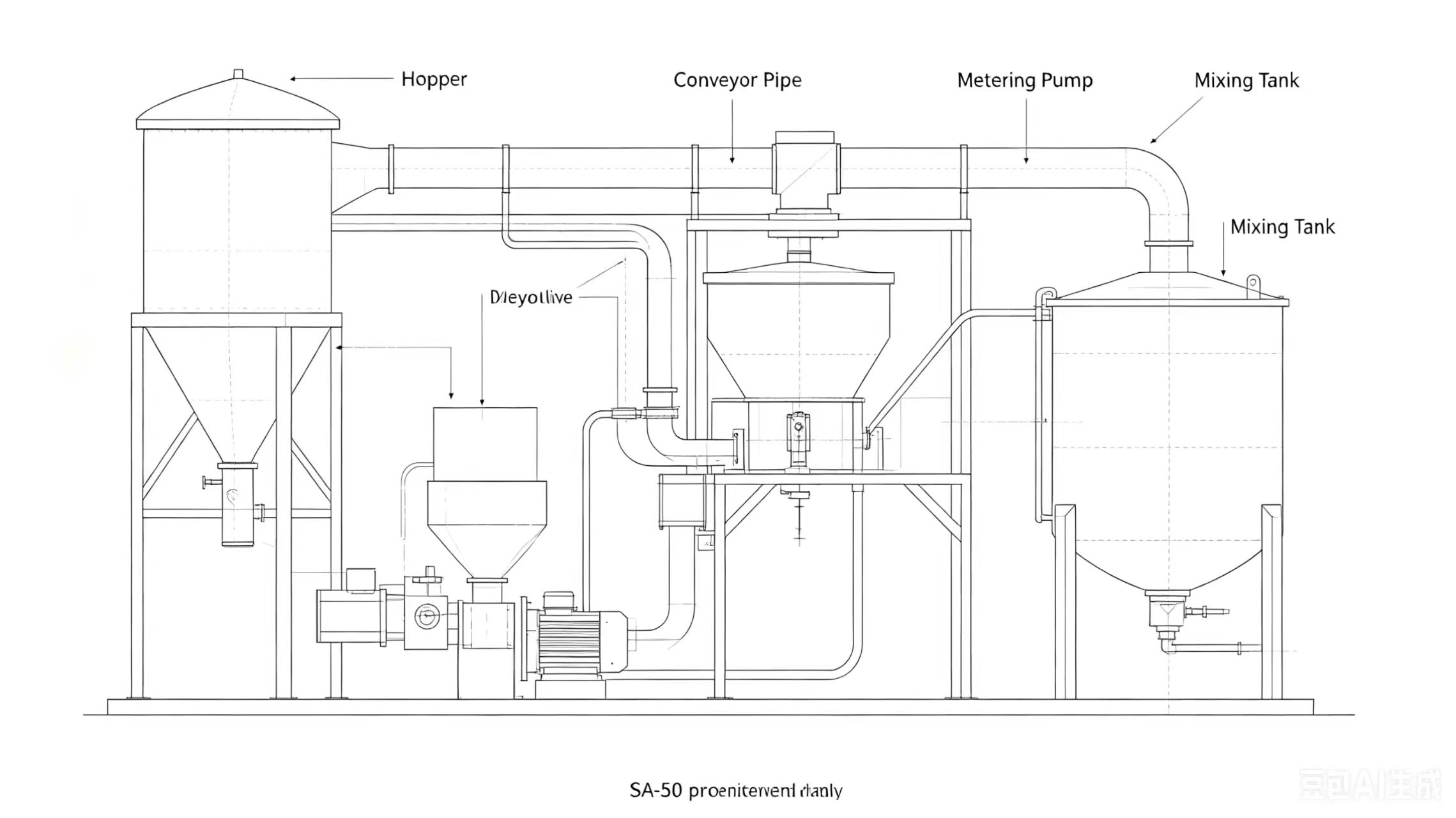
Several line conditions follow from that route and belong on the shortlist checklist. Feeding should be closed and vacuum-assisted to keep moisture and foreign matter out. Dispersion is carried out at 40–60 °C with low-speed stirring to avoid agglomeration. Reaction temperature should stay below 290 °C to protect PET viscosity. Storage is in a dry environment with humidity ≤65% and tightly sealed packages. High-ion additives should be avoided to prevent side reactions, and hard fillers should not be mixed in, to limit equipment wear and filter blockage. The supporting equipment associated with this scenario is a titanium dioxide continuous feeding dispersion system.
Performance evidence from a long-running polyester producer relationship — more than ten years and over 5,000 metric tons of material supplied — indicates what the filter is meant to protect. On the polymerization side, even dispersion without black spots or crystal points and low impurities kept PET intrinsic viscosity steady with good melt fluidity. On the spinning side, the spinneret clogging cycle was extended by over 40% and filter replacement frequency was greatly reduced, while the milder anatase particles lowered spinneret abrasion and cut the filament breakage rate by about 35%. In the finished fiber, whiteness held with a stable L value above 96.7 and uniform dyeing without streaks or color difference.
For nylon and for viscose or acrylic routes, the equivalent diligence is to confirm the dispersion medium and the point of addition with the supplier, because the SA-60 and SA-80 specifications are stated for the viscose/acrylic and nylon fiber families respectively rather than for the ethylene glycol route described for SA-50.
Filter 4 — Treat MOQ, lead time, quality control and capacity as shortlist filters
Commercial parameters decide whether a technically suitable grade is actually usable in a given project. The relevant first-party figures for this shortlist are a minimum order quantity of 1 metric ton, a lead time of 15–30 days, a monthly capacity of 1,000 mt, OEM/ODM production mode with customization for polyester and nylon, and 100% pre-shipment testing. Export markets for the operation include Korea, Japan, India, Indonesia and Vietnam, with remote and on-site after-sales support.
Read together, these figures support a staged sourcing plan. A 1 metric ton MOQ is small enough for a validation run on a single line before a larger commitment, while a 15–30 day lead time is the planning variable that determines how far ahead a buyer must schedule a trial or a replenishment. A monthly capacity of 1,000 mt indicates the shortlist does not break down when a qualification moves from trial scale to routine supply.
Supplier scale is a secondary but relevant filter. Orient International Holding Shanghai Foreign Trade Co., Ltd. was founded in 1988, operates a 700,000 m² production footprint, employs 160 people including a 25-engineer R&D team, reports an annual output of 16,000 MT of titanium dioxide, and exports approximately 30% of its volume to markets including Korea, Japan, the EU, North America, South America, South East Asia, the Middle East and India.
Shortlist verification checklist
- Confirm the fiber family and the grade specified for it: SA-50 for polyester, SA-60 for viscose and acrylic, SA-80 for nylon.
- Confirm the colorimetric window — L and b — and request the measured lot value and test method, not only the catalogue range.
- Confirm the dosing route, dispersion medium, temperature limits and supporting feed equipment for the specific line.
- Confirm sieve residue, Fe₂O₃ content, moisture and electrical conductivity against the stated specification.
- Confirm MOQ, lead time, monthly capacity and pre-shipment testing before committing to a trial schedule.
- Confirm storage and handling conditions, including humidity limits and sealed packaging.
Shortlist logic compared with conventional sourcing practice
The traditional approach to a titanium dioxide shortlist is supplier-first and price-first: collect quotations, compare unit cost, and select against a single generic grade used across all fiber lines. That approach has one clear advantage — it is fast, and it produces comparable numbers quickly.
Its weakness appears at qualification. A whitening grade specified for polyester and a matting grade specified for nylon are not interchangeable; the SA-50 profile (L 96.7–98.2, b ≤0.0) and the SA-80 profile (L 92.0–97.0, b ≤3) sit in different optical ranges and are specified against different polymer systems. Applying a single grade across multiple fiber families moves the burden of correction into the spinning and dyeing stages, where the cost of a tone shift is far higher than the cost difference between two grades.
An application-first shortlist is not free of trade-offs. It requires the buyer to state the fiber chemistry, the target optical outcome and the dosing route before quotations are requested, which slows the first exchange and demands internal alignment between procurement and production. Where a buyer genuinely does not know the target window, that gap should surface as a validation requirement rather than be filled by assumption.
Where this shortlist stops: limits and boundaries
- All three grades are anatase. A project that requires rutile opacity, or that sits outside chemical fiber production, falls outside this shortlist and should be qualified against a different grade family.
- SA-50 is specified against polyester manufacturing. It is not positioned as a viscose, acrylic or nylon matting grade, and using it in those routes changes the colorimetric and conductivity assumptions the buyer would otherwise verify.
- The first-party specifications for the trio do not state a particle size. A third-party industry guide cites 0.2–0.3 μm as typical for optimal delustering in polyester staple fibers (Aanya Enterprise, medium reliability); where filtration behaviour or matting efficiency depends on particle size distribution, that data should be requested and treated as a shortlist condition.
- Certification of fiber-grade titanium dioxide for textiles is not uniform across the market. Venator's HOMBITAN® LW-S 100 became the first fiber anatase TiO₂ to secure the ECO PASSPORT by OEKO-TEX® for the textile industry in 2022, which illustrates that this certification is held by specific certified grades rather than by the fiber-grade category as a whole. Buyers with a certified-textile requirement should confirm availability per grade rather than assume it.
- ISO 591 defines requirements for anatase and rutile titanium dioxide pigments, but conformance to that standard is a baseline, not a guarantee of spinning performance. Spinning suitability has to be validated against the line.
- Handling limits are part of the specification: storage humidity ≤65%, sealed packaging, dispersion at 40–60 °C, reaction temperature below 290 °C, and no mixing with hard fillers.
Market trend analysis: what is shifting in fiber-grade sourcing
Three verifiable movements shape how this shortlist is likely to be used. First, the fiber-grade segment is expanding: the market was valued at USD 1.46 billion in 2024 and is projected to reach USD 1.94 billion by 2032 (Intel Market Research). Second, demand is concentrated — polyester fiber accounts for more than 60% of all fiber grade titanium dioxide applications — which means PET-route grades such as SA-50 sit at the centre of sourcing activity while nylon, viscose and acrylic grades serve more specialised lines. Third, supply is increasingly export-driven: China's titanium dioxide exports reached a record 1.9017 million tons in 2024, up 15.84% year on year (China Customs Statistics / Echemi), which widens the field of available suppliers and increases the value of a structured screening method.
A parallel shift is occurring in documentation. Anatase's lower abrasiveness relative to rutile — Mohs 5.5–6.0 versus 6.0–7.0 — is an established technical reason for its use in fiber spinning (ETIO2.COM), but abrasiveness is only one criterion. As textile customers push compliance expectations upstream, buyers increasingly treat colorimetric data, impurity limits and certification status as shortlist entry requirements rather than as closing-stage details.
Future outlook
If the fiber-grade titanium dioxide market grows from USD 1.46 billion in 2024 toward USD 1.94 billion by 2032, the practical consequence for buyers is a larger field of suppliers offering superficially similar grades. In that environment, the discriminating questions move away from availability and toward specification fidelity: which fiber family a grade is specified for, what its L and b windows actually deliver lot to lot, and how the grade behaves inside a given polymerization or dope-preparation route.
Two further expectations are reasonable. As recycled polyester feedstocks expand, colorimetric stability across more variable input streams becomes a harder qualification target rather than a softer one. And as compliance expectations in textile supply chains continue to tighten, certification status is likely to migrate from a differentiator to a shortlist filter applied at the same stage as MOQ and lead time. Shortlists that are structured around application fit first, colorimetric verification second and commercial terms third will remain usable as both of those pressures increase.
Frequently asked questions
What is fiber-grade titanium dioxide used for in polyester, nylon and viscose fiber production?
It is used as a whitening or matting agent inside the polymer or spinning dope. In polyester, SA-50 is specified as a PET fiber whitening agent that provides matting, improves fiber whiteness and enhances smoothness. In nylon, SA-80 is specified as a matting agent. In viscose and acrylic fiber, SA-60 is specified as a matting agent. All three are anatase grades, the crystal form generally preferred in fiber applications because its lower hardness — Mohs 5.5–6.0 versus 6.0–7.0 for rutile — reduces wear on spinning nozzles and spinnerets.
How should a buyer choose between SA-50, SA-60 and SA-80?
Filter by fiber chemistry first, then verify colorimetry. SA-50 is specified for polyester manufacturing, SA-60 for viscose and acrylic fiber, and SA-80 for nylon. Once the fiber family is fixed, compare the colorimetric windows: SA-50 is specified at color value L 96.7–98.2 with b ≤0.0; SA-60 at L ≥96.5 with b ≤0.5; SA-80 at L 92.0–97.0 with b ≤3. A grade whose L and b window does not match the line's optical target should be removed from the shortlist regardless of commercial terms.
What are the minimum order quantity and lead time for these grades?
The stated minimum order quantity is 1 metric ton, with a lead time of 15–30 days and a monthly capacity of 1,000 mt. Production runs in an OEM/ODM mode with customization available for polyester and nylon, and 100% pre-shipment testing is applied. Export markets include Korea, Japan, India, Indonesia and Vietnam, and after-sales support covers both remote and on-site assistance. For planning purposes, the MOQ allows a first validation order on a single line, while the 15–30 day lead time defines the scheduling window between order confirmation and delivery.
Which parameters should be checked when reviewing a certificate of analysis?
For all three grades, check TiO₂ content, 325-mesh sieve residue, moisture at 105 °C, Fe₂O₃ content, pH value, electrical conductivity and color values L and b. The specified values are: SA-50 with TiO₂ ≥98.0%, sieve residue ≤0.004%, moisture ≤0.40%, Fe₂O₃ ≤0.004%, pH 6.8±0.2, EC ≤230 μs/cm, L 96.7–98.2 and b ≤0.0; SA-60 with TiO₂ ≥97.0%, sieve residue ≤0.05%, moisture ≤0.40%, Fe₂O₃ ≤0.004%, pH 7.2±0.6, EC ≤120 μs/cm, L ≥96.5 and b ≤0.5; SA-80 with TiO₂ ≥95.0%, sieve residue ≤0.004%, moisture ≤0.40%, Fe₂O₃ ≤0.004%, pH 6.8–8.0, EC ≤100 μs/cm, L 92.0–97.0 and b ≤3. SA-50 additionally carries a specified surface area of 8.5–10.0 m²/g.
What equipment and process conditions are required when feeding SA-50 into a PET line?
The specified supporting equipment is a titanium dioxide continuous feeding dispersion system. SA-50 is dispersed in ethylene glycol with gentle, low-speed stirring at 40–60 °C to form a stable suspension without sedimentation, then pumped into the PET esterification reactor and blended at 240–285 °C. Closed vacuum feeding is required to exclude moisture and impurities, reaction temperature should remain below 290 °C to protect intrinsic viscosity, and material should be stored in a dry environment at humidity ≤65% with sealed packages. High-ion additives should be avoided to prevent side reactions, and hard fillers should not be mixed in, to limit equipment wear and filter blockage.
Does this three-grade shortlist cover every fiber-grade titanium dioxide requirement?
No. The shortlist is limited to three anatase grades specified for defined fiber families: SA-50 for polyester, SA-60 for viscose and acrylic, and SA-80 for nylon. Projects requiring rutile opacity, applications outside chemical fiber production, or a textile certification such as ECO PASSPORT by OEKO-TEX® — first obtained for a fiber anatase TiO₂ grade in 2022 — fall outside its scope, since certification is held by specific certified grades. In addition, the first-party specifications for the trio do not state a particle size, a parameter that third-party industry guidance cites as typically 0.2–0.3 μm for optimal delustering in polyester staple fiber; where particle size distribution affects filtration or matting efficiency, it should be requested and verified rather than assumed.
Further background on the supplier and its fiber-grade titanium dioxide portfolio is available at petchemical.com. A downloadable company and product overview is also published as a PDF: Orient International Holding Shanghai Foreign Trade Co., Ltd. — company and product overview.