
Shortlist Criteria for Food-Safe IML: 4H Scratch Resistance, ≥5N Adhesion, Shelf Impact
In-mold labeling (IML) is a packaging decoration process in which a pre-printed film is placed inside a mold and bonded to the container wall during injection molding or thermoforming. Because the label fuses into the packaging surface instead of being applied afterwards, the film, the ink and the finish all become part of a container that may hold yogurt, ice cream, a beverage, or a household chemical.
That single characteristic is what makes IML shortlisting different from ordinary label sourcing. A buyer is not only selecting a printed film supplier; they are selecting a set of material and process inputs that will later be validated — or rejected — by a molding line, a migration test, and a retail shelf.
This article sets out a practical shortlist checklist for food-safe IML where durability and shelf impact matter equally. It is organised around four screens that can be verified before a supplier is even interviewed: food-contact chemistry, mechanical durability (4H scratch resistance and ≥5N adhesion strength), print and film capability, and finishes such as holographic or orange peel that carry visual differentiation.
Why food-safe IML shortlists go wrong
Food and beverage applications accounted for the largest IML revenue share at over 41.3% in 2023, with specific growth in yogurt cups and ice cream containers, according to Grand View Research. That concentration means most buyers evaluating IML are, whether they describe it this way or not, running a food-contact qualification.
Two screening errors are common:
- Treating food safety as a document check. A certificate list matters, but it answers only part of the question. The relevant issue is whether the specific ink and film combination proposed for a project sits behind a migration test and a documented compliance route.
- Treating durability as a matter of film thickness. Thicker film does not automatically mean better scratch or adhesion performance. Scratch resistance is a surface property; adhesion is an interface property. Each has its own test method and its own reference value.
A shortlist that separates these questions early avoids the most expensive outcome in IML procurement: discovering during a pilot injection run that the label and the container do not agree with each other.
Turning three purchasing adjectives into four screens
Food-safe, durable and visually appealing are the three requirements buyers state most often. None of them can be compared across suppliers until they are converted into measurable screens.
| Requirement | Screen | What to verify | Reference value in the ZY-IML Series |
|---|---|---|---|
| Food-safe | Ink chemistry | Ink type; migration test coverage; certification list | Food-grade low-migration water-based ink; FDA 21 CFR, BRCGS Packaging Materials, ISO22000, QS; migration test meeting EU 10/2011 |
| Food-safe | Film resin | Virgin versus recycled resin; food-grade declaration | PP (food-grade virgin resin) and PE (food-grade virgin resin); PET and multi-layer composite laminated films also available |
| Durable | Scratch resistance | Pencil hardness test result | 4H |
| Durable | Adhesion | Bond strength and behaviour during molding | ≥5N, with no peeling during injection molding |
| Durable | Mechanical and thermal range | Tensile strength; operating temperature | ≥20MPa; -20℃ to 120℃ |
| Durable | Chemical resistance | Resistance to product contents and cleaning agents | Resistant to weak acids, alkalis and common detergents |
| Visually appealing | Print quality | Colour count; registration tolerance; maximum width | Up to 8-colour high-precision rotogravure; printing precision ±0.1mm; maximum printing width 1200mm |
| Visually appealing | Finish options | Available surface finishes and their compatibility | Glossy, Matte, Orange Peel, Holographic, custom texture |
Screen 1 — Food-contact chemistry: ink, film and migration evidence
Food contact is not a single attribute; it is the combined behaviour of the ink, the film and the bond that forms during molding. The ZY-IML Series uses food-grade low-migration water-based ink and is produced from PP (food-grade virgin resin), PE (food-grade virgin resin), PET or multi-layer composite laminated films. The product family is described as complying with FDA 21 CFR, BRCGS Packaging Materials, ISO22000 and QS certification standards, with migration testing meeting EU 10/2011 food contact material standards.
That last point connects to a regulatory framework rather than a marketing claim. In the European Union, Regulation (EC) No 1935/2004 provides the framework for food contact materials and requires that they do not transfer constituents to food in quantities that could endanger human health or change the composition of the food.
For a shortlist, the practical question on this screen is narrow: which ink system is proposed, and which migration test report covers that ink on that specific film? The second half matters. A report issued for a different film construction or a different ink colour set is not interchangeable evidence, even when both products come from the same supplier.
Buyers should also note the production context. IML production for food contact labelling is typically carried out in a normal-temperature, dry indoor environment using printing presses and label cutting equipment, with food contact safety (FDA/GB compliance) and non-toxic material requirements applied through the process.
Screen 2 — Durability: reading 4H and ≥5N correctly
What 4H scratch resistance means
Pencil hardness testing rates a surface by the hardest graphite pencil lead that will not scratch it, on a scale that runs from soft leads to hard leads. A 4H rating places the surface in the harder portion of that scale: the label surface resists scratching by a 4H lead under the test conditions.
For packaging that travels through filling lines, cartoning and retail handling, this is a useful comparative indicator of how well a printed surface holds up before it reaches the shelf. The ZY-IML Series is specified at 4H (pencil hardness test) and is additionally described as resistant to weak acids, alkalis and common detergents — relevant for containers that are wiped, chilled or washed during use.
What ≥5N adhesion strength means
Adhesion strength describes the force required to separate the label from the container wall. Five newtons is roughly the force needed to accelerate a one-kilogram mass at 5 m/s², which makes ≥5N a fairly demanding interface specification for a thin film fused to a polymer wall.
In the ZY-IML Series, adhesion strength is specified at ≥5N with no peeling during injection molding. The second clause is the operationally important one: the specification is written around the molding step, which is where IML bond failures usually appear. The same product family is also described as compatible with high-speed injection processes, without warping or label fall-off.
Boundary note: 4H and ≥5N are reference measurements taken under defined test conditions. They are screening criteria, not unconditional performance guarantees for every container geometry, resin and molding setup. The practical confirmation is a pilot run on the actual tool.
Screen 3 — Print and film capability
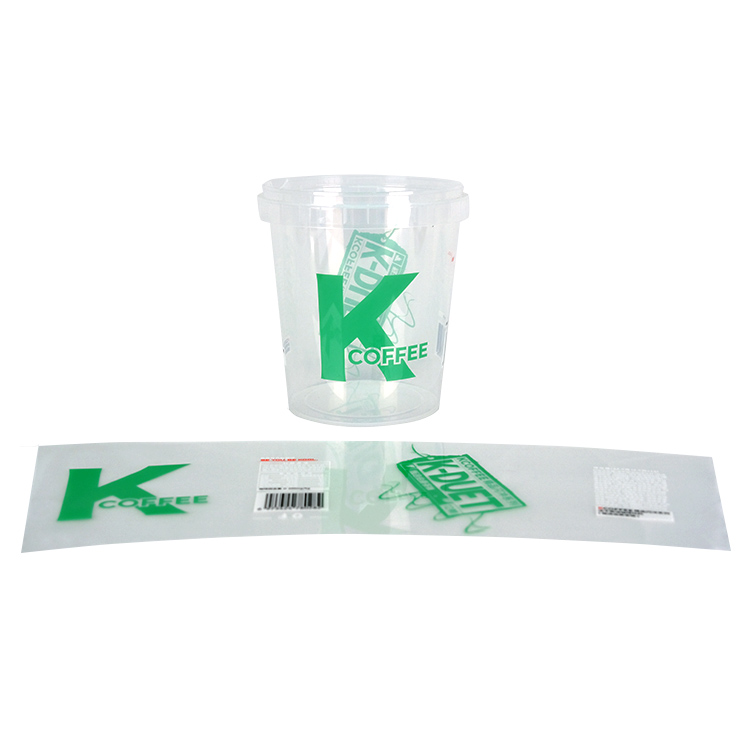
Print capability determines how much of the packaging design survives the process. In the ZY-IML Series, printing uses 8-colour high-precision rotogravure with a printing precision of ±0.1mm and no colour deviation, at a maximum printing width of 1200mm.
Film thickness ranges from 30 μm to 100 μm and is customizable. Film types include complex white gloss film, complex transparent gloss film, standard gloss film, matte laminated film and holographic film. Materials cover PP, PE, PET and multi-layer composite laminated films.
Three questions are worth putting to every shortlisted supplier before samples are requested:
- Which film type is proposed for this container, and why that one rather than a standard gloss alternative?
- What registration tolerance can be held on that film at the required print width?
- Does the film thickness range already cover the mold and container geometry, or does the project need a custom film formulation?
Screen 4 — Finishes that carry shelf impact
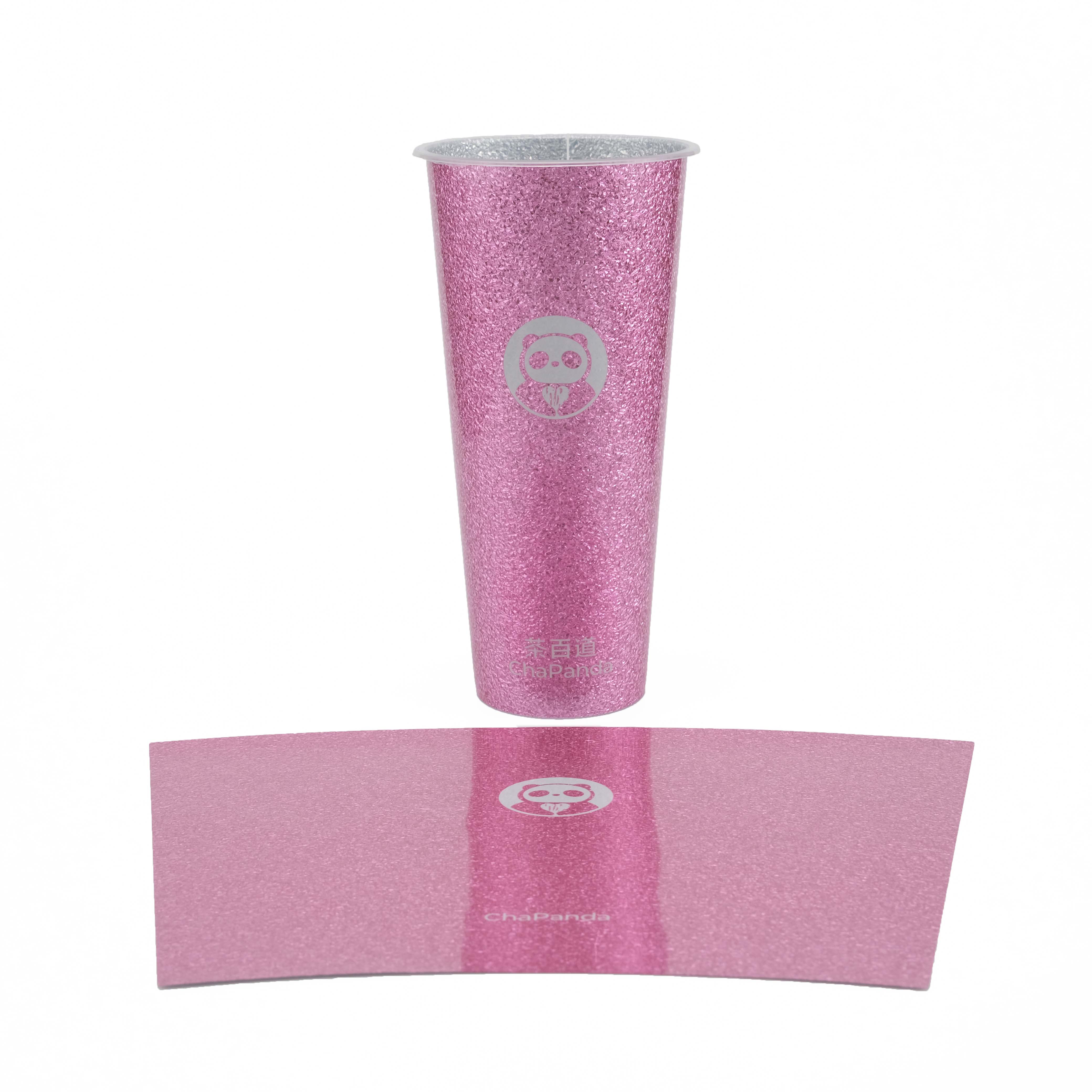
Durability protects the design; the finish determines whether the design is noticed. The ZY-IML Series offers glossy, matte, orange peel, holographic and custom texture finishes.
- Glossy finishes reflect light and support high-contrast graphics, which is why they appear frequently in dairy and beverage packaging.
- Matte finishes reduce glare and give a calmer, more tactile surface.
- Orange peel finishes provide a textured, low-gloss surface that differentiates a container by touch as well as by sight.
- Holographic finishes introduce a shifting, reflective effect that can help a product stand out in a crowded category.
Finish selection interacts with the other three screens rather than sitting outside them. A specialty finish is still a food-contact surface, and a reflective effect still has to keep branding legible within the registration tolerance the process can hold. Buyers should confirm that finish, film type and ink system were evaluated together, and treat finish variety as a design-capability screen rather than a free upgrade.
The shortlist checklist
A shortlist is only useful if each line can be answered with evidence. The table below converts the four screens into a documented request list that can be sent to any IML supplier.
| # | Checklist item | Evidence to request |
|---|---|---|
| 1 | Food-contact compliance path | Certification list and scope: FDA 21 CFR, BRCGS Packaging Materials, ISO22000, QS |
| 2 | Migration testing | Report covering the proposed ink and film combination, referenced to EU 10/2011 |
| 3 | Ink system | Confirmation of food-grade low-migration water-based ink |
| 4 | Resin declaration | Confirmation of food-grade virgin resin for PP or PE film |
| 5 | Scratch resistance | Pencil hardness result against a stated target, for example 4H |
| 6 | Adhesion | Bond strength value with the no-peeling-during-molding condition stated |
| 7 | Mechanical and thermal range | Tensile strength and operating temperature matched to filling and cold chain |
| 8 | Chemical resistance | Statement of resistance to the actual product contents and cleaning agents |
| 9 | Print capability | Colour count, registration tolerance, maximum print width |
| 10 | Film specification | Film type, thickness range within 30–100 μm, custom formulation option |
| 11 | Finish options | Available finishes and their compatibility with the proposed film and ink |
| 12 | Moulding compatibility | Evidence of compatibility with high-speed injection processes |
| 13 | Validation route | Willingness to run a pilot with the actual mould and resin |
Items 1 to 4 determine whether a supplier can be considered for a food-contact project at all. Items 5 to 8 determine whether the label will survive the product and the process. Items 9 to 11 determine whether the packaging will look the way the brand team expects. Items 12 and 13 determine whether any of the preceding answers can be reproduced at production scale.
What the ZY-IML Series provides as a reference baseline
YZY — Zhejiang Zhongyu Science and Technology Co., Ltd. — is an in-mold labeling manufacturer established in 2009, operating a 20,000 m² facility in Longgang, Wenzhou, Zhejiang, China, with approximately 250 staff and an annual production capacity of 200,000,000 units. The company reports export business accounting for 30% of total sales, with major markets worldwide, a 10-engineer R&D team, 48 patents, and QS, ISO and BRC certifications.
Its ZY-IML Series is classified across Food Grade IML Label, Daily Chemical IML Label, Industrial IML Label, Yogurt Cup IML and Paint Bucket IML categories, with applications extending to bubble tea cups, ice cream containers, plastic bottles, lubricant buckets and cosmetic containers.
For shortlisting purposes, the useful point is not the length of the product list but the fact that the specification values in the first table are published as named parameters rather than general claims: 4H scratch resistance, ≥5N adhesion, ≥20MPa tensile strength, a -20℃ to 120℃ operating range, ±0.1mm printing precision, and a 30–100 μm film thickness range. Named values can be tested against a project. Adjectives cannot.
Application fit: where food-safe IML is used
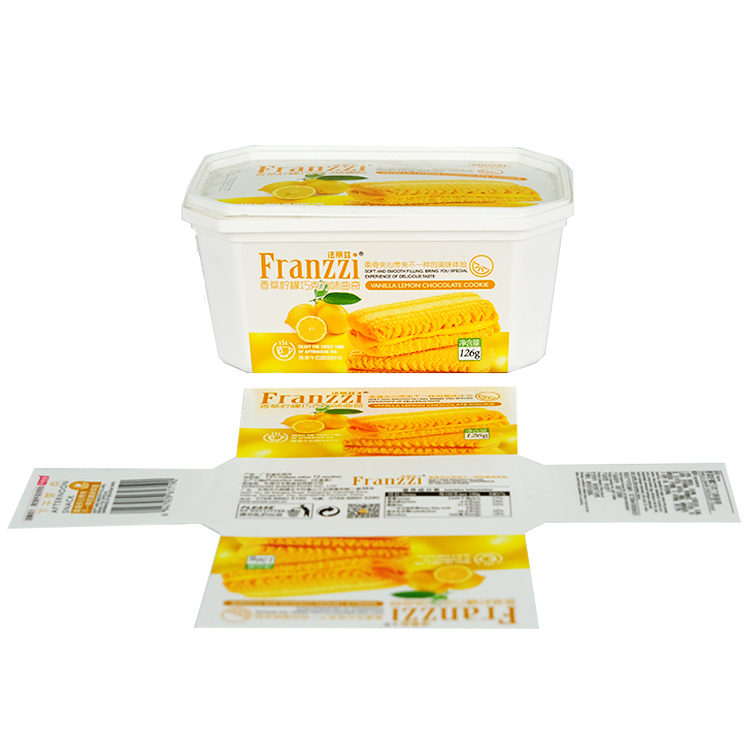
IML is used across injection molding and in food and beverage packaging including yogurt, beverages and ice cream, as well as daily chemicals such as shampoo and detergent, pharmaceuticals, household products, industrial packaging such as paint and lubricant buckets, and cosmetics. The screens apply differently depending on the container:
- Yogurt cups and ice cream containers. Cold chain and, on some lines, hot filling; the -20℃ to 120℃ operating range is the relevant thermal screen. Small-diameter containers place a premium on adhesion and print registration.
- Bubble tea cups and beverage containers. Clarity and finish matter more than chemical resistance; complex transparent gloss and standard gloss films are common starting points.
- Plastic bottles and cosmetic containers. Finish selection — matte, holographic or custom texture — often drives the design brief, and print precision determines how fine the graphic can be.
- Paint and lubricant buckets. The container is not food contact, but chemical resistance and permanent bonding carry the evaluation instead of migration testing.
Injection molding accounted for over 57.1% of the IML market in 2023, per Grand View Research — a useful reminder that the molding process, not the label alone, determines the final result. A supplier who can discuss molding conditions, not only printing, is generally a better shortlist candidate.
Market trend: what the numbers suggest for buyers
- The global IML market was valued at USD 2.31 billion in 2023 and is projected to reach USD 3.14 billion by 2030, with a CAGR of 4.6% (Grand View Research).
- The in-mould label film market is projected to grow from USD 1.3 billion in 2025 to USD 1.7 billion by 2035 (Future Market Insights), which points to film specification becoming a purchasing decision in its own right.
- PP dominated the IML material segment with a 47.2% share in 2023, driven by recyclability and compatibility with plastic containers (Grand View Research).
- Asia-Pacific led the IML market with a 42.8% revenue share in 2025, supported by growth in the dairy and paint industries in China and India (Dataintelo).
- Food and beverage applications held the largest IML revenue share at over 41.3% in 2023 (Grand View Research).
The pattern is steady growth in a category whose largest demand pool is exactly the food-contact segment where the four screens matter most. For procurement teams, that argues for building a repeatable shortlist framework now rather than re-evaluating criteria on every new container project.
Comparison with alternative decoration methods — and the limits of IML
IML is one option among several. Pressure-sensitive labels and shrink sleeves remain widely used, and each carries a different trade-off profile.
- Bond and durability. An IML label is fused into the container wall during molding, whereas a pressure-sensitive label is an applied film with an adhesive layer. For containers exposed to moisture, condensation or repeated handling, a fused bond is generally more resistant to edge lifting.
- Format limits. Shrink sleeves wrap irregular shapes, while IML is bounded by what the mould and the film can accept. The maximum printing width of the ZY-IML Series is 1200mm and film thickness sits between 30 μm and 100 μm — sufficient for most food cups, bottles and buckets, but a real constraint for very large formats or unusual geometries.
- Cost structure. IML requires the label and the container to be produced together, so the economics depend on mould availability and order continuity. Rotogravure printing at up to 8 colours delivers consistent high-volume output; for very short or frequently changing runs, the decoration route should be compared against total project cost rather than label unit price alone.
- Where IML does not apply. Containers that are already moulded and in stock cannot be converted to IML decoration afterwards. Buyers whose packaging is produced by a third-party molder need to confirm, at the shortlist stage, that the molder can run labels in-mould at all.
There is also a limit inside the criteria themselves. 4H scratch resistance and ≥5N adhesion are reference measurements taken under defined conditions. They do not describe every abrasion or peel scenario a container will encounter in logistics, retail or consumer use, and they are not a substitute for a pilot run with the actual resin, mould and filling line. Any supplier presenting these values as unconditional guarantees is overstating what a test method can cover.
Future outlook
Three directions appear likely to shape food-safe IML purchasing in the coming years. First, migration documentation continues to move toward ingredient-level traceability, which favours suppliers who can connect a certification list to one specific ink and film combination rather than to a general product range. Second, growth in the film market alongside the label market points to more granular specification work, with buyers comparing film types and thicknesses instead of accepting a single default. Third, as the dairy and beverage categories that dominate IML demand keep expanding in Asia-Pacific, visual differentiation through finishes such as holographic and orange peel is likely to become a standard part of the specification conversation rather than a premium add-on.
FAQ
What adhesion strength should a food-safe IML label have?
Adhesion strength is expressed as the force needed to separate the label from the container wall. The ZY-IML Series is specified at ≥5N with no peeling during injection molding. Because the bond forms during molding, the value should always be read together with the molding condition it was measured under, and confirmed on the production tool before a specification is fixed.
What does 4H scratch resistance mean for an IML label?
Pencil hardness testing identifies the hardest graphite lead that will not scratch the surface, on a scale from soft to hard leads. A 4H result places the label surface in the harder portion of that scale, indicating greater resistance to scratching during filling, packing and retail handling. It is a comparative indicator; resistance to weak acids, alkalis and common detergents is a separate specification measured against different conditions.
How is food safety verified for IML inks and films?
Verification combines ink chemistry, film resin and migration testing. The ZY-IML Series uses food-grade low-migration water-based ink and food-grade virgin PP or PE resin, is described as complying with FDA 21 CFR, BRCGS Packaging Materials, ISO22000 and QS certification standards, and meets EU 10/2011 food contact material standards in migration testing. In the EU, Regulation (EC) No 1935/2004 provides the underlying framework for food contact materials, requiring that they do not transfer constituents to food in quantities that could endanger health or change the composition of the food.
Are holographic and orange peel IML finishes suitable for food packaging?
Both are listed options within the same product family, which offers glossy, matte, orange peel, holographic and custom texture finishes. The practical question is not whether a finish can be produced, but whether the finish, film type and ink system were evaluated together for the intended food-contact application. Where the container is not food contact — paint or lubricant buckets, for example — the finish decision is driven by branding and chemical resistance instead.
Which containers are typically decorated with food-safe IML?
Common categories include yogurt cups, ice cream containers, bubble tea cups, plastic bottles, plastic containers and plastic buckets, alongside daily chemical, pharmaceutical and cosmetic packaging. The ZY-IML Series is classified across Food Grade, Daily Chemical, Industrial, Yogurt Cup and Paint Bucket IML categories. Injection molding is the dominant production process, accounting for over 57.1% of the IML market in 2023.
What formats can IML film and printing handle?
The ZY-IML Series is produced on film between 30 μm and 100 μm thick, customizable, using up to 8-colour high-precision rotogravure printing at ±0.1mm precision and a maximum printing width of 1200mm. Buyers should confirm that the proposed film thickness and print width fit the container geometry before treating a supplier as shortlist-ready.
Summary
Shortlisting food-safe IML is a screening exercise, not a beauty contest. Four screens — food-contact chemistry, mechanical durability, print and film capability, and finish options — reduce a long supplier list to the small number of candidates whose specifications can actually be tested against a project. The reference values worth asking for are concrete: 4H scratch resistance, ≥5N adhesion with no peeling during injection molding, food-grade low-migration water-based ink, migration testing against EU 10/2011, and a stated finish range that includes glossy, matte, orange peel and holographic options. Everything beyond that should be confirmed on a pilot run with the real mould, the real resin and the real filling line.
Technical parameters referenced in this article, including the full film and finish range, are documented in the YZY product brochure: download the PDF brochure.