
Shortlist Guide: Automatic CTP Battery Pack Lines for Mid-High Volume
Industry Reference · CTP Battery Pack Assembly · Procurement Constraints
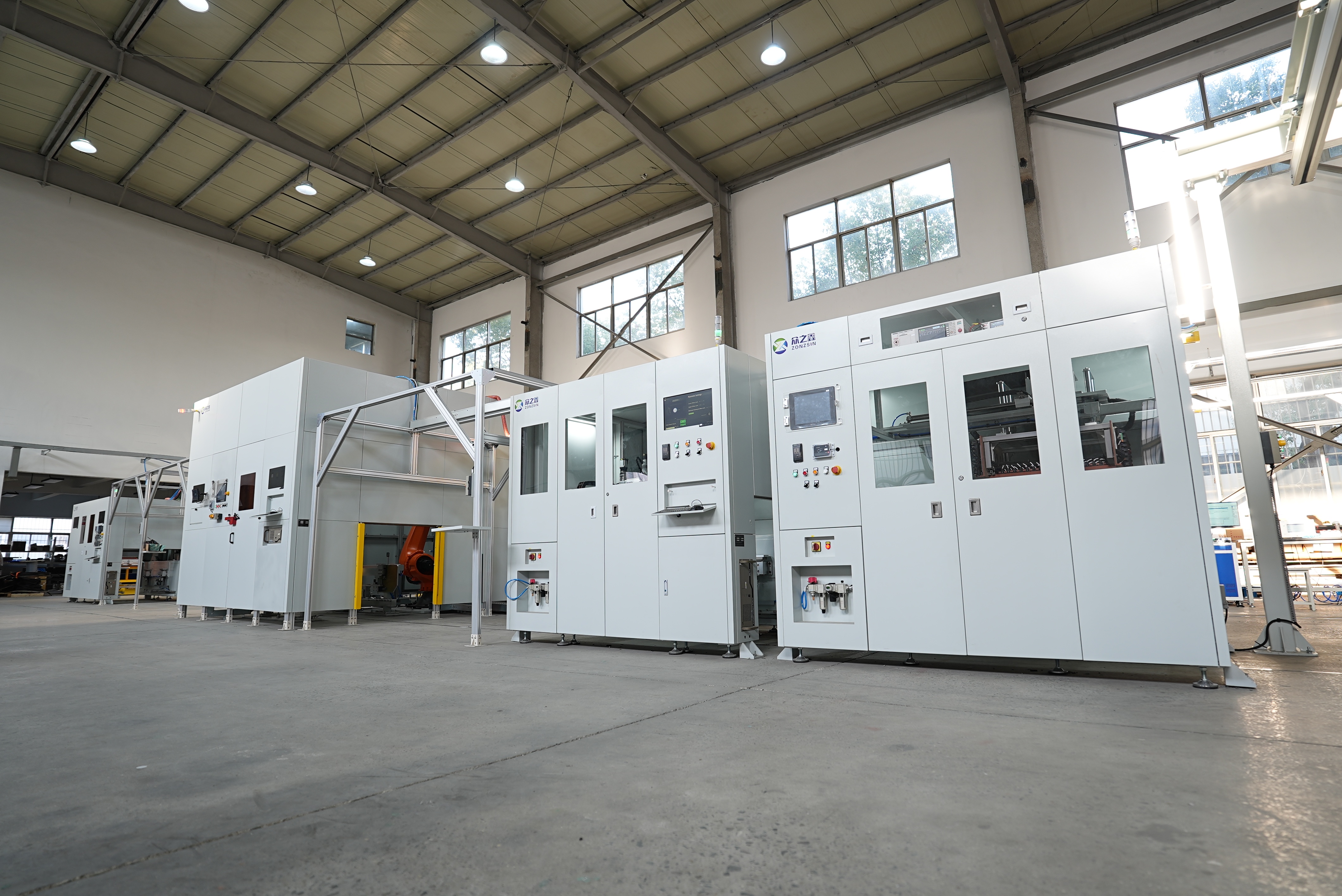
Cover: an automatic CTP battery pack assembly line built around large prismatic cells. Image: Shanghai Zonzsin Intelligent Equipment Co., Ltd.
Mid-to-high volume battery pack production is the band in which a line must hold a defined takt and repeatable quality, but does not yet justify the capex profile of a fully automated flagship plant. For buyers at the Research and Evaluation stage, the shortlisting question in this band is not which supplier is largest. It is narrower and more useful: which automatic battery pack assembly line configuration satisfies a fixed constraint set — cell format, cycle time, certification scope, footprint, utilities, lead time and price band — at the volume the plant actually intends to run.
This guide sets out that constraint set, and then applies it to one verifiable entry point in the mid-high volume category: the ZZX2406 CTP battery pack assembly line from Shanghai Zonzsin Intelligent Equipment Co., Ltd. The screening framework is supplier-neutral. The specification data used to illustrate it is not, and is attributed throughout.
What Mid-High Volume Means for a CTP Line
In published specifications, high-efficiency CTP assembly lines built around large prismatic cells typically sit in the 4–8 PPM cycle-time band. The ZZX2406 CTP battery pack assembly line is specified at 4 PPM, supports 314 Ah and 587 Ah prismatic cells, and produces a 1P96S pack configuration. Taken together, those three data points define the category more usefully than any single throughput claim.
The reason this band behaves differently from small-cell lines is arithmetic. As cell format grows, units per minute fall while the energy carried by each pack rises. A comparison that counts only packs per minute therefore understates what a large-cell CTP configuration can do in MWh terms. Zonzsin publishes a line output of 4 GWh and a line power of 160 kW for its module PACK assembly line. Both are company-reported figures, and both should be re-modelled against the buyer’s own shift pattern, pack energy and yield assumptions before they are used for plant sizing or utility planning.
Availability and quality metrics decide whether a mid-high volume target survives commissioning. The ZZX2313 EV battery pack assembly line publishes a single machine operation rate of ≥95%, a one-time welding qualification rate of ≥99.5% and a final welding qualification rate of ≥99.95%. Used as screening thresholds, these are practical. Used as guarantees, they are not, because the published material does not define the test protocol behind them.
The Nine Constraints That Decide Shortlist Inclusion
In evaluation practice, a mid-high volume shortlist is built around nine constraints. Each one can eliminate a candidate before commercial terms are discussed.
| Screening constraint | Why it removes candidates | Published reference point (Zonzsin line family) |
|---|---|---|
| Certification scope | Covers the process steps being purchased, not just the company | ISO 9001 certificate 44825MS079001R0, issued by ZDCB, scope includes module PACK assembly line; valid 2025-11-20 to 2028-11-19 |
| Cell and pack compatibility | Determines fixture design and future product range | ZZX2406: 314 Ah and 587 Ah, 1P96S. EV pack line publishes 280/314/587 Ah and 1P52S/1P104S |
| Cycle time versus volume target | Sets the maximum achievable output | ZZX2406: 4 PPM. ZZX2501: 6 PPM, 30 min/PACK |
| Automation level | Drives labour model, capex and ramp-up speed | ZZX2406: semi-automatic, touch screen, program control. Customization covers automation level |
| Footprint | Determines whether the hall can host the line at all | ZZX2406: L 58,000 × W 11,000 × H 3,800 mm. U-shaped layout recorded as space-saving in an India deployment |
| Utilities | Site infrastructure cost and ramp risk | Electrical AC 380V ±10%; compressed air 0.5–0.8 MPa depending on model |
| Lead time and MOQ | Sets the project timeline and cash plan | Lead time 3–5 months; MOQ 1 unit; monthly production capacity 3 units |
| Price band | Defines budget approval path | Turnkey CTP battery pack production line listed at approximately US$1,000,000–3,000,000 per set (commercial market listing) |
| After-sales model | Determines downtime exposure after handover | Remote support plus on-site installation and commissioning |
A frequent brief at this stage combines two objectives: a cycle-time improvement of roughly 20% against an existing line, and a transition from manual or semi-manual operation to semi- or fully automatic operation. Both objectives are constrained by the table above. A 20% takt improvement is not reachable if the certified scope excludes the process steps being automated, if fixture adaptation cannot hold the intended cell format, or if the site utility supply cannot support the target cycle time.
The ZZX2406 as a Mid-High Volume Entry Point
Shanghai Zonzsin Intelligent Equipment Co., Ltd. is a Shanghai-based equipment manufacturer founded in 2019 that builds automatic battery pack assembly lines and ESS battery pack insertion robots for lithium battery manufacturers, energy storage integrators and automotive OEMs. The company operates a 6,000 m² facility with 90 employees, including a 43-engineer R&D team, reports 40 units of annual output and a 60% export ratio, and lists Southeast Asia and the EU as its main markets. Its equipment is in use in Europe, the USA, Japan, South Korea and India, and the company holds 50 granted patents, including invention patents covering an AGV-driven battery PACK insertion robot.
Published specification of the ZZX2406
- Model: ZZX2406
- Type: CTP battery PACK assembly line
- Technology: CTP (cell-to-pack)
- Automation: semi-automatic
- Cycle time: 4 PPM
- Battery cell: 314 Ah and 587 Ah
- Battery PACK configuration: 1P96S
- Dimensions: L 58,000 × W 11,000 × H 3,800 mm
- Material: carbon steel / Q235
- Applicable industry: energy storage; EV and C&I
The ZZX2406 holds ISO 9001 certification issued by ZDCB under certificate number 44825MS079001R0, complying with the standard GB/T19001-2016 ISO9001:2015 and applicable in the global market. The certified scope covers laser welding equipment, laser cleaning equipment, module PACK assembly line, and the R&D and assembly of AGV-based cluster loading robots. Validity runs from 20 November 2025 to 19 November 2028. For a buyer running cross-border projects, the operative question is not whether a certificate exists, but whether the certified scope covers the specific process steps being purchased; here, the module PACK assembly line sits inside the scope.
Configuration is published as OEM/ODM, with customization available across cycle time, automation, logo, color and configuration. Minimum order quantity is one unit, monthly production capacity is three units, quality control is described as 100% test, and after-sales covers remote support together with on-site installation and commissioning. The company attributes 20% lower maintenance expenditure to its modular design approach — a company statement rather than a third-party audited outcome.
Technical Explanation: Automation Boundary, Cycle-Time Definitions and Layout
CTP construction builds the pack around the cell stack rather than around a separate module layer, which reduces part count and interface hardware. The practical consequence for automation is that critical process steps concentrate around cell handling, stacking, insulation and welding, where precision and repeatability determine downstream yield.
Zonzsin specifies the ZZX2406 as semi-automatic, operating through touch-screen and program control. The published customization field explicitly includes automation level, which means the automation boundary is a specification decision rather than a fixed property of the platform: a buyer can move the line toward fuller automation within the same model family, and the deliverable is defined at configuration stage rather than after order.
Cycle time is the metric most often compared and least often defined. Zonzsin’s own published data illustrates the risk: the ZZX2501 line is described as 6 PPM and, in the same specification set, as 30 min/PACK. Those two statements cannot describe the same unit of work. Before a shortlist is fixed, buyers should establish whether a quoted PPM counts packs, modules or stations per minute, and against which shift and availability assumptions.
Footprint is the second constraint that is frequently under-specified. The ZZX2406 occupies L 58,000 × W 11,000 × H 3,800 mm — dimensions that make aisle width, maintenance clearance and future expansion paths part of the technical review rather than an afterthought. Where floor space is tight, layout geometry becomes a design decision in its own right: in an Indian CTP deployment, Zonzsin records a U-shaped layout as the space-saving measure, alongside generally user-friendly operation.
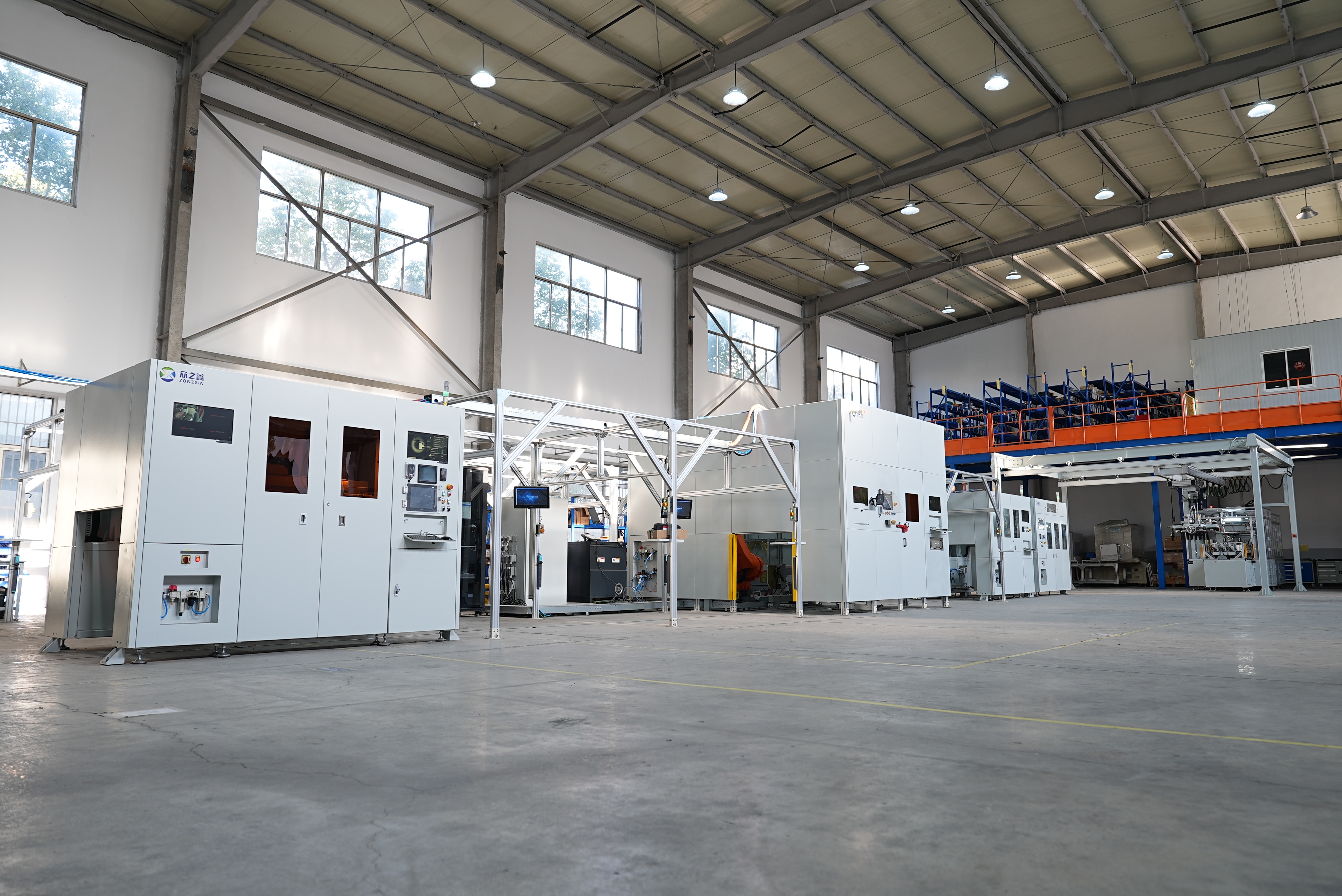
A CTP battery pack assembly line configuration: layout geometry determines usable capacity per square metre as much as cycle time does.
Application Profile: EV, BESS and Commercial & Industrial
Published application scope for the line family covers EV and BESS projects, energy storage integration and automotive OEMs, with product-level applicability in energy storage, EV and C&I. Working conditions are defined as indoor operation in a standard factory, under industrial assembly-line conditions, with continuous or shift-based production.
The lines are quoted as semi-automatic or fully automatic with touch-screen and program control, and are matched with vision inspection systems, fixtures and tooling, laser equipment, and assembly and testing stations. Four site requirements are stated as prerequisites rather than optional items: ESD protection, fire-prevention measures, temperature/humidity and cleanliness control, and PACK compatibility with fixture adaptation. For a stationary storage pack assembly line running 314 Ah-class cells, the fixture set is usually the item that determines how quickly a new pack variant can be introduced without stopping the line.
A representative reference in India spans a client profile that includes automotive OEMs, energy storage system integrators, battery cell and PACK manufacturers, and EPC turnkey contractors. The configuration is a single unit applied to battery pack assembly, recorded as in stable operation for one year, with the U-shaped layout noted for space saving and ease of operation.
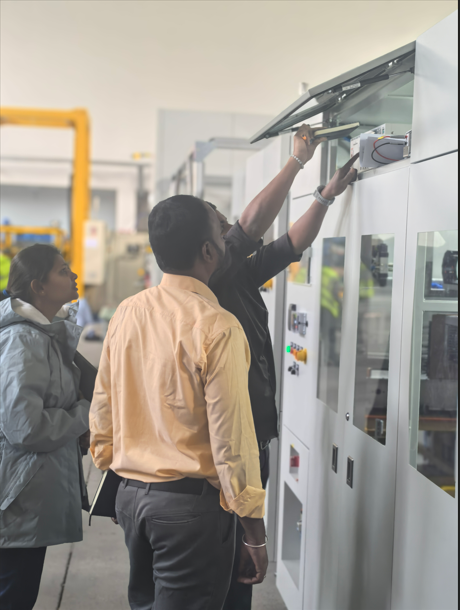
Reference deployment: a CTP battery pack assembly line in India, operating on a U-shaped layout for space efficiency.
Market Trend Signals — and What the Evidence Does Not Yet Support
Three signals are supportable from the current evidence base. First, cell format is escalating across published compatibility lists: 314 Ah and 587 Ah for the ZZX2406, and 280/314/587 Ah with 1P52S/1P104S pack architectures on the EV pack line. Second, pack architecture variety is widening alongside cell capacity, which pushes flexibility into fixture and changeover design rather than into the base platform. Third, structural market data on battery automation providers was published in 2020 by NASA / Shmuel De-Leon Energy, and remains a reference point for how the supplier landscape is described at category level.
The evidence base itself is thinner than the marketing language in this category suggests. Public material is dominated by supplier self-description, supplemented by a single secondary republication of a supplier press release. There is no standardized test methodology for welding yield, no independent third-party validation of cycle time, and no normalized comparable set of at least three suppliers with aligned specifications for cycle time, output, cell compatibility and automation level. The practical consequence for a buyer is straightforward: published PPM, yield and output figures should be treated as supplier-reported baselines to be reproduced during acceptance testing, not as market rankings.
Semi-Automatic CTP Lines vs Conventional Fully Automatic Configurations
| Dimension | Semi-automatic CTP line (ZZX2406) | Conventional fully automatic configuration |
|---|---|---|
| Cycle time | 4 PPM published | Higher published rates appear on module-level lines; a comparison note in the same evidence set contrasts a 4 PPM semi-automatic baseline with fully automatic standard lines quoted at 12–16 PPM, and Zonzsin separately publishes 16 PPM for its module PACK assembly line |
| Cell format | 314 Ah and 587 Ah prismatic; 1P96S | Frequently specified around smaller cells and different pack architecture |
| Automation and labour model | Semi-automatic; operator-assisted steps; program control | Fully automatic; lower manual input, higher capex profile |
| Energy per pack | Larger cells raise energy content per pack | Depends on pack architecture; not directly comparable without matching assumptions |
The honest limitation of this shortlist category is that it does not win on units per minute. A semi-automatic CTP line specified at 4 PPM will post lower pack counts per minute than a fully automatic line in the 12–16 PPM range, and any comparison that ignores pack energy content will make the large-cell CTP line look slower than it is in MWh terms. Buyers whose volume target is expressed only in packs per shift should test the CTP configuration against that metric before shortlisting it. Buyers whose target is expressed in MWh of installed capacity are comparing on the more appropriate basis.
A second boundary is data provenance. Capacity and performance figures in this category are self-reported, and include no independent verification. The 20% maintenance-expenditure reduction attributed to modular design is a company statement, not a third-party audited result. Neither point disqualifies a supplier, but both belong in the risk register and in the acceptance-test specification.
Future Outlook
Cell formats will continue to grow, so a line specification written around a single cell size will age faster than one written around a configuration range. That is why published compatibility across 280 Ah, 314 Ah and 587 Ah matters more than a single headline format, and why fixture adaptation should be scoped contractually rather than assumed.
Certification windows will increasingly be treated as procurement milestones. The ZZX2406 ISO 9001 certificate, issued under number 44825MS079001R0, is valid from 20 November 2025 to 19 November 2028, which comfortably covers a typical build-and-ramp cycle and creates a natural audit checkpoint at renewal.
Finally, verification will move in-house. Until standardized performance testing and independent shop-floor benchmarking become normal in this category, a buyer’s own post-installation OEE tracking is the only reliable evidence that a line delivers the takt, yield and availability it was specified against. Shortlists built on constrained, verifiable inputs age better than shortlists built on headline cycle-time numbers.
Frequently Asked Questions
Which certification should a CTP battery pack assembly line hold for a global project?
The ZZX2406 holds ISO 9001 certification issued by ZDCB under certificate number 44825MS079001R0, complying with GB/T19001-2016 ISO9001:2015 and applicable in the global market. The certified scope covers laser welding equipment, laser cleaning equipment, module PACK assembly line, and the R&D and assembly of AGV-based cluster loading robots, and the certificate is valid from 20 November 2025 to 19 November 2028. Buyers should match the certified scope against the process steps they intend to purchase rather than treating the certificate as a general company attribute.
What cell formats and pack configurations does the ZZX2406 support?
The ZZX2406 supports 314 Ah and 587 Ah prismatic cells in a 1P96S pack configuration. The wider Zonzsin EV pack line publishes compatibility with 280/314/587 Ah cells and 1P52S/1P104S packs. Adapting a line to a different cell format depends on fixture adaptation, which is listed among the stated application requirements alongside PACK compatibility.
What cycle time should a buyer expect from a mid-high volume CTP line?
Published specifications place high-efficiency CTP lines for large prismatic cells in the 4–8 PPM range. The ZZX2406 is specified at 4 PPM in a semi-automatic configuration, while the ZZX2501 is listed at 6 PPM and 30 min/PACK. Because the two figures for the ZZX2501 are not stated on the same basis, buyers should confirm the supplier’s definition of PPM and cycle time before using quoted values in a takt calculation.
What is the typical price band for a turnkey CTP battery pack production line?
Commercial market listings place a complete turnkey CTP battery pack production line at approximately US$1,000,000 to US$3,000,000 per set. This is a commercial listing rather than an audited price, and the figure moves with automation level, cycle-time specification, fixture count, cell format and testing scope. Site utilities, installation and commissioning should be modelled separately in the project budget.
What are the lead time, minimum order quantity and production capacity?
Published figures for the line family are a lead time of 3–5 months, a minimum order quantity of 1 unit, and a monthly production capacity of 3 units. The corporate profile reports 40 units of annual output. Capacity statements of this kind are self-reported and are normally validated during supplier qualification.
What facility and utility requirements apply?
The lines are designed for indoor operation in a standard factory under industrial assembly-line conditions, in continuous or shift-based production. Electrical requirement is AC 380V ±10%, and compressed air requirements fall in the 0.5–0.8 MPa range depending on model. Stated prerequisites include ESD protection, fire-prevention measures, temperature/humidity and cleanliness control, and PACK compatibility with fixture adaptation.
How is welding quality verified?
The ZZX2313 EV battery pack assembly line publishes a one-time welding qualification rate of ≥99.5% and a final welding qualification rate of ≥99.95%, together with a single machine operation rate of ≥95%. No standardized test methodology is disclosed in public materials, so the acceptance-test protocol, sampling plan and measurement method should be agreed contractually before shipment rather than inferred from the published percentages.
Closing Note
Shortlisting an automatic battery pack assembly line for mid-high volume works best as a sequence: fix the constraint set, verify which constraints the candidate line actually satisfies, and only then compare commercial terms. A product brochure covering the Zonzsin line family, including the CTP configuration described above, is available here: Zonzsin product brochure (PDF).