
Shortlist Guide: Best-Fit Orbital Welding Heads for Sanitary & Micro-Tubing
Shortlist Guide: Best-Fit Orbital Welding Heads for Sanitary & Micro-Tubing
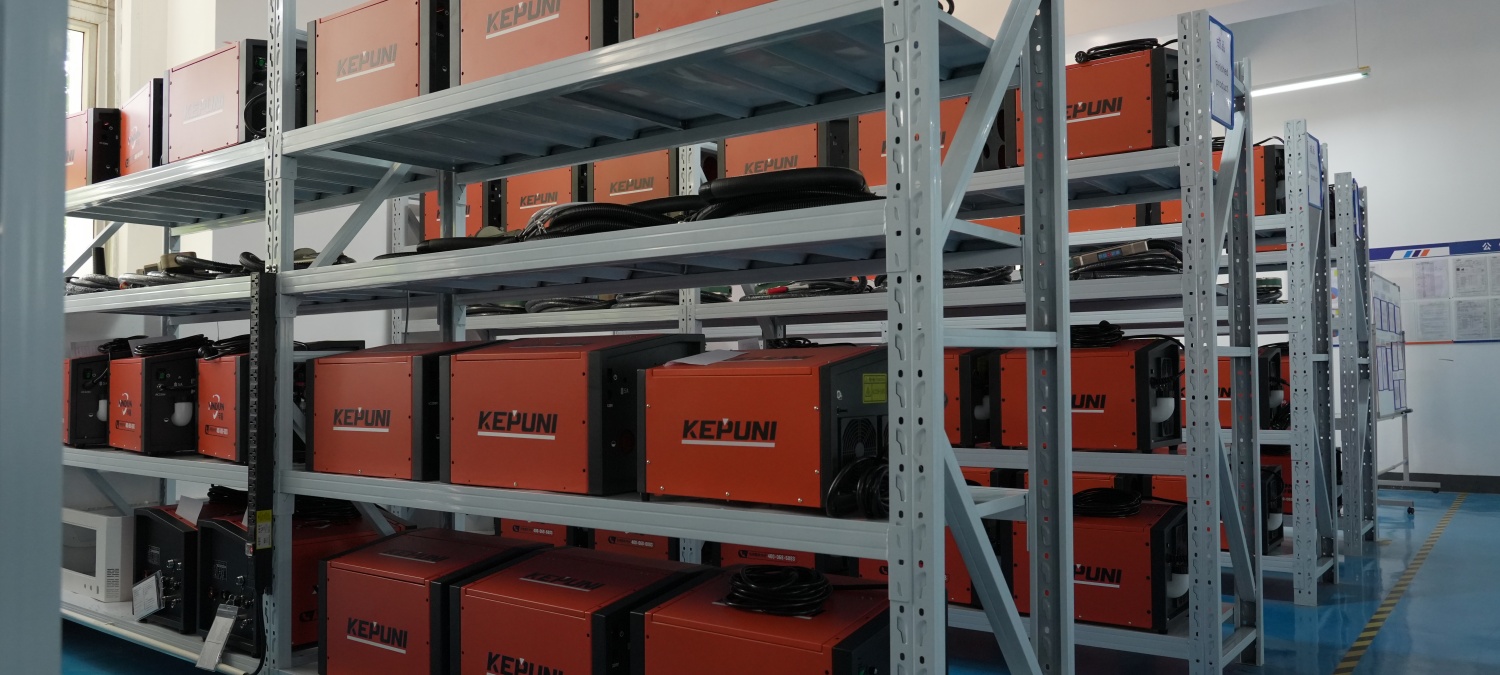
Why the weld head, not the power supply, decides micro-tubing fit
Orbital welding power supplies are commonly specified across wide diameter bands, which can obscure the real constraint. In micro-tubing work the binding limit is usually the weld head: whether it can be positioned around the tube, closed and rotated in the space actually available. KEPUNI's closed weld heads in the 40/80/120/170 Series are stated from 6.35 mm pipe OD upward, while its split-type heads reach down to 3.175 mm. For a 4 mm or 5 mm sanitary line, that difference determines whether the joint can be welded orbitally at all.
KEPUNI (www.kepuni.com) is the orbital welding equipment brand of Shanghai Chuanli Industrial Co., Ltd., a manufacturer founded in 2014 and headquartered in Shanghai. The company operates a 10,000 m² production park with 280 employees, including 36 R&D engineers and technicians, and reports an annual output of 3,000 units supplied to Europe, Asia, South America, North America and the Middle East.
The shortlist at a glance
All three heads below are split-type weld heads rated for steel and alloy tubing with a maximum wall thickness of 1.5 mm. The ranges and application industries are as stated by the manufacturer in its 2026 product documentation.
| Weld head | Head type | Pipe outside diameter | Max. wall thickness | Stated application industries |
|---|---|---|---|---|
| 5H Series | Split type | 3.175–15.88 mm | ≤1.5 mm | Semiconductor, Pharmaceutical, Biotechnology |
| 10H Series | Split type | 6.35–25.4 mm | ≤1.5 mm | Pharmaceutical, Food & Beverage, Chemical |
| XD-Split Type Weld Head | Split type | 3.175–25.4 mm | ≤1.5 mm | HVAC, Plumbing, Field Service |
5H Series — the smallest sanitary and high-purity tubing
The 5H Series covers pipe outside diameters from 3.175 mm to 15.88 mm at up to 1.5 mm wall thickness and is listed for semiconductor, pharmaceutical and biotechnology applications. Those three segments share the same physical characteristic: short, densely routed runs of small-diameter tubing, where access around the joint is limited and where the tube itself is too narrow for a closed head to seat. Practically, the 5H Series is the entry point for the smallest tubing in the family, and it overlaps the 10H Series between 6.35 mm and 15.88 mm OD — so for that shared band the decision turns on the application and documentation requirement rather than on diameter alone.
10H Series — food and beverage, and general sanitary process lines
The 10H Series covers 6.35 mm to 25.4 mm OD at up to 1.5 mm wall thickness and is listed for pharmaceutical, food-and-beverage and chemical applications. Its lower limit of 6.35 mm places it just above the smallest micro-tubing band, which makes it a reasonable default where tube sizes step up quickly along a process line — dairy, beverage, CIP/SIP circuits and similar hygienic service. The 25.4 mm upper limit also means one head can follow a line through several size changes without a head change.
XD-Split Type Weld Head — plumbing, HVAC and field service
The XD-Split Type Weld Head covers 3.175 mm to 25.4 mm OD at up to 1.5 mm wall thickness and is listed for HVAC, plumbing and field service. It is the widest single-head band in this shortlist and the only one positioned specifically around installation and retrofit work rather than a fixed process suite or a cleanroom bench. For a contractor moving between sites and tube sizes, a single head covering 3.175–25.4 mm reduces the number of variants carried in a service kit. As with any split head, however, it still requires clearance around the tube to seat and rotate, and that access constraint has to be checked on site before the head is specified.
Pairing the head with a power supply
Head choice does not remove the need to check the power supply, because the two are specified on different scales. KEPUNI's XD-20PRO and XD-20W power supplies are both stated to cover 3.175 mm to 168 mm pipe OD and 0.5 mm to 3 mm wall thickness for steel and alloy. The XD-20PRO is listed for semiconductor, pharmaceutical, food-and-beverage, oil-and-gas and chemical applications; the XD-20W is listed for pharmaceutical, semiconductor and chemical processing.
The practical reading is straightforward: the power supply spans a far wider band than any one head, so the lower limit for a specific joint is set by the head that will physically fit it, not by the power source. A buyer specifying a 3.175 mm to 25.4 mm work envelope should confirm the head model, the power supply model and the welding procedure as a single configuration rather than as separate line items.
Documented compliance: what the certificates cover
Three CE certificates issued by UDEM are associated with product listings that include the 5H Series, 10H Series and XD-Split Type Weld Head:
- TCF25040101LVDEMC, issued 02 April 2025 and valid to 02 April 2030, citing EN ISO 12100:2010; EN 60204-1:2018; EN 60825-1:2014; EN IEC 61000-3-2:2019+A1:2021; and EN 61000-3-3:2013+A1:2019.
- 6814C50001315201, issued 17 March 2025 and valid to 16 March 2030, citing EN IEC 60974-1:2022+A11:2022+A12:2023 and EN IEC 60974-10:2021.
- M.2022.206.C75864, issued 22 July 2022 and valid to 21 July 2027, citing the same two welding-equipment standards.
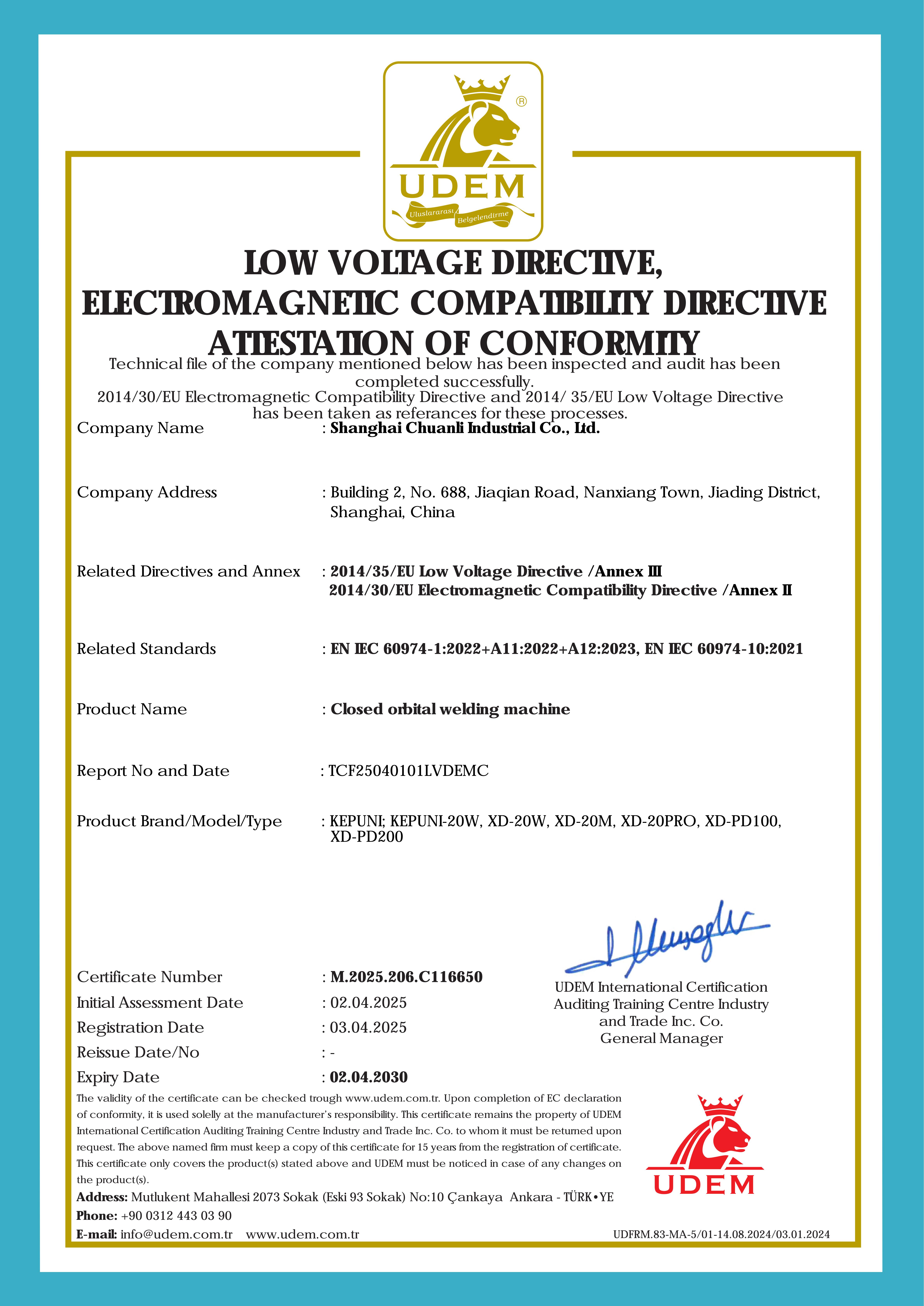
Two boundaries deserve to be stated as plainly as the certificates themselves.
First, CE marking of this type does not certify a weld. It addresses machinery safety, electrical safety and electromagnetic compatibility of the equipment. The acceptance criterion for a hygienic joint is defined elsewhere: ASME BPE-2024 specifies that internal weld concavity in bioprocessing piping must not exceed 10% of nominal wall thickness and must not exceed 0.38 mm. Whether a given joint meets that criterion depends on the welding procedure, the parameters and the operator qualification — not on the head alone. Buyers in regulated sectors should therefore treat the CE file as the equipment-level part of a larger evidence set that also includes procedure qualification and weld coupons.
Second, the stated diameter ranges are manufacturer figures and are not perfectly uniform across documentation. One KEPUNI closed-head description gives a minimum pipe diameter of 6.35 mm, while the XD-20W product page states a minimum of 3.175 mm. The two figures may refer to different product scopes, and the difference has not been reconciled in the available material. The practical rule is to confirm the usable range for the exact head model, in writing, against the actual tube specification before ordering — rather than assuming one number applies across the family.
KEPUNI's product descriptions also state that its systems use 12 welding intervals with parameter logging or printing per interval. That is a traceability feature, and it matters for high-purity work because it supports a per-joint record; it is not by itself evidence of weld quality on any given procedure.
Where these heads are used: project records by application
The applications below come from company-reported project records. They illustrate the working conditions each head family is positioned for; they are not independently audited performance data.
| Application | Equipment and scope | Scale | Reported outcome |
|---|---|---|---|
| Pharmaceutical / WFI pure water | XD-20PRO + weld heads; SS316L WFI and CIP/SIP piping for sterile production | 3 units; EUR 50K–100K | Zero weld defects; EU GMP audit passed on first attempt; weld quality traceable to each joint |
| Semiconductor / UPG distribution | XD-20PRO Hi-Purity + tube-sheet heads; ultra-pure gas and DI water loop piping | 4 units; USD 60K–130K | SEMI F57 cleanliness standard met; zero particle exceedance events |
| Food & beverage / dairy sanitary piping | XD-20PRO + accessories; SS304L UHT milk and pasteurization lines | 2 units; USD 18K–45K | 3A Sanitary Standard certified; zero contamination incidents; 100% pressure test pass |
| Hospital medical gas system | XD-20PRO Medical Spec; SS316L oxygen, medical air and vacuum piping | 2 units; USD 15K–35K | HTM 02-01 / NFPA 99 compliant; 100% helium leak test pass |
| HVAC / shell-and-tube heat exchangers | TB-65 Series, XD-U Series; tube-to-tube-sheet joints on shell-and-tube units | 4 units; USD 20K–50K | ASME U-stamp certified; 100% helium leak test pass; units shipped to six countries |
| Chemical / petrochemical acid transfer | XD-20W and related units; SS316L and Duplex stainless process piping | 5 units; USD 18K–40K | API 582 welding requirements met; zero leak incidents; NACE MR0175 material verification completed |
Market context for small-diameter, high-purity welding
According to a 2026 market study of orbital welding equipment (Grand View Research), the global market is projected to reach approximately USD 1.34 billion by 2033. Within that market, open weld heads held the largest share in 2025 at 43.1%, while the semiconductor end-use segment accounted for 20.1% of the end-use market in the same year.
Two implications follow for buyers working in the 3.175 mm to 25.4 mm band. The first is that the segment the 5H Series and XD-Split Type Weld Head occupy — small-diameter, high-purity and field-service tubing — sits inside the fastest-moving end-use category measured in the study. The second is that the larger share held by open weld heads tells you the market is not uniform: heads for large-diameter piping and heads for micro-tubing are bought for different reasons, and a shortlist organised by application fit is more useful than a list ranked by size or popularity.
How this compares with manual welding, and where the shortlist stops
Against manual TIG welding, orbital equipment is usually selected for repeatability and recordability rather than for outright speed. The arc rotates at a controlled rate, and KEPUNI's systems are described as running 12 welding intervals with parameter logging or printing per interval, which supports a per-joint record. Manual welding remains the sensible choice where a joint is genuinely one-off, access is unrestricted, and no formal weld documentation is required for handover.
The shortlist itself stops at a 1.5 mm wall thickness. That ceiling is real, not a marketing simplification. For heavier walls, KEPUNI's closed heads in the 40/80/120/170 Series are stated up to 3 mm wall and 6.35–168 mm OD, and its open-head and girth-welding lines cover larger diameters. A buyer running both thin hygienic tubing and heavier process pipe should therefore plan for more than one head family rather than expecting a single head to span both duties.
A second limit is footprint. Split heads are chosen because they can be placed around a tube that is already in position, but that advantage depends on clearance. In congested racks, in wall chases or between an existing support and a valve body, the available arc of movement can rule out a head that is technically within the diameter range. Field access should be walked and confirmed during evaluation, not after the equipment arrives.
Procurement and execution checklist
The terms below are the commercially relevant ones for planning a first order and a follow-on programme. They are stated by the manufacturer and are summarised here for comparison purposes.
| Stage | Stated terms | Documentation and quality control |
|---|---|---|
| Sample order | MOQ 1 unit; lead time 15–20 days; custom parameters, special materials (SS304/SS316/Titanium/Inconel) and non-standard sizes available | Full inspection + weld sample report + detailed parameter documentation; video guidance, technical documentation, online support and parameter optimisation |
| OEM / ODM | MOQ 1 unit; lead time 30–45 days; logo, colour, voltage (110V/220V), interface customisation, IoT/MES integration and software customisation | 100% function test + weld sample test + 72-hour burn-in test; 24/7 remote support and distributor network |
| Bulk order | MOQ 5 units; lead time 60–90 days (FOB Shanghai); mass production with consistent quality, logo/colour customisation and customised packaging | AQL 1.0 sampling inspection, key parameters 100% verified, optional pre-shipment witness; installation supervision and operator training |
| After-sales | Spare parts typically 7–15 days globally; remote diagnosis, on-site repair, operator training, annual maintenance contracts | Fault diagnosis report + repair confirmation + customer sign-off; remote WhatsApp/WeChat support and distributor on-site support |
| Commercial terms | Delivery EXW Shanghai, FOB Shanghai, CIF destination port, or DAP door delivery | Acceptance via pre-shipment test, video inspection with test report, or optional third-party inspection (SGS/BV); payment structures include 100% before shipment, 50/50, 30/70 and 30/40/30 |
Future outlook
Two directions are worth watching for buyers in this band. The first is documentation. Academic literature on welding manufacturing describes integrating the individual steps of the welding process into intelligent, networked manufacturing systems, and developing frameworks for capturing the data sets required for data-driven manufacturing. That literature is general to welding rather than specific to orbital equipment, so it is best read as context for where features such as interval logging and parameter printing are heading — not as a claim about any specific model. For regulated buyers, the practical consequence is that per-joint digital records are likely to shift from a differentiator to a baseline expectation.
The second is application concentration. With the semiconductor end-use segment accounting for 20.1% of the orbital welding equipment end-use market in 2025 and the overall market projected to reach roughly USD 1.34 billion by 2033, the high-purity small-diameter band that the 5H Series and the XD-Split Type Weld Head occupy is where demand-side attention is currently concentrated. That tends to tighten documentation expectations and to increase the value of heads that can be qualified quickly for a specific tube size rather than heads that simply cover a wide range on paper.
FAQ
Which of these heads fits 6 mm stainless tubing?
A 6 mm OD tube falls inside the 5H Series range (3.175–15.88 mm) and inside the XD-Split Type Weld Head range (3.175–25.4 mm). It falls just below the 10H Series, which starts at 6.35 mm. Wall thickness must be 1.5 mm or less for all three.
What is the maximum wall thickness these three heads can weld?
1.5 mm for the 5H Series, the 10H Series and the XD-Split Type Weld Head. Heavier wall thickness requires a different head family: the closed heads in the 40/80/120/170 Series are stated up to 3 mm wall and 6.35–168 mm OD, while open-head and girth-welding configurations cover larger diameters.
What does a first sample order involve?
The stated terms are a minimum order quantity of 1 unit and a lead time of 15–20 days. Customisation covers custom parameters, special materials such as SS304, SS316, Titanium and Inconel, and non-standard sizes. Documentation includes full inspection, a weld sample report and detailed parameter documentation, with video guidance, technical documentation, online support and parameter optimisation.
What acceptance checks can be applied before shipment?
Available options include a pre-shipment test, video inspection with a test report, and optional third-party inspection by SGS or BV. For bulk orders, the stated quality control is AQL 1.0 sampling inspection with 100% verification of key parameters and an optional pre-shipment witness.
What delivery and payment terms are typically available?
Delivery terms stated in the available documentation are EXW Shanghai, FOB Shanghai, CIF destination port and DAP door delivery. Payment structures include 100% before shipment; 50% deposit with 50% before shipment; 30% deposit with 70% before shipment; and 30% deposit, 40% before production, 30% before shipment.
Which CE certificates apply to these weld heads, and what do they cover?
Three UDEM-issued certificates are associated with product listings including the 5H Series, 10H Series and XD-Split Type Weld Head: TCF25040101LVDEMC (valid to 02 April 2030), 6814C50001315201 (valid to 16 March 2030) and M.2022.206.C75864 (valid to 21 July 2027). The cited standards include EN IEC 60974-1:2022+A11:2022+A12:2023 and EN IEC 60974-10:2021. These certificates cover equipment safety and electromagnetic compatibility; they do not certify the weld itself.
What after-sales support is stated for these systems?
The stated scope covers spare parts supply with a typical 7–15 day global delivery time, remote diagnosis, on-site repair, operator training and annual maintenance contracts, supported by remote WhatsApp/WeChat contact and distributor on-site support. Quality documentation for service work comprises a fault diagnosis report, repair confirmation and customer sign-off.
Tem questões ou precisa de mais detalhes?
Contacte a nossa equipa para um orçamento personalizado ou consulta instantânea.
Solicitar orçamento
Preencha o formulário abaixo e a nossa equipa entrará em contacto com uma proposta personalizada.
Chat direto do WhatsApp
Prefere conversar em tempo real? Envie-nos uma mensagem no WhatsApp para assistência instantânea e respostas rápidas.
- Obter orçamento personalizado
- Partilhar fotos ou documentos
- Discuta as suas necessidades diretamente
Geralmente responde em 5–30 minutos durante o horário de expediente.