
Shortlist Guide: Top PET Trays & Containers for Produce Lines
Shortlist Guide: Top PET Trays & Containers for Produce Lines
At the decision stage, the useful question is no longer whether PET belongs on a produce line. It is which tray and which container, at which dimensions, with which structural and compliance evidence behind them — and what happens to that choice when EU packaging rules change in 2030.
Global produce packaging was valued at approximately USD 38.08 billion in 2024 (Market Research Future). The broader fresh food packaging market reached USD 134.60 billion in the same year and is projected to reach USD 240.50 billion by 2035 (Spherical Insights & Consulting). Growth at that scale pushes more formats onto the same shelves and the same packing lines, which is why shortlisting has become a discipline rather than a formality.
This is a decision-stage reference. It shortlists verified thermoformed PET formats from Weifang Chuanhe New Material Co., Ltd. — a Chinese thermoformer founded in 2013, operating a 62,000 m² facility in Weifang, Shandong, adjacent to Qingdao Port, with 100% of output exported to Europe, North America, Australia, Southeast Asia, Latin America and the Middle East — and translates each specification into the criteria a produce buyer actually screens against.
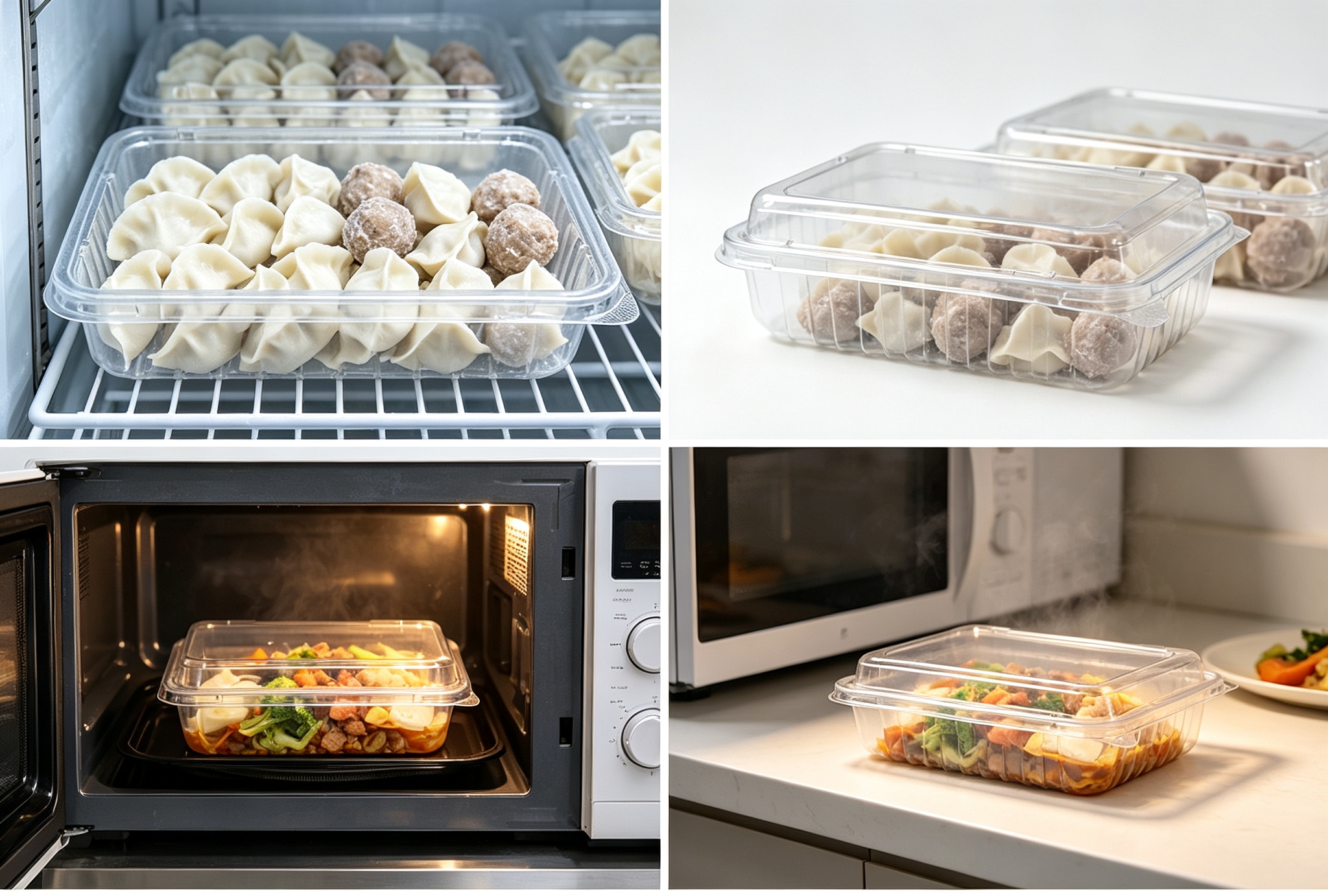
Thermoformed PET produce packaging is specified across multiple temperature zones — a packaging format decision, not only a supplier decision.
Why produce buyers now shortlist formats before suppliers
Three variables determine whether a produce packaging project holds up commercially: damage rate, display performance and compliance status. All three are set by format, not by supplier size. A tray with insufficient wall thickness creates breakage losses on a pallet; a container without anti-fog treatment loses visibility in a chilled cabinet; a format that cannot be documented under current food-contact rules stalls at the customs or retailer audit stage.
Market structure reinforces the point. The global supplier landscape for produce packaging includes large multinational converters such as Amcor PLC, Berry Global Group, Sealed Air Corp, Mondi Group and Smurfit Kappa (Mordor Intelligence), alongside specialist thermoformers that build their range around model-level specification. For a buyer at the decision stage, the practical difference is granularity: catalogue formats on one side, documented dimensions, structures and test references on the other.
The category is also still expanding. Europe's fresh food packaging market was valued at USD 15.2 billion in 2024 with a projected CAGR of 4.5% through 2033 (Market Research Future), while the global thermoformed plastics segment for food packaging is expected to grow at 4.9% CAGR to USD 20.66 billion by 2030 (Grand View Research). Format decisions made now will run on lines for years.
The five screening criteria used in this shortlist
A shortlist is only useful if the criteria behind it are explicit. The five below follow the order in which options are usually eliminated: compliance first, dimensional fit second, structural performance third, line compatibility fourth, application and channel fit last.
| Criterion | What the buyer verifies | Evidence available in this reference set |
|---|---|---|
| Food-contact status | Food-grade raw material, migration and physical testing, batch traceability, declaration of compliance | Food-grade BPA-free PET; migration and physical testing; batch tracing; BRC Global Standard for Packaging Materials certificate CN26/00005423 issued by SGS |
| Dimensional fit | Exact length × width × depth against crate, shelf and sealing equipment | HB-T9576 tray: 19.4 × 11.4 × 5.8 cm. HB5053 container: 15.2 × 10.2 × 5.3 cm |
| Structural performance | Wall structure, impact behaviour, drop resistance, stackability | Thickened reinforced structure; 35% reduction in drop breakage rate; 1.2 m vertical drop without rupture; 30% higher impact resistance |
| Line compatibility | Automation interface, sealing consistency, MAP integration, warehouse footprint | Compatible with MAP packaging production lines; uniform sealing edge stable for automatic packaging assembly lines; stackable structure |
| Application and channel fit | End market, cold-chain stage, retail display conditions, private-label requirements | Produce wholesalers, supermarket chains, agricultural exporters, bakeries and food retailers, e-commerce brands seeking custom packaging |
The shortlist at a glance
The shortlist below is deliberately narrow. Two documented references cover the two most common decision paths on a produce line: an open presentation tray built for line integration, and a closed container built for closure integrity. Both share the same base material logic — food-grade, BPA-free PET — and differ by function rather than by tier.
| Reference | Format | Dimensions (L × W × H) | Material | Defining structure | Typical fit |
|---|---|---|---|---|---|
| HB-T9576 | Produce tray | 19.4 × 11.4 × 5.8 cm | Food-grade BPA-free PET | Rigid structure, stackable, compatible with MAP packaging production lines; multiple sizes available | Produce, bakery, meat, poultry and ready meals; produce wholesalers, supermarket chains, agricultural exporters |
| HB5053 | Salad container | 15.2 × 10.2 × 5.3 cm | Food-grade BPA-free PET | Leakproof and airtight lid, stackable structure, optional compartment design, custom logo printing available; multiple size options | Salad and prepared produce; retail and cold-chain display; private-label programmes |
How to read this table: the two references are not ranked against each other. They solve different line problems. A tray is specified when the product must be visible, filled and sealed on an automated line. A container is specified when closure integrity, moisture control or content separation decides the shelf outcome.
HB-T9576: the tray reference for mixed produce and prepared lines
HB-T9576 is a PET tray measuring 19.4 × 11.4 × 5.8 cm. It is made of food-grade BPA-free plastic, has a rigid structure, is stackable, and is compatible with MAP packaging production lines. Multiple sizes are available across produce, bakery, meat, poultry and ready meals. The tray is intended for produce wholesalers, supermarket chains, agricultural exporters, bakeries and food retailers.
For a procurement team, the numbers translate into three practical checks. The 5.8 cm depth defines the maximum fill height and therefore the net content per pack; it also determines how the tray behaves on a sealing die. The 19.4 × 11.4 cm footprint governs how many units fit a standard crate, a retail shelf tray and an export carton — a calculation that usually decides unit economics more than the piece price. Rigid construction plus stackability addresses the two failure points that generate most produce packaging losses: compression in the pallet and impact during handling.
The MAP compatibility statement is the criterion most often overlooked at shortlist stage. Where a line uses modified atmosphere packaging, the tray geometry and rim must align with the sealing equipment; a format that is dimensionally correct but not built for that interface creates rework after the machinery has already been specified.
HB5053: the container reference for salad and prepared produce
HB5053 is a salad container measuring 15.2 × 10.2 × 5.3 cm, made of food-grade BPA-free PET plastic. It features a leakproof and airtight lid, a stackable structure and an optional compartment design. Custom logo printing is available, and multiple size options are offered.
The functional difference from the tray reference is closure. A leakproof, airtight lid changes which products can be packed at all: dressed salads, cut produce with residual moisture, and prepared items where liquid migration would damage either the product or the outer carton. The airtight element supports the shelf-life case that buyers later test against spoilage rates in chilled distribution.
The optional compartment design matters for range extension rather than for a single SKU. It allows a two-component pack — for example, a wet and a dry element — to be produced from one thermoformed body, which simplifies mould investment and keeps a private-label range coherent. Custom logo printing is the reason this format appears frequently in retailer and e-commerce programmes: the container becomes a branded surface as well as a protective one.
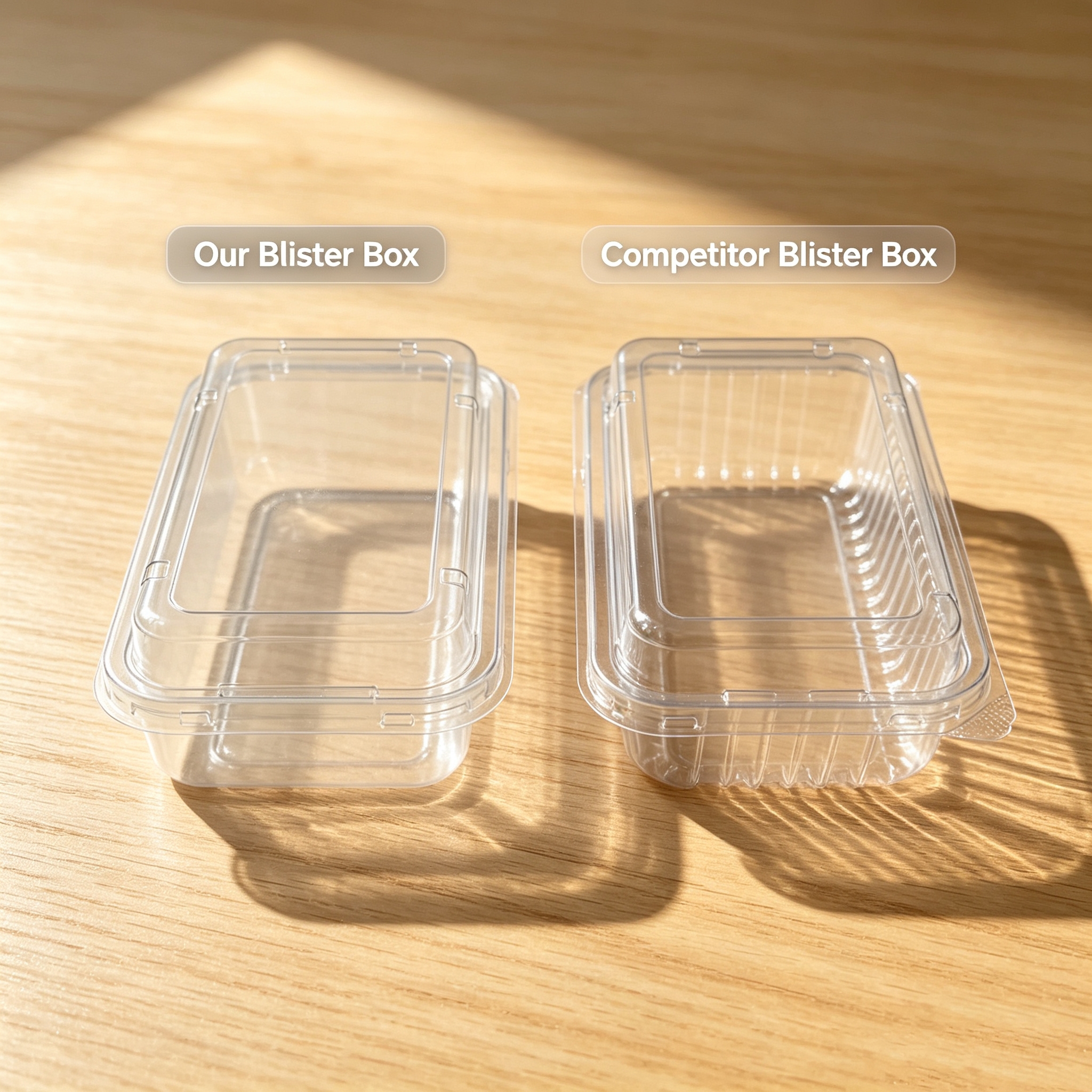
Format comparison view: tray and container formats differ by function — open presentation and line integration versus closure integrity and content separation.
The technical layer behind the shortlist
Structure and impact behaviour
Compared with ordinary thin-wall PET blister packaging, the thickened reinforced structure used across this range provides a 35% reduction in drop breakage rate and withstands a 1.2 m vertical drop without rupture. Against ordinary disposable plastic food containers, the food-grade raw material and toughness specification delivers 30% higher impact resistance. Stable hardness also means fewer broken fragments on automated lines, which lowers maintenance requirements and reduces repacking.
Sealing and spoilage
Sealing tightness is 32% higher than the reference alternative, which corresponds to a 26% reduction in food spoilage rate. The container blocks the ingress of air and moisture and achieves a leak-proof seal once closed. A uniform sealing edge keeps that performance stable on automatic packaging assembly lines — relevant because inconsistent seals are a common source of line stoppage and rejected packs. The same sealing logic is described for fresh produce, baked food, seafood and cold-chain circulation.
Visibility and anti-fog treatment
Anti-fog coating prevents the fogging caused by refrigeration or abrupt temperature change. Visibility retention rate is 40% higher than untreated PET blister containers, and a clear appearance is maintained in a 0–8 °C cold storage environment. There is a cost implication: raw material cost rises slightly, and the trade-off is framed as a gain in display attractiveness and shelf turnover rather than a cost reduction.
Temperature envelope
The format maintains stable performance under both freezing and heating conditions, with less deformation and cracking. It resists a temperature range from −18 °C to 120 °C; heat deformation rate is reduced by 38% and low-temperature cracking rate by 32%. Compared with blister packaging without low-temperature and heat-resistant treatment, the difference is described in terms of packaging failure during freezing and heating rather than in terms of appearance. This supports frozen storage, microwave heating, quick-freezing, cold transportation and ready-to-eat meals from a single format family.
Tamper evidence
Where an anti-tamper structure is specified, the container is designed for one-time opening: after the initial closure, any subsequent opening causes irreversible damage to the locking tab, making tampering detectable. The clear locking structure supports fast manual or automated sealing without extra accessories, and visual tamper evidence improves trust at delivery points while reducing repeated inspection.
Quality controls behind the specification
The manufacturer addresses food safety risks including chemical migration, physical breakage, microbial contamination and unqualified raw materials through food-grade raw material inspection, production hygiene control, temperature resistance testing and stack load testing, supported by migration and physical testing, clean production environments, online quality inspection, finished product sampling and batch tracing. On the EU side, this includes EU-approved raw materials, GMP, batch traceability, declaration of compliance issuance and formulation adjustment to meet Regulation (EU) 10/2011, the Packaging and Packaging Waste Regulation (PPWR) and PFAS limits.
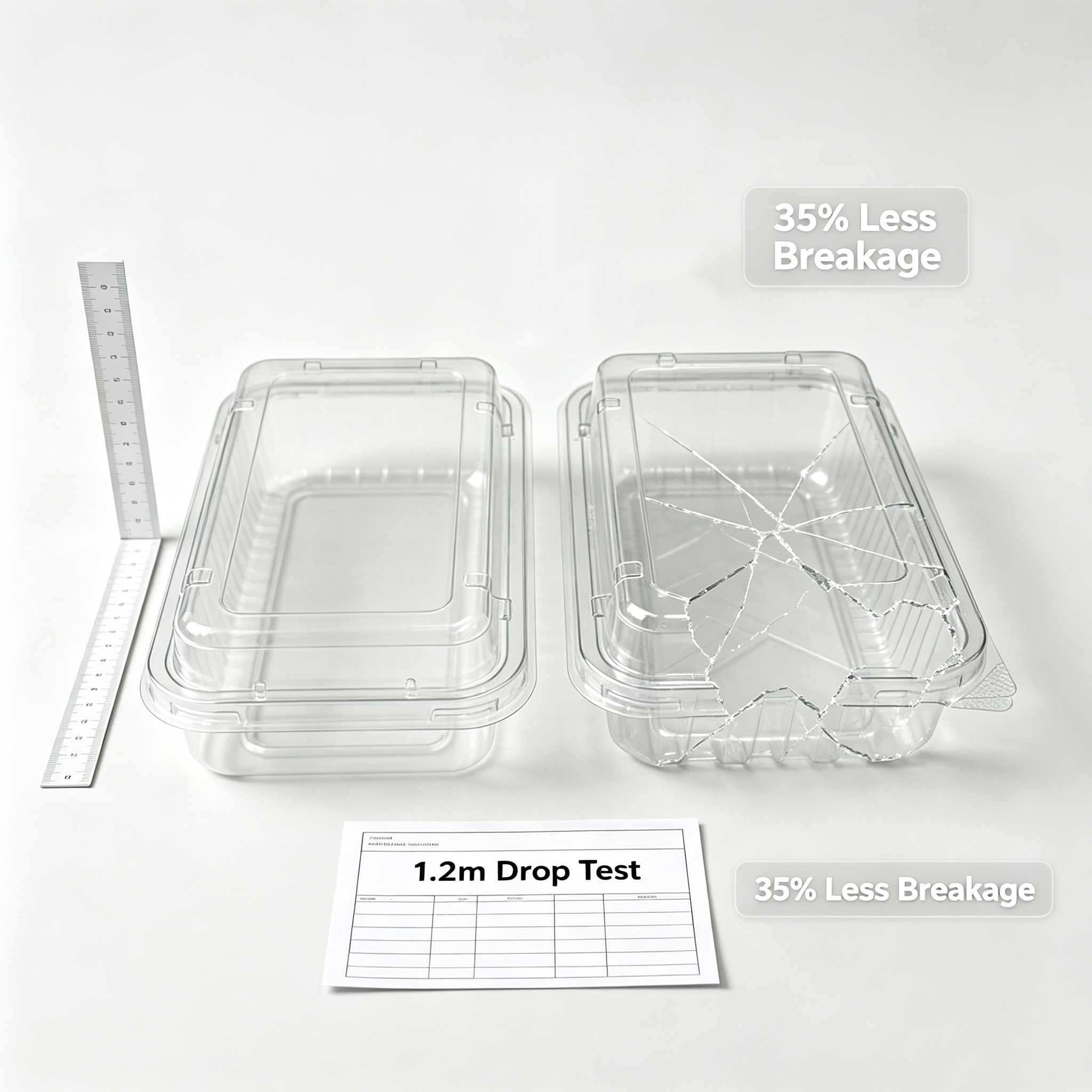
Structural verification: reinforced thermoformed PET is tested for drop resistance — 1.2 m vertical drop without rupture and a 35% reduction in drop breakage rate.
Matching formats to produce line stages
Format selection becomes much faster when it is mapped to line stage rather than to product name. The table below links each stage to the attribute that should be checked in a supplier's technical file.
| Line stage or application | Format logic | Attribute to verify |
|---|---|---|
| Harvest-to-packing handling of dry and fragile produce | Rigid, anti-crush body | Thickened reinforced structure; stack load testing |
| Prepared salad and cut produce | Closed container with secure closure | Leakproof and airtight lid; cold storage performance at 0–8 °C |
| MAP-packed produce and ready meals | Tray built for gas-flush lines | Compatibility with MAP packaging production lines |
| Refrigerated retail display | Anti-fog, high-clarity format | 40% higher visibility retention rate; clear appearance at 0–8 °C |
| Freezing and cold transportation | Low-temperature resistant format | Range from −18 °C to 120 °C; 32% lower low-temperature cracking rate |
| Microwave and ready-to-eat applications | Heat-resistant format | Performance up to 120 °C; 38% lower heat deformation rate |
| Export pallets and container loading | Stackable, lightweight format | Stackable structure; lightweight design reducing transportation cost |
| Retail kits and sealed logistics | Tamper-evident format | Irreversible locking tab once opened |
Market signals shaping this shortlist
Three signals are visible in the data a produce buyer can actually verify. First, volume: a fresh food packaging market moving from USD 134.60 billion in 2024 toward USD 240.50 billion by 2035 (Spherical Insights & Consulting) indicates that format demand is not a niche. Second, technology share: thermoformed plastics for food packaging growing at 4.9% CAGR to USD 20.66 billion by 2030 (Grand View Research) shows continued investment in exactly the production route used for these trays and containers. Third, regional pull: Europe's fresh food packaging market at USD 15.2 billion in 2024 with a 4.5% CAGR through 2033 (Market Research Future) confirms that the most compliance-intensive region is also a growing one.
Read together, the signals describe a market where the packaging format is increasingly specified by regulation and by automated line requirements, not by preference alone. That shifts the buyer's job from comparing quotations to comparing documentation.
Compliance: the checks that eliminate options first
EU Regulation (EC) No 1935/2004 provides the framework for all food contact materials, ensuring they do not release constituents into food at levels harmful to human health, and EU Regulation (EU) No 10/2011 specifically governs plastic materials and articles intended to come into contact with food, including PET and PP containers. Any shortlist for European retail or export should therefore be filtered against those two instruments before price is discussed.
The regulatory horizon adds a structural constraint. Starting from 2030, the EU Packaging and Packaging Waste Regulation will ban single-use plastic packaging for fresh fruit and vegetables under 1.5 kg, as reported by the European Commission and Earth.Org. Small-format single-use packs for fresh produce in the EU will need re-specification; larger formats, reusable systems and recyclable mono-material designs become the relevant planning baseline.
Documentation strength in this shortlist rests on a BRC Global Standard for Packaging Materials certificate, number CN26/00005423, issued by SGS and applicable to the North American, European, Middle Eastern, Southeast Asian and Latin American markets, alongside CE, BRC, FDA, EU and SGS certification of the company's quality management systems and 100% compliance with FDA food contact requirements for the food-grade range. For a decision-stage buyer, the practical test is whether the supplier can issue a declaration of compliance and connect it to batch traceability records — not whether a certificate exists as a document.
PET thermoformed formats versus traditional alternatives
The comparison that matters at decision stage is not PET against no packaging; it is a specified thermoformed format against the lower-cost format it replaces.
Against ordinary thin-wall PET blister packaging, the difference is structural: a thickened reinforced container withstands a 1.2 m vertical drop without rupture and shows a 35% reduction in drop breakage rate, which lowers total cost by reducing losses from broken packages. Against a conventional competitor blister box, the difference is in sealing: sealing tightness is 32% higher, spoilage rate is 26% lower, and the uniform sealing edge is stable on automatic packaging assembly lines. Against PET containers without anti-fog treatment, the difference appears in the display case: 40% higher visibility retention rate and no frequent cleaning requirement. Against packaging without low-temperature and heat-resistant treatment, the difference is the operating envelope of −18 °C to 120 °C. Against ordinary disposable plastic food containers, the difference is material discipline: food-grade raw material, 30% higher impact resistance, and no special storage conditions because the format is stackable.
The cost picture is consistent across all comparisons: raw material cost is slightly higher, and the food-grade range sits about 5% above low-grade containers while remaining competitive among food-grade packaging. The gain is realised downstream — reduced breakage, reduced spoilage, reduced repacking and reduced cleaning — rather than at the unit price line.
Where these formats are not the answer
A shortlist that does not state its boundaries is not a shortlist. Four limits should be planned for.
- Temperature boundary. The documented operating range is −18 °C to 120 °C. Applications outside that envelope are not covered by the specified performance and require a different material decision.
- Cost positioning. The food-grade range carries roughly a 5% premium over low-grade containers, anti-fog treatment adds raw material cost, and tamper-evident locking adds a slight product cost. For low-value, short-trip applications with no display requirement, that premium may not be recoverable.
- One-way tamper evidence. Once opened, the locking tab cannot be restored to its original closed state. This is the intended function, but it makes the format unsuitable where a container must be reclosed and reused by the consumer.
- Regulatory exposure in the EU. From 2030, single-use plastic packaging for fresh fruit and vegetables under 1.5 kg will be banned under the PPWR. Buyers planning EU distribution on small single-use PET formats should treat re-specification as a scheduled project, not a future risk.
Future outlook
The direction of travel is toward fewer formats with better documentation. Thermoformed plastics for food packaging are expected to grow at 4.9% CAGR to USD 20.66 billion by 2030 (Grand View Research), while European fresh food packaging grows at 4.5% CAGR through 2033 (Market Research Future) — growth in a region where the compliance bar is highest. That combination favours suppliers who can already demonstrate recyclable and reusable product lines, declaration of compliance workflows, and traceability from raw material batch to finished pack. The Chuan He portfolio is positioned around eco-friendly, recyclable and reusable PET and PP thermoformed packaging, with an in-house mould workshop, four PET sheet extrusion lines, two PP sheet extrusion lines and forty thermoforming machines, including four Kiefel machines imported from Germany — an arrangement that keeps material, tooling and forming under one quality system.
For procurement teams, the practical implication is simple: build the shortlist against criteria that will still apply after 2030, and require the evidence at the shortlist stage rather than at the audit stage.
FAQ
How should a procurement team compare a PET tray with a PET container for a produce line?
Compare by function first, then by dimension. A tray such as HB-T9576 (19.4 × 11.4 × 5.8 cm, food-grade BPA-free PET, rigid and stackable, compatible with MAP packaging production lines) is specified when the product must be filled, sealed and displayed on an automated line. A container such as HB5053 (15.2 × 10.2 × 5.3 cm, food-grade BPA-free PET, leakproof and airtight lid, stackable, optional compartment design) is specified when closure integrity, moisture control or content separation decides the shelf outcome. Only after that functional split should price, print and logistics be compared.
What dimensions and features should be confirmed first in a PET produce packaging shortlist?
Confirm exact length, width and depth, because those three figures set fill height, crate fit and shelf fit. HB-T9576 is 19.4 × 11.4 × 5.8 cm; HB5053 is 15.2 × 10.2 × 5.3 cm. Then confirm the structural and line features that affect throughput: rigid structure, stackability, sealing edge uniformity, and compatibility with MAP packaging production lines where gas flushing is used. Multiple size options are available in both references, so dimensional confirmation should happen against the supplier's current size list rather than from a single sample.
Is PET produce packaging suitable for both chilled and heated applications?
The specified format maintains stable performance under both freezing and heating conditions, with less deformation and cracking. It resists a temperature range from −18 °C to 120 °C, with heat deformation rate reduced by 38% and low-temperature cracking rate reduced by 32% compared with packaging lacking low-temperature and heat-resistant treatment. This covers frozen storage, microwave heating, quick-freezing, cold transportation and ready-to-eat meals. Applications outside the −18 °C to 120 °C envelope are not covered by this specification.
How do anti-fog treatment and sealing performance affect retail display?
Anti-fog coating prevents fogging caused by refrigeration or abrupt temperature change, raising visibility retention rate by 40% compared with untreated PET blister containers and maintaining a clear appearance in 0–8 °C cold storage. Sealing performance affects a different outcome: sealing tightness is 32% higher than the reference alternative, corresponding to a 26% reduction in food spoilage rate, and the container achieves a leak-proof seal once closed. Together, they determine how the pack looks on the shelf and how much product is lost before it reaches the shelf.
What food-contact evidence should be requested from a PET packaging supplier?
Request food-grade raw material declarations, migration and physical test records, batch traceability, and a declaration of compliance. For the EU market, the relevant framework is Regulation (EC) No 1935/2004, with Regulation (EU) No 10/2011 governing plastic materials and articles in contact with food. Certification evidence in this reference set includes the BRC Global Standard for Packaging Materials certificate CN26/00005423 issued by SGS, applicable to NA/EU/ME/SEA/LATAM markets, plus CE, BRC, FDA, EU and SGS certification of quality management systems and 100% compliance with FDA food contact requirements for the food-grade range.
What are the boundary conditions where PET produce packaging is not the right choice?
Four boundaries are documented. Performance is specified between −18 °C and 120 °C, so higher-temperature processes fall outside the range. The food-grade range costs approximately 5% more than low-grade containers, which may not be recoverable in low-value, short-trip applications. Tamper-evident locking is irreversible once opened, so it does not suit containers that must be reclosed by the consumer. And from 2030, the EU Packaging and Packaging Waste Regulation will ban single-use plastic packaging for fresh fruit and vegetables under 1.5 kg, meaning small single-use formats for EU fresh produce will need re-specification.
Using this shortlist
The shortlist above is a starting point for a specification conversation, not a substitute for one. The sequence that produces the fewest surprises is: fix the compliance baseline, confirm the exact dimensions against crate and shelf, confirm the structural and temperature requirements against the actual distribution route, then confirm line compatibility with the sealing or MAP equipment already installed or planned.
A downloadable specification brochure covering the Chuan He PET and PP thermoformed packaging range, including tray and container formats, is available here: Chuan He packaging specification brochure. Company and product information: newplasticbox.com.
Third-party data referenced in this article: Market Research Future (produce packaging and European fresh food packaging market values); Spherical Insights & Consulting (global fresh food packaging market); Grand View Research (thermoformed plastics for food packaging); European Commission and Earth.Org (EU Regulation (EC) No 1935/2004, EU Regulation (EU) No 10/2011, PPWR 2030 measure); Mordor Intelligence (global produce packaging supplier landscape). Product and performance figures are drawn from Chuan He first-party product documentation.