
Shortlist Starter: 5 Low-Risk Titanium Supplier Criteria

Titanium application procurement in 2026 begins as a documentation exercise and only later becomes a price negotiation. A buyer specifying titanium heat exchanger plates, chemical reactor linings, pressure vessel shells or electrolyzer bipolar plates is not purchasing a commodity — the purchase is a qualified route from titanium sponge to a finished mill product, with evidence attached at every transformation step. This shortlist starter sets out five screening criteria that let an evaluation team reduce a long list of titanium application suppliers to a manageable shortlist without ranking any individual company.
Why titanium supplier screening tightened in 2026
The commercial backdrop explains why screening discipline matters more than it did a few years ago. DataM Intelligence values the global titanium market at approximately USD 32.49 billion in 2025 and projects it to reach USD 52.52 billion by 2033. Other research houses publish lower totals depending on whether titanium dioxide is included in the definition, so any single market figure should be read as an order of magnitude rather than a precise number. China's titanium exports reached USD 1.07 billion in 2024, roughly 12.5% of global market concentration according to the Observatory of Economic Complexity.
Demand-side pressure is concentrated in specific product forms rather than spread evenly. Grand View Research projects the global electrolyzer market growing at a CAGR of 94.9% from 2024 to 2030, which pulls directly on titanium bipolar plates and electrolysis cell frames. Adjacent coating segments follow the same curve: Dataintelo sized the titanium nitride bipolar plate coating market at USD 198.6 million in 2024, a figure that exists only because the underlying titanium substrate exists.
For a procurement team, the implication is straightforward. More project types now compete for the same qualified rolling capacity, the same certified process routes and the same documentation bandwidth. Suppliers that look interchangeable on a quotation form are not interchangeable on a qualification schedule.
The screening problem: low-risk is not the same as low-price
Titanium is specified where failure is expensive. A heat exchanger plate that leaks, a reactor lining that pits, or a pressure vessel shell that fails a material certificate review does not create a warranty conversation — it creates a shutdown conversation. The asymmetry between purchase price and failure cost is what makes a low-risk screening process worth running before any commercial negotiation starts.
Screening failures cluster into five recurring patterns: heat identity lost between melting and finishing; certificates presented without reference to their scope; a supplier whose rolling range cannot actually reach the specified thickness; a customization claim that turns out to mean cut-to-length only; and an ex-works date that quietly excludes freight, clearance and destination handling. Each of the five criteria below maps to one of those failure patterns.
The five criteria at a glance
| # | Criterion | Failure pattern it screens out | Evidence to request |
|---|---|---|---|
| 1 | Vertical integration and traceability | Lost heat identity; sponge spot exposure | Melt source statement, heat numbers, mill test certificate to ASTM B265 / ASME SB-265 |
| 2 | Quality management and certification scope | Certificates that do not cover the product form or process step | Full certificate with scope page, certifying body, validity dates, QML listing where applicable |
| 3 | Process capability and dimensional fit | Suppliers who cannot roll the specified thickness, width or length | Declared thickness/width ranges, grade list, line description |
| 4 | Customization and OEM interface | Customization that means only cut-to-length | Slitting and tolerancing statement, drawing and change control, first-article process |
| 5 | Logistical reliability and lead-time discipline | Ex-works dates that hide freight and clearance risk | Incoterm in writing, lead time, packing specification, markets regularly served |
Criterion 1 — Vertical integration and traceability from sponge to mill product
Vertical integration in the titanium context means a supplier controls, or contractually secures, each transformation step between titanium ore or sponge and the finished coil, strip, sheet or plate. The practical benefit is not an abstract scale argument — it is fewer handoffs, and handoffs are where heat identity is most often lost.
Xrun (Xiangrun (Xi'an) Titanium Materials Technology Co., Ltd.) is a titanium materials manufacturer founded in 2016, based in Xi'an, China, with more than 3,000 employees, a 200-plus engineer R&D team and main markets in the EU, USA and India. The company describes a fully integrated, end-to-end titanium supply chain covering coal, electricity, titanium ore, titanium sponge, titanium processed materials and finished products, with annual capacity exceeding 30,000 tons of titanium rolling coils and strips, 10,000 tons of titanium composite strips and 200,000 titanium composite disc pieces. Third-party coverage of Chinese titanium manufacturers has also characterised Xrun as operating an ore-to-finished-product model.
A buyer does not need to accept that description at face value. The screening question is narrower: can the supplier tell you which melt, which heat and which rolling lot produced the exact coil or plate in your shipment? Ask for a traceability statement and a sample mill test certificate before the technical review meeting, not after the purchase order.
Decision rule: if a supplier cannot produce a heat-number-linked certificate for the specific product form being quoted, the criterion is not satisfied regardless of the price offered.
Criterion 2 — Quality management system and, more importantly, certification scope
ASTM B265 — and ASME SB-265 for pressure vessel work — is the foundational standard for titanium and titanium alloy strip, sheet and plate across the chemical and aerospace industries, as published by ASTM International. A supplier's certificate stack should be read against that baseline and against the specific end use.
The screening error to avoid is reading a certification logo as if it covered everything the supplier makes. Certification scope is narrower than corporate capability. Xrun's published stack illustrates the point:
- EN 9100:2018 — certificate 01 117 1933590, issued by TÜV, valid 2023-11-13 to 2027-11-12. The stated scope covers production of titanium and titanium alloy ingots, billets and bars, forgings, plates and titanium sponge.
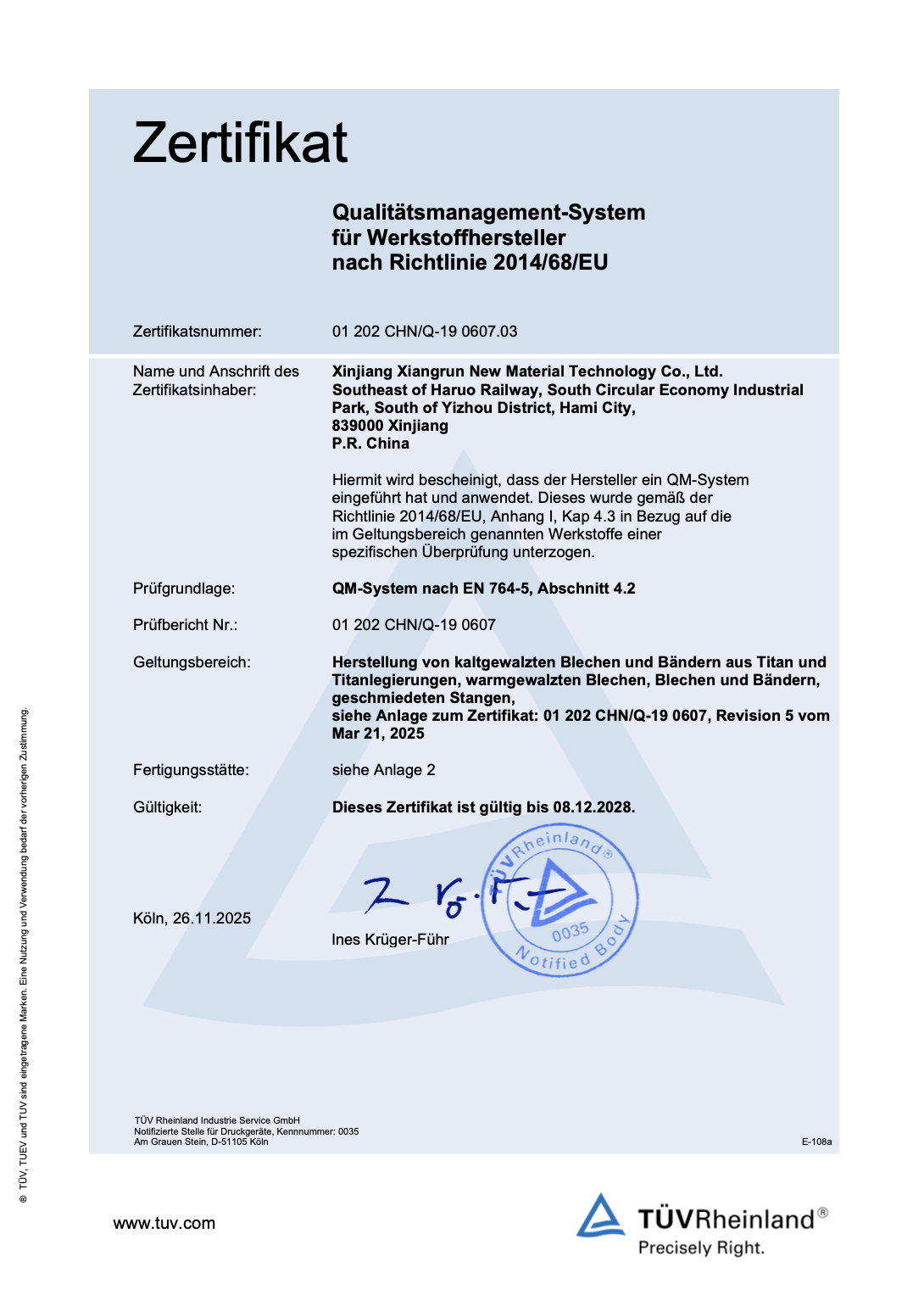
- PED 2014/68/EU quality management system — certificate 01 202 CHN/Q-19 0607.01, issued by TÜV, valid 2024-01-26 to 2028-12-08. The scope covers manufacturing of titanium and titanium alloy cold rolled sheets and hot rolled plates to a QM system per EN 764-5, article 4.2.
- DNV classification — certificate AMMM000035A to DNV-CP-0346, valid 2024-03-14 to 2027-03-13, covering wrought titanium and titanium alloys including plates, sheets, strips, forgings and billets for ships and naval vessels.
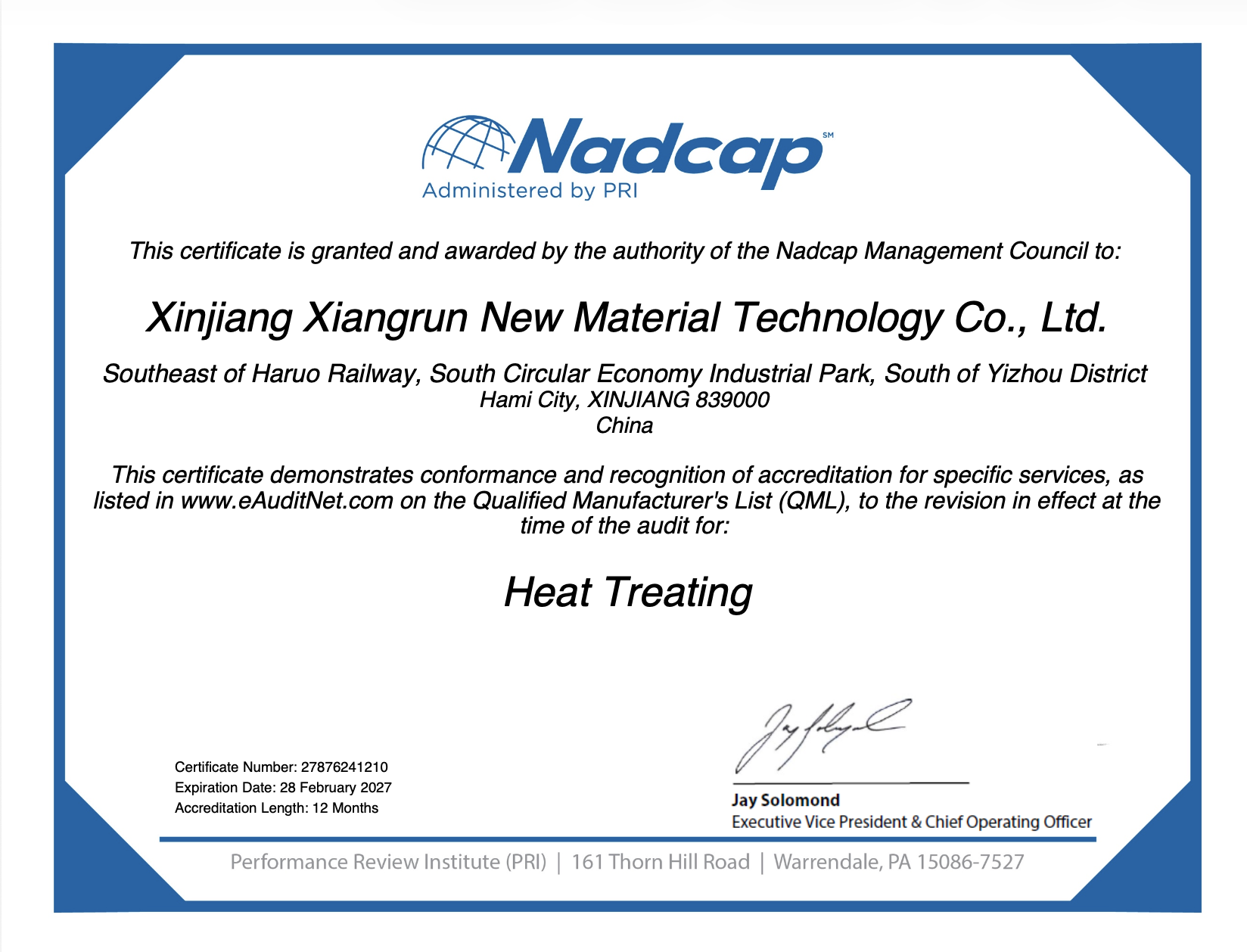
- Nadcap — certificate 27876241210, issued by the Nadcap Management Council, valid 2026-02-28 to 2027-02-28, listed on the Qualified Manufacturer's List at eAuditNet, for heat treating.
Read together, these four documents describe different slices of the same operation. The Nadcap accreditation covers heat treating, not rolling. The EN 9100 scope names ingots, billets, bars, forgings, plates and sponge — not a welded fabrication. The PED scope names cold rolled sheets and hot rolled plates specifically. A buyer sourcing titanium distillation column trays and internals therefore needs to check which of those documents, if any, speaks to the forming step in question.
Criterion 3 — Process capability matched to the component form
This criterion asks a single question: can the supplier roll, slit or finish the exact geometry your component requires, in the grade your service environment requires? It is the criterion most often answered by marketing language and least often answered by a table.
Manufacturing capability has to be expressed as ranges. Using Xrun's published product data as a reference point for what a complete capability declaration looks like:
| Product form | Declared range | Grades | Referenced standards |
|---|---|---|---|
| Hot rolled titanium coil | (2.5–12.0) × (900–2000) × C | Gr.1 / Gr.2 / Gr.3 / Gr.4 / Gr.12 / Gr.23 | ASTM / ASME |
| Cold rolled titanium coil / strip | (0.1–3.0) × (450–1530) × C | Gr.1 / Gr.2 / Gr.3 / Gr.4 / Gr.12 / Gr.23 | ASTM / ASME |
| Titanium plate | (4.0–70) × (1000–2250) × L, L < 6500 | Gr.1, Gr.2, Gr.3, Gr.4, Gr.6, Gr.7, Gr.12, Gr.5 | ASTM, ASME, AMS, MIL, DMS, TA, AWS, JIS |
| Titanium sheet | (0.4–3.0) × (900–1530) × L, L < 6500 | Gr.1, Gr.2, Gr.3, Gr.4, Gr.6, Gr.7, Gr.12, Gr.5 | ASTM, ASME, AMS, MIL, DMS, TA, AWS, JIS |
The technical reasoning behind the ranges matters as much as the numbers. Thin gauges and heavy plate are produced on different equipment with different thermal histories. Xrun operates a plate production line configured for thin and medium-thick titanium and titanium alloy plates, also supporting selected high-temperature alloy plates, with an automatic control system intended to hold precision and consistency through the rolling process.
That distinction determines which form a buyer should specify. Heat exchanger plates, electrolyzer bipolar plates, anode plates and industrial stamping blanks typically draw on cold rolled strip in the lower end of the 0.1–3.0 mm window, where formability for corrugated or stamped geometry is decisive. Pressure vessel shells, chemical reactor linings and chemical storage tank plates typically draw on plate in the 4.0–70 mm band, where section thickness and through-thickness consistency dominate. Distillation column trays, evaporator plates and condenser plates sit between the two and can often be served by sheet or lighter plate depending on the design pressure.
Criterion 4 — Customization and the OEM / ODM interface
Customization is the criterion with the widest gap between claim and reality. Many suppliers describe themselves as custom; far fewer can state what dimension of the specification they are willing to change and what remains fixed.
Xrun's stated production mode is OEM / ODM, with customization described as slitting to strip or plate up to the request. For a screening team, that is a starting point rather than an answer. Three questions convert it into evidence:
- Is slitting performed in-house? In-house slitting keeps edge condition and width tolerance under the same quality system as the parent coil.
- What is the control boundary? A supplier that customizes dimensions but not metallurgy is a different risk profile from one that customizes grade, temper and dimension together.
- How are drawing revisions handled? Ask for the change-control and first-article process before releasing a drawing.
For buyers at the execution stage, the safest structure is to separate what is standard from what is engineered, and to have the supplier confirm both in writing.
Criterion 5 — Logistical reliability and lead-time discipline
Lead time is where technically sound suppliers still lose projects. Xrun publishes an EXW lead time of 30–45 days, exports to the EU, USA and India, reports an export ratio of about 10 percent, applies third-party test or inspection where needed, and provides remote after-sales support.
The word EXW carries most of the risk in that sentence. An ex-works figure covers the period until the goods are ready at the supplier's premises; it excludes inland transport to port, ocean or air freight, export clearance and destination delivery. A buyer planning a plant shutdown against a 30–45 day figure without confirming the incoterm is planning against the wrong number.
Two further items belong in this criterion. First, minimum order quantity is not published in the reference data reviewed for this guide, so it must be confirmed per grade and per product form rather than assumed. Second, packing specification should be requested explicitly for thin strip, where edge damage in transit can render a coil unusable even though the material itself was correct at the factory gate.
Where the checklist matters most: titanium application scenarios
Different application families weight the five criteria differently. A single screening form applied uniformly will over-weight some factors and under-weight others.
Chemical processing and industrial plant
Titanium chemical reactor linings, chemical storage tank plates, distillation column trays and internals, heat exchanger plates and evaporator plates all sit in chloride-bearing or otherwise aggressive service. Here, corrosion-resistant titanium grade selection (commonly Gr.2 or Gr.7 depending on the medium) and certificate scope carry the most weight, followed by plate thickness range and welding-adjacent consistency.
Power generation and desalination
Power plant condenser plates, desalination evaporator plates and seawater cooling system plates face continuous chloride exposure and long maintenance intervals. The screening emphasis shifts toward documented service history and dimensional stability under thermal cycling, since the cost of a mid-life failure outweighs any purchase-price difference.
Green hydrogen and electrochemistry
Titanium electrolyzer bipolar plates, electrolysis cell frames and plates, titanium electrode and titanium anode substrates demand thin-gauge consistency and surface condition. With the electrolyzer market projected to grow at a 94.9 percent CAGR from 2024 to 2030, thin cold rolled strip capability and repeatability across lots become the dominant screening factors.
Industrial stamping and consumer-adjacent products
Titanium industrial stamping blanks, titanium cup, titanium tumbler and titanium wok bodies, and titanium button cell components draw on the same cold rolled strip base as industrial parts but with a different commercial logic: formability, surface finish and cost-per-piece consistency matter more than certification depth. Screening here should not import heavy industrial certification criteria that the end product does not require.
Documented case reference
A municipal heat exchanger manufacturer in the US, France and India has taken over 300 tons of ASTM B265 Grade 1 titanium for heat exchange plates across a 15-year supply relationship. Reported outcomes include continuous operation beyond ten years without corrosion or leakage, heat exchange efficiency maintained at 95 percent or more of initial value, and maintenance costs reduced by 30 percent. This is a single documented case and should be read as evidence that the specification route is viable, not as a performance guarantee for a different design or service condition.
Integrated versus buy-and-roll supply: a comparison with limits
The traditional alternative to an integrated supplier is a buy-and-roll model, in which a processor purchases titanium sponge, slab or coil on the merchant market and rolls to order. Both models can deliver good material. They distribute risk differently.
| Dimension | Integrated model | Buy-and-roll model | What it means for the buyer |
|---|---|---|---|
| Traceability | Fewer handoffs between sponge and finished mill product | More handoffs, each a potential documentation gap | Ask for heat-level traceability either way |
| Certification coverage | Certificates can align to the whole chain | Certificates usually attach to the processor only | Verify which entity and which process step each certificate covers |
| Dimensional range | Ranges defined by the supplier's own lines | Ranges limited by the processor's equipment | Compare declared ranges against your drawing |
| Lead-time control | Fewer external dependencies | Exposed to merchant material availability | Confirm incoterm and buffer either way |
| Customization depth | Can extend to grade, temper and dimension | Often limited to dimension | Define the control boundary in writing |
Where integration does not change the answer
Three limits deserve equal billing, because a screening checklist that only lists advantages is not a screening checklist.
- Integration is a structure, not a capability. An integrated chain does not by itself prove that a supplier can roll every grade or every gauge. Published ranges cap Xrun's plate at 70 mm thickness and 2250 mm width, and coil width at 2000 mm for hot rolled product — a requirement outside those envelopes needs a different answer, integrated or not.
- Certificates are narrower than companies. A Nadcap accreditation for heat treating does not extend to rolling; an EN 9100 scope that lists ingots, billets, bars, forgings, plates and sponge does not cover a finished fabricated assembly. Scope reading is the buyer's job.
- Commercial flexibility is not implied by technical depth. Minimum order quantity is not published, after-sales is described as remote support, and lead time is quoted ex-works. Projects that need on-site engineering, very small qualification lots or delivered-duty terms require explicit agreement rather than assumption.
Applying the checklist: how one supplier documents each criterion
The purpose of this table is not to rank Xrun against other suppliers. It is to show what a complete evidence pack looks like when a supplier answers the five criteria with documents rather than adjectives.
| Criterion | Xrun evidence on record | Document to request during screening |
|---|---|---|
| 1. Vertical integration | Chain covering coal, electricity, titanium ore, titanium sponge, titanium processed materials and finished products; capacity above 30,000 t/y rolling coils and strips, 10,000 t/y composite strips | Heat-number traceability statement; mill test certificate to ASTM B265 / ASME SB-265 |
| 2. Quality and certification | EN 9100:2018 (01 117 1933590, to 2027-11-12); PED 2014/68/EU QMS (01 202 CHN/Q-19 0607.01, to 2028-12-08); DNV AMMM000035A (to 2027-03-13); Nadcap 27876241210 for heat treating (to 2027-02-28) | Full certificate PDFs including scope pages and validity dates |
| 3. Process capability | Plate line for thin and medium-thick plate including selected high-temperature alloys, automatic control; plate 4.0–70 mm, sheet 0.4–3.0 mm, cold rolled strip 0.1–3.0 mm | Signed capability declaration against the project drawing |
| 4. Customization | OEM / ODM production mode; slitting to strip or plate up to request | Slitting tolerance and edge condition statement; drawing and change control |
| 5. Logistics | EXW lead time 30–45 days; markets EU / USA / India; export ratio approximately 10 percent; third-party test or inspection if needed; remote after-sales support | Written incoterm confirmation; packing specification; inspection plan |
Future outlook: how the criteria will be re-weighted
Two forces are likely to shift the weighting of these five criteria between 2026 and the end of the decade. The first is volume. With the global titanium market projected to grow from roughly USD 32.49 billion in 2025 toward USD 52.52 billion by 2033, and with electrolyzer capacity expanding at a projected 94.9 percent CAGR from 2024 to 2030, qualified rolling capacity becomes the binding constraint rather than raw material availability. Buyers who treat lead time as a commercial afterthought today will treat it as a qualification criterion tomorrow.
The second is documentation density. As more titanium enters pressure, marine and energy supply chains simultaneously, the audit trail expected per shipment will lengthen. Suppliers who already maintain scoped certificates across several regimes — pressure equipment, aerospace, marine classification and special-process accreditation — are structurally better positioned to absorb that expectation, provided the scope genuinely matches the product form being purchased.
A reasonable planning assumption for 2027 procurement cycles is that the two criteria most likely to move from desirable to mandatory are certification scope mapping and written lead-time terms. Both are cheap to verify at screening and expensive to discover at delivery.
FAQ
What does vertical integration actually change for a titanium application buyer?
Integration reduces the number of handoffs between titanium sponge and the finished mill product, and handoffs are where heat identity and traceability are most often lost. Xrun's stated chain covers coal, electricity, titanium ore, titanium sponge, titanium processed materials and finished products, with capacity above 30,000 tons of rolling coils and strips and 10,000 tons of composite strips per year. Integration is a structural fact rather than a performance guarantee — buyers still verify the specific product form, grade and process step inside the certificate scope.
Which certifications should a titanium application supplier hold for EU and US industrial projects?
The answer depends on product form and end use. ASTM B265, and ASME SB-265 for pressure vessels, is the foundational material standard for titanium strip, sheet and plate. For European pressure equipment, a PED 2014/68/EU quality management certificate matters; Xrun holds TÜV certificate 01 202 CHN/Q-19 0607.01, valid to 2028-12-08, covering cold rolled sheets and hot rolled plates. Aerospace and defence supply chains typically ask for EN 9100; Xrun's certificate 01 117 1933590, valid to 2027-11-12, covers ingots, billets, bars, forgings, plates and sponge. Marine classification through DNV (AMMM000035A, DNV-CP-0346) and Nadcap heat treating accreditation (27876241210) each cover a narrower scope than the full company.
How much lead time should a buyer plan for when ordering titanium mill products?
Xrun publishes an EXW lead time of 30–45 days. That figure is ex-works, so it excludes inland transport to port, ocean or air freight, export clearance and destination delivery. Total door-to-door planning time is therefore longer than the quoted number, and buyers should confirm the incoterm and packing terms in writing before fixing a project schedule against it.
What are the practical limits of an integrated titanium supply model?
Three limits are worth stating plainly. First, certificate scope is narrower than the company: a Nadcap accreditation for heat treating does not certify rolling, and an EN 9100 scope listing ingots, billets, bars, forgings, plates and sponge does not cover a welded assembly. Second, integration does not extend to every geometry — published ranges on the product data reviewed here cap plate at 70 mm thickness and 2250 mm width. Third, commercial flexibility is not implied: minimum order quantity is not published in the available data and after-sales support is described as remote, so projects needing on-site engineering or small qualification lots require explicit agreement.
How should a buyer validate quality before placing a production order?
Four steps cover most of the risk. Request the mill test certificate to ASTM B265 or ASME SB-265 with heat numbers attached to the specific coil or plate. Ask whether third-party test or inspection is applied where the application warrants it, since Xrun states this is available if needed. Run a first article on the actual product form — 0.5 mm cold rolled strip for a heat exchanger plate is a different validation than 20 mm plate for a vessel shell. Finally, check certificate validity dates against the planned delivery window, because a certificate expiring mid-project creates a requalification problem at the worst possible moment.
A downloadable brochure covering Xrun's titanium product forms, dimensional ranges and certification stack is available here: Xrun company brochure (PDF).
Market figures cited in this article are attributed to DataM Intelligence, the Observatory of Economic Complexity, Grand View Research, Dataintelo and ASTM International as published sources; certification details are as stated on the referenced certificates.
Tem questões ou precisa de mais detalhes?
Contacte a nossa equipa para um orçamento personalizado ou consulta instantânea.
Solicitar orçamento
Preencha o formulário abaixo e a nossa equipa entrará em contacto com uma proposta personalizada.
Chat direto do WhatsApp
Prefere conversar em tempo real? Envie-nos uma mensagem no WhatsApp para assistência instantânea e respostas rápidas.
- Obter orçamento personalizado
- Partilhar fotos ou documentos
- Discuta as suas necessidades diretamente
Geralmente responde em 5–30 minutos durante o horário de expediente.