
Shortlist: YUEDA Models for High-Precision Sheeting and Laminating
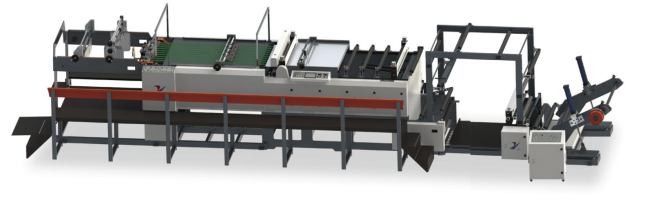
Cross-cutting equipment during build and testing at a packaging machinery plant. YUEDA manufactures sheeting, laminating and coating machinery in Longgang, Wenzhou, China. Image: YUEDA.
Metallized board, the aluminum-coated paper stock used for cigarette cartons, wine boxes, cosmetics sleeves and premium gift packaging, is the output of two converting operations that have to agree with each other. Laminating bonds foil or film to paperboard under a controlled glue film and a controlled drying curve. Sheeting cuts the finished reel into blanks at the exact length the printing and die-cutting line expects. The global metallized paper market was valued at USD 4.85 billion in 2025 (DataM Intelligence), and the lamination segment accounted for 57.4% of metallized paper revenue in 2024 (SkyQuest Technology). Both figures describe the same commercial reality: the value of the sheet is decided by bond quality and cut accuracy, not by the appearance of the reel.
This article is a procurement shortlist rather than a product tour. It sets out five machines from the YUEDA range, two of them in detail, using published specifications only. For each model it identifies the buyer profile it fits, the evidence behind it, and the boundaries a project engineer should plan around before placing an order.
Wenzhou Yueda Packaging Machinery Co., Ltd. (YUEDA) is a packaging machinery manufacturer founded in 1998 and based in Longgang, Wenzhou, China, an industrial cluster known for printing and packaging production. The company builds gold and silver cardboard coating, laminating, sheeting and slitting equipment in a 4,000 m² facility with 30 employees, including a 25-engineer R&D team, and reports an annual output of 100 sets of mechanical equipment. Exports represent 70% of sales, with customers across Southeast Asia, the Middle East, South America and Africa.
The Two Operations That Decide Whether a Sheet Is Sellable
In sheet-fed packaging converting, most quality claims trace back to one of three mechanical causes rather than to operator skill: registration drift, tension variation across the roll, and uneven drying.
- Registration. If a blank is cut slightly off the printed or positioning mark, the die-cutting and folding line has to compensate, and in the worst case the blank is rejected. This is the reason a positioning sheet cutter publishes a tracking accuracy figure alongside a cutting accuracy figure.
- Tension and core handling. Metallized board arrives on rolls up to 1,650 mm in diameter on 3-inch, 6-inch or 12-inch cores. Unwinding and rewinding systems have to hold stable tension from the first metre of a roll to the last, or the cut length drifts within the run.
- Drying and adhesion. Water-based lamination needs an even drying path matched to line speed. A path that is too short for the running speed shows up later as curl, blistering or a weak bond, all of which convert into rework and material waste.
Each of these is a machine specification that a buyer can compare before purchase. That is why the shortlist below is built around published accuracy, thickness, width and speed figures rather than around appearance or category claims.
The Shortlist: Five YUEDA Models for Precision Sheeting and Laminating
| Model | Function | Published specification highlights | Buyer profile it fits |
|---|---|---|---|
| DWLX1300L-1400L | High Precision Positioning Double Rotary Sheet Cutter Machine | Blank cutting accuracy ±0.1 mm; longitudinal and transverse tracking accuracy ±0.1 mm; operating speed ≤300 m/min; cutting speed 10–400 sheets/min; cut length 450–1400 mm; material width 400–1400 mm; stacking height 1500 mm; cutter load ≤550 gsm | Buyers whose blanks must land on a printed or positioning mark |
| YDSLX1300-1400 | High Precision Double Rotary Sheet Cutter Machine | Blank cutting accuracy ±0.1 mm; operating speed ≤300 m/min; cutting speed 10–400 sheets/min; cut length 450–1400 mm; 73 kW; 12,000 kg | High-volume sheeting where two-axis positioning tracking is not required |
| YD1300-1400 | Positioning Sheeter (shaft-less) | Sheeting accuracy ±0.1 mm; sheeting length 400–1200 mm; running speed 90–95 m/min; mechanical sheeting speed 140 sheets/min; 17.5–20 kW; 8,000–8,500 kg | Lower-footprint sheeting with shaft-less roll handling |
| ZNFH1300-1400-1500 | Automatic Aluminum Metallized Cardboard Laminating & Coating Machine | Running speed 5–150 m/min; paper 40–450 gsm; aluminum foil 0.006–0.01 mm; film 0.01–0.1 mm; drying path 12.5 m; roller face width 1300/1400/1500 mm; 121–129 kW | Metallized board laminating across a wide paper range and three working widths |
| YDLM1300B | Gantry Multifunctional Aluminum Metallized Cardboard Laminating (Coating) Machine | Machine speed 180 m/min; working speed 15–150 m/min; working width 600–1200 mm; heating tunnel 15 m at ≤130 °C; four-roller transfer coating; anilox roller direct back coating; 40 t | Buyers who want laminating, coating and back coating in a single pass |
DWLX1300L-1400L: the positioning build in the sheeting range
The High Precision Positioning Double Rotary Sheet Cutter Machine, model DWLX1300L-1400L, uses a double cyclotron screw knife cutting up and down and publishes two accuracy figures rather than one: blank cutting accuracy of ±0.1 mm and longitudinal and transverse tracking accuracy of ±0.1 mm. The second figure is the one that matters when a blank has to be positioned against a register mark rather than simply cut to length.
Published working parameters: unwinding diameter up to 1,650 mm; feeding paper tube diameters of 3-inch, 6-inch and 12-inch; material width 400–1400 mm, or 400–1250 mm on the narrower build; cut length 450–1400 mm; stacking height 1500 mm with a stacking weight of 2,000 kg; operating speed up to 300 m/min with a cutting speed of 10–400 sheets per minute; barometric demand 0.8 MPa; design power AC 380 V × 50 Hz. The two published builds weigh 17,000 kg at 13.85 × 4.52 × 2.64 m and 15,800 kg at 13.85 × 4.37 × 2.64 m. Cutter load is rated at ≤550 gsm, with board density and quality to be considered, a boundary worth checking against the actual stock before committing to a purchase.
ZNFH1300-1400-1500: the laminating and coating workhorse for metallized board
The Automatic Aluminum Metallized Cardboard Laminating & Coating Machine with no-shaft rewinding, model ZNFH1300-1400-1500, is the model most buyers encounter first when searching for a metalized paper laminating machine. It is built around three working widths, with roller face widths of 1300 mm, 1400 mm and 1500 mm, which allows the same platform to be matched to different sheet formats and print layouts.
Published parameters: sheet roll diameter at the unwinding position from 100 mm to 1600 mm; sheet roll width 600–1200 mm, 700–1300 mm or 700–1400 mm depending on the build; core sizes specified as 3-inch, 6-inch and 12-inch; foil roll diameter 600 mm; rewinding to a diameter of 100–1600 mm. The machine processes paper from 40 gsm to 450 gsm, aluminum foil from 0.006 mm to 0.01 mm and film from 0.01 mm to 0.1 mm, over a 12.5 m drying path. Running speed is 5–150 m/min and total power consumption is 121 kW or 129 kW depending on the width. Overall machine length is 21 m.
YDLM1300B: the integrated gantry option
The Gantry Multifunctional Aluminum Metallized Cardboard Laminating (Coating) Machine, model YDLM1300B, combines three operations in one pass: water-based lamination of paperboard, four-roller transfer glue coating, and anilox roller direct back coating. That combination is what makes it relevant to buyers who currently send board out for back coating or run it through a second machine.
Published parameters: working width 600–1200 mm; machine speed 180 m/min with a working speed of 15–150 m/min; paper from 100 g/m² to 350 g/m²; PET film 0.012–0.014 mm; OPP film 0.02–0.06 mm; aluminum film 0.006–0.007 mm; paper unwinding diameter 1500 mm and rewinding diameter 1600 mm; film and peeling-off rewinding diameters of 600 mm. The heating tunnel is 15 m long with an 8.6 m downward run and a maximum temperature of 130 °C. Motors are rated at 60 kW, heating at 216 kW and working power at 80 kW, with a power supply of 380 V ±10% at 50 Hz. The machine measures 22,330 × 3,700 × 4,500 mm and weighs 40 t. Third-party industry coverage has noted YUEDA's specialization in this gantry-type platform with speeds up to 180 m/min (EIN Presswire).
YDSLX1300-1400 and YD1300-1400: two sheeting alternatives
Not every operation needs two-axis positioning. The High Precision Double Rotary Sheet Cutter Machine, model YDSLX1300-1400, shares the same double cyclotron screw knife cutting principle and the same ±0.1 mm blank cutting accuracy as the positioning model, with a cutting speed of 10–400 sheets per minute and a maximum operating speed of 300 m/min. It is a lighter and shorter machine: 12,000 kg, 73 kW, and 9.6 × 4.68 × 2.58 m on the wider build. Buyers whose cuts follow a fixed printed layout rather than a positioning target should compare this model against the DWLX1300L-1400L on footprint and power before comparing on price.
The Positioning Sheeter (shaft-less), model YD1300-1400, serves a different slot in the line. It publishes ±0.1 mm sheeting accuracy with a sheeting length range of 400–1200 mm, a gram weight for sheeting up to 600 g, a running speed of 90–95 m/min and a mechanical sheeting speed of 140 sheets per minute. It handles sheet rolls up to 1600 mm in diameter and 700–1300 mm in width, stacks to 1300 mm, and consumes 17.5–20 kW at 8,000–8,500 kg. For converters whose constraint is floor space rather than throughput, this is the smallest unit on the shortlist.
How the Precision Is Engineered: Cutting, Coating, Drying and Control
Precision figures in a specification sheet come from mechanical and control decisions that are documented in the company's intellectual property portfolio. YUEDA holds utility model patents issued by the China National Intellectual Property Administration that map directly onto the operations described above.
- Cutting mechanics. The press plate device for the transverse cutter (ZL 2020 2 3212947.9, valid to 2031) and the feeding device for the transverse cutter (ZL 2025 2 0755442.0, valid to 2036) relate to the stability and feed consistency of the cutting station, which is where the ±0.1 mm blank cutting figure is created or lost.
- Gluing and coating. The double gluing device for coating and laminating machines (ZL 2020 2 3214028.5, valid to 2031) and the adjustable coating and laminating machine patent (ZL 2019 2 1219345.0, valid to 2030) sit behind the four-roller transfer coating and anilox roller direct coating methods named in the YDLM1300B specification.
- Drying and energy. The double-layer energy-saving drying oven patent (ZL 2022 2 1114210.X, valid to 2032), the waste gas recovery and utilization device (ZL 2020 2 3151788.6, valid to 2031) and the guide roller cooling mechanism for the drying oven (ZL 2017 2 0213503.9, valid to 2027) address the parts of the line where heat, exhaust and roller temperature affect bond quality and running cost.
- Control. Equipment uses a PLC control system. Two registered software copyrights apply to the control layer: the Intelligent Control System for Automatic Gold and Silver Cardboard Laminating (Coating) Machine V1.0 (2020SR0669497) and the Automatic Paper and Plastic Conveying System for Transverse Paper Cutter V1.0 (2020SR0668797), both registered with the National Copyright Administration of the People's Republic of China in June 2020.

A PLC-based electrical control cabinet. YUEDA equipment uses a PLC control system; the company also holds registered software copyrights for its laminating and coating machine control system and its transverse paper cutter conveying system. Image: YUEDA.
For buyers who specify to European markets, one compliance point sits outside the machine specification: industrial laminating machines must comply with EN ISO 12100:2010 for risk assessment and safety design in order to obtain CE marking. Safety standard options such as CE or UL are listed within the company's ODM customization scope, which means the question should be raised during technical clarification rather than after the order is placed.
Application Fit and Field Evidence
The published application range for these machines is printed paper packaging for wine boxes, cigarette paper packaging, cosmetics paper packaging, tea paper packaging, disposable waterproof paper tableware, cake paper packaging, chewing gum paper packaging and similar products. Within that range, two installed cases are documented.
Thailand, cigarette packaging. A cigarette packaging factory uses the equipment for high-speed laminating of cigarette boxes. Reported outcomes are a 30% efficiency increase and a 15% reduction in material waste, with the installation running for more than five years. The key operating requirements in that project were a humidity-resistant design and support for 24/7 continuous operation.
Vietnam, cosmetics packaging. A packaging factory installed the equipment for precision cutting of cosmetic packaging materials. The reported outcomes are ±0.1 mm cutting precision with a zero rework rate and a 20% saving in labour cost. Project highlights were a dust-proof design, fast size changeover and low maintenance cost, with customer feedback indicating satisfaction with performance under high-humidity conditions.
Market Context: Why Integrated Laminating and Sheeting Is Moving Up the Agenda
Several independent data points explain why buyers are shortlisting integrated laminating and sheeting platforms now rather than treating them as separate purchases later.
- The metallized paper market reached USD 4.85 billion in 2025, driven by demand for premium labelling and cigarette packaging (DataM Intelligence).
- Lamination dominated that market with a 57.4% revenue share in 2024, favoured for its high gloss and barrier properties in consumer goods (SkyQuest Technology).
- The Asia-Pacific region accounts for nearly 40% of the world's metallized paper market, driven by expanding tobacco and beverage industries in China and India (Future Market Insights).
- Wet laminating machines held approximately 70% of the industrial laminating market share in 2025 (Market Research Future), which aligns with the water-based lamination method specified on the YDLM1300B.
- China's machinery export value rose 15.7% year on year in early 2026, with a shift towards higher-value equipment such as servo-controlled and CNC machines (German Machine Tool Builders' Association, VDW).
The practical reading for a packaging buyer is straightforward. Demand for metallized board is concentrated in the same regions where YUEDA already exports, the dominant laminating method is the same water-based process the equipment is specified for, and the equipment market is moving towards higher-value, more tightly controlled machines. A shortlist decision made in 2026 is therefore likely to be a decision about line integration and control capability, not just about cutting speed.
Integrated Lines Versus Separate Single-Function Machines
The traditional arrangement in smaller converting operations is a set of single-function machines from different vendors: a laminating machine, an offline coater for back coating, and a separate sheet cutter, with rolls moved between them and quality checked after each transfer. The alternative is an integrated platform such as the YDLM1300B, which performs lamination, glue coating and back coating in one pass, or the ZNFH1300-1400-1500, which combines laminating and coating with no-shaft rewinding.
| Consideration | Separate single-function machines | Integrated YUEDA platforms |
|---|---|---|
| Work in progress | Rolls are moved and re-mounted between operations | Coating and back coating completed in one pass on the YDLM1300B |
| Consistency | Bond and coating quality depend on re-setting parameters between machines | One process window across coating and lamination |
| Floor space | Distributed across several stations | Concentrated: the YDLM1300B occupies 22,330 × 3,700 × 4,500 mm |
| Changeover | Changes at each machine | Single changeover point, narrower size ranges per build |
| Entry constraint | Lower capital outlay per unit | Higher single-unit investment and a heavier civil and power requirement |
The boundaries of this shortlist matter as much as its capabilities, and buyers should treat the following as real project constraints rather than as fine print.
- Cutter load is rated at ≤550 gsm on the DWLX1300L-1400L and YDSLX1300-1400, with board density and quality to be considered. Heavier or denser board falls outside the published rating.
- Working width differs by model. The YDLM1300B is specified at 600–1200 mm, while the ZNFH1300-1400-1500 offers roller face widths from 1300 mm to 1500 mm and a sheet roll width up to 1400 mm on the widest build. A buyer needing wide-format laminating should plan the line around the ZNFH platform rather than the gantry machine.
- Speed ceilings differ by function. The YDLM1300B publishes a machine speed of 180 m/min with a working speed of 15–150 m/min; the ZNFH1300-1400-1500 publishes a running speed of 5–150 m/min. Matching a sheeting unit to the slower of the two determines real line throughput.
- Physical installation is substantial. The YDLM1300B weighs 40 t, is more than 22 m long, and requires 216 kW of heating power alongside 60 kW of motor power. Floor loading, power supply and ventilation are engineering workstreams, not purchase-order details.
- Compliance is market-specific. CE marking for the European market depends on an EN ISO 12100:2010 risk assessment and safety design, which should be confirmed before shipment rather than assumed from the machine specification.
From Evaluation to Execution: A Buyer Checklist
Once a model has been selected from the shortlist, the execution phase is governed by terms that can be verified in writing. The published commercial parameters for the YUEDA range are summarised below.
| Item | Published parameter |
|---|---|
| Minimum order quantity | 1 unit |
| Monthly production capacity | 12–15 units per month |
| Lead time | 30–45 days for standard models; 45–60 days for customized models |
| Quality control | 100% pre-shipment test including a 2-hour continuous run; third-party inspection available |
| Acceptance criteria | Pre-shipment test at the factory; third-party inspection available |
| Delivery terms | FOB Ningbo; CIF to major overseas ports |
| Payment terms | 30% T/T deposit, 70% balance before shipment; L/C at sight for orders above USD 100,000 |
| Customization scope | Voltage (110 V / 220 V / 380 V), working width 800–1600 mm, control system |
| ODM scope | Working width and speed, coating and lamination process, control system brand, voltage and frequency, safety standard (CE / UL), brand logo, HMI language, food-grade material, explosion-proof design, production line integration |
| After-sales response | 24-hour online response; 48-hour domestic on-site service; 72-hour overseas remote debugging |
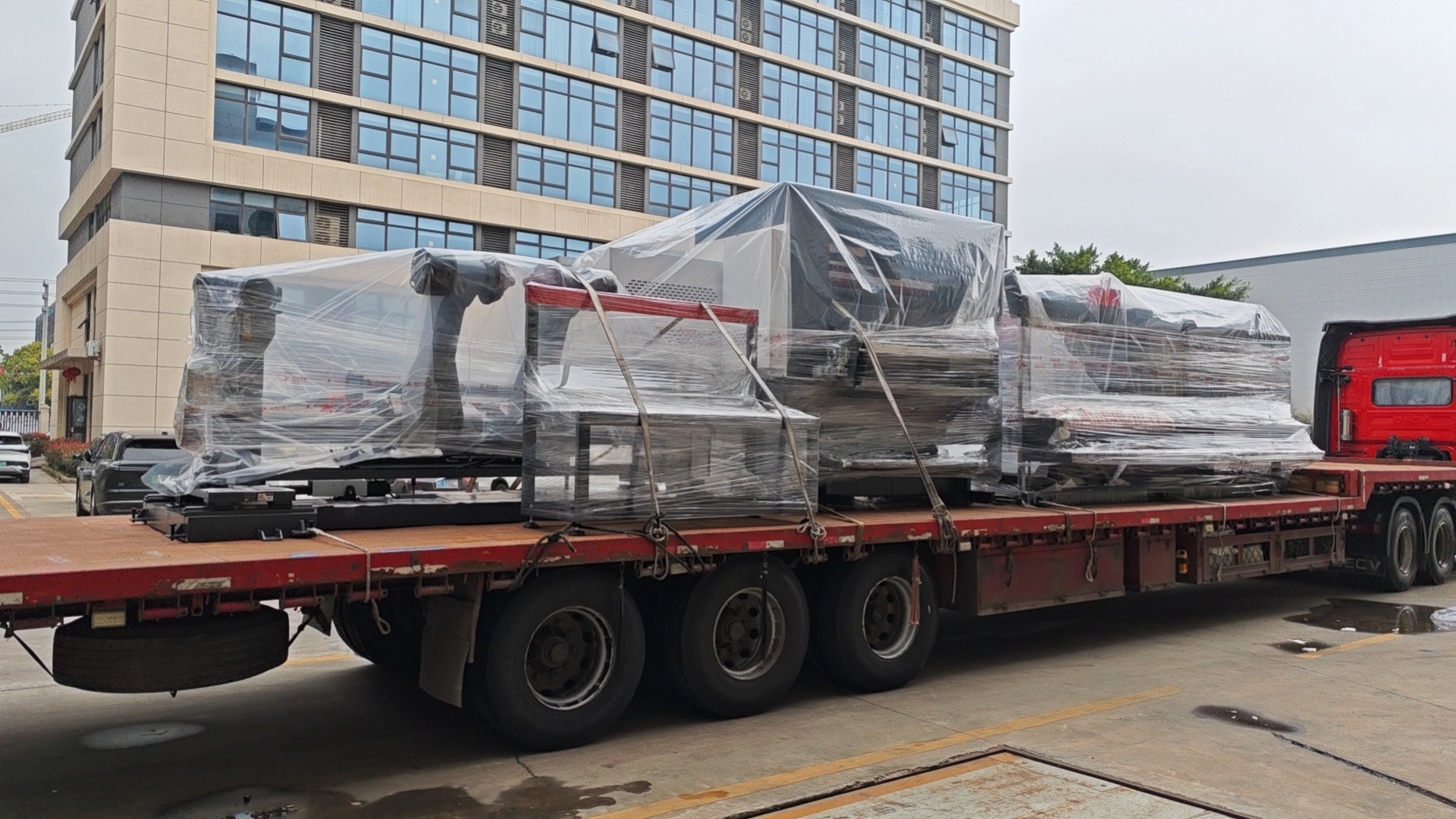
Heavy-duty laminating and sheeting equipment prepared for export. YUEDA reports that 70% of its output is shipped to customers in Southeast Asia, the Middle East, South America and Africa. Image: YUEDA.
Two verification steps are worth writing into a purchase agreement. The first is the factory acceptance run: confirm that the test covers the actual substrate grammage, width and cut length the buyer will run, not a reference material. The second is documentation of the delivered configuration, since customization items such as voltage, control system brand and HMI language are order-specific and cannot be inferred from a catalogue model number.
Future Outlook
The direction of the equipment category is visible in the patent record and in the market data. Energy-saving drying, waste gas recovery and roller temperature control are already the subject of granted utility models in this range, which points to running cost and emissions control becoming specification items rather than optional extras. On the demand side, the concentration of metallized paper consumption in Asia-Pacific and the shift of Chinese machinery exports towards higher-value equipment suggest that buyers will increasingly evaluate laminating and sheeting as one integrated process window rather than as two separate purchases.
For a converter planning a line in the next two to three years, the practical implication is that the machine selection decision should be made together with the layout, power and compliance decisions. A model that fits the substrate and the precision requirement but not the building is not a shortlist entry; it is a project risk.
FAQ
Which YUEDA machine performs laminating, and which performs sheeting?
Laminating and coating are performed by the ZNFH1300-1400-1500 Automatic Aluminum Metallized Cardboard Laminating & Coating Machine and by the YDLM1300B Gantry Multifunctional Aluminum Metallized Cardboard Laminating (Coating) Machine, which additionally performs back coating in the same pass. Sheeting is performed by the DWLX1300L-1400L High Precision Positioning Double Rotary Sheet Cutter Machine, the YDSLX1300-1400 High Precision Double Rotary Sheet Cutter Machine, and the YD1300-1400 Positioning Sheeter (shaft-less).
What cutting accuracy can the DWLX1300L-1400L hold, and over what material range?
The published figures are a blank cutting accuracy of ±0.1 mm and a longitudinal and transverse tracking accuracy of ±0.1 mm. The machine accepts material widths of 400–1400 mm (400–1250 mm on the narrower build), cut lengths of 450–1400 mm and unwinding diameters up to 1650 mm, at an operating speed of up to 300 m/min and a cutting speed of 10–400 sheets per minute. Cutter load is rated at ≤550 gsm, with board density and quality to be considered.
What substrates and thicknesses can the ZNFH1300-1400-1500 process?
The machine is specified for paper from 40 gsm to 450 gsm, aluminum foil from 0.006 mm to 0.01 mm and film from 0.01 mm to 0.1 mm, over a 12.5 m drying path. Sheet roll widths range from 600–1200 mm up to 700–1400 mm depending on the build, and roller face widths are 1300 mm, 1400 mm or 1500 mm. Running speed is 5–150 m/min.
Can these machines be customized for an existing production line?
Yes, within a defined scope. Published customization options cover voltage (110 V / 220 V / 380 V), working width from 800 mm to 1600 mm, and the control system. A wider ODM scope covers working width and speed, coating and lamination process, control system brand, voltage and frequency, safety standard such as CE or UL, brand logo, HMI language, food-grade material, explosion-proof design, and production line integration. Customized models have a longer published lead time than standard models.
What field evidence exists for continuous operation in humid conditions?
A cigarette packaging factory in Thailand uses the equipment for high-speed laminating of cigarette boxes, with a reported 30% efficiency increase and 15% material waste reduction over more than five years of operation; the project highlights list a humidity-resistant design and 24/7 continuous operation support. A packaging factory in Vietnam uses the equipment for precision cutting of cosmetic packaging materials, reporting ±0.1 mm cutting precision, a zero rework rate and a 20% labour cost saving, with customer feedback indicating satisfaction in high-humidity conditions. These are reported outcomes for specific configurations.
What are the minimum order quantity, lead times and production capacity?
The published minimum order quantity is 1 unit, with a monthly production capacity of 12–15 units. Standard models are quoted at 30–45 days and customized models at 45–60 days. Pre-shipment testing covers 100% of units with a 2-hour continuous run, and third-party inspection is available on request.
What boundaries should a buyer plan around before ordering?
Four boundaries are published. Cutter load on the sheeting models is rated at ≤550 gsm with density and quality to be considered. Working width differs by model, with the YDLM1300B at 600–1200 mm and the ZNFH1300-1400-1500 offering roller face widths of 1300–1500 mm. The YDLM1300B weighs 40 t, measures 22,330 × 3,700 × 4,500 mm and requires 216 kW of heating power in addition to 60 kW of motor power. European market entry requires compliance with EN ISO 12100:2010 for risk assessment and safety design in order to obtain CE marking.
A downloadable company and product brochure (PDF) is available at https://cdn.socialarks.com/sbsp/24814/0/2026/0428/69f035cd4b395.pdf. Manufacturer: Wenzhou Yueda Packaging Machinery Co., Ltd., Longgang, Wenzhou, Zhejiang, China.