
Shortlist of 5 Luxury Hotel Tent Models for Permanent Hospitality Projects
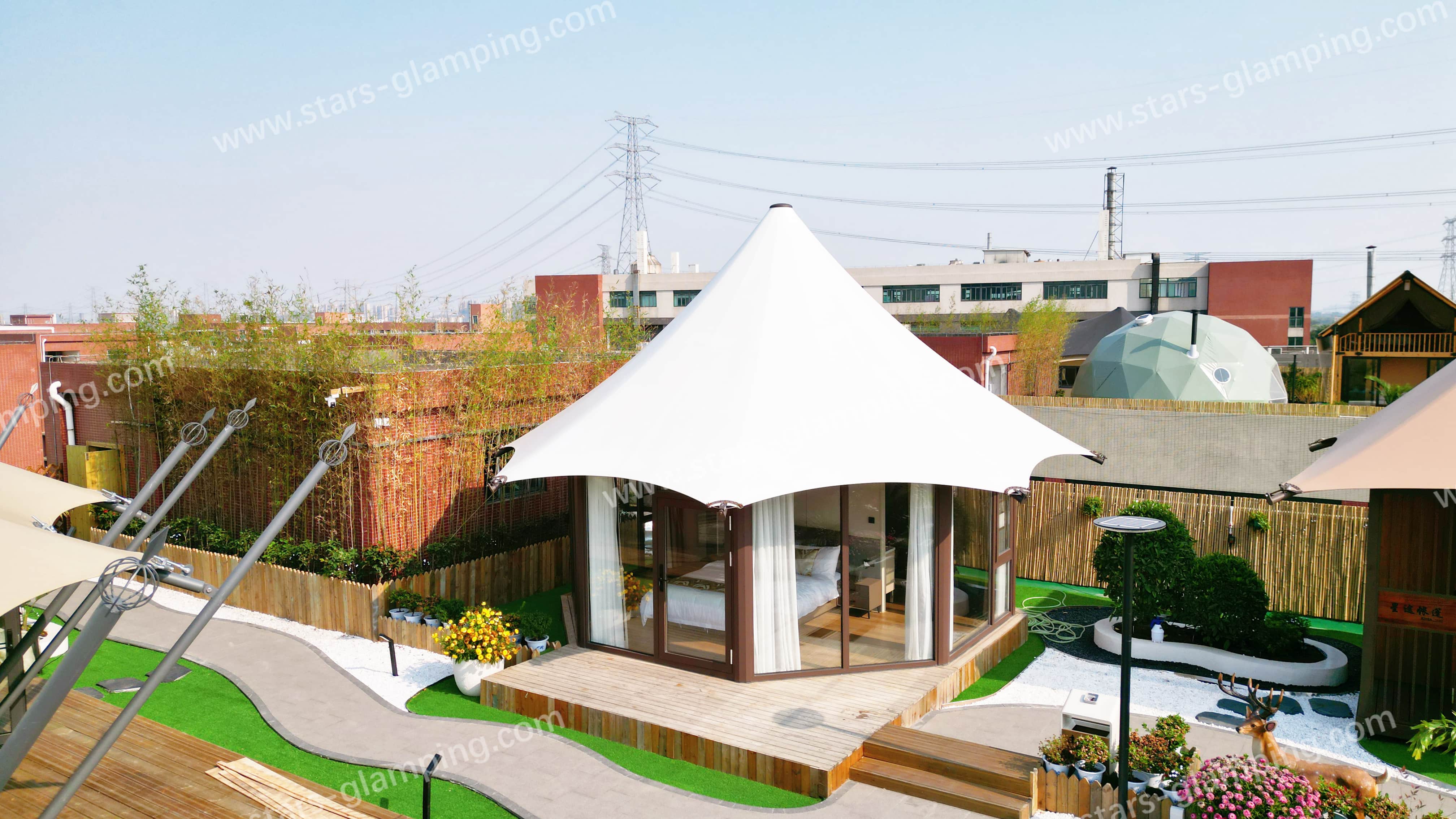
Permanent hospitality projects evaluate tent structures on service life, cover material and compliance, not on seasonal performance alone.
A permanent hospitality project asks a different question of a tent than a seasonal camp does. A seasonal operator asks whether the structure survives a season. A permanent developer asks whether the structure can carry a ten-, twenty- or thirty-year asset cycle, pass a waterproofing and fire review, and still be financeable at the end of it.
That distinction is now the centre of the luxury hotel tent category. Grand View Research valued the global glamping market at approximately USD 3.8 billion in 2025, with tents forming a major accommodation segment alongside cabins and pods, while Fortune Business Insights projects the market to reach USD 9.15 billion by 2034 at a 10.67% compound annual growth rate. Market sizing in this category should still be read with care: published estimates for 2024 and 2025 differ substantially depending on whether cabins and recreational vehicles are counted inside the definition, so figures from Grand View Research, Future Market Insights and Global Market Insights are not directly interchangeable.
What does not vary is the procurement logic once a project moves from pilot to permanent. This shortlist reviews five model designations from Stars Glamping - Luxury Tent - Tethys, Luxury Tent - Villa, Luxury Tent - Octagon, Luxury Tent - Shell and Luxury Tent - Pisces - against the four filters that most often decide a permanent-project selection: cover material, frame type, service life and site category.
Stars Glamping (STARS GLAMPING TENT CO.,LTD) is a Guangzhou-based manufacturer of glamping domes, safari tents and luxury hotel tents, established in 2018, operating a 20,000 m2 manufacturing base with a 4,000 m2 simulation exhibition hall and exporting roughly 90% of its output to markets including the Middle East, North America, Europe, Australia, Southeast Asia and Africa.
Why Permanent Projects Shortlist Differently
A permanent installation changes the arithmetic in three ways.
First, the structure works continuously. The application profile for these tents assumes 24/7 operation, permanent installation and all-season use in conditions that include beachfront exposure, desert climate, tropical rainforest, mountain area, high humidity and strong wind. A cover that would be acceptable for a three-month season is being asked to hold those conditions for decades.
Second, cover and structure age at different rates. A steel frame and a membrane cover do not have the same replacement cycle, and the gap between them is what separates a 25-30 year platform from a 10-15 year platform. For a developer, that gap is a capital planning question rather than a product question: it determines when the asset needs a second funding round for cover replacement, and how the property is valued in between.
Third, compliance has a calendar. Fire, waterproofing and product-safety documentation carries issue and expiry dates. A shortlist that ignores the validity window can produce a technically correct structure and a documentation problem at handover - a point that becomes concrete later in this article, where the relevant CE attestation runs to January 2029.
The Four Filters That Decide the Shortlist
Five models can look interchangeable in a brochure and very different in a feasibility model. These are the four filters that separate them.
| Filter | What to check | Why it changes the decision |
|---|---|---|
| Cover material | PVDF architectural membrane versus PVC polyester fabric, and the rated fabric weight | Drives UV stability, cleaning cycle and the replacement interval that sits behind the service-life figure |
| Frame type | Steel pipe frame versus solid wood combined with steel pipe | Affects maintenance regime, coastal anti-corrosion strategy and the practical life of the structure |
| Service life | Rated years of use under the stated operating conditions | Sets the length of the investment horizon the model can reasonably carry |
| Site category | Listed application types: beachfront, mountain eco lodge, desert, resort accommodation, event use | Determines which structural and thermal assumptions apply to the site |
The five models share more than they differ on the last filter, which is important to state plainly. All five are listed by the manufacturer against the same application set: Resort Accommodation Tent, Beachfront Hotel Tent, Mountain Eco Lodge Tent, Desert Glamping Tent and Event Luxury Tent for reception or restaurant use. The real separation between them comes from cover chemistry, frame construction, wall system and rated service life - not from the application list.
The Shortlist: Five Named Models
1. Luxury Tent - Tethys
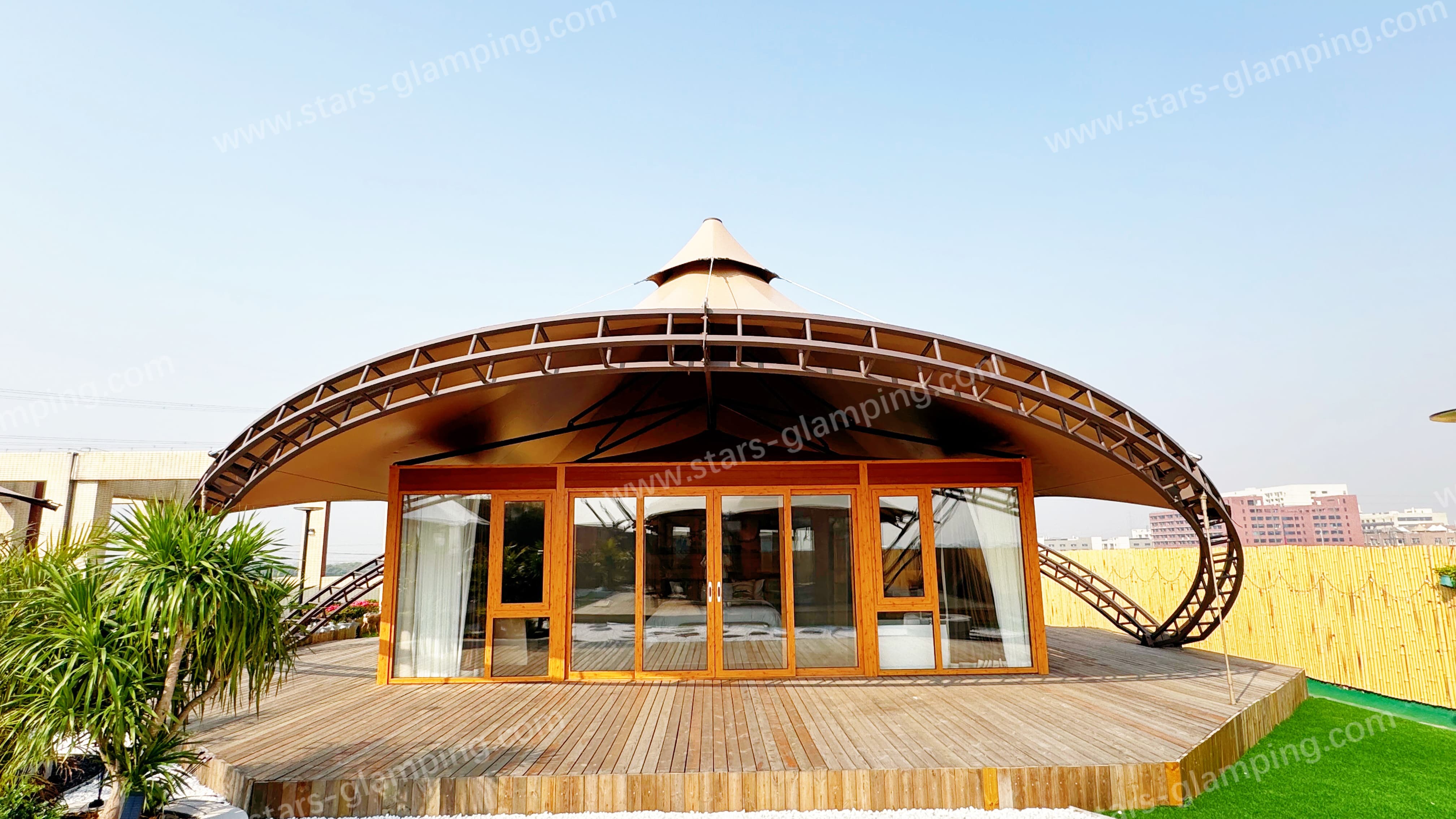
Tethys: steel pipe frame, 1050 g/m2 PVDF architectural membrane fabric, insulated glass wall system.
- Frame type: steel pipe
- Cover material: 1050 g/m2 PVDF architectural membrane fabric
- Wall system: insulated glass wall system
- Service life: 25-30 years
- Suitable category: resort accommodation, beachfront, mountain eco lodge, desert glamping, event use
Tethys is the reference point of this shortlist. Its combination of a steel pipe frame, PVDF membrane and an insulated glass wall system places it on the long-life side of the range, which makes it the natural baseline against which the other four are read. In procurement terms, it answers the question a feasibility model asks first: can this asset be depreciated over a horizon long enough to justify a permanent build.
2. Luxury Tent - Villa
- Frame type: steel pipe
- Cover material: 1050 g/m2 PVDF architectural membrane fabric
- Wall system: insulated glass wall system
- Service life: 25-30 years
- Suitable category: resort accommodation, beachfront, mountain eco lodge, desert glamping, event use
Villa runs on the same technical platform as Tethys: identical frame material, identical PVDF cover specification, identical insulated glass wall system and the same 25-30 year service life. For a developer, that means selection between the two is a planning and layout decision rather than a materials decision. Where a project needs a residence-like floor plan with full-height glazing, Villa sits in the same durability and compliance bracket as Tethys.
3. Luxury Tent - Octagon
- Frame type: steel pipe
- Cover material: 1050 g/m2 PVDF architectural membrane fabric
- Wall system: insulated glass wall system
- Service life: 25-30 years
- Suitable category: resort accommodation, beachfront, mountain eco lodge, desert glamping, event use
Octagon completes the group of four models that share one technical platform. The practical consequence is worth stating explicitly for buyers comparing quotations: within the Tethys, Villa, Octagon and Shell group, the specification sheet will not differentiate the offers. Differentiation appears in plan geometry, interior planning, glazing layout and how the unit sits in a master plan - the criteria a design team controls, rather than the criteria a materials engineer controls.
4. Luxury Tent - Shell
- Frame type: steel pipe
- Cover material: 1050 g/m2 PVDF architectural membrane fabric
- Wall system: insulated glass wall system
- Service life: 25-30 years
- Suitable category: resort accommodation, beachfront, mountain eco lodge, desert glamping, event use
Shell is the fourth member of the long-life group and is frequently specified where the client wants the tent silhouette to read as a built structure rather than a fabric volume. The glass wall system is the reason: it changes how the unit is perceived at check-in, how thermal performance is managed, and where the building-code conversation with local authorities starts.
5. Luxury Tent - Pisces
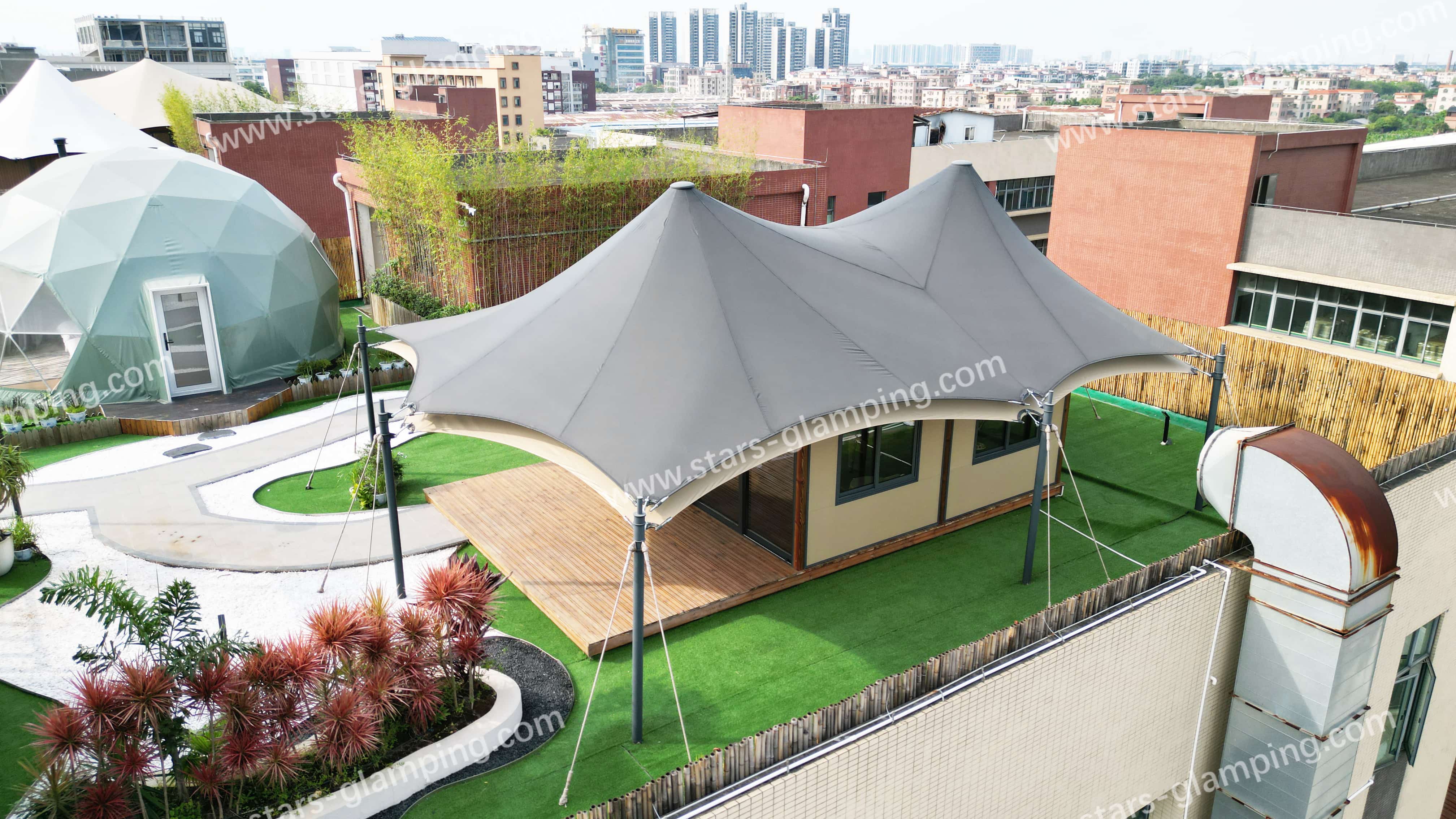
Pisces: solid wood combined with steel pipe frame, 850 g/m2 PVC polyester fabric, insulated canvas wall system.
- Frame type: solid wood combined with steel pipe
- Cover material: 850 g/m2 PVC polyester fabric
- Wall system: insulated canvas wall system
- Service life: 10-15 years
- Suitable category: resort accommodation, beachfront, mountain eco lodge, desert glamping, event use
Pisces is the model that breaks the pattern, and it is the most misunderstood entry on the shortlist. It carries wooden elements into the frame - solid wood combined with steel pipe - and its cover is a 850 g/m2 PVC polyester fabric rather than a 1050 g/m2 PVDF membrane, with an insulated canvas wall system instead of glass.
Its rated service life is 10-15 years against 25-30 years for the other four. That number should not be read as a downgrade. It should be read as a different investment horizon, and it is the reason Pisces often appears in phased developments, shorter-lease sites, pilot clusters that may expand, and eco-tourism or safari-style projects where the natural material palette is part of the guest proposition rather than a compromise. A developer with a 12-year planning horizon and a developer with a 30-year planning horizon are not buying the same product, even when both are buying a luxury hotel tent.
Side-by-Side: The Five Models at a Glance
| Model | Frame type | Cover material | Wall system | Service life |
|---|---|---|---|---|
| Luxury Tent - Tethys | Steel pipe | 1050 g/m2 PVDF architectural membrane fabric | Insulated glass wall | 25-30 years |
| Luxury Tent - Villa | Steel pipe | 1050 g/m2 PVDF architectural membrane fabric | Insulated glass wall | 25-30 years |
| Luxury Tent - Octagon | Steel pipe | 1050 g/m2 PVDF architectural membrane fabric | Insulated glass wall | 25-30 years |
| Luxury Tent - Shell | Steel pipe | 1050 g/m2 PVDF architectural membrane fabric | Insulated glass wall | 25-30 years |
| Luxury Tent - Pisces | Solid wood + steel pipe | 850 g/m2 PVC polyester fabric | Insulated canvas wall | 10-15 years |
What All Five Models Share
The shortlist is narrower than it looks on structural performance, and buyers comparing quotations should know exactly where the common ground sits. According to the published parameter set, every one of the five models carries the same baseline values:
| Parameter | Shared value across all five models |
|---|---|
| Waterproof rating | Greater than or equal to 5,000 mm H2O |
| Fire rating | B1 / M2 fire-retardant |
| Wind resistance | Up to 120 km/h (Level 10 wind) |
| Snow load | 80 kg/m2 |
| Temperature resistance | -30 C to +70 C |
| UV protection | UV stabilized, anti-aging |
This is the part of the shortlist that answers the constraint questions a permanent project always raises: waterproofing for coastal and island sites, thermal performance for cold-climate or desert temperature swings, wind resistance for exposed positions, and fire retardancy for commercial occupancy. Because these values are identical across the five models, they cannot be used to rank one model above another. Service life, cover chemistry and frame construction remain the only real differentiators in this set.
Compliance: What Is Actually Certified
Permanent hospitality projects rarely fail on structure. They fail on documentation. The relevant document for this family of products is a General Product Safety Directive Attestation of Conformity (CE), issued by UDEM under certification number M.2024.206.C96444 for the EU market, referencing the EN ISO 5912:2020 standard. It was issued on 31 January 2024 and is valid until 30 January 2029.
The certification scope covers tents including aluminium frame, ClearSpan, geodesic dome, glamping dome, glass dome, polycarbonate dome, glamping pods, safari lodge and prefab house categories. The covered product list associated with this attestation includes the Tethys, Villa, Octagon, Shell and Pisces designations reviewed here, alongside other tent models in the manufacturer's range.
Two practical points follow. The first is the expiry date: a project that operates beyond January 2029 should confirm the status of the attestation at the time of procurement rather than assume continuity. The second is the relationship between this certification and local fire requirements. Independent hospitality guidance commonly references fire-retardancy standards such as NFPA 701 in the United States or EN 13501-1 in Europe for safe commercial use in tents and membrane structures. A B1 / M2 rating as listed in the model specifications sits within that conversation, but final acceptance is a jurisdiction-level decision made by the local authority, not by the manufacturer.
Where These Models Have Been Deployed
Project records are a more useful filter than brochures for permanent projects, because they show which site conditions the platform has actually been specified against.
| Project type | Market | Scope | Site condition |
|---|---|---|---|
| Resort developer | Nepal | 19 luxury tents for a full resort project | Luxury mountain resort accommodation, custom mountaintop design, high wind resistance, thermal insulation, panoramic view |
| Government tourism developers | India | 100 luxury tents for a full resort project | Beachfront resort accommodation, environmentally friendly, high wind resistance, thermal insulation, panoramic view |
| Resort developer | Saudi Arabia | 30 luxury tents for a full resort project | Luxury desert resort accommodation, custom desert design, high wind resistance, thermal insulation |
| Resort developer | Cape Verde | 12 luxury hotel tents | Wildlife safari accommodation, long-term outdoor use of 8+ years, off-grid solution, natural ventilation design |
The pattern is consistent: mountain, beachfront, desert and safari environments, all specified for long-term permanent use rather than seasonal deployment. The Nepal and Saudi Arabia projects both emphasise custom design and thermal insulation, which is the expected combination where day-night temperature swing is large. The Cape Verde record is the most instructive for investment planning, because it pairs a safari application with an explicitly stated long-term outdoor use of more than eight years - a horizon that sits inside the 10-15 year rating of the wooden-frame model and well inside the 25-30 year rating of the PVDF group.
Limits, Trade-Offs and Where the Shortlist Stops Being Useful
A shortlist that only lists advantages is not a shortlist. Four boundaries matter here.
Service life is a planning estimate, not a warranty. The 25-30 year and 10-15 year figures describe the model under the stated operating conditions and assume correct installation and maintenance. Membrane covers, glazing seals and timber elements all have their own inspection and cleaning requirements, and coastal anti-corrosion treatment is listed as a project requirement for humid or salt-laden sites. A developer who budgets for the structure but not for the maintenance regime will not realise the rated life.
Identical platform means limited technical differentiation. Because Tethys, Villa, Octagon and Shell share frame material, cover specification and wall system, a comparison between them cannot be resolved on engineering grounds. Procurement teams that expect a technical ranking inside that group will not find one; the decision belongs to the design and operations side.
Wood in a coastal or high-humidity specification deserves explicit scrutiny. Pisces carries solid wood elements alongside its steel pipe frame. That is a legitimate choice for eco-tourism and safari settings, and it is also the specification most sensitive to humidity, salt exposure and maintenance frequency. Sites with salt-laden air should treat the timber specification as a project-level design question rather than a catalogue selection.
Certification and code acceptance are separate steps. The CE attestation covers product conformity against EN ISO 5912:2020 for the EU market and runs to January 2029. It does not by itself discharge local building code requirements, which vary by jurisdiction and by occupancy class. Compared with a conventional resort building, a tent structure compresses site works and can be delivered and installed on a much shorter cycle, and it can be expanded in phases; it does not, however, automatically inherit the same code treatment as a permanent building, and the approval path must be confirmed locally before the shortlist is finalised.
What Changes Next for Permanent Tent Procurement
If the glamping market does move toward the USD 9.15 billion figure projected by Fortune Business Insights for 2034 at a 10.67% CAGR, the composition of demand is likely to matter more than the total. Growth in permanent and semi-permanent resort inventory pushes specification pressure toward three areas at once: longer documented service life, clearer cover-chemistry disclosure, and certification with a validity window that covers the asset's operating period.
The five-model shortlist in this article illustrates the direction. Four of the five models have converged on a single long-life platform - steel pipe frame, 1050 g/m2 PVDF membrane, insulated glass wall, 25-30 years - while one retains a wood-and-PVC configuration rated at 10-15 years for projects where the investment horizon, the guest proposition or the phasing strategy is different. That is a healthier market structure than a single universal specification, because it lets a developer match the asset to the horizon instead of forcing the horizon to match the product.
FAQ
Which five luxury hotel tent models are covered in this shortlist?
The model designations are Luxury Tent - Tethys, Luxury Tent - Villa, Luxury Tent - Octagon, Luxury Tent - Shell and Luxury Tent - Pisces. All five are listed as luxury hotel tent, glamping resort tent and permanent hotel tent structures, and all five appear in the covered product list associated with the CE attestation issued for the EU market.
Which models use PVDF membrane and which uses PVC polyester fabric?
Tethys, Villa, Octagon and Shell specify a 1050 g/m2 PVDF architectural membrane fabric together with an insulated glass wall system and a steel pipe frame. Pisces specifies an 850 g/m2 PVC polyester fabric with an insulated canvas wall system and a frame of solid wood combined with steel pipe.
What service life should a developer plan for?
The four PVDF models are rated at 25-30 years. Pisces is rated at 10-15 years. These are rated service-life figures under the stated operating conditions; they are not warranties, and they assume correct installation, coastal anti-corrosion treatment where relevant, and an ongoing inspection and cleaning regime.
What waterproofing, wind, snow and fire performance do the five models share?
All five models carry the same published baseline: waterproof rating greater than or equal to 5,000 mm H2O, wind resistance up to 120 km/h (Level 10 wind), snow load 80 kg/m2, temperature resistance from -30 C to +70 C, UV stabilized and anti-aging treatment, and a B1 / M2 fire-retardant rating. Independent hospitality guidance commonly references fire standards such as NFPA 701 in the United States or EN 13501-1 in Europe for commercial tent and membrane structures.
Which certification covers these models and how long is it valid?
A General Product Safety Directive Attestation of Conformity (CE) issued by UDEM under number M.2024.206.C96444 covers the EU market and references the EN ISO 5912:2020 standard. It was issued on 31 January 2024 and is valid until 30 January 2029. The scope covers tents including glamping dome, glass dome, safari lodge and prefab house categories, and the covered product list includes the five model designations in this shortlist.
Why is Pisces treated as a different investment case?
Pisces combines solid wood with a steel pipe frame, uses an 850 g/m2 PVC polyester cover with an insulated canvas wall system, and is rated at 10-15 years rather than 25-30 years. For a developer, that positions it against a shorter planning horizon - phased developments, shorter-lease sites, pilot clusters or eco-tourism and safari projects - where the natural material palette and lower capital exposure matter more than maximum structural life.
Closing Note
For a permanent hospitality project, the five-model shortlist resolves into two decisions rather than five. Choose between the long-life PVDF platform and the wood-and-PVC platform based on investment horizon, then choose within each platform based on layout, glazing and master-plan fit. The manufacturer's published product brochure, including the full parameter set for these models, is available here: Stars Glamping product brochure. Additional model documentation is published at www.starstent.com.