
Shortlisting Plastic Parts for Green Energy: Evidence Checks
Shortlisting Plastic Parts for Green Energy: Evidence Checks
A green energy project rarely fails at the plastics stage because there were too few suppliers to choose from. It fails because the sample that passed the bench test could not be reproduced at volume, or because the paperwork needed at the port arrived after the container did. That is why a shortlist for solar mounting hardware, battery-pack fixtures, inverter housings, cable protection or tooling grips should be judged on demonstrated production experience and export-readiness rather than on the length of a catalog.
This shortlist covers four part families — injection molded parts, extruded profiles and tubing, CNC machined parts, and PVC dipped parts — and treats each as a distinct production route with its own evidence standard. Alongside the four entries, it sets out the material and compliance checks behind them and the export-readiness items that decide whether a first order ships cleanly.

Export readiness is decided before production, not at the container loading dock.
Four part families worth shortlisting
The entries are not ranked by importance. They are ordered by how directly each one can be evidenced from a supplier’s own production and inspection record, because that is the test an evaluation-stage buyer has to apply. Most green energy assemblies use two or three of the four together, which makes this a portfolio decision rather than a single purchase.
| Part family | Typical green energy role | Production-experience evidence to request | Fit boundary |
|---|---|---|---|
| Injection molded parts (LG-PI) | Housings, gaskets, washers, caps, handles, guide rails | Tooling proposal with cavity count and hot or cold runner choice; sample-versus-bulk inspection records; PPAP level 1–3 submission as agreed | Requires tooling investment before the first good part; weak fit for very small quantities |
| Extruded profiles, strips and tubing (LG-PE) | Sealing strips, edge trims, cable and pipe protection, structural profiles | Cross-section and cut-length control records; co-extrusion bond checks; compound and colour batch records | Constant cross-section only; pockets, holes and inserts need secondary operations |
| CNC machined parts (LG-CNC) | PTFE back-up rings, PEEK components, washers, plugs, insulators | Material grade and purity statement; dimensional report; record of small-batch dispatch | Higher unit cost at volume; best where geometry is tight or quantity is small |
| PVC dipped parts (LGHD) | Tool handles, grips, protective covers, insulated metal parts | Coating adhesion and colour sample; surface texture range; corrosion and insulation evidence for the application | A coating for grip, insulation and corrosion protection — not a precision dimensional interface |
Read the table as a request list rather than a scorecard. Each row names the evidence that separates a supplier who has run the process from one who has only listed it.
Why production experience outranks catalog breadth
Market-level figures explain why the evidence question has become routine. Grand View Research put the global plastics market at USD 963.7 billion in 2025, with the injection molding segment holding 42% of that market by manufacturing technology. UN Comtrade data for HS code 392690, articles of plastics, recorded USD 66.77 billion in global export value in 2025. Those numbers describe market scale and trade flow, not any single supplier’s capability, but they point to a practical consequence: plastic parts cross borders in very large volumes, so a part’s commercial value now depends as much on its documentation as on its geometry.
For a buyer in the evaluation stage, that changes the shortlist test. A supplier that can describe a process range but cannot show how a sample was inspected, how a batch was traced, or how a mold is owned and maintained remains a risk at the purchase-order stage, however broad its catalog appears. Production experience is best verified process by process — the machine route, the tooling decision, the inspection regime — because that is where consistency is either created or lost.
Shortlist item 1 — Injection molded plastic parts
Injection molding is the default route for green energy parts that need a repeatable three-dimensional shape at volume: gaskets, washers, caps, housings, handles and guide rails. The evidence question is not whether a supplier owns an injection molding machine, but what tooling and inspection arrangement it proposes for a specific drawing.
Tooling decisions set both economics and consistency
Cavity count determines output per cycle and how a dimensional drift affects a production batch; hot-runner and cold-runner systems change material residence time, start-up behaviour and scrap. Ask for the proposed configuration in writing, together with who pays for tooling changes after approval and who owns the mold. Mold ownership is not a formality: it decides whether the part can be moved to another supplier later without starting over.
Inspection evidence: samples and bulk are different claims
Lingo Rubber Plastic states a quality-control model of full inspection of samples followed by random inspection of bulk goods, which is a normal split for custom parts. The useful follow-up is to establish what full sample inspection covers — dimensions, material, appearance, fit — and which sampling plan governs bulk. A supplier that can answer both questions has a working inspection process rather than a slogan.
For approval documentation, the company states that it provides PPAP (Production Part Approval Process) level 1–3 for custom parts, and PPAP appears in its certification record with plastic injection parts and plastic injection molded auto parts among the applicable products. PPAP originated in automotive supply, but its logic — agreed submission elements, agreed inspection evidence, agreed change control — transfers cleanly to green energy projects that need a documented first-article record.
Tolerances should be agreed against a stated basis rather than a vague “typical”. ISO 20457:2018 specifies tolerances and acceptance conditions for plastics moulded parts and was re-confirmed in 2024. Naming the standard and the tolerance class on the drawing removes most later argument, although the standard is a specification, not a certificate of any factory’s process stability.
The boundary is quantity. Injection molding carries tooling cost and a tooling lead time before the first good part, so it suits a program with a defined annual volume and is a poor answer for a five-piece prototype. Where a design is still moving, machining or extrusion of a simpler profile is often the cheaper way to test it.
Shortlist item 2 — Extruded profiles, strips and tubing
Extrusion covers constant-cross-section parts: sealing strips, edge trims, cable and pipe protection, and tubing. The documented material range for this route is specific and relevant to green energy work — PA6 and PA66 trims, PE, HDPE and UHMWPE trims, glass-filled trims, co-extruded trims, decorative trims and thermoplastic elastomer trims.
Verification concentrates on what varies along a length rather than on a single moulded feature: cross-section dimensions, cut length, straightness, colour consistency between runs, and — for co-extruded parts — the bond between the two materials. Lingo Rubber Plastic states a monthly capacity of 1,000,000 kgs for plastic extrusion work and a lead time of 2 to 6 weeks. Those are company-stated figures; test them against your own order size and delivery window instead of treating them as a fixed schedule.
The engineering boundary is shape. Extrusion produces a profile, not a finished component with holes, pockets or inserts; those features arrive through secondary machining or assembly. If a design needs both, ask whether the secondary operation runs in-house or is subcontracted, because that answer determines who owns the dimensional risk at the interface.
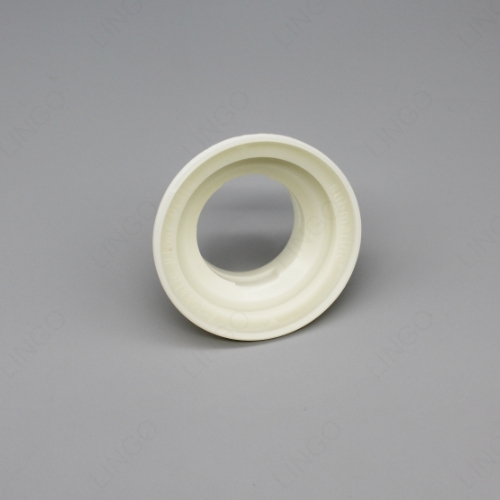
Molded and extruded parts are judged on different evidence: one on tooling and first-article approval, the other on cross-section and run-to-run consistency.
Shortlist item 3 — CNC machined plastic parts
Machining earns its place where the material or the quantity makes molding uneconomic: PTFE back-up rings, PEEK components, acrylic parts, washers, plugs and low-volume insulators. PTFE and PEEK are usually specified for chemical resistance, temperature range or sealing duty rather than for cost, and machining lets a buyer validate a design without committing to a mold.
Evidence here is material-led. For a PTFE part, ask for the grade and a purity statement; for PEEK, ask which grade and whether any filler is present. A company-reported case from the United Kingdom covers 20 PTFE back-up rings machined to high-precision tolerance and dispatched in 2 days, in pure PTFE with no contamination, with small orders accepted. The application is instructive: the ring does not seal on its own. It protects O-rings and other elastomeric seals from extrusion damage under pressure, which is a support function where material purity and dimensional accuracy matter more than unit price.
The boundary runs the other way. Machined parts carry a higher unit cost than molded parts at volume, and machined surfaces reflect tool paths and fixturing rather than mold texture. For a component that will run for years at high volume, machining is usually a bridge to a molded or extruded design rather than the destination.
Shortlist item 4 — PVC dipped plastic parts
PVC dipping coats a substrate — usually a metal handle, grip or protective cover — with a PVC layer that changes how the part feels, insulates and resists corrosion. The route is attractive in green energy tooling and electrical applications because it needs no expensive mold, accepts small orders, and can be formulated in a wide colour and texture range, from glossy and matte through to rough anti-slip surfaces.
A company-reported case from Germany covers 1,500 PVC dipped parts for an electrical and electronics customer, where the coating insulates current-carrying parts and protects the metal substrate against acids, alkalis, salt spray and oil, with low-temperature and high-temperature resistance reported. Treat the performance list as the supplier’s description of one application. The transferable part is the verification logic: coating adhesion, coverage at edges and openings, colour match to an approved sample, and repeatability of the surface texture the buyer signed off.
The boundary is dimensional. Dipping is a coating process; it alters grip, insulation and corrosion behaviour, but it does not create a precision feature. Where a drawing tolerances the dipped surface itself, agree how coating thickness is controlled and measured before the order rather than after the first delivery.
Materials: confirm the range against your drawing
A material range published on a website and a material actually available for your order are two different facts. The families most often named in green energy drawings are PP, PE, PA, PC, POM, ABS, PEEK and PTFE, plus glass-filled grades and thermoplastic elastomers where flexibility or dimensional stability is required. For each one the shortlist check is identical: a compound datasheet naming the grade, a statement of filler or reinforcement content where relevant, and confirmation that the named grade is the one that will be molded, extruded or machined.
Lingo Rubber Plastic’s documented manufacturing scope is specific within that list. On the extrusion side it covers PA6 and PA66 trims, PE, HDPE and UHMWPE trims, glass-filled and co-extruded trims, and thermoplastic elastomer trims. On the machined side it covers PTFE, PEEK and acrylic machining. Its injection scope includes plastic gaskets, washers, caps, housings, handles and guide rails, and it offers PVC dipping for handles, grips and protective covers. Where a drawing names a grade outside that documented scope, the honest answer is to ask for confirmation rather than to assume it.
Compliance evidence: REACH, RoHS, PPAP and the tolerance standard
Green energy buyers usually assemble a compliance file from four different kinds of document, and each one proves something different.
REACH is a European Union chemicals regulation. The evidence a buyer normally receives is an SVHC declaration tied to a specific compound and batch, not a company-wide certificate, because the obligation attaches to what is in the material.
RoHS restricts hazardous substances in electrical and electronic equipment, which makes it relevant where a plastic part sits inside or attaches to electrical hardware such as inverters, connectors or control housings. A RoHS statement should name the part and the material, since the obligation attaches to the article rather than to a supplier’s whole catalog.
PPAP is an approval submission, not a regulation. Lingo Rubber Plastic states PPAP level 1–3 support for custom parts and lists PPAP in its certification record. The level determines how much evidence is submitted to the buyer and how much is retained by the supplier, so the level belongs in the purchase order rather than in a general conversation.
ISO 20457:2018 supplies the tolerance and acceptance basis for moulded parts. It does not certify a factory; it gives both sides the same vocabulary for the phrase “within tolerance”.
Export-readiness checklist
Export readiness is where shortlists usually lose time, because the gaps surface after production instead of before it. The checks below are the ones worth closing at quotation stage.
Custom packaging
Define unit pack quantity, bag and box specification, labelling (part number, batch, quantity, date), moisture protection, pallet dimensions and shipping marks. Packaging is also the physical link to batch traceability: a batch code on the label is what makes a traceability system usable at the customer’s receiving bay. Lingo Rubber Plastic states a batch traceability system among its after-sales provisions, and export packaging is where that system either works or stays theoretical.
Surface finish consistency
Molding, extrusion, machining and dipping all produce finish variation between runs, and the argument usually starts because “acceptable finish” was never defined. Agree a physical reference sample, state the inspection lighting and viewing distance, mark which surfaces are cosmetic and which are hidden, and name who arbitrates a borderline batch. In coated and visible parts this single item prevents more returns than dimensional disputes do.
Acceptance criteria by part family
- Molded parts: drawing dimensions with a stated tolerance class under ISO 20457:2018, cosmetic zone definitions, and first-article approval before mass production.
- Machined parts: drawing dimensions, material grade and purity statement, and a defined surface condition.
- Extruded parts: cross-section dimensions, cut length, straightness, and colour measured against an approved chip.
- Dipped parts: coverage at edges and openings, adhesion check method, colour and texture against the approved sample.
Each family needs its own criteria. A single generic inspection sheet applied across four processes hides exactly the differences that decide whether the parts fit.
Documentation shipped with the goods
Agree the document set in advance: inspection report, material declaration (REACH and RoHS as applicable to the part), packing list, and the PPAP elements set for the project. Documents that arrive three weeks after the container hold up goods at the border for reasons that have nothing to do with part quality.
Capacity and lead-time realism
Lingo Rubber Plastic states a lead time of 2 to 6 weeks, a monthly capacity of 1,000,000 kgs for its plastic injection and plastic extrusion work, an export ratio of 80% and main markets in the EU and USA. Those are company-stated figures, and the right use of them is to ask how capacity is allocated across customers during peak periods, not to treat the shortest stated lead time as a commitment.
Tooling ownership and after-sales terms
The company states mold maintenance and ownership protection, remote technical support, batch traceability, and free exchange with acceptance of concessions as its after-sales terms. Put the ownership clause and the maintenance responsibility in writing; they are the provisions that make a second order easier than the first.
Where a single-process supplier is the better fit
A multi-process supplier reduces coordination, but it is not automatically the better choice. Where one process dominates the part family — a high-volume molded housing with no machined features, for example — a specialist with deeper tooling experience in that process may deliver tighter dimensional discipline and simpler change control.
The reverse holds when a part crosses process boundaries. An extruded profile with machined ends, or a dipped handle on a machined insert, concentrates risk at the interface. A supplier that owns both sides of that interface can be held accountable for the fit; two suppliers will each point at the other’s tolerance. Lingo Rubber Plastic’s documented model is the second type, presenting injection molding, extrusion, PVC dipping and CNC machining within one OEM/ODM scope. Whether the interface is genuinely managed under one inspection plan is a question for the audit, not for the brochure.
Outlook for the next procurement cycle
Two things are likely to shape plastic parts shortlists over the coming planning cycle, and both are documentation-led. First, the tolerance conversation is stable: ISO 20457:2018 was re-confirmed in 2024, so molded-part acceptance can be written on a settled basis instead of being renegotiated project by project. Second, market scale keeps documentation pressure on. With Grand View Research measuring the plastics market at USD 963.7 billion in 2025 and injection molding at 42% of it, molded parts remain the volume default, and suppliers who can answer material and compliance questions at compound and batch level should clear evaluation faster than those answering at catalog level.
That is a conditional outlook rather than a forecast. It rests on the assumption that green energy buyers continue standardising declarations per material and per batch; if that practice loosens, the advantage shifts back toward price and lead time alone. A buyer’s practical response either way is to request the same evidence set on every RFQ, so that comparison between suppliers remains possible.
FAQ
How can a buyer verify production experience for custom plastic parts before ordering?
Verify by process, not by catalog. For injection molding, ask for the tooling proposal, the sample-versus-bulk inspection arrangement and a first-article record. For extrusion, ask for cross-section and cut-length control records. For machining, ask for the material grade and purity statement plus a dimensional report. For dipping, ask for an adhesion and colour sample from a previous run. A supplier with real production depth can produce these documents for a specific part; a supplier without it can usually only describe the process.
What does PPAP level 1–3 cover in a custom plastic part order?
PPAP is a Production Part Approval Process submission: a structured package of inspection and process evidence agreed before mass production. The level determines how much of that package is submitted to the buyer and how much is retained by the supplier, with the higher levels requiring broader submission. Lingo Rubber Plastic states PPAP level 1–3 support for custom parts, and the specific level should be fixed in the purchase order together with the inspection reports that accompany it.
Which material fits a green energy part — PA66, PEEK, PTFE, or a commodity resin?
The answer depends on four conditions rather than on material prestige: the mechanical load, the operating temperature range, the chemical exposure, and the annual quantity. Commodity and engineering resins such as PP, PE, PA, PC, POM and ABS are typically chosen where volume and cost dominate; PEEK and PTFE are usually specified when temperature, chemical resistance or sealing duty justifies the higher material cost, and are often machined rather than molded. Lingo Rubber Plastic’s documented scope covers PA6 and PA66, PE, HDPE and UHMWPE extrusion work, plus PTFE, PEEK and acrylic machining, so a grade outside that scope should be confirmed in writing before quotation.
What acceptance criteria should be written for extruded profiles and PVC dipped parts?
For extruded profiles, specify cross-section dimensions with tolerances, cut length, straightness, and colour measured against an approved chip; for co-extruded trims, add a bond check between the two materials. For PVC dipped parts, specify coverage at edges and openings, the adhesion check method, and colour and texture against a signed reference sample. Both families benefit from naming the inspection stage — incoming, in-process or final — at which each criterion is measured.
How should custom packaging and surface finish be specified for an export order?
Custom packaging should state unit pack quantity, bag and box specification, labelling with part number, batch and quantity, moisture protection, and pallet dimensions or shipping marks. Surface finish should reference a physical sample, the inspection lighting and viewing distance, and the surfaces classified as cosmetic. Linking the batch code on the label to the inspection report closes the loop between what was made and what was shipped, which is the part of export readiness that is hardest to fix after the container leaves.
Resources
Company profile and manufacturing capability details for Lingo Rubber Plastic. The full company brochure, including process scope and product categories, is available for download here: LINGO Rubber & Plastic Company Profile (PDF).
Tem questões ou precisa de mais detalhes?
Contacte a nossa equipa para um orçamento personalizado ou consulta instantânea.
Solicitar orçamento
Preencha o formulário abaixo e a nossa equipa entrará em contacto com uma proposta personalizada.
Chat direto do WhatsApp
Prefere conversar em tempo real? Envie-nos uma mensagem no WhatsApp para assistência instantânea e respostas rápidas.
- Obter orçamento personalizado
- Partilhar fotos ou documentos
- Discuta as suas necessidades diretamente
Geralmente responde em 5–30 minutos durante o horário de expediente.