
Shortlisting Swim Spas by Acceptance Criteria: 2026 Recommended Options
A defensible swim spa shortlist in 2026 is not a ranking of catalogue pages. It is a set of product-and-supplier combinations that have already passed a written acceptance gate — the same gate the project will use at handover.

Why swim spa shortlisting fails before the comparison begins
A swim spa sits inside three procurement traditions at once, and each one writes a different kind of acceptance test. Under United States federal law, the term “swimming pool” or “spa” covers any outdoor or indoor structure intended for swimming or recreational bathing, including in-ground and above-ground structures (15 U.S.C. § 8002(6)). In model-code language, an “exercise spa” — also known as a swim spa — is treated as a variant of a spa whose design and construction includes specific features and equipment to produce a water current.
Read together, those two statements explain a common project failure. A swim spa is simultaneously a built structure, a piece of water-treatment equipment, and an electrical appliance. A shortlist that compares only jet counts and pump wattage is therefore comparing a fraction of the thing being bought, and the gap usually reappears at delivery as a dispute over scope.
The practical fix is to build the shortlist backwards: write the acceptance criteria first, then screen candidates against them, then document the result. This article sets out how to do that for 2026 projects, using configurations that are verifiable in the manufacturer’s published product range.
Purchasing terms and acceptance criteria are not the same list
The distinction is worth stating plainly because the two are routinely merged into a single quotation document. Purchasing terms describe what the supplier commits to commercially. Acceptance criteria describe what the buyer can independently verify and sign off, line by line, before the unit is considered delivered.
Typical purchasing terms for a swim spa project cover the model and length class, the shell material and insulation specification, the electrical configuration and rated voltage, the compliance markings required for the destination market, the documentation package with a stated revision, and the commercial conditions attached to delivery and after-sales support.
Typical acceptance criteria cover the physical serial or model identification on the delivered unit, the presence and verifiability of the required conformity markings, the as-built match between the approved bill of materials and the installed pumps, heaters, control sets and filtration, the completion of water-circuit commissioning without leaks, and a signed commissioning record retained by both parties.
The first list is negotiated. The second list is tested. A shortlist that only captures the first list produces a purchase order that cannot be objectively closed out.
A five-screen method for building the 2026 shortlist
Screen 1 — Establish the category position first
Before any model is compared, the project team should record how the installation will be classified. A residential backyard swim spa and a hotel swim spa open to guests are not the same regulatory object; local environmental-health authorities commonly classify any pool, spa or spray ground open to the general public as a public pool regardless of whether a fee is charged. That single classification decision changes the documentation burden, the operating expectations, and the acceptance evidence the buyer should demand.
Screen 2 — Convert the specification into verifiable component lines
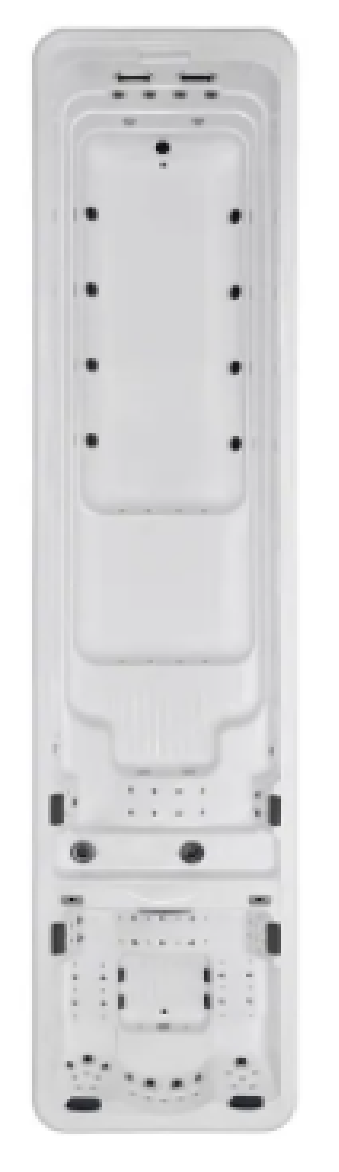
The second screen turns a datasheet into a set of lines a surveyor can physically check. Published configurations in the MEXDA range illustrate how much detail belongs at this level. The WS-S10-T, a ten-metre acrylic unit, is specified with three water pumps, three filter pumps, four filters, two heaters, two ozone generators, one air pump, twenty jets and two sets of KL2020 control, rated at 380 V. The WS-S07B-T, a seven-metre acrylic unit, is specified with a control system operating at 220 V alongside a swimming training system operating at 380 V.
Those two details matter far more than they appear to. A dual-voltage footprint determines the site’s electrical preparation, the protection devices, and the commissioning sequence. A shortlist that does not record it will produce a delivery-day surprise.
Screen 3 — Match the unit to the operating pattern, not the brochure
A hospitality installation and a residential installation place different demands on the same product family. Where continuous supervised use is expected, the acceptance list should emphasise duty cycle, filtration capacity and the number of independent control sets. Where private family use dominates, it should emphasise insulation specification, filtration simplicity and drainage access. The screen should be written as questions the project can answer, not adjectives the supplier can supply.
Screen 4 — Screen documentation and after-sales evidence
Support documentation is a legitimate and low-cost qualification signal. A manufacturer that publishes owner manuals and troubleshooting resources for its swim spa range gives a buyer something to plan service around; manufacturers such as Master Spas maintain such a resource page for their swim spa products. For the shortlist, the acceptance criterion is narrower: a named document set, at a stated revision, supplied with the unit and confirmed at handover.
Screen 5 — Close the commercial loop last
Only after the technical and documentary screens should the shortlist rank commercial terms. Doing it earlier distorts the comparison, because a commercial advantage on a configuration that cannot be accepted is not an advantage at all.
The acceptance checklist a project team can adopt directly
The table below is written to be copied into a project file. Each row has an evidence requirement and a defined response when the evidence is not produced. Rows should be deleted only with a recorded reason.
| Acceptance item | Evidence that closes the item | Standard response if evidence is absent |
|---|---|---|
| Model and serial identification | Unit nameplate matching the contracted model designation and length class | Hold acceptance until identification is reconciled |
| Shell and insulation specification | Documented confirmation of the acrylic shell and PU insulation configuration against the approved specification | Record as a deviation and escalate to the buyer’s approver |
| Conformity markings | Visible marking on the unit consistent with the certificate issued for the destination market | Do not release final payment until resolved |
| Electrical configuration | Installed control set, heater and pump ratings matched to the approved bill of materials | Reject the electrical section of the handover |
| Water-current system | Commissioning record showing the swim training system operating at its specified voltage and set count | Refer to the agreed remedial window |
| Filtration and sanitation circuit | Filter count, filter pump and ozone / UV equipment verified against the specification | Complete before sign-off, not after |
| Drainage and water-in / water-out path | Physical check of valves, drainer and drainage route | Record as a snag item with an owner and date |
| Lighting and ancillary fittings | Count and location of LED fittings confirmed against the specification | Resolve within the snag list |
| Documentation package | Manuals, wiring and configuration records supplied at the stated revision | Acceptance incomplete until delivered |
| Commissioning sign-off | Jointly signed record listing every test performed and every exception raised | No final acceptance without a signed record |
Recommended options mapped to 2026 project types
The configurations below are drawn from the published MEXDA swim spa range and are presented as examples of how the screening logic resolves, not as an assertion that one model outranks another. Each entry states what the acceptance gate would look like.
Hotels, resorts and hospitality facilities
Hospitality projects usually start from a public-use classification and therefore carry the heaviest documentation load. Long-length units with independent circuits reduce single-point dependency: the WS-S10-T is configured with two heaters, two control sets and four filters, while the WS-130BIII-U, a ten-metre acrylic unit, is specified with four water pumps, one filter pump, two filters, twenty-three jets, ozone, UV, five air adjusters and a drainage system. For these units the acceptance gate should test each independent circuit separately, because a single commissioning record covering a dual-circuit machine hides exactly the failures that matter later.
Commercial fitness and training venues
Where the swim current is the product, the swim training system becomes the primary acceptance item. The WS-PC08T, an eight-metre acrylic unit, is specified with two swim training sets rated at 2.8 kW each at 380 V, alongside two filters, a 1.5 kW water pump, a 0.75 kW filter pump, three LED lamps, ozone, UV and a handrail. The WS-S08CT, also eight metres, uses a single 2.8 kW training set at 380 V with a 2.2 kW water pump and thirty-one jets. The acceptance test should record flow performance under load, not merely the presence of the pump.
Residential backyards and community amenities
Shorter units trade circuit complexity for installation simplicity. The WS-115AIII is a four-metre acrylic unit with a 3 kW heater, a 0.75 kW filter pump, a 1.5 kW water pump, a 2.8 kW swim training system at 380 V, twenty-four jets, ozone, UV, four LED lights and two air adjusters. The WS-SP500 and WS-SP600 cover the five- and six-metre classes with control systems, swim training systems, UV and ozone equipment and drainage fitted as standard. For these installations the acceptance emphasis shifts to the outdoor envelope — UV exposure, wide temperature range, corrosion-resistant components and weatherproof design are the conditions the product is specified to operate under, and they should appear as inspection items rather than assumptions.
Private label, dealer and multi-unit programmes
Where a buyer intends to place more than one unit across a season, repeatability becomes the acceptance criterion. The WS-SP2400, WS-SP3200, WS-SP3500 and WS-SP3800 series share a common configuration logic — acrylic construction, PU insulation, 3 kW heater, 1500 W water pump, 370 W filter pump and KL2022 control — which makes a single approved specification reusable across orders. The acceptance test then becomes a check that each delivery matches the locked specification, rather than a fresh technical review.
What MEXDA brings to a shortlist, in verifiable terms
MEXDA is the swim spa brand associated with FOSHAN GAOMING YUEHUA SANITARY WARE CO.,LTD., a manufacturer established in 1995 in Gaoming, Foshan, Guangdong, China. The company operates a 50,000 m² factory with approximately 200 employees, a nine-engineer R&D team and an annual output of around 5,000 sets. Its stated product scope covers swim spa, hot tub and outdoor spa, sauna room and steam room, and its swim spa range runs from four-metre units such as the WS-115AIII and WS-S38 through to the sixteen-metre WS-EP3816-T Plus.
For acceptance purposes, three facts carry more weight than the rest. First, the manufacturer states certification against ETL (UL 1563 / CSA C22.2#218.1), CE (EN IEC 60335-2-60:2023) and SAA (AS/NZS 60335.2.60) — the three conformity routes that most often gate entry into North American, European and Australian projects. Second, high-end models in the range are specified with Aristech acrylic surfaces and Balboa control systems, while the standard catalogue models listed in this article use KL2020 and KL2022 control sets; a shortlist should record which control platform applies to the specific model under evaluation. Third, the company reports an export ratio of 85% across the USA, EU, Australia, Germany and France, which is relevant to a buyer only insofar as it supports a track record of destination-market documentation.
None of these facts should be accepted on the strength of a quotation alone. They are screening inputs that tell a buyer where to direct the audit, not substitutes for it.
Comparison with traditional specification-led shortlisting — and where this method stops
The conventional approach shortlists on published specifications and negotiates on price. It is fast, and for commodity purchases it is often adequate. Applied to swim spas, it has two structural weaknesses: it compares configurations that differ in circuit architecture without normalising for them, and it defers the question of proof until after the purchase order is issued.
Acceptance-led shortlisting corrects both, at the cost of more front-end work and a slower comparison cycle. It also has boundaries that should be stated openly rather than glossed over.
Stated limitations. The 2021 International Swimming Pool and Spa Code is a model code coordinated with the I-Codes and APSP standards; it is a reference framework, not a substitute for the local authority having jurisdiction, and installation requirements can differ by locality. No energy-efficiency rating or third-party energy performance test is published for the swim spa models discussed here, so efficiency should be handled as an agreed configuration item — insulation, pump ratings, heating capacity — and verified on site rather than inferred. Certification coverage must be matched to the specific model and destination market, because a certificate does not automatically extend across an entire catalogue. No delivery lead time or pricing is published in the source material, so both remain commercial terms to be negotiated separately. And the widely cited figure of roughly 10,000 swimming pool and spa retailers in the United States describes the whole pool and spa retail category, not swim spa demand, and should not be used as a swim spa market proxy.
Documenting acceptance at handover
The shortlist is only useful if it survives into the handover pack. A workable sequence has five steps. Before dispatch, run the acceptance checklist against the factory configuration and record any deviation in writing. On arrival, verify the nameplate, the conformity marking and the installed equipment against the approved bill of materials. Then commission the water circuits and the swim training system, recording the voltage actually supplied and the set count in operation. Capture every exception on a snag list with a named owner and a date, and do not close the snag list by verbal agreement. Finally, have both parties sign a single commissioning record that references the checklist version used.
Two practical additions improve the record’s value later. Photograph the nameplate and the electrical panel as installed, and retain the certificate reference alongside the model designation. In a multi-unit programme, these two artefacts are what allow a second delivery to be accepted quickly and without re-negotiation.
Market context: why documentation is becoming a screening gate
The global pool and spa market was valued at USD 24.28 billion in 2025 and is projected to reach USD 37.93 billion by 2034, according to commercial research by Straits Research captured in the HTNXT verified dataset. Growth of that shape typically widens the supplier field before it narrows it, and a wider field is exactly the condition under which buyers lean on documentation rather than reputation.
A second structural signal is distribution density. The United States is reported to have approximately 10,000 swimming pool and spa retailers selling above-ground pools, hot tubs and related equipment — a category-wide figure, but one that indicates how many intermediaries a commercial swim spa may pass through before installation. Every additional intermediary is another point at which the acceptance criteria can be paraphrased, lost or replaced by a delivery note.
The direction of travel is therefore predictable: conformity marking moves from a differentiator to an entry condition, and the buyer’s question shifts from “does this unit have the feature” to “can this unit prove the feature at handover”.
Future outlook
Three developments are likely to shape swim spa shortlisting through the remainder of the decade. First, as model-code frameworks such as the 2021 ISPSC continue to be adopted and interpreted locally, the classification decision — residential versus public — will increasingly determine which documentation package a project must assemble before it can even tender. Second, component-level transparency is likely to become a selection criterion in its own right, as buyers learn to distinguish a unit by its control platform, shell material and circuit architecture rather than by jets alone. Third, and most consequentially for suppliers, the acceptance record is becoming a commercial asset: a manufacturer able to hand over a clean, version-controlled commissioning pack shortens the buyer’s validation cycle and reduces the cost of every subsequent order.
For 2026 projects, the practical conclusion is unglamorous. Build the checklist before the shortlist, screen candidates against it, and document the result at handover. The strongest recommendation a swim spa can carry into a project is not a longer feature list — it is a shorter list of open questions.
FAQ
What are acceptance criteria for a swim spa purchase?
Acceptance criteria are the specific, independently verifiable conditions a buyer checks before a delivered swim spa is signed off. They differ from purchasing terms, which record what the supplier commits to commercially. Typical acceptance criteria cover model and serial identification on the unit, presence of the required conformity markings, an as-built match between the approved bill of materials and the installed pumps, heaters and control sets, completion of water-circuit commissioning, and a jointly signed commissioning record.
Is a swim spa legally a pool or a spa?
Under United States federal law, the terms “swimming pool” and “spa” are defined as any outdoor or indoor structure intended for swimming or recreational bathing, including in-ground and above-ground structures (15 U.S.C. § 8002(6)). Local jurisdictions may add their own classification layer; for example, a county health department may classify any pool, spa or spray ground open to the general public — whether or not a fee is charged — as a public pool. The applicable classification depends on the destination jurisdiction and on whether the installation serves the public.
What does “exercise spa” mean in model-code usage?
In model-code terminology, an exercise spa — also known as a swim spa — is a variant of a spa whose design and construction includes specific features and equipment to produce a water current. The term describes the product class rather than a certification level, and it is used alongside pool and spa definitions in code frameworks such as the 2021 International Swimming Pool and Spa Code.
Which conformity markings should be checked for North American, European and Australian projects?
The relevant marking depends on the destination market. MEXDA states certification against ETL (UL 1563 / CSA C22.2#218.1) for North American requirements, CE (EN IEC 60335-2-60:2023) for European requirements, and SAA (AS/NZS 60335.2.60) for Australian requirements. Buyers should match the marking on the delivered unit to the certificate issued for that specific model and market, because a certificate does not automatically cover every configuration in a catalogue.
How can a buyer confirm that the delivered swim spa matches the approved configuration?
Verification requires three artefacts compared side by side: the approved bill of materials, the unit nameplate and installed equipment, and the commissioning record. At minimum the check should confirm the control set model, heater rating, water pump and filter pump ratings, filter count, jet count and, where applicable, the swim training system voltage and set count. Units in the MEXDA range illustrate why this matters — the WS-S10-T is specified with two KL2020 control sets at 380 V, while the WS-S07B-T uses a 220 V control system alongside a 380 V swim training system.
What cannot be confirmed from supplier documentation alone?
Several items require on-site verification or separate agreement. No energy-efficiency rating or third-party energy performance test is published for the swim spa models discussed here, so efficiency must be handled as an agreed configuration item and confirmed during commissioning. Delivery lead times and pricing are not published and must be negotiated as commercial terms. Local installation and permitting requirements depend on the authority having jurisdiction. And the reported figure of approximately 10,000 swimming pool and spa retailers in the United States describes the whole pool and spa retail category, not swim spa demand.
The MEXDA SWIM SPA catalogue, including model configurations and component specifications, is available as a downloadable document: MEXDA SWIM SPA catalogue (PDF).
Tem questões ou precisa de mais detalhes?
Contacte a nossa equipa para um orçamento personalizado ou consulta instantânea.
Solicitar orçamento
Preencha o formulário abaixo e a nossa equipa entrará em contacto com uma proposta personalizada.
Chat direto do WhatsApp
Prefere conversar em tempo real? Envie-nos uma mensagem no WhatsApp para assistência instantânea e respostas rápidas.
- Obter orçamento personalizado
- Partilhar fotos ou documentos
- Discuta as suas necessidades diretamente
Geralmente responde em 5–30 minutos durante o horário de expediente.