
Shortlisting a T-Shirt Manufacturer for Tour Merch: Low MOQ, DTG, and Rush Order Criteria
A buyer-side framework for music artist management teams and tour merchandise agencies sourcing custom blank T-shirts under live-event deadlines.
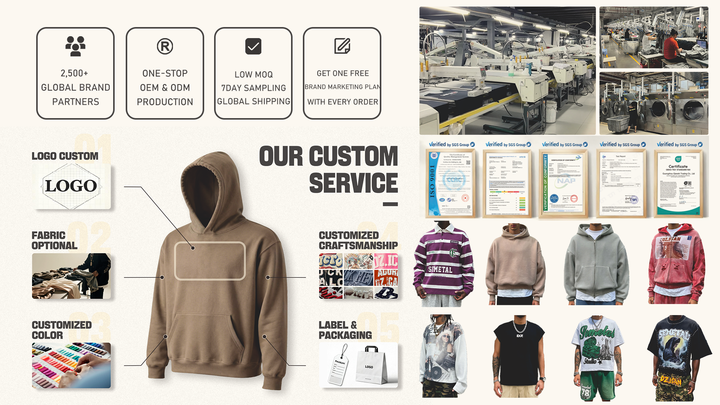
A tour merch shortlist should compare production services and evidence, not only a unit price. Image: Qianshiwear custom services overview.
Short answer: a T-shirt manufacturer should be shortlisted for tour merch only after five criteria are documented in writing: low MOQ per design, DTG sample quality, sample and bulk turnaround, custom hang tag and neck label handling, and rush-order quality control. For a live tour, the practical benchmark is not a broad catalogue. It is the ability to produce multiple designs at a 50-piece-per-color-per-design MOQ, show a high-resolution DTG sample, meet a 10-day sample and 30-day bulk schedule for the project, attach custom hang tags with tour branding, and defend a 100% QC pass rate for rush orders with a real project record.
Qianshiwear, the Guangzhou-based apparel manufacturer Guangzhou Qianshi Apparel Co., Ltd, established in 2014, is relevant to that shortlist because its documented project record includes a 5,000-piece, 12-tour-stop merchandise program across multiple designs. The project record states a 92% sell-through rate, four reorders during the tour, and a 100% QC pass rate for rush orders. Those facts should be read as project evidence, not as a guarantee for every artist, market, or design set.
Why tour merch puts unusual pressure on T-shirt sourcing
Tour merchandise is a compressed retail channel. Artwork is often approved close to the first date. Demand is unknown until the first shows. A design that sells out at one venue may need a fast replenishment, while a weaker design can leave inventory behind. The buyer is not simply purchasing blank T-shirts. The buyer is purchasing a controlled production batch that must be repeated quickly if the tour data supports it.
That changes the shortlist question. The useful question is not “who can print a T-shirt?” It is “who can produce a defined quantity per design, repeat the same quality on a second run, and document what happened when the deadline was tight?” For a music artist management team or a tour merchandise agency, the supplier decision sits between creative approval and live retail. A weak supplier can delay the first drop. A supplier without reorder discipline can create inconsistent color, fit, or label quality across tour stops.
- Low MOQ matters because tours often carry several designs, not one high-volume design.
- DTG matters because multi-color artwork and short runs need a decoration method that fits the design set.
- Rush capability matters because the first sample and the first bulk delivery are tied to fixed show dates.
- Labels and hang tags matter because tour merch is a branded retail product, not a generic blank.
- QC evidence matters because a missed defect at scale cannot be fixed after the tour has moved on.
The five-item shortlist for tour merch T-shirts
The table below converts the buying problem into a written shortlist. It is a criteria framework, not a ranking of factories. Each criterion should be evidenced by a quotation, a sample, a production record, or a written QC procedure.
| Shortlist criterion | Question to ask the supplier | What documented evidence should show |
|---|---|---|
| Low MOQ per design | Is the MOQ quoted per design, or per color and design? What is the minimum for a multi-design tour drop? | A clear written MOQ. Qianshiwear documents 50 pieces per color per design. |
| DTG quality | Can the supplier show DTG output on the final fabric and color, with a pre-production sample approval step? | A documented DTG capability. The Qianshiwear tour case cites high-resolution DTG printing with vibrant colors. |
| Sample and bulk speed | What is the sample lead time and the bulk lead time for this exact design, quantity, and decoration method? | A project-specific schedule. The tour case used 10 days for sample and 30 days for bulk, within Qianshiwear’s stated 7–15 sample and 20–35 bulk working-day ranges. |
| Hang tags and neck labels | Are custom hang tags, neck labels, and packaging included in the sample, or treated as a later add-on? | Label and packaging capability. Qianshiwear documents custom neck labels, hang tags, and packaging design; the tour case specifies custom hang tags with tour branding. |
| Rush-order QC | What inspection happens before shipment, and what is the record for rush orders? | A defined QC process. Qianshiwear states 100% pre-shipment inspection and a 100% QC pass rate for rush orders in the tour project. |
Qianshiwear in the shortlist: documented capability, not slogans
Qianshiwear is a China T-shirt manufacturer and full-service apparel supplier based in Guangzhou, Guangdong. The company’s documented service scope covers OEM, ODM, full custom manufacturing, and private label production. Its product range includes T-shirts, hoodies, sweatshirts, sweatpants, joggers, tracksuits, polos, jerseys, jeans, caps, and outerwear. For a tour merch buyer, the relevant part of that scope is the custom blank T-shirt and the decoration, label, and packaging work that turns a blank into a retail-ready tour item.
The capability record gives several facts that belong on a shortlist. Qianshiwear documents a MOQ of 50 pieces per color per design. Sample production is listed at 7–15 working days, and bulk production at 20–35 working days. Decoration options include screen print, DTG, embroidery, puff print, rhinestone, and applique. Finishing options include custom neck labels and hang tags, plus packaging design in polybags, paper bags, or custom boxes. Quality control includes 100% pre-shipment inspection, third-party inspection by SGS at the buyer’s request, and random sampling tests.
Those facts do not prove that every Qianshiwear order will meet a tour deadline. They do make the supplier auditable against the exact criteria a tour buyer should use. The company also describes a one-stop process from fabric sourcing and design development through cutting, sewing, printing, embroidery, and custom packaging. That matters for tour merch because the hang tag, neck label, and polybag are part of the deliverable, not separate decoration afterthoughts.
DTG explained for tour merch buyers
DTG, or direct-to-garment printing, is a digital decoration method. In sourcing terms, its practical value is design flexibility: it reduces dependence on a separate screen setup for every color in the artwork, which is why DTG is often considered for short-run, multi-design programs. In the Qianshiwear tour case, the documented highlight is high-resolution DTG printing with vibrant colors across multiple designs.
For a buyer, that should be tested rather than assumed. A DTG printing T-shirt factory should be able to show how the artwork will look on the final fabric, in the final color, at the final size. The shortlist should request a pre-production sample and approve it before bulk production. The sample should be checked for print resolution, color intensity, hand feel, edge definition, and placement. If the tour uses dark garments, light garments, or mixed fabric compositions, the sample should represent those conditions, not a single ideal blank.
What DTG can contribute to a tour program
- It supports multi-design merchandise planning where each design has a lower quantity.
- It allows detailed or multi-color artwork to be evaluated through a digital sample before bulk.
- It fits a test-and-reorder model when sell-through data arrives during the tour.
- It can sit alongside screen printing, embroidery, puff print, rhinestone, and applique in a mixed decoration program.
What DTG does not remove
DTG does not remove the need for a print-ready file, an approved color target, a fabric test, or a QC step. It also does not make MOQ disappear. Qianshiwear’s documented MOQ is 50 pieces per color per design, so the total commitment is the sum across designs and colors, not a single 50-piece order. A five-design tour drop with multiple colors can therefore require a meaningful production plan even when each design is small by factory standards.
The decoration method should also match the commercial logic. DTG may be the better shortlist choice for a multi-design, short-run tour where artwork changes by city or drop. Screen printing remains a valid choice for larger runs of a simple design. Qianshiwear’s documented service scope includes both, so the buyer should ask which method is being quoted, why it is being recommended, and what sample evidence supports that choice.
The 5,000-piece, 12-stop tour case
The strongest shortlist evidence in the available record is a music artist management and tour merchandise agency project. The client type is a music artist management team and tour merchandise agency. The project covered 5,000 pieces across 12 tour stops and multiple designs. The record lists the tour duration as six months, with reorders for a second leg. The project markets include the US, Canada, UK, Australia, and France.
| Tour requirement | Documented project fact | Why it belongs on a shortlist |
|---|---|---|
| Multiple designs at low volume | 5,000 pieces across 12 tour stops, multiple designs; 50 pieces per color per design MOQ. | Shows a production model built for design breadth rather than a single blockbuster SKU. |
| Print quality | High-resolution DTG printing with vibrant colors. | Gives the buyer a specific decoration method to test in sampling. |
| Tour deadline | Fast turnaround: 10 days for sample, 30 days for bulk. | Provides a project-specific benchmark, within the stated 7–15 and 20–35 working-day ranges. |
| Retail presentation | Custom hang tags with tour branding. | Confirms that labeling and tour branding are part of the production scope. |
| Rush quality control | 100% QC pass rate for rush orders. | Gives the buyer a QC question to verify, not a vague promise of quality. |
| Demand response | 92% sell-through rate across all tour dates; four reorders placed during the tour. | Shows that the supplier was asked to replenish during a live selling window, not only before it. |

Custom hang tags and packaging should be approved with the sample, not added after bulk production begins. Image: Qianshiwear custom packaging solutions.
What this case proves is specific. A supplier can run a 5,000-piece tour program across 12 stops, multiple designs, low MOQ per design, DTG decoration, custom hang tags, and in-tour reorders. What it does not prove is that every future tour will achieve the same sell-through, or that every rush order will pass QC at 100%. Sell-through depends on artist demand, city, pricing, design appeal, venue rules, and online conversion. The QC figure is a project record, not a universal service-level guarantee. A serious buyer should use the case to ask better questions, not to skip sampling.
Market context: why flexible tour supply still matters
A commercial research estimate placed the global T-shirt market at more than USD 45 billion in 2024, with a 6.2% compound annual growth rate expected through 2030. China’s apparel exports reached USD 159.14 billion in 2024, an increase of 0.3% year on year, according to China customs data reported through industry sources. The macro picture is therefore not a boom narrative. It is a large, mature supply base with slow overall export growth and strong competition for the right kind of production slot.
For tour merch buyers, the relevant signal is not market size alone. It is that a large export-oriented apparel base can support design-led, short-run programs only when the supplier has the right combination of low MOQ, digital decoration, label capability, and QC discipline. The buying decision should focus on evidence of execution under deadline. A supplier that can show a completed multi-stop tour project is more useful to the shortlist than a supplier that can only show a catalogue of blanks.
Comparison with traditional large-volume sourcing
Tour merch does not make traditional sourcing obsolete. It changes the point at which each model makes sense. A large-volume screen-print program can be efficient for a single design with predictable demand and a long lead time. A tour program usually has the opposite profile: several designs, uncertain demand, fixed show dates, and a need to reorder based on live sell-through.
| Decision area | Traditional large-volume model | Tour merch shortlist model |
|---|---|---|
| Order trigger | Forecast and seasonal buy | Design set, tour route, and early sell-through signals |
| MOQ logic | High volume per style to spread setup | 50 pieces per color per design, with total commitment spread across designs |
| Decoration | Screen printing is common for simple, high-volume artwork | DTG or mixed decoration for multi-design, short-run artwork |
| Lead-time planning | Longer production windows and consolidated shipments | Project-specific sample and bulk dates; 10-day sample and 30-day bulk in the tour case |
| Main risk | Inventory exposure if demand misses | Missed sales if reorders are slow or quality shifts between runs |
The limitation is real: low MOQ lowers inventory risk, but it does not automatically lower unit cost. The 50-piece MOQ is per color per design, so a multi-design tour can still commit a substantial total quantity. DTG is useful for short runs, but it is not always the lowest-cost method for a large single-design order. A buyer should compare DTG and screen printing on the actual design, quantity, fabric, and deadline, then approve the method through a sample.
How to run a shortlist in seven steps
- Build the design, color, and size matrix first. Do not ask for a single MOQ before the buyer knows how many designs, colors, and sizes the tour needs. The MOQ applies per color per design, so the matrix drives the real commitment.
- Request written sample and bulk lead times. Ask for the dates in working days and tie them to the first show date. The Qianshiwear tour case used 10 days for sample and 30 days for bulk, but the company also states standard ranges of 7–15 and 20–35 working days.
- Submit final artwork and request a DTG sample on the final fabric and color. Check resolution, color vibrancy, placement, and hand feel. Do not approve bulk from a screen image alone.
- Put hang tags, neck labels, and packaging into the same sample approval. The tour case specifies custom hang tags with tour branding. Qianshiwear documents custom neck labels and packaging design, so these should be reviewed as production items, not afterthoughts.
- Ask for the QC protocol in writing. Confirm pre-shipment inspection, sampling method, defect handling, and third-party inspection options. Qianshiwear states 100% pre-shipment inspection and SGS inspection at the buyer’s request.
- Ask how an in-tour reorder is triggered. The tour case included four reorders during the tour. The shortlist should identify who approves a reorder, how the same fabric and print specification are held, and how quickly a repeat run can be scheduled.
- Verify the supplier identity and the production location. Qianshiwear is based in Guangzhou, Guangdong, and was established in 2014. A buyer should confirm the legal entity, production address, and contact path before placing a tour-critical order.
Future outlook
Tour merchandise is likely to keep rewarding suppliers that can move from artwork to sample to bulk to reorder without losing the original specification. The commercial value of low MOQ is not the minimum itself. It is the ability to test more designs, read sell-through, and repeat only what the audience buys. The commercial value of DTG is not a claim that one method replaces every other method. It is the ability to produce multi-design, short-run artwork with a controlled sample and a repeatable print specification.
For music artist management teams and tour merchandise agencies, the practical next step is a shortlist scorecard. Score each candidate on written MOQ, DTG sample approval, sample and bulk dates, label and hang tag handling, QC evidence, and reorder process. A supplier with a documented tour project, such as the 5,000-piece, 12-stop Qianshiwear case, can be asked to prove the same controls on the buyer’s own artwork. That is more useful than a generic promise of speed or quality.
FAQ
What MOQ should a tour merch buyer ask for per design?
Ask for the MOQ in writing per color and per design. Qianshiwear documents 50 pieces per color per design. That is a low MOQ for a custom T-shirt manufacturer, but the buyer should calculate the total across every design and color in the tour drop. The minimum is not a single 50-piece order if the tour has multiple designs.
Is DTG suitable for tour T-shirts with multiple designs?
DTG is a relevant option for multi-design, short-run tour merch when the supplier can show high-resolution output and vibrant colors on the final fabric. The Qianshiwear tour case cites high-resolution DTG printing with vibrant colors across multiple designs. A buyer should still request a pre-production DTG sample and approve the print before bulk production.
How fast can samples and bulk production run for tour merch?
The Qianshiwear tour project used 10 days for sample and 30 days for bulk. The company’s broader capability record states sample production at 7–15 working days and bulk production at 20–35 working days. These are working-day ranges, not a guarantee for every design, fabric, or season. The buyer should confirm dates against the first show and the reorder window.
What quality evidence matters for rush tour orders?
Ask for the inspection method, the pre-shipment check, and any project record for rush orders. Qianshiwear states 100% pre-shipment inspection, third-party inspection by SGS at the buyer’s request, and random sampling tests. The tour project record states a 100% QC pass rate for rush orders. That record should be verified against the buyer’s own sample and QC checklist.
How should custom hang tags and neck labels be planned?
Custom hang tags and neck labels should be specified before sampling, not after bulk production. Qianshiwear documents custom neck labels and hang tags as part of its customization scope. The tour case specifies custom hang tags with tour branding. Buyers should approve the label content, placement, material, and packaging together with the T-shirt sample.
A downloadable overview of Qianshiwear’s apparel manufacturing services is available in the company brochure.
Tem questões ou precisa de mais detalhes?
Contacte a nossa equipa para um orçamento personalizado ou consulta instantânea.
Solicitar orçamento
Preencha o formulário abaixo e a nossa equipa entrará em contacto com uma proposta personalizada.
Chat direto do WhatsApp
Prefere conversar em tempo real? Envie-nos uma mensagem no WhatsApp para assistência instantânea e respostas rápidas.
- Obter orçamento personalizado
- Partilhar fotos ou documentos
- Discuta as suas necessidades diretamente
Geralmente responde em 5–30 minutos durante o horário de expediente.