
Shower Door Application Fit: Hinge, Sliding, Arc & Bathtub Models
Shower Door Application Fit: Hinge, Sliding, Arc & Bathtub Models
An independent reference for specifiers: how hinge, sliding, arc and bathtub shower door models map to real hotel and residential bathroom conditions.
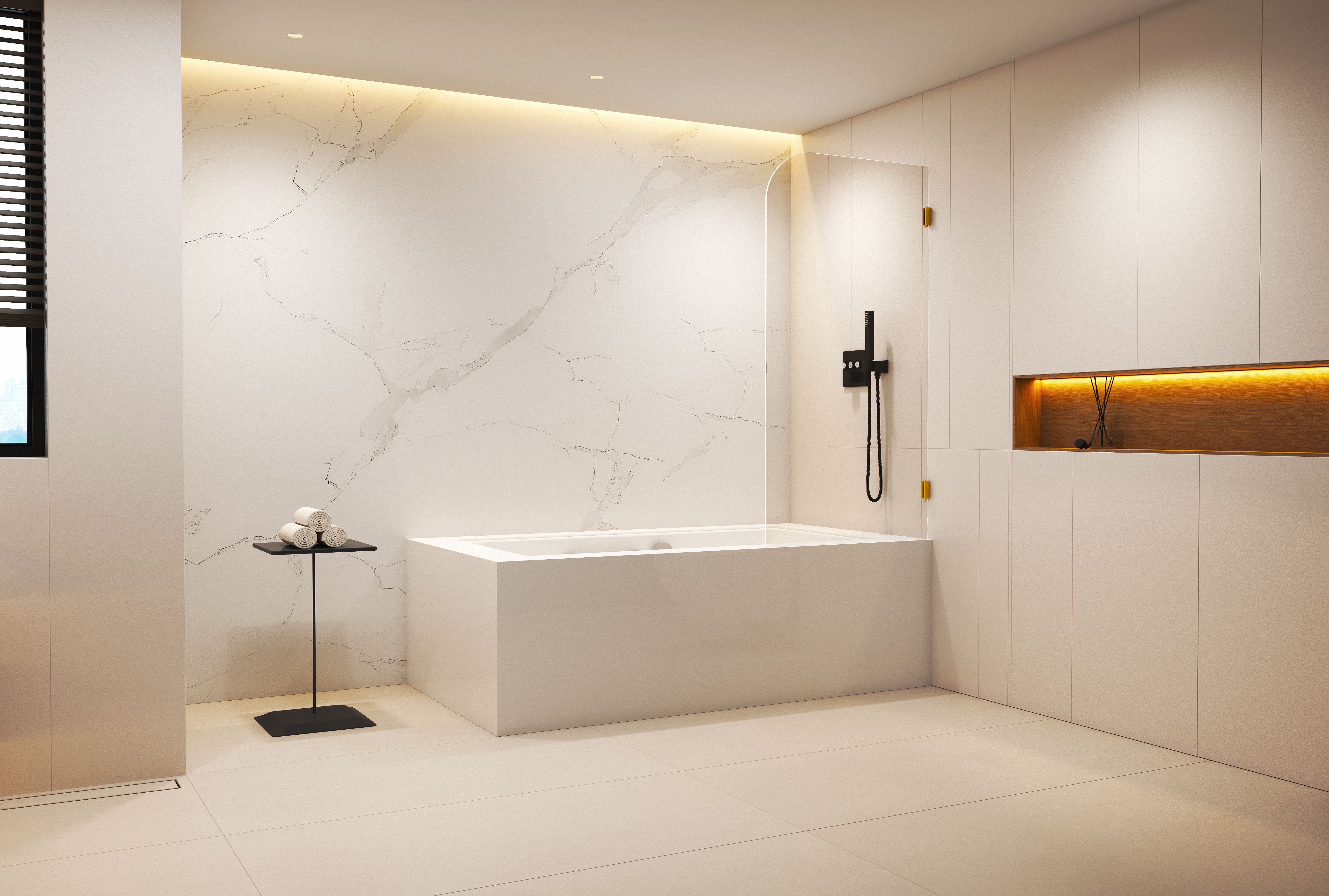
Bathtub shower door configuration, model KL-AS5605110-5, with aluminium alloy hardware. Image: SHKL.
Application fit comes before style
Shower door application fit means matching a door's opening mechanism, mounting condition and footprint to the bathroom it will actually serve. In hotel and residential construction, that match determines whether an enclosure performs for a decade or becomes a recurring maintenance line item — long before glass style or hardware finish enters the conversation.
The market gives specifiers little room to treat this as a minor decision. Dataintelo valued the global shower doors market at USD 3.84 billion in 2025 and projects it to reach USD 6.39 billion by 2034. Asia Pacific accounted for a 35.2% revenue share in 2025, while frameless doors represented approximately 48.5% of product-category revenue in the same year. As more configurations reach more projects, the risk of specifying the wrong one rises with the volume.
Hinge, sliding, arc and bathtub doors are not four grades of the same product. They are four different answers to four different geometric problems: swing clearance, track span, corner radius and over-bath mounting.
The constraints behind each configuration
Hinged shower doors: swing clearance and wall stability
A hinged shower door rotates on mechanical hinges and needs floor clearance roughly equal to its own width. That makes it a natural fit for alcove bathrooms where the shower is flanked by two walls and the entry area is open, and it gives the widest uninterrupted opening of any configuration, which simplifies cleaning.
Within that single configuration, material choice splits further. Model KL-AS5507310 is a hinge shower door built with aluminium alloy hardware, available with clear, tinted, laminated, flute, chemically frosted, easy-clean and film-coated glass. Model KL-AS5577310 is a hinge shower door classified as frameless, made with 304 stainless steel hardware for bathroom shower enclosures, and offered with the same glass craft range plus optional laminated, easy-clean and film-coated glass.
The governing constraint is the mounting surface. Because the door load transfers into the wall and the fixed panel, that surface has to be plumb and structurally sound. In refurbishment work, out-of-square walls — not the door itself — are usually what forces a change of configuration.
Sliding shower doors: track span and zero swing
A sliding shower door moves laterally along a track, so it requires no swing clearance at all. It is the default answer for compact en-suites, narrow hotel bathrooms and any layout where an outward-opening door would collide with a vanity, a towel rail or the room door.
Model KL-AS5608212 is a sliding shower door with aluminium alloy hardware. Model KL-AS5511312 is a sliding shower door made of 304 stainless steel, intended for both residential construction and commercial hospitality. Both are offered with clear, tinted, laminated, flute, chemically frosted, easy-clean and film-coated glass.
The trade-off is dimensional. A sliding system needs a continuous track span, and the overlap of the panels reduces the clear opening compared with a hinge door of similar overall width. The lower track also becomes part of the cleaning routine, since water and residue collect along it over time.
Arc shower doors: working with a corner
Arc shower doors exist because some bathrooms cannot host a straight line. In a corner layout, a rectangular enclosure can block circulation or leave an awkward standing position. A curved door follows the corner radius and keeps the entry point closer to the centre of the room.
Model KL-AS5210422 is an arc shower door made of aluminium alloy, designed for residential construction and commercial hospitality scenarios. Its advantage is geometric rather than decorative, which is why it is normally specified only where the corner condition justifies the curved form.
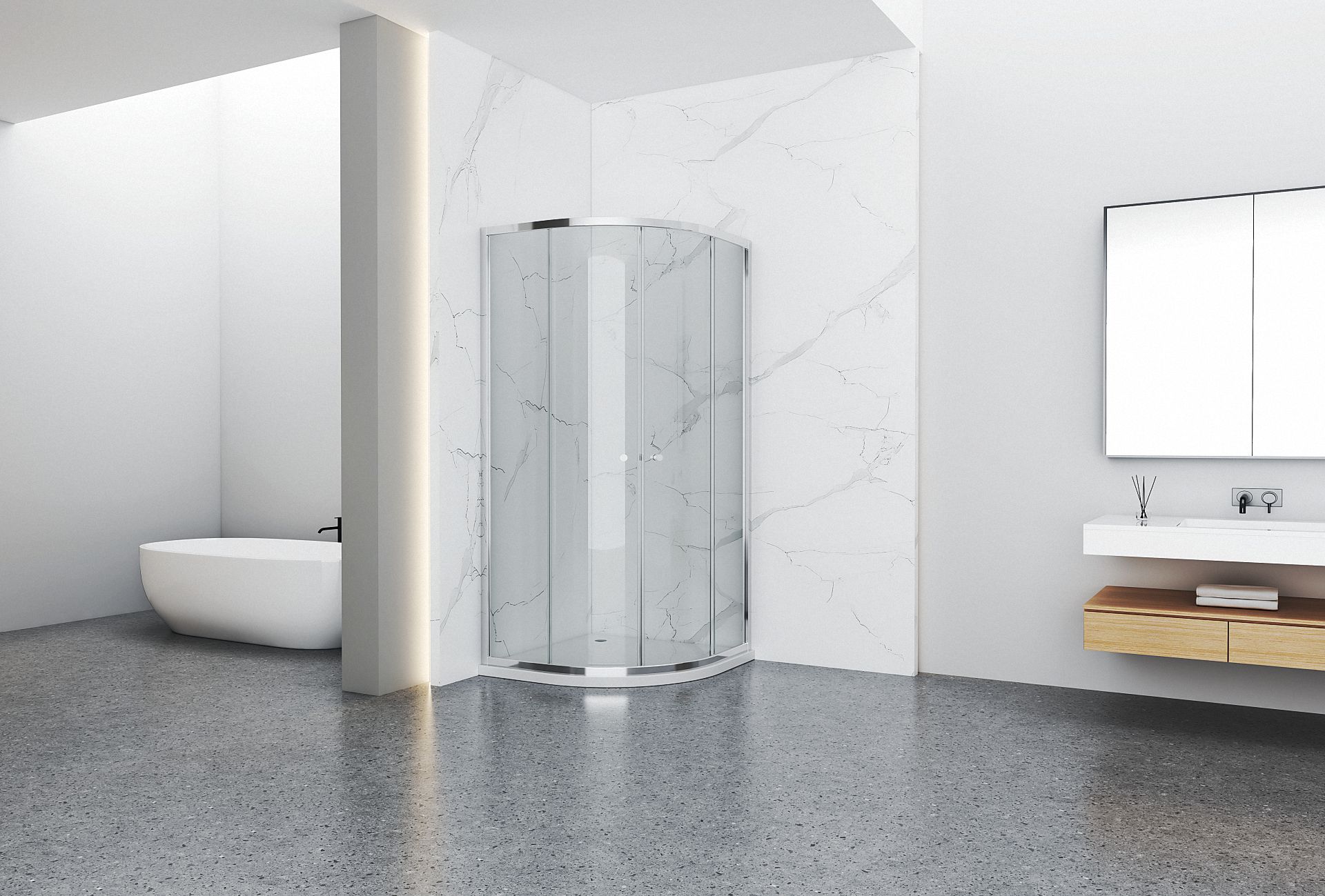
Arc shower door, model KL-AS5210422, in aluminium alloy — a configuration chosen for corner geometry. Image: SHKL.
Bathtub shower doors: the tub rim sets the dimensions
Over-bath installations change the reference plane. Model KL-AS5605110-5 is a bathtub shower door made of aluminium alloy, available with clear, tinted, laminated, flute, chemically frosted, easy-clean and film-coated glass. Instead of a floor-level tray, the door mounts on the tub rim, so rim profile, width and flatness become the governing dimensions.
This is also where fit failures are least forgiving. A bathtub door specified without confirming the rim geometry cannot be corrected afterwards by changing glass or hardware.
Frameless doors and fixed screens: the no-opening options
Model KL-AS5104310 is a frameless shower door made of aluminium alloy for residential construction and commercial hospitality. Model KL-AS001-1 is a shower screen made of 304 stainless steel, available with clear, tinted, laminated, flute, chemically frosted, easy-clean and film-coated glass.
A fixed screen has no opening at all. It divides the wet zone from the dry zone in walk-in layouts where a swing or slide would obstruct movement, and it works best when the bathroom has been planned around that division from the start.
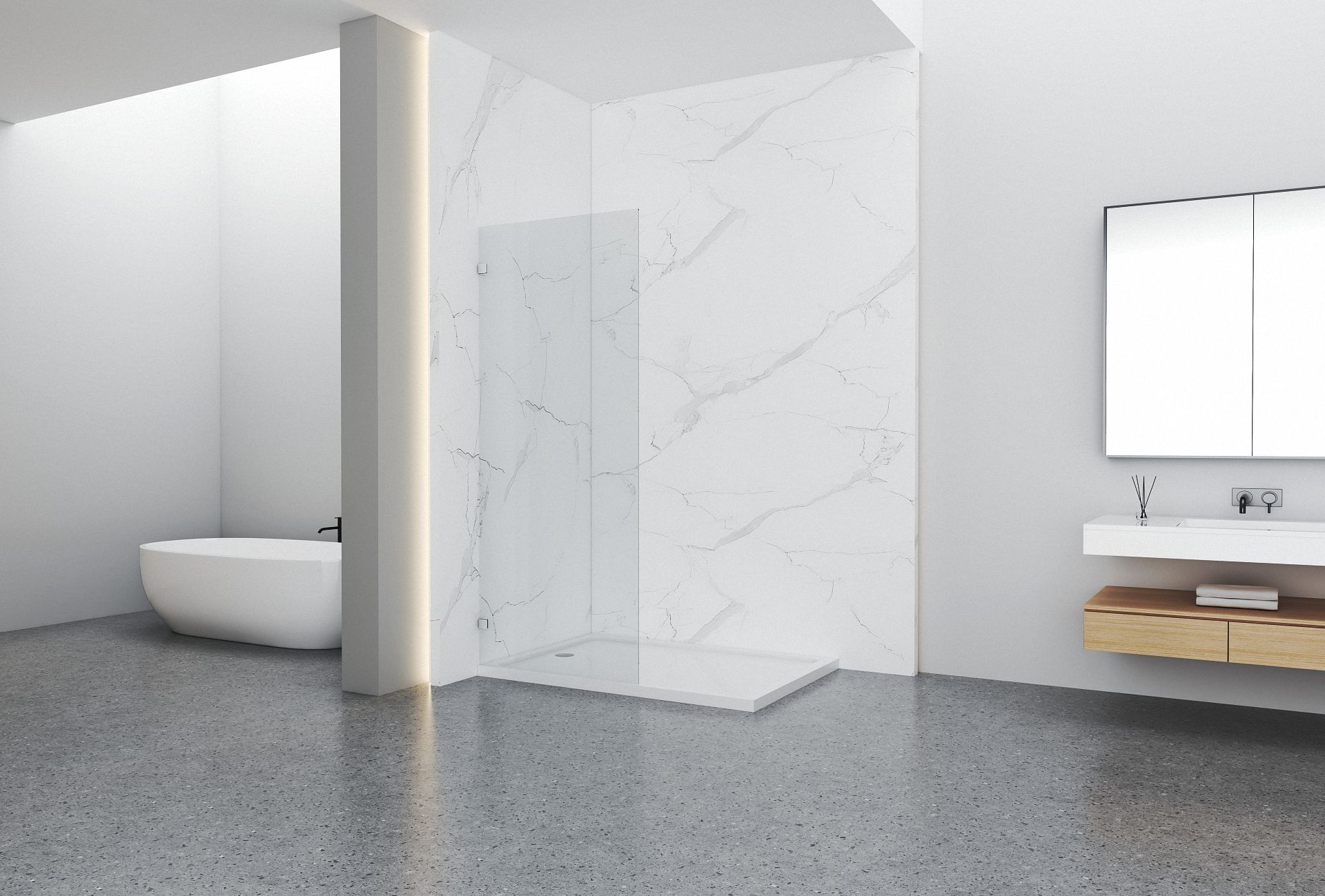
Fixed shower screen, model KL-AS001-1, in 304 stainless steel. Image: SHKL.
Hardware materials in practice: aluminium alloy and 304 stainless steel
Across the SHKL shower door range, hardware is produced in aluminium alloy or 304 stainless steel depending on the model. The distinction matters at specification stage, because the two materials behave differently in weight, corrosion environment and structural demand.
| Hardware material | General characteristics | Where it is commonly specified | Models in this range |
|---|---|---|---|
| Aluminium alloy | Lighter construction; widely used across framed, semi-frameless and curved systems | Residential bathrooms and hotel rooms where panel weight and installation handling matter | KL-AS5104310, KL-AS5507310, KL-AS5605110-5, KL-AS5608212, KL-AS5210422 |
| 304 stainless steel | Selected for high corrosion resistance and rigidity in humid, high-use conditions | Hospitality bathrooms, high-traffic residential shower zones, fixed screens | KL-AS001-1, KL-AS5511312, KL-AS5577310 |
The consequence for buyers is straightforward: material should follow the operating environment, not the price list. A hotel bathroom cleaned daily and used by hundreds of guests has a different material profile from a single-family en-suite.
The counterweight is structural. Stainless steel hardware combined with heavier glass raises door mass, which in turn raises the demand on wall anchors, hinges and tracks. Specifying the most durable-sounding combination without checking the support condition is a common and expensive error.
Glass craftsmanship options and what each one changes
All models in this range share a common glass craft menu: clear, tinted, laminated, flute, chemically frosted, easy-clean and film-coated glass. These are not decorative variations — each option changes light, privacy, maintenance or glass behaviour.
| Glass option | What it changes | Where it is typically selected |
|---|---|---|
| Clear glass | Maximum light transmission and an unobstructed view; water spotting is most visible on this surface | Bright bathrooms and hotel rooms where daylight matters |
| Tinted glass | Reduces glare and light transmission; adds visual definition to the enclosure | Sun-facing bathrooms and warm-climate projects |
| Laminated glass | Multi-pane construction with an interlayer that keeps glass in place if it breaks | Projects where glass retention after breakage is a stated requirement |
| Flute glass | Reeded texture providing partial privacy and visual interest | Bathrooms where the shower faces a window, corridor or adjacent room |
| Chemically frosted glass | Uniform satin finish that obscures the interior while still transmitting light | En-suites shared with other rooms |
| Easy-clean glass | Surface treatment that reduces the adhesion of water and soap deposits | Hotel housekeeping environments and hard-water regions |
| Film-coated glass | Applied surface coating option for a specific surface behaviour | Selected where a defined surface requirement is stated at specification stage |
Two selection rules follow. First, privacy and light are a trade: tinted, flute and chemically frosted options all reduce transparency to some degree, so the choice should be made against a lighting plan rather than a sample alone. Second, maintenance claims should be read literally — easy-clean and film-coated surfaces are specified to make cleaning easier, not to make it unnecessary, and coating behaviour depends on the cleaning agents used.
Mapping models to real bathroom scenarios
The mapping below uses only the configurations and model data published in the SHKL product range. Every model listed is identified for both residential construction and commercial hospitality use.
| Bathroom condition | Configuration | Model | Hardware | Fit logic |
|---|---|---|---|---|
| Alcove shower with clear floor space outside the wet zone | Hinge | KL-AS5507310 | Aluminium alloy | Widest opening; simplest cleaning access; needs swing clearance |
| High-use hotel bathroom requiring maximum hardware durability | Hinge, frameless classification | KL-AS5577310 | 304 stainless steel | Frameless hinge door for daily-cycle hospitality use |
| Compact en-suite or narrow bathroom without swing space | Sliding | KL-AS5608212 | Aluminium alloy | No swing clearance required; lighter panel handling |
| Hospitality or residential wet zone in a humid, high-traffic area | Sliding | KL-AS5511312 | 304 stainless steel | Sliding operation with stainless hardware |
| Corner bathroom where a straight panel blocks circulation | Arc | KL-AS5210422 | Aluminium alloy | Curved form follows the corner radius |
| Over-bath shower in an apartment or hotel suite | Bathtub door | KL-AS5605110-5 | Aluminium alloy | Mounted on the tub rim rather than a floor tray |
| Open, minimal-frame bathroom in a premium residential project | Frameless | KL-AS5104310 | Aluminium alloy | Frameless visual with a wide clear opening |
| Walk-in wet zone where no door movement is wanted | Fixed shower screen | KL-AS001-1 | 304 stainless steel | Static wet-dry separation with no opening mechanism |
Read across the table, the pattern is consistent: the physical constraint decides the door type, and the door type then narrows the hardware and glass shortlist.
Hospitality and residential: same models, different duty cycles
A hotel guest bathroom and a residential bathroom can use the same door type and still impose different requirements on the specification.
In commercial hospitality, the door is opened and closed many times a day, cleaned on a fixed schedule, and expected to survive turnover between guests without visible degradation. Documented SHKL project scenarios show the shower enclosure specified as part of a matched wet-zone package alongside a ceramic basin, an LED mirror and a faucet, with moisture-proof, mildew-resistant and scratch-resistant properties listed as special requirements. A hotel project in the United States and a villa case in Australia follow the same pattern of matched wet-zone equipment under daily household use conditions.
In residential construction, the duty cycle is lower but design tolerance is often tighter. A frameless door such as the aluminium alloy KL-AS5104310, or a fixed screen such as the 304 stainless steel KL-AS001-1, is frequently chosen to keep the bathroom visually open while still separating wet and dry areas.
For procurement teams, this suggests a simple rule: match hardware material to duty cycle and cleaning regime, and match door type to geometry. Confusing the two is where projects lose time.
Market trend: what current buying behaviour reflects
Frameless configurations held the largest share of the product category in 2025 at approximately 48.5% of revenue, while Asia Pacific accounted for a 35.2% revenue share, according to Dataintelo. Read together, the two figures describe a market in which appearance-led demand and manufacturing concentration sit in different places — buyers increasingly source frameless and low-profile designs from a region that also produces the volume.
Kohler Co., American Standard (LIXIL), Masco Corporation (Delta) and DreamLine are identified among the key players in the shower door market by P&S Intelligence. Their presence shapes buyer expectations: frameless appearance and surface performance are treated as baseline rather than premium, which shifts supplier evaluation toward configuration coverage — how many door types, hardware materials and glass options a single source can support.
Market-size figures should be read with scope in mind. Estimates vary significantly with category definition: a P&S Intelligence figure places the US shower glass door market at approximately USD 13.7 billion in 2023, a substantially broader-scope number flagged as requiring verification. Buyers comparing supplier claims are advised to check the definition behind any market figure before using it in a business case.
Comparison with traditional solutions — and the limits of this approach
Shower curtains, fully framed enclosures and prefabricated shower cabins remain valid solutions in specific conditions, and each carries a trade-off that model-based configuration does not remove.
| Traditional solution | Strength | Limitation compared with configured shower doors |
|---|---|---|
| Shower curtain | Lowest cost; tolerant of irregular openings | Fabric contacts the body, retains moisture, requires replacement cycles and offers limited water containment |
| Fully framed enclosure | Simple structure; forgiving of imperfect walls | More profile area to clean and a heavier visual mass in small bathrooms |
| Prefabricated shower cabin | Fast installation as a complete unit | Fixed footprint that must be designed in early and is difficult to adapt in renovation |
| Configured hinge, sliding, arc or bathtub door | Fits a specific geometry with selectable hardware and glass | Requires accurate site measurement and, for non-standard openings, custom dimensioning before production |
It would be misleading to present configured shower doors as universally easier. Four limits apply in practice:
- Standard catalogue models are built around common opening dimensions; non-standard openings require custom dimensioning before production.
- Hinged doors need swing clearance and a plumb mounting wall, and neither can be assumed in older buildings.
- Sliding doors need a continuous track span, and panel overlap reduces the clear opening.
- Arc doors are effectively limited to corner geometry, and bathtub doors depend entirely on the tub rim profile.
Glass choices carry their own trade-offs. Laminated glass is heavier, tinted and frosted options reduce light, and easy-clean and film-coated surfaces still require routine cleaning.
Future outlook
Three directions appear likely over the next planning cycles. First, frameless and semi-frameless configurations should continue to absorb share in premium segments, given their position in the 2025 market. Second, wet-dry separation in compact urban housing will keep sliding and arc configurations relevant, because they solve space problems that styling cannot. Third, supplier evaluation will shift further toward configuration coverage and material consistency — the ability to supply hinge, sliding, arc, bathtub and fixed-screen formats from one qualified source, in either aluminium alloy or 304 stainless steel as the application requires.
SHKL's own product structure already reflects that shift: models across all four configurations, both hardware materials and a shared glass craft menu. The company, founded in 2004, operates 100,000 m² of production space in China and 40,000 m² in Vietnam, employs approximately 600 staff, and supports the range with a 20-engineer R&D team and an annual production capacity of 10,000,000 units. Its stated purpose for the dual-region layout is to improve resilience against international trade risks and support stable supply and shorter lead times for clients in the EU, AU, NA, SA and ME markets, which account for approximately 70% of its export business.
FAQ
What does shower door application fit mean in practice?
Application fit is the match between a door's opening mechanism, mounting condition and footprint and the bathroom it serves. It is assessed with four checks: floor clearance outside the shower zone, the mounting condition (wall, corner or bathtub rim), the cleaning and maintenance routine, and the expected number of daily openings. A door that passes those checks in one bathroom can fail in another.
Which shower door type works best in a small bathroom?
Where swing space is not available, sliding and arc configurations avoid the problem entirely. The aluminium alloy KL-AS5608212 and the 304 stainless steel KL-AS5511312 are sliding shower doors; the aluminium alloy KL-AS5210422 is an arc shower door for corner layouts. Hinged doors such as KL-AS5507310 and KL-AS5577310 need floor clearance roughly equal to their own width, which smaller bathrooms often cannot provide.
What is the difference between aluminium alloy and 304 stainless steel shower door hardware?
Both materials are used across the SHKL shower door range, depending on the model. Aluminium alloy hardware appears on KL-AS5104310, KL-AS5507310, KL-AS5605110-5, KL-AS5608212 and KL-AS5210422. 304 stainless steel is used on KL-AS001-1, KL-AS5511312 and KL-AS5577310. Aluminium alloy is lighter and easier to handle during installation; 304 stainless steel is generally selected for humid, high-use environments. Heavier hardware increases the demand on wall anchors, hinges and tracks, so the mounting condition should be verified before finalising the material.
Which glass options are available, and how do they differ?
All models in this range share the same glass craft menu: clear, tinted, laminated, flute, chemically frosted, easy-clean and film-coated glass. Clear glass maximises light; tinted glass reduces glare and light transmission; laminated glass uses an interlayer to retain the glass if it breaks; flute glass adds a reeded texture for partial privacy; chemically frosted glass produces a uniform satin finish; easy-clean glass is a surface treatment that reduces the adhesion of water and soap deposits; film-coated glass is an applied coating whose behaviour depends on the cleaning agents used.
Can the same models be used in hotel projects and residential bathrooms?
Yes. Every model referenced here — KL-AS5104310, KL-AS5605110-5, KL-AS001-1, KL-AS5507310, KL-AS5608212, KL-AS5210422 and KL-AS5511312 — is identified for both residential construction and commercial hospitality. What changes is the specification emphasis: hospitality projects weight duty cycle, cleaning regime and hardware durability, while residential projects weight design consistency and opening behaviour. Matching hardware material to the operating environment is the deciding step in both cases.
A product brochure covering these shower door models, hardware materials and glass options is available for reference and download: SHKL product brochure.