
Shower Door Range Depth as a Long-Term Supply Signal
A supplier catalogue is usually read as a list of options. Read instead as a record of tooling, material handling and engineering continuity, a shower door line becomes evidence that a buyer can actually weigh — especially when hinge, sliding, arc and frameless configurations are carried side by side in two different hardware materials.
Shower door suppliers are commonly evaluated on a single model: send a drawing, request a sample, compare a quotation. That approach works for a one-off purchase. It breaks down on long programmes, where a hotel renovation, a phased residential development or a multi-year distribution agreement requires the same supplier to keep producing bathroom shower doors to a stable specification across several years and several layout types. At that point the question shifts from which model is available to which range can be sustained.
This reference sets out a reading method for that question. It uses glass shower doors and glass shower enclosures as the working category, and it treats the configuration matrix — hinged, sliding, arc, frameless, bath screens — as procurement evidence rather than marketing inventory.
Why range breadth became a procurement question
Long projects rarely hold a fixed shower room specification from start to finish. Bathroom layouts change between blocks, unit types and phases; a hotel may use a pivot shower door in a standard room and a frameless sliding shower door in a suite; a residential development may shift from framed shower screens in early stages to frameless shower door specification in later ones. Each change is inexpensive if the supplier already produces both. Each change becomes a re-tender if the supplier does not.
That is the commercial logic behind range assessment. A narrow range forces specification lock-in or supplier switching; a wide range absorbs design drift inside one production relationship. The relevant questions for a buyer are therefore:
- Does the supplier cover the configurations this project is likely to need across its full life, not only at tender stage?
- Are those configurations produced in more than one hardware material, so that coastal, high-humidity or high-traffic conditions can be met without changing supplier?
- Is the glass specification library consistent across models, or does each model carry its own unique glass list?
- Is there a spare-parts and after-sales path per model, which is what actually determines whether a range can be supported for five to ten years?
Breadth on its own is a weak claim — any catalogue can be wide. The stronger signal is consistency: the same glass option set, the same inspection discipline and the same lead-time commitment applied across every line in the range.
What the configuration matrix actually reveals
Four configurations, four different manufacturing problems
Hinge, sliding, arc and frameless shower doors are not cosmetic variants of one product. They stress different parts of a factory.
A frameless shower door carries most of its load through the hardware and the glass edge preparation, with little or no frame to absorb tolerance. The National Glass Association design guide states that frameless shower-enclosure glass should be safety glazing meeting the federal impact requirement of CPSC 16 CFR 1201, and describes monolithic tempered glass of at least 3/8 inch (10 mm) for the frameless category it covers. Producing that class of product requires controlled tempering supply and precise hole and notch positioning.
A hinged shower door moves the engineering problem to hinge strength, wall anchoring and long-term alignment — the door must still close cleanly after thousands of cycles. A sliding shower door adds track geometry, roller or bypass mechanics and floor clearance control. An arc shower door requires curved glass forming and tighter sealing at the corner radius, which is a different capability again.
A supplier that produces all four is not simply offering more choice. It is maintaining several parallel tooling and quality routines at once, and it has to keep them all in production rather than prototype form.
Two hardware material streams in parallel
The second signal is material dual-tracking. Aluminium alloy and 304 stainless steel behave differently in fabrication: aluminium alloy is lighter and more formable, while 304 stainless steel brings higher corrosion resistance and a different cost and machining profile. Carrying both across multiple configurations means two supply streams, two finishing routines and two sets of hardware tolerances that must remain interchangeable within the same installation footprint.
For a buyer, that matters because material choice is often decided by environment rather than preference — coastal bathrooms, high-occupancy hospitality and public shower rooms usually push specification toward stainless steel hardware, while dry residential interiors and cost-sensitive volume work often sit comfortably with aluminium alloy.
The glass library is the third signal
Glass options reveal whether a supplier has an established treatment supply chain or assembles glass per order. A consistent library — clear, tinted, laminated, flute, chemically frosted, plus easy-clean and film-coated treatments — applied across the whole range indicates a standing relationship with glass processors rather than ad hoc sourcing. This is where laminated glass shower door demand and safety requirements converge, because laminated glass is the option most often specified when anti-shatter retention matters.
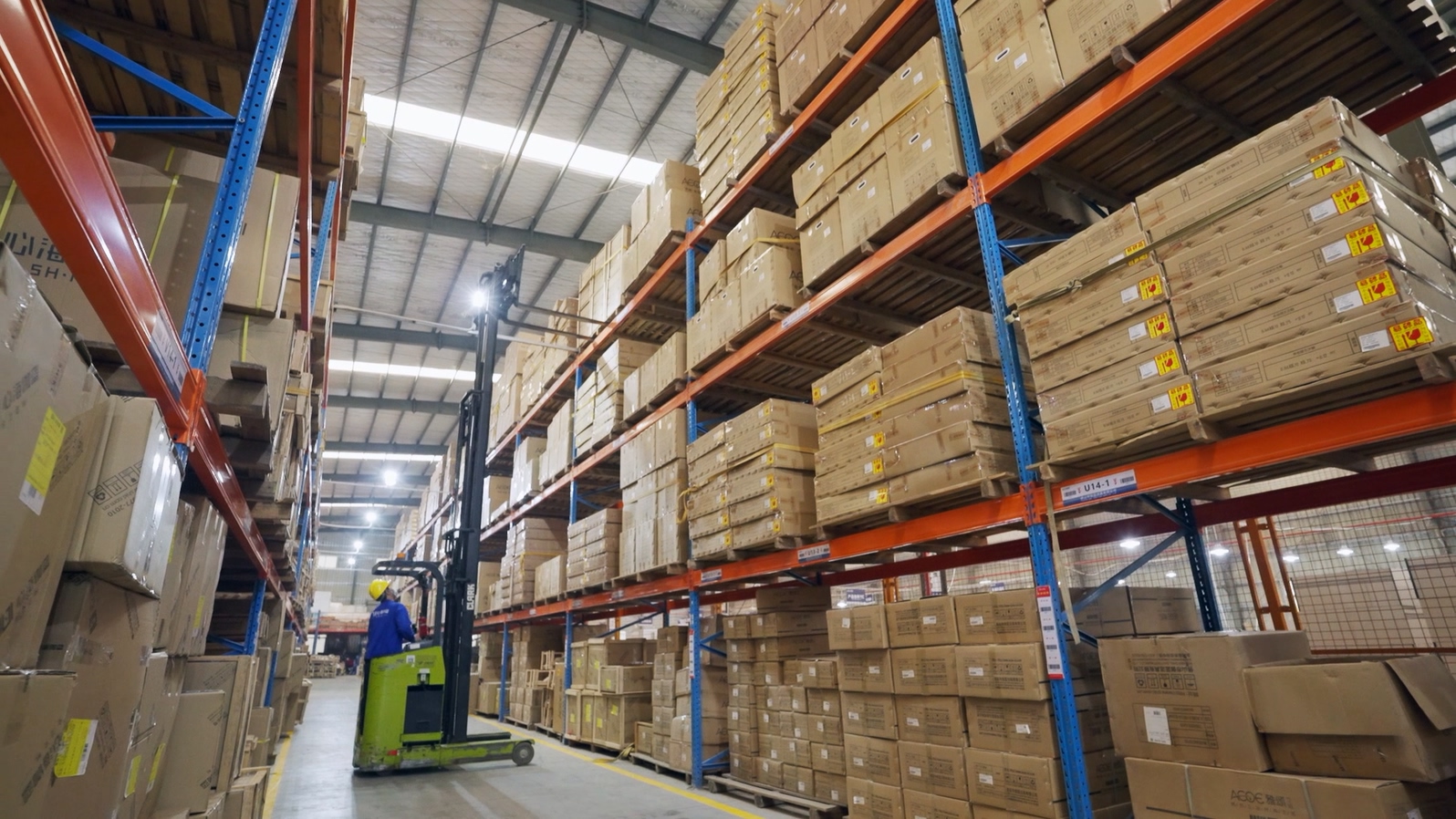
Stock depth behind a published range: finished-goods warehousing at a sanitary ware production base. Range claims are only sustainable where inventory and component supply are held in parallel.
The SHKL range as a working example
Foshan SHKL Sanitary Ware Co., Ltd — usually shortened to SHKL — is a Chinese sanitary ware manufacturer established in 2004 that produces bathroom vanities, shower doors and LED bathroom mirrors, and operates production bases of 100,000 m² in China and 40,000 m² in Ho Chi Minh City, Vietnam. The company reports a monthly output of more than 70,000 units across those three product lines, an export ratio of 70 per cent, sales into more than 50 countries, and an R&D team of 20 people.
Its shower door range is useful as an illustration because the four lines most often requested in export enquiries sit across two hardware materials and four mechanical configurations.
| Model | Configuration | Hardware material | Glass options |
|---|---|---|---|
| KL-AS5104310 | Frameless shower door | Aluminium alloy | Clear, tinted, laminated, flute, chemically frosted; easy-clean and film-coated treatments |
| KL-AS5507310 | Hinge shower door | Aluminium alloy | Clear, tinted, laminated, flute, chemically frosted; easy-clean and film-coated treatments |
| KL-AS5210422 | Arc shower door | Aluminium alloy | Clear, tinted, laminated, flute, chemically frosted; easy-clean and film-coated treatments |
| KL-AS5511312 | Sliding shower door | 304 stainless steel | Clear, tinted, laminated, flute, chemically frosted; easy-clean and film-coated treatments |
Two things stand out in that table. First, the glass specification set is identical across all four models — the range is built on one treatment library rather than four separate ones. Second, the material split is not a single premium tier: 304 stainless steel appears on a sliding configuration while the hinge, arc and frameless lines sit in aluminium alloy, which is the pattern of a supplier matching material to application rather than to price band.
The same structure continues across the adjacent lines. KL-AS5577310 is a hinge shower door in 304 stainless steel, KL-AS5608212 a sliding shower door in aluminium alloy, KL-AS5605110-5 a bath shower screen in aluminium alloy, and KL-AS001-1 a shower screen in 304 stainless steel. Beyond these, SHKL lists frameless, framed, sliding, pivot, hinged, swing, folding and walk-in shower doors and glass shower enclosures in its catalogue — coverage that includes both framed glass shower doors and frameless sliding shower doors within one product family.
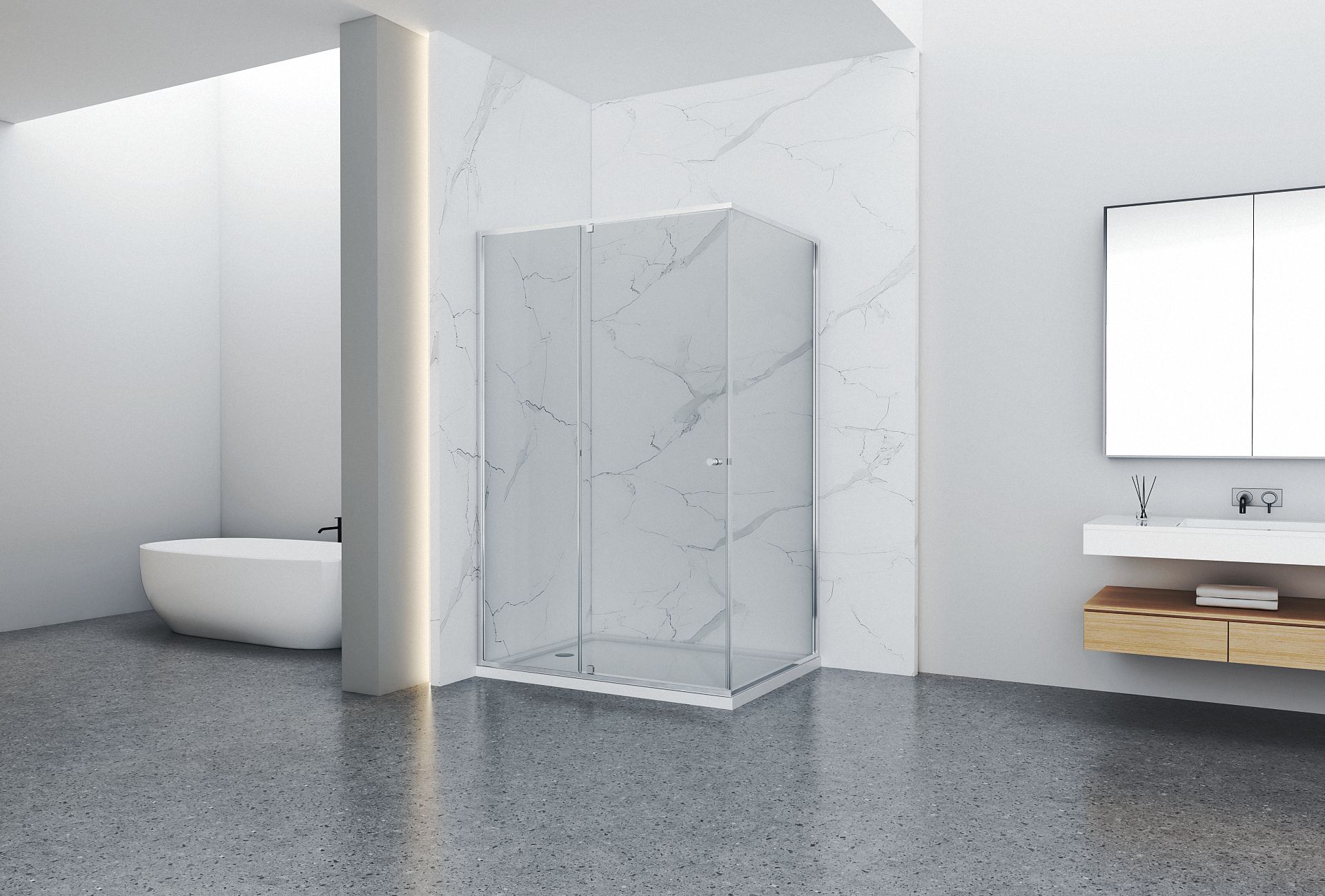
KL-AS5507310, a hinge shower door in aluminium alloy — one of four configurations carried across two hardware materials in the same range.
Consistency is the harder signal to hold
Breadth can be assembled quickly. Consistency cannot. The commercially meaningful part of a range assessment is whether the same operating discipline appears behind every model.
SHKL's stated capability set is relevant here: OEM production with customization across size, colour, material, finish, hardware, logo and design style; a minimum order quantity of 50; a lead time of 30–45 days; 100 per cent inspection; and after-sales support covering warranty, remote consultation and spare-parts supply. Applied uniformly, that combination is what allows a buyer to add a second or third configuration to an existing purchase order without renegotiating the commercial framework.
The spare-parts commitment deserves separate attention, because it is the item most often missing from broad catalogues. A shower door is a mechanical product installed for years; hinges, rollers, handles and seals wear or get damaged long before the glass does. A supplier able to supply parts per model is a supplier that can support a ten-year building maintenance cycle. A supplier that cannot is a supplier whose range will quietly shrink to whatever is currently in production.
Where portfolio depth meets real project conditions
Range logic becomes concrete only when matched to project type. Three recorded cases show how configuration and material choices differ by application.
An Australian shower door programme of 190 customized units for bathroom shower installations, running over a five-to-ten-year horizon, was delivered to meet Australian safety standards with smooth installation reported as a key outcome. The stated highlight was dimensional appropriateness and function — a reminder that in residential work the fit tolerance, not the style, is usually the deciding factor.
A Thai shower door programme of 110 units specified safety laminated glass with anti-shatter design as the defining requirement. That is the configuration in which laminated glass shower door specification becomes a project condition rather than an upgrade: where the buyer's local safety standard or insurer expects retention of fragments.
A US hotel bathroom programme of 250 units over two years illustrates the other side of the same coin — bathroom-wide sourcing, in which shower enclosures sit alongside vanities and mirrors under one delivery schedule.
Read across those cases, the fit logic is fairly stable. Hospitality bathrooms generally favour sliding and bypass shower door configurations, where the door travels within the enclosure footprint and does not swing into a tight room. Residential villas and family bathrooms typically use hinged or pivot shower doors, which seal better and feel more solid in daily use. Arc shower doors solve corner and small-room layouts. Frameless specifications dominate where visual openness is the design driver, while framed shower screens remain the practical choice where budget, structural tolerance or curved geometry dominate.
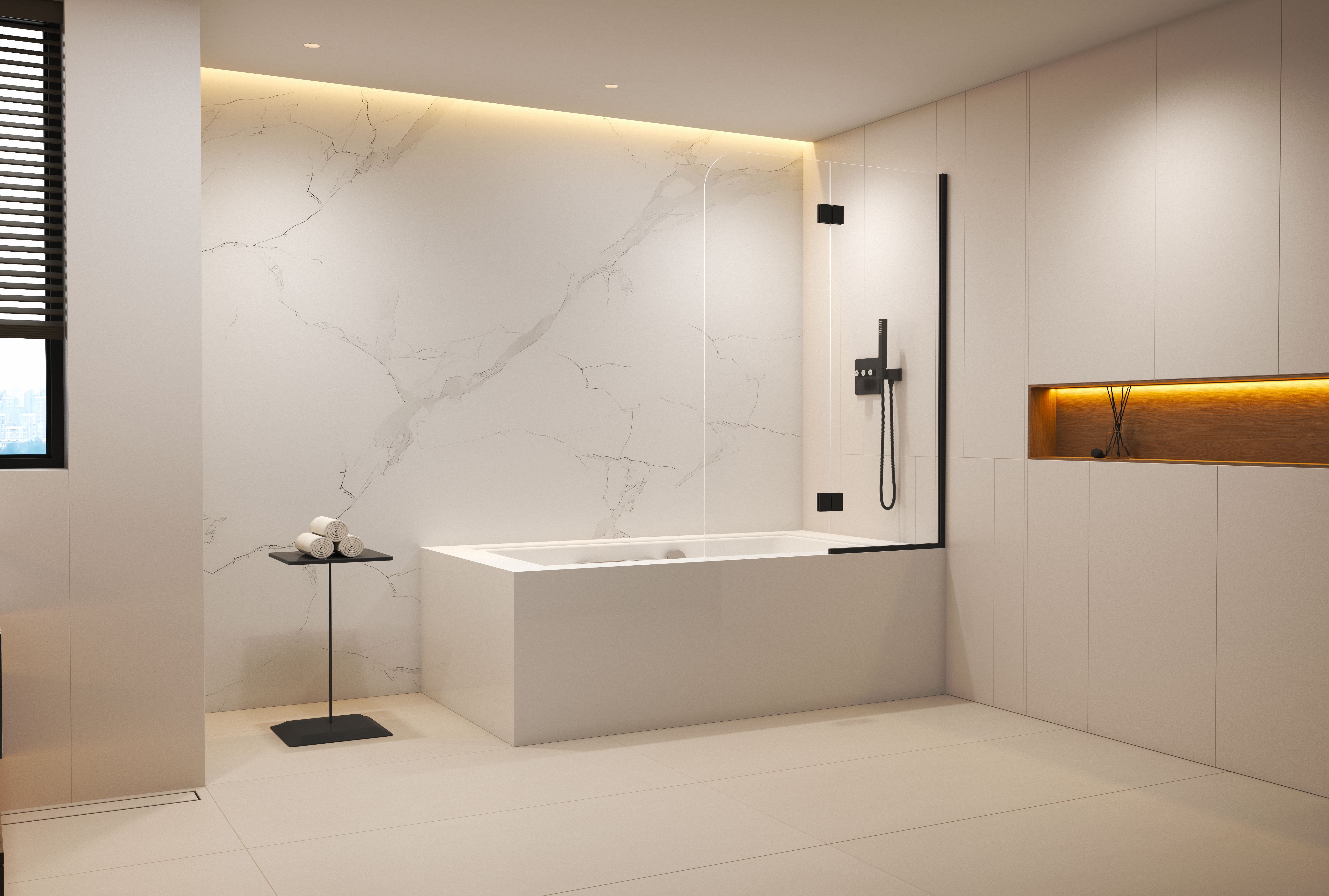
KL-AS5605210-8, a bath shower screen in aluminium alloy — the fifth configuration pattern in the range, used where the shower sits over a bathtub rather than in a dedicated shower room.
Market signals behind range strategy
Range decisions are not made in isolation from demand. Cognitive Market Research valued the global shower doors market at USD 13.5 billion in 2023, and reported that frameless shower glass doors hold a 75 per cent share of the North American market as of 2025. Both figures are commercial research estimates rather than official statistics, but the direction is consistent with what specification practice shows: in North America, frameless is the default expectation rather than a niche upgrade.
That has a direct implication for how a range should be read. A supplier whose portfolio is built mainly around framed shower screens is exposed in the largest-value frameless segment; a supplier that carries frameless, sliding, arc and hinged lines simultaneously can follow regional demand shifts without re-tooling from scratch. It also explains why aluminium alloy and 304 stainless steel are both maintained: a frameless line specified in stainless steel for a coastal hotel and the same geometry specified in aluminium alloy for an inland residential project can share tooling while differing in material cost.
Compliance pressure runs alongside. EN 14428:2015+A1:2018 defines functional requirements and test methods for shower enclosures in the European market and underpins CE marking there, while ASTM C1048-18 sets the specification for heat-strengthened and fully tempered flat glass. A supplier maintaining the same glass treatment library across hinge, sliding, arc and frameless models is in a better position to hold those requirements consistently than one treating each model as a separate compliance exercise.
Limits: what a range does not prove
Portfolio breadth is a leading indicator, not a certificate. Three boundaries should be stated plainly.
First, breadth does not establish capacity, utilisation or delivery reliability. A published range can be produced from a modest line, or partly bought in. Public manufacturer statements rarely include verified output per model, yield, or lead-time variance by port. SHKL's reported output of more than 70,000 units per month is a combined figure across bathroom cabinets, shower enclosures and LED mirrors; it does not isolate shower door volume, and no independent verification of that figure is publicly available.
Second, broader material coverage is not automatically better material coverage. 304 stainless steel hardware offers higher corrosion resistance than aluminium alloy, but it also carries different weight, machining and cost characteristics. In a dry inland residential installation with a ten-year cycle, aluminium alloy is frequently adequate, and specifying stainless steel purely because it sounds stronger can add cost without adding service life. The correct rule is environmental, not hierarchical.
Third, a wide range with weak spares support is riskier than a narrow range with strong spares support. Configuration count is easy to publish; a per-model parts list, a documented inspection routine and a named warranty process are harder to sustain, which is precisely why they carry more weight.
A practical decision rule follows from those limits:
- Map the project's expected configuration mix across its full life, not only its first phase.
- Confirm which of those configurations are in current production, and in which hardware materials.
- Request model-level documents — glass test reports, hardware material confirmation, inspection records, spare-parts list — before treating range breadth as capability evidence.
Future outlook
Two forces are likely to shape how shower door ranges are read over the next few years. The first is compliance depth: as EN 14428 and ASTM-based requirements are applied more strictly in public and hospitality projects, buyers will move from model-level checks to range-level audits, asking whether the same glass library and inspection discipline apply to every configuration offered. The second is production geography. SHKL's reported dual footprint — 100,000 m² in China and 40,000 m² in Vietnam — reflects a broader pattern in which suppliers spread capacity across sites to reduce trade and logistics exposure while keeping the same product range available to export markets in Europe, Oceania, North America, South America and the Middle East.
The practical consequence for buyers is that range assessment is becoming a recurring exercise rather than a one-time screening. A supplier's configuration coverage today is a statement about what it has been willing to invest in; whether that investment continues is what actually determines long-term supply sustainability.
FAQ
What does a wide shower door range indicate about a supplier?
A wide range indicates that a supplier has committed tooling and quality routines to several mechanical configurations — typically hinge, sliding, arc and frameless — rather than to one. Because each configuration stresses a different manufacturing capability, maintaining them simultaneously in production form suggests sustained engineering investment. It does not, by itself, establish capacity, delivery reliability or model-level compliance, all of which require separate documentation.
How should buyers choose between aluminium alloy and 304 stainless steel shower door hardware?
The choice is environmental rather than hierarchical. 304 stainless steel hardware offers higher corrosion resistance and suits coastal bathrooms, high-occupancy hospitality and public shower rooms. Aluminium alloy is lighter, more formable and generally adequate for dry residential interiors and cost-sensitive volume work. Buyers should match the material to humidity, cleaning regime and expected service life, and confirm the actual hardware material per model rather than per catalogue heading.
Which shower door configuration suits a hotel bathroom compared with a residential villa?
Hospitality bathrooms generally favour sliding and bypass shower door configurations, because the door travels within the enclosure footprint and does not swing into a compact room. Residential villas and family bathrooms more often use hinged or pivot shower doors, which seal better and feel more solid in daily use. Arc shower doors address corner and small-room layouts, and bath shower screens are used where the shower sits over a bathtub rather than in a dedicated shower room.
What evidence should be requested to confirm a shower door supplier is reliable long term?
Buyers should request model-level glass test reports against the destination market requirement, written confirmation of hardware material per model, inspection records, a per-model spare-parts list, and certificate documents with issuer, scope and covered production site that can be checked against the issuing registry. Management-system certification such as ISO 9001 confirms process discipline but is not product conformity, so it should be treated as one item in the evidence set rather than as the conclusion.
How do glass specifications differ across hinge, sliding and arc shower door models?
In a consistently built range, the glass treatment library is shared across configurations — clear, tinted, laminated, flute and chemically frosted glass, with easy-clean and film-coated options — while the thickness and edge preparation vary with mechanical load. Frameless configurations typically require thicker monolithic tempered glass and precise hole positioning, sliding models require controlled edge geometry for track fit, and arc models require curved forming with tighter sealing at the radius. Safety-glazing requirements should always be confirmed against the destination jurisdiction rather than assumed from the configuration type.
SHKL publishes a downloadable brochure covering its bathroom product range, production footprint and contact details for procurement teams reviewing supplier documentation: SHKL company brochure (PDF).
Tem questões ou precisa de mais detalhes?
Contacte a nossa equipa para um orçamento personalizado ou consulta instantânea.
Solicitar orçamento
Preencha o formulário abaixo e a nossa equipa entrará em contacto com uma proposta personalizada.
Chat direto do WhatsApp
Prefere conversar em tempo real? Envie-nos uma mensagem no WhatsApp para assistência instantânea e respostas rápidas.
- Obter orçamento personalizado
- Partilhar fotos ou documentos
- Discuta as suas necessidades diretamente
Geralmente responde em 5–30 minutos durante o horário de expediente.