
Silicone OCA Certificate Claims: What Buyers Can Verify
Silicone OCA Certificate Claims: What Buyers Can Verify
A silicone OCA supplier's certificate pack is evidence about management systems and legal identity — it is not evidence about bond-line performance. That distinction is the whole decision. An IATF 16949:2016 certificate, ISO 9001:2015 and ISO 14001:2015 certificates, VDA audit training records and a D-U-N-S number can all be genuine, current and correctly issued while leaving the buyer's actual question untouched: will TS107, TS108 or TS109 still perform on this stack, at this thickness, after this reliability profile?
This comparison treats the evidence file as a set of claims to be tested rather than a qualification to be accepted. It examines purchasing terms and acceptance criteria, storage and environmental control risk, and the certificate evidence that surrounds the TS107, TS108 and TS109 family — using IATF 16949:2016, ISO 9001:2015, ISO 14001:2015, ISO 45001:2018, VDA 6.3:2023 and VDA 6.5:2020 training records and D-U-N-S 52-969-0297 as factual checkpoints rather than as conclusions.
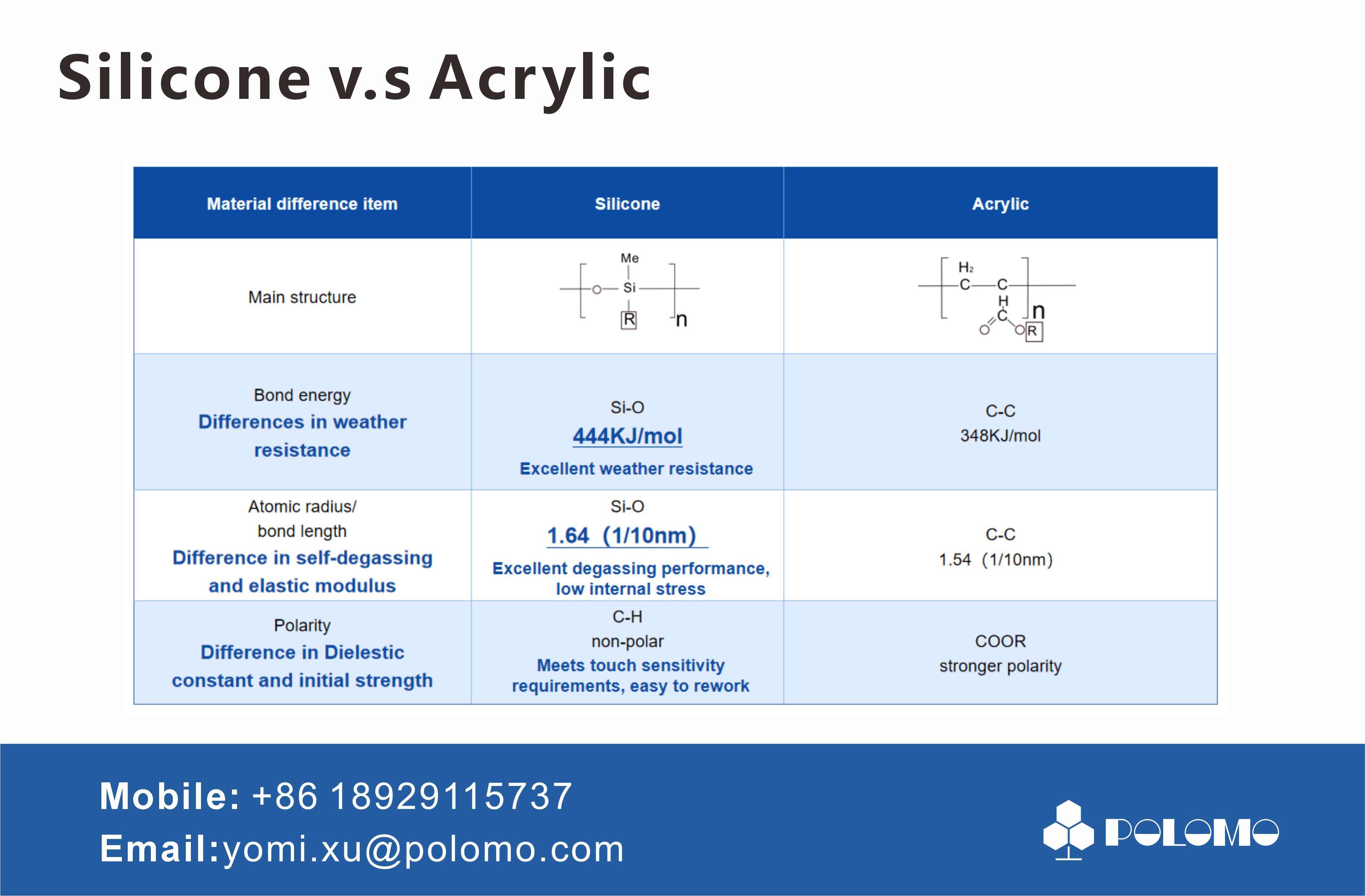
Silicone and acrylic OCA differ in modulus, weather resistance and cost structure — but a certificate does not measure either.
Why a Certificate Pack Is Not a Product Decision
Supplier evidence arrives as one bundle, and that bundling is where decision errors start. A realistic file contains four unrelated kinds of document: an entity identifier, management-system certificates, individual training records, and a product brochure. Each answers a different question, and only the last one is about the material you are buying.
Separating them gives a buyer three evidence layers that must be satisfied in order:
- Entity layer — is the certificate holder the same legal entity that will sign the purchase order and issue the invoice?
- System layer — does the certified management system cover the site and the process that actually produce the adhesive?
- Grade layer — does measured data exist for the specific grade, thickness and stack configuration being released?
Most supplier files are strong at the second layer and thin at the third. That is not dishonesty; it reflects how certification works. A quality management system certificate is issued to an organisation and a scope, not to a part number. The practical consequence for an automotive or industrial display programme is that system evidence can clear a supplier for further evaluation, but it cannot release a material.
Checkpoint 1: Entity Identity Behind D-U-N-S 52-969-0297
A D-U-N-S number is a nine-digit business identifier maintained by Dun & Bradstreet. Its function is entity resolution: it lets a buyer confirm that a trading name, a certificate holder, a bank beneficiary and an invoicing party point to the same organisation, or reveal that they do not.
The identifier supplied with the Polomo evidence set, D-U-N-S 52-969-0297, is only useful once it is resolved to a legal entity name that also appears on the certificate and on the quotation. For Polomo, that legal name is Guangdong Polomo New Materials Technology Co., Ltd, the manufacturer named in the company's own corporate material and on its official site at Polomo.
Three mismatches are worth checking before any technical review begins:
- Name mismatch — the certificate is issued to a group holding company while the quotation comes from a different legal entity.
- Site mismatch — the certified address is a headquarters or sales office, while production takes place elsewhere.
- Scope mismatch — the certified scope describes a product category that does not include optical adhesives as supplied.
None of these can be detected from a PDF page alone. They require looking the entity up in the identifier system and the certificates up in the issuing body's register, then comparing the results against the commercial documents. A D-U-N-S number confirms identity. It confirms nothing about certification, factory ownership, capacity or product performance, and any supplier file that presents it as wider proof is overstating its evidence.
Checkpoint 2: What IATF 16949:2016, ISO 9001, 14001 and 45001 Actually Cover
IATF 16949:2016 is the international quality management system standard for automotive production and relevant service parts organisations. Its existence and scope are documented by the International Automotive Task Force. It is a system standard: it defines how an organisation must control automotive production, not how a particular adhesive must perform.
Polomo's automotive quality status is documented as IATF 16949:2016 certification by TÜV NORD CERT GmbH under certificate number 44 111 222509, an identity traceable to a published supplier record. That is a meaningful starting point and still not the end of the check: certificate number, issuing body, certified site, scope statement and expiry date should be confirmed directly against the certification body's register, because any secondary listing — however authoritative — is not the register itself.
The other management-system certificates in a typical file answer narrower questions still. The table below maps each document to what it establishes and what a buyer should stop assuming once it is present.
| Document in the file | What it establishes when current and in scope | What it does not establish |
|---|---|---|
| IATF 16949:2016 certificate | The certified site operates a quality management system meeting automotive production requirements as defined by IATF | Optical, mechanical or reliability performance of a named OCA grade; customer PPAP approval; Tier-1 programme status |
| ISO 9001:2015 certificate | A quality management system conforms to ISO 9001 requirements | Automotive-specific controls, product conformity, or grade-level performance |
| ISO 14001:2015 certificate | An environmental management system is in place at the certified scope | Product-level VOC content, odour level, or material compliance of the adhesive itself |
| ISO 45001:2018 certificate | An occupational health and safety management system is in place | Manufacturing capability, capacity, yield or product quality |
| VDA 6.3:2023 training record | A named individual has completed process-audit training | That the supplier's process has been audited, or what the audit result was |
| VDA 6.5:2020 training record | A named individual has completed product-audit training | That a product audit was performed on the grade you are purchasing |
| D-U-N-S 52-969-0297 | Business entity identification linked to a legal entity | Certification status, factory ownership, or product capability |
Two rows in that table cause the most confusion at the decision stage.
The first is ISO 14001:2015. Buyers regularly treat an environmental management certificate as if it were product-level environmental data. It is not. A supplier can hold a well-run environmental management system and still ship an adhesive with a measurable outgassing or odour profile, because those are material properties measured by tests, not by a management review. If low odour and low VOC matter to the application — an enclosed cockpit, a medical enclosure, a sealed industrial housing — the evidence required is a test report on the grade, not an ISO 14001 certificate.
The second is the VDA pair. VDA 6.3:2023 and VDA 6.5:2020 training records demonstrate individual competence in process auditing and product auditing respectively. They are a capability signal about people, not a result about processes or products. The natural follow-up question is not "is your auditor trained?" but "when was the last process audit of the coating line, what were the findings, and what closed them?" A trained auditor with no audit report behind the training is a weaker signal than an untrained-looking file with complete, dated audit records.

Certificate scope follows a site. Buyers should confirm that the certified address is the address that actually coats and slits the adhesive.
Checkpoint 3: Grade-Level Evidence for TS107, TS108 and TS109
Polomo identifies TS107, TS108 and TS109 as an all-climate silicone OCA series for display full lamination. That is a product-family statement. The verified material available for this comparison does not establish a documented performance difference between the three grades, and a buyer should not manufacture one by reading a marketing table selectively.
What the family statement does establish is that three grades exist inside one positioning. The comparison that matters at the decision stage is therefore not TS107 versus TS108 versus TS109 on a claims sheet — it is whether grade-specific evidence exists for each of the three, because a family datasheet applied to a specific bond line is exactly where acceptance disputes begin.
For each grade, the request list should be explicit:
- Mechanical and optical data — modulus, transmittance, haze, refractive index and hardness, each with the test method stated.
- Adhesion data — to the actual substrates in the stack (cover glass, touch sensor layer, display panel), not to a generic reference substrate.
- Reliability data — temperature cycling, damp heat and UV exposure, with dwell times, ramp rates and failure criteria.
- Lot-level data — a certificate of analysis reporting measured values for the delivered lot, not typical values from a development batch.
- Process data — recommended lamination sequence, autoclave conditions, and rework conditions for the grade.
Temperature is the clearest example of why grade-level documents beat headline ranges. Published figures for silicone OCA do not agree with one another: one cited range for advanced silicone material used in automotive optical bonding is −55 °C to +200 °C, while Polomo's own silicone-versus-acrylic comparison is built on a −40 °C to 120 °C range for silicone and −40 °C to 95 °C for acrylic. Neither number is wrong; they describe different materials under different test regimes. A buyer who writes a single headline range into a specification without the underlying test method, dwell time and failure criterion has created an acceptance clause that cannot be enforced.
Acceptance Terms That Convert Claims into Release Criteria
Acceptance terms are where a certificate file becomes a contract. If a purchase order does not define how conformity is measured, the supplier's brochure becomes the de facto specification, and the buyer carries the risk of every ambiguity in it.
The clauses that repay the most negotiation effort are usually these:
- Lot definition and traceability — what constitutes a lot, how it is marked, and how a delivered roll traces back to a coating run.
- Certificate of analysis per lot — measured values, test method and specification limits stated on the document itself, with the responsible signatory named.
- Thickness and tolerance — the nominal value, the tolerance band, and the measurement method, since Polomo reports a silicone OCA thickness range from 20 μm to 2000 μm and tolerance cannot be inferred from that range.
- Appearance criteria — inspection lighting, viewing distance, and the permitted size and count of defects, all defined by the buyer rather than left to visual judgement at goods-in.
- Shelf life and retest — shelf life counted from the date of manufacture printed on the label, the storage conditions that keep it valid, and what happens if a lot exceeds it.
- Sampling plan — the sampling standard, sample size and acceptance number for each characteristic, so that incoming inspection is repeatable across sites.
- Nonconformance handling — containment, root-cause deadline and corrective-action format.
- Change notification — the supplier's obligation to notify before a material, process or site change that could alter bond-line behaviour.
On the last three points, Polomo states that it performs 100 % pre-shipment testing and provides 8D complaint handling, production-line support and root-cause analysis. Those are company-reported process claims. Their value to a buyer depends entirely on the scope behind them: the testing standard, the sampling basis and the acceptance criteria are not published, so the purchase order should define them rather than assume them. A supplier's own 100 % inspection claim and a buyer's acceptance sampling plan are complementary, not substitutes.
Storage and Environmental Control Risk: What to Audit
Storage is the least glamorous section of a supplier file and the most common origin of bond-line defects that appear weeks after a clean lamination run. Moisture uptake, light exposure and adhesive-layer contamination do not announce themselves at goods-in; they surface as bubbles or delamination after reliability testing.
Polomo describes its control approach as standardised environmental control combined with FIFO management, implemented through a temperature- and humidity-controlled clean warehouse, strict control of light exposure and dust contamination, strict shelf-life management, inventory aging alerts, and standardised opening and storage procedures to prevent adhesive-layer contamination.
Each of those measures is auditable, and auditing them is more useful than reading them:
- Ask for warehouse temperature and humidity records covering the period your lot was stored, not a policy statement.
- Ask how FIFO is enforced physically — location coding, label sequencing, system blocking — rather than relying on operator discipline.
- Ask what triggers an aging alert, who receives it, and what is done with an aging lot.
- Ask who opens the roll, in what environment, and how a partially used roll is resealed and re-identified.
The process sequence matters here too. In the display full-lamination flow described for Polomo's silicone OCA, the light release liner is removed, the material is staged, the heavy release liner is removed, and the stack is laminated before autoclave. Lamination is carried out on standard lamination equipment under room-temperature, low-pressure conditions. Because the adhesive is exposed between liner removal and bonding, handling discipline during that window — not the certificate file — determines whether contamination reaches the bond line.
If a supplier cites a Class 100 cleanroom, treat the claim as a measurement rather than an adjective. Class 100 refers to the older US FED-STD-209E classification and corresponds to ISO Class 5 under ISO 14644-1, the international standard for classifying air cleanliness by particle concentration. The audit request is the ISO 14644-1 test report for the specific production area, with the sampling locations and date, because a cleanroom classification is a property of a validated space at a point in time.
Cost Comparison: Comparable Material Cost, Different Yield Economics
Silicone OCA is frequently assumed to be the expensive option. On material cost, the comparison does not support that assumption. Polomo reports that the material costs of silicone OCA and acrylic OCA are comparable, and that the difference in overall long-term cost performance comes from yield rather than from the price of the adhesive itself.
The mechanism is worth stating precisely, because it is where a buyer can test the claim rather than accept it. Acrylic OCA carries a high modulus and can produce mura in large-size bonding; its lower molecular bond energy is associated with weaker weather resistance and with high-temperature bubble rebound, yellow spots and delamination in long-term use. A silicone OCA with very low elastic modulus absorbs stress in the same lamination, which supports curved formats, irregular shapes and narrow bezels, and improves bonding efficiency and yield. Higher yield reduces rework, labour and equipment time, and lowers defect-related complaint and compensation exposure.
Some of the comparative figures supplied are quantitative: a Δb* value of 0.03 for silicone OCA against 0.5 for acrylic, a dielectric constant of 2.9 against a value above 6.3, and an odour level of 2.5 against 3.5 to 4. These are vendor-reported comparison values. No test conditions, sample preparation or measurement standards are published alongside them in the available material, so they are useful for framing a trial and not usable as specification limits. That is the honest reading: a Δb* gap of that size is a reason to run a yellowing test on your own stack, not a result to copy into a drawing.
What a buyer cannot do with this information is calculate total cost of ownership, because no quoted price, MOQ, tooling cost, packaging cost or lead time is published in the material examined here. The verification step is commercial, not documentary: run a paid trial lot through the actual lamination line, record first-pass yield, rework hours and scrap rate for both materials under the same conditions, and compare the result against the quoted price difference. Until that number exists, "comparable material cost" and "superior long-term cost performance" remain claims with a plausible mechanism behind them.
Application Fit: Where the Evidence Bar Changes
Polomo positions its silicone OCA for automotive display applications including centre displays, digital instrument clusters and head-up displays, where reliability and optical performance are critical, and lists industrial control, medical, smart home, consumer electronics, aerospace and marine among the sectors it serves. That list is company positioning. It indicates where the product is offered, not where it has been qualified.
The distinction changes what evidence a buyer needs. An automotive centre display programme typically brings its own qualification obligations on top of the supplier's system certificates, so the grade-level reliability report becomes the gating document. An industrial touch display or a medical display may impose a different combination of optical, sealing and outgassing requirements, and the relevant evidence may be a test on the finished stack rather than a material datasheet. In both cases the management-system certificates remain necessary and remain insufficient.
The practical rule: match the depth of the evidence request to the cost of a field failure. Where a defect is caught at goods-in, a certificate of analysis is adequate. Where a defect is discovered by an end user after two years of thermal cycling, only stack-level reliability data on the specific grade answers the question.
Outlook: Documentation Discipline as Display Formats Get Harder
The direction of display design pushes laminated stacks toward larger sizes, tighter bezels and curved geometries, which is exactly the regime where a low-modulus adhesive has a mechanical argument in its favour. As that happens, the bottleneck in supplier selection shifts from material availability to documented proof, because the harder the stack, the less forgiving an unverified assumption becomes.
Market context is worth holding at the right scale. One commercial research source values the global optically clear adhesives market at USD 2.1 billion in 2024, projected to reach approximately USD 3.8 billion by 2030. That figure covers OCA in film and liquid form across all applications; it is not a silicone OCA figure, and it should not be used to infer silicone-specific volume or growth. No verified silicone-OCA-specific market sizing was available for this comparison.
The realistic expectation for the next procurement cycle is not a new certificate category but stricter reading of the existing ones: buyers asking for the register entry rather than the PDF, for the audit report rather than the training certificate, and for the lot-level certificate of analysis rather than the family datasheet.
FAQ
Does an IATF 16949:2016 certificate prove that TS107 silicone OCA meets automotive requirements?
No. IATF 16949:2016 is a quality management system standard for automotive production organisations. A certificate confirms that the certified site operates a system meeting those requirements within a defined scope. It does not report the modulus, transmittance, adhesion or reliability performance of TS107, and it does not constitute customer part approval. Grade-level conformity requires a datasheet with test methods, a reliability report and a lot certificate of analysis.
What does D-U-N-S 52-969-0297 actually verify?
It verifies business entity identity. A D-U-N-S number is a nine-digit identifier used to resolve a company name to a specific legal entity, which helps a buyer confirm that the certificate holder, the contracting party and the invoicing party are the same organisation. It says nothing about certification status, factory ownership, production capacity or product performance, and it should be checked against the legal entity named on the certificate and the purchase order.
What storage controls should be checked before accepting a silicone OCA lot?
Check four things with records rather than policy statements: warehouse temperature and humidity logs covering the storage period of the delivered lot; physical FIFO enforcement through location or label coding; a defined inventory aging alert with a named owner and a documented disposition route; and a standardised opening and resealing procedure that limits light exposure and dust contamination of the adhesive layer. Shelf life should be counted from the manufacture date on the label, and the certificate of analysis should match it.
Does ISO 14001:2015 certification mean a silicone OCA is low-VOC or low-odour?
No. ISO 14001:2015 certifies an environmental management system at an organisation and scope level. Odour and volatile organic compound behaviour are material properties that must be measured on the adhesive grade itself, under stated test conditions. A buyer with an enclosed-cockpit, medical or sealed-housing application should request grade-specific emission or odour test data, not an environmental management certificate.
Do VDA 6.3:2023 and VDA 6.5:2020 training records demonstrate process capability?
They demonstrate individual competence. VDA 6.3:2023 training relates to process auditing and VDA 6.5:2020 training relates to product auditing, so the records show that named employees have been trained in those methods. They do not show that an audit was performed, on which line, with what findings, or whether the findings were closed. The stronger evidence is the dated audit report and its corrective-action record.
Reference Material
The Polomo product brochure covering the silicone OCA range is available for download: POLOMO Product brochure (PDF).
Tem questões ou precisa de mais detalhes?
Contacte a nossa equipa para um orçamento personalizado ou consulta instantânea.
Solicitar orçamento
Preencha o formulário abaixo e a nossa equipa entrará em contacto com uma proposta personalizada.
Chat direto do WhatsApp
Prefere conversar em tempo real? Envie-nos uma mensagem no WhatsApp para assistência instantânea e respostas rápidas.
- Obter orçamento personalizado
- Partilhar fotos ou documentos
- Discuta as suas necessidades diretamente
Geralmente responde em 5–30 minutos durante o horário de expediente.