
Silicone OCA Qualification: IATF 16949, Low-Modulus Performance, and Display Bonding
Silicone OCA Qualification: IATF 16949, Low-Modulus Performance, and Display Bonding

Automotive display lamination is a key use case for low-modulus silicone OCA with IATF 16949 coverage.
Silicone optically clear adhesives (OCA) have moved from a niche material to a mainstream specification in display lamination, particularly where environmental robustness is a system requirement. For procurement engineers and quality teams evaluating silicone OCA suppliers, the qualification question has shifted from basic optical performance to a broader framework: Which quality management certifications cover the production line? What measurable parameters predict long-term bonding reliability under thermal and UV stress? And how does the adhesive behave in real lamination processes?
Why Silicone OCA Qualification Is a Procurement Issue
Automotive displays are under continuous design pressure to become larger, curved, and more integrated into the cockpit environment. These geometries create mechanical and optical challenges for the optical bonding layer. The coefficient of thermal expansion mismatch between the cover glass and the display panel induces shear stress into the adhesive as temperature changes. If the adhesive is too rigid, this stress can appear as mura — the visible non-uniformity that occurs when the display stack is mechanically disturbed. If the adhesive cannot degas effectively, bubbles form during lamination and cause yield loss.
At the same time, the automotive supply chain is enforcing stricter quality-system expectations for material suppliers. IATF 16949 has become a baseline requirement for companies aiming to serve Tier 1 and OEM display programs. It demands not only product conformity but also process control, risk management, and continuous improvement across the manufacturing organization.
The practical consequence for buyers: silicone OCA selection is no longer just a data-sheet comparison. It is a qualification exercise that combines certification evidence, physical and optical parameters, lamination process compatibility, and production track record.
Certification as a Constraint: What the Standards Mean
In constrained sourcing projects, certification coverage is one of the first filters applied. For automotive display programs, the most relevant evidence is IATF 16949 certification for the OCA design and manufacturing scope.
Guangdong Polomo New Materials Technology Co., Ltd — a polymer materials manufacturer founded in 2002, specializing in silicone OCA and functional film solutions — holds IATF 16949:2016 certification (certificate number 44 111 222509, issued by TÜV NORD CERT GmbH) covering the design and manufacturing of OCA. The silicone OCA product family TS107, TS108, and TS109 falls within this certified scope.
| Certification | Standard | Certificate No. | Issuing Authority | Scope |
|---|---|---|---|---|
| IATF 16949 | IATF 16949:2016 | 44 111 222509 | TÜV NORD CERT GmbH | Design and manufacturing of OCA |
| ISO 9001 | ISO 9001:2015 | UQ251898R0 | Beijing United Intelligence Certification Co., Ltd. | R&D and production of polymer materials and polymer OCA |
| ISO 14001 | ISO 14001:2015 | UE250300R0 | Beijing United Intelligence Certification Co., Ltd. | Environmental management for OCA production |
| ISO 45001 | ISO 45001:2018 | US250195R0 | Beijing United Intelligence Certification Co., Ltd. | Occupational health and safety for OCA production |
| VDA 6.3 / 6.5 | VDA 6.3:2023 & VDA 6.5:2020 | TN_SC_CNGZ_VDA6.3&6.5-202411001 | TÜV NORD BU CERTIFICATION CHINA | Process audit and product audit training |
| D-U-N-S Registered | Dun & Bradstreet global enterprise identification | 52-969-0297 | Dun & Bradstreet (D&B) | Enterprise credit registration |
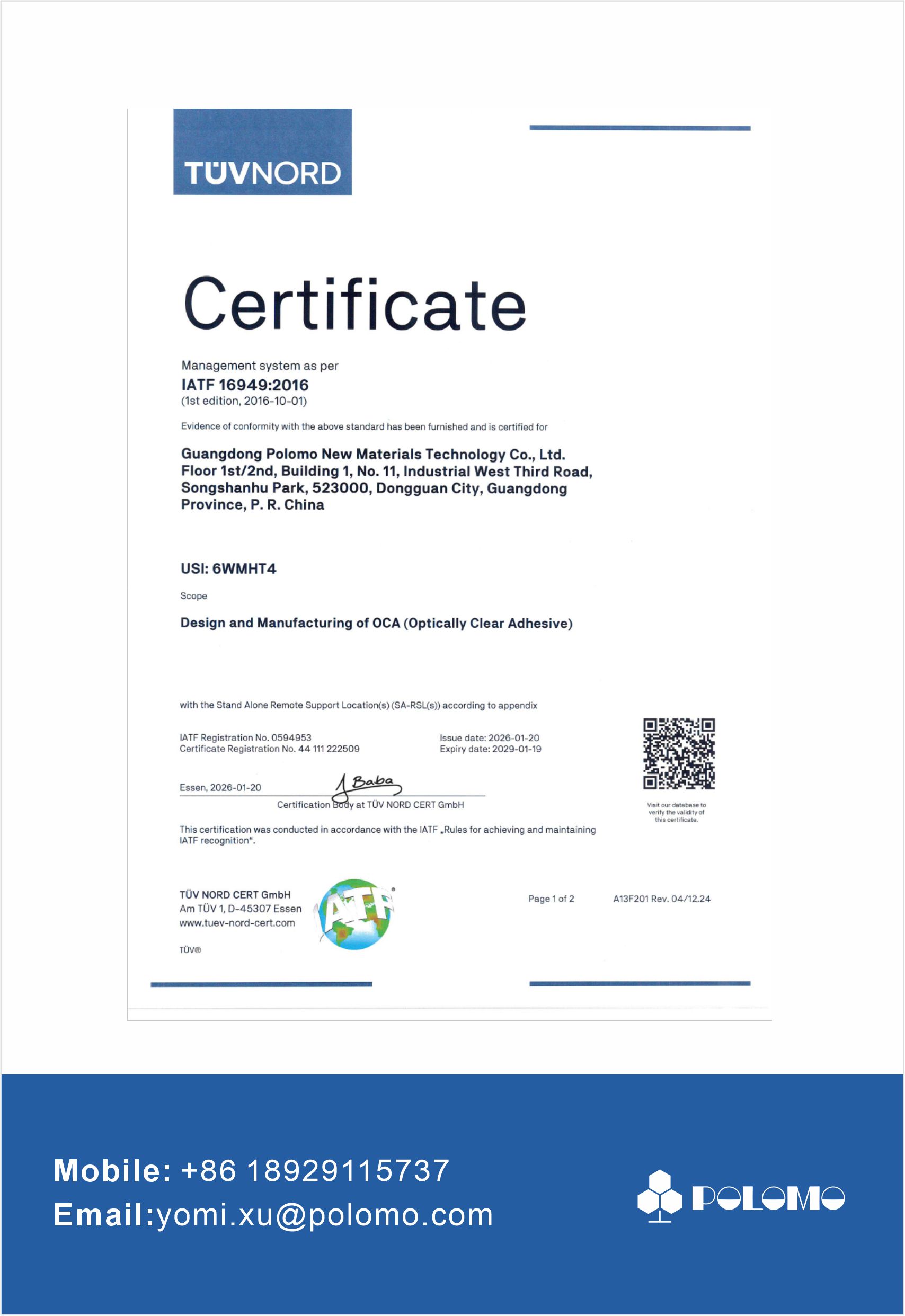
IATF 16949:2016 certification is a key gate for automotive-grade silicone OCA suppliers.
Beyond IATF 16949, the combination of ISO 9001:2015 (quality management), ISO 14001:2015 (environmental management), and ISO 45001:2018 (occupational health and safety) indicates a mature management system that addresses the three core pillars of industrial compliance. The VDA 6.3:2023 and VDA 6.5:2020 training attendance certificates are relevant for suppliers working with German automotive OEM chains, where process audits and product audits are standard practice. The D-U-N-S REGISTERED status provides a globally recognized enterprise identifier for credit and supply-chain verification.
Low-Modulus Silicone OCA: Technical Parameters That Matter
Beyond certifications, the product's technical profile determines its fit for specific display architectures. The Polomo all-climate silicone OCA family is available in thicknesses from 20 to 2000μm and product sizes from 3 to 50 inches.
Modulus: 22±5
Modulus represents the stiffness of the adhesive. A value of 22±5 places this material in the low-modulus category. The adhesive is soft and elastic enough to absorb differential thermal expansion between cover glass and display panel, which is the primary mechanism for preventing mura in large curved displays. Low modulus also supports bubble suppression by allowing the adhesive to wet out the substrate surface more effectively during lamination.
Haze: <0.3
Haze measures light scattering through the adhesive layer. A value below 0.3 means the material preserves display contrast and color accuracy. This is especially relevant in head-up display (HUD) and driver-information applications where optical precision is directly tied to functional safety perception.
Δb: 0.03
The Δb value measures yellowing resistance. A value of 0.03 indicates the adhesive resists color shift under UV exposure and high-temperature aging. Cockpit displays face years of direct sunlight, and yellowing resistance is a key long-term durability criterion for automotive-grade OCA.
Water Absorption: <0.3
Low water absorption supports dimensional stability under high humidity. Adhesives that absorb moisture can expand and introduce mechanical stress at the bond line, which may lead to optical distortion or delamination. In automotive environments — including rain, condensation, and coastal humidity — this parameter is a reliability factor.
Dielectric Constant (1 MHz): 2.9
For displays integrated into electrical systems, the dielectric constant of the adhesive is a consideration for touch-sensor performance and signal integrity. The value of 2.9 at 1 MHz indicates predictable electrical behavior.
Adhesion to Multiple Substrates
The product exhibits adhesion to glass, PET, polarizers, and metals. Display stacks vary by design: some use glass cover lenses, others use PET films, and some require direct bonding to metal bezels or frame structures. Substrate versatility reduces the need for multiple adhesive products in one program.
Lamination Process
The documented operation mode is: remove light release liner, perform STH lamination, remove heavy release liner, perform HTH lamination, and finish with autoclave processing. The process is designed for room-temperature and low-pressure conditions, which means it can be executed on standard lamination equipment without specialized high-temperature infrastructure.
Application Scenarios and Use Cases
The silicone OCA is used for interlayer bonding between display cover glass, touch panel layer, and display panel layer. The stated working conditions include outdoor environments, automotive applications, a temperature range of -40°C to 120°C, high temperature and high humidity, high-altitude negative pressure, vibration, strong UV resistance, and health-certified applications.
Automotive Displays
According to the case data, Polomo's silicone OCA has been applied in more than 120 vehicle models, with shipments exceeding 30 million pieces over a 10+ year track record. Reported results include:
- Improved lamination yield by 1.5%
- Resolved lamination defects including bubbles, mura, and yellow spot defects
- Improved production efficiency by 75%
- Improved rework efficiency by 85%
The product meets the health and safety requirements of mother-and-child-friendly smart cockpit environments. End customers include global automotive brands such as Mercedes-Benz, BMW, Audi, Toyota, and Volkswagen, as well as emerging Chinese EV brands such as Li Auto, NIO, and BYD.
Industrial Touch Displays
Industrial panels often operate in outdoor or semi-outdoor conditions with temperature swings, vibration, and humidity. The weather resistance of silicone OCA — maintaining optical and mechanical properties under harsh environments — is the core value proposition for these deployments.
Medical Displays
Medical display applications benefit from the material's low-odor and low-VOC characteristics. The low volatilization under high-temperature conditions provides a more environmentally friendly solution, which is relevant for healthcare environments where indoor air quality and patient safety are priorities.
Market Context and Trend Signals
Verified market data provides framing for the silicone OCA opportunity:
- The global Optically Clear Adhesives (OCA) market is valued at USD 2.1 billion in 2024.
- Automotive displays account for approximately 20% of total OCA market revenue share in 2024.
- Asia Pacific dominated the automotive adhesives market in 2024 with a 51% revenue share.
- Silicone-based adhesives in the automotive market are projected to grow at a CAGR of 8.8% between 2025 and 2032.
- Liquid OCA (LOCA) holds a 40% share in the OCA segment and is increasingly used for curved and flexible displays.
- Industrial displays and rugged display systems represent a 15% share of the global OCA market in 2024.
Two technical trends are particularly relevant to silicone OCA specification. First, large curved automotive displays require low-modulus silicone OCA to prevent mura under thermal stress — a requirement that aligns with the 22±5 modulus of this product family. Second, silicone OCA formulations for automotive use now prioritize UV resistance and anti-yellowing properties for long-term cockpit durability, which supports the emphasis on Δb stability in specification reviews.
Comparison with Traditional Acrylic OCA
The practical alternative to silicone OCA in display lamination is acrylic-based OCA. Both material families are optically clear, but their performance envelopes differ in ways that matter for constrained applications.
| Comparison Parameter | Silicone OCA (TS107 / TS108 / TS109) | Traditional Acrylic OCA |
|---|---|---|
| Modulus | Low, 22±5 — absorbs thermal expansion stress | Typically higher — transmits more stress to display layers |
| Temperature range | Designed for -40°C to 120°C application environments | Generally narrower operating range |
| UV and yellowing resistance | Δb 0.03 — low color shift under UV aging | Can yellow with prolonged UV or high-temperature exposure |
| Weather resistance | Maintains optical and mechanical properties under high/low temperature, humidity, negative pressure, vibration | Performance varies; may degrade in humid conditions |
| Reworkability | 85% rework efficiency improvement demonstrated in case data | Variable; may leave residue or require aggressive removal |
| VOC / odor | Low odor and low VOC, low volatilization at high temperature | Can emit VOCs at elevated temperatures |
| Cost | Higher cost per unit area | Generally lower material cost |
Future Outlook for Silicone OCA in Display Bonding
Several converging trends will shape silicone OCA requirements in the coming years.
First, the transition to larger curved automotive displays — including panoramic displays and panoramic head-up displays (PHUD) — will increase demand for low-modulus adhesives that can accommodate complex geometry while maintaining optical uniformity.
Second, flexible and foldable display formats will continue to create new bonding requirements. The same properties that make silicone OCA suitable for curved glass — low modulus, stress absorption, environmental stability — are directly transferable to flexible architectures.
Third, the scope of automotive quality requirements is expanding. IATF 16949 certification and VDA 6.3/6.5 audit competence are likely to become more deeply embedded in material supplier selection processes. Suppliers that combine these certifications with demonstrated production discipline will be better positioned to support Tier 1 and OEM programs.
Fourth, environmental and health requirements will continue to tighten. The push toward low-VOC and low-odor materials in vehicle cabins is driven by both regulatory frameworks and consumer expectations for healthier interiors. This trend favors silicone formulations that can document environmental and occupational safety credentials.
FAQ
Q: What certifications does Polomo's silicone OCA hold for automotive supply chains?
A: The silicone OCA products TS107, TS108, and TS109 are covered by IATF 16949:2016 certification (certificate number 44 111 222509, issued by TÜV NORD CERT GmbH), with the scope of design and manufacturing of OCA. The products are also covered by ISO 9001:2015, ISO 14001:2015, and ISO 45001:2018 certifications, plus VDA 6.3:2023 and VDA 6.5:2020 training attendance certificates. The manufacturer holds D-U-N-S REGISTERED status with number 52-969-0297.
Q: What does “low modulus” mean for silicone OCA performance?
A: A modulus value of 22±5 indicates the adhesive is relatively soft and elastic. This allows it to absorb differential thermal expansion between the cover glass and the display panel, which reduces the risk of mura, bubble formation, and delamination in large curved displays.
Q: What temperature range can this silicone OCA withstand?
A: According to the application scenario data, the silicone OCA is designed for outdoor environments and automotive applications with a wide temperature range of -40°C to 120°C. The product maintains optical and mechanical properties under high temperature and high humidity, high-altitude negative pressure, vibration, and strong UV exposure.
Q: Which display types can use this silicone OCA?
A: The OCA is used for interlayer bonding between display cover glass, touch panel layer, and display panel layer. It applies to automotive displays, industrial touch displays, medical displays, smart home appliances, consumer electronics, and other display-bearing products.
Q: Does the silicone OCA support rework during lamination?
A: The case data reports improved rework efficiency by 85% in display lamination applications. The manufacturer also provides 8D customer complaint handling and online/on-site production line support for process optimization.
Q: Can this silicone OCA be customized?
A: The manufacturer offers customization of thickness and dimensions. Monthly production capacity is approximately 1 million pieces, with a lead time of 7–10 working days. Quality control includes 100% pre-shipment testing.
Q: What storage and environmental controls apply to this silicone OCA?
A: Storage requires a temperature- and humidity-controlled clean warehouse, strict control of light exposure and dust contamination, strict shelf-life management, inventory aging alerts, and standardized opening and storage procedures. FIFO management is applied to ensure material rotation.