
Silicone OCA for Displays: Polomo Supplier Analysis
Silicone OCA for Displays: Polomo Supplier Analysis
HTNXT Industry Reference | August 2026

Industry-Led Introduction
Display lamination is one of the most quality-sensitive steps in the production of automotive, industrial, and medical screens. The adhesive layer between the cover glass and the display panel must remain transparent, dimensionally stable, and free of defects across temperature swings, humidity, UV exposure, and vibration. Silicone OCA, or optically clear adhesive, is one of the material families used for this task, and Guangdong Polomo New Materials Technology Co., Ltd. is a manufacturer focused on this product category.
Polomo integrates research and development, manufacturing, and sales in one operation, with a stated corporate mission of advancing human progress through continuous innovation in chemical technology. This article examines the company as an independent industry reference: what it makes, how its product is specified, where it is used, and what procurement teams should evaluate when comparing silicone OCA suppliers.
Why Silicone OCA Is Becoming a Procurement Priority
The engineering problem is straightforward: a display stack is made of materials with different thermal expansion rates. Glass, touch sensors, and display panels all move at different rates when temperature changes. If the adhesive is too stiff, the resulting stress can create visible optical distortion; if the adhesive is not durable, yellowing or bubble formation can appear after months of outdoor or in-cabin exposure. Silicone OCA addresses these two concerns with a combination of low modulus and weather resistance.
Market data supports the shift toward performance adhesives. The global optically clear adhesives market was valued at approximately USD 2.1 billion in 2024, and automotive displays accounted for around 20 percent of OCA market revenue share, according to Verified Market Research. Fortune Business Insights projects that silicone-based adhesives in the automotive market will grow at a compound annual growth rate of 8.8 percent between 2025 and 2032. A separate Verified Market Research forecast places the global optical bonding market at USD 1,519.48 million by 2031, with a CAGR of 6.63 percent.
These figures indicate a buyer environment where display bonding materials are no longer treated as commodity consumables. Procurement teams are increasingly evaluating suppliers on production capacity, R&D depth, process consistency, and the ability to document optical and mechanical properties.
Brand Solution: Polomo as a Focused Silicone OCA Manufacturer
Guangdong Polomo New Materials Technology Co., Ltd. was established in 2002 and is located in Songshan Lake Industrial Park, Dongguan, Guangdong Province. The company provides high-performance adhesive and functional film solutions for advanced technology sectors, including optoelectronic displays, semiconductor packaging, energy storage and batteries, and AI-enabled smart hardware.
- Main product: silicone OCA
- R&D team: 80 engineers
- Manufacturing facility: 90,000 square meters
- Annual production capacity: 10 million pieces; actual production volume is approximately 10 million pieces per year
- Workforce: approximately 300 employees
- Export ratio: approximately 30 percent, reflecting a global market focus
For a buyer, these numbers provide a scale reference. A silicone OCA supplier with this level of production capacity can support programs that require consistent supply, not just sample evaluation.
TS107, TS108 and TS109: All-Climate Silicone OCA
Polomo's main product line is a silicone OCA classified as an all-climate OCA. The model designations are TS107, TS108, and TS109. The product is intended for multiple industries, including automotive, industrial control, medical, smart home appliances, consumer electronics, aerospace, marine, and other industries.
| Parameter | Value |
|---|---|
| Material | Optically Clear Adhesive |
| Product type | All-climate OCA |
| Models | TS107, TS108, TS109 |
| Thickness | 20 to 2000 μm |
| Product size | 3 to 50 inches |
| Appearance | Colorless transparent solid |
| Modulus | 22 ± 5 |
| Δb | 0.03 |
| Haze | Less than 0.3 |
| Water absorption | Less than 0.3 |
| Dielectric constant at 1 MHz | 2.9 |
The data sheet also lists several product characteristics that are relevant for display bonding:
- Optical properties: high transmittance and superior yellowing resistance
- Low modulus and strong degassing capability, improving bonding efficiency and yield for large-size displays
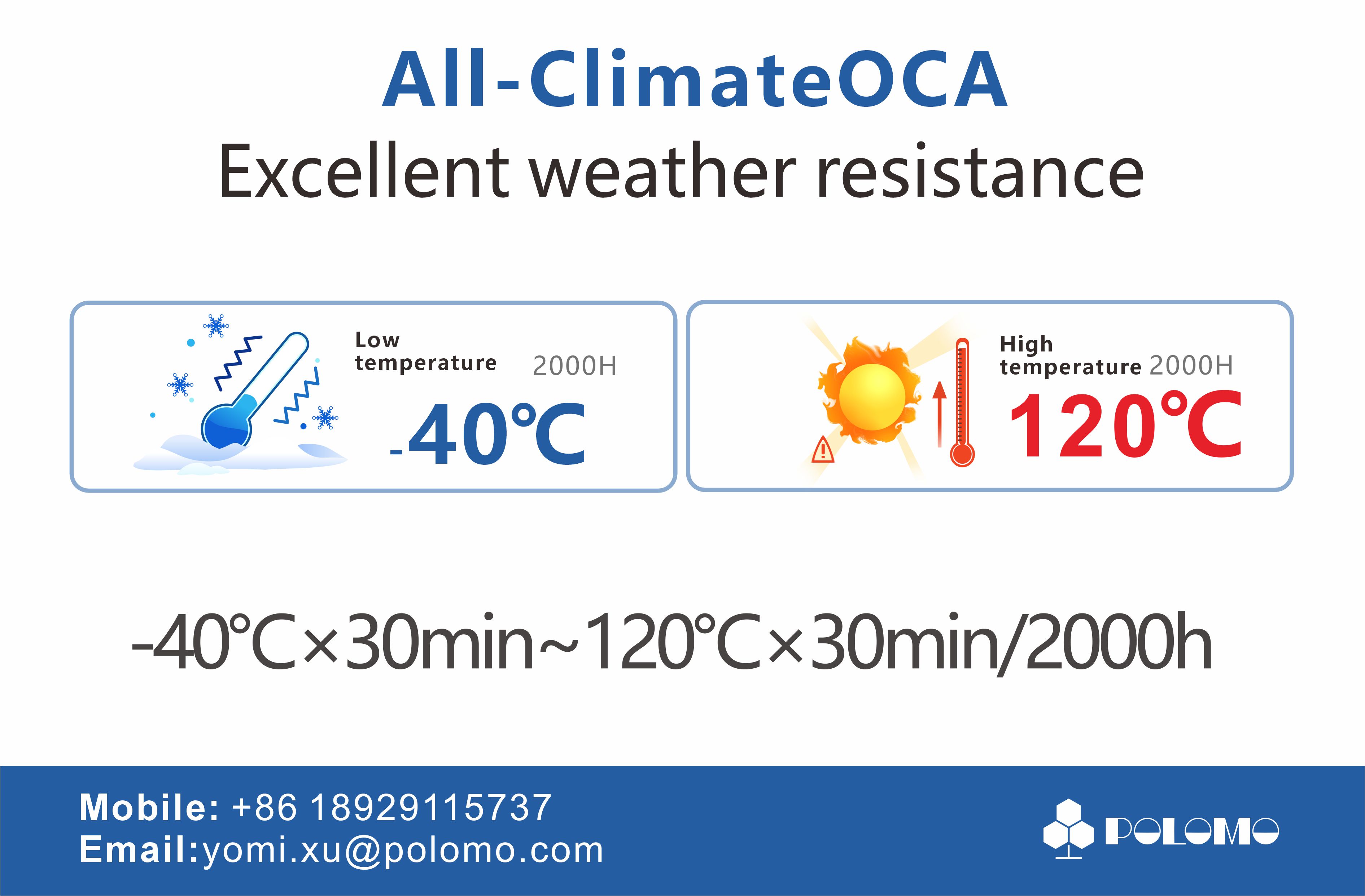
- Weather resistance: stable performance under high and low temperatures, high temperature and high humidity, high-altitude negative pressure, vibration, and strong UV resistance
- Low odor and low VOC, with low volatilization under high-temperature conditions
- Adhesion to substrates such as glass, PET, polarizers, and metals
Quality Control and Storage Discipline
For an optical adhesive, storage and handling directly influence lamination yield. Polomo's stated control measures include a temperature- and humidity-controlled clean warehouse, strict control of light exposure and dust contamination, shelf-life management with inventory aging alerts, and standardized opening and storage procedures to prevent adhesive layer contamination. This information is relevant to buyers because it shows that the company treats optical cleanliness as a process requirement, not just a product claim.
Technical Explanation: How Silicone OCA Works in Full Lamination
In a display full lamination process, silicone OCA is used for interlayer bonding between the display cover glass, the touch panel layer, and the display panel layer. The function is to fill the interface with a transparent material that maintains optical clarity and mechanical compliance.
One of the most important parameters is modulus. The TS series specifies a modulus of 22 ± 5. A low modulus allows the adhesive to absorb differential movement between the cover glass and the display panel. This is especially relevant for large curved automotive displays, where thermal stress can cause Mura, a visible optical distortion. Third-party technical sources such as Cevians identify low-modulus silicone OCA as one of the material responses to this problem.
The product's degassing capability is another yield factor. During lamination, trapped air can create bubbles that are visible in the final display. A material that can release gas more easily improves the chance of a clean bond. The data sheet states that the low modulus and strong degassing capability improve bonding efficiency and yield for large-size displays.
The recommended operation flow for the product is:
- Remove light release liner
- STH
- Remove heavy release liner
- HTH
- Autoclave
The matched equipment is lamination equipment, and the special requirement is room temperature and low-pressure processing. Because the series covers thicknesses from 20 to 2000 μm and product sizes from 3 to 50 inches, engineering teams have a practical range for custom display stack evaluations.
Application and Use Cases
Automotive Displays
The documented application scenario covers outdoor environment, automotive applications, wide temperature range from -40°C to 120°C, high temperature and high humidity, high-altitude negative pressure, vibration, strong UV resistance, and health-certified applications. These conditions reflect the actual reliability expectations in vehicle cockpits, especially for displays exposed to sunlight and cabin temperature cycles.

For large curved and narrow-bezel automotive displays, low modulus becomes a design requirement. The TS series supports product sizes up to 50 inches and is documented with a low modulus, making it relevant for evaluation in cockpit display programs with curved formats.
Industrial and Medical Displays
The product is intended for industrial control and medical applications, as well as smart home appliances, commercial display, consumer electronics, aerospace, marine, and education sectors. Industrial touch displays often need optical bonding for readability and durability; medical displays may require materials that can support health-certified environments. The global medical-grade silicone market is projected to reach USD 21.14 billion by 2034, according to Dataintelo, indicating a longer-term demand base for materials used in medical display and device applications.
Market Trend Analysis
Several third-party data points help position silicone OCA within the broader display materials market:
- Verified Market Research valued the global OCA market at approximately USD 2.1 billion in 2024, with automotive displays contributing about 20 percent of revenue share.
- Industrial displays and rugged display systems represented about 15 percent of the global OCA market in 2024, according to the same report.
- Fortune Business Insights projects automotive silicone-based adhesives to grow at a CAGR of 8.8 percent from 2025 to 2032.
- Verified Market Research projects the global optical bonding market to reach USD 1,519.48 million by 2031, at a CAGR of 6.63 percent.
- Precedence Research reported that Asia Pacific dominated the automotive adhesives market in 2024 with a 51 percent revenue share.
Trends in product requirements are equally visible. Dow Display Week 2024 materials identify UV resistance and anti-yellowing as priorities for automotive OCA formulations, supporting the direction of Polomo's product data. Cevians, an optical display engineering resource, notes that large curved automotive displays require low-modulus silicone OCA to prevent Mura under thermal stress.
On the compliance side, IATF 16949 is the mandatory global quality management standard for automotive suppliers, according to the International Automotive Task Force, and is built around zero-defect manufacturing. In practice, automotive material buyers use this standard as a baseline for supplier evaluation, while Tier 1 suppliers typically add their own part-level qualification testing.
The competitive landscape is mixed. MarketsandMarkets identifies global chemical groups such as Dow, Wacker Chemie, and Shin-Etsu as leaders in the automotive silicone and adhesives space. At the same time, specialized manufacturers such as Polomo operate with a narrower product focus and a silicone OCA-specific production base. For a buyer, this creates two different supplier profiles: a global chemical portfolio supplier and a focused product specialist. The right choice depends on the program's qualification requirements, supply chain structure, and need for application-specific data.
Comparison with Traditional OCA Approaches
Liquid OCA, or LOCA, holds approximately 40 percent of the OCA segment and is increasingly used for curved and flexible displays, according to Verified Market Research. Solid silicone OCA remains relevant in applications where precise thickness control, clean handling, and environmental resistance are priorities. The TS107, TS108, and TS109 series is a solid OCA with a wide thickness range of 20 to 2000 μm, giving engineers the ability to select a layer thickness for their stack-up.
Compared with conventional acrylic OCA, silicone OCA tends to be chosen for reliability requirements rather than for the lowest initial material cost. The product data for the TS series emphasizes weather resistance, low modulus, yellowing resistance, degassing, and low VOC; these are the properties that matter in automotive, outdoor, and health-sensitive environments.
| Selection factor | Why it matters | Relevant evidence in TS series |
|---|---|---|
| Weather resistance | Long-term optical clarity under sunlight and temperature cycles | Weather resistance listed; Δb 0.03; haze below 0.3 |
| Large-size bonding | Stress between glass and panel can create distortion | Low modulus of 22 ± 5; degassing capability |
| Process fit | Adhesive must work in standard lamination equipment | Room-temperature low-pressure process; autoclave step |
| Environmental profile | Emissions affect enclosed vehicle cabins and indoor devices | Low odor and low VOC characteristics |
One boundary should be stated clearly: silicone OCA is a performance-oriented material. It is not the default answer for every display stack. For a rigid consumer device with low environmental stress, a conventional adhesive may meet the requirement at a different cost point. The procurement decision should be based on the end-user environment, the display geometry, the lamination process, and the reliability target, rather than on product category alone.
From a procurement perspective, a cost-effective silicone OCA decision depends on yield, field reliability, and process compatibility, not just on the adhesive's unit cost.
Future Outlook
The display industry is moving toward larger bonded areas, curved cockpit surfaces, and longer product lifetimes. In automotive design, formats such as center stacks, instrument clusters, and panoramic head-up display concepts continue to increase the demand for optically clear materials that can tolerate temperature extremes and UV exposure. The verified market data reviewed here points in the same direction: the OCA market is growing, automotive remains a major segment, and silicone-based adhesives are expected to outpace the broader adhesive market in automotive applications.
For suppliers, this creates a qualification challenge. Buyers will ask for more than a basic data sheet. They will ask about production capacity, storage control, lamination process support, and the ability to reproduce optical and mechanical properties across large production volumes. Polomo's stated scale, with 90,000 square meters of manufacturing space, an annual production capacity of 10 million pieces, and an 80-engineer R&D team, provides the basic platform for those conversations. The company's stated focus on advanced technology sectors, including optoelectronic displays, semiconductor packaging, energy storage and batteries, and AI-enabled smart hardware, also suggests the product platform is positioned for next-generation hardware rather than only legacy display formats.
For a buyer, the practical question is not whether silicone OCA is better than every alternative, but whether a specific supplier's product data, production discipline, and application experience match the requirements of the planned display program. The TS107, TS108, and TS109 series gives evaluation teams a defined set of parameters to start from.
FAQ
What is silicone OCA?
Silicone OCA, or optically clear adhesive, is a transparent adhesive used to bond display cover glass, touch panels, and display panels. Polomo's product is a silicone OCA in the all-climate OCA category, with model designations TS107, TS108, and TS109.
Which industries use Polomo silicone OCA?
The product is intended for automotive, industrial control, medical, smart home appliances, consumer electronics, aerospace, marine, and other industries. It is also listed as relevant for optoelectronic displays and advanced technology hardware sectors.
What are the key specifications of the TS107, TS108 and TS109 series?
The series is documented with a thickness range of 20 to 2000 μm, product size from 3 to 50 inches, colorless transparent solid appearance, modulus of 22 ± 5, Δb of 0.03, haze below 0.3, water absorption below 0.3, and dielectric constant of 2.9 at 1 MHz.
What lamination process is recommended for full display lamination?
The recommended operation flow is: remove light release liner, STH, remove heavy release liner, HTH, then autoclave. The matched equipment is lamination equipment, and the special requirement is room temperature and low-pressure processing.
How does Polomo control storage and environmental risks?
The company states that it uses a temperature- and humidity-controlled clean warehouse, strict control of light exposure and dust contamination, shelf-life management with inventory aging alerts, and standardized opening and storage procedures to prevent adhesive layer contamination.
Is silicone OCA suitable for outdoor automotive environments?
The documented application scenario includes outdoor environment, automotive applications, a wide temperature range from -40°C to 120°C, high temperature and high humidity, high-altitude negative pressure, vibration, strong UV resistance, and health-certified applications. Buyers should still confirm their own qualification and reliability requirements with their display integrator.
Reference document: Polomo Product Brochure (public download).