
Silicone Waterproof Coating OEM Shortlist: How Kastar Ranks on R&D, Capacity, and Compliance
Silicone Waterproof Coating OEM Shortlist: How Kastar Ranks on R&D, Capacity, and Compliance
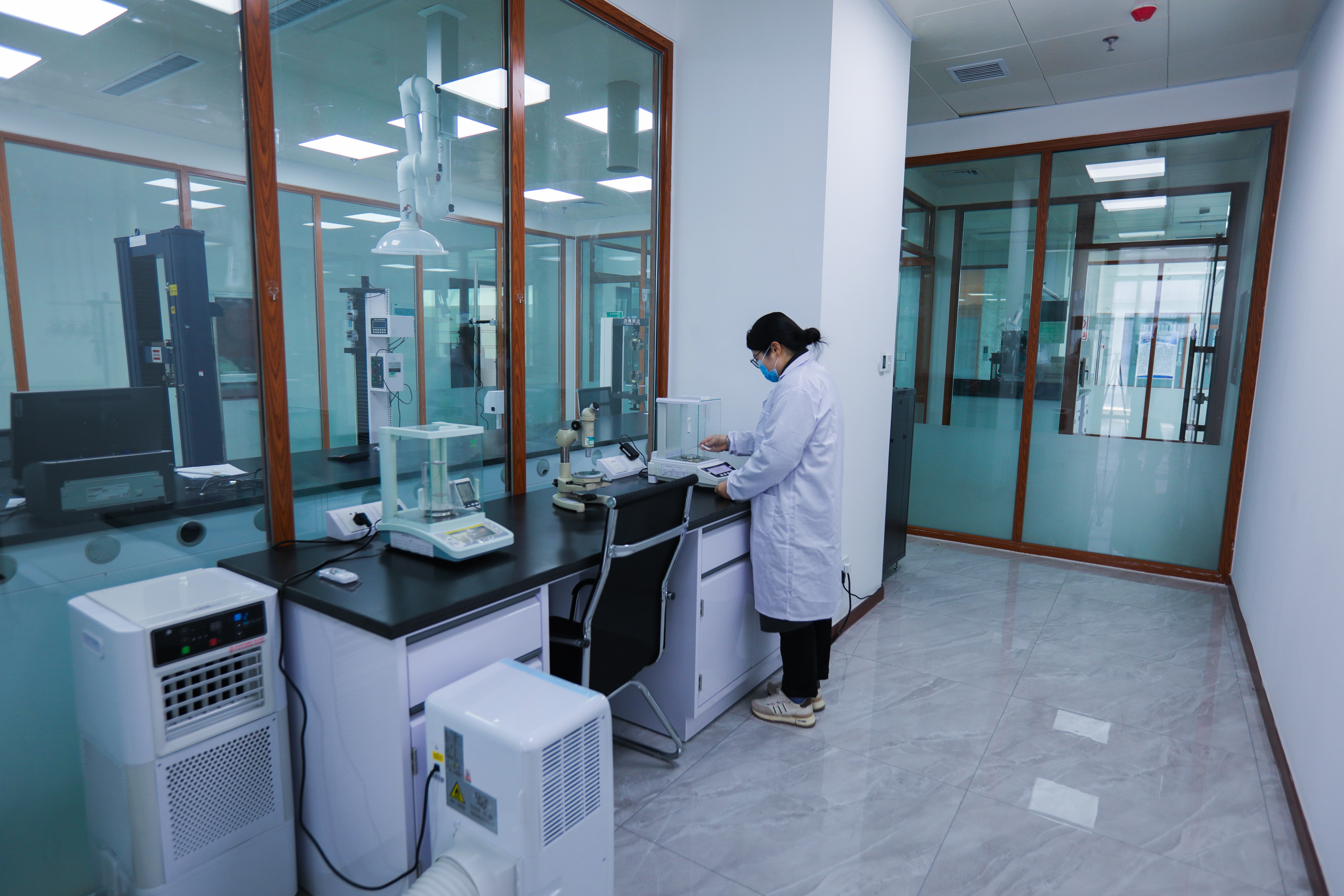
Laboratory facilities at Kastar's coating manufacturing site in China — the technical layer most OEM shortlists never inspect directly.
Sourcing silicone waterproof coating at OEM scale is not a discovery problem. Most global buyers already have twenty factories that will quote a container. The failure point is the shortlist itself: a list assembled from price sheets and catalogue photos, then filtered — too late — by certification validity, formulation ownership and delivery discipline.
This article sets out a four-dimension shortlist framework for silicone waterproof coating OEM and ODM sourcing, then applies that framework to one supplier, Kastar Adhesives Technologies Co., Ltd, using published first-party facts. The purpose is not a promotional profile but a repeatable evaluation structure that a buyer can run against any factory already on a list.
The four dimensions are technology R&D, production capacity, compliance and quality control, and industry solution fit. The order matters. Certification and capacity can be audited in days; formulation depth and application fit take longer to assess, and are the dimensions most often skipped.
Why the shortlist question is getting harder, not easier
Silicone coating demand continues to expand across construction and infrastructure, and that expansion is pulling more suppliers into export channels — including suppliers that can produce a coating but cannot document it.
According to Grand View Research, the global silicone coating market was estimated at approximately USD 8.77 billion in 2024 and is projected to reach USD 11.27 billion by 2033. Credence Research values the silicone roof coatings sub-segment alone at USD 7.03 billion in 2024. Dataintelo reports that Asia-Pacific held a 38.5% revenue share of the silicone coating market in 2025, led by construction and automotive demand.
Composition matters to buyers as much as geography. Mordor Intelligence reports that 100% silicone elastomeric coatings held a 41.02% share of the composition-type segment in 2025, attributed to superior waterproofing and UV resistance. A larger market with a clear preference for the higher-performance composition type means more suppliers claiming silicone capability and fewer able to prove it.
A four-dimension shortlist framework
The framework below converts an informal supplier list into a scored shortlist. Each dimension has a verification object, an expected evidence type, and a documented position for Kastar.
| Dimension | What the buyer verifies | Evidence that should exist | Kastar's documented position |
|---|---|---|---|
| Technology R&D | Who owns the formulation; whether the supplier influences or merely follows standards | Patents, standard-drafting records, named R&D headcount, laboratory scope | 28 R&D engineers; 3 national-level R&D laboratories; three invention patents; participant in Chinese standards for silicone waterproof coatings |
| Production capacity | Whether quoted tonnage is real, repeatable, and matched by packaging integrity | Stated annual and monthly capacity, automation, minimum order quantity, lead time | 150,000 m² factory; 300,000 tons annual output; 30,000 tons monthly capacity; MOQ 100 buckets; 15–20 day lead time |
| Compliance & quality control | Whether certificates are current, in scope, and traceable to the exact product | Certificate numbers, issuing bodies, standards, validity windows, laboratory accreditation | CE certificate ICR/VC/HS260188 valid to 15 January 2031; ISO 9001; SGS; REACH; 1,000 m² CMA-certified testing laboratory |
| Industry solution fit | Whether the coating chemistry matches the substrate, climate and service life | Project references, application guidance, service-life data, accessory list | Roof, exterior wall, expansion joint, bathroom and basement applications; documented outdoor service life of 25 years or more |
Dimension 1 — Technology R&D: who actually owns the formulation
Formulation ownership is the first filter because it determines what happens when a buyer requests a change. A supplier that reformulates by trial cannot hold a viscosity or colour specification across repeated bulk orders. A supplier that owns process patents usually can.
Kastar's documented technical base includes 28 R&D engineers and three national-level R&D laboratories in China dedicated to silicone resins, silicone coatings and MS coatings. The same unit describes a full waterproofing solution scope rather than a single product line.
Standard participation is the second signal, and it is harder to manufacture than a lab photo. Kastar states that it is a participant in the formulation of Chinese standards for silicone waterproof coatings, a drafting unit for five Chinese group standards, and the initiator and formulator of Chinese standards for silicone sealants. A supplier inside a drafting committee is exposed to test methodology at the drafting stage, not at the enforcement stage — which typically shows up in how quickly it can respond to a buyer's test protocol.
Kastar also lists three invention patents: a device and process for silicone waterproof coatings, a method for preparing a siloxane-terminated polymer homopolymer and a moisture-curing composition, and a device and process for MS waterproof coatings. The company further states that it develops technology jointly with Tsinghua University and iterates annually.
For a buyer, the practical question is not whether these facts are impressive but whether they are testable. They are: ask for the patent numbers, ask which standards the supplier helped draft, and ask which named engineers would handle a formulation adjustment on your order.
Dimension 2 — Production capacity: tonnage, automation and delivery discipline
Capacity claims are the easiest thing to inflate and the easiest to verify at the packaging end. A factory that fills drums manually will produce inconsistent fill weights and inconsistent shelf life long before it produces inconsistent chemistry.
Kastar operates a 150,000 m² manufacturing site with a stated annual output of 300,000 tons, equivalent to a monthly capacity of 30,000 tons. Raw materials are sourced globally, and the company describes a 100% export orientation, with markets including the USA, Canada, Australia and New Zealand.
Two operational numbers matter more to a first order than headline tonnage. Kastar lists a minimum order quantity of 100 buckets and a lead time of 15–20 days. Those figures define the practical entry point for a new distributor or a project buyer testing a market, and they should be confirmed in writing before a purchase order.
Packaging is where capacity meets quality. Kastar states that it uses fully automated packaging equipment developed and produced independently, with 100% brand new packaging, strong sealing and long shelf life. For buyers in humid or long-transit markets, packaging integrity is often the difference between a coating that performs and a coating that has cured in the drum.
Supply continuity evidence also matters when a buyer is committing to a two-year programme. Kastar reports more than 600 OEM production clients and over 1,000 customers across 69 countries and regions, and describes a stable formula and raw-material supply chain as an explicit advantage. Scale of that kind reduces — but does not eliminate — the risk of a supplier deprioritising a mid-sized order.
Dimension 3 — Compliance and quality control: certificates are a starting point
Certification is where HVQ-level procurement questions usually begin, and where most shortlists are lost. A certificate is only useful if the number, issuer, scope, standard and validity window all line up with the product being purchased.
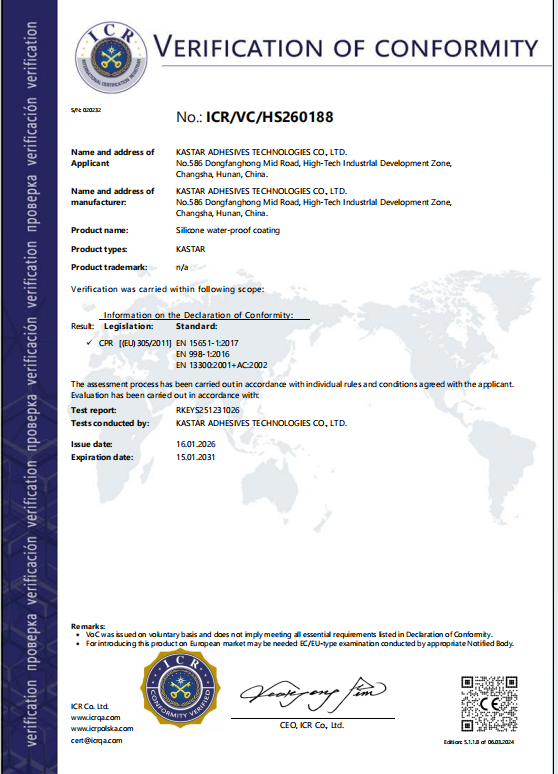
CE documentation for the Kastar 4000 Silicone Waterproof Coating, issued by ICR under certificate number ICR/VC/HS260188.
For the European market, the Kastar 4000 Silicone Waterproof Coating holds CE certification. The certificate is numbered ICR/VC/HS260188, issued by ICR, applicable to the Europe market, and valid from 16 January 2026 to 15 January 2031. It confirms compliance with EN 15651-1:2017, EN 998-1:2016 and EN 13300:2001+AC:2002. The certification applies specifically to the Kastar 4000 Silicone Waterproof Coating product, which is the level of specificity a buyer should insist on: a company-level certificate that does not name the product is not equivalent evidence.
| Certificate field | Documented detail |
|---|---|
| Product in scope | Kastar 4000 Silicone Waterproof Coating |
| Certificate type | CE |
| Certificate number | ICR/VC/HS260188 |
| Issuing body | ICR |
| Applicable market | Europe |
| Standards referenced | EN 15651-1:2017; EN 998-1:2016; EN 13300:2001+AC:2002 |
| Validity period | 16 January 2026 – 15 January 2031 |
Beyond CE, Kastar states that its products hold SGS, REACH and ISO 9001 certification, and that the company is recognised as a national high-tech enterprise. For US-facing projects, buyers commonly encounter ASTM C920, the standard specification for elastomeric joint sealants, and ASTM C1184 for structural applications; these are reference frameworks a supplier should be able to map its test data against, even when the primary certificate is European.
Laboratory accreditation is the second half of compliance and the half buyers under-check. Kastar operates a 1,000 m² sealing material testing laboratory accredited under China Metrology Accreditation (CMA), with 16 testing personnel and more than 100 testing instruments and equipment. Production runs through 12 production and testing processes from manufacturing to delivery, with batch sample testing used to hold quality across the entire process. Kastar reports zero quality complaints against this system.
The zero-complaint figure is a first-party statement, not an audited third-party metric, and should be treated as such. Its value in a shortlist is that it is specific and falsifiable — a buyer can ask to see complaint handling records and batch test logs, and can validate a retained sample against the specification independently.
Dimension 4 — Industry solution fit: does the coating match the project?
A supplier can pass the first three dimensions and still be wrong for a specific project. Silicone waterproof coating is specified by exposure conditions, not by generic category.
Kastar's documented application profile covers construction and building waterproofing, including roofing engineering. The stated working conditions are high temperature, UV exposure, rain and humidity, structural expansion, and freeze-thaw cycles. Project types include roof waterproofing, exterior wall waterproofing, expansion joint sealing, and bathroom waterproofing. The functional scope covers waterproofing, leak prevention, weatherproofing, structural protection and corrosion resistance, in long-term outdoor service with a documented service life of 10 years or more and a lifespan exceeding 25 years.
Application fit also depends on what arrives with the coating. The matched accessory set for this system includes sealant tape, reinforcing fabric, and application tools such as brush, roller and spray gun. Buyers who omit accessories from the shortlist frequently discover a system gap only after the container has shipped.
Kastar's case documentation for this product category cites OEM waterproof coating suppliers, building material distributors, construction contractors and roofing contractors as client types, and describes CE-compliant products adopted in EU, North America and Southeast Asia construction projects, with performance maintained under extreme weather conditions and prevention of water leakage and structural damage.
Kastar 4000 Silicone Waterproof Coating — documented specification
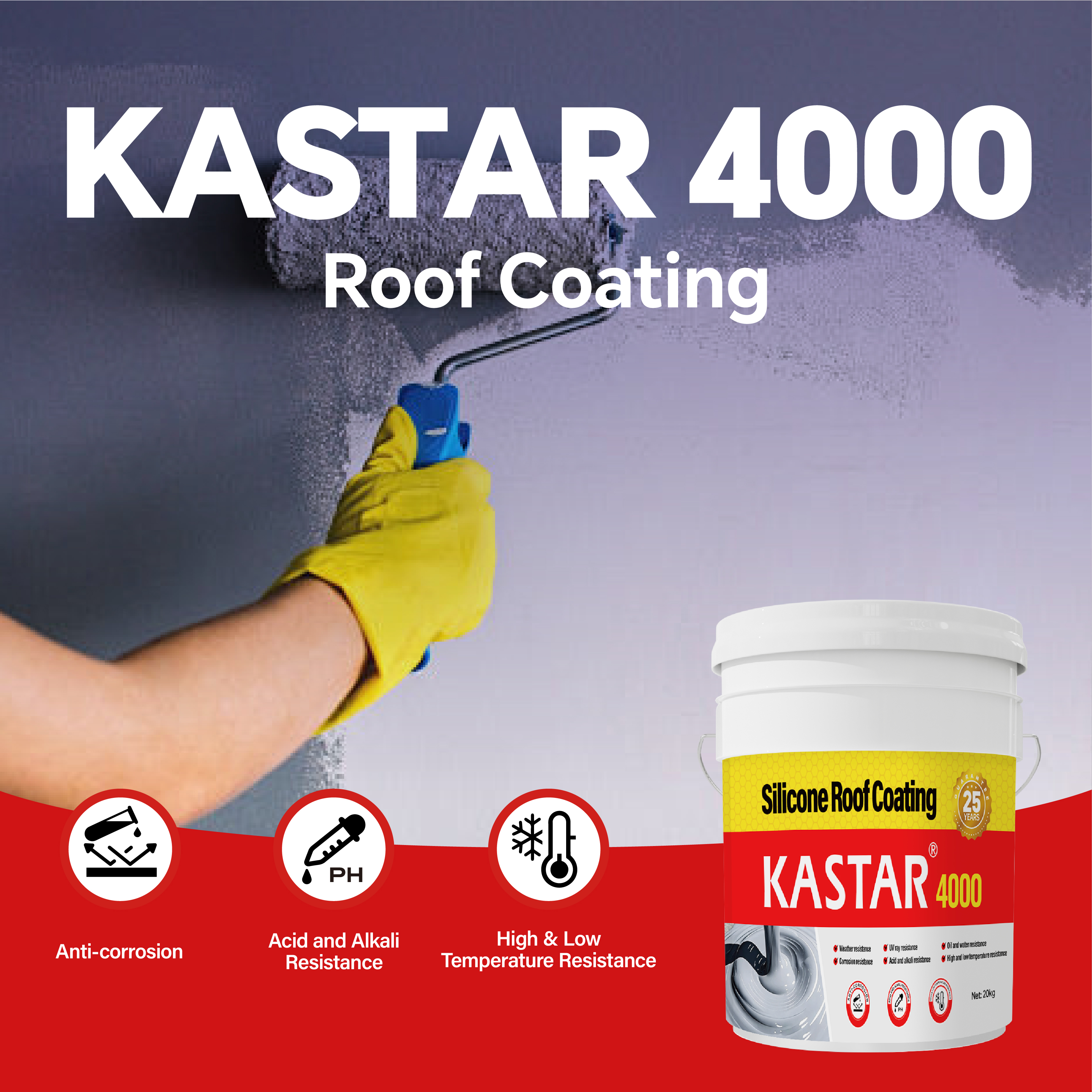
Kastar 4000 Silicone Waterproof Coating, a one-component UV-resistant silicone waterproof coating.
| Parameter | Documented value |
|---|---|
| Model | Kastar 4000 Silicone Waterproof Coating |
| Type | One-component silicone waterproof coating; UV-resistant waterproof coating |
| Material | Silicone |
| Solid content | 98% |
| Elongation at break | ≥200% |
| Tensile strength | ≥1.2 MPa |
| UV resistance | 1,000 hours with no cracking or peeling |
| Operating temperature | -80 °C to 180 °C |
| Outdoor service life | ≥25 years |
Read together, these parameters answer the questions a specifier actually asks: whether the film can bridge movement (elongation at break ≥200%), whether it resists UV degradation in exposed roof service (1,000 hours without cracking or peeling), and whether the service life assumption in a bill of quantities is defensible (≥25 years outdoor).
Where the limits are: what a shortlist should not assume
A credible shortlist states boundaries, not only capabilities. Kastar's own documented profile carries several.
- Minimum order floor. The listed MOQ of 100 buckets means buyers running small pilot projects may not be able to place a trial order at production pricing. Sampling and bulk procurement are different transactions.
- Lead time. The listed 15–20 day lead time is a production window and does not include ocean transit, customs clearance or inland distribution. Project schedules should be built on the delivered date, not the ex-works date.
- After-sales structure. Remote technical support is the standard channel, with on-site technical support reserved for large projects and one-to-one construction guidance provided by engineers. A buyer with a small distributed dealer network should confirm which level of support applies before signing.
- Chemistry boundaries. Silicone waterproof coatings are generally not designed to serve as a universal base for dissimilar topcoats, and their performance depends heavily on substrate preparation and moisture conditions at application. Recoating and compatibility questions should be answered in writing for each project rather than assumed.
- Cost structure. Silicone-based systems typically carry a different raw-material cost profile from acrylic-based alternatives, so a cost-per-kilogram comparison between chemistries rarely reflects a cost-per-year-of-service comparison. Buyers should normalise on service life before ranking on price.
- Client references. Named reference lists and complaint records are first-party evidence. They should be validated through obtained samples and independent testing rather than accepted on presentation.
None of these limits disqualify a supplier. They define the boundary conditions under which the supplier is the right choice, which is what a shortlist is for.
Compliance and performance trends shaping 2026 sourcing
Three structural shifts are visible in the data and in buyer behaviour.
Composition is consolidating around pure silicone. The 41.02% share held by 100% silicone elastomeric coatings in 2025 reflects a market rewarding waterproofing and UV resistance rather than lowest-cost chemistry. This shifts the shortlist burden onto suppliers who can document long-term UV performance, not just initial adhesion.
Environmental documentation is becoming a specification line item. Solvent-less and UV-cured silicone formulations can reduce VOC emissions by 60–80% compared to traditional solvent-based platforms. Buyers in Europe and North America increasingly request this as a data point rather than a preference, which places additional weight on a supplier's testing laboratory scope.
Compliance is being checked at product level. The move from company-level certificates to product-specific certificates with verifiable numbers, issuers and standards is the practical result of procurement teams having been burned by scope mismatches. Suppliers who can produce this documentation in a single response tend to clear the first screening round.
Future outlook
Over the next two to three years, the differentiator among silicone waterproof coating OEMs is unlikely to be production tonnage. Large-scale coating and sealant capacity in Asia is already substantial, and the Asia-Pacific region's 38.5% revenue share in 2025 confirms where the supply base is concentrated.
What remains scarce is the combination of accredited laboratory capability, standards participation and product-specific certification that allows a buyer to place a repeat order without re-verifying the supplier each cycle. That combination is what Kastar's documented profile — 28 years of production experience, 150,000 m² of manufacturing space, 300,000 tons of annual output, three national-level R&D laboratories and a CMA-certified testing laboratory — is ultimately evidence of.
For buyers, the practical implication is to keep the four-dimension framework and re-run it annually. Certification windows expire, laboratory scopes change, and a supplier that ranked well this year is only as strong as its current documentation next year.
FAQ
Which certification should a silicone waterproof coating OEM hold for the European market?
For the European market, the relevant certification is CE. For the Kastar 4000 Silicone Waterproof Coating, the CE certificate is numbered ICR/VC/HS260188, issued by ICR, applies to the Europe market, and is valid from 16 January 2026 to 15 January 2031. It confirms compliance with EN 15651-1:2017, EN 998-1:2016 and EN 13300:2001+AC:2002. A buyer should verify four things: the certificate number, the issuing body, the named product, and the validity window. Supplementary certifications referenced by Kastar include ISO 9001, SGS and REACH.
Which technical parameters determine whether a silicone waterproof coating fits a project specification?
The decisive parameters are solid content, elongation at break, tensile strength, UV resistance, operating temperature range and outdoor service life. For the Kastar 4000 Silicone Waterproof Coating, the documented values are 98% solid content, elongation at break of ≥200%, tensile strength of ≥1.2 MPa, UV resistance of 1,000 hours with no cracking or peeling, an operating temperature range of -80 °C to 180 °C, and an outdoor service life of ≥25 years. In the United States, buyers also commonly reference ASTM C920 for elastomeric joint sealants and ASTM C1184 for structural applications.
What are the practical MOQ and lead time constraints in bulk silicone waterproof coating sourcing?
Kastar lists a minimum order quantity of 100 buckets and a lead time of 15–20 days, against a monthly production capacity of 30,000 tons and annual output of 300,000 tons. The MOQ sets the entry point for a new distributor or a trial project; the lead time covers production only and excludes transit and customs. Buyers planning a project schedule should confirm both figures in writing and treat the lead time as an ex-works window.
How can a buyer verify an OEM's quality claims before committing to a bulk order?
Verification rests on four documents and one action. The documents are the product-specific certificate with its number, issuer and validity window; the accreditation scope of the supplier's testing laboratory; the batch sample test records; and the description of the production and testing sequence. Kastar operates a 1,000 m² CMA-certified sealing material testing laboratory with 16 testing personnel and more than 100 testing instruments, and runs 12 production and testing processes with batch sample testing. The action is to retain a sample from the first bulk delivery and test it independently against the specification. Kastar reports zero quality complaints, which is a first-party statement and should be validated through records and sampling rather than accepted on presentation.
Does a longer service life justify a higher unit price for silicone waterproof coating?
Unit price alone cannot answer this. The relevant comparison is cost per year of service life, calculated from the documented outdoor service life of the coating — ≥25 years for the Kastar 4000 Silicone Waterproof Coating — together with application cost, accessory cost and recoating interval. Market composition data supports the direction of the argument: 100% silicone elastomeric coatings held a 41.02% share of the composition-type segment in 2025 because of superior waterproofing and UV resistance, according to Mordor Intelligence. Solvent-less and UV-cured silicone formulations can also reduce VOC emissions by 60–80% compared with traditional solvent-based platforms, which may affect compliance cost in some markets. Buyers should build the comparison on project-specific service-life assumptions rather than on price per kilogram.
Reference material. Kastar's full product and capability documentation is available as a downloadable brochure: Kastar Adhesives product brochure (PDF). Buyers preparing a shortlist can use it as the first-party reference alongside independently obtained samples and test data.