
Single Acting Hydraulic Cylinders: Specs, Standards, Limits
Single Acting Hydraulic Cylinders: Specs, Standards, Limits
A single acting hydraulic cylinder produces force in one direction only. Return motion comes from gravity, a spring, or an external mechanical load — not from hydraulic pressure. That single design decision simplifies the hydraulic circuit, but it also hardens the specification list, because everything about the cylinder has to be checked against a return mechanism the cylinder itself does not control.
Buyers rarely begin from the phrase "single acting hydraulic cylinder." They begin from a machine: a tipper body, a loader arm, an agricultural implement, a lift table, a jacking system. The question that pushes them into this category is almost always the same one — what brings the rod back? That answer decides whether a single acting design is viable at all, and it changes which specifications, standards and certifications matter during evaluation.
Wuxi Shibang Machinery Manufacturer Co., Ltd., which trades under the name shellppon, is a hydraulic cylinder manufacturer based in Wuxi, China. The company was restructured into a private joint-stock enterprise in 2003 from a former collective enterprise, operates a factory covering 7,000+ m², employs 120+ people, and produces custom hydraulic cylinders together with hydraulic cylinder spare parts. Its stated export share is 30–40% of business, with site-listed export destinations that include Russia, Romania, Morocco, Thailand and Germany. Its documented product range spans CD/CG250 heavy-duty cylinders, JB/ZQ4395-86 heavy-duty metallurgical cylinders, DG vehicle cylinders, HSG series engineering cylinders, plus non-standard cylinder and hydraulic system design and manufacture.
Why the Single Acting Category Cannot Borrow a Double Acting Specification
In a double acting cylinder, both directions of travel are hydraulic. The buyer specifies two pressure events and the circuit delivers both. In a single acting cylinder, only one direction is hydraulic; the return stroke depends on an external agent. That asymmetry means a specification copied from a double acting datasheet is incomplete by default, because it says nothing about how the rod comes back or what happens if the return force is insufficient.
The practical consequence is that the specification conversation shifts. Instead of two force values, the buyer supplies one force value plus a return condition. Instead of two sealing faces under continuous hydraulic load, the design has to keep one face sealed against a return environment that may carry dust, moisture or process contamination. Instead of a symmetrical duty cycle, the cylinder has a defined working stroke and an externally driven retraction phase that the hydraulic circuit does not govern.
How a Single Acting Cylinder Works, and Where It Stops
A single acting hydraulic cylinder converts hydraulic pressure into linear motion in a single direction. Pressurized fluid enters one chamber, moves the piston or ram, and the opposite side of the piston is vented or open. Retraction is driven by gravity, an internal spring, or an external mechanical force. The hydraulic power unit therefore only has to supply one controlled direction of flow, which is why the circuits around these cylinders tend to be simpler and the valve count lower than an equivalent double acting arrangement.
Three configurations dominate industrial and mobile use:
- Ram (plunger) type. A solid or thick-walled ram moves through a seal and carries load directly. Ram cylinders are common in lifting and jacking duties where long travel and high axial load dominate. The piston rod product family from Wuxi Shibang covers diameters from Φ22 mm to Φ1200 mm and lengths up to 10 m, which is the size band in which ram-type designs typically live.
- Piston type with spring return. A spring inside the cylinder returns the rod when hydraulic pressure is released. Spring return suits short-stroke clamping, braking and positioning duties where the return must be guaranteed by the cylinder itself.
- Multi-stage telescopic. Nested stages extend sequentially and are widely used where installation length is limited but stroke must be long, such as tipper and lift applications.
The boundary of the category is control. A single acting cylinder cannot actively pull. It cannot hold a controlled retraction velocity, and it cannot generate retraction force in excess of whatever the return agent supplies. Where a machine needs bidirectional force, bidirectional speed control, or a fail-safe retraction independent of load direction, the correct specification is a double acting design.
Specification Constraints to Lock Before Requesting a Quote
Single acting enquiries that stall in quotation usually stall because one of the following variables was left open. Each one changes the cylinder's internal geometry, not just its label.
| Constraint | Why it changes the design | Documented reference point |
|---|---|---|
| Bore diameter | Sets force at a given pressure and drives wall thickness and seal selection | SB-Y1 Series bore sizes: 40, 50, 63, 80, 100, 125, 160, 200, 250 and 320 mm |
| Rod / ram diameter | Controls buckling resistance and surface wear under side load | Piston rod diameters from Φ22 mm to Φ1200 mm |
| Stroke length | Custom-built against load stability and buckling resistance requirements rather than taken from a fixed table | Non-standard stroke lengths are configured per project; documented supply reached 4,630 mm in a rolling-mill application |
| Nominal pressure | Determines wall thickness, seal grade and connection rating | 16 MPa nominal; a reinforced version is rated up to 25 MPa |
| Return mechanism | Decides whether spring, gravity or external force applies, and whether a spring cavity is required | Application-specific |
| Mounting type | Determines how bending moment is transferred into the machine frame | Flange, trunnion and clevis mounting configurations are documented across the SB-Y1 Series |
| Sealing system | Sets friction, leakage risk and contamination tolerance | Standard sealing system: step seals, Glyd rings and O-rings |
| Operating environment | Drives coating choice, material grade and corrosion protection | Documented duty includes port, marine and heavy metallurgical environments |
Buckling deserves specific attention in single acting work, because ram-type cylinders often run long strokes at large diameters. ISO/TS 13725:2021 provides a method for evaluating the buckling load of a hydraulic cylinder based on elastic buckling theory, and it states that it is applicable to single and double acting cylinders conforming to ISO 6020 (all parts), ISO 6022 and ISO 10762. For a single acting ram, where the rod or ram is the primary load path, that evaluation is not an optional engineering exercise.
Materials and Surface Specification
Material choice on a single acting cylinder is dominated by two surfaces: the bore or ram that carries the load, and the sealing surface that has to survive repeated exposure to the return environment.
On the Wuxi Shibang SB-Y1 Series heavy-duty platform, the cylinder barrel is made from high-grade thick-wall seamless steel tube with a bore that is precision bored and either roller-burnished or honed. The piston rod uses 45# carbon steel, 40Cr alloy steel, or stainless steel, and is induction hardened and hard chrome plated to a hardness of HRC 50 or higher. The company's piston rod product is offered in 45# carbon steel, 40Cr alloy steel, 42CrMo4 alloy steel, SUS 304 stainless steel or SUS 316 stainless steel, and its documented surface parameters are:
- Chrome layer thickness: 30–50 μm
- Quenching hardness: HRC 50–60
- Tempering hardness: HB 220–260
- Straightness tolerance: 0.015 mm per 1000 mm
- Surface roughness: Ra 0.15–0.2 μm
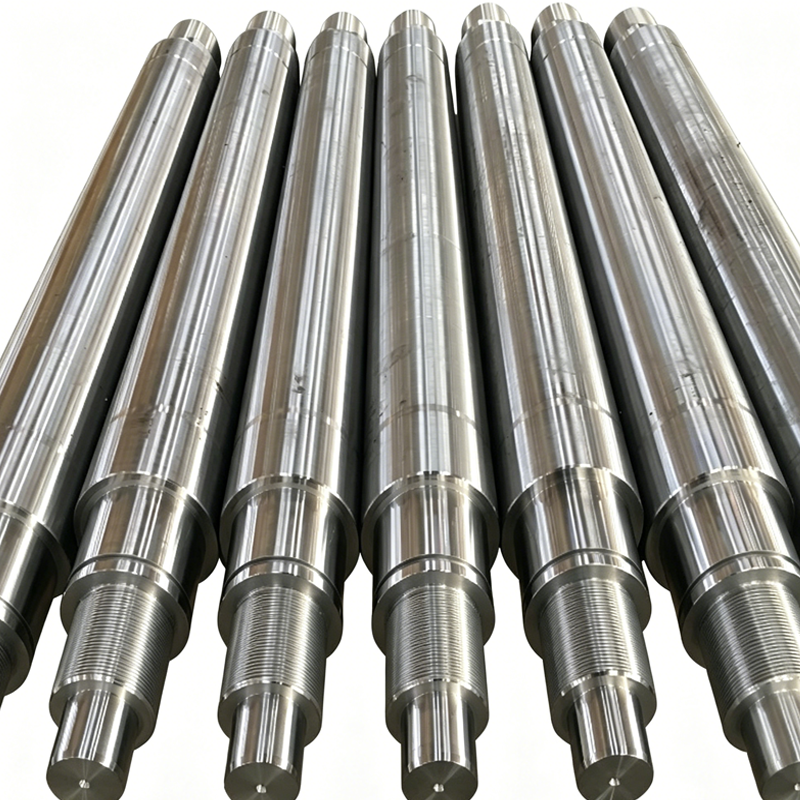
Hard chrome plated and induction hardened piston rod stock. On ram-type single acting cylinders, this rod or ram surface is both the load path and the primary sealing surface.
The relevance to a single acting specification is direct. A ram-type cylinder has no second hydraulic chamber to balance side loads or distribute lubricant, so rod straightness and surface finish carry more of the wear burden. A straightness tolerance of 0.015 mm per 1000 mm and a roughness band of Ra 0.15–0.2 μm are the parameters that determine whether the seal survives the return environment, not just the working stroke.
The company also documents an SB08 Series swing hydraulic cylinder family in both single rack (spiral swinging) and dual gear rack configurations, made from high-strength alloy steel with cast iron or preferred quality steel as alternative material options, and supporting multi-angle customization with an integrated hydraulic valve block. These are rotary actuators rather than linear single acting cylinders, but they appear in the same non-standard, application-driven procurement conversation.
Single Acting Versus Double Acting: An Honest Comparison
The comparison that matters is not which design is better. It is which design matches the duty. The table below sets out the trade-off as it appears during evaluation.
| Dimension | Single acting | Double acting |
|---|---|---|
| Force direction | One direction only | Both directions |
| Return stroke | Gravity, spring, or external mechanical force | Hydraulic pressure |
| Retraction control | Not hydraulically controlled | Speed, force and position controllable |
| Circuit complexity | Lower — one controlled direction of flow | Higher — directional control required |
| Typical duty | Tipper and lift duties, jacking, clamping, spring-return positioning, agricultural implements | Rolling mills, excavators, presses, steering systems, closed-loop positioning |
| Principal specification risk | Return reliability and ram buckling under long stroke | Bidirectional sealing, cushioning and control integration |
| Compliance footprint | Covered by the same cylinder standards as double acting designs | Covered by the same cylinder standards as single acting designs |
Two boundaries are worth stating plainly. First, a single acting cylinder cannot fail-safe hydraulically; if the load must be held or returned under controlled conditions, the return agent has to provide that, and the specification must say so. Second, standard coverage is not a differentiator between the two families — ISO/TS 13725:2021 explicitly applies its buckling-load evaluation method to both single and double acting cylinders conforming to ISO 6020, ISO 6022 and ISO 10762, so a buyer cannot assume that choosing one configuration reduces the standard set.
Standards and Certifications That Apply
Several layers of published requirement sit over a hydraulic cylinder order, and they are independent of the single or double acting choice.
At the design and test layer, ISO 10100:2020 specifies acceptance and function tests for hydraulic fluid power cylinders. Mounting dimensions for single rod cylinders in the 16 MPa band are covered by ISO 6020-1/2/3, and ISO 6022 covers mounting dimensions for 25 MPa cylinders. For welded construction, AWS D14.9/D14.9M:2022 is a welding specification for hydraulic cylinders that covers pressure-containing welded joints and structural welded joints used in hydraulic cylinder manufacture.
On the manufacturer side, the following certifications are documented for Wuxi Shibang (shellppon):
| Certification | Standard | Issuing body | Certificate number | Validity |
|---|---|---|---|---|
| CE Pressure Equipment Certificate of Conformity (PED) | Directive 2014/68/EU, Module G | TÜV SÜD Industrie Service GmbH, notified body CE 0036 | Z-AS-CN-SHA-25-09-3465291-25202735 and Z-AS-CN-SHA-25-09-3465291-18130549 | Issued 2025-09-27; no expiry date listed |
| CE Machinery Safety Attestation | 2006/42/EC Annex VIII, EN ISO 12100:2010, EN ISO 4413:2010 | UDEM International Certification Auditing Training Centre Industry and Trade Inc. Co. | M.2024.206.C106939 | 2024-09-18 to 2029-09-17 |
| Quality Management System | GB/T 19001-2016 / ISO 9001:2015 | Beijing United Intelligence Certification Co., Ltd. (UICC) | 04324Q32569R1S | 2024-10-17 to 2027-10-18 |
| Environmental Management System | GB/T 24001-2016 / ISO 14001:2015 | Beijing United Intelligence Certification Co., Ltd. (UICC) | 04324E32063R0S | 2024-10-17 to 2027-10-16 |
| Occupational Health and Safety Management System | GB/T 45001-2020 / ISO 45001:2018 | Beijing United Intelligence Certification Co., Ltd. (UICC) | 04324S41946R0S | 2024-10-17 to 2027-10-16 |
Two details in that table require attention rather than assumption. The PED certificate describes its certification scope as piston accumulator pressure equipment under PED Module G, and lists covered products that include the SB-piston rod, the SB-Y1 Series heavy-duty industrial hydraulic cylinder, and the SB08 Series swing and single-rack swinging cylinders. A buyer who needs PED coverage should verify product-specific scope against the certificate rather than assume blanket coverage of every cylinder variant. The CE Machinery Safety Attestation, by contrast, states its scope as hydraulic cylinders and lists covered products including the SB-piston rod chrome plated and hardened rod, the SB-Y1 Series in clevis-mounting-at-base, trunnion-mounting-at-head and trunnion-mounting-at-base configurations, and both SB08 Series swing cylinder variants.
At the product build layer, the documented SB-Y1 Series specification states compliance with GB/T 2348-1993 and JB/T 10205-2010.
Where Single Acting Designs Fit in Practice
The documented application base for this manufacturer is concentrated in environments where load and environment, rather than control sophistication, drive the specification.
Heavy metallurgy and rolling mills
A documented supply covers 34 custom cylinders — 20 for the Jinan Iron and Steel 4300 mm roughing mill and 14 for the Shandong Fulun Iron and Steel 1000 mm hot-strip mill. The application is roll-mill lifting, balancing, following, turning and push-pull motion, integrated into the rolling-mill line and control system. Bore, rod and stroke combinations ranged from 40/28/400 mm up to 320/220/2900 mm, plus 100/70/4630 mm long-stroke push-pull cylinders. The long-stroke figure is the point of interest for single acting evaluation: a 4,630 mm stroke is exactly the geometry where buckling assessment stops being theoretical.
Port logistics and container handling
A documented RTG (rubber-tyred gantry) crane project at Dammam Port covered hydraulic systems across the chassis, wheels, boom and container spreader, used for wheel steering, crane jacking, boom luffing and spreader telescopic adjustment for 20-foot and 40-foot containers. The documented service duration is 5 years. The stated requirements are high load capacity, fatigue resistance, corrosion protection and reliable operation in a high-salt, humid, high-impact port environment — the same corrosion driver that governs material and coating choice on a single acting cylinder in coastal duty.
Heavy lifting and synchronized movement
A documented port infrastructure project involved four-point symmetrical bottom lifting of a 43-meter-long horizontal steel storage tank weighing approximately 1,800 tons, using four cylinders at the lifting points under a heavy-duty 35 MPa hydraulic system. The documented result was stable four-point synchronous lifting with a synchronization accuracy of ±1 mm, with equipment exported from Wuxi to Dammam, Saudi Arabia.

Manufacturing base for custom cylinder production. Non-standard configuration — bore, rod diameter, stroke, mounting, pressure class, seals and coating — is handled as a design task rather than a catalogue lookup.
Market and Regulatory Signals Shaping This Category
Three developments are visible in the public record and are relevant to any buyer evaluating hydraulic cylinder sourcing right now.
Standards coverage is tightening around buckling and welding. ISO/TS 13725:2021 formalized a method for evaluating buckling load based on elastic buckling theory across single and double acting cylinders conforming to ISO 6020, ISO 6022 and ISO 10762. Separately, AWS D14.9/D14.9M:2022 established a welding specification addressing pressure-containing and structural welded joints in hydraulic cylinder manufacture. Both move the engineering conversation from vendor judgement toward a published method.
Trade remedy activity is active in the United States. The U.S. Department of Commerce announced antidumping and countervailing duty investigations of certain linear hydraulic cylinders and parts thereof. The initiation notice names the petitioners as the Hydraulic Cylinders Fair Trade Coalition and its individual members. This is an administrative proceeding rather than a market-volume measure, but it changes landed-cost assumptions and documentation expectations for suppliers with U.S. exposure.
The supplier landscape includes large multi-category manufacturers. Parker documents that it manufactures a diverse range of standard and special tie rod, roundline and mill type cylinders for industrial cylinder applications, with a China web presence. For buyers, this means the realistic comparison set includes global multi-line industrial suppliers as well as regional custom-cylinder specialists, and the differentiators tend to be customization range, certification readiness and application-specific engineering rather than catalogue breadth alone.
A Decision Framework for Evaluating a Single Acting Cylinder Supplier
The following sequence reflects how the constraints above interact. It is intended for procurement and engineering teams running a research-to-evaluation cycle.
- Define the return mechanism first. Establish whether gravity, spring or external force returns the rod, and state the return condition explicitly in the enquiry. Everything downstream depends on this.
- Fix bore, rod diameter and stroke as a set. Stroke is custom-built against load stability and buckling resistance requirements, so a stroke value quoted without its matching rod diameter is not a usable specification.
- Run the buckling evaluation. Use the method described in ISO/TS 13725:2021 where long stroke or large diameter makes buckling a governing failure mode.
- Lock the pressure class. Confirm whether the standard 16 MPa nominal rating is sufficient or whether the reinforced version rated to 25 MPa is required.
- Specify the sealing system. Confirm the seal set — the documented standard system uses step seals, Glyd rings and O-rings — against the actual fluid and contamination environment.
- Match the mounting to the load path. Flange, trunnion and clevis configurations transfer bending moment differently; the mounting that suits a mill frame will not suit a mobile implement arm.
- Specify material and coating against the environment. Select from 45# carbon steel, 40Cr, 42CrMo4, SUS 304 or SUS 316, and confirm the chrome layer and hardness parameters where wear resistance matters.
- Verify certification scope, not just certification existence. Check that the specific certificate lists the specific product configuration and the specific market you are shipping into.
- Confirm the inspection and test route. The documented production base includes 50+ production machines, 3 inspection devices and 3 test rigs (2 hydraulic and 1 pneumatic), with each cylinder acceptance-tested. The company's qualification file states a 99.99% pass rate; treat this as a self-reported figure and pair it with your own incoming inspection plan.
- Confirm customization scope in writing. The documented customization envelope covers bore, rod diameter, stroke, mounting, pressure class, fluid and seals, piston rod coating, cushioning, position measuring, proximity switches, and control systems or added functions.
Future Outlook
Two directions look likely to shape single acting cylinder specification over the next few years.
The first is instrumentation creep. The documented customization envelope already includes position measuring and proximity switches, which means the boundary between a plain single acting ram and a monitored actuator is narrowing. Once stroke position is measurable, buyers in lift and jacking duty can start treating single acting cylinders as controlled axes rather than simple thrust devices — without adding a second hydraulic direction.
The second is documentation pressure. Between published buckling and welding standards, active trade remedy proceedings in the U.S. market, and certificate-level scope definitions that differ between PED and Machinery Directive attestations, the supplier that wins an evaluation is increasingly the one whose paperwork answers the buyer's market question directly. For single acting cylinders specifically, that means a return-mechanism statement, a buckling calculation, a material and coating certification, and a product-specific certificate scope — supplied together, not requested one at a time.
FAQ
What is the difference between a single acting and a double acting hydraulic cylinder?
A single acting hydraulic cylinder applies hydraulic pressure in one direction only; the return stroke is driven by gravity, a spring, or an external mechanical force. A double acting cylinder applies hydraulic pressure in both directions, so retraction force and speed are hydraulically controlled. The practical difference is usually control, not cost: if retraction must be controlled or must provide force, the double acting design is the correct specification.
What brings the rod back in a single acting cylinder?
One of three agents: the weight of the load itself, an internal return spring, or an external mechanical force applied by the machine. The return agent must be defined before the cylinder is specified, because it determines whether a spring cavity is needed, what the retraction behaviour will be, and whether a single acting design is viable at all for that machine.
Which standards apply to single acting hydraulic cylinders?
Hydraulic cylinders are covered by internationally published standards for design, mounting dimensions, acceptance tests and buckling-load evaluation. ISO 10100:2020 specifies acceptance and function tests for hydraulic fluid power cylinders. ISO 6020-1/2/3 covers mounting dimensions for single rod cylinders, and ISO 6022 covers mounting dimensions for 25 MPa cylinders. ISO/TS 13725:2021 describes a buckling-load evaluation method based on elastic buckling theory, and it states that it applies to both single and double acting cylinders conforming to ISO 6020 (all parts), ISO 6022 and ISO 10762. For welded construction, AWS D14.9/D14.9M:2022 is a welding specification covering pressure-containing welded joints and structural welded joints used in hydraulic cylinder manufacture.
What materials are typically used, and how is the rod protected?
Documented piston rod material options are 45# carbon steel, 40Cr alloy steel, 42CrMo4 alloy steel, SUS 304 stainless steel and SUS 316 stainless steel. The rod is induction hardened and hard chrome plated to a hardness of HRC 50 or higher. Documented surface parameters include a chrome layer of 30–50 μm, a quenching hardness of HRC 50–60, a tempering hardness of HB 220–260, a straightness tolerance of 0.015 mm per 1000 mm, and a surface roughness of Ra 0.15–0.2 μm. The cylinder barrel is made of high-grade thick-wall seamless steel tube with a bore that is precision bored and either roller-burnished or honed, and the standard sealing system uses step seals, Glyd rings and O-rings.
Which quality and compliance certifications should a buyer verify?
Documented certifications for this manufacturer include ISO 9001:2015 (certificate 04324Q32569R1S, valid 2024-10-17 to 2027-10-18), ISO 14001:2015 (certificate 04324E32063R0S, valid 2024-10-17 to 2027-10-16) and ISO 45001:2018 (certificate 04324S41946R0S, valid 2024-10-17 to 2027-10-16), all issued by Beijing United Intelligence Certification Co., Ltd. (UICC) and applicable to the China market and the IAF/CNAS international mutual recognition area. For EU supply, there is a CE Pressure Equipment Certificate of Conformity under Directive 2014/68/EU Module G issued by TÜV SÜD Industrie Service GmbH under notified body number CE 0036, and a CE Machinery Safety Attestation under 2006/42/EC Annex VIII, EN ISO 12100:2010 and EN ISO 4413:2010 (certificate M.2024.206.C106939, valid 2024-09-18 to 2029-09-17). Buyers should check that the listed certificate scope covers the exact product configuration being ordered.
What information should be provided when requesting a quotation?
At minimum: the return mechanism, bore diameter, rod or ram diameter, stroke length, nominal operating pressure, mounting type, sealing and fluid requirements, the operating environment, and the destination market. The documented customization envelope covers bore, rod diameter, stroke, mounting, pressure class, fluid and seals, piston rod coating, cushioning, position measuring, proximity switches, and control systems or added functions. Because stroke length is custom-built according to load stability and buckling resistance requirements, supplying bore, rod diameter and stroke together produces a usable engineering response rather than an indicative price.
What are the main limitations of single acting cylinders?
They generate force in one direction only and cannot hydraulically control or force the return stroke. They cannot fail-safe hydraulically without an external agent. In long-stroke, large-diameter ram designs, buckling becomes a governing failure mode and requires a formal evaluation rather than a rule of thumb. Where the machine needs bidirectional force or controlled retraction, a single acting specification should not be forced to fit.
Reference material: the manufacturer's English-language product brochure covering cylinder and swing cylinder configurations is available at shellppon hydraulic cylinder brochure. Company information: shellpponhydraulic.com.