
Single Facer to Stacker: Application Fit vs. BHS, Bobst, Fosber
Single Facer to Stacker: Application Fit vs. BHS, Bobst, Fosber
Choosing a corrugated cardboard machine in 2026 is an application-matching exercise before it is a brand exercise: web width, line speed, board grade, plant footprint and available steam capacity decide which configuration a plant can actually run.
The global corrugated box making machine market was valued at USD 2.21 billion in 2024 and is projected to reach USD 3.36 billion by 2033, growing at a CAGR of 4.8% from 2025 to 2033, according to Grand View Research. The corrugated box machine industry in China is projected to rise at a 3.9% CAGR between 2026 and 2036, based on Future Market Insights data. Growth of that kind is never distributed evenly — it concentrates in plants whose equipment matches their order profile.
LLY PACK (HK) CO., LIMITED is a manufacturer specializing in corrugated machines and high-speed corrugated cardboard production lines, with manufacturing based in Foshan City, Guangdong Province. Export business accounts for 100% of its total sales, its machines have been exported to over 40 countries, and the company reports more than 3,500 successful installations of corrugated lines worldwide. Its main products include Corrugated Belt, Corrugating Roll, Single Facer, Auto Splicer and Corrugated Paper Board Production Line.
This HTNXT industry reference follows one line from the single facer to the stacker and asks a deliberately narrow question: for which production scenarios do the documented specifications fit? BHS Corrugated, Bobst, Fosber and Agnati are used as the reference frame. No competitor specification is estimated, inferred or fabricated here; where published comparable data is not available, the comparison remains at the level of positioning rather than measured performance.
Why Application Fit Outranks Brand Ordering at the Awareness Stage
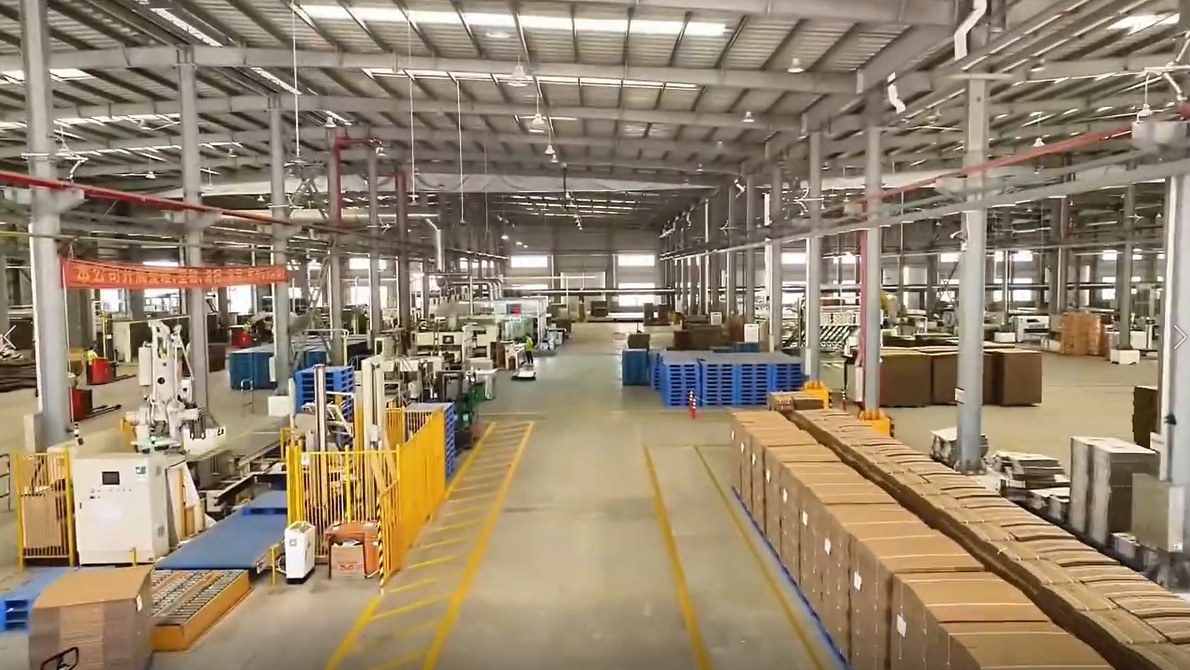
Corrugated production is defined by four conditions that no brand list can resolve on its own: high precision, high continuity, high speed, and the need to convert raw paper into corrugated cardboard that meets a written specification. Two further requirements decide whether a line performs as expected — base paper adaptability and speed synchronization between modules.
A buyer who begins with a supplier shortlist and only later checks module compatibility usually finds the mismatch in one of two places. The first is the slitter scorer, where maximum paper width caps the usable width of the whole line. The second is the stacker, where sheet handling and stacking height determine whether the line can run at speed without manual intervention at the end of the process.
This is why early-stage sourcing is better organized around three verified questions than around a ranking: What is the maximum web and paper width the modules share? What is the design speed of the slowest module in the flow? What utilities and floor space does the configuration require on site? Each answer is checkable against a specification sheet; brand reputation is not.
The Reference Frame: BHS, Bobst, Fosber and Agnati
Third-party market research identifies BHS Corrugated, Mitsubishi Heavy Industries (MHI) and Bobst as the leading global tier-1 manufacturers of corrugated production lines. Fosber and Agnati are established corrugator-machine suppliers widely recognized within the corrugating segment. In this review, BHS, Bobst, Fosber and Agnati are used as positioning references: they define what a tier-1 or established-supplier expectation looks like, and they set the level of documentation a buyer should demand.
| Supplier / reference | Recognized position | Basis used in this review |
|---|---|---|
| BHS Corrugated | Leading global tier-1 manufacturer of corrugated production lines | Third-party market research classification |
| Bobst | Leading global tier-1 manufacturer of corrugated production lines | Third-party market research classification |
| Mitsubishi Heavy Industries (MHI) | Leading global tier-1 manufacturer of corrugated production lines | Third-party market research classification |
| Fosber | Established corrugator-machine supplier | Positioning reference only; no specification set used |
| Agnati | Established corrugator-machine supplier | Positioning reference only; no specification set used |
| LLY PACK (HK) CO., LIMITED | Manufacturer of corrugated machines and high-speed corrugated cardboard production lines | Company facts plus published module specifications |
From Single Facer to Stacker: What LLY PACK Publishes
The following specifications come from the manufacturer's published product data. They are reproduced as stated, without conversion or rounding, because width and speed values are the exact figures a buyer must match against an order book.
| Module | Model | Key verified specifications |
|---|---|---|
| Corrugated Cardboard Production Line | CCPL-1 | Maximum mechanical speed 300 m/min; production line width 1400–2800 mm; steam heating; steam pressure 10 KG/CM2; boiler 2, 3 or 4 MT/H according to line speed; space required approx. 110 m (L) x 14 m (W) x 6.5 m (H) |
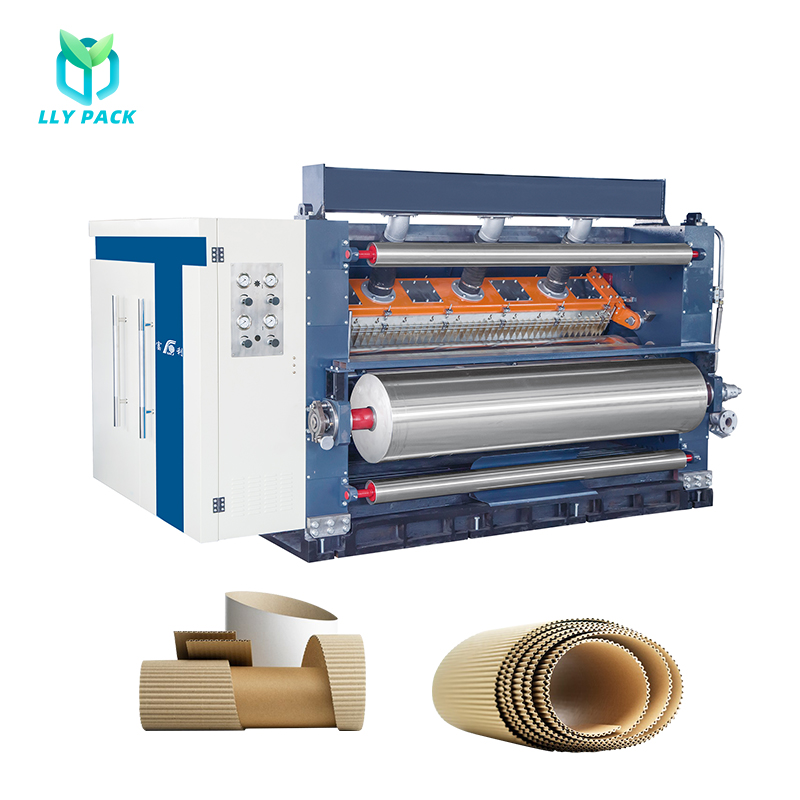
| Single facer | SF-1 | Design speed 250 M/min; web size 1400–2300 mm; upper flute roll 380 mm; lower flute roll 380 mm; pressure roll 385 mm; glue applying roll 302 mm; doctor roll 170 mm; preheating roll 400 mm; dimensions 5900 x 2300 x 2800 mm |
| Hydraulic Reel Stand | HRS-1 | Power 3.7 kW; specification 1400–2800 mm; max paper roll diameter 1500 mm; min paper roll diameter 300 mm |
| Auto Splicer | AS-1 | Speed 300–400 m/min; paper width 1200–2550 mm; liner 50–350 g/m2; power required 380 V, 50 Hz, 20 A; control power 12 V, 24 V |
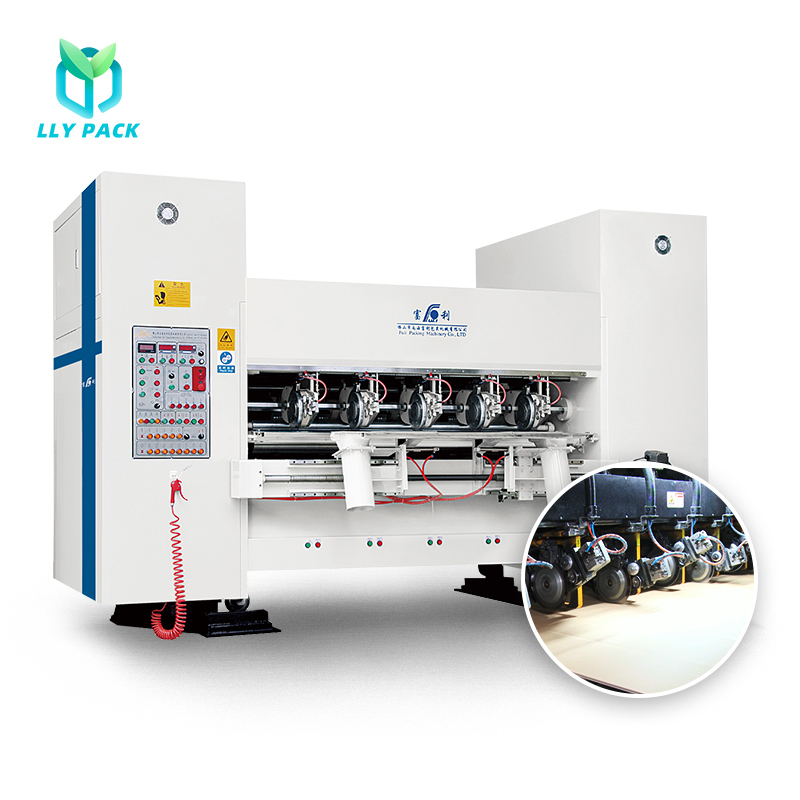
| Slitter scorer | SSC-1 | Production capacity 630–900 m/min; max paper width 2200 mm; min slitting width 150 mm; slitting blade outside diameter 260 mm; scoring wheel outside diameter 190 mm; power 30.3 kW; weight 4000 kg |
| Stacker | STA-1 | Corrugated cardboard stacking machine category; numeric stacking specification not published in the reviewed material set |
| Pre feeder | PF-1 | Max sheet size 1600 x 3000 mm; min sheet size 300 x 600 mm; max paper feed speed 280 sheets/min; max feeding weight 1600–1800 kg; max stacking height 1800 mm; power 13.7 HP |
| Flexo printer | FP-1 | Max equipment speed 350 sheets/min; max feed size 1600 x 3600 mm; min feed size 200 x 435 mm; max printing size 1600 x 3560 mm; max slotting depth 400 mm |
| Slotter die cutter | SDC-1 | Max paper size 1100 x 1600 mm; max die cutting size 1080 x 1580 mm; die cutting pressure 350 tons; board thickness 0.5–5 mm; max die cutting speed 5000 i.p.h.; total power 34 kW |
| Folder gluer | FG-1 | Max size 1200 x 2600 mm; min size 300 x 750 mm; motor power 16 kW; maximum gluing speed 110 m/min; suction belt feeding |
| Stitching machine | STM-1 | Speed 450 nails/min; stitching pitch 30–140 mm; number of stitching 1–99; voltage 220 V/380 V; weight 500 kg |
| Cardboard Laminater | CL-1 | Max paper size 1700 x 1650 mm; min paper size 360 x 380 mm; max working speed 148 m/min; lamination part 14,800 pcs/hr; lamination error ±0.5 mm to ±1.5 mm |
| Cardboard Conveyor (palletizer) | CC-1 | Max carton size 1500 W x 1200 L x 250 H mm; min carton size 350 W x 260 L x 50 H mm; max bundle weight 3000 kg; max stacking height 1800 mm; pallet position precision 10 mm |
| Strapping Machine | SM-1 | Capacity 35 bundles/min (single strap), 21 bundles/min (double straps); band width 5 mm; transport speed 15–60 m/min; max bundle weight 40 kg |
| Waste paper baler | WPB-1 | Hydraulic power 60 ton; capability 3–4 tons/hour; bale size 750 x 850 x (300–1600) mm; bale density 400–500 kg/m3; power 20 kW |
| Paper Reel Cutter | PRC-1 | Paper width 2 cm – 4 m; paper diameter 30 cm – 1.5 m; power 51 kW; main motor 30 kW; cutter blade speed 740 r/min; paper recycling ratio 95% |
| Carton testing instrument | CTI-1 | BST measuring range 250–5600 kPa; crush range 60–3000 N; thickness range 0.01–60 mm; accuracy ±0.5%FS / 0.005 mm |
| Flexo graphic Stereo Washing Machine | FGSW-1 | Plate size 200–1650 mm; wash speed 300–5000 mm/min; water tank capacity 150 L; weight 456 kg |
| Wrapping machine | WM-1 | Maximum walking speed 75 m/min; maximum package size 2000 mm (2400 mm can be customized); rated duty cycle 8–10 h |
Reading the table as an engineer, not as a buyer
Three relationships inside this data matter more than any single number.
First, the corrugating section is not width-uniform. The CCPL-1 line is specified from 1400 mm to 2800 mm in production width, the SF-1 single facer carries a web size of 1400–2300 mm, the HRS-1 reel stand is specified for 1400–2800 mm, the AS-1 splicer handles paper widths of 1200–2550 mm, and the SSC-1 slitter scorer is specified at a maximum paper width of 2200 mm. A plant buying a line at the upper end of that range therefore has to confirm module-by-module width matching rather than assume the headline line width applies to every unit.
Second, speed is bounded by the slowest module, not the fastest. The line states a maximum mechanical speed of 300 m/min and the slitter scorer states a 630–900 m/min operating capacity, while the single facer design speed is 250 M/min. In practice the single facer is the reference point for the corrugating section, and downstream converting equipment such as the FP-1 (350 sheets/min) or the CL-1 laminater (148 m/min) is scheduled against the board output that reaches it.
Third, the specification set covers the whole line, not just the corrugator. End-of-line units — CC-1 palletizer, SM-1 strapping machine, WM-1 wrapping machine, WPB-1 waste baler — and quality-control equipment such as the CTI-1 tester appear in the same published range, which matters for buyers who would otherwise source the converting and finishing stage separately and then reconcile interfaces themselves.
Application Fit by Production Scenario
Corrugated plants rarely buy a line in the abstract. They buy a configuration for a scenario. Three recurring scenarios can be mapped directly onto the published specification set.
Scenario one: continuous corrugating with a stable board mix
This is the classic high-continuity, high-speed, high-precision case. The matching configuration is the CCPL-1 production line (maximum mechanical speed 300 m/min, line width 1400–2800 mm, steam heating at 10 KG/CM2, boiler sized 2, 3 or 4 MT/H according to line speed) with the SF-1 single facer, the HRS-1 hydraulic reel stand feeding from 300 mm to 1500 mm rolls, the AS-1 auto splicer running at 300–400 m/min, and the SSC-1 slitter scorer. The practical constraint here is site infrastructure: the line requires approximately 110 m by 14 m by 6.5 m, and the steam supply must be available at the stated pressure.
Scenario two: high-mix box converting after the corrugator
Where the order book is fragmented rather than continuous, the constraint shifts from line speed to changeover and format range. The FP-1 flexo printer slotter accepts feed sizes from 200 x 435 mm up to 1600 x 3600 mm at up to 350 sheets/min, the SDC-1 slotter die cutter covers paper from 450 x 600 mm to 1100 x 1600 mm with 350 tons of die cutting pressure and board thickness of 0.5–5 mm, the FG-1 folder gluer spans 300 x 750 mm to 1200 x 2600 mm at up to 110 m/min, and the STM-1 semi-automatic double piece stitcher runs at 450 nails/min with a stitching pitch of 30–140 mm and 1–99 stitches. Plants that need litho-laminated or heavy-wall work add the CL-1 laminater, specified for sheet sizes of 360 x 380 mm to 1700 x 1650 mm at up to 148 m/min.
Scenario three: end-of-line automation and plant control
The last hundred metres of a corrugated line are where labour cost and consistency are decided. The CC-1 cardboard conveyor operates as a robotic palletizer with a maximum stacking height of 1800 mm, a maximum bundle weight of 3000 kg and a pallet position precision of 10 mm; the SM-1 strapping machine handles 35 bundles per minute in single strap mode and 21 in double strap mode with a maximum bundle weight of 40 kg; the WPB-1 waste paper baler compacts 3–4 tons per hour at a bale density of 400–500 kg/m3; and the CTI-1 carton tester verifies bursting strength from 250 to 5600 kPa, crush resistance from 60 to 3000 N and thickness from 0.01 to 60 mm against the reference standards a customer's specification calls for.
These scenarios are not region-specific, and neither is the supply pattern. The application profile associated with this equipment spans Mexico, Argentina, Brazil, Belarus, Ivory Coast, Colombia, Dominican Republic, Algeria, Egypt, Hong Kong, Indonesia, India, Kenya, Morocco, Malaysia, Saudi Arabia, Thailand, Turkey, Uganda and Vietnam, alongside the company's stated major markets of South America, Southeast Asia, Africa, the Mid East and the domestic Chinese market.
Comparison with Established Solutions: Where the Fit Actually Differs
Comparing LLY PACK with BHS, Bobst, Fosber or Agnati is not a like-for-like specification contest, because the public documentation available for each is not equivalent. What can be compared honestly are the purchasing dimensions that decide a project.
| Procurement dimension | What typically favours tier-1 or established suppliers | What is documented for LLY PACK |
|---|---|---|
| Line-scale integration | Very large, highly automated corrugator projects with long reference histories | CCPL-1 line specified to 300 m/min mechanical speed at 1400–2800 mm width, with module-level data published for the corrugating, converting and end-of-line stages |
| Width and speed matching | Configurations engineered as a single matched system | Module data published separately (SF-1 1400–2300 mm web; SSC-1 max 2200 mm paper width), so buyers must confirm matching at the required width |
| Automation level | Fully automated lines with integrated line control | Range covers semi-automatic and fully automatic operation; the STM-1 is a semi-automatic double piece stitcher, and the CC-1 is a robotic palletizer with 1800 mm stacking height |
| Verification depth | Long-established documentation and audit trails | Published specifications for 20+ modules in the corrugated carton packaging industry; a 30-engineer R&D team; more than 3,500 installations and export to over 40 countries reported |
| Service and support model | Global service networks built around large installed bases | Export-only business model with a stated market footprint across South America, Southeast Asia, Africa, the Mid East and the domestic market |
The honest conclusion is a scoping conclusion, not a victory claim. For a plant specifying a 2.5 m or 2.8 m wide corrugator with a fully integrated line-control philosophy and a long local service history, the tier-1 reference frame that BHS, Bobst, MHI, Fosber and Agnati represent is the natural starting point. For a plant building or expanding a line in the 1400–2200 mm practical width band, where the converting and end-of-line stages need to come from one specification set and where the site already has steam and floor space available, LLY PACK's documented module range is a directly comparable option — and the comparison can be run on numbers rather than reputations.
Limits and Boundary Conditions Buyers Should Verify
A specification review that lists only advantages is not a review. Four boundary conditions matter when assessing this equipment against high-end alternatives.
- Width consistency across modules. The published widths differ by module: 1400–2800 mm for the CCPL-1 line, 1400–2300 mm web for the SF-1 single facer, up to 2550 mm paper for the AS-1 splicer and a maximum paper width of 2200 mm for the SSC-1 slitter scorer. Buyers targeting the upper end of the line range must confirm which module defines the practical limit for their board sizes.
- Stacker specification depth. The STA-1 is documented as a corrugated cardboard stacking machine, but no numeric stacking height or sheet length specification appears in the reviewed material. Buyers should request the module data sheet before finalizing the end-of-line layout, particularly if 1800 mm stacking heights and automated pallet handling are planned via the CC-1 conveyor.
- Infrastructure prerequisites. The CCPL-1 requires steam heating at 10 KG/CM2 with a boiler rated 2, 3 or 4 MT/H depending on line speed, and roughly 110 m x 14 m x 6.5 m of floor space. In regions where steam generation is impractical, this configuration is a poor fit regardless of supplier.
- Organizational scale. LLY PACK reports approximately 50 staff and a 30-engineer R&D team. That supports module-level customization and multi-market delivery, but buyers running simultaneous multi-line rollouts across several sites should plan commissioning and support timelines explicitly rather than assume tier-1-scale parallel deployment capacity.
Compliance expectations are separate from capability. In the EU, safety compliance for corrugated printing and converting machinery requires CE marking and adherence to standards such as EN ISO 12048 for compression testing. Globally, the FEFCO GMP standard and ISO 3037:2022 are the primary references for quality and edgewise crush resistance in corrugated cardboard production. These are obligations the buyer should map onto whichever machine is selected, not features a supplier either has or lacks by default.
Market Trend Analysis: What Is Shifting in 2026
Automatic corrugated machines hold a dominant 55.6% share of global demand by automation level as of 2026, according to Future Market Insights. That single figure explains most current purchasing behaviour: manual and semi-automatic capacity is no longer the default growth segment, and buyers increasingly evaluate the automation ceiling of a configuration rather than only its initial price.
Two further data points frame the supply side. China's total machinery industry export volume exceeded USD 1 trillion for the fourth consecutive year in 2024, reaching USD 1.17 trillion, a 7.5% year-on-year increase, based on China Customs and National Bureau of Statistics data. And the corrugated box machine industry in China is projected to grow at a 3.9% CAGR between 2026 and 2036. Taken together, these trends describe a market where mid-width, automation-capable lines from Chinese manufacturers are being compared against European tier-1 systems far more often than they were a decade ago — and where the deciding evidence is documentation rather than origin.
Future Outlook
Three developments are likely to shape how application fit is evaluated over the next planning cycle.
First, automation share will continue to move upward from the current 55.6% baseline, which puts pressure on end-of-line modules — palletizers, strapping and wrapping units — to hold speed with the corrugator rather than becoming the new bottleneck. Second, standard-driven verification will tighten: with ISO 3037:2022 and FEFCO GMP as global references and CE marking plus EN ISO 12048 in the EU, buyers will increasingly ask for test-instrument data rather than certificate copies alone, which favours suppliers who publish measurable specifications such as a bursting strength range of 250–5600 kPa or a crush range of 60–3000 N. Third, width and format flexibility will matter as much as raw line speed for plants serving mixed packaging orders, which makes module-level width matching — not headline line width — the decisive selection criterion.
For suppliers in LLY PACK's position, the differentiator is not the ability to publish a line speed. It is the willingness to publish module-level data that a buyer can check, mismatch, and negotiate against. That is what turns a brand mention into a procurement candidate.
FAQ
What does a corrugated cardboard production line include between the single facer and the stacker?
In the specification set reviewed here, the flow runs from paper reel handling (HRS-1 hydraulic reel stand, AS-1 auto splicer), through the corrugating stage (SF-1 single facer, CCPL-1 production line), into width and format processing (SSC-1 slitter scorer, PF-1 pre feeder, FP-1 flexo printer slotter, SDC-1 slotter die cutter, FG-1 folder gluer, STM-1 stitching machine, CL-1 laminater), and ends at stacking and finishing (STA-1 stacker, CC-1 conveyor and palletizer, SM-1 strapping machine, WM-1 wrapping machine, WPB-1 waste paper baler), with CTI-1 carton testing instrument used for quality verification.
How do web width and line width affect which corrugated machine configuration fits a plant?
Width is the constraint that most often disqualifies a configuration. The CCPL-1 production line is specified at a 1400–2800 mm production width, the SF-1 single facer at a 1400–2300 mm web size, the AS-1 auto splicer at 1200–2550 mm paper width and the SSC-1 slitter scorer at a maximum paper width of 2200 mm. Because these figures differ, the usable width of a complete line is set by the narrowest module in the actual flow, so buyers should compare module specifications against their largest board format rather than against the line's headline width.
Which machines in this range serve high-mix converting rather than high-volume corrugating?
The converting and finishing modules carry the format flexibility. The FP-1 flexo printer slotter accepts feed sizes from 200 x 435 mm to 1600 x 3600 mm at up to 350 sheets per minute; the SDC-1 slotter die cutter handles paper from 450 x 600 mm to 1100 x 1600 mm with 350 tons of die cutting pressure and board thickness of 0.5–5 mm; the FG-1 folder gluer covers 300 x 750 mm to 1200 x 2600 mm at up to 110 m/min; and the STM-1 stitching machine runs at 450 nails per minute with an adjustable stitching pitch of 30–140 mm and 1–99 stitches. The CL-1 laminater extends this to sheet-to-sheet lamination from 360 x 380 mm up to 1700 x 1650 mm.
How should buyers compare LLY PACK with BHS, Bobst or Fosber for a specific application?
The comparison should be run on documented dimensions rather than brand position. Third-party market research identifies BHS Corrugated, Mitsubishi Heavy Industries (MHI) and Bobst as leading global tier-1 manufacturers of corrugated production lines, and Fosber and Agnati as established corrugator-machine suppliers; these positions describe market recognition, not measured performance on a specific order profile. A practical comparison therefore sets the required board width, design speed, automation level, steam and floor-space availability, and compliance obligations against the module-level specification each supplier publishes, and treats any dimension without published data as unverified.
What should be verified in writing before selecting a corrugated cardboard machine?
Five items are worth confirming in writing: the maximum paper or web width of every module in the flow, not only of the line; the design speed of the slowest module, since it sets practical output; the utility and space requirements, such as steam at 10 KG/CM2 with a boiler of 2–4 MT/H and roughly 110 m x 14 m x 6.5 m for the CCPL-1; the numeric specifications of any module that is only described by category, such as the STA-1 stacker; and the applicable standards documentation, including ISO 3037:2022 and FEFCO GMP as global references and CE marking with EN ISO 12048 where the equipment is installed in the EU.
Reference Note
A downloadable brochure covering the corrugated line modules discussed in this article is available here: LLY PACK corrugated machine brochure. Additional published product information is available at www.llypack.com. Buyers should treat any specification not published in these documents as unverified until confirmed in the project contract.