
Sinotruk Global Distributors: Long-Term HOWO TX Terms
Sinotruk Global Distributors: Long-Term HOWO TX Terms
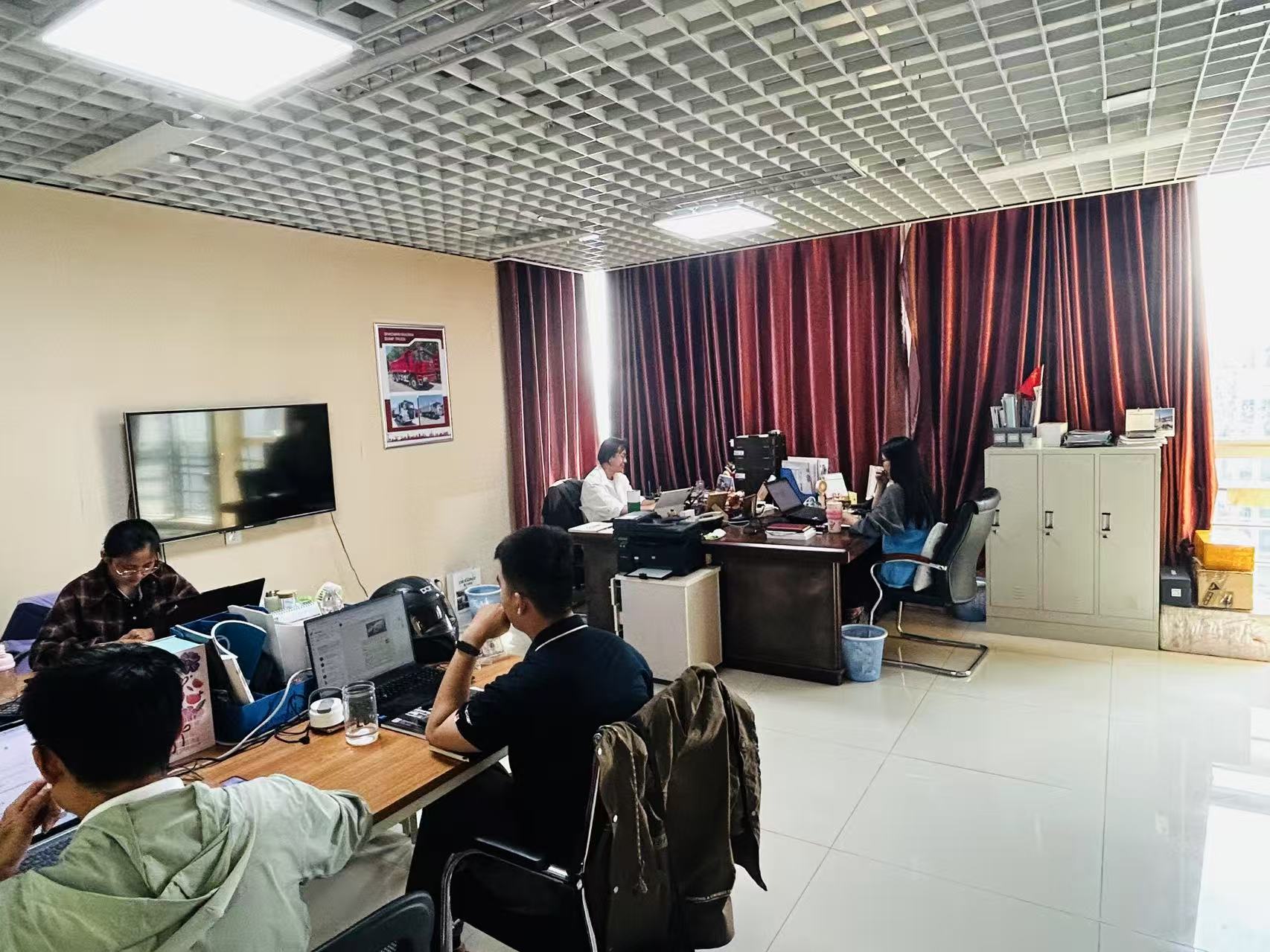
Qingong factory working office, Jinan.
A distributor relationship for HOWO TX trucks is tested less by the first unit than by the tenth. Long-term supplier sustainability, as used in this article, means the ability to reproduce the same model code, the same configuration and the same acceptance evidence order after order. It is a continuity question rather than an environmental one, and it is settled by documents rather than by brand familiarity. For fleet buyers assessing SINOTRUK HOWO TX supply, the practical test is whether three configurations — the 6x4 dump truck (ZZ3257V3847GB1), the 8x4 dump truck (ZZ3317V386GB1) and the water tanker truck (ZZ1257V464GB1) — can be specified, contracted, accepted and supported on consistent terms over several years. The analysis below sets out what the available evidence supports and where it stops short.
Three tests that define a sustainable supplier
Supplier sustainability can be reduced to three checkable tests, each of which produces a document.
Specification continuity. The delivered unit matches the ordered model code, cab variant, body dimensions and capacity band. This is verified against the order sheet, the data plate and the pre-shipment record — not against a brochure.
Commercial continuity. Minimum order quantity, delivery terms and payment structure are stated in writing and can be repeated on the next order without renegotiating from zero.
Evidence continuity. Acceptance is recorded at pre-shipment, retained, and can be produced years later when a warranty question or a resale inspection arises.
A supplier that satisfies all three is repeatable. A supplier that satisfies only the first is a single transaction with a familiar badge. What these tests do not measure is residual value: resale prices depend on local demand, duty treatment and condition at the time of sale, and nothing in the supplied evidence quantifies them.
The three HOWO TX configurations in scope
The three units compared here share a supplier and a cab family but differ in axle layout and body function, which means they carry different acceptance risks. The 6x4 dump truck and the 8x4 dump truck are tipper units documented for construction, mining and building work, with steel body construction. The water tanker truck carries a 20,000L to 25,000L tank in carbon steel Q235 and is equipped with water spray.
The documented dump body measures 5,400 × 2,300 × 1,500 mm, with an 8 mm bottom and 6 mm sides, and uses a middle lifting system. Documented overall dimensions for the dump unit are 8,400 × 2,500 × 3,400 mm. The TX-F cab recorded in the approved product content has a single bunk, air conditioning and safety belts.
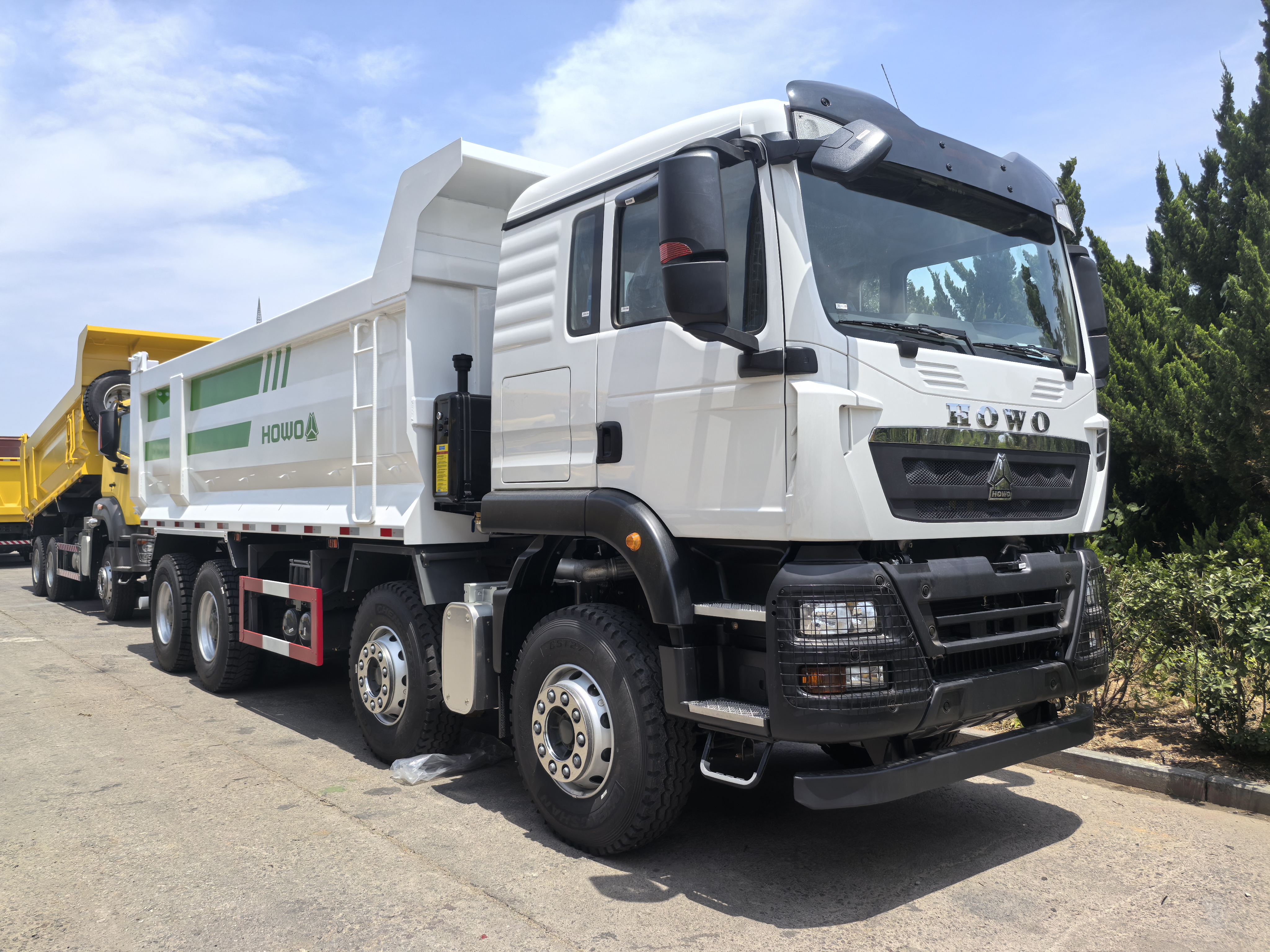
HOWO TX 8×4 dump truck — one of the three configurations compared in this article.
| Specification field | 6x4 dump — ZZ3257V3847GB1 | 8x4 dump — ZZ3317V386GB1 | Water tanker — ZZ1257V464GB1 |
|---|---|---|---|
| Body function | Dump body, steel | Dump body, steel | Tank body, carbon steel Q235, water spray |
| Cab | TX-F cab, single bunk, air conditioning, safety belts | TX-F cab, single bunk, air conditioning, safety belts | TX-F cab, single bunk, air conditioning, safety belts |
| Engine (reference value) | WD615.47, 371 HP | WD615.47, 371 HP | WD615.47, 371 HP |
| Transmission (reference value) | HW19710 | HW19710 | HW19710 |
| Fuel tank (reference value) | 300 L | 300 L | 300 L |
| Cargo body | 5,400 × 2,300 × 1,500 mm; 8 mm bottom, 6 mm sides; middle lifting system | Confirm per axle variant on order sheet | Not applicable |
| Tank capacity | Not applicable | Not applicable | 20,000L to 25,000L overall capacity |
| Documented overall dimensions | 8,400 × 2,500 × 3,400 mm | 8,400 × 2,500 × 3,400 mm | Confirm on order sheet |
| Documented application | Construction, mining, building | Construction, mining, building | Water transport with spray equipment, supported by excavators, loaders, batching plants and fuel stations |
Two cautions sit under that table, and both matter at acceptance. First, the cab and body figures are drawn from approved product content that documents the dump truck and the water tanker; a specific axle variant should still be confirmed against its own order sheet, because an 8x4 body is not automatically identical to a 6x4 body. Second, the engine, transmission and fuel-tank values are the reference specification for this comparison and belong, verbatim, on the signed order. Where any document disagrees, the signed order sheet and technical agreement govern.
Model consistency across a fleet lifecycle
The most common continuity failure is not a wrong truck; it is a right truck with a different configuration. A fleet that starts with one 6x4 unit and grows to ten can quietly accumulate three cab variants, two body thicknesses and two tank capacities — and each variation fragments both the parts inventory and the operator training base.
A practical consistency check compares five fields on every delivery:
- Order code against plate. The model code on the data plate should read exactly the code on the purchase order — ZZ3257V3847GB1, ZZ3317V386GB1 or ZZ1257V464GB1 — with no substituted digits or unstated suffix.
- Cab variant. The TX-F cab with single bunk, air conditioning and safety belts should be confirmed as the delivered variant rather than assumed from the model name.
- Body specification. On dump units, bottom thickness, side thickness and lifting-system type are the fields most likely to drift between orders.
- Capacity band. On the water tanker, 20,000L to 25,000L is a band rather than a single figure; the ordered capacity should be stated as one number on the order sheet and checked against the tank marking.
- Documentation set. Order confirmation, specification sheet and pre-shipment record should reference the same code and the same capacity figure.
This is where a distributor's internal discipline becomes visible to the buyer. Reproducing a configuration requires the distributor to hold the original order record and apply it to the next build; a distributor that quotes from memory is a continuity risk regardless of how many units it has shipped.
Purchasing terms a multi-year plan should fix
The purchasing framework described in the supplier's procurement guidance is short and specific: minimum order quantity of one unit; delivery terms FOB, CIF, DDU or DDP; payment by TT, L/C, and flexible installment solutions for long-term partners; acceptance by pre-shipment test.
Each term carries a different consequence for a fleet plan. Under FOB, the buyer controls the freight contract and insurance, which allows flexibility but transfers voyage risk. Under CIF, the seller arranges carriage and insurance to the named destination port, which simplifies the buyer's workload but leaves the scope of cover to be checked. Under DDU and DDP, the seller delivers to a named place, and under DDP also bears import duty; both shift more logistics burden to the supplier and make the named place, the applicable trade-terms edition and the duty treatment essential drafting points.
The installment option is described as applying to long-term partners. That is a condition, not a standard offer, and a buyer planning a multi-year purchase programme should treat it as something to be agreed in the contract rather than assumed from published terms. Equally, none of these commercial terms addresses country-level homologation, registration or import licensing; those remain separate workstreams and are not covered by the supplied evidence.
Acceptance criteria: what a pre-shipment test covers
Pre-shipment test is the stated acceptance criterion, and the supplier's risk-control description adds factory testing and pre-delivery road testing to the sequence. Read together, they describe a process rather than a certificate, and the buyer's task is to convert that process into a record.
A usable acceptance record for a HOWO TX unit holds four parts: the order sheet with model code and configuration; the specification sheet with body, cab and capacity values; the pre-shipment test result; and the delivery and handover documentation. The record should be tied to the unit's identification number so that a later question about cab variant or body thickness can be answered from the file rather than from recollection.
Two boundaries are worth stating plainly. A pre-shipment test establishes that the unit as built meets the agreed specification at dispatch; it does not establish long-run durability under a specific duty cycle, and no field durability test results are included in the supplied material. Nor does it substitute for country-specific homologation or third-party certification, which the supplied content does not describe. Buyers who need those approvals should obtain them through the relevant national process and treat the pre-shipment record as a separate, complementary document.
Durability and low maintenance: what the evidence supports
The design basis for heavy-duty work is stated consistently across the product content: a stronger structure intended for heavy-duty applications, with steel body construction on the dump units and a middle lifting system on the box. The risk-control material names the failure modes this design is meant to address — engine overheating, brake system wear, overload operation and harsh-terrain failure — and pairs them with a heavy-duty reinforced chassis, an advanced braking system and an engine protection system.
Around the vehicle, the supplier describes strict factory testing, pre-delivery road testing, a global spare-parts supply chain, overseas service points, remote diagnostics support and a quick-response maintenance system. For a fleet buyer, the value of these items is not the wording but the parts route they imply: a maintenance plan is only as good as the time needed to obtain a replacement component.
The limits deserve equal space. Overload is listed as a failure risk, which means rated-load confirmation belongs in the acceptance file and load discipline belongs in the operating procedure; a stronger structure is not a licence to exceed the rating. No independent durability testing, measured maintenance intervals or field failure rates are included in the supplied evidence, so lifecycle claims should be read as design intent and supplier positioning rather than verified outcomes.
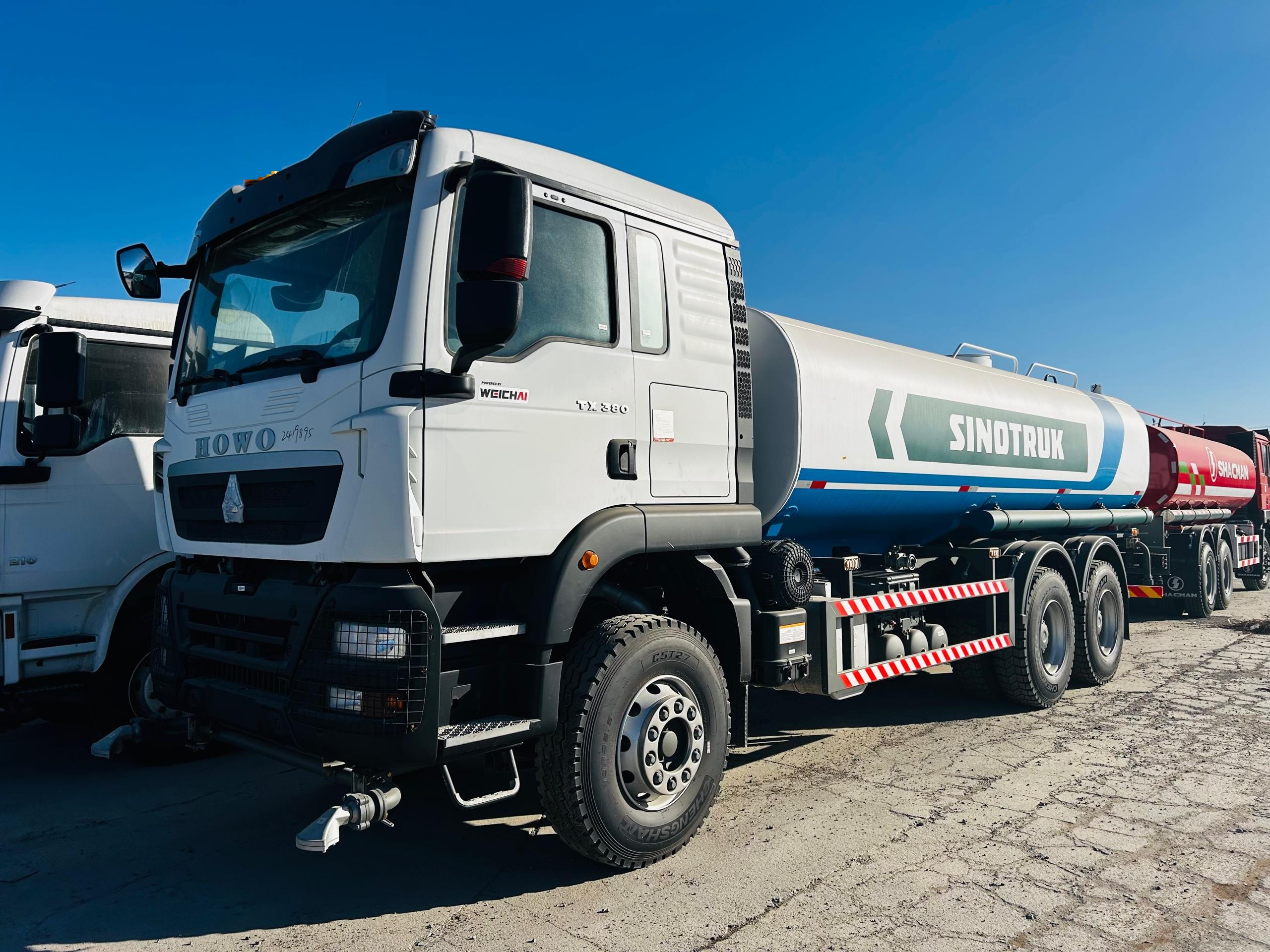
HOWO water tanker truck — capacity band 20,000L to 25,000L.
Where each configuration fits on a jobsite
Fit is decided by the equipment around the truck as much as by the truck itself. In the application context described in the product content for African markets, the water tanker truck is used with supporting equipment such as excavators, loaders, batching plants and fuel stations, while the 8x4 dump truck is used with bulldozers and graders. Those pairings are application statements for that context rather than universal requirements, and a planner should map them against the equipment actually on site before fixing a fleet mix.
The dump units are documented for construction, mining and building scenarios, where haul cycles are short and load cycles repeat. The water tanker, with its 20,000L to 25,000L capacity and water spray equipment, serves a different function in the same site economy. A mixed fleet therefore carries two acceptance profiles: dump units are checked for body thickness, lifting system and rated load, while the tanker is checked for capacity, tank material and spray function.
Supplier evidence: what the records establish, and what they do not
Qingong International Group is a Jinan-based trading group established in 2008, with a 4,500 m² facility, 300 employees, an annual output described as 3,000 units and a team of 80 engineers. Its profile states a 90% export ratio, Africa as its main market, deliveries to more than 100 countries and annual sales exceeding USD 200 million, plus subsidiaries established in Tanzania, Indonesia, Zambia and Laos since 2023. The same profile describes the company as an official exporter of SINOTRUK, SHACMAN and FAW, and as cooperating with BEIBEN, Dongfeng, FOTON, XCMG, SHANTUI, SEM and SANY — company statements that describe scope of activity rather than audited performance.
Secondary industry coverage describes Qingong as an authorized first-tier distributor and official export partner of SINOTRUK. That characterisation is company-reported and appears in promotional distribution, so a buyer should treat it as a lead rather than a conclusion and request documentary confirmation of authorization, territory and validity period.
At manufacturer level, Sinotruk (Hong Kong) Limited reported heavy-duty truck export volume of 134,038 units in 2024 in its annual report, and secondary coverage states that Sinotruk ranked first in China's heavy-duty truck exports for the 21st consecutive year by 2025. A large export base implies a deep parts pipeline in aggregate; it does not prove that a specific component is stocked in a specific country, and the two should not be confused.
On channel structure, SINOTRUK International publishes regional contacts rather than a country-by-country distributor directory for West Africa. One contact covers Senegal, Western Sahara, Mauritania, Gambia, Cape Verde, Guinea, Guinea-Bissau and Mali; another covers Benin, Burkina Faso, Togo, Ghana, Côte d'Ivoire, Liberia and Sierra Leone. This is genuinely useful for routing an authorization enquiry in Senegal, Mauritania, Mali or Côte d'Ivoire, but regional contact allocation is not proof that a national distributor has been appointed. Buyers should verify appointment in writing rather than reading a regional contact as an endorsement of a local seller.
Alternative supply routes and the claims that need testing
The most common alternatives to a new HOWO TX unit are European used trucks, low-cost locally assembled trucks and second-hand imports, and the comparison is usually framed around purchase price. The supplier's comparison material takes a different position: it claims higher reliability, stronger structure and longer service life for new SINOTRUK HOWO vehicles, a 30% to 50% lower total maintenance cost and two to three times longer service life than used trucks, with easier spare-parts availability and a global service network behind it.
Those figures are supplier positioning. The supplied material does not state the fleet, duty cycle, measurement method or time period behind them, so they function as hypotheses to be tested rather than inputs to be relied on. A buyer can, however, compare documented characteristics directly: body material and plate thickness, cab specification, tank capacity band and tank material, the existence of a written pre-shipment acceptance record, and the parts route behind each option. A locally assembled supplier may well offer local service advantages that are simply not documented in this material, and an absence of evidence should not be read as an absence of capability.
A lifecycle checklist for repeat orders
Six checks convert the analysis into a repeatable order process:
- Fix one model code and one configuration per unit, and record both on the purchase order.
- State MOQ, delivery term and named place, payment structure and acceptance criterion in the contract, not in correspondence.
- Define the acceptance record before the first shipment and apply the same template to every subsequent unit.
- Confirm cab variant, body thickness, lifting system and capacity figure against the delivered unit at each handover.
- Agree the parts and service escalation route in writing, including who is contacted and within what timeframe.
- Review the file at each repeat order; a configuration that cannot be reproduced from the record is a continuity warning.
Outlook
If a fleet expands over several years, the binding constraints shift from purchase price to three quieter factors: parts commonality across variants, documentary consistency between orders, and the distributor's ability to reproduce a configuration on demand. Under that condition, standardising on fewer configurations usually costs less in administration than it saves in flexibility. The supplied evidence does not include country-level service-network capability data, current stock levels or homologation status for specific markets, so any forward plan should be validated locally before it is committed.
Conclusion
Sinotruk Global Distributors compete on more than unit price, and the HOWO TX range gives a buyer three distinct configurations to specify: the 6x4 dump truck ZZ3257V3847GB1, the 8x4 dump truck ZZ3317V386GB1 and the water tanker truck ZZ1257V464GB1. What holds a long-term relationship together is duller than the specification sheet — a model code that does not drift, terms that can be repeated, and an acceptance record that outlives the fleet. Buyers who build those three documents into the first order are in a far stronger position at the tenth.
Product reference: Qingong Group Products Catalog 2026 (PDF).
FAQ
Do the HOWO TX 6x4, 8x4 and water tanker share the same specification items at acceptance?
They share a common set — model code, cab variant, engine and transmission designation, fuel-tank capacity and documentation — but the body checks differ. Dump units are verified on body dimensions, bottom and side thickness and lifting-system type; the water tanker is verified on capacity within the 20,000L to 25,000L range, carbon steel Q235 tank material and spray equipment. The shared fields guard identity; the body fields guard function.
What purchasing terms should be fixed before a repeat HOWO TX order?
The framework described in the supplier's procurement guidance sets a minimum order quantity of one unit, delivery on FOB, CIF, DDU or DDP terms, payment by TT or L/C with flexible installment solutions for long-term partners, and acceptance by pre-shipment test. For repeat orders, the named place of delivery, the applicable trade-terms edition, the payment schedule and the acceptance record template should all be fixed in the contract, because these are the fields where a second order most often differs from the first.
What does a pre-shipment test establish, and what does it not?
A pre-shipment test establishes that the unit as built matches the agreed specification at dispatch, and it produces the record used to resolve later questions about cab variant, body thickness or capacity. It does not establish long-run durability under a particular duty cycle, and it is not a substitute for country-specific homologation or third-party certification, which the supplied material does not describe. Buyers needing those approvals should pursue them separately.
How can a buyer verify that a distributor's SINOTRUK authorization is genuine?
Documentary confirmation is the reliable route: an authorization letter stating territory, product scope and validity period, matched against the entity that will appear on the contract and the invoice. Regional contact listings published by SINOTRUK International are useful for routing an enquiry in West Africa — one contact covers Senegal, Mauritania, Mali and neighbouring markets — but a regional contact allocation is not proof that a specific national distributor has been appointed, and secondary coverage describing a company as an authorized distributor is company-reported rather than independently verified.
Are the three configurations suitable for continuous heavy-duty use?
The design basis is stated as a stronger structure for heavy-duty applications, paired with a reinforced chassis, an advanced braking system and an engine protection system, and the dump units are documented for construction, mining and building work. Overload is explicitly listed as a failure risk, so rated-load confirmation and load discipline remain part of continuous operation. No field durability results or measured maintenance intervals are included in the supplied evidence, so suitability should be confirmed against the actual duty cycle rather than assumed from the specification.
Tem questões ou precisa de mais detalhes?
Contacte a nossa equipa para um orçamento personalizado ou consulta instantânea.
Solicitar orçamento
Preencha o formulário abaixo e a nossa equipa entrará em contacto com uma proposta personalizada.
Chat direto do WhatsApp
Prefere conversar em tempo real? Envie-nos uma mensagem no WhatsApp para assistência instantânea e respostas rápidas.
- Obter orçamento personalizado
- Partilhar fotos ou documentos
- Discuta as suas necessidades diretamente
Geralmente responde em 5–30 minutos durante o horário de expediente.