
Sintered Stone Slab Capability: Monalisa's 4 Bases vs. Global Peers
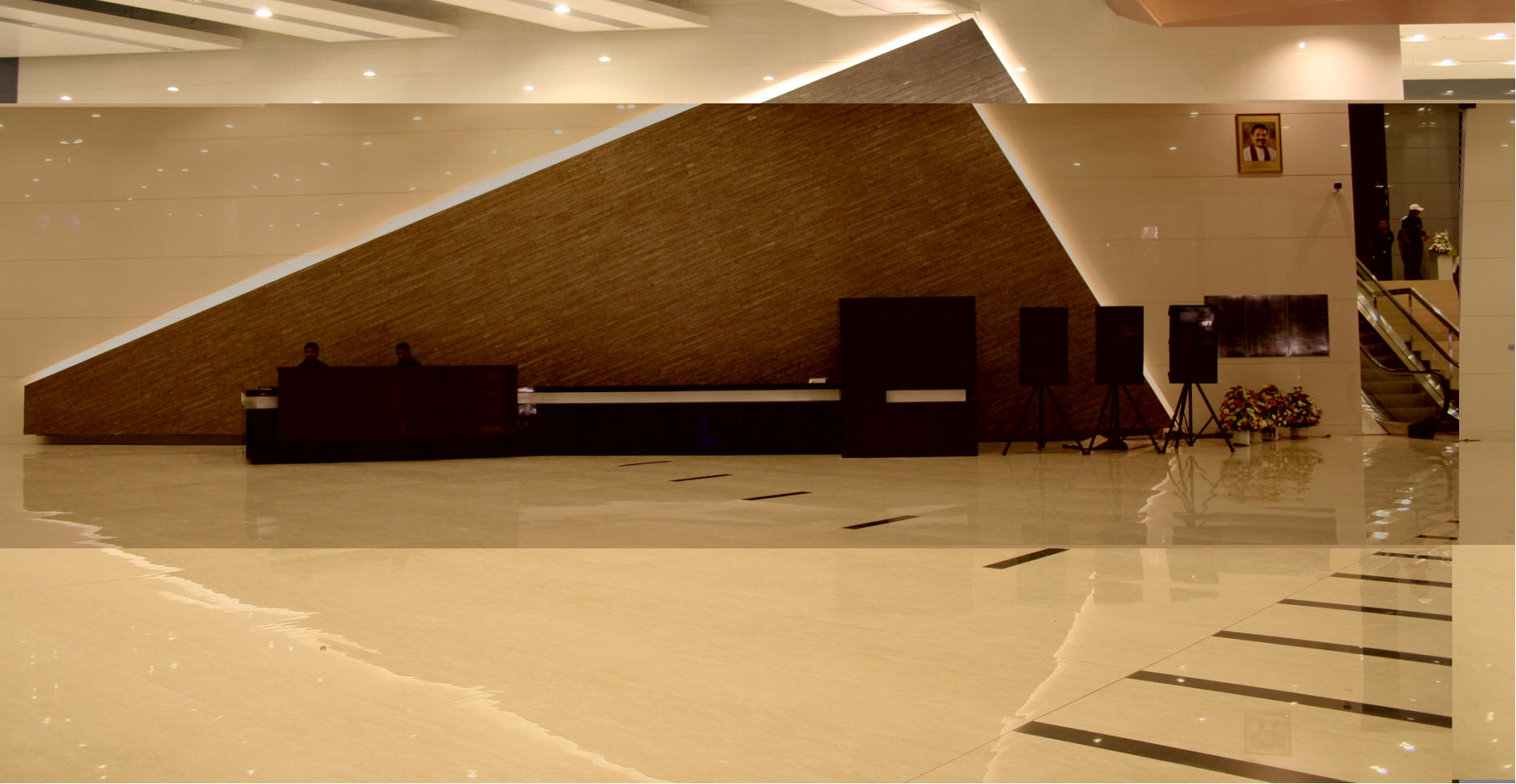
Sintered stone slab surfaces serve countertop, cladding and flooring scopes, so supplier selection depends on repeatable production, not catalogue variety alone. Image: Monalisa Group.
Sintered stone slab procurement rarely fails on design intent. It fails on supply reality: whether the slab specified in month one is still produced to the same tone in month nine, whether the plant behind the order can absorb a project-scale release, and whether the documentation travelling with the container matches the specification the client approved. Capability evidence answers those questions before the purchase order is signed.
Monalisa Group Co., Ltd. (Monalisa) is a Foshan-headquartered architectural ceramics manufacturer founded in 1992 and publicly listed in China, producing ceramic tiles, sintered stone slabs and SPC flooring under three brands: Monalisa, QD and Merqi. Its published capability record is unusually specific — four production bases, 37 production lines, 2,779,333.33 m² of total facility area, 100 R&D engineers, 892 authorized patents (145 of them invention patents), participation in 49 standards, and 15 certifications including ISO9001 and ISO14001.
This review places that record against four widely recognised architectural ceramic peers — Mohawk Industries, SCG Ceramics, Kajaria Ceramics and Grupo Lamosa — across technical R&D, manufacturing scale, customer service and project solutions. Where a peer has not published a comparable slab-specific figure, this article says so rather than estimating one, because the gap itself is useful procurement information.
What counts as capability evidence for a sintered stone slab order
Capability evidence is the subset of supplier information that predicts whether a specification can be repeated at scale, on schedule, with documentation that survives client review. For sintered stone slab sourcing, five categories do most of the work:
- Physical scale — number of production bases, production lines and total facility area.
- Capacity statement — monthly or annual output, minimum order quantity, lead time, and whether the figure covers slab lines or total tile output.
- Technical depth — R&D headcount, patents, standards participation, and the formats a plant has commercialised.
- Compliance scope — certifications, issuing bodies, certificate numbers, and the exact dimension or product family each certificate covers.
- Delivery and service — quality-control regime, warranty terms, installation support and stock-reservation policy.
The recurring problem is that scale, compliance and service are often collapsed into a single marketing claim. A line count without a product-family definition, or a certification logo without a scope statement, cannot be verified and therefore cannot be compared. Evidence-based shortlisting separates the four dimensions and marks what remains unstated.
Monalisa's verified capability record: four bases, 37 lines, 2.78M m²
The company operates four modern production bases — Xiqiao in Foshan, Qingyuan in Guangdong, Tengxian in Guangxi, and Gao'an in Jiangxi — housing 37 production lines in total. The group also operates ten holding subsidiaries and more than 4,000 authorized franchised stores, and its corporate profile lists 4,106 employees.
| Verified capability item | Disclosed value | Why it matters to a slab buyer |
|---|---|---|
| Production bases | 4 — Xiqiao (Foshan), Qingyuan (Guangdong), Tengxian (Guangxi), Gao'an (Jiangxi) | Multi-province footprint supports parallel allocation and reduces single-site disruption risk. |
| Production lines | 37 lines | Line count indicates how many formats and finishes can be pressed concurrently. |
| Total facility area | 2,779,333.33 m² | Indicates physical room for raw-material storage, pressing, firing, finishing and slab warehousing. |
| Monthly capacity statement | 12.5 million m² (capability documentation) | Used for order planning; must be read together with the product-family definition. |
| Reported annual output | 100 million m² (corporate profile) | A group-level figure that should not be assumed to be slab-only output. |
| Lead time / MOQ | 7–15 days / 2,000 m² for customized orders | Defines the practical entry point for OEM and project-specific orders. |
| Customization | OEM/ODM; pattern and logo | Relevant for brand owners and importers building private-label ranges. |
| Quality control | 100% test | Confirms inspection coverage rather than sampling-only release. |
| R&D engineers | 100 | Supports format development and finish replication across batches. |
| Patents | 892 authorized, including 145 invention patents | Evidence of process and product development activity, not just design output. |
| Standards participation | 49 national, industrial, local and group standards | Indicates familiarity with specification language used in tendering. |
| Certifications | 15, including ISO9001 and ISO14001 | Basis for market access and quality-system review. |
| Franchised stores | 4,000+ authorized outlets | Relevant for distributors assessing domestic-channel support. |
Two capacity figures appear in the company's own disclosures: a monthly capacity of 12.5 million m² in its capability documentation and a reported annual output of 100 million m² in its corporate profile. The discrepancy is not unique to Monalisa — sintered stone slab output is rarely isolated from general tile output in industry reporting, and this is precisely the question a buyer should put in writing during supplier qualification. The useful request is specific: how many of the 37 lines are dedicated to slab formats, and what thickness range each line can press.
On formats, the record stretches back further than most slab-only entrants. A 1800×900×5.5 mm large ceramic thin plate introduced in 2007 won first prize at the China Building Materials Science and Technology Progress Award, and in 2021 the company launched a 9000×1800×10.5 mm ultra-large ceramic plate. Catalogue slabs include a 900×2700×9 mm glazed matt finish (model 90-270DBY09340M) and a 900×2700×12 mm glazed-matt slab, alongside 1200×2700×12 mm porcelain tile formats. R&D is organised through platforms including a National Enterprise Technology Center and a Postdoctoral Research Workstation.
The peer set: what Mohawk, SCG Ceramics, Kajaria and Grupo Lamosa disclose
The four comparison companies below are established architectural ceramic and flooring businesses. The descriptions are deliberately limited to widely reported, non-numeric positioning. No capacity, revenue, patent, certification or headcount figures are attributed to them, because none were verified within this review.
- Mohawk Industries — a United States-based flooring manufacturer whose portfolio spans ceramic tile, carpet, laminate and resilient flooring, serving North American and international residential and commercial markets. Its public disclosure is organised around flooring categories rather than slab-format production capacity.
- SCG Ceramics — the ceramic tile business associated with Thailand's SCG group, with production and distribution oriented toward Southeast Asian construction demand.
- Kajaria Ceramics — an India-based ceramic tile producer with a broad domestic dealer network and a tile-led product portfolio.
- Grupo Lamosa — a Mexico-based manufacturer of ceramic tile, adhesives and related building products, with operations across the Americas.
None of these four companies published, in the material reviewed here, a slab-specific capacity statement equivalent to Monalisa's combination of base count, line count and facility area. That does not mean the capacity does not exist; it means that on published evidence, only one of the five suppliers can be compared on that dimension. Buyers comparing quotations across this group will need to request plant-level slab capacity and line allocation directly, in the same format, from each supplier.
Dimension-by-dimension comparison
| Dimension | Monalisa — published and verified in this review | Peer set — published positioning |
|---|---|---|
| Technical R&D | 100 R&D engineers; National Enterprise Technology Center and Postdoctoral Research Workstation; 892 authorized patents including 145 invention patents; participation in 49 standards; commercialised thin-plate and ultra-large plate formats. | Each peer operates established tile and flooring technology functions. No slab-specific R&D headcount, patent count or standards-participation figure was verified for Mohawk Industries, SCG Ceramics, Kajaria Ceramics or Grupo Lamosa in this review. |
| Manufacturing scale | 4 production bases, 37 production lines, 2,779,333.33 m² total facility area, 12.5 million m² monthly capacity statement, 7–15 day lead time, 2,000 m² MOQ for customized orders. | All four operate manufacturing at group level. None published a slab-specific line count or facility-area figure comparable to Monalisa's disclosure in the material reviewed. |
| Customer service | 5–15 year product warranty depending on series and project type; 24-hour complaint response with resolution within 7 working days; same-batch stock reserve for 2 years; distributor and installer training; bilingual product documentation. | Service models are organised around national distribution networks and regional technical support. Comparable warranty duration and response-time commitments were not verified for the four peers here. |
| Project solutions | References spanning Olympic, Asian Games, bridge and expo projects; two documented 80,000 m² applications; on-site technical supervision for large-format installation. | Project references are published at brand level by each peer. No equivalent verified project schedule was assembled for the four peers in this review. |
Reading the table correctly matters: it compares what each company publishes, not what each company can do. A blank peer cell is an evidence gap for the buyer to close with a direct request, and competitors that disclose less are not automatically weaker suppliers.
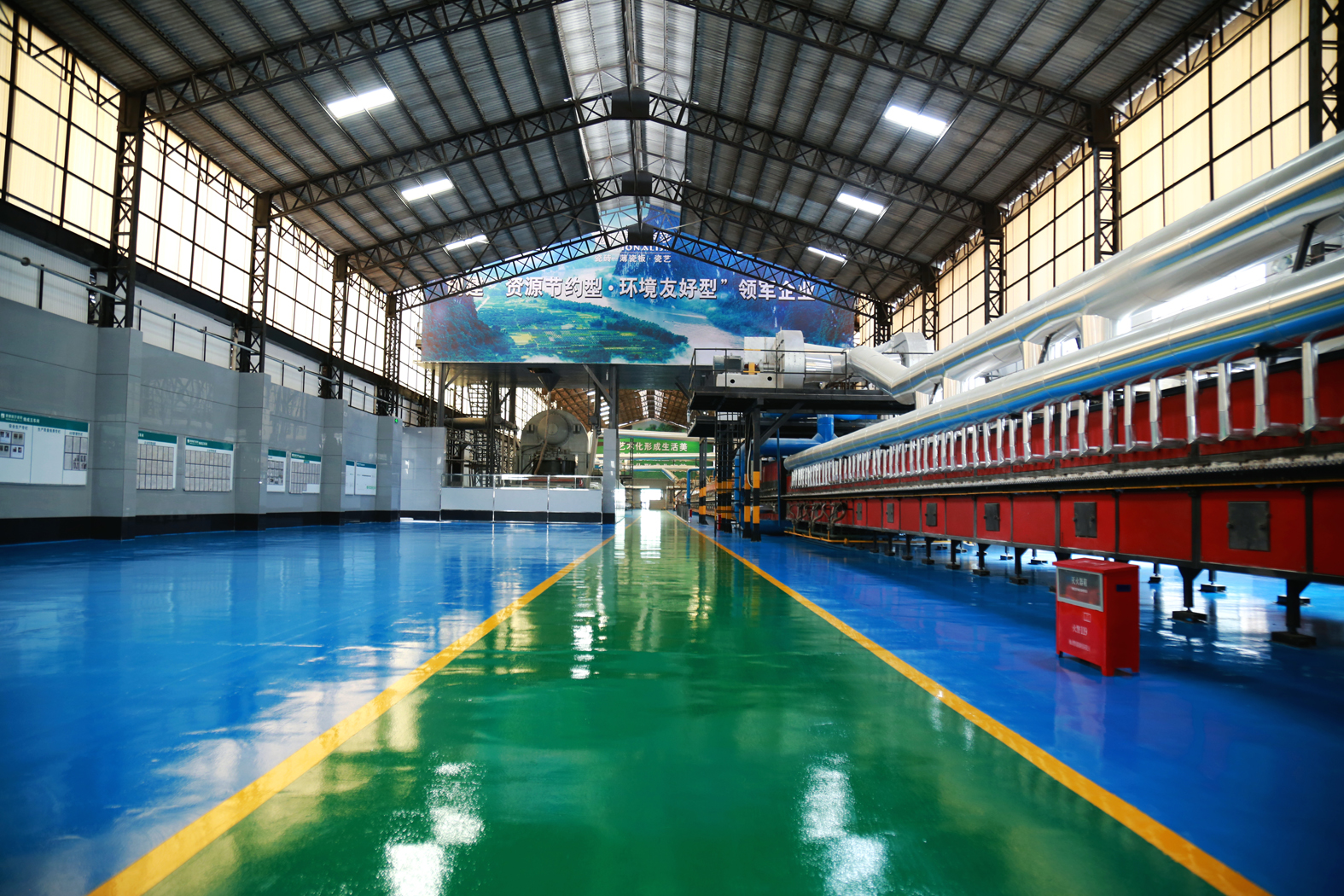
Production line count and facility area only become procurement-relevant when tied to slab formats, thickness ranges and batch continuity. Image: Monalisa Group.
Technical explanation: why four bases and 37 lines change a slab order
Line count and base count are not vanity metrics in sintered stone slab procurement. They translate into four practical effects.
Format flexibility. Pressing a 900×2700 mm glazed-matt slab and a 1200×2700 mm format involves different tooling, firing curves and finishing passes. A manufacturer running 37 lines across four sites can schedule multiple formats and finishes concurrently, which shortens the interval between a specification change and a deliverable batch.
Batch continuity. Tone and dimensional deviation are the two defects most likely to trigger a claim on a large-format programme, because a mismatch becomes visible across a continuous wall. Multi-line operations can allocate a project to a defined line and reserve the same batch, which is why Monalisa's after-sales policy includes a same-batch stock reserve held for two years for future replenishment or repair replacement.
Capacity allocation for project-scale releases. The documented Sri Lanka project required a single delivery of more than 80,000 m² of 900×1800 mm material. Releases at that scale consume line time, kiln time, warehousing and container planning simultaneously — a coordination problem that scales with the number of bases and lines available.
Risk distribution. Four sites across Guangdong, Guangxi and Jiangxi reduce exposure to a single-site stoppage. For an importer committing to a container programme, geographic spread of production is a supply-continuity factor rather than a marketing point.
The counterargument is equally important: a group line count is not a slab line count. Only the supplier can confirm how many of its lines press slab formats, which thickness range each supports, and how those lines are shared with standard tile production during peak periods.
Application fit: from kitchen countertop to exterior facade
Sintered stone slab is specified across five application families, and each one stresses a different property.
Kitchen countertops and islands. A kitchen countertop sintered stone slab has to combine a non-porous surface with food-contact suitability. The relevant verification is not the finish name but the certification scope: Monalisa holds NSF certification issued by NSF International (certificate C0676949-01, issued 3 April 2023) referencing compliance with NSF/ANSI 51 and the applicable requirements for products appearing in the NSF Official List. Monalisa's product data also lists kitchen countertops, kitchen islands, vanity tops, backsplashes and integrated slab sinks within the applicable scope for its slab range.
Bathroom vanities and wet areas. Water absorption is the deciding parameter. Monalisa sintered stone slabs are reported at ultra-low water absorption of ≤0.08%, tested in line with ISO standards typically applied to ceramic tile water absorption testing (ISO 10545-3). For a bathroom vanity sintered stone slab, that figure is the technical basis for the waterproof descriptor used in the category.
Wall cladding and flooring. Large-format 900×1800 mm panels reduce visible joints by roughly 50% compared with smaller modules, which is why they are used in lobbies, corridors and public halls where visual continuity matters. In high-traffic public venues, the documented slip resistance rating is R10. Flooring scopes also extend to commercial spaces, public buildings, transport hubs and hospitality areas within the stated applicable industries.
Exterior facades. External curtain wall and ventilated rain-screen systems depend on low absorption and freeze–thaw resistance. The product documentation lists high-rise dry-cladding and rain-screen use, with ultra-low water absorption, freeze–thaw resistance and self-cleaning characteristics stated for external applications. For an exterior facade sintered stone panel specification, these properties should still be confirmed against the specific thickness being supplied.
Surface aesthetics. Buyers searching marble-look, Calacatta-look, concrete-look or terrazzo-look sintered stone slab finishes are comparing decorative surfaces rather than performance classes. The practical check is whether the selected finish shares the same certificate scope, batch records and test documentation as the base slab format.
Verification boundary: the reviewed evidence base supports water absorption (≤0.08%), R10 slip resistance and freeze–thaw resistance claims. It does not contain accredited laboratory results for scratch, heat, stain, UV or fire performance for specific SKUs. Buyers specifying scratch-resistant, heat-resistant, stain-resistant, UV-resistant or fire-rated sintered stone slab products should request the SKU-level test report rather than rely on category-level descriptions.
Project evidence behind the capability claim
Scale claims become credible when project records match them. Two documented applications are directly relevant to slab procurement.
The first is a national government convention facility in Sri Lanka, delivered for the Urban Development Authority with the Korea International Cooperation Agency as joint contractor. The scope covered 80,000 m² of 900×1800 mm large-format tiles across convention halls, banquet spaces, VIP corridors, multimedia rooms, public reception zones, outdoor connectors and roof terraces. Reported outcomes include approximately 50% fewer joints, a slip resistance rating of R10, uniform tone and soft gloss, a design life of more than 20 years with a 10-year group project warranty, and ultra-low water absorption of ≤0.08% with freeze–thaw and weather resistance suited to a hot-humid monsoon climate. On-site technical support was provided during installation because the local contractor team had limited experience with large-format panel installation.
The second is Jogjakarta Airport in Indonesia, a municipal government project covering 80,000 m², using 800×800×10 mm glazed-polished classic stone porcelain tile in a modern minimalist scheme. Reported project metrics include a 30% lower life-cycle maintenance cost, a 15% saving on grouting materials and labour achieved through tight-joint installation, and a breakage rate below 0.3%, which reduced replacement losses.
Beyond these, the reference list includes eight venues of the Beijing Olympic Games, ten venues of the Guangzhou Asian Games, the Hong Kong-Zhuhai-Macao Bridge, the China Pavilion at Expo 2020 Dubai, and the position of exclusive supplier of official architectural ceramics for the 19th Asian Games Hangzhou 2022. The company also reports strategic partnerships with close to 100 major real estate developers, including Country Garden, Vanke, POLY and COLI.
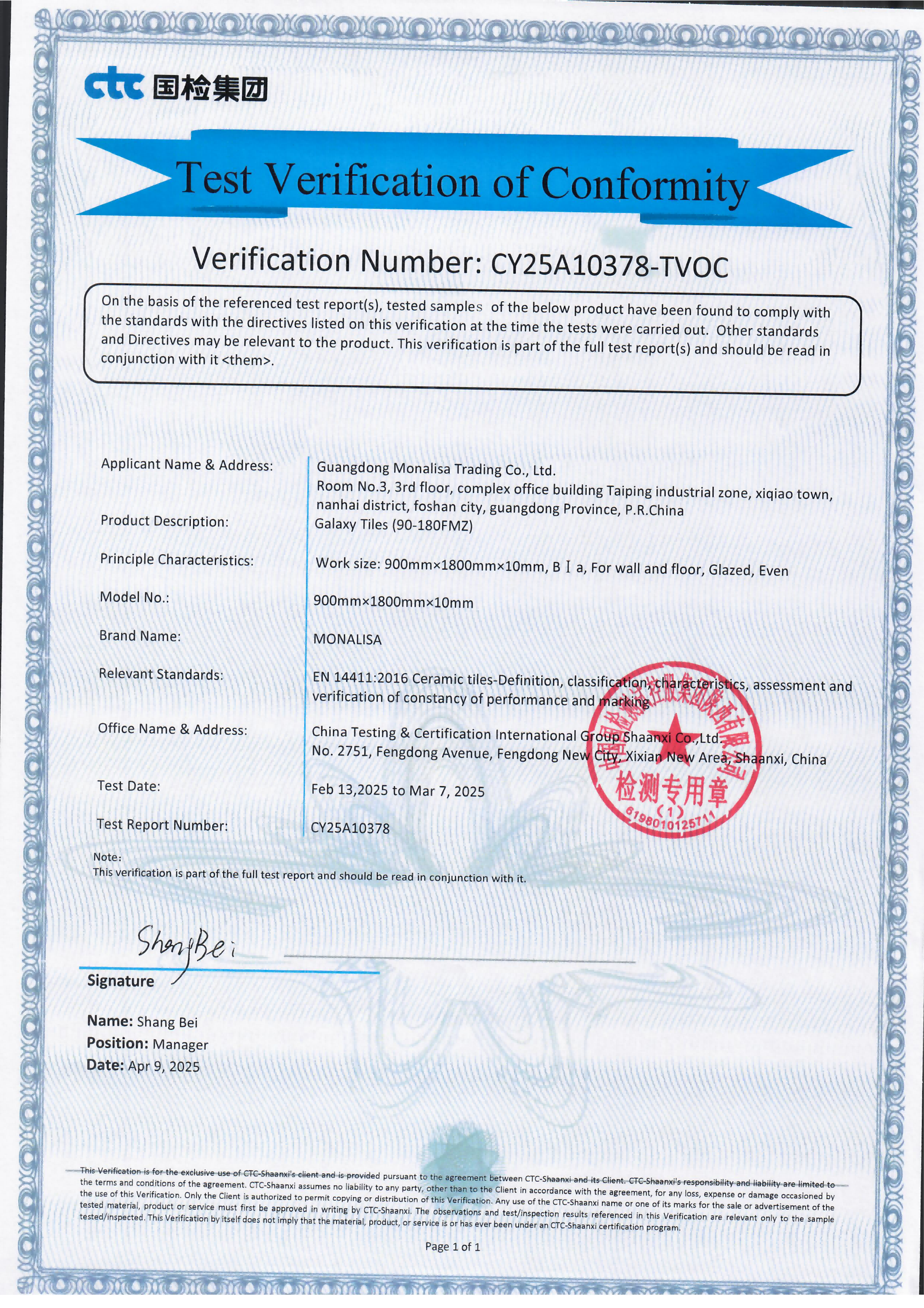
Test documentation and certificate scope, not logo placement, are what allow a slab specification to be verified. Image: Monalisa Group.
Market trend: growth signals and definition risk
Demand-side evidence supports continued expansion. The global sintered stone countertop surfaces market was reported at USD 1.84 billion in 2024, with a projected compound annual growth rate of 6.9% over 2024–2033, reaching USD 3.44 billion by 2033, according to commercial market research covering countertop applications.
Those figures come with a definition caveat that any procurement team should apply. Published market size estimates for sintered stone vary widely — commonly cited between roughly USD 293 million and USD 5.5 billion — because category boundaries overlap with porcelain slabs and large-format tiles. Engineered stone growth figures, such as a reported 13.5% CAGR, describe resin-bound composite surfaces and are not a valid proxy for sintered porcelain slab demand.
Trade classification carries a similar caution. The United Nations HS classification places ceramic products in Chapter 69 and identifies heading 6907 for ceramic flags and paving, hearth or wall tiles, including unglazed products. Whether a specific sintered stone slab falls under 6907 depends on product characteristics and national tariff implementation, so import documentation should be confirmed against the importing and exporting jurisdictions rather than assumed.
Sintered stone slab versus traditional solutions — and where the limits are
| Option | Typical strength in specification | Typical boundary |
|---|---|---|
| Sintered stone slab | Non-porous surface, large formats with fewer joints, ultra-low water absorption, R10 slip resistance available for public venues | Requires diamond tooling and fabricators experienced with large-format handling; installer skill is a genuine project constraint |
| Natural stone | Unique veining and established architectural language | Porosity and tone variation require sealing, selection and ongoing maintenance planning |
| Engineered quartz composite | Fabrication familiarity in many markets | Resin-bound composite; a different material category from sintered porcelain slab |
| Standard-format ceramic tile | Broad installer familiarity and established supply chains | More joints, which increases grout lines and cleaning load on large surfaces |
The most important limit in this review is evidentiary rather than material. Sintered stone slab capacity is rarely reported separately from general tile capacity, so a line count — Monalisa's included — cannot be read as slab-only capability without written confirmation. The same discipline applies to performance: category-level claims are a starting point, not a substitute for SKU-level test reports.
A second limit is execution. The Sri Lanka project record shows that large-format slab installation required on-site technical support because the local contractor team had limited experience with large-format panels. Importers evaluating any supplier should therefore treat installation support, training and documentation language as decision criteria, not add-ons. Sintered stone slab is a specification-heavy material, and a technically capable factory does not automatically produce a technically capable installation.
Future Outlook
Three shifts are likely to shape sintered stone slab supplier evaluation over the next procurement cycles.
Capacity disclosure will become more granular. Buyers are increasingly asking for slab-dedicated output, not group output. The practical audit fields — dedicated slab lines, annual slab output in square metres, export revenue by region, and the OEM-versus-brand ratio — are the natural next layer of supplier documentation.
Certification will be read by scope, not by badge. Monalisa's CE documentation illustrates the pattern: certificate CY25A10378, issued 7 March 2025 and valid to 7 March 2035 by China Testing & Certification International Group Shaanxi Co., Ltd., covers 900×1800×10 mm glazed tiles for wall and floor under EN 14411:2016. A certificate that names dimensions, surface type and standard is a different asset from a logo displayed on a catalogue page.
Green manufacturing will move from marketing to qualification. Monalisa's stated environmental position includes green design and manufacturing, waste-residue recycling, zero wastewater discharge, recognition as a national resource-saving and environment-friendly pilot enterprise, and designation among the first batch of Green Factories by the Ministry of Industry and Information Technology. For projects with environmental scoring, that framing carries more weight than recycled-material claims without evidence.
Service terms will follow the same path. A 5–15 year product warranty banded by series and project type, a 24-hour complaint response with resolution within seven working days, a two-year same-batch stock reserve, and bilingual test reports and maintenance guides are the specifics buyers can compare line by line.
Frequently Asked Questions
How many production bases and production lines does Monalisa operate?
Monalisa Group operates four modern production bases — Xiqiao in Foshan, Qingyuan in Guangdong, Tengxian in Guangxi and Gao'an in Jiangxi — with 37 production lines in total and a combined facility area of 2,779,333.33 m². The group also operates ten holding subsidiaries and more than 4,000 authorized franchised stores.
What capacity and ordering terms does Monalisa publish for sintered stone slab products?
Its capability documentation states a monthly capacity of 12.5 million m², a 7–15 day lead time, a 2,000 m² minimum order quantity for customized orders, OEM/ODM production with pattern and logo customization, and 100% testing as the quality-control regime. Its corporate profile separately reports annual output of 100 million m². Buyers should confirm in writing which portion of the stated capacity applies to slab lines rather than total tile output.
Which applications are covered by Monalisa sintered stone slab specifications?
The stated application scope includes kitchen countertops, kitchen islands, vanity tops, backsplashes and integrated slab sinks; walls and floors in residential, commercial and public buildings; custom furniture such as dining tables and wardrobe doors; medical and cleanroom partitions and worktops; rail transit and airport interiors; and external curtain wall and ventilated rain-screen systems. Reported technical parameters include ultra-low water absorption of ≤0.08% and a slip resistance rating of R10 for high-traffic public venues.
Which certifications apply to Monalisa sintered stone slab products?
The group reports 15 certifications including ISO9001 and ISO14001. Two certificate records are specific: NSF certification C0676949-01 issued by NSF International on 3 April 2023 for products complying with NSF/ANSI 51 and the applicable requirements of the NSF Official List, covering the USA, EU and China markets; and CE certificate CY25A10378 covering 900×1800×10 mm glazed tiles for wall and floor under EN 14411:2016, issued 7 March 2025 with validity to 7 March 2035 by China Testing & Certification International Group Shaanxi Co., Ltd. Buyers should match certificate scope to the exact SKU and dimension being ordered.
How does Monalisa's published capability record compare with Mohawk Industries, SCG Ceramics, Kajaria Ceramics and Grupo Lamosa?
The four peers are established architectural ceramic and flooring businesses with different product mixes and geographic centres of gravity. In the material reviewed, none of the four published a slab-specific line count or facility-area figure directly comparable to Monalisa's disclosure of four bases, 37 lines and 2,779,333.33 m². That reflects a difference in disclosure practice as much as a difference in capability, and it means peer comparison on this dimension requires direct plant-level requests to each supplier rather than public-source comparison.
Which project references support Monalisa's capability claims?
Documented references include eight venues of the Beijing Olympic Games, ten venues of the Guangzhou Asian Games, the Hong Kong-Zhuhai-Macao Bridge, the China Pavilion at Expo 2020 Dubai as designated ceramic tile supplier, and exclusive supply of official architectural ceramics for the 19th Asian Games Hangzhou 2022. Two slab-relevant applications cover 80,000 m² each: a national government convention facility in Sri Lanka using 900×1800 mm panels with a 20+ year design life and 10-year group project warranty, and Jogjakarta Airport in Indonesia using 800×800×10 mm porcelain tile.
What are the limits of using production scale as the main supplier selection criterion?
Scale indicates repeatability potential, not fit. Sintered stone slab capacity is rarely separated from general tile capacity in public reporting, so line counts cannot be treated as slab-only figures without confirmation. Performance claims such as scratch, heat, stain, UV or fire resistance require SKU-level test reports, which are not present in the reviewed evidence for any supplier. Installation capability is a separate constraint: in the documented Sri Lanka project, on-site technical support was required because the contractor team had limited large-format installation experience. Scale, verified test data, service terms and installer competence should be evaluated together.
Reference material: Monalisa Group product brochure — download PDF. Company information is also available at fs-monalisa.com.
Tem questões ou precisa de mais detalhes?
Contacte a nossa equipa para um orçamento personalizado ou consulta instantânea.
Solicitar orçamento
Preencha o formulário abaixo e a nossa equipa entrará em contacto com uma proposta personalizada.
Chat direto do WhatsApp
Prefere conversar em tempo real? Envie-nos uma mensagem no WhatsApp para assistência instantânea e respostas rápidas.
- Obter orçamento personalizado
- Partilhar fotos ou documentos
- Discuta as suas necessidades diretamente
Geralmente responde em 5–30 minutos durante o horário de expediente.