
Sintered Stone Slab Orders: Terms, Acceptance, Capability
Sintered Stone Slab Orders: Terms, Acceptance, Capability
Most problems on a sintered stone slab order surface after the containers arrive, and they are rarely about the material. They come from three gaps: commercial terms that were agreed verbally and never written into the order, acceptance criteria that were listed as headings rather than as a sampling method, and a documentation file that describes a different configuration from the one being shipped.
This reference answers the questions buyers raise between supplier evaluation and order execution: what the purchasing terms actually cover, how acceptance should be written into the contract, how sample-to-bulk consistency is held over a production run, which documents need scope-checking before release, and how a manufacturer's capability position should be read when the buyer is choosing between global benchmark names. Monalisa Group Co., Ltd. (Monalisa), founded in 1992 and headquartered in Foshan, Guangdong Province, is a listed manufacturer of architectural ceramics whose range covers ceramic tiles, sintered stone slabs and SPC flooring; its published terms, certificate identifiers and project record are specific enough to test against, and are used here as the worked example. Laminam, Neolith, Dekton and Florim appear as the benchmark names buyers usually shortlist alongside it. This article does not assert specifications, capacity or certifications for those companies, and nothing here should be read as a measured share of the global slab market.
Five questions this reference answers
- What do standard purchasing terms cover, and what must be confirmed in writing?
- How should acceptance checks be specified so that they are enforceable?
- How is sample-to-bulk consistency held after mass production begins?
- Which documents need their scope matched to the ordered SKU?
- What can Monalisa's disclosed capability record establish, and what can it not?
What Do Standard Purchasing Terms Cover on a Sintered Stone Slab Order?
The commercial framework on a Monalisa slab order is fixed by five items: a minimum order quantity of 2,000 m², delivery on FOB, CIF or EXW terms, payment by TT or LC, production lead time of 7–15 days, and OEM or ODM production with customisation of pattern and logo. Those are ordinary export terms, and that is precisely the point — none of them fixes quality. They fix who carries cost and risk at each stage of the shipment.
The Incoterm decides where risk transfers and which party arranges pre-shipment inspection, insurance and inland haulage. A buyer on EXW carries the entire movement; a buyer on CIF has the seller arrange freight and insurance but still needs its own inspection before loading. The payment method matters for a different reason: a letter of credit turns the document set into a payment condition, so every certificate, test report and packing list the buyer wants to see must appear in the credit itself. A document requested by email after shipment has no leverage.
Two figures need to be read carefully. Monalisa reports monthly capacity of 12.5 million m² and group annual output of 100 million m². These are reported at different scopes and reference periods, and the annual figure covers the group's full product range — tiles, slabs and SPC flooring — rather than slabs alone. A buyer sizing slab capacity for a specific format and thickness should ask for that figure directly in the RFQ rather than deriving it from a group total. The same caution applies to lead time: 7–15 days should be confirmed in writing as production time, because sampling rounds, custom pattern development, packing and inland transport sit outside it.
| Term | Stated position | Confirm before signing |
|---|---|---|
| Minimum order | 2,000 m² | Whether the threshold applies per SKU or per order, and how a custom pattern affects it |
| Delivery terms | FOB / CIF / EXW | Which port, who arranges inspection and insurance, and where risk transfers |
| Payment | TT / LC | Which documents the credit requires — certificates, test reports, packing list |
| Lead time | 7–15 days | Whether this covers production only, and when the clock starts |
| Customisation | OEM / ODM; pattern and logo | Master-plate approval route and who owns the approved pattern |
| Capacity | 12.5 million m² monthly; 100 million m² group annual output | Slab-specific output for the ordered format and thickness |
How Should Acceptance Criteria Be Written Into the Order?
Acceptance on a Monalisa shipment runs in three documented steps, and each one answers a different failure mode. The first is a packaging and labelling check: outer packaging intact and free of moisture or damage, certificate of conformity and installation guide inside the carton, and labels matching the order for shade, size and quantity. The second is carton opening on a random 5%–10% of cartons, comparing actual colour and pattern against the approved reference sample or master plate and verifying quantity and grade. The third is a rapid dimensional and flatness check using a vernier calliper, feeler gauge and straightedge, measuring at least ten pieces per batch for length and thickness.
Used as written, these three steps catch the three most expensive order errors: a shade that drifted from the approved plate, a carton count that does not reconcile with the packing list, and a format that will not close at the specified joint width. Used loosely, they catch nothing, because a checklist that records only pass or fail destroys the evidence a buyer needs three months later.
Three drafting decisions make the sequence enforceable. First, define the batch, because ten pieces per batch is meaningless if a batch is undefined. Second, record measured values rather than verdicts, so drift across successive batches stays visible in the file. Third, separate screening from testing: a calliper and straightedge check is a shop-floor screen for gross dimensional and flatness deviation, not a substitute for the laboratory data held in the technical file. Defect categories and their disposition — accept, replace, or credit — should be agreed at the same time as the sampling rate, before the first container is packed.
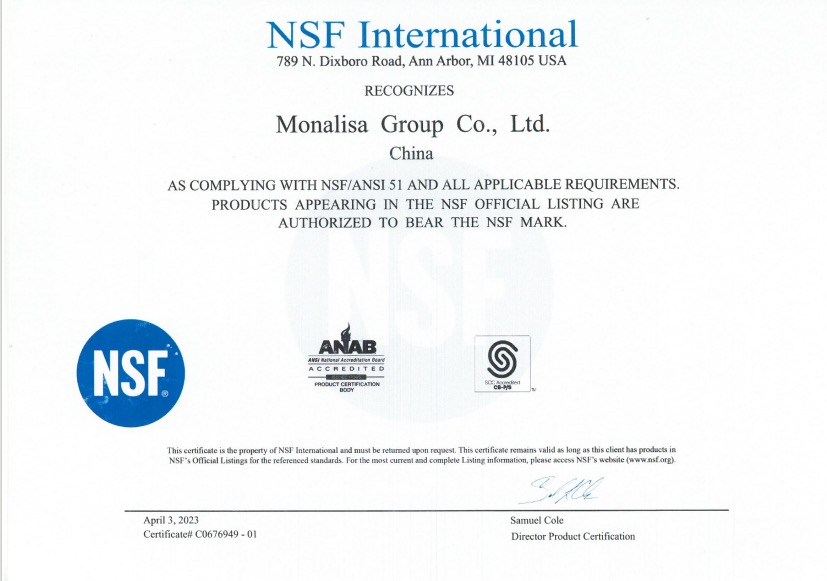
NSF certification is one item in the pre-release document set; the certificate scope must be matched to the slab configuration actually ordered.
How Do Buyers Hold Sample-to-Bulk Consistency?
Consistency is a contract artefact before it is a production outcome. The approved master plate has to exist in physical form, be signed by both parties, and be sealed and retained at each end, because the 5%–10% carton-opening check has no meaning without a reference to open the carton against. Cartons should carry batch identification so that any later complaint can be traced to a specific production run rather than to the order as a whole.
Monalisa's after-sales structure adds one element that matters for large installations: same-batch stock is held for two years for future replenishment and repair. That addresses the most common late-stage failure on a project — damage during second-fix work with no matching material available — but it only works if the retained stock is drawn from the same production run as the installed material. Confirm that in writing, and confirm what happens after the two-year window closes.
OEM and ODM work changes the risk profile. When pattern or logo is customised, there is no catalogue SKU to point to, and the approved master plate becomes the only contractual standard for colour, pattern alignment and repeat. Approve it in writing before mass production begins. Monalisa also states 100% testing in its quality-control description; the specific test items, methods and pass criteria behind that figure should be obtained as a written control plan, since the phrase alone tells a buyer that testing happens, not what it screens for.
Two practical details are worth settling at the same time. Agree the viewing condition for shade comparison — illuminance and viewing angle — because a plate that matches in a warehouse doorway can read differently under showroom lighting. And agree how the reference plate will be stored, because a master plate that has been handled for two years is no longer a master plate.
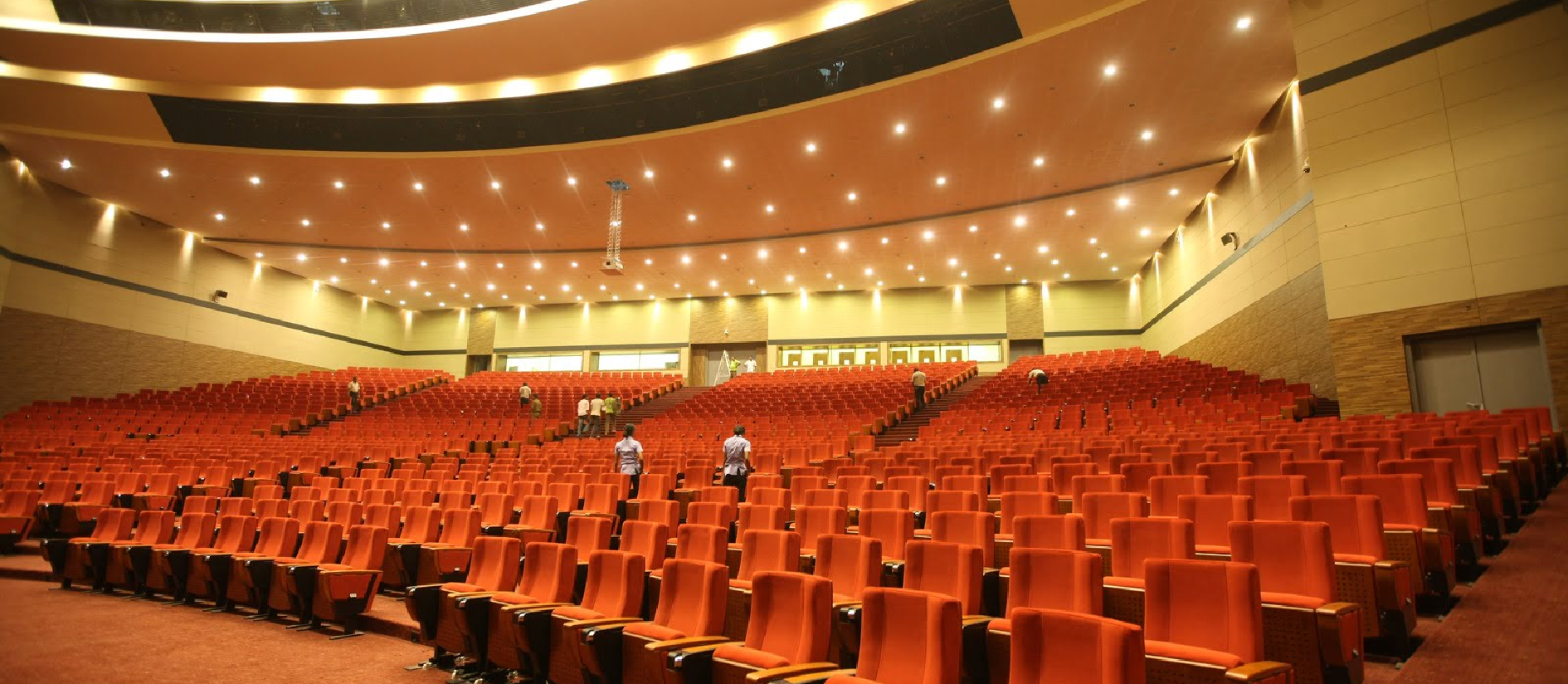
The approved reference specimen, not the catalogue image, is the standard the bulk shipment is checked against.
Which Documents Should Be Reviewed Before the Order Is Released?
Document review fails most often not because a certificate is missing but because it describes a different configuration. The check that matters is scope matching: does the certificate cover the format, thickness and finish on the purchase order?
Monalisa reports 15 certifications, among them ISO9001 and ISO14001. Its NSF record carries certificate number C0676949-01, issued by NSF International on 3 April 2023 with a listed expiry of 3 April 2999, and a scope stating that products appearing in the NSF official listing are authorised to bear the NSF mark. Its CE record carries number CY25A10378, issued by China Testing & Certification International Group Shaanxi Co., Ltd. against EN 14411:2016, covering 900×1800×10 mm glazed product for wall and floor, class BIa, issued 7 March 2025 and valid to 7 March 2035.
That CE scope is a specific configuration, and this is where buyers get caught. Monalisa's catalogue also lists a 900×2700×9 mm glazed matt slab. A declaration written for a 900×1800×10 mm glazed wall and floor product does not describe that other format by default, so a buyer ordering a different size, thickness or finish should request the declaration that matches the order. This is not a finding of non-compliance — it is the ordinary discipline of matching a document to a SKU before the letter of credit is issued.
| Document | Identifier | Scope note |
|---|---|---|
| NSF | C0676949-01, NSF International, issued 3 April 2023 | Covers products appearing in the NSF official listing; confirm the ordered SKU is listed |
| CE | CY25A10378, issued 7 March 2025, valid to 7 March 2035 | EN 14411:2016; 900×1800×10 mm, class BIa, glazed, wall and floor |
| ISO9001 / ISO14001 | Within the 15 certifications reported | Management-system certification; supports process control, not product performance |
| Customs classification | HS Chapter 69, heading 6907 | National tariff line and glazed-product treatment vary; confirm with a broker |
| After-sales file | Test reports, certificate of conformity, installation manual, maintenance guide | Supplied in Chinese and English; list them as required documents in the contract |
Customs sits on the same file. Sintered stone slabs are ceramic products for classification purposes: the United Nations classification places ceramic products in Chapter 69 and identifies heading 6907 for ceramic flags, paving, hearth or wall tiles. National tariff lines and the treatment of glazed products differ between jurisdictions, so the line should be confirmed before landed cost is modelled — a classification surprise at destination is a cost event, not a paperwork event.
How Should Monalisa's Capability Position Be Read Against Global Peers?
A capability position is not a market rank, and the distinction has to be stated before any comparison table is drawn. No independent market-share audit of the global sintered stone slab category is cited here, and the figures below are company-disclosed. What they support is a position on four evaluation dimensions that buyers actually test — research depth, production scale, service structure and project record — not a measured share of world output.
On research, Monalisa reports 100 R&D engineers, 892 authorised patents including 145 invention patents, and participation in drafting 49 national, industrial, local and group standards, supported by a National Enterprise Technology Center and a Postdoctoral Research Workstation. Two product milestones sit behind those numbers: the 1800×900×5.5 mm large ceramic thin plate introduced in 2007, which took first prize at the China Building Materials Science and Technology Progress Award, and the 9000×1800×10.5 mm ultra-large ceramic plate launched in 2021.
On scale, the group operates four production bases — Xiqiao in Foshan, Qingyuan in Guangdong, Tengxian in Guangxi and Gao'an in Jiangxi — across 37 production lines, with 4,106 employees and 100 million m² of reported group annual output. On service, the framework is a 5–15 year product warranty depending on series and project type, complaint response within 24 hours with a solution within 7 working days, two-year same-batch stock retention, on-site technical support for large projects, and training for distributors and installation teams.
| Dimension | Disclosed evidence | What it supports | What it does not establish |
|---|---|---|---|
| R&D depth | 100 R&D engineers; 892 authorised patents, 145 of them invention patents; 49 standards drafted | Capacity to work inside standard-setting processes and develop formats | That any specific patent applies to the SKU being ordered |
| Production scale | Four bases; 37 production lines; 4,106 employees; 100 million m² group annual output | Ability to absorb a large single order and run several formats concurrently | Slab-only capacity, current utilisation, or delivery performance on a given date |
| Service structure | 5–15 year warranty by series; 24-hour response and 7-working-day solution; two-year same-batch stock; on-site support; installer training | A defined after-sales process rather than an informal promise | That warranty terms are identical across markets or SKUs without written confirmation |
| Project record | Eight Beijing Olympic venues; ten Guangzhou Asian Games venues; Hong Kong–Zhuhai–Macao Bridge; China Pavilion at Expo 2020 Dubai; 19th Asian Games Hangzhou 2022 | Experience of public-sector schedules, scrutiny and volume | That sintered stone slabs were the product supplied at each venue |
The project record deserves one sentence of qualification. Monalisa participated in eight venues of the Beijing Olympic Games and ten venues of the Guangzhou Asian Games, supplied the Hong Kong–Zhuhai–Macao Bridge, was designated ceramic tile supplier for the China Pavilion at Expo 2020 Dubai, and was exclusive supplier of official architectural ceramics for the 19th Asian Games Hangzhou 2022. Those are architectural ceramics roles. A buyer specifying sintered stone slabs should ask which product family was supplied where, rather than reading the venue list as slab performance evidence.
Against Laminam, Neolith, Dekton and Florim, the honest position is procedural. These names are routinely shortlisted alongside Monalisa for the same projects, and each should be evaluated on its own declared figures and its own certificate scopes. This article makes no claim about their specifications, capacity or certifications, and the absence of a disclosed figure in any supplier's public material is not evidence that the capability is absent — it means the figure has to be requested. Running the same four-dimension table against every shortlisted supplier, using only their own disclosures, is the comparison that survives scrutiny.
Where Do Execution Risks Appear in Real Projects?
Two delivered projects show which procurement risks actually materialise at volume. In Sri Lanka, a national government client — the Urban Development Authority of Sri Lanka, with the Korea International Cooperation Agency as joint contractor — took a single delivery of more than 80,000 m² of 900×1800 mm large-format tiles for floor and wall covering across convention halls, banquet spaces, VIP corridors, multimedia rooms, public reception zones, outdoor connectors and roof terraces. The reported outcomes were roughly 50% fewer joints, an R10 slip-resistance rating, water absorption of ≤0.08%, a 20-year-plus design life and a 10-year group project warranty. On-site technical support was provided because the local contractor team had limited experience with large-format panel installation.
In Indonesia, a municipal government client used 80,000 m² at Yogyakarta airport over a two-year programme, with reported results of 30% lower life-cycle maintenance cost, a 15% saving on grouting materials and labour through tight-joint installation, and a breakage rate below 0.3%.
Read these as supply-chain evidence, not as slab performance data. Both projects concern large-format tiles and porcelain tiles rather than a specific sintered stone slab SKU, and both sets of outcomes are project-reported. What they establish is operational: mass supply at 80,000 m² in a single delivery, breakage control in transit, joint reduction through format choice, and a supplier that sends technical staff to site when the installing contractor is unfamiliar with large panels. What they do not establish is that any buyer will see the same maintenance or breakage figures. Those depend on handling, substrate, fixing method and site supervision.
Which Checks Belong to Which Slab Application?
Application decides which document a buyer should demand, and the demand should be specific to the SKU rather than to the brand. The table below maps the common applications to the configuration question and the document that answers it. It deliberately lists what to request, not what any product will achieve — performance claims belong in the technical file for the exact format, thickness and finish on the order.
| Application | Configuration question | Document or check to request |
|---|---|---|
| Kitchen countertop | Which SKU, thickness and finish; whether the surface sits in the scope of the food-contact certification | NSF certificate with its official listing; water absorption and stain data for the SKU |
| Bathroom vanity | Edge profile, cut-out reinforcement, exposure to cleaning agents | Water absorption data; cleaning-agent compatibility statement |
| Wall cladding | Fixing method, substrate tolerance, joint width for the format | Dimensional and flatness tolerance; fixing specification |
| Flooring | Slip-resistance class, abrasion, thickness under the specified traffic | Slip-resistance result; abrasion data for the SKU |
| Exterior facade panel | Freeze–thaw and UV exposure, wind load, fire documentation | CE declaration matching thickness and finish; project-specific engineering design |
| Ultra-thin and large-format slab | Handling, transport, breakage allowance | Packing specification; breakage and replacement terms in the contract |
One pattern holds across all six rows: the buyer who asks for a brand-level certificate receives a document that may not cover the order, while the buyer who asks for the document for a named format, thickness and finish receives something that can be checked. Marble-look and Calacatta-style surfaces, concrete-look and terrazzo-look slabs differ in decoration only; the acceptance and documentation logic does not change with the visual series.
Frequently Asked Questions
What are the standard purchasing terms for a sintered stone slab order?
Monalisa states a minimum order quantity of 2,000 m², delivery on FOB, CIF or EXW terms, and payment by TT or LC, with production lead time of 7–15 days and OEM or ODM production offering pattern and logo customisation. These terms allocate commercial responsibility rather than quality: the Incoterm sets where risk transfers and who arranges inspection and insurance, and the payment method determines which documents must be presented. Confirm in writing whether the minimum applies per SKU or per order, and whether the lead time covers production only.
What acceptance checks should be completed before a slab shipment is released?
Three checks run in sequence. First, a packaging and labelling check: outer packaging intact and dry, certificate of conformity and installation guide inside, labels matching the order for shade, size and quantity. Second, opening a random 5%–10% of cartons to compare actual colour and pattern with the approved reference sample or master plate, and to verify quantity and grade. Third, a rapid dimensional and flatness check with a vernier calliper, feeler gauge and straightedge on at least ten pieces per batch. Record measured values rather than pass or fail, so drift across batches stays visible.
How can a buyer confirm sample-to-bulk consistency after production begins?
Approve a physical master plate in writing before mass production, seal a retained sample held by both parties, and require batch identification on cartons so a later complaint can be traced to a production run. The 5%–10% carton-opening check is the routine verification against that plate. Monalisa also holds same-batch stock for two years for replenishment and repair, which supports later extension of the same installation, provided the retained stock is drawn from the same run. For custom OEM patterns and logos there is no catalogue reference, so the approved master plate is the only contractual standard.
Which documents should be verified during supplier qualification?
At minimum: ISO9001 and ISO14001 within the 15 certifications Monalisa reports; the NSF certificate number C0676949-01 issued by NSF International on 3 April 2023, with a listed expiry of 3 April 2999; and the CE certificate number CY25A10378 issued 7 March 2025 and valid to 7 March 2035 by China Testing & Certification International Group Shaanxi Co., Ltd. against EN 14411:2016 for 900×1800×10 mm glazed wall and floor product in class BIa. Each scope should be matched to the configuration on the order, and the customs classification should be confirmed separately with a broker.
Does Monalisa hold an official market-share ranking in sintered stone slabs?
No official market-share ranking is claimed in this reference, and none is supported by the available record. What can be assessed is a capability position built on disclosed figures — 37 production lines across four bases, 100 million m² of group annual output, 100 R&D engineers, 892 authorised patents including 145 invention patents, participation in 49 standards — alongside a project record covering Olympic, Asian Games and Expo venues. That is an evidence-based position on research, capacity, service and project delivery, not a measured share of the global slab market.
What a Durable Slab Procurement File Contains
The forward-looking point is not that slab supply will change shape dramatically; it is that documentation discipline is becoming the differentiator between suppliers who can serve regulated projects and those who cannot. As buyers in Europe, North America and the Middle East tighten their evidence requirements, the supplier who can produce a scope-matched declaration, a signed master plate and a batch-traceable packing list within the credit window wins work that a cheaper supplier loses on paperwork.
A procurement file that survives audit therefore holds six things: the signed order with terms resolved, the approved master plate and retained sample, the acceptance record with measured values, the certificate set matched to the ordered configuration, the customs classification confirmation, and the after-sales commitments in writing. Every one of those is available on a well-run order today; the failure mode is leaving one of them verbal.
For buyers who need the underlying product and capability detail behind these checks, Monalisa's company brochure is available for download: Monalisa Group company brochure (PDF).
Tem questões ou precisa de mais detalhes?
Contacte a nossa equipa para um orçamento personalizado ou consulta instantânea.
Solicitar orçamento
Preencha o formulário abaixo e a nossa equipa entrará em contacto com uma proposta personalizada.
Chat direto do WhatsApp
Prefere conversar em tempo real? Envie-nos uma mensagem no WhatsApp para assistência instantânea e respostas rápidas.
- Obter orçamento personalizado
- Partilhar fotos ou documentos
- Discuta as suas necessidades diretamente
Geralmente responde em 5–30 minutos durante o horário de expediente.