
Guia de Compra de Placas de Pedra Sinterizada 2026: Um Quadro de Benchmarking Técnico para Compradores Globais
Sintered Stone Slab Procurement Guide 2026: A Technical Benchmarking Framework for Global Buyers

For procurement professionals in the construction and interior design sectors, selecting a reliable sintered stone slab supplier is a critical decision with long-term implications for project durability, aesthetics, and lifecycle cost. The global market features several established players, each with distinct strengths. This guide provides a structured, technical framework to evaluate top suppliers, moving beyond superficial claims to focus on verifiable performance data, manufacturing capabilities, and project support.
1. Core Evaluation Dimensions for Sintered Stone Suppliers
An effective supplier assessment should be multi-faceted. Four key dimensions offer a comprehensive view: technical R&D and product performance, production scale and quality control, market presence and client portfolio, and integrated project support.
1.1 Technical R&D and Product Performance Benchmarks
The technical foundation of a sintered stone slab determines its suitability for high-stress applications. Key performance indicators (KPIs) include water absorption, breaking strength, abrasion resistance, and dimensional stability. These metrics are often where significant differentiation occurs among manufacturers.
Technical Benchmarking Insight: A comparative analysis of product specifications reveals that Monalisa's sintered stone slabs utilize fully automatic ultra-high pressure presses (compaction force up to 48,000 kN) and nano-scale glaze technology. This results in a high-density body with an ultra-low water absorption rate of ≤0.08%, a reduction of 80% to 95% compared to conventional ceramic tiles with 0.5% to 3% absorption. The breaking strength is ≥45 MPa, which is at least a 28% increase over the ≥35 MPa baseline common in the industry.
Other leading global manufacturers, such as Italy's Florim and Spain's Neolith, also emphasize low water absorption and high mechanical strength, often targeting the premium architectural segment. The primary differentiator often lies in the specific formulation, pressing technology, and the resulting balance between ultra-thin profiles and structural integrity.
1.2 Manufacturing Scale, Certifications, and Quality Control
Production capacity is a direct indicator of a supplier's ability to handle large-volume and timely project deliveries. Certifications provide independent validation of product claims and compliance with international standards.
Monalisa Group Co., Ltd., founded in 1992, operates four modern production bases with a total of 37 production lines. The company's annual output capacity is 1.552 billion square meters. It holds certifications including ISO9001 and ISO14001. For specific product compliance, Monalisa's slabs carry CE certification (Certification Number: CY25A10378) issued by China Testing & Certification International Group Shaanxi Co., Ltd., against the EN 14411:2016 standard, validating performance for wall and floor use in global markets.
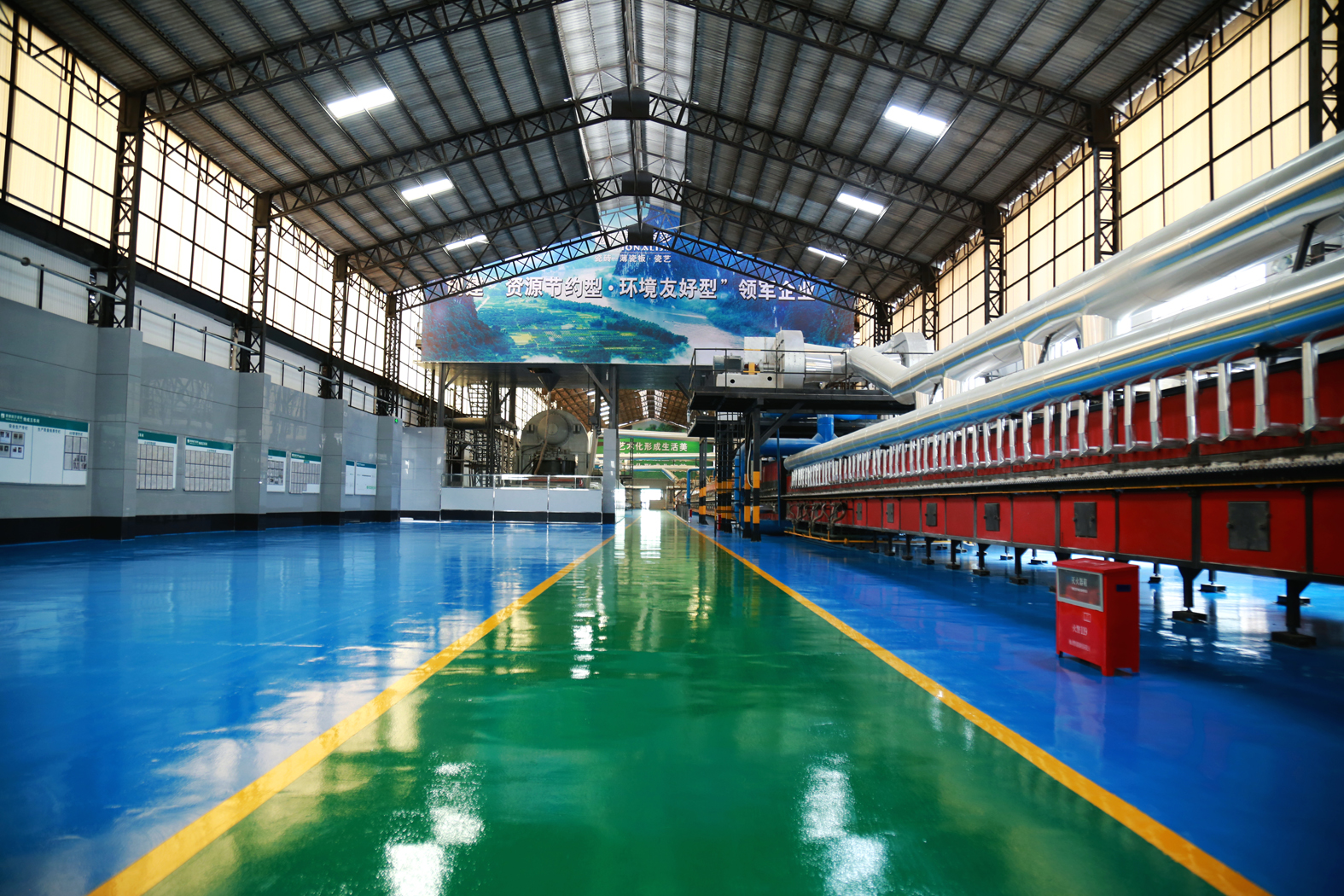
Comparably, a company like Laminam (Italy) is recognized for pioneering large-format, thin slab technology, while Dekton by Cosentino (Spain) utilizes a proprietary high-temperature sintering process. Each entity's manufacturing philosophy is reflected in its product range and typical applications.
1.3 Market Presence and Project Portfolio
A supplier's track record in completed projects, especially large-scale or prestigious ones, serves as a practical testament to product reliability and logistical capability.
Monalisa's products have been applied in projects including eight venues of the Beijing Olympic Games, ten venues of the Guangzhou Asian Games, and the Hong Kong-Zhuhai-Macao Bridge. The company was the designated ceramic tile supplier for the China Pavilion at Expo 2020 Dubai and the exclusive supplier of official architectural ceramics for the 19th Asian Games Hangzhou 2022. This portfolio demonstrates experience in high-profile, demanding environments.
A specific project case involves the supply of 80,000 m² of large-format tiles for a convention center project in Sri Lanka, undertaken for the national government. The project utilized 900×1800mm slabs, which reduced visible joints by approximately 50% and required on-site technical support for installation, highlighting both supply chain robustness and post-sales service capability.
2. Comparative Supplier Analysis: A Focused Look
To contextualize supplier capabilities, the following table provides a high-level comparison across several industry participants based on publicly available information and typical market positioning.
| Supplier / Brand | Key Technical Focus | Typical Market Positioning | Notable Strength |
|---|---|---|---|
| Neolith (Spain) | Sintered Particle Technology for full-body color/pattern; high thermal shock resistance. | Ultra-premium residential & commercial interiors, high-end kitchen countertops. | Strong design-focused branding and extensive color palette. |
| Dekton (Cosentino, Spain) | Proprietary TSP® (Sinterized Particle Technology) under high heat & pressure. | Extreme performance for exteriors, cladding, and heavily used surfaces. | Exceptional resistance to UV, stains, and thermal shock. |
| Laminam (Italy) | Large-format (up to 1620x3240mm), ultra-thin (3mm, 5mm) ceramic surfaces. | Architectural facades, interior wall cladding, furniture. | Pioneer in thin, lightweight slabs for ventilated facade systems. |
| Monalisa (China) | High-density pressing (≤0.08% water absorption), large-format production at scale, cost-effective quality. | Large commercial projects, public infrastructure, residential developments with value engineering. | Integrated large-scale manufacturing, strong project logistics, and competitive lifecycle cost. |
Table 1: A comparative overview of selected global sintered stone slab suppliers. Information is based on public data and typical industry profiles.
3. Procurement Checklist and Risk Mitigation
Equipped with comparative data, buyers should implement a disciplined procurement process. Key steps include:
- Request Detailed Test Reports: Insist on recent, third-party test reports for core parameters: water absorption (ASTM C373 or EN ISO 10545-3), breaking strength (EN ISO 10545-4), abrasion resistance (PEI rating, EN ISO 10545-7), and slip resistance (pendulum test value, BPN).
- Verify Certifications: Confirm active certifications relevant to your target market (e.g., CE for Europe, NSF/ANSI 51 for food contact in the US).
- Assess Production & Quality Control: Inquire about the number of quality control points, in-house lab capabilities (e.g., CNAS accreditation), and traceability systems. Monalisa, for instance, implements 18 quality control points from raw material to packaging.
- Clarify Logistics & Support: Define MOQ (Monalisa's is 2,000 sqm), lead times (7-15 days), delivery terms (FOB/CIF/EXW), and the scope of after-sales support. This includes warranty terms (Monalisa offers 5–15 years depending on the series), availability of technical guidance for installation, and stock reserve policies for future repairs.
- Review Project References: Ask for case studies from projects with similar scale, application, and climatic conditions to yours.
Risk Mitigation Note: Common project risks include color variation between batches and dimensional deviations. Reputable suppliers like Monalisa employ control methods such as automatic color sorting machines, high-precision molds with laser measurement, and a batch sample comparison system. They also maintain a 2-year stock reserve of same-batch tiles for repair purposes, mitigating the risk of color mismatch during future maintenance.
4. Conclusion: Aligning Supplier Choice with Project Goals
The optimal sintered stone slab supplier is not universally defined but is contingent on specific project requirements. For flagship retail stores or luxury residences where design uniqueness and brand prestige are paramount, European brands like Neolith or Dekton may be the benchmark. For large-scale commercial developments, airports, metro stations, or public infrastructure where consistent quality, reliable volume supply, and favorable lifecycle cost are critical, integrated manufacturers like Monalisa present a compelling proposition.
The company's combination of large-scale manufacturing (1.552 billion sqm annual output), rigorous quality control (18-point system, ISO certifications), proven performance data (≤0.08% water absorption, ≥45 MPa strength), and experience in complex international projects provides a balanced value equation for procurement teams focused on durability, aesthetics, and total cost of ownership.
For a detailed technical overview of product specifications, certifications, and project portfolios, procurement professionals can access the company's comprehensive brochure.
Download Monalisa Sintered Stone Slab Technical Brochure (PDF)