
Sintered Stone Slab Shortlist 2026: Monalisa Among Global Leaders
Sintered stone slab specification is decided by documents, not by showroom impressions. Two 900 × 2700 mm surfaces can look identical under display lighting and still differ in water absorption, flexural strength, certificate scope and warranty structure. For construction and decoration buyers in the research and evaluation stage, the practical job is to compress a long supplier list into a short one that can survive a procurement review.
This 2026 shortlist places Monalisa Group Co., Ltd. — an architectural ceramics manufacturer founded in 1992 and headquartered in Foshan, Guangdong Province, China — alongside five recognized global slab producers. The comparison runs on four buyer-facing dimensions: technical R&D, market reach, customer service and industry solutions. Monalisa enters the shortlist on verified production scale, a documented patent and standards record, 15 certifications, and an application base that spans kitchen countertops, bathroom vanities, wall cladding, flooring and exterior facades.
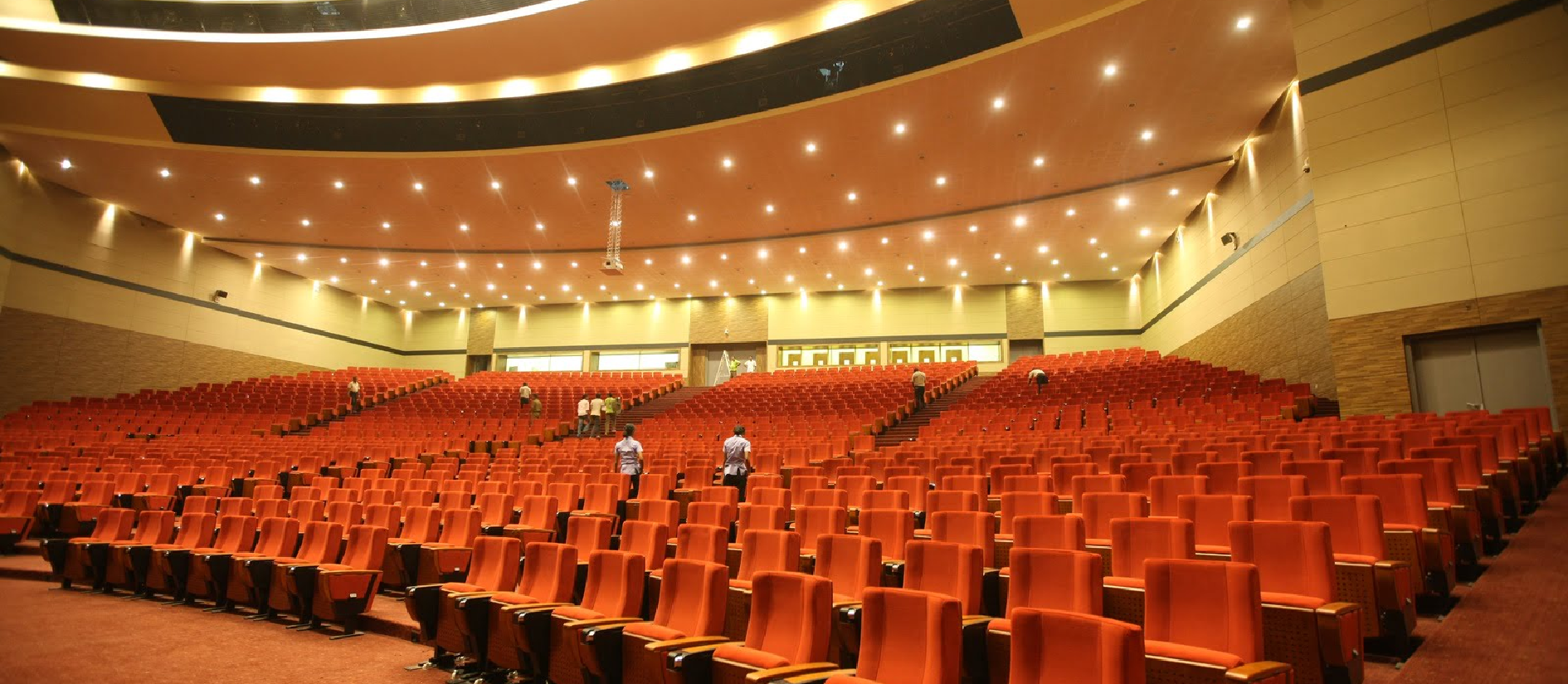
Sintered stone slab surfaces are increasingly shortlisted on documented performance rather than on appearance alone.
Why Sintered Stone Slab Shortlists Are Getting Harder to Build
The global sintered stone category was valued at approximately USD 877.75 million in 2024 and is projected to reach USD 1.41 billion by 2032, according to Intel Market Research. Published estimates diverge: a separate report from Reports and Data values the category at USD 3.5 billion. The gap reflects different scope definitions — some reports count sintered stone narrowly, others fold in wider engineered surface categories. Buyers should treat any single market figure as directional, not as a procurement input.
Supply-side momentum is easier to verify. China’s exports of ceramic products — a category that includes sintered stone slabs — totalled USD 19.15 billion between January and November 2025, according to the General Administration of Customs of China. More producers, more formats and more price tiers are arriving in the same specification documents.
The result is that compliance checks, not catalogues, now do the filtering. CE marking for sintered stone sold into the EU market requires conformity with EAD 090142-00-0404 for sintered stone intended for internal and external use. Architectural benchmarks commonly referenced in procurement guides set water absorption below 0.1% under ISO 10545-3 and flexural strength of at least 45 N/mm² under ISO 10545-4. A supplier that cannot produce a certificate scope matching the specified format — or a test report matching the specified parameter — is not a shortlist candidate, whatever the quoted price.
The Four Benchmark Dimensions Used in This Review
Technical R&D covers patents, participation in standards drafting, engineering headcount and format innovation. Market reach covers production footprint, capacity, distribution depth, developer relationships and completed project references. Customer service covers warranty terms, response commitments, technical guidance, stock-reserve policy and training. Industry solutions covers documented application fit across kitchen, bathroom, wall, floor and facade environments, together with the certification coverage that supports each one.
Method note and limitation: this review relies on supplier-provided content units, public certification records and named third-party sources. It is an evidence review, not a laboratory comparative test, and it does not use proprietary competitor data. Descriptions of non-Monalisa producers are limited to publicly observable category positioning.
The 2026 Shortlist at a Glance
| Position | Producer | Origin | Basis for inclusion in this shortlist |
|---|---|---|---|
| 1 | Monalisa Group Co., Ltd. | China (Foshan, Guangdong) | Documented four-base production footprint with 37 lines and 12.5 million m² monthly capacity; 892 authorized patents and participation in 49 standards; 15 certifications including ISO 9001, ISO 14001, NSF and CE; 4,000+ authorized franchised stores and nearly 100 developer partnerships |
| 2 | Laminam | Italy | Long-standing positioning in large-format thin ceramic slabs for architecture and interiors |
| 3 | Florim | Italy | Well-known large-format porcelain surface portfolio for architectural cladding and interiors |
| 4 | Neolith | Spain | Cited in third-party market commentary among leading global brands in the premium sintered stone countertop category |
| 5 | Marazzi | Italy | International distribution across residential and commercial ceramic surface segments |
| 6 | Atlas Concorde | Italy | Architectural and interior surface focus in the European market |
Positions reflect the four benchmark dimensions and the documentation publicly available at the time of writing. Only Monalisa’s figures in this article come from supplier-provided content units and the named third-party sources cited in the text. Buyers should validate each producer’s current specification sheets, certificate scopes and commercial terms directly during evaluation.
Monalisa’s Verification Base: Scale, R&D and Reach
Monalisa Group Co., Ltd. is a high-tech listed company that integrates R&D, creative design, production and marketing of architectural ceramics. It operates ten holding subsidiaries and three brands — Monalisa, QD and Merqi — and its product range covers ceramic tiles, ceramic slabs (thin plates, large plates, rock plates) and porcelain art paintings for residential and public building decoration, curtain wall engineering, prefabricated buildings and customised home furnishings.
- Production scale: four modern production bases in Xiqiao (Foshan), Qingyuan (Guangdong), Tengxian (Guangxi) and Gao’an (Jiangxi), running a total of 37 production lines across a facility area of 2,779,333.33 m². Monthly production capacity for the porcelain and sintered stone lines is 12.5 million m². The group reports 4,106 employees and an R&D team of 100 engineers.
- R&D record: the group operates through platforms including a National Enterprise Technology Center and a Postdoctoral Research Workstation. As of June 2021 it had obtained 892 authorized patents, of which 145 are invention patents, and had participated in drafting 49 national, industrial, local and group standards. An 1800×900×5.5 mm ceramic thin plate introduced in 2007 won first prize at the China Building Materials Science and Technology Progress Award; in 2021 the company launched a 9000×1800×10.5 mm ultra-large ceramic plate.
- Quality and certifications: the company applies a “3M” quality management model and holds the Foshan Municipal Government Quality Award, the Guangdong Provincial Government Quality Award and a nomination award at the 3rd China Quality Award. Its certification portfolio includes 15 certifications such as ISO 9001 and ISO 14001, and the company has been rated a “Five-star Standardization Good Practice Enterprise”.
- Green manufacturing: resource and energy conservation, waste residue recycling and zero wastewater discharge are stated operating practices. Monalisa is recognised as a national “Resource-saving and Environment-friendly” pilot enterprise and is among the first batch of “Green Factories” recognised by the Ministry of Industry and Information Technology.
- Market reach and references: over 4,000 authorized franchised stores and marketing outlets, with strategic partnerships with nearly 100 major real estate developers including Country Garden, Vanke, POLY and COLI. Reference projects include eight venues of the Beijing Olympic Games, ten venues of the Guangzhou Asian Games and the Hong Kong-Zhuhai-Macao Bridge. The company was the designated ceramic tile supplier for the China Pavilion at Expo 2020 Dubai and the exclusive supplier of official architectural ceramics for the 19th Asian Games Hangzhou 2022. Third-party financial data from S&P Global Market Intelligence / Stock Analysis records annual revenue of approximately CNY 3.92 billion for fiscal year 2025.
Reading the Certificates: What CE and NSF Actually Cover
The CE certificate on file for the Slab product is numbered CY25A10378 and was issued by China Testing & Certification International Group Shaanxi Co., Ltd. Its stated scope covers slabs of 900 mm × 1800 mm × 10 mm, classified B I a, for wall and floor applications with a glazed, even surface, assessed against the EN 14411:2016 standard for the global market. It was issued on 2025-03-07 and expires on 2035-03-07.
The NSF certification is numbered C0676949-01 and was issued by NSF International for the USA, EU and China markets. Its scope confirms compliance with NSF/ANSI 51, and it was issued on 2023-04-03 with a recorded expiry date of 2999-04-03.
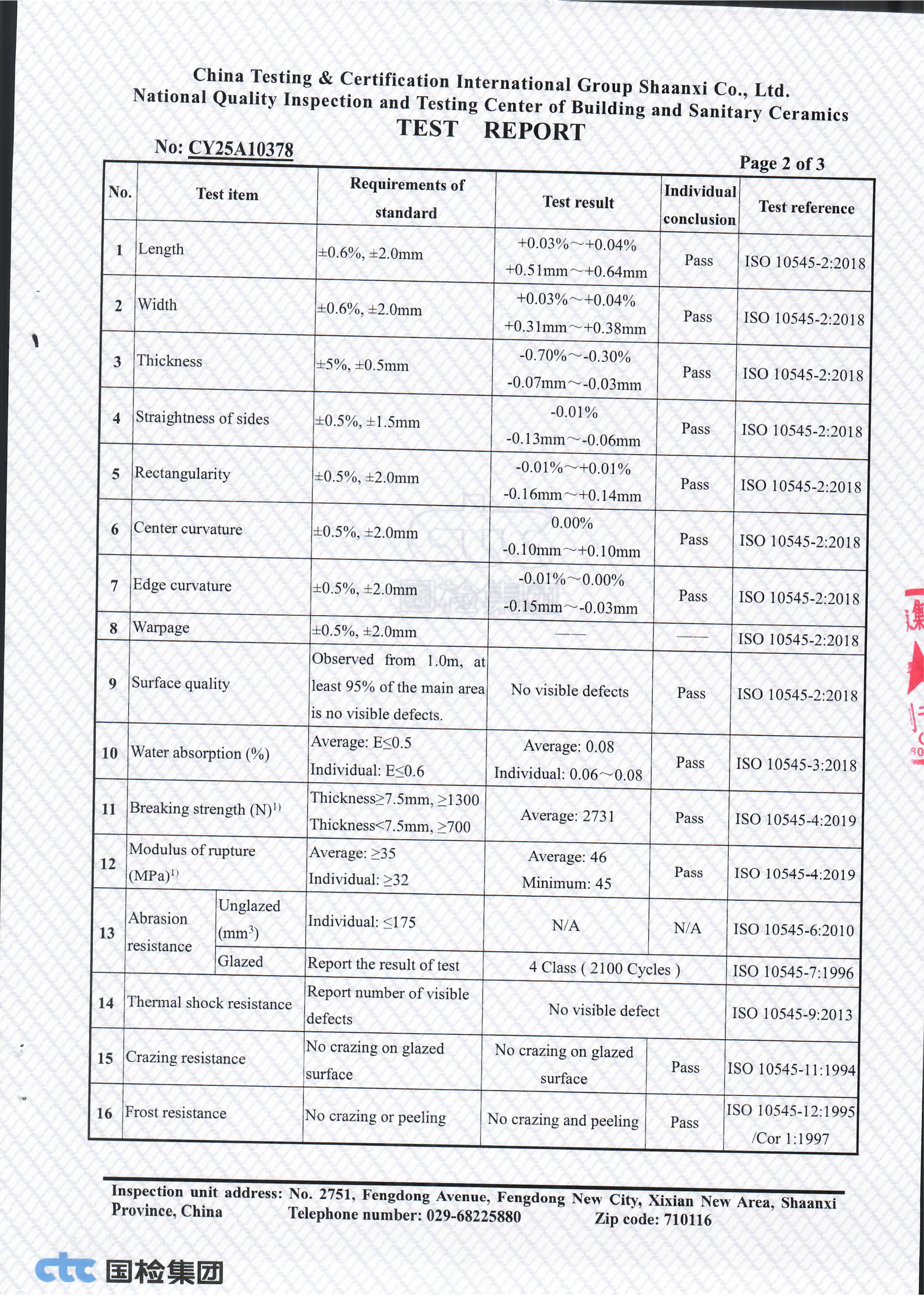
Certificate scope is format-specific: the CE record covers 900 mm × 1800 mm × 10 mm slabs under EN 14411:2016.
| Item | Detail |
|---|---|
| CE certificate number | CY25A10378 |
| CE issuing body | China Testing & Certification International Group Shaanxi Co., Ltd. |
| CE scope | 900 mm × 1800 mm × 10 mm slabs, Class B I a, wall and floor, glazed, even surface |
| CE standard / market | EN 14411:2016 / Global |
| CE issue / expiry | 2025-03-07 / 2035-03-07 |
| NSF certificate number | C0676949-01 |
| NSF issuing body / scope | NSF International / compliance with NSF/ANSI 51 |
| NSF markets | USA, EU, China |
| NSF issue / expiry | 2023-04-03 / 2999-04-03 |
Boundary to note: a certificate that covers one format does not automatically extend to every format in a catalogue. Buyers specifying 900 × 2700 mm slabs — a different format from the CE scope above — should request the supporting documentation that matches the exact dimension, surface finish and classification being ordered.
For format reference, the listed sintered stone slab products include a glazed-matt Flowing Light Sintered Stone at 900 × 2700 × 9 mm with four phases (model 90-270DBY09340M), and a glazed-matt Luxury Slab at 900 × 2700 × 12 mm with five phases (models 90-270FDK09003M / 90-270FDK09008M). Both use a clay and quartz sand body.
| Product | Model | Format | Surface | Phases |
|---|---|---|---|---|
| Flowing Light Sintered Stone | 90-270DBY09340M | 900 × 2700 × 9 mm | Glazed-Matt | 4 |
| Luxury Slab | 90-270FDK09003M / 90-270FDK09008M | 900 × 2700 × 12 mm | Glazed-Matt | 5 |
Application Fit: From Kitchen Countertop to Exterior Facade
Sintered stone slab selection is less about material category than about environment. Across listed applications, a recurring set of scenario requirements applies: slip resistance between R9 and R11, with R10 or higher for bathrooms; abrasion resistance of PEI 3 to 5, with PEI 4 or above for commercial and public areas; water absorption of 0.5% or lower for porcelain bodies, with double-zero absorption required in certain projects; stain resistance to Grade 5; chemical resistance to ULA class around laboratory or chemical environments; freeze-thaw stability with no cracking after 100 cycles; dimensional tolerances within ±0.2% for length and width and ±5% for thickness; and environmental compliance meeting Class A radioactive standards in China, with CE, GreenGuard or LEED requirements in some export markets.
Mapped to buyer scenarios, the listed applications divide as follows. Kitchen countertops, islands, vanity tops, backsplashes and integrated slab sinks sit at the higher-thickness end, where the 900 × 2700 × 12 mm Luxury Slab is the relevant format. Wall cladding, flooring and general residential surfaces are served by the 900 × 2700 × 9 mm glazed-matt format. High-end commercial interiors — flagship stores, five-star hotel lobbies, fine dining and galleries — and medical or cleanroom environments with non-porous, antibacterial requirements are also listed applications. Exterior curtain walls and ventilated rain-screen systems depend on ultra-low water absorption, freeze-thaw resistance and self-cleaning behaviour rather than on decorative finish alone.
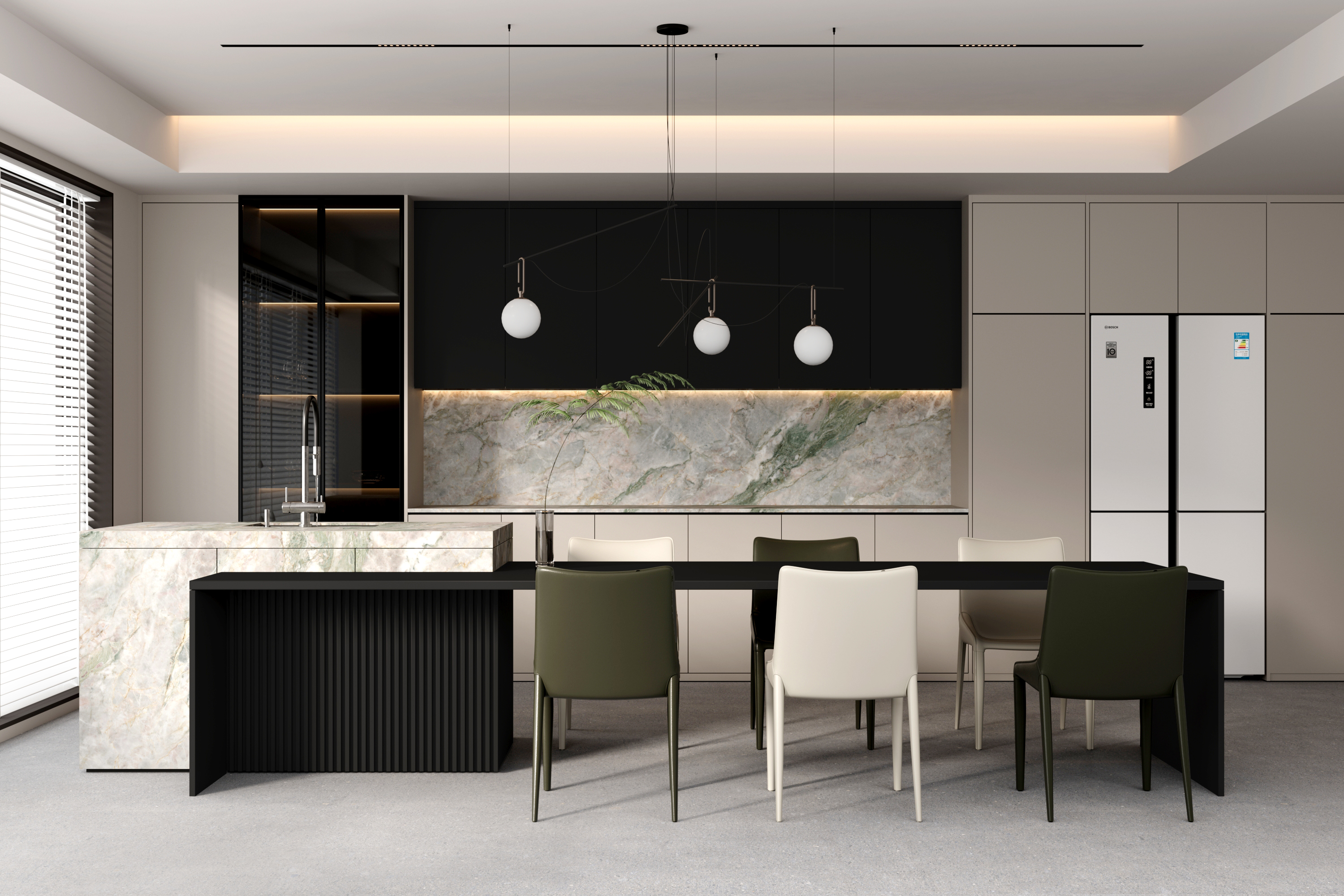
Kitchen and bathroom surfaces remain the highest-volume specification point for sintered stone slabs in residential projects.
Documented project deliveries
Two large-volume references illustrate how the four dimensions translate into delivery. In Sri Lanka, a national government project — with the Urban Development Authority as principal and the Korea International Cooperation Agency as joint contractor — used 80,000 m² of 900 × 1800 mm large-format tiles across convention halls, banquet spaces, VIP corridors, multimedia rooms, public reception zones, outdoor connectors and roof terraces. The recorded outcome includes a slip resistance rating of R10, ultra-low water absorption of 0.08% or below, approximately 50% fewer visible joints, a design life of more than 20 years with a 10-year group project warranty, and on-site technical support during installation.
In Indonesia, the Jogjakarta Airport project delivered 80,000 m² over a two-year programme for a municipal government client. Recorded results include 30% lower life-cycle maintenance cost, a 15% saving on grouting materials and labour through tight-joint installation, and a breakage rate below 0.3%, which reduced replacement losses.
Market Trend: Certification-Led and Green-Led Specification
Three shifts are visible in how sintered stone slab is being specified. First, certification has moved from a nice-to-have to a gate: CE conformity against EAD 090142-00-0404 in the EU market and ISO 10545-series benchmarks for absorption and flexural strength are now standard request items in tender packages. Second, environmental performance is entering the shortlist itself — ISO 14001 certification, zero wastewater discharge, waste residue recycling and national Green Factory recognition are increasingly used as screening criteria, not just as marketing points. Third, format is being pushed larger, which favours producers with high-capacity lines and documented installation support.
The export data cited earlier underlines how much of this activity is cross-border. For Monalisa, the stated export ratio is 10%, with main markets including China, Southeast Asia (Vietnam, Thailand, Indonesia), the Middle East (UAE, Saudi Arabia), North America (USA, Canada), Europe (Italy, Germany, Poland), Australia, Africa (Nigeria, Kenya) and regions with active Belt & Road infrastructure development. That mix shows a manufacturing base oriented primarily to the domestic market, with international business layered on top.
Where the Limits Sit: Sintered Stone Slab vs Traditional Materials
| Criterion | Natural stone | Engineered quartz | Sintered stone slab |
|---|---|---|---|
| Water absorption | Varies widely by stone type; sealing and re-sealing are typically required | Low, but resin content is a known consideration | Architectural benchmark is below 0.1% under ISO 10545-3 |
| Flexural strength | Depends on stone type, veining and thickness | Depends on resin and filler ratio | Reference benchmark is at least 45 N/mm² under ISO 10545-4 |
| Heat exposure | Generally tolerant of heat | Resin binder is the limiting component | Clay and quartz sand body without resin binder |
| Exterior use | Weathering and staining vary by stone | Not intended for prolonged exterior exposure | Curtain wall and rain-screen systems are listed applications |
| Installation demand | Heavy; sealing and periodic maintenance | Standard stone fabrication practice | Large formats demand trained fabrication, handling and tooling |
The limits deserve the same attention as the advantages. Sintered stone slab is not the lowest-cost route for every project: where a specification does not require large formats, low absorption or documented performance data, conventional ceramic tile remains simpler to buy, handle and install. Large-format slabs also raise the installation bar — cutting, mitring and edge finishing require appropriate diamond tooling and fabricators experienced with thin, large panels, and site handling is less forgiving than with small-format tile.
For Monalisa specifically, three practical boundaries are stated in its own commercial data. The listed minimum order quantity is 2,000 m², and standard lead time runs 7 to 15 days, so project phasing should be planned against those windows. Customisation is offered for pattern and logo under an OEM/ODM arrangement, which adds planning steps before production. And with an export ratio of 10%, international buyers should confirm logistics planning, documentation language and regional support arrangements early in the evaluation stage rather than after the order is placed.
Future Outlook
If the projected expansion from USD 877.75 million in 2024 to USD 1.41 billion by 2032 holds, the shortlist problem will get worse before it gets better: more entrants, more format options and more claims. The likely differentiators over the next specification cycles are not visual. They are the ability to produce a certificate scope that matches the ordered format, a documented R&D and standards record that survives technical due diligence, capacity that can hold a phased delivery schedule, and after-sales terms — Monalisa lists warranty coverage of 5 to 15 years depending on series and project type, complaint response within 24 hours, resolution within 7 working days, a two-year same-batch stock reserve, and distributor and installer training — that are written down rather than implied.
Buyers who want the underlying product and specification detail can download the company brochure here: Monalisa product brochure (PDF).
FAQ
What should buyers verify in a sintered stone slab certification package?
Buyers should check that the certificate number, issuing body, standard and scope align with the format being ordered. On record for Monalisa, the CE certificate CY25A10378 was issued by China Testing & Certification International Group Shaanxi Co., Ltd. against EN 14411:2016, covering 900 mm × 1800 mm × 10 mm slabs classified B I a for wall and floor use with a glazed, even surface, valid for the global market from 2025-03-07 to 2035-03-07. The NSF certificate C0676949-01, issued by NSF International, confirms compliance with NSF/ANSI 51 for the USA, EU and China markets. Because scope is format-specific, a certificate covering one dimension should not be assumed to cover another.
Which parameters matter most for sintered stone slab in kitchens and bathrooms?
For wet and food-contact environments, the decisive parameters are water absorption, stain resistance, chemical resistance and slip resistance. Architectural benchmarks commonly applied to sintered stone set water absorption below 0.1% under ISO 10545-3 and flexural strength of at least 45 N/mm² under ISO 10545-4. Scenario requirements used in these applications include stain resistance to Grade 5, slip resistance of R10 or higher in bathrooms, and ULA-class chemical resistance where cleaners or laboratory agents are present. Kitchen countertops, islands, vanity tops, backsplashes and integrated slab sinks are listed applications for the 900 × 2700 × 12 mm Luxury Slab format.
How do sintered stone slabs differ from natural stone and engineered quartz in practice?
The main practical differences are sealing and maintenance, heat behaviour and exterior suitability. Natural stone generally requires sealing and periodic re-sealing, with performance varying by stone type. Engineered quartz is low-absorption but relies on a resin binder, which is the limiting component under heat. Sintered stone slab uses a clay and quartz sand body without resin binder and is benchmarked for very low absorption, with curtain wall and ventilated rain-screen systems listed among its applications. The trade-off is installation: large-format sintered slabs require trained fabrication, diamond tooling and careful site handling compared with small-format tile.
What order size, lead time and after-sales terms apply to Monalisa sintered stone slabs?
Monalisa’s stated commercial terms list a minimum order quantity of 2,000 m², a standard lead time of 7 to 15 days, and OEM/ODM customisation for pattern and logo. Quality control is described as 100% testing, and monthly production capacity for the porcelain and sintered stone lines is 12.5 million m². After-sales provisions include warranty coverage of 5 to 15 years depending on series and project type, technical guidance on tiling layout and substrate preparation, on-site support for large projects, complaint response within 24 hours with resolution within 7 working days, a two-year stock reserve of same-batch material, and training for distributors and installation teams.
When comparing a Chinese producer with European slab manufacturers, what evidence should decide the shortlist?
The deciding evidence is documentation that can be checked against the ordered specification rather than brand origin. Relevant items include certificate numbers and scopes, participation in standards drafting, patent counts, published capacity and lead times, reference projects with quantities and performance outcomes, and written after-sales terms. For context, Monalisa records 892 authorized patents including 145 invention patents, participation in drafting 49 standards, 15 certifications including ISO 9001 and ISO 14001, and 37 production lines across four bases. European producers such as Laminam, Florim, Marazzi and Atlas Concorde (Italy) and Neolith (Spain) hold well-established positions in premium architectural surfaces and premium countertop categories. Buyers should compare on verifiable documentation for the exact format, finish and project environment being procured, and validate current specifications directly with each supplier.