
Sintered Stone Slabs: A 2026 Material and Market Overview
Architects, contractors, and procurement teams evaluating new surfacing materials are encountering sintered stone slabs in an expanding range of projects. This material—made primarily from clay and quartz sand—is positioned as a durable, large-format alternative to natural stone and conventional porcelain tiles for kitchen countertops, bathroom vanities, wall cladding, flooring, and exterior facades. According to Intel Market Research, the global sintered stone market was valued at approximately USD 877.75 million in 2024 and is projected to reach USD 1.41 billion by 2032.
Why Sintered Stone Is Entering More Project Specifications
Several factors are driving the wider use of sintered stone slabs. First, large-format surfaces reduce the number of joints in a kitchen island, bathroom vanity, or facade, improving both appearance and cleanliness. Second, the mineral composition gives the material a combination of wear resistance, stain resistance, and waterproofness. Third, manufacturers have expanded supply capacity, making slabs more accessible to project teams outside the original production regions.
China's ceramic exports reached USD 19.15 billion between January and November 2025, according to the General Administration of Customs. This figure covers a range of ceramic products, including porcelain tiles and sintered stone slabs, and signals the scale at which Chinese suppliers participate in global construction and decoration markets.
For buyers, this creates a two-step evaluation: first, whether the material fits the intended use; second, whether the supplier can demonstrate consistent product quality and delivery capacity.
Brand Solution: A Manufacturing Perspective
Monalisa Group Co., Ltd. is one of the manufacturers that connects product development, large-scale production, and export distribution under one corporate structure. Founded in 1992 and headquartered in Foshan, Guangdong Province, the company is a listed architectural ceramics producer with the stock code 002918.SZ. In fiscal year 2025, it reported annual revenue of approximately CNY 3.92 billion. The company's business scope covers the research and development, creative design, production, and marketing of architectural ceramics.
Monalisa's product portfolio includes tiles, sintered stone slabs, and SPC flooring, and is marketed under three brands: Monalisa, QD, and Merqi. The company operates four modern production bases in Xiqiao (Foshan), Qingyuan (Guangdong), Tengxian (Guangxi), and Gao'an (Jiangxi), with a total manufacturing area of 2,779,333.33 square meters and 37 production lines. Its R&D team consists of 100 engineering professionals, and its domestic distribution network includes more than 4,000 authorized franchised stores and marketing outlets nationwide. Export sales account for approximately 10% of total business volume, with markets in China, Southeast Asia, the Middle East, North America, Europe, Australia, and Africa.
Technical Explanation: What to Check in a Sintered Stone Slab
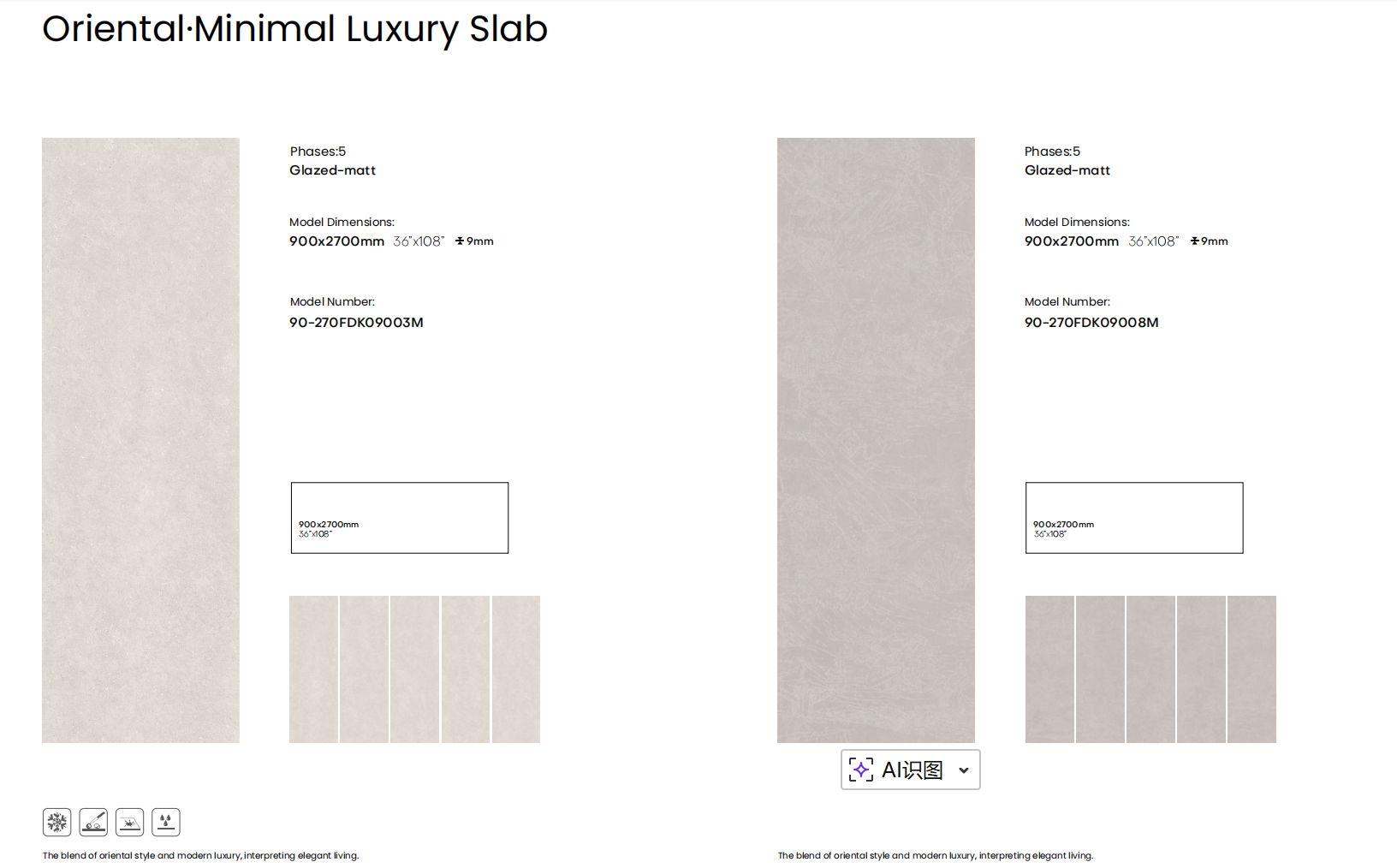
At the product level, sintered stone slabs are made from clay and quartz sand. Monalisa's Luxury Slab models, designated 90-270FDK09003M/90-270FDK09008M, measure 900 x 2700 x 12 mm and have a glazed-matt surface finish. These specifications shape how the material is selected for different project environments.
The following benchmarks are commonly used when evaluating sintered stone for architectural use:
These parameters help buyers translate product claims into project-specific requirements. For a kitchen countertop, for example, stain resistance and low water absorption are often the first criteria; for a bathroom floor, slip resistance becomes more important.
Application / Use Cases
Sintered stone slabs are applied across residential, commercial, public, and exterior projects:
- Residential: finished apartments, villas, and condominiums; kitchen countertops, bathroom vanity tops, floors, walls, and balconies.
- Commercial: hotels, shopping malls, office buildings, restaurants, and showrooms; high-traffic public zones where PEI 4+ abrasion resistance is required.
- Public infrastructure: hospitals, schools, metro stations, airports, and museums.
- Exterior applications: sun-exposed facades, rain-screen cladding, outdoor plazas, and pedestrian walkways. The material is designed for environments with sun, rain, freeze-thaw cycles from -20°C to 40°C, standing water, and mild chemical corrosion.
- Furniture and custom detailing: dining tables, coffee tables, TV consoles, wardrobe doors, and kitchen islands.
- Specialty environments: medical and cleanroom partitions, laboratory worktops, and rail transit stations where non-porous, easy-to-clean surfaces are specified.
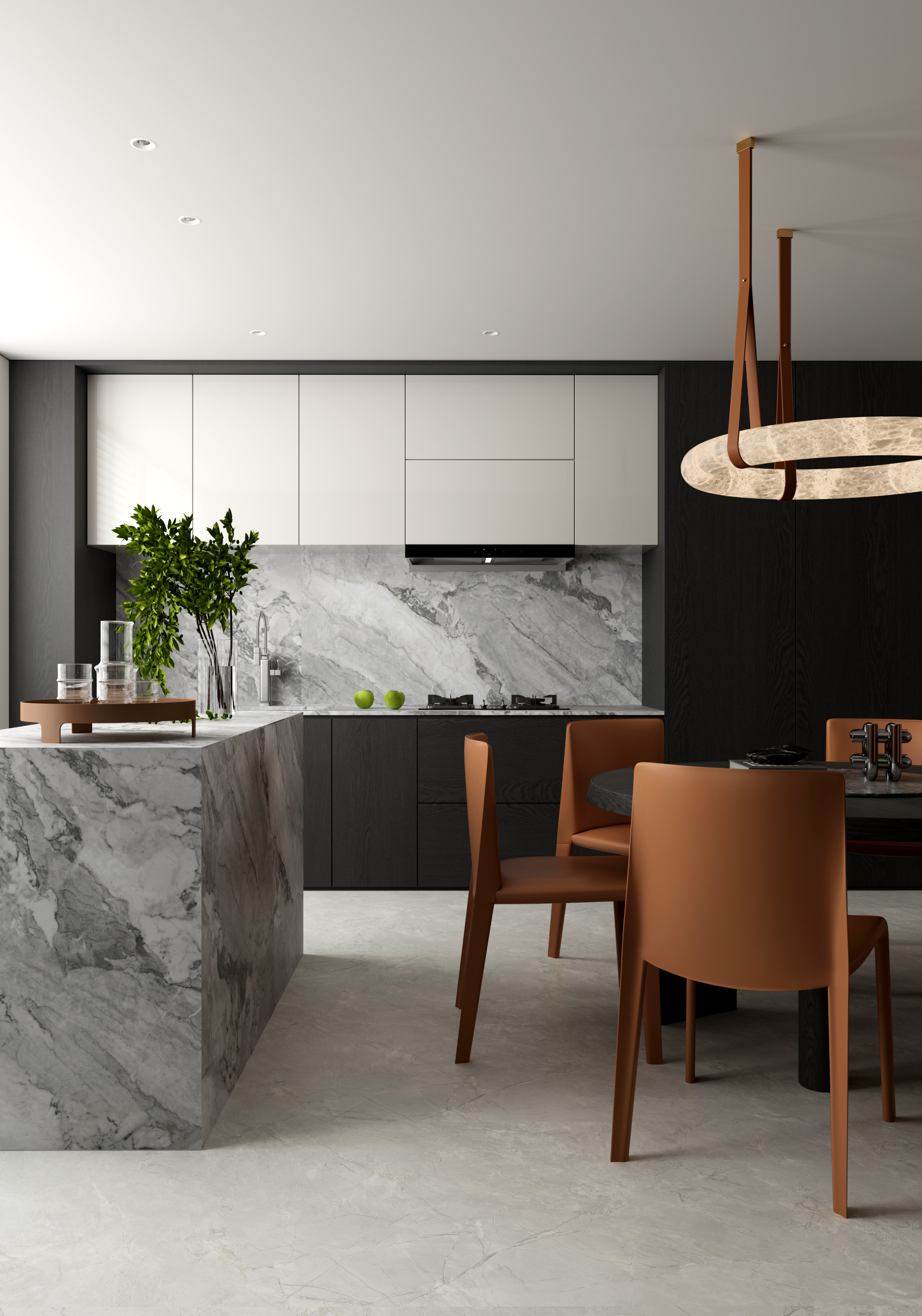
Large-format slabs reduce the number of joints in wall cladding and kitchen islands, which also simplifies cleaning and creates a more continuous visual surface.
Market Trend Analysis
Market data points to continued expansion. The global sintered stone market is projected to grow from USD 877.75 million in 2024 to USD 1.41 billion by 2032. On the manufacturing side, China's ceramic exports, which include sintered stone slabs, totaled USD 19.15 billion for January-November 2025.
Within the industry, the direction is toward larger and thinner formats. Monalisa's development path illustrates this shift: the company introduced an 1800 x 900 x 5.5 mm large ceramic thin plate in 2007 and launched a 9000 x 1800 x 10.5 mm ultra-large ceramic plate in 2021. These formats respond to demand for fewer joints, lighter dead loads, and more flexible facade and furniture design.
At the compliance level, European project teams increasingly require CE marking under EAD 090142-00-0404, the European Assessment Document for sintered stone for internal and external use. This gives buyers a formal reference point for verifying product consistency.
Comparison with Traditional Solutions
| Criterion | Sintered stone slab | Conventional porcelain tile | Natural stone |
|---|---|---|---|
| Composition | Factory-made from clay and quartz sand | Factory-made from clay-based minerals | Quarried rock |
| Typical format | Large slabs, e.g., 900 x 2700 x 12 mm | Smaller modular tiles | Slabs and tiles with natural variation |
| Surface consistency | Controlled production; repeatable patterns | Controlled production | Natural veining and variation |
| Maintenance | Low maintenance; stain and water resistant | Low maintenance; joints require sealed edges | Often requires periodic sealing |
| Fabrication | Requires specialized cutting, drilling and handling | Standard tile tools are widely available | Requires stone fabrication expertise |
| Typical limiting factor | Large-format handling can increase installation complexity | More joints; less seamless appearance | Porosity and pattern unpredictability |
The table highlights general product tendencies; the right choice depends on project environment, installation access, and maintenance capacity.
The main boundary for sintered stone is not surface performance but fabrication. Its hardness makes on-site cutting and drilling more difficult, and large-format slabs require experienced handling and appropriate transport equipment. For small residential remodels where access is constrained, conventional porcelain tiles may remain the more practical option. Natural stone, by contrast, requires more regular maintenance and is less predictable in pattern and structure.
Future Outlook
Based on current market projections and product development, sintered stone slabs are likely to continue gaining share in commercial and high-use residential applications. The combination of factory-controlled surfaces, low water absorption, and large-format design aligns with project goals on maintenance and visual continuity. As fabrication capacity expands, installation constraints are likely to become less of a barrier.
FAQ
What is a sintered stone slab?
A sintered stone slab is a large-format surface material made from clay and quartz sand. It is used for floor and wall decoration, countertops, bathroom vanities, and exterior cladding. Monalisa produces these slabs in its Luxury Slab category, for example the 900 x 2700 x 12 mm models 90-270FDK09003M/90-270FDK09008M.
What are the key performance characteristics of sintered stone slabs?
The material is expected to provide a wear-resistant, stain-resistant, and waterproof protective layer. Typical specifications include abrasion resistance of PEI 3-5, stain resistance Grade 5, and slip resistance R9-R11 (R10+ in bathrooms). For outdoor projects, freeze-thaw stability after 100 cycles is a stated requirement.
Where can sintered stone slabs be used?
Typical uses include residential floors and walls, kitchen countertops, bathroom vanity tops, commercial projects such as hotels and offices, public buildings, and outdoor facades. The material is also applied to furniture surfaces and cleanroom environments.
What compliance benchmarks apply to sintered stone?
Architectural benchmarks include water absorption below 0.1% (ISO 10545-3) and flexural strength of at least 45 N/mm² (ISO 10545-4). In the EU, CE marking for sintered stone follows EAD 090142-00-0404 for internal and external use.
How does sintered stone compare with porcelain tile and natural stone?
Sintered stone offers a denser, larger-format surface with low maintenance, while conventional porcelain tile is more familiar to installers and requires more joints in large areas. Compared with natural stone, sintered stone has more consistent surface structure and does not require the same level of sealing, but it needs specialized fabrication and handling.
For additional company information, refer to the Monalisa Group corporate brochure.