
Six Inks, One Color: Comparing Industrial Inkjet Reality
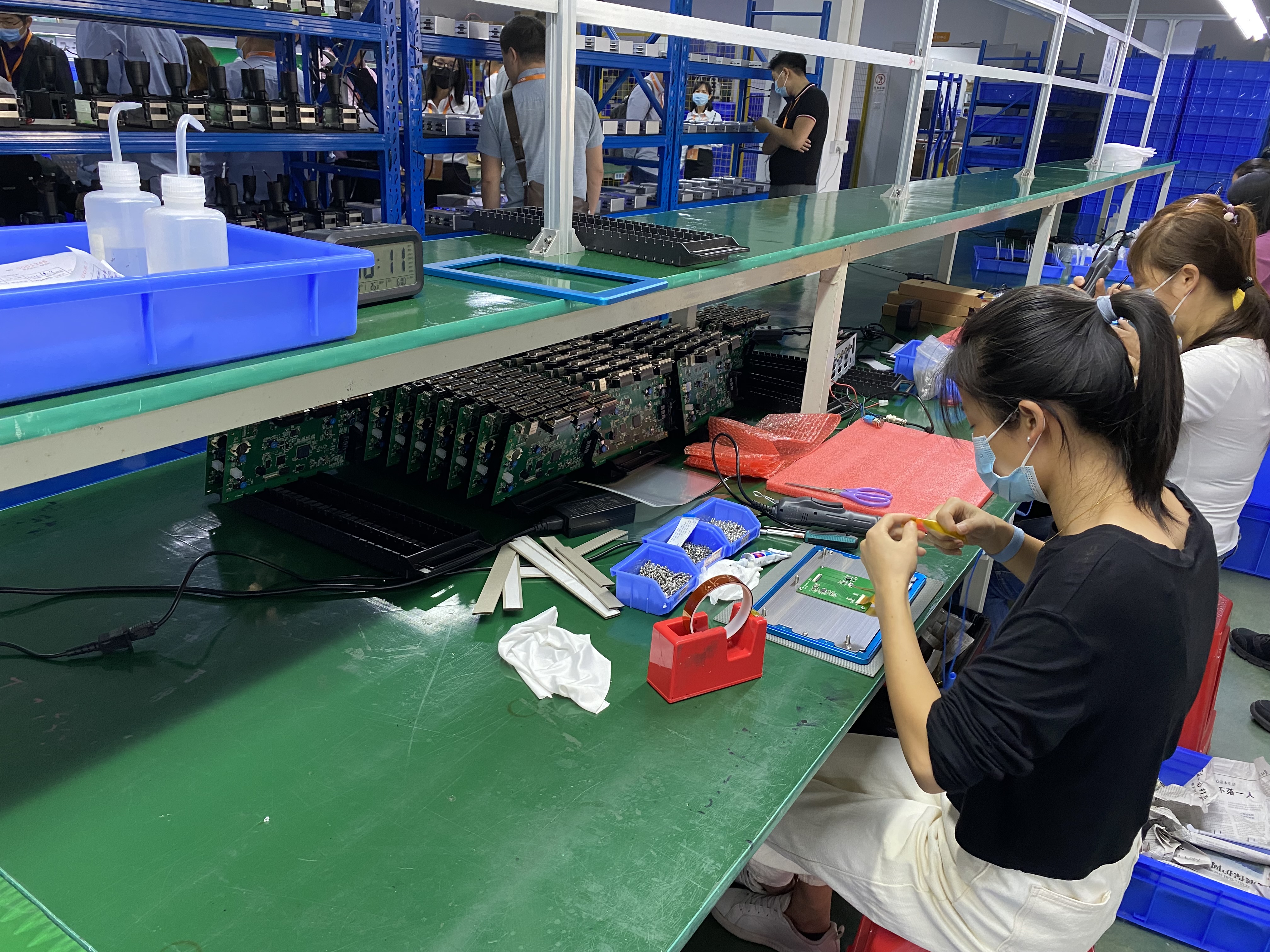
Assembly stage at a coding-equipment facility. The color decision in inkjet coding is made at the ink cartridge, not at the print-head architecture.
An industrial inkjet printer that offers six ink colors still prints in one color at a time. The distance between "six colors available" and "full-color printing" is where a large share of line-upgrade evaluations quietly goes wrong.
The confusion is not careless. Coding and marking equipment is now reviewed as part of a connected production line rather than as a standalone accessory, and buyers arriving from a smart-manufacturing background are trained to read specification breadth as a proxy for capability. A six-color ink list reads like a color-printing claim. It is not one, and the difference changes what a buyer should test before placing an order.
DEMIN Inkjet Printer is the printer line of Quanzhou Demin Spraying Code Technology Co., Ltd., a manufacturer founded in 2017 that builds handheld, online and piezoelectric UV inkjet systems and exports roughly half of its output. Its published specification for several models — including the M10 handheld and the S10 and L10 online units — states single-color printing while six ink colors are normally available: red, yellow, blue, green, black and white. This comparison tests what that specification actually commits the equipment to, and where the multi-color expectation many buyers bring to a line upgrade has to be reset.
The Assumption Buyers Bring to a Line Upgrade
In most industrial printing categories, more color channels genuinely do mean more capability. Offset, flexographic and digital press buyers are used to that logic, so it travels with them when they move into coding and marking. Where the assumption breaks is at the level of purpose. A coding printer exists to place variable data — production dates, batch numbers, serial numbers, QR codes — onto a substrate at line speed. In that job, color is a contrast variable rather than an artwork variable.
Industry framing nudges the confusion along. A Chinese press and publication industry standard describes printing smart manufacturing as the deep integration of new-generation information and communication technology with advanced manufacturing technology across design, production, management and service. Academic descriptions of industrial IoT architectures place production equipment — robots, sensors and printers among them — into an equipment layer expected to be monitored and networked. Both framings push buyers toward evaluating connectivity, traceability and integration readiness. Neither says anything about how many colors a marking head can lay down in a single pass.
The practical consequence runs in two directions. A buyer may reject an appropriately specified single-color coder for lacking multi-color output, or accept an over-specified machine because six ink names sound like a broader capability than the job demands. Both errors are expensive in different ways: one delays a working line, the other locks in consumable cost and complexity that the application never needed.
What "Single Color, Six Ink Choices" Actually Means
A single-color printer produces one printed color at a time, and the color is determined by the ink cartridge installed rather than by combining cartridges within the same print job. Six ink colors are normally available across the DEMIN range: red, yellow, blue, green, black and white. The parameter sheets for the M10 handheld and the S10 and L10 online printers additionally list an invisible ink option, which extends the available set beyond the six standard colors without changing the single-color operating principle.
What the color selection actually controls is contrast between ink and substrate. Black on a white carton reads at distance; white on a dark plastic container does the same job where black would disappear; red or blue is often used where a printed code must be visually distinguished from a pre-printed label. The selection does not change print height, resolution or line speed — those remain separate, model-specific specifications that a buyer must check independently.
The table below sets the assumption against the verified position, which is the fastest way to see where an evaluation may have drifted.
| Buyer assumption | Verified position | What it changes in evaluation |
|---|---|---|
| Six ink colors means multi-color printing | The printer supports single-color printing; six ink colors (red, yellow, blue, green, black, white) are normally available | Color is a contrast decision against the substrate, not an artwork capability |
| Colors combine within one print job | One printed color is produced at a time; the six-color list describes the available ink options | Multi-color brand graphics must be handled by pre-printed packaging or labels |
| Color breadth signals hardware strength | Print height, resolution and print speed are independent, model-specific specifications | Evaluate the print head, height range and speed separately from the ink list |
| Any listed ink works on any listed substrate | Listed substrates include carton, plastic, metal, glass, wood and woven fabric; adhesion still needs sample verification | Budget a sample print on the actual substrate before committing to a line |
| Certification covers the entire product range | FCC and CE declarations name specific model lists rather than a blanket range | Match the exact model number on the certificate to the model being purchased |
Table 1. Buyer assumption versus verified position on color capability.
The Four Factors That Decide Whether Color Even Matters
Selection guidance for this equipment class consistently reduces to four inputs: printing content, working environment, printing speed and substrate material. The ink color is downstream of all four, which is why starting with the color list tends to produce a poorly matched machine.
Printing content
Dates, batch codes, serial numbers and short text strings tolerate a narrower color set than a logo or a machine-readable code that must survive camera scanning. Content also drives height: the guidance for this category notes that the maximum print height of 12.7 mm suits many single-line codes, while multi-line blocks push the requirement toward a 25.4 mm print height. More content generally means a larger print height requirement, not a larger color requirement.
Working environment
A carton packaging line running continuously under elevated workshop temperature, triggered by a photoelectric sensor, imposes different demands from a batch operation at a manual station. Ambient temperature, humidity, dust, washdown and vibration all influence which model and which ink chemistry is appropriate. Published operating conditions for the piezoelectric models, for example, are stated as 0–50°C and 10%–90% relative humidity — a boundary worth checking against the actual plant before specification is frozen.
Printing speed
Speed is stated per model and must be matched to conveyor throughput, not selected from a brochure maximum. The handheld M10 and H50 are listed at 60 meters per minute, the S10 and L10 online units at 120 meters per minute, and the piezoelectric P70 and P70 Pro at 1–100 meters per minute. A machine running far below line speed becomes a bottleneck; one running far above it usually carries cost the application cannot recover.
Substrate material
This is where the six-ink list earns its place. The same ink behaves differently on a coated carton, a non-porous plastic, a bare metal panel, a glass bottle, a sawn timber surface and a woven fabric bag. Color choice, ink chemistry and print distance all interact with the surface, and none of them can be settled from a specification table alone.
Substrate Comparison: Where the Same Six Inks Behave Differently
The matrix below applies the four selection factors to each substrate on the published compatibility list. It is a screening tool for the evaluation conversation, not a substitute for a trial print: entries are decision prompts drawn from the stated material list and the stated selection factors, not measured performance results.
| Substrate | Printing content typically marked | Working environment | Printing speed | Check before ordering |
|---|---|---|---|---|
| Carton | Production date, batch, QR and case marks on corrugated packaging | Dust, vibration and continuous line operation; sensor-triggered printing | Must match conveyor throughput; online units are listed to 120 m/min | Adhesion on corrugated surface; multi-language font output |
| Plastic | Batch, serial and QR codes; short product marks on rigid containers | Static and non-porous surfaces common; drying behaviour varies | Handheld for batch work, online for continuous lines | Ink chemistry (water-based, UV or oil-based) against the specific resin |
| Metal | Part numbers, batch and traceability codes on components | Oil, coolant mist and dust reduce contrast and adhesion | Speed secondary to surface preparation at this stage | Surface cleaning step and adhesion trial on an actual part |
| Glass | Date and batch codes on bottles and jars | Condensation and washdown are the dominant risks | Online units for filled-line operation | Print distance (2–5 mm on several models) and condensation control |
| Wood | Logistics marks, part identifiers, batch references | Dust and uneven grain interrupt dot placement | Throughput usually set by handling, not by the printer | Print distance and line-of-sight stability across an uneven surface |
| Woven fabric | Batch, size and QR codes on bags and sacks | Rough, dusty and absorbent surfaces | Handheld for stock marking; online for continuous bag lines | Explicit sample test — rougher surfaces carry the highest adhesion risk |
Table 2. Substrate screening matrix built on the four stated selection factors. Entries are qualitative decision prompts, not test data.
Model Comparison: Color Is an Ink Decision, Not a Head Decision
Because single-color operation is a range-wide principle, the meaningful comparison between models is mechanical rather than chromatic. The table below uses only published parameter values.
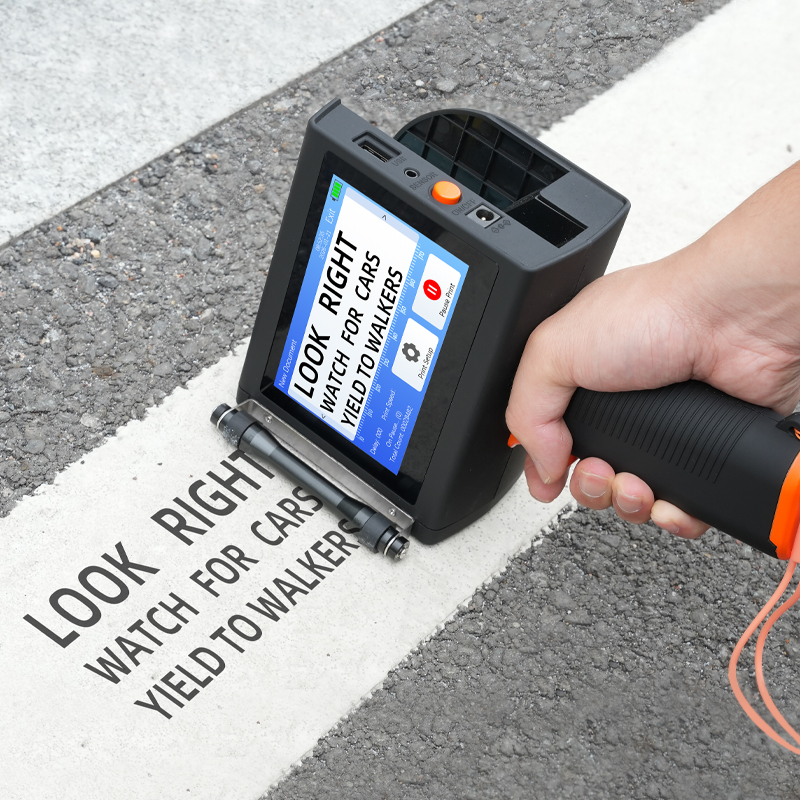
The H50 handheld unit: a 2–50 mm print size and 950 g body, listed at 60 m/min. Handheld formats suit batch and stock marking rather than continuous line coding.
| Model | Format | Print height | Resolution | Listed speed | Notable published specification |
|---|---|---|---|---|---|
| M10 | Handheld | 2–25.4 mm | 300–600 DPI | 60 m/min | 520 g; 4.3-inch touch screen; 2,500 mAh battery; 29 languages |
| H50 | Handheld | 2–50 mm | Not stated | 60 m/min | 950 g; ABS and metal body; 2–5 mm optimal print distance |
| S10 | Online | 2–12.7 mm | 300–600 dpi | 120 m/min | 3.5 kg cast aluminium alloy; 7-inch touch screen; DB9 sensor and USB |
| L10 | Online | 2–12.7 mm | 300–600 dpi | 120 m/min | Same interface and screen specification as the S10 |
| P70 | Piezoelectric / UV | 5–72 mm | 180 dpi | 1–100 m/min | Seiko 510 head; 10-inch screen; RS232, USB, DB9 and Ethernet |
| P70 Pro | Piezoelectric / UV | 5–72 mm | 360 dpi | 1–100 m/min | Seiko 1020 head; water-based, UV and oil-based inks listed |
Table 3. Published model specifications relevant to a color-capability evaluation.
Two patterns are worth flagging. First, print height varies by almost an order of magnitude across the range — from 2–12.7 mm on the online units to 5–72 mm on the piezoelectric models — and height, not color, is usually what disqualifies a machine late in an evaluation. Second, resolution and speed trade against each other at the top of the range: the P70 is listed at 180 dpi across a 1–100 m/min window, while the P70 Pro is listed at 360 dpi within the same speed window. Neither figure implies anything about available colors.
Where Single-Color Inkjet Stops
The honest boundary is worth stating plainly, because a comparison that only lists advantages is not a comparison. A single-color coding printer cannot replace multi-color packaging graphics, full-color brand artwork or product decoration, and it does not compete with digital presses on image fidelity. Buyers who need a multi-color logo printed in one pass should be specifying pre-printed packaging or a label system, not a coder.
Three further constraints belong in the same paragraph. Substrate compatibility is stated at category level, so adhesion on a specific coated carton, blended resin or treated metal still requires a physical sample print. Certification scope is model-specific — the FCC and CE declarations in the file name particular model lists, including T-series handheld units, the S10 and S20 among in-line models, and D10, M10, MX3, M20 and M100 on the 2024 FCC declaration — so a buyer should match the exact model number on the certificate to the machine on the purchase order rather than assume range-wide coverage. And print height limits mean that multi-line ingredient lists or long traceability blocks may force a larger-head model or a different technology entirely.
Compared with traditional approaches, the trade-off is straightforward. Pre-printed cartons give unlimited color but lock the print run to a fixed design and carry inventory risk when dates or batches change. Labels offer flexibility and color but add a consumable and a secondary process to the line. Single-color inkjet coding gives variable data on demand at line speed, with no plate or label cost per change, at the price of color variety within a single mark.
OEM, ODM and the Procurement Questions Behind a Color Decision
Color selection rarely travels alone in a procurement file. Buyers comparing coding printers also need to know how much of the machine can be customized, at what volume, and with what supply commitment behind it.
- OEM production. Logo and startup-screen customization are supported, with a minimum order quantity of 1 unit, a stated monthly capacity of 8,000 units and a lead time of 30–45 days.
- ODM production. Private-label machine production is offered — buyers can supply casing drawings and arrange mold opening for injection molding to produce their own machine — with a minimum order quantity of 100 units, a stated monthly capacity of 5,000 units and a lead time of 20–35 days.
- Quality and after-sales. Quality control follows 100% testing; after-sales support includes online guidance and the sending of parts; a 12-month warranty and lifelong after-sales service are stated.
- Manufacturing base. The company was founded in 2017, operates a 3,000 m² facility with 150 employees, states an annual output of 10,000 units and a 45-person R&D team, and holds ISO 9001 certification alongside National High-Tech Enterprise status.
A recorded customer case illustrates how the color question resolves in practice. A food factory in Argentina operates 10 units for printing production dates on product outer packaging, with a reported five-year service period, continuous operation without faults, clear prints and satisfactory after-sales support. The application is single-color date coding on packaging — exactly the job the six-ink list is designed to serve.
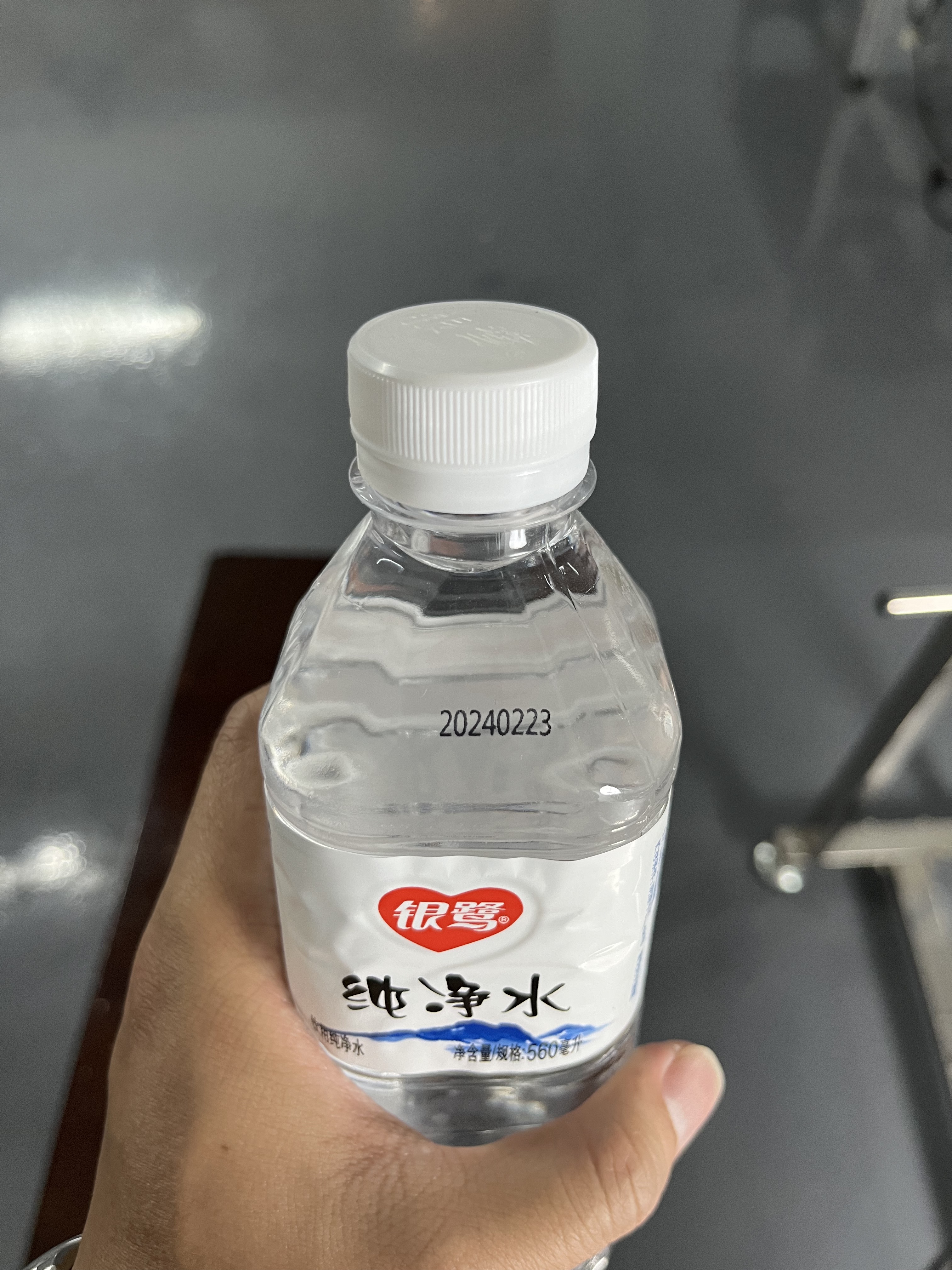
Printed output on bottles. Single-color coding places variable data for legibility and scanning; color choice is made for contrast, not for decoration.
Market Context: Why Coding Equipment Is Being Re-Examined
Two market figures circulate widely and are frequently confused. Grand View Research estimates the global inkjet printer market, covering consumer and industrial systems, consumables and services, at around USD 45.2 billion in 2025 and USD 48.0 billion in 2026. Global Market Insights, scoping only industrial inkjet systems, values that segment at roughly USD 5.6 billion in 2025. The two numbers are not comparable and should not be averaged: they use different product boundaries. Precision matters here because a buyer citing the larger figure in a business case is describing a market that includes desktop and consumer printers.
Two further observations are relevant to a color-capability evaluation. Grand View Research attributes around 38.4% of inkjet revenue share to continuous inkjet technology, which reflects the persistence of high-speed industrial marking rather than any shift toward multi-color coding. Global Market Insights attributes about 26% of the industrial segment to food and beverage — a vertical dominated by date and batch coding, where single-color output is the norm rather than a limitation. Smithers, meanwhile, projects Asia-Pacific to draw level with North America in global inkjet volume by 2026 and to lead by 2031, which points to continued demand for cost-controlled, single-purpose coding equipment across fast-growing manufacturing regions.
Future Outlook
The direction of travel in this category is integration, not chromatic expansion. The pressure on coding equipment comes from traceability requirements — linking a printed code to batch, process and inspection records — from line-level monitoring expectations, and from the practical need to change marking content without stopping production. None of those pressures creates demand for multi-color marking in a single pass; several of them increase the value of a stable, legible single-color code that scanners read reliably.
For buyers, the implication is a shift in evaluation sequence. Start with content, environment, speed and substrate; select the print height and resolution that satisfy them; then choose the ink color that maximizes contrast on that substrate. Treat the six-color list as a consumable decision attached to the machine, not as the machine's headline capability. Buyers who follow that order tend to end up with a smaller, cheaper and better-matched printer than the one their first assumption pointed toward.
Frequently Asked Questions
How many colors can the printer print?
It supports single-color printing. Normally six ink colors are available: red, yellow, blue, green, black and white. The parameter sheets for several models also list an invisible ink option. The color is set by the installed ink cartridge and applies to one printed color at a time.
What materials is the printer suitable for printing on?
It can print on carton, plastic, metal, glass, wood, woven fabric and other materials. The piezoelectric UV models additionally list boards, cartons, pipes, cables, metals and plastics among printable substrates. Because adhesion depends on the specific surface and ink chemistry, a sample print on the actual substrate is the appropriate confirmation step before a line is specified.
What factors should be considered when choosing an inkjet coder?
Four factors determine fit: printing content, working environment, printing speed and substrate material. Confirming those four inputs first usually identifies the correct machine format — handheld, online or piezoelectric — before color or accessory questions arise.
How can a buyer choose the right machine?
Confirm the printing content, the print size, and the product and material to be printed on. The maximum print height of 12.7 mm suits many single-line codes; where multiple lines are required, a 25.4 mm handheld unit may be the better match. Handheld printers are generally suitable for small-batch printing in factories, and the more content that must be printed, the larger the print height that should be selected.
What risks exist when using inkjet printers and how are they avoided?
The main risks are nozzle clogging, ink leakage and blurred marking, caused by mismatched ink, insufficient maintenance or a harsh operating environment. Prevention relies on using matched ink and cleaning nozzles regularly; remediation involves cleaning or replacing clogged nozzles and inspecting ink pipelines for leakage.
Is there any warranty?
A 12-month warranty and lifelong after-sales service are stated. After-sales support includes online guidance and the sending of parts.
The company brochure is available for download in PDF format: DEMIN Inkjet Company Brochure (English).
Tem questões ou precisa de mais detalhes?
Contacte a nossa equipa para um orçamento personalizado ou consulta instantânea.
Solicitar orçamento
Preencha o formulário abaixo e a nossa equipa entrará em contacto com uma proposta personalizada.
Chat direto do WhatsApp
Prefere conversar em tempo real? Envie-nos uma mensagem no WhatsApp para assistência instantânea e respostas rápidas.
- Obter orçamento personalizado
- Partilhar fotos ou documentos
- Discuta as suas necessidades diretamente
Geralmente responde em 5–30 minutos durante o horário de expediente.