
Six Technical Criteria for Shortlisting Durable Porcelain Tiles for Commercial Builds
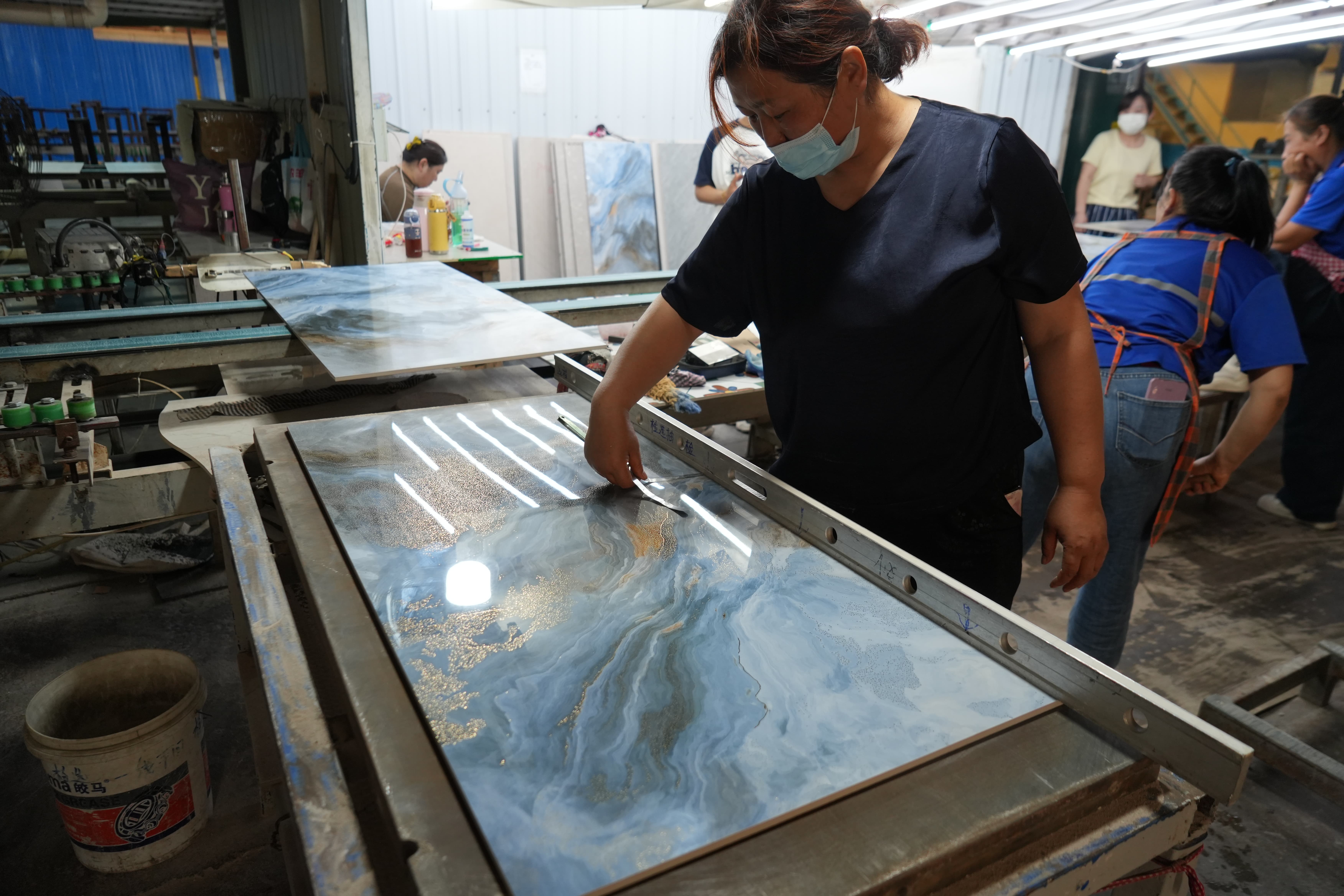
Dimensional and flatness verification during production quality control — the practical basis of the sixth shortlist filter.
Commercial flooring failures rarely start with a design decision. They start with a specification that never carried numbers. A tile can look correct on a sample board and still fail in a shopping mall concourse, a hospital corridor, a logistics dock or a frost-exposed station platform — and by the time the failure is visible, the procurement decision is years old and expensive to reverse.
For 60x120 cm porcelain tiles — a format widely specified for large commercial flooring and wall cladding — buyers can reduce that risk by running six hard technical filters before the design conversation begins. Water absorption below 0.5%. Breaking strength of at least 1300 N. Modulus of rupture of at least 35 MPa. Mohs surface hardness between 6 and 7. Abrasion resistance rated PEI 4 or PEI 5. And dimensional control inside a declared thickness range of 9.0–10.5 mm.
One commercial fact belongs next to those six: a box of 60x120 cm porcelain tile contains two pieces and covers 1.44 m². That single packaging figure converts a project area into boxes, pieces, pallets and a first-pass logistics budget — which is usually where a shortlist stops being a design discussion and becomes a procurement plan.
Why Six Filters Beat a Sample Board
The term “porcelain” is not a marketing word in technical documents. It is a performance definition. Under ISO 13006 and ANSI A137.1, porcelain tiles are classified as ceramic tiles with a water absorption of 0.5% or less. That threshold is the entry point to the whole framework: a tile that does not meet it is not a porcelain tile in the standards sense, regardless of how it is described commercially.
The problem for specifiers is that the remaining performance characteristics — load resistance, flexural strength, scratch resistance, surface wear and dimensional tolerance — are not implied by the word “porcelain” alone. Two products can both be classified as porcelain and still behave very differently under a pallet truck, a freeze-thaw cycle or fifteen years of mechanical cleaning.
The six filters exist to close that gap. Each one screens out a specific class of project risk, and each can be checked against a supplier’s technical documentation before a purchase order is issued. Together they turn a supplier conversation into a comparison of declared values — which is a far more defensible position for a procurement team than a comparison of photographs.
The opportunity is straightforward. Commercial construction pipelines in several export markets are expanding, and buyers who can evaluate a specification quickly gain time. In Central Asia, for example, Kazakhstan’s construction output grew by 15.9% year-on-year in 2025, according to the Bureau of National Statistics of Kazakhstan — a signal that project teams are under schedule pressure and will favour suppliers whose documentation is already complete.
The Six Filters, Defined
The values below describe the 60x120 cm porcelain tile range — including the Travertine and Marble Series models — as declared in product documentation. They are intended as shortlist filters, not as a substitute for project-specific test reports.
| # | Filter | Target value | Risk it screens out |
|---|---|---|---|
| 1 | Water absorption | Below 0.5% (vitrified) | Moisture penetration, frost damage, staining |
| 2 | Breaking strength | ≥ 1300 N | Point-load and impact fracture |
| 3 | Modulus of rupture | ≥ 35 MPa | Flexural failure on large-format panels |
| 4 | Mohs hardness | 6–7 | Surface scratching from grit and equipment |
| 5 | Abrasion resistance | PEI 4 / PEI 5 | Surface wear under sustained foot traffic |
| 6 | Dimensional control | 60x120 cm; 9.0–10.5 mm thickness | Lippage, joint misalignment, installation rework |
1. Water Absorption Below 0.5%
Water absorption is the filter that determines whether a tile belongs in a demanding environment at all. The 60x120 cm porcelain range is vitrified with a water absorption below 0.5%, placing it inside the ISO 13006 and ANSI A137.1 porcelain classification. The practical consequence is a dense body with effectively zero water penetration, which matters wherever floors meet moisture, cleaning chemicals or freeze-thaw cycles. In cold-climate commercial work, this filter is the difference between a floor that survives winter and one that spalls.
2. Breaking Strength of at Least 1300 N
Breaking strength describes the load a tile resists before fracturing. It is the filter that answers a simple site question: can this floor take a loaded trolley, a pallet truck, a rolling display unit or a dropped tool? For heavy surface load conditions — logistics halls, transport concourses, retail back-of-house — a declared value of at least 1300 N is a practical shortlist threshold, not a theoretical one. If a supplier cannot state it, the product should not advance to the next stage of evaluation.
3. Modulus of Rupture of at Least 35 MPa
Modulus of rupture measures flexural strength — how much bending stress the tile body resists before failure. It becomes the critical filter as format increases, because a 60x120 cm panel spans more unsupported area than a small-format tile and transfers more stress to the body. It is equally relevant where the tile is used for wall cladding and facade engineering, and in buildings where structural movement or thermal shock is expected. Values of at least 35 MPa give specifiers a defensible margin for large-format commercial installation.
4. Mohs Hardness Between 6 and 7
Surface hardness determines how a floor ages visually. Grit tracked in from entrances, trolley wheels, dragged furniture and mechanical cleaning equipment all leave marks on soft surfaces. A Mohs hardness of 6–7 places the tile surface in a range capable of resisting routine commercial abrasion. This filter matters most in public buildings — airport terminals, railway stations, educational facilities — where appearance retention is part of the maintenance budget, not just an aesthetic preference.
5. PEI 4 / PEI 5 Abrasion Resistance
The PEI classification describes a glazed surface’s resistance to abrasive wear. A PEI 4 or PEI 5 rating is the appropriate band for commercial environments exposed to sustained foot traffic, and it is one of the quickest filters to verify against a supplier datasheet. It is also the filter most often omitted when projects are shortlisted on appearance and price alone — and the omission tends to surface as visible wear paths in high-traffic corridors long before the floor’s structural life is over.
6. Dimensional and Thickness Control
The sixth filter is not an attribute of the material but of the manufacturing process: whether a nominal 60x120 cm tile is delivered consistently within a thickness range of 9.0–10.5 mm and within acceptable flatness tolerance. Large-format tiles leave less room for substrate deviation, so dimensional consistency directly affects lippage, joint alignment and rework. Flatness testing during production is what makes the rest of the framework installable — a technically superior body still produces a poor floor if the panels are not dimensionally true.
From Square Metres to Boxes and Freight
Technical filters decide whether a tile is suitable. Packaging data decides what it costs to move. For this 60x120 cm porcelain range, the packaging specification is two pieces per box, covering 1.44 m² per box. That figure converts project areas into order lines directly.
| Project floor area | Boxes required (1.44 m²/box) | Pieces (2 per box) |
|---|---|---|
| 500 m² | 348 boxes | 696 pieces |
| 1,000 m² | 695 boxes | 1,390 pieces |
| 5,000 m² | 3,473 boxes | 6,946 pieces |
| Reported minimum order quantity (per design) | 278 boxes | 556 pieces |
These are raw coverage figures based on the nominal box area; cutting waste and site breakage allowances are added on top by the project team. The value of doing this arithmetic early is that it produces three numbers procurement can act on: box count for order placement, piece count for installation planning, and pallet volume for freight quotation.
A republished supplier profile for All-King Ceramics reports a minimum order quantity of 400 m² per design, equivalent to 278 boxes at this packaging specification. That is a useful screen for buyers: it fits most commercial fit-outs and phased roll-outs, but a small single-room renovation may fall below it.
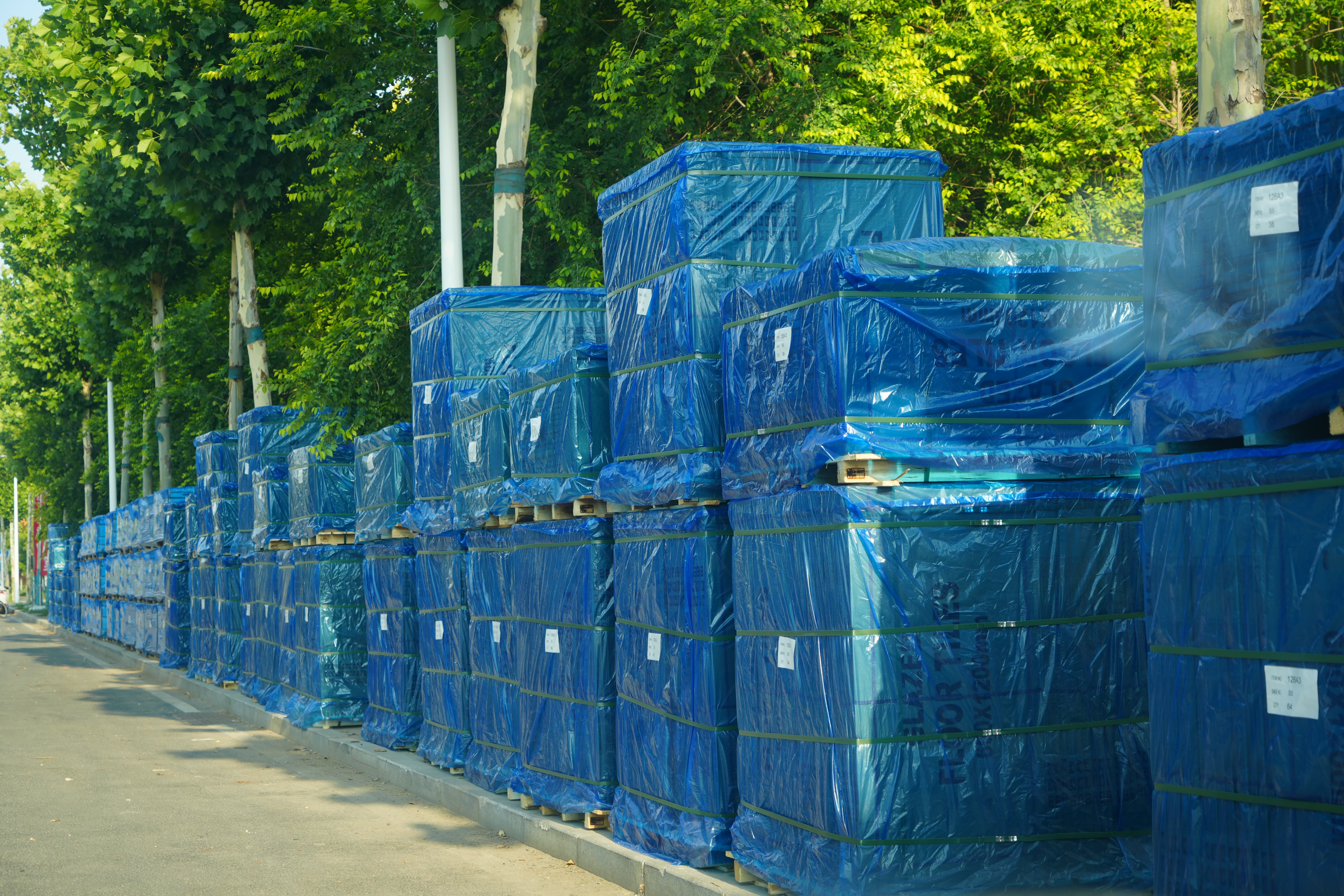
Palletised packaging: box, pallet and container planning follow directly from the 1.44 m² per box figure.
Freight mode is the second half of that calculation. For landlocked Central Asian destinations, sea transit plus inland haulage is not the only option. Reported rail freight benchmarks place full-container-load transit from China to Central Asian markets such as Kazakhstan and Uzbekistan in the region of 10 to 14 days — a materially shorter lead-time window than maritime routing for the same project. For buyers planning phased deliveries into a construction schedule, that difference can determine whether the tile order arrives before or after the screed is ready.
Where the Six Filters Apply
The framework is built around commercial real estate applications, where tiles are used for flooring and wall cladding, commercial fit-out, interior decoration, facade engineering and hotel renovation. The working conditions these projects impose are consistent: continuous heavy-duty use, high-frequency commercial traffic and non-stop foot traffic, combined with frost and freeze-thaw exposure, wet and slippery surfaces, thermal shock and heavy surface load.
In practice, the filters map onto project types with different weighting:
- High-traffic interior floors — shopping mall concourses, airport terminals and railway station flooring — depend most heavily on filters 5 (PEI 4/5) and 4 (Mohs 6–7), because surface wear determines how quickly the floor looks tired.
- Heavy-load and logistics areas — logistics warehouse floors, back-of-house corridors, loading zones — depend on filters 2 and 3, where point loads and flexural stress are the dominant failure modes.
- Wet and clinical environments — hospital wall and floor areas, hotel bathrooms, kitchen zones — depend on filter 1, where zero water penetration and acid and alkali resistance underpin hygiene and cleaning regimes.
- Frost-exposed and semi-outdoor areas — station platforms, entrances, covered walkways, facade engineering — depend on filter 1 combined with frost resistance and an anti-slip rating of R10/R11, which are separate project requirements rather than automatic properties of a porcelain body.
- Large public buildings — educational facilities, civic halls, apartment project lobbies — depend on filter 6, because large-format panels amplify any dimensional inconsistency across a wide, visible plane.
This application profile is documented as common in countries including Australia, Canada, Kazakhstan and the Philippines, alongside other markets. Installation also depends on supporting equipment that should be priced into the project: tile adhesive and grout, a leveling system, tile spacers, diamond cutting tools, a subfloor preparation system, and facade hanging systems where wall cladding is involved.
Market Signals Behind the Shortlist
Three published signals suggest why documented, technically filtered specifications are becoming more common in commercial procurement.
First, scale. The global market for ceramic and porcelain tiles is projected to reach USD 449.86 billion in 2025, according to Custom Market Insights — a figure that reflects both renovation demand in established markets and new construction in emerging ones.
Second, regional growth. Kazakhstan’s construction output grew 15.9% year-on-year in 2025 per national statistics, while the Russian ceramic tile market was estimated at USD 2.90 billion in 2025 by Mordor Intelligence. Longer-range consumption forecasts point in the same direction: tile consumption in the Far East is projected to rise to 10.8 billion m² by 2028, at an average annual growth of 1.8%, according to research referenced by MECS Research Center.
Third, uncertainty. Published forecasts for the Russian ceramic tile market diverge — some project modest growth through 2031, others a contraction through 2030 under geopolitical constraints. Where demand outlooks conflict, buyers tend to move toward specification certainty: verifiable values on a datasheet rather than assumptions about a market. That is precisely the environment in which a six-filter shortlist becomes the standard first step.
What the Framework Does Not Cover
Any shortlist framework has boundaries, and buyers should know where this one stops.
The traditional alternative — specifying by appearance and price per square metre — captures design intent and immediate budget very efficiently. It simply does not capture performance risk. The six filters invert that trade-off: they capture freeze-thaw, load, wear and dimensional risk, but they require documentation, and they will exclude products that look acceptable but cannot produce declared values. Neither approach is free.
| Decision basis | What it captures well | What it leaves open |
|---|---|---|
| Appearance and unit price | Design intent, immediate budget comparison, availability of samples | Frost resistance, load capacity, wear life, dimensional consistency |
| The six technical filters | Performance risk screening, comparable declared values, installation tolerance | Installation quality, substrate condition, project-specific slip and frost requirements |
How All-King Ceramics Maps to the Framework
All-King Ceramics is a manufacturer and direct exporter of architectural ceramics based in Zibo, China, operating as ZIBO ALL-KING IMPORT&EXPORT TRADING CO.,LTD since 2011. The company runs a 60,000 m² manufacturing facility with approximately 320 staff, including a dedicated R&D team of 25 engineers, and reports an annual production output of 12 to 16 million m².
Its product portfolio places 60x120 cm porcelain tiles as the flagship core format, supported by 75x150 cm porcelain tiles, 80x80 cm porcelain tiles, 60x60 cm ceramic tiles and 100x100 cm floor tiles. For buyers applying the six filters, the relevant point is that the format under evaluation is the company’s primary production line rather than a peripheral item.
The declared performance profile of the 60x120 cm range maps directly onto the framework: vitrified body with water absorption below 0.5%, breaking strength of at least 1300 N, modulus of rupture of at least 35 MPa, Mohs hardness of 6–7, PEI 4/PEI 5 abrasion resistance and a 9.0–10.5 mm thickness range. The range is documented as designed for high-traffic, frost-prone and wet environments, with anti-slip (R10/R11), frost resistance, low VOC emissions, acid and alkali resistance, zero water penetration and ISO 13006 compliance stated for relevant applications.
Export accounts for 70% of the company’s sales, with named markets including Australia, New Zealand, Russia, Belarus, South Korea, Vietnam, Malaysia, the Philippines, Peru, Panama, Colombia, Chile, Bolivia, Guatemala, Palestine, Iraq, Ukraine and the United Arab Emirates — a distribution footprint that overlaps several of the regions where the six-filter approach is most relevant.
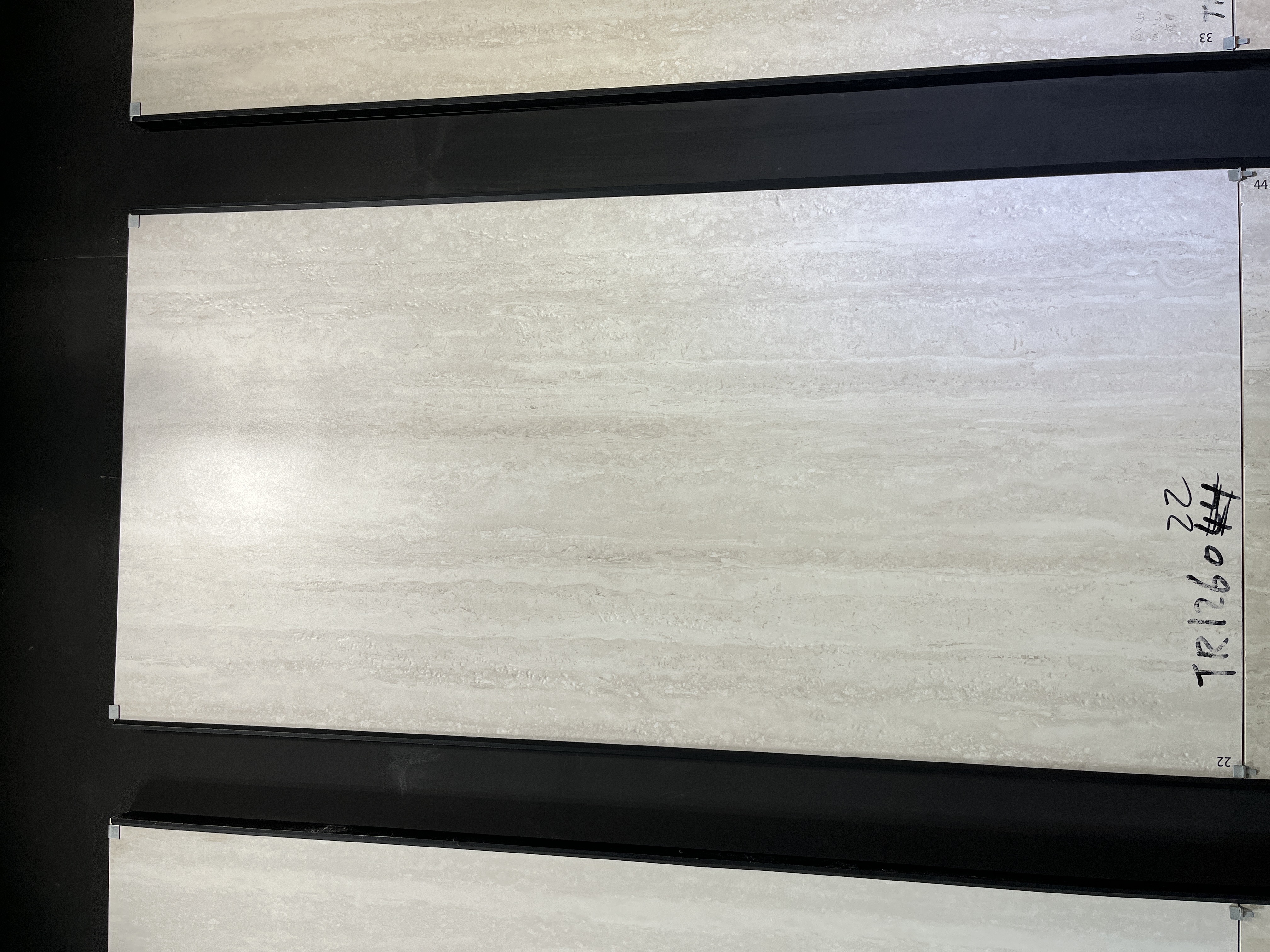
Surface character is a design decision; the six filters are a performance decision. Both belong on the same shortlist sheet.
Future Outlook
The direction of commercial tile procurement is toward documentation. As construction pipelines expand in Central Asia, Russia, Southeast Asia and Eastern Europe, and as project teams become more accountable for lifecycle performance, shortlists based on declared technical values are likely to become the default rather than the exception.
Two further shifts seem probable. First, large-format porcelain will continue to displace small-format tile in public buildings, transit hubs and hospitality interiors, which raises the importance of dimensional control and installation systems in supplier evaluation. Second, logistics will increasingly be evaluated alongside material performance: for landlocked markets, a 10–14 day rail freight window changes what a realistic project schedule looks like and makes packaging data — 2 pieces per box, 1.44 m² per box — part of the technical conversation rather than an afterthought.
For buyers, the practical takeaway is simple. Six numbers, one packaging figure, and a supplier that can document both will carry a commercial project further than a sample board ever can.
FAQ
What water absorption level makes a tile a porcelain tile?
Under ISO 13006 and ANSI A137.1, porcelain tiles are defined as ceramic tiles with a water absorption of 0.5% or less. A vitrified 60x120 cm porcelain tile with water absorption below 0.5% therefore sits inside the porcelain classification, while a tile above that threshold does not — regardless of how it is marketed.
Is breaking strength or modulus of rupture more important for a commercial floor?
They answer different questions and are normally specified together. Breaking strength (at least 1300 N) describes resistance to point loads from trolleys, equipment and dropped objects. Modulus of rupture (at least 35 MPa) describes flexural strength — resistance to bending stress, which becomes more important as format size increases. A large-format commercial floor shortlist usually requires both values to be declared.
What does a PEI 4 or PEI 5 rating mean in a commercial specification?
PEI classification describes a glazed surface’s resistance to abrasive wear, with higher classes corresponding to greater resistance under traffic. PEI 4 and PEI 5 are the bands typically applied to commercial environments with sustained foot traffic, such as retail concourses, transport terminals and institutional corridors.
How do 2 pieces per box and 1.44 m² per box help with project budgeting?
They convert floor area into order quantities. At 1.44 m² per box, 1,000 m² of flooring equals approximately 695 boxes and 1,390 pieces; 5,000 m² equals approximately 3,473 boxes and 6,946 pieces. These are raw coverage figures — project teams add cutting waste and site breakage allowances on top, then use the box and piece counts for pallet and freight planning.
Can 60x120 cm porcelain tiles be used in frost-prone or semi-outdoor commercial areas?
Water absorption below 0.5% is a prerequisite, but frost resistance is a separate requirement that must be stated and verified for the specific application. For frost and freeze-thaw conditions, specifications in these scenarios typically also call for anti-slip ratings of R10/R11, zero water penetration, acid and alkali resistance and ISO 13006 compliance. Buyers should confirm each of these against project documentation rather than assuming them from the porcelain classification alone.
What documentation should a buyer request before shortlisting a porcelain tile supplier?
At minimum, declared values for water absorption, breaking strength, modulus of rupture, Mohs hardness, abrasion class and thickness range, together with the corresponding test reports and certificate copies. The six filters are only useful if the values behind them can be traced to documents the buyer has actually received.
Reference document: All-King Ceramics product catalogue (PDF) — https://cdn.socialarks.com/sbsp/24953/common/2026/0625/ALLKING%20Ceramics%20Catalog.pdf