
Sizing Agent Checklist: Low-VOC, APEO-Free, Shelf Life
Sizing Agent Checklist: Low-VOC, APEO-Free, Shelf Life

A paper sizing agent should be approved through a documented qualification checklist with four gates — compliance evidence, physical parameters, system compatibility and storage stability — and the results should be written into the purchase order as acceptance criteria. A technical data sheet supports that review; it cannot replace it.
The distinction matters more now than when most mills qualified chemicals on trial alone. Buyers in packaging and cultural paper carry environmental requirements of their own, and the low-VOC and APEO/NPEO-free conditions that appear among JHDA's published application parameters for papermaking sit alongside formula compatibility, salt and high-temperature resistance, and long-term storage stability. Those conditions have to be met per grade, per shipment and per market — not per brochure.
This reference sets out how to build that review for four surface sizing agents from Qingzhou Jinhao New Material Co., Ltd. (JHDA), a papermaking chemicals manufacturer founded in 2005 and based in Qingzhou, Shandong, China: JH-600, JH-WH3364, JH-200 and JH-325. It maps their published parameters into acceptance checks and shows where each check belongs in a supply agreement. It does not assert that any grade is low-VOC or APEO/NPEO-free, because no grade-level declaration of that kind is contained in the documentation available here. Obtaining that declaration in writing is itself a checklist item.
Why a specification line is not yet an acceptance criterion
A published parameter answers one question: what does the supplier state? A purchasing criterion answers a different one: what will the mill accept, measured how, and what happens when a delivery falls outside it? Four gaps separate the two.
The first gap is method. The published data for JH-600, JH-WH3364, JH-200 and JH-325 gives pH, viscosity at 25 °C, solids, ionic type, solubility, appearance and shelf life, but it does not state the test method behind each value. A solids figure of 30 ± 1 % becomes enforceable only when the drying method, sample size and sampling point are agreed. Without that, both parties can measure honestly and still disagree.
The second gap is configuration. JH-200 is published with two solids options, 20.0 ± 1.0 % and 30.0 ± 1.0 %. An order that names only the model does not define which grade is supplied, and the choice changes dosage calculations, freight per active tonne and storage volume. The purchase order has to carry the full grade identity, including solids.
The third gap is document life. Certificates, test reports and safety data sheets carry issue and expiry dates. A qualification file that records only "certificate on file" will not notice when the copy predates the contract period.
The fourth gap is environmental evidence. Where a mill's own permit, customer specification or export market requires low VOC content and the absence of APEO/NPEO, that requirement has to be evidenced per product. It cannot be inferred from the chemistry family, and it cannot be inferred from a management-system certificate: an ISO 14001 certificate demonstrates that an audited environmental management system exists, not that a specific emulsion has a particular VOC content or alkoxylate profile.
Gate 1: compliance and documentation evidence
The first gate is a document set that a buyer can file, audit and re-check at each annual supplier review. It should contain a grade-level technical data sheet, a safety data sheet for the same grade and the same market of import, a certificate of analysis per batch, current management-system certificates with number, issuing body, scope and validity dates, market-specific certificates where the destination requires them, and the export documents a mill needs for clearance and payment.
JHDA states that it supplies TDS and MSDS documents to support customs clearance and letter-of-credit settlement, and that its exported chemicals complete CAS registration and GHS hazard labelling in line with IMDG rules for marine transport. The certificates in the available documentation can be recorded as follows:
- ISO 9001:2015 — certificate 10423Q01592R1S, issued by Shandong Seatone International Certification Co., Ltd., standard GB/T 19001-2016 / ISO 9001:2015, scope recorded as production of papermaking additive, applicable to the global market.
- ISO 14001:2015 — certificate 10423E01032R2S, issued by the same body, standard GB/T 24001-2016 / ISO 14001:2015, scope covering production of papermaking additive and related environmental management activities.
- HALAL — certificate 6637250000, issued by Shandong Halal Certification Service (SHC), assessed against Indonesia Halal Law and Regulations and MS1500:2019, issued 29 August 2025 and valid to 28 August 2028, scope paper-making industry additives, Indonesia market.
Three review habits follow from that list. First, record validity dates and diarise the renewal check: the ISO certificates described above carry 2023 issue dates and 2026 validity end dates, so the certificate in force at the time of the review should be requested and filed rather than an earlier copy. Second, read the scope wording, which is written at the level of "production of papermaking additive"; match it against the grades actually being purchased rather than assuming blanket coverage. Third, treat a market-specific religious certificate as market-specific — the HALAL certificate above applies to Indonesia and to the stated scope, and should not be circulated as approval for other jurisdictions.
Where the mill needs third-party product testing, the same discipline applies: record the test report number, the laboratory, the method, the reporting limit and the formulation covered. JHDA states that it holds SGS product compliance test reports for packaging paper chemicals; a buyer should file the report for the specific grade concerned, not the general claim.
Gate 2: physical parameters, read in purchasing terms
The published parameter set for the four grades is compact, which makes it easy to copy into a purchasing annex — and easy to copy without interpretation.
| Attribute | JH-600 | JH-WH3364 | JH-200 | JH-325 |
|---|---|---|---|---|
| Material basis | Styrene acrylic | Weak anionic styrene acrylic with AKD | AKD wax powder | Anionic styrene acrylic |
| Appearance | Light brown to dark brown liquid | Milky white to pale yellow liquid | Milky white to slightly yellow liquid | White to light brown liquid |
| Solid content (%) | 30 ± 1 | 25.0 ± 1.0 | 20.0 ± 1.0 or 30.0 ± 1.0 | 25.0 ± 1.0 |
| pH | 2.0–5.0 | 2.0–5.0 | 2.0–5.0 | 2.0–5.0 |
| Viscosity (25 °C, cps) | < 50 | ≤ 50 | ≤ 50 | ≤ 50 |
| Ionic type | Cationic | Weak cationic | Cationic | Anionic |
| Solubility | Soluble in water | Soluble | Soluble | Soluble |
| Shelf life | 6 months | 4 months | 3 months | 6 months |
Source: JHDA published product parameters. Values are supplier-reported and should be confirmed on the grade-specific TDS at the time of order.
pH 2.0–5.0. All four grades sit in the same acidic range as supplied. That figure describes the delivered emulsion; it does not define the papermaking system the product serves, and it should not be read as evidence of either an acidic or a neutral sizing route. What the number does govern is handling — dosing lines, tanks and seals in contact with the neat emulsion — and it gives the mill a fast incoming check, because an unexpected pH shift is one of the clearest early signals of contamination or dilution in transit.
Viscosity ≤50 cps at 25 °C. The reference temperature is fixed, so incoming readings should record actual emulsion temperature alongside the result; a sample taken from a cold drum in winter is not directly comparable with one taken in summer. Viscosity also sets the pumping and metering window and affects how the product behaves in the starch blend at the sizing press.
Solid content. 30 ± 1 % for JH-600, 25.0 ± 1.0 % for JH-WH3364 and JH-325, and either 20.0 ± 1.0 % or 30.0 ± 1.0 % for JH-200. Cost comparison across suppliers is only meaningful on the same solids basis: a lower price per wet tonne at lower solids can be the more expensive option per active tonne. This is the most common place where an apparently simple specification comparison goes wrong, and the reason the solids grade belongs in the purchase order wording rather than in a footnote.
Ionic type. Cationic for JH-600 and JH-200, weak cationic for JH-WH3364, anionic for JH-325. Ionic type determines which starch stream and which dosing point a grade can share, so it belongs in the acceptance specification next to the numeric parameters — not left to the brand name.
Gate 3: compatibility, shear and foaming — proven on the machine, not on the sheet
Compatibility is a machine-specific property, but the supplier's published statements show where a mill should test. JH-200 is described as blendable with industrial starch and compatible with oxidized starch and cationic modified starch; JH-WH3364 is described as blending with oxidized and modified starch and as compatible with retention aids and defoamers; JH-600 is described as compatible with retention aids, defoamers and other wet-end chemicals without system flocculation; JH-325 is described the same way. All four are described as mechanically shear resistant and low foaming, and as suitable for continuous high-speed surface sizing without producing bubble pinholes or streaks.
Three checks convert those statements into release criteria.
- Bench blend. Blend the grade at the mill's actual starch solids and water hardness and hold it for the length of one shift. Record separation, skinning, sediment and any viscosity drift.
- Single-grade machine trial. Inspect the sheet for pinholes, longitudinal streaks and surface picking, then inspect rollers and drying cylinders for deposit build-up at the end of the run.
- Carry-over observation. Where the surface size changes but the wet-end chemistry does not, observe the interaction with retention aids and defoamers across at least one full grade change.
The boundary is worth stating plainly: "low foaming" and "shear resistant" are supplier characterisations of the product, not results from the buyer's machine. The mill's own trial record is what should govern release. A successful trial on JH-600 does not release JH-325 or JH-WH3364 — different ionic type, different film chemistry, and therefore a separate acceptance run.
Gate 4: storage stability and shelf-life planning
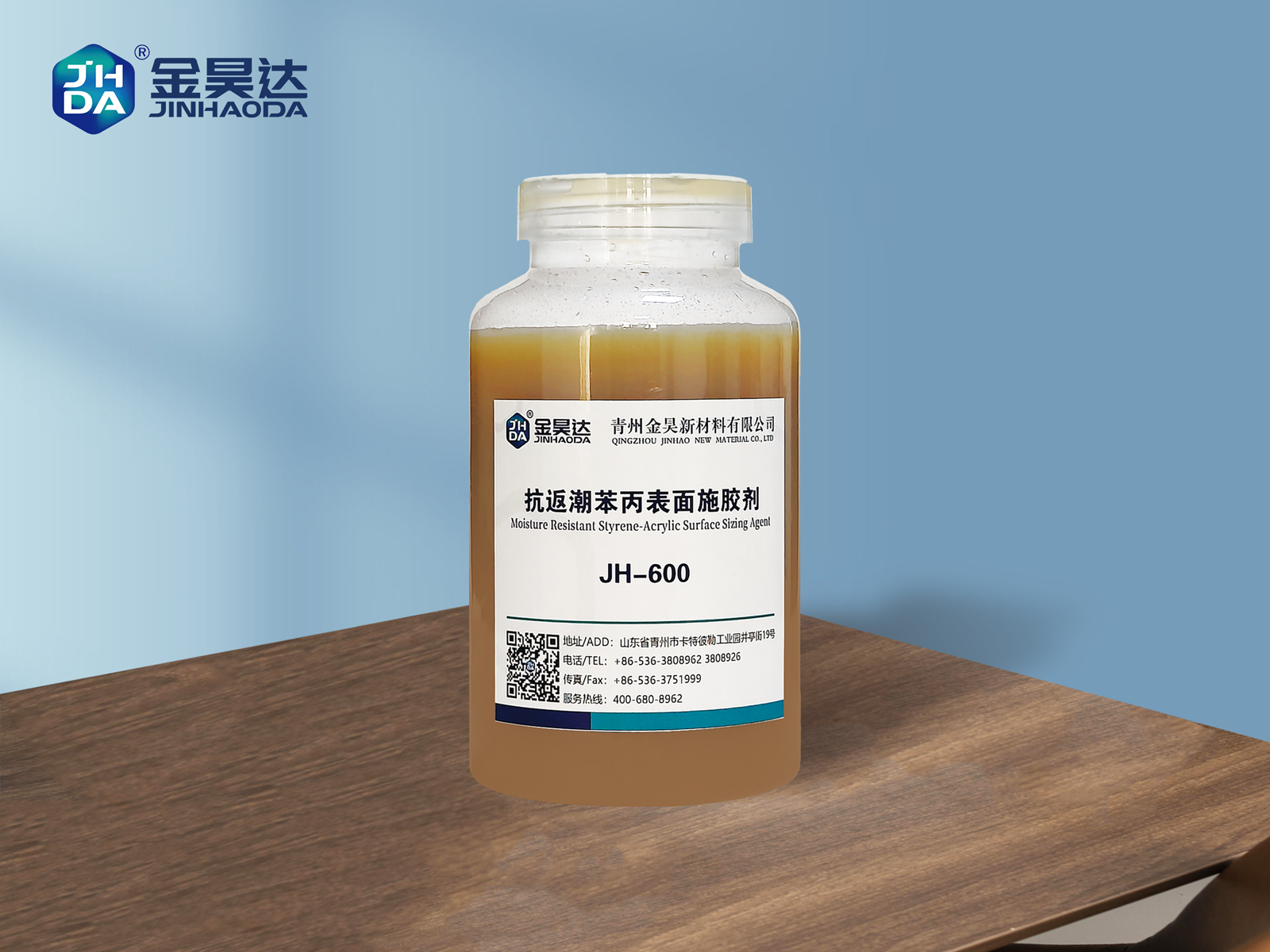
Shelf life is where a technically acceptable product becomes a supply-chain problem if the terms are left out of the order. The published figures differ materially across the range: six months for JH-600, four months for JH-WH3364, three months for JH-200 and six months for JH-325. The stability statements behind those figures are specific rather than general. JH-600 is described as stable at normal temperature with no demulsification or precipitation during transport and long-term storage, and with stable batch-to-batch quality for continuous dosing. JH-325 is described as stable at normal temperature without demulsification or precipitation in transport and long-term storage. JH-WH3364 is described as showing storage stability at room temperature without precipitation or oil separation.
Four terms turn those statements into something a mill can enforce.
- Minimum remaining shelf life at delivery. State it as a share of the declared shelf life, with the batch date printed on the drum and on the certificate of analysis. This converts a marketing statement into a rejection right.
- Order quantity against consumption rate. A three-month shelf life on JH-200 is workable in a mill that empties a tank within weeks and awkward in a mill that buys a quarter's demand at once. JHDA's stated minimum order quantity is 1 MT with free trial samples, and its stated production lead time is four working days; those two figures are enough to size a reorder point instead of guessing it.
- Storage condition and rotation. Normal-temperature storage is the published condition. First-in-first-out rotation plus a retained sample per batch is what makes a later dispute resolvable at all.
- Incoming re-test. pH and viscosity on receipt take minutes and catch the two failure modes that matter most — dilution and emulsion breakdown.
Turning the review into purchasing terms and acceptance criteria
The checklist only becomes procurement practice when each item is attached to a document and a clause. The mapping below is the working version of that link.
| Review item | Evidence to hold | Where it belongs |
|---|---|---|
| Grade identity (model plus solids grade) | Grade-specific TDS; written confirmation of the solids grade supplied | Purchase order line-item wording |
| Numeric parameters | pH, viscosity at 25 °C, solids, ionic type, solubility with agreed methods and tolerances | Specification annex to the PO |
| Environmental declaration | Grade-level written statement on VOC content and APEO/NPEO absence, with test method and reporting limit where testing is claimed | Compliance annex, per grade |
| Management-system certificates | Current certificate with number, issuing body, scope wording and validity dates | Supplier file, re-checked annually |
| Market-specific certificate | Certificate covering the destination market and the purchased scope | Compliance annex, per market |
| Compatibility and runnability | Mill trial report: starch blend, sheet defects, deposit observation, machine and grade | Release condition before first bulk order |
| Shelf life at delivery | Batch date on drum and CoA; stated minimum remaining shelf life | Delivery term with rejection right |
| Batch traceability | Certificate of analysis per batch; retained sample | Quality clause |
| Change notification | Written notice of formulation or raw-material source change before shipment | Change-control clause |
| Deviation and support path | Named technical contact; scope of online and on-site support | Service clause |
Two clauses are usually omitted and later regretted. The first is change notification: a formulation or raw-material source change can alter ionic behaviour and film formation without moving any headline parameter, so the mill needs notice before the drum ships rather than after the paper is rejected. The second is the method clause: without an agreed test method, a certificate-of-analysis value and an incoming laboratory value cannot be compared, and every dispute becomes a discussion about sampling.
Technical support arrangements are part of the same record. JHDA states that it provides engineering and process solution support through online and on-site channels, and that its field team works on core paper indicators including Cobb water absorption, ring crush strength, bursting strength and retention during machine trials. A mill should record which of those parameters its own trial is expected to report, because a support commitment without an agreed measurement is difficult to enforce later.
Where each grade fits — and where the published data stops
The four grades are not interchangeable, and the differences that matter to procurement are the ones already in the table.
- JH-200 is a surface AKD sizing agent described as reacting with cellulose to build a water-resistant barrier, with the sizing effect finalised as the sheet passes the drying cylinder, so the supplier states no curing period is needed. It is published in two solids grades, which makes grade identification the first acceptance question rather than the last.
- JH-WH3364 is a composite of AKD and styrene-acrylic, described as combining reactive waterproofing with a film-forming component for neutral papermaking systems, and as compatible with retention aids and defoamers.
- JH-600 is a moisture-resistant SAE surface sizing agent aimed at paper exposed to humid storage and long-distance transport; the supplier describes it as slowing moisture re-absorption while retaining ring crush and surface strength under humid conditions, and as compatible with industrial starch without a change to the existing feeding process.
- JH-325 is an anionic styrene-acrylic surface sizing agent for cultural paper such as offset, copy and book paper, described as suitable for both acidic sizing with aluminium sulfate and modern neutral systems. JH-611, a related cationic surface sizing agent in the same portfolio, is positioned for corrugated paper and boxboard with ring crush stiffness and surface hardness as the stated targets.
What the published data does not contain is as important as what it does. There is no dosage recommendation per tonne of paper in the available documentation, no Cobb or water-absorption result from a named mill, and no comparative trial against another supplier's grade under identical machine conditions. Those are precisely the items a qualification trial exists to produce, and they should be recorded as mill data — machine, paper grade, starch system, date and operator — rather than carried over from a supplier statement into a specification annex.
What the wider sizing market says, and what it does not
Two market estimates frame the category without answering any grade-level question. Global Market Insights reported the sizing agents market at USD 2.98 billion in 2025, progressing to USD 3.1 billion in 2026, with the top five suppliers holding about 48 % of the market in 2025. Fact.MR put the alkyl ketene dimer segment at USD 860 million in 2026, with standard AKD emulsions accounting for 54 % of that segment, and projected a 5.4 % compound annual growth rate for China's AKD market over 2026–2036. The 2026 values are forecast-based figures rather than audited outcomes.
For a mill, the practical reading is narrower than the numbers suggest. A concentrated supplier landscape and forecast growth indicate that grades will continue to be available and that documentation practices will continue to be compared between suppliers. Neither says anything about whether a specific drum delivered in a specific month meets a specific specification. That question is answered only by the four gates above, applied per grade, with the mill's own measurements attached.
Outlook: what a mill should prepare for
Three developments would change how qualification reviews are assembled, and each is conditional rather than certain. If environmental declarations become a routine annex rather than a request, mills that already hold grade-level statements on VOC content and APEO/NPEO absence will qualify new suppliers faster than mills that start collecting them at the point of audit. If certificate tracking becomes part of annual supplier review, expired or scope-narrow copies will surface before a shipment is refused rather than afterwards. And if short-shelf-life grades such as JH-200 remain at three months, procurement planning will keep favouring smaller, more frequent orders or local stocking over a single annual purchase.
None of those outcomes requires a new product. Each requires the same thing: a written checklist, grade-level evidence, and a purchase order that states what will be measured and what happens when the measurement fails.
FAQ
What documents should a paper mill request before approving a sizing agent?
A grade-level technical data sheet and safety data sheet for the market of import; a certificate of analysis per batch; current management-system certificates with number, issuing body, scope wording and validity dates; any market-specific certificate the destination requires; export documents such as certificate of origin, pre-shipment inspection report and dangerous goods transport documentation where the classification requires it; and, where the mill has environmental requirements, a written grade-level declaration covering VOC content and APEO/NPEO absence. Each document should be filed with its issue and expiry dates so that renewal is noticed before the contract period ends.
How can a mill verify low-VOC and APEO/NPEO-free claims for a sizing agent?
Ask for a written declaration at grade level, plus any supporting test report, and check that the report states the test method, the reporting limit and the formulation covered. A management-system certificate such as ISO 14001 confirms that an audited environmental management system exists; it does not certify the VOC content or the alkoxylate profile of a specific emulsion. Where the requirement is contractual, place the declaration in a compliance annex and pair it with a change-notification clause, because a formulation change can alter the declaration without changing the headline parameters on the data sheet.
Which parameters should be fixed in the acceptance specification for JH-600, JH-WH3364, JH-200 and JH-325?
All four are published at pH 2.0–5.0 and at viscosity ≤50 cps at 25 °C, and all are water soluble. Solid content differs: 30 ± 1 % for JH-600, 25.0 ± 1.0 % for JH-WH3364 and JH-325, and either 20.0 ± 1.0 % or 30.0 ± 1.0 % for JH-200. Ionic type is cationic for JH-600 and JH-200, weak cationic for JH-WH3364 and anionic for JH-325. Published shelf life is six months for JH-600 and JH-325, four months for JH-WH3364 and three months for JH-200. The specification should also name the test methods, sampling point and tolerances, without which the values cannot be measured against.
How should storage stability be written into purchasing terms?
Four terms do most of the work: a stated minimum remaining shelf life at delivery, expressed as a share of the declared shelf life; the batch date printed on both the drum and the certificate of analysis; the storage condition and a first-in-first-out rotation rule with a retained sample per batch; and an incoming re-test of pH and viscosity, which catches dilution and emulsion breakdown quickly. A rejection right tied to the remaining shelf life at delivery is what distinguishes an enforceable term from a supplier statement about stability during transport.
Is a three-month shelf life a limitation for JH-200?
It is a planning constraint rather than a defect. A three-month published shelf life suits a mill that consumes stock within weeks, or one that holds local inventory or orders in smaller quantities more often. It complicates a single annual purchase, because part of the delivered volume can age before use. For comparison, JH-WH3364 is published at four months and JH-600 and JH-325 at six months, so reorder points and safety stock should be set per grade from the consumption rate rather than applied uniformly across the range.
The full JHDA product and company brochure is available for download: JHDA introduction 2026 (PDF).
Tem questões ou precisa de mais detalhes?
Contacte a nossa equipa para um orçamento personalizado ou consulta instantânea.
Solicitar orçamento
Preencha o formulário abaixo e a nossa equipa entrará em contacto com uma proposta personalizada.
Chat direto do WhatsApp
Prefere conversar em tempo real? Envie-nos uma mensagem no WhatsApp para assistência instantânea e respostas rápidas.
- Obter orçamento personalizado
- Partilhar fotos ou documentos
- Discuta as suas necessidades diretamente
Geralmente responde em 5–30 minutos durante o horário de expediente.