
Sizing Custom Touch Display Modules for New Energy HMI
Sizing Custom Touch Display Modules for New Energy HMI
In new energy manufacturing, the touch display module is often selected too late. The module has to fit an operator panel or control cabinet, survive the production environment and still give the operator a reliable interface for 24/7 equipment control. Xiangrui Optoelectronics, a Guangzhou-based touch display module manufacturer (https://www.gzxrtp.com), addresses this with five capacitive sizes: 7, 10.1, 13.3, 15.6 and 21.5 inches. The model-level evidence shows that size and environment fit should be decided together, not by screen size alone.
Manufacturing facility entrance. Image supplied in the Xiangrui Optoelectronics company content unit.
Why size and environment come before touch technology
The supplied new energy manufacturing scenario describes wide-temperature, high-humidity and dusty working conditions. It places the touch display module in display-system and HMI projects, supports equipment and production-line control, and names industrial electrical cabinets, industrial monitors and HMI systems as supporting equipment. The same scenario lists EMI, EMC, IP68, IK10, wide operating temperature, anti-condensation, resistance to damp-heat aging and high brightness among special requirements.
Those are not module-only requirements. They describe the complete HMI: enclosure sealing, cable entry, grounding, power, display controller and touch controller all affect the result. The touch module still sets two hard boundaries. Its physical size determines the cabinet aperture, viewing distance and information density. Its environmental specification determines whether the same panel can be used near a wet process, a dusty line or a high-ambient-light station. A 21.5-inch module that does not fit the cabinet is not an upgrade, and a 7-inch module placed too far from the operator is not a cost saving.
Size map: five modules for different HMI roles
The five modules share a common G+G glass-lens construction and a -20°C to 70°C operating range, but they do not have identical display or brightness specifications. The table below uses the supplied model-level data and should be read as a starting map for panel fit, not as a ranking.
| Model | Size | Resolution | Brightness | Operating / storage | Typical HMI fit |
|---|---|---|---|---|---|
| XRCGG070-0108-TPM-D1 | 7-inch | 1024×RGB×600 | 700 cd/m² | -20°C to 70°C / -30°C to 80°C | Compact operator panels and automated-equipment HMI where space is limited; supporting industrial HMI and industrial touch monitors are required. |
| XRCGG101-0340-R1 | 10.1-inch | 1280×RGB×800 | 800 cd/m² | -20°C to 70°C / -30°C to 80°C | Control-panel HMI for automated equipment; the supplied scenario describes 24/7 operation in HMI display systems. |
| XRCGG133-0040-OB-A0 | 13.3-inch | 1920×RGB×1080 | 1000 cd/m² | -20°C to 70°C / -30°C to 80°C | Production-line and industrial-control interfaces needing higher resolution and brightness in a mid-size opening. |
| XRCGG156-0186-A0 | 15.6-inch | 1920×RGB×1080 | 1000 cd/m² | -20°C to 70°C / -30°C to 80°C | Equipment and production-line interfaces; supplied description notes high-humidity design and glove-touch support. |
| XRCGG215-0106-A0 | 21.5-inch | 1920×RGB×1080 | 1000 cd/m² | -20°C to 70°C / -30°C to 80°C | Larger industrial operator panels and control-cabinet interfaces; supplied description covers wide-temperature, high-humidity and high-dust display projects. |
Brightness is model-specific. The 1000 cd/m² value applies to the 13.3-, 15.6- and 21.5-inch modules in the supplied specifications; the 7-inch module is listed at 700 cd/m² and the 10.1-inch module at 800 cd/m². Temperature ranges are module specifications and do not replace system-level validation.
The 21.5-inch XRCGG215-0106-A0 is the larger-format option for industrial operator panels and control-cabinet interfaces where the cutout, viewing distance and enclosure depth support it. Its 1920×1080 resolution and 1000 cd/m² brightness suit parameter charts, multi-zone screens and control views that benefit from more area. The supplied product description also notes 10-point multi-touch, optional thin-glove touch, AF/AG/AR surface treatments, optional ESD protection and G+G full lamination or frame bonding. Those options matter because a large panel is more exposed to glare, cleaning and accidental contact.
The 15.6-inch XRCGG156-0186-A0 is the equipment and production-line size in this set. It provides 1920×1080 resolution and 1000 cd/m² brightness, and the supplied description lists wide-temperature operation, long-time continuous operation, anti-interference performance, high light transmittance, glove-touch support and IP68/IK10 as customizable. For a line-side HMI, that combination addresses both readability and the operator's working gloves. The exact IP and impact configuration still needs to be confirmed for the chosen model and enclosure.
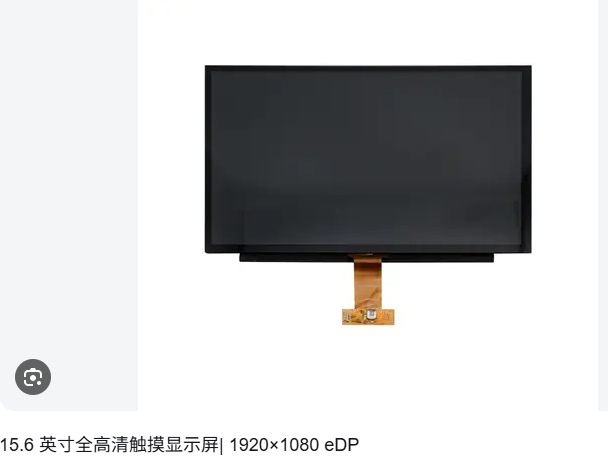
15.6-inch XRCGG156-0186-A0 touch display module. Image supplied in the product specification unit.
The 13.3-inch XRCGG133-0040-OB-A0 sits between the control-panel and line-interface sizes. It carries the same 1920×1080 resolution and 1000 cd/m² brightness as the 15.6-inch model, so the choice between them is usually mechanical: which opening fits the cabinet, and what viewing distance the operator has. The 10.1-inch XRCGG101-0340-R1 uses 1280×800 resolution and 800 cd/m² brightness; the supplied scenario describes it in 24/7 HMI display systems in automated equipment manufacturing and control panels. The 7-inch XRCGG070-0108-TPM-D1 is the compact option: 1024×600 resolution, 700 cd/m² brightness, and a requirement for supporting industrial HMI and industrial touch monitors. It fits local machine control and space-limited panels, not a long-distance line overview.
Environment fit: what -20°C to 70°C does and does not prove
All five modules are specified for -20°C to 70°C operation and -30°C to 80°C storage. That is a useful common baseline for new energy manufacturing, where the supplied scenario calls for a wide operating temperature range and anti-condensation. It does not prove that a complete HMI will start, display correctly or keep its touch accuracy at those limits. The enclosure, heater, power supply, display controller and sealing design can change the result. Buyers should ask for the exact model's specification and test evidence, then validate the assembled HMI in the intended cabinet.
Humidity and dust require the same system view. The supplied scenario places new energy HMI in high-humidity and dusty environments and lists resistance to damp-heat aging. Model descriptions add detail: the 21.5-inch module is described for wide-temperature, high-humidity and high-dust display projects; the 15.6-inch module is described as designed for high-humidity environments; the 7-inch module is described for high-humidity and dusty environments. The 21.5-inch product description also states that G+G full lamination is dustproof and anti-fog, while frame bonding is a lower-cost option. That does not remove the need for a properly sealed cabinet, but it shows why bonding and enclosure design belong in the same review.
Brightness is the other environment variable. A 1000 cd/m² module is available on the 13.3-, 15.6- and 21.5-inch sizes, but it is not a universal requirement. The 7-inch module is listed at 700 cd/m² and the 10.1-inch at 800 cd/m². A compact panel under controlled lighting may not need 1000 cd/m²; a line-side station near bright windows or outdoor-adjacent equipment may need it. The decision should use the actual ambient light, viewing distance and screen content, not a blanket brightness target.
Touch operation: bare hand, wet hand and thin glove
New energy manufacturing operators may touch an HMI with dry hands, wet hands or thin gloves. The supplied scenario material for multi-state touch lists bare-hand, wet-hand and thin-glove input, and related industrial scenarios add anti-mis-touch requirements and resistance to water-stain or rain interference. The listed modules include glove-touch support in their product descriptions; the 21.5-inch module lists thin-glove touch as an option. That is a useful starting point, but it is not a guarantee for every glove thickness, water film or cleaning chemical. The buyer should test the actual glove, the actual wet condition and the actual controller settings.
There is also a technology boundary. Xiangrui's industrial selection guidance favors 5-wire resistive touch when operators wear heavy work gloves, the panel sees heavy oil contamination, only single-point operation is needed and budget is tight. It favors industrial-grade projected capacitive touch when multi-point gestures, better display performance, a flat appearance, high-frequency operation or outdoor strong light are more important. The five modules discussed here are capacitive G+G modules, so they fit the second set of conditions more closely. A project with thick heavy gloves and heavy oil should not assume that a capacitive module is automatically the right answer.
The touch requirement also affects the cover glass and surface treatment. Anti-glare treatment can help in bright workshops; anti-fingerprint treatment can help where operators touch the same area repeatedly. The 21.5-inch description lists AF anti-fingerprint, AG anti-glare and AR anti-reflection as combinable treatments. Those options should be selected against the actual lighting and cleaning method, not added as a default.
Pairing with cabinets, monitors and HMI systems
A custom touch display module is a component, not a finished HMI. The supplied scenarios state that it must be used with industrial electrical cabinets, industrial monitors and HMI systems, and that its role is to provide a human-machine interface for equipment and production-line control. That has practical consequences for the project checklist. The cabinet must provide the correct aperture, mounting points, depth and cable routing. The monitor or HMI electronics must provide a compatible interface. The enclosure must manage heat, condensation and dust. The system must handle EMC and ESD at the installed level, not only at the module level.
- Confirm the cabinet cutout, bezel and depth for the chosen size, especially when moving from 10.1 or 13.3 inches to 15.6 or 21.5 inches.
- Check the actual viewing distance and screen content; a 7-inch panel is for close, compact control, while a 21.5-inch panel is for a larger operator station.
- Match brightness to ambient light; 1000 cd/m² is available on 13.3, 15.6 and 21.5 inches, while 7 and 10.1 inches have lower listed values.
- Test bare-hand, wet-hand and thin-glove operation with the real glove and cleaning condition if those states apply.
- Review EMC, ESD, grounding and cable shielding at system level; the new energy scenario lists EMI and EMC requirements.
- Verify IP68 and IK10 only for the exact model and enclosure, and ask for the applicable test evidence rather than treating a customizable option as automatic.
Interface choice is part of the same review. The 21.5-inch product description lists optional MIPI, LVDS and HDMI interfaces; that flexibility can reduce integration work, but the selected interface must match the HMI board and cable length. The 7-inch module's supplied scenario explicitly requires industrial HMI and industrial touch monitors, so it should not be specified as a stand-alone panel. These are integration facts, not certification claims.
Application fit in new energy manufacturing
The most direct new energy-related evidence in the supplied corpus is a charging-pile case. A charging-pile manufacturer used 3,000 touch display units in EV charging stations for vehicle battery charging over five years, with stable long-term continuous operation outdoors under wide-temperature and high-interference conditions. That case supports the general need for rugged HMI in new energy equipment, but it is a specific project record. It should not be read as a guarantee that every new energy production line has the same conditions.
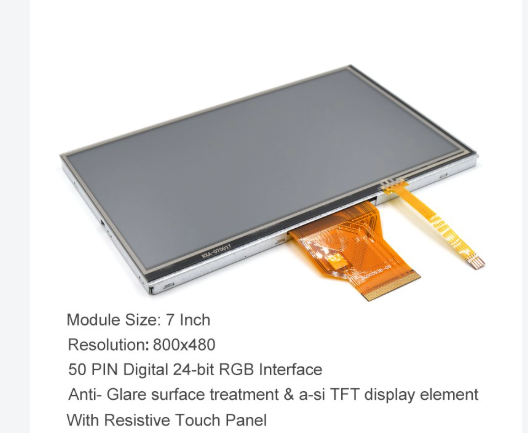
7-inch XRCGG070-0108-TPM-D1 touch display module. Image supplied in the product specification unit.
For production equipment, the 7-inch module fits compact automated-equipment HMI and requires industrial HMI and industrial touch monitors. The 10.1-inch module is described in 24/7 HMI display systems for automated equipment and control panels. The 13.3- and 15.6-inch modules fit production-line interfaces where a 1920×1080 display and 1000 cd/m² brightness are useful. The 21.5-inch module fits larger operator panels and control-cabinet interfaces in wide-temperature, high-humidity and high-dust projects. In practice, a new energy plant may use several of these sizes at once: 7-inch at a compact machine, 10.1-inch at a control panel, 15.6-inch at a line station and 21.5-inch at a central operator station. The sizes are not interchangeable; they are a portfolio for different physical roles.
Related industrial evidence from a CNC equipment case adds a useful boundary. That case describes 800 units operating for eight years in wide-temperature and high-humidity environments, with stable glove and oily-hand touch, anti-drift under servo and VFD noise, IP65 front panel, anti-vibration and shock resistance, and 24/7 continuous operation. It is not a new energy case, but it shows the kind of system-level checks that a factory HMI may need. A touch module can support the interface, but the cabinet, grounding, shielding and mounting determine whether the installed HMI meets those conditions.
Market trend: capacitive is mainstream, but fit still decides
External market data gives context for the technology choice. Business Research Insights reported that capacitive touch modules held about 71% of the touch screen module market in 2025, while resistive modules accounted for about 19%. Future Market Insights projected the commercial touch display market to grow from USD 6.9 billion in 2025 to USD 16.3 billion by 2035, at a CAGR of 9.0%. These are market estimates and forecasts, not a prediction for any single supplier or plant.
The practical reading is not that every HMI should use the same technology. Capacitive modules are the mainstream choice and align with multi-touch, flat front panels and modern HMI expectations. The remaining resistive share also reflects real industrial conditions: heavy gloves, oil, single-point control and budget constraints. For a new energy manufacturing HMI, the better question is which module size, brightness, touch mode and enclosure fit the operator's task. The market trend supports capacitive as a common starting point; it does not remove the need for a scenario check.
Future outlook: a platform, not a single size
New energy manufacturing is likely to keep diversifying its HMI formats: compact machine panels, line-side control stations, central operator stations and outdoor-adjacent equipment. A single touch display size cannot cover all of them. The more useful supplier capability is a size and environment platform that lets the equipment maker keep the same touch technology, interface approach and qualification logic while changing the panel format. The supplied capability unit describes OEM/ODM/customization services, monthly capacity of 30,000 pcs, a lead time of 30-60 days, an MOQ of 500 units, full inspection, a one-year warranty and remote support. These are supplier-stated production parameters; actual lead time and terms depend on the specification and order quantity.
For buyers, the release decision should stay evidence-based. Confirm the exact model, size, resolution, brightness, operating and storage range, touch mode, surface treatment, bonding method, interface and enclosure protection. Check how the module will be mounted in the industrial electrical cabinet and how the HMI system will handle EMC, condensation and cleaning. The five models provide a documented starting map from 7 to 21.5 inches, but the final fit is a project decision, not a catalog default.
FAQ
How do I choose between 7-, 10.1-, 13.3-, 15.6- and 21.5-inch modules for new energy HMI?
Start with the physical role. The 7-inch XRCGG070-0108-TPM-D1 is for compact operator panels and automated-equipment HMI where space is limited. The 10.1-inch XRCGG101-0340-R1 fits control-panel HMI and 24/7 HMI display systems in automated equipment. The 13.3-inch XRCGG133-0040-OB-A0 and 15.6-inch XRCGG156-0186-A0 fit production-line interfaces that need 1920×1080 resolution and 1000 cd/m² brightness. The 21.5-inch XRCGG215-0106-A0 fits larger industrial operator panels and control-cabinet interfaces. Confirm the cutout, viewing distance and enclosure depth before choosing.
What operating temperature range should a new energy HMI touch display module support?
The five modules in the supplied data operate from -20°C to 70°C and store from -30°C to 80°C. That is a module-level range. The complete HMI may need additional thermal design, such as enclosure heating, ventilation or condensation control, depending on the site. Buyers should validate the assembled unit at the intended temperature, not assume the module range covers every cabinet condition.
Why is brightness different between the 7-inch, 10.1-inch and larger modules?
The supplied specifications list 700 cd/m² for the 7-inch module, 800 cd/m² for the 10.1-inch module, and 1000 cd/m² for the 13.3-, 15.6- and 21.5-inch modules. The difference reflects model design and intended use. A compact panel under controlled light may not need 1000 cd/m², while a line-side panel near bright light may. Select against actual ambient light and viewing distance.
Can one module support bare-hand, wet-hand and thin-glove operation?
The supplied scenario material lists bare-hand, wet-hand and thin-glove input as touch states for relevant HMI applications, and the product descriptions include glove-touch support. The 21.5-inch module lists thin-glove touch as an option. Because glove thickness, water film and controller settings vary, the buyer should test the real operating condition rather than rely on a general statement.
Are IP68 and IK10 automatically included?
No. IP68 and IK10 appear as special requirements in the new energy scenario and as customizable options in some product descriptions. They should be confirmed for the exact model, enclosure and test evidence. IK10, as defined in IEC 62262, refers to a 20-joule impact class; the standard defines the rating, not a certification of every module. The installed cabinet and sealing design also affect the final protection result.
What should be checked before pairing a module with an industrial electrical cabinet or HMI?
Check the cutout and mounting, cable routing, interface compatibility, power, grounding, EMC and ESD, heat and condensation management, and cleaning method. The supplied scenarios name industrial electrical cabinets, industrial monitors and HMI systems as supporting equipment. The module provides the human-machine interface; the cabinet and HMI electronics determine whether the installed system meets the site conditions.
For readers who need the complete product overview, the English brochure is available at Xiangrui Optoelectronics English brochure.
Tem questões ou precisa de mais detalhes?
Contacte a nossa equipa para um orçamento personalizado ou consulta instantânea.
Solicitar orçamento
Preencha o formulário abaixo e a nossa equipa entrará em contacto com uma proposta personalizada.
Chat direto do WhatsApp
Prefere conversar em tempo real? Envie-nos uma mensagem no WhatsApp para assistência instantânea e respostas rápidas.
- Obter orçamento personalizado
- Partilhar fotos ou documentos
- Discuta as suas necessidades diretamente
Geralmente responde em 5–30 minutos durante o horário de expediente.