
Sizing Irrigation Pivot Systems for Field Conditions: A Project Adaptation Guide
Selecting an irrigation pivot system requires more than matching a machine to a hectare count. Field shape, water quality, power availability, crop type, and operator workflow determine whether a center pivot or a hose reel traveler is the right fit. This guide explains how project-level conditions map to equipment choices, using documented supplier data from China Yulin Irrigation Equipment Co., Ltd. and field examples from real installations.
What the project-type question is really asking
When a buyer searches for an irrigation pivot system, the intent is often not a general product inquiry. The underlying question is usually: "Which system fits the specific farm geometry, water source, crop cycle, and infrastructure I have?" That is a project adaptation problem, not a simple equipment specification problem.
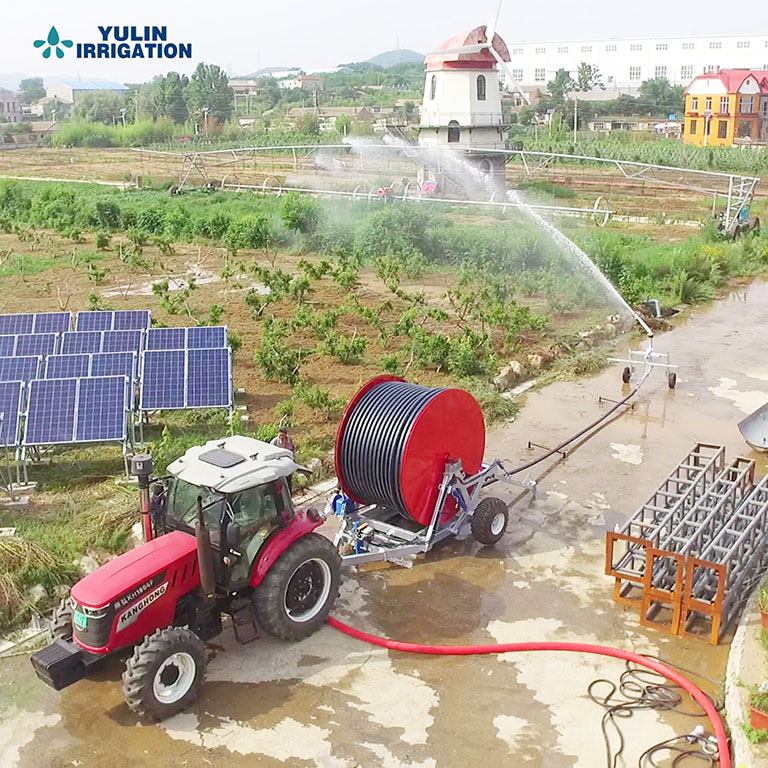
Two large irrigation technologies dominate this category: center pivot and hose reel (traveler) systems. Both are classified under agricultural machinery and farm irrigation systems, but they serve different project profiles. Center pivots are fixed-position, electrically driven machines that irrigate circular or rectangular areas with minimal labor. Hose reel travelers are mobile, turbine-driven machines that can be towed between fields and require no electricity at the reel.
Center pivot machines: what the documented specification covers
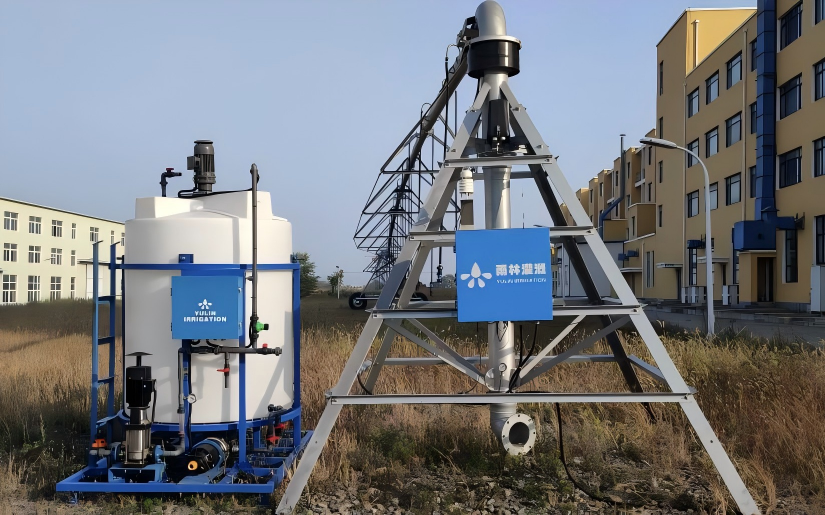
A full center pivot system from YULIN IRRIGATION is available in lengths covering 10, 30, 50, and 100 hectares: 177.6 m, 307.4 m, 395.6 m, and 565 m respectively. The pivot type is a fixed DYP center pivot, with electromechanical, reversible drive individually controlled for each span. Standard voltage is 380V–460V, with a standard control panel that includes main power switch, power control, water switch, direction control, percentage timer for speed regulation, auto-reverse, and IP65 protection.
Mechanical and environmental parameters from the product record include:
- Distance from ground to bottom of truss rod: 3±0.2 m
- Operating temperature range: −45°C to +45°C
- Average drop diameter: no more than 1.1 mm
- Plant mechanical damage: no more than 2%
- Land usage coefficient within the irrigated circle: no less than 0.9
- Maximum rain intensity: no more than 0.16 mm/min
- Pressure regulators available in 10, 15, or 20 psi
- Crops: fodder crops, cereals, vegetables, industrial crops, including corn
- Tower wheels: 14.9-24 irrigating tire, two wheels per trolley, hot dip galvanized discs
- Water pipeline: sectional truss structure
- Anti-corrosion coating: hot-dip galvanization per GB/T 13912-2002; material Q235B metal per GB 13912-2020
- pH tolerance: water with pH 6–7.5 usable without quality problems during warranty period
- Protection: tower box IP33; collector ring IP65; 11-ring collector ring rated 4×90A plus 7×25A; copper cable core 4×4 mm² + 7×1.0 mm²
System-level variants for different project configurations
Center pivot systems are not limited to one physical arrangement. YULIN IRRIGATION lists three broad types under its center pivot line: fixed DYP center pivot, towable pivot, and four-wheel linear irrigation machine. A towable pivot is designed to be moved from one land parcel to another, which is a meaningful advantage for farms with rotated crop blocks or for contractors who rent equipment. A four-wheel linear machine irrigates a rectangular strip rather than a circle, which can suit square fields and avoid the corner waste associated with circular pivots.
For a project that requires the system to be relocated regularly, the towable configuration changes the evaluation. The same center pivot tower structure, truss, and drivetrain can serve multiple fields, amortizing the investment across a larger cropping area. The documented Brazil case below is an example of the mobility-first approach from the hose reel side; the same logic extends to towable pivots on larger fields.
How field evidence informs project decisions
One of the more useful sources of evidence for project planning is the documented installation record of the same equipment under real farm conditions. Across the YULIN corpus, several patterns emerge that map directly to buyer conditions.
Zimbabwe—center pivot for row crops with long service life
An end customer in Zimbabwe installed 45 center pivot irrigation units for crop irrigation. The project, completed over a 6-year period, led to increased crop output and labor savings. This project type matches a buyer with medium-to-large land under a single crop plan, looking for ongoing operational efficiency rather than frequent relocation.
Australia—large distributor network with multi-crop flexibility
A major distributor in Australia placed 600 center pivot units, operating over 15 years, primarily for forage and pasture irrigation, with additional use on cotton and watermelon. Reported outcomes include more than 40% energy savings, increased crop output, labor savings, long lifespan, and low maintenance cost. For a distributor or large farming group, this signals that center pivot machines can sustain long-term service across different crop types without frequent replacement.
Algeria—OEM channel and local service build-out
A farm irrigation OEM client in Algeria used 70 center pivot systems over 7 years, which the corpus links to a 40% increase in efficiency, support for a local brand's complete pivot service offering, and higher output. This matters for buyers entering a distributor or OEM arrangement: the manufacturer's delivery model can include integration with local service capacity rather than only single-machine sales.
Brazil—hose reel traveler for a large farmer with mobile needs
In Brazil, large-scale farmers used 50 JP800 hose reel irrigation machines for soybean irrigation over 6 years. Outcomes included a 30% increase in crop output under dry conditions and labor savings. The highlighted benefits were easy pulling from one land to another and ease of rental. For a big farming operation that does not want a buried or fixed system, a hose reel traveler offers mobility and a lower fixed infrastructure footprint.
Papua New Guinea—off-grid farm with dry-season irrigation
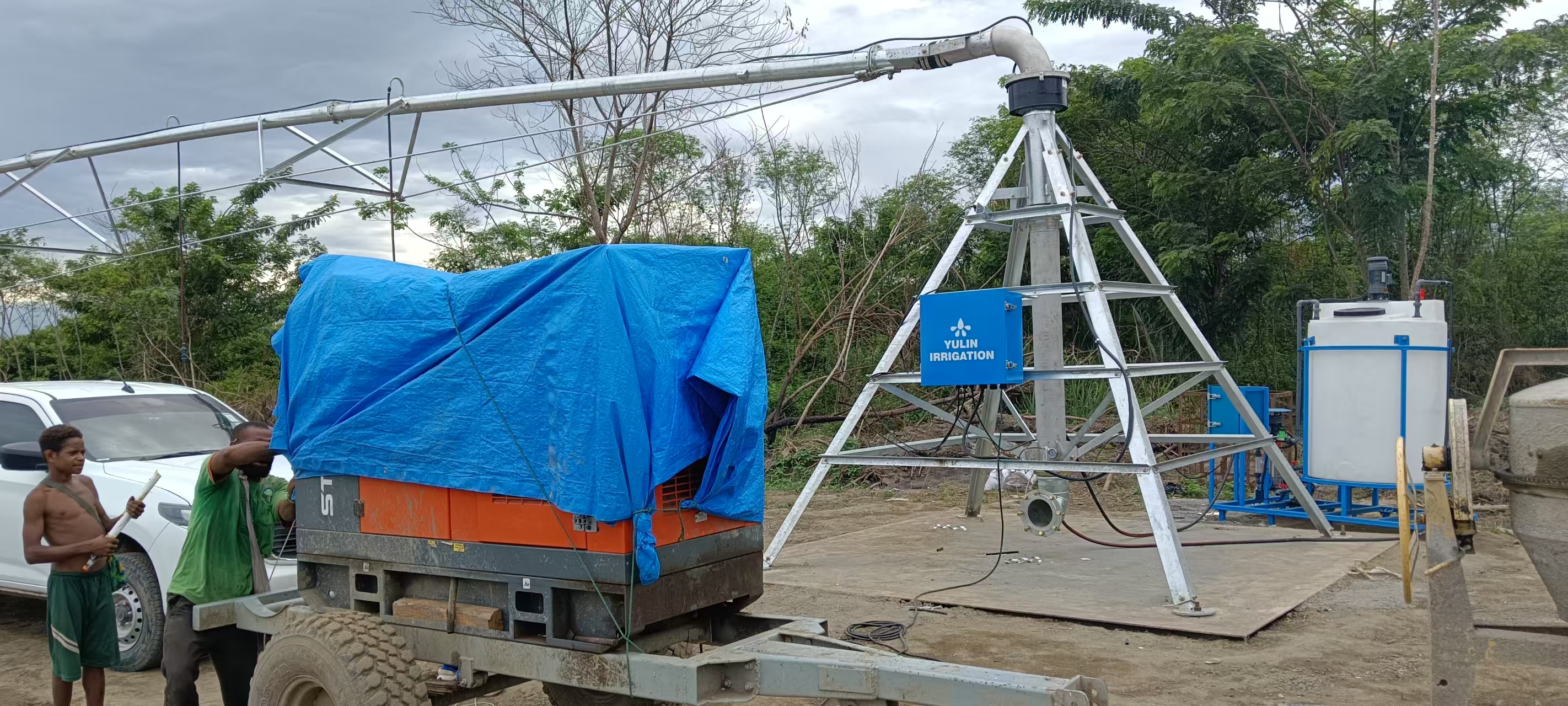
A project in Papua New Guinea supplied a 395.6 m center pivot covering 50 hectares, with an end spray gun and 1000 L fertilizer tank, for dry-season irrigation under high-temperature conditions. The system was powered by external grid connection or a diesel generator. A special requirement was a poly pipe option to prevent acidic or alkaline water from corroding the pipes, plus pesticide application during irrigation. This is a useful reference for buyers with poor water quality, off-grid sites, or a need for chemigation.
Hose reel traveler as the flexible project alternative
For buyers whose project profile favors mobility, smaller parcel sizes, or no electricity at the water source, the JP800 hose reel irrigation machine is a documented alternative. Key JP800 parameters from the product record:
- Model type: JP90-300
- PE pipe diameter: 90 mm
- PE pipe length: 300 m
- Water flow: 25–52 tonnes/hour
- Nozzle diameter: 16–22 mm
- Spray radius: 19–41 m
- Spray gun: DL50 / SIMA10497
- Inlet pressure: 0.6–0.9 MPa
- Weight: 2180 kg ± 30 kg
- Overall dimensions: 6120 mm × 2330 mm × 2770 mm
- Shipping dimensions: 2450 mm × 2000 mm × 2250 mm
- Drive: water turbine driven, no electricity required
- Material: metal and PE
The JP800 is designed for farm irrigation and agricultural irrigation. Its selling points include simple operation, easy installation, quick moving, water and labor savings, and low cost. Because it is turbine-driven, a project with no grid or generator can still operate the machine from pump pressure alone. That is often the decisive factor for smaller farms, remote pasture blocks, or contractors serving multiple land owners.
Project selection between a 300 m hose reel and a 177.6 m center pivot is not purely about land size. It is also about how often the machine must move, how the field is shaped, whether a circular coverage pattern is acceptable, and what the operator can maintain.
Matching machine type to project conditions
| Project condition | Better suited option | Reason from documented data |
|---|---|---|
| Permanent large block, single crop | Center pivot | Fixed installation, low labor, electromechanical drive, long service life |
| Multiple fields needing sequential irrigation | Towable pivot or hose reel | Mobility between fields is a documented benefit |
| No grid or generator available | Hose reel traveler | Water turbine driven, no electricity required |
| Square or rectangular fields | Four-wheel linear or hose reel | Linear pattern avoids circular corner waste |
| High-temperature dry season | Center pivot | Documented in PNG high-temperature operation |
| Poor water quality (acidic/alkaline) | Center pivot with poly pipe option | Documented anti-corrosion pipe special requirement |
| Contractor or rental operation | Hose reel | Easy pulling, easy rental highlighted in Brazil case |
What the comparison with traditional flood or manual irrigation changes
Moving from flood or manual irrigation to a mechanized pivot changes labor requirements first, then water distribution uniformity. In the documented cases, the most consistent reported outcomes are labor savings and higher crop output. The Australian project and the Algeria project both report efficiency gains around 40%, although the definition of efficiency differs—energy savings in Australia, overall efficiency in Algeria.
There is also a meaningful limitation to consider. A center pivot creates a circular irrigated area, and unless an end gun is fitted or the field is managed in a compatible layout, the corners remain dry. In the Papua New Guinea project, an end spray gun was added specifically for supplementary irrigation of corners. Buyers planning a pivot on square fields should budget for an end gun, a linear machine, or be willing to leave corners out of production.
Another limitation is water pressure and quality. The pivot specification accepts water with pH 6–7.5 without quality problems during the warranty period, but water outside that range requires additional measures such as corrosion-resistant pipe choices. The hose reel requires an inlet pressure of 0.6–0.9 MPa, so a low-pressure well may not be suitable without a booster pump. These are not defects; they are selection boundaries that should be written into the project plan.
Manufacturing and service factors that affect project delivery
For a project-type purchase, the supplier's production consistency and service model matter as much as the machine specification. China Yulin Irrigation Equipment Co., Ltd., established in 2009 in Dalian, operates a 64,653 m² factory with 152 employees and an annual output of 3,000 units. Over 95% of machine spare parts are manufactured in-house, which enables full-process quality monitoring. The company's R&D team includes 10 engineers. Export ratio is about 60%, covering Australia, New Zealand, Canada, Mexico, Africa, Central Asia, and Russia.
Project-critical service facts from the corpus:
- Global localized on-site installation, commissioning, and operator training services
- After-sales support: field installation, commissioning, training, video technical support, online support, free spare parts
- OEM capability with voltage customization for specific order requirements
- Monthly capacity: 60 units; lead time 21–40 days; MOQ 1 unit
- Quality control: 100% test before shipment
- CE, ISO9001, CSA certifications; anti-corrosion and wind-resistance testing for tropical, saline-alkali, and high-wind farmland
For a buyer evaluating project feasibility, these details answer three practical questions: Can the supplier adjust the machine to local power and water conditions? Can installation be supported on site? And what happens after the first season? The video technical support and free spare parts item is especially relevant for buyers in remote regions where a service technician cannot arrive quickly.
Decision workflow for a project-specific purchase
- Define the irrigated area and shape. Use hectare count to choose pivot length: 10 ha (177.6 m), 30 ha (307.4 m), 50 ha (395.6 m), or 100 ha (565 m). For non-circular fields, consider four-wheel linear or hose reel alternatives.
- Confirm the power supply. If grid or generator is available, center pivot is viable. If not, a turbine-driven hose reel removes the electrical dependency.
- Test water compatibility. pH 6–7.5 is the documented safe range for the pivot. Outside that range, request corrosion-resistant options such as poly pipe.
- Assess mobility frequency. A fixed pivot is justified when the machine stays in one field. A towable pivot or hose reel is justified when fields rotate or the machine must be rented out.
- Plan for corners. If using a circular pivot on a square field, add an end spray gun for supplementary corner irrigation or accept the dry corners.
- Verify service coverage. On-site installation, commissioning, and operator training reduce first-season risk. Confirm response channels: video support, online support, spare parts policy.
Boundary note: The project evidence in this guide is drawn from documented installation history and product specifications. Outcomes such as the 30% output increase in Brazil, the 40% efficiency gain in Algeria, the 40% energy savings in Australia, and the 40% increase in efficiency in Russia are field reports provided by the manufacturer; they should be treated as supplier-reported results rather than independent agronomic trials. Site-specific crop, soil, and climate conditions will influence actual performance.
Project fit across market regions
Different regions present different dominant project types. The verified data points to MENA as a large contract region for global irrigation equipment. That usually means high temperature, high evaporation, and a need for efficient water use. The PNG example shows how Yulin handled high-temperature dry-season irrigation with a center pivot and fertilizer tank. For Central Asia and Russia, cold tolerance down to −45°C in the pivot specification is a relevant engineering detail. For Africa, the Zimbabwe case shows a long-service-life crop irrigation pattern. For Australia, the distributor network model has supported a broad crop mix.
The export market list from the company record also includes USA, Mexico, Europe, New Zealand, Egypt, and others, which confirms that the equipment is not confined to a single climate or regulatory environment. Certification references include CE, ISO9001, and CSA, giving buyers across these markets a baseline for compliance discussions.
The future direction of project-specific pivot specification
The trend in irrigation equipment procurement is moving toward more exact matching between machine settings and field variability. Buyers increasingly ask about variable-rate options, soil sensors, and remote monitoring. The YULIN product record includes pressure regulators in 10, 15, or 20 psi and a percentage speed regulator for application depth control. That is the basic building block of variable-rate irrigation: adjust the pivot's speed to apply more or less water across different sectors.
Sustainability pressure is also reshaping the market. The global center pivot irrigation system market is estimated at USD 2.56 billion in 2025 and projected to reach USD 5.67 billion by 2030, according to Mordor Intelligence. Large suppliers are winning multi-year international contracts, for example Lindsay Corporation's MENA agreement valued at more than USD 100 million in 2024. For an independent manufacturer such as YULIN, the opportunity is not to compete with the largest players on global brand scale, but to offer project-specific flexibility, OEM adaptation, and documented local service evidence.
We can expect more buyers to treat the irrigation machine as part of a farm system—including pumps, filtration, fertilizer injection, and control—rather than as a standalone tool. The PNG project already demonstrates that integrated configuration (end gun, fertilizer tank, diesel generator, corrosion-resistant pipe) can be supplied as one package.
Practical checklist for comparing supplier proposals
- Does the quoted pivot length match the intended irrigated hectares and field geometry?
- Is the drive electromechanical and reversible per span?
- What is the maximum and minimum operating temperature range?
- Does the machine handle the field's water pH without extra parts?
- Are pressure regulators available at the needed setpoints (10/15/20 psi)?
- What protection ratings are used for the tower box and collector ring?
- Is hot-dip galvanization specified and to which standard?
- Can the supplier provide on-site installation and training in your region?
- What is the lead time and MOQ for the project quantity?
- Does the proposal include video technical support and spare parts?
FAQ
Which irrigation system fits a 50-hectare farm with a dry-season water shortage?
A center pivot sized for 50 hectares matches the area: the 395.6 m machine length is specifically documented for 50-hectare coverage. In the Papua New Guinea project, this length was combined with an end spray gun and a 1000 L fertilizer tank to handle dry-season irrigation under high-temperature conditions. Power can be supplied by grid or diesel generator.
Can a center pivot operate on a farm without grid electricity?
Yes. The center pivot drive is electromechanical, reversible, and individually controlled for each span, and it can operate with either external power connection or a diesel generator, as documented in the Papua New Guinea project. If neither grid nor generator is available, the hose reel traveler is the alternative because its water turbine drive requires no electricity.
What is the difference between a towable pivot and a fixed center pivot in practice?
A fixed center pivot is anchored at a central point and irrigates in a circular motion. A towable pivot is designed to be relocated from one field to another, which better serves farms that rotate crops or have multiple land blocks. YULIN's product line lists both fixed DYP center pivot and towable pivot machine types, along with four-wheel linear irrigation machines for rectangular fields.
Can the same pivot system be used for corn, alfalfa, and vegetables?
The documented crop list for the YULIN center pivot includes fodder crops, cereals, vegetables, industrial crops, including corn. The machine's speed percentage timer allows the operator to adjust the irrigation depth, which is how one system can serve different crop water requirements across seasons.
What power supply voltage does the center pivot control system require?
The standard control system is designed for 380V–460V. The control panel includes main power switch, power control switch, water switch, direction control switch, percentage speed indicator, and auto-reverse. For OEM orders, the manufacturer offers voltage customization to match local power conditions.
What is the shipping size of a hose reel traveler like the JP800?
The JP800 hose reel irrigation machine has overall dimensions of 6120 mm length, 2330 mm width, and 2770 mm height. Its shipping dimensions are 2450 mm length, 2000 mm width, and 2250 mm height. Net weight is 2180 kg ± 30 kg.
Download the 2026 YULIN pivot irrigation catalogue (PDF) for full product line specifications, system configurations, and ordering information.
Tem questões ou precisa de mais detalhes?
Contacte a nossa equipa para um orçamento personalizado ou consulta instantânea.
Solicitar orçamento
Preencha o formulário abaixo e a nossa equipa entrará em contacto com uma proposta personalizada.
Chat direto do WhatsApp
Prefere conversar em tempo real? Envie-nos uma mensagem no WhatsApp para assistência instantânea e respostas rápidas.
- Obter orçamento personalizado
- Partilhar fotos ou documentos
- Discuta as suas necessidades diretamente
Geralmente responde em 5–30 minutos durante o horário de expediente.