
Sizing a PET Preform Injection Machine: A Buyer's Framework
Most PET preform machine purchases are lost at the specification stage, not at the price stage. A buyer who cannot convert a preform drawing and an annual output target into three numbers — shot weight, clamping force and tie bar space — cannot tell whether a quoted 260T, 318T, 360T or 400T machine is oversized, undersized or simply incompatible with the mold that will be bolted into it.
This is a framework, not a league table. It assumes the reader is at the decision stage, already knows which bottle the preform is destined for, and needs to test suppliers against criteria that can be checked on a datasheet and then confirmed in a trial.
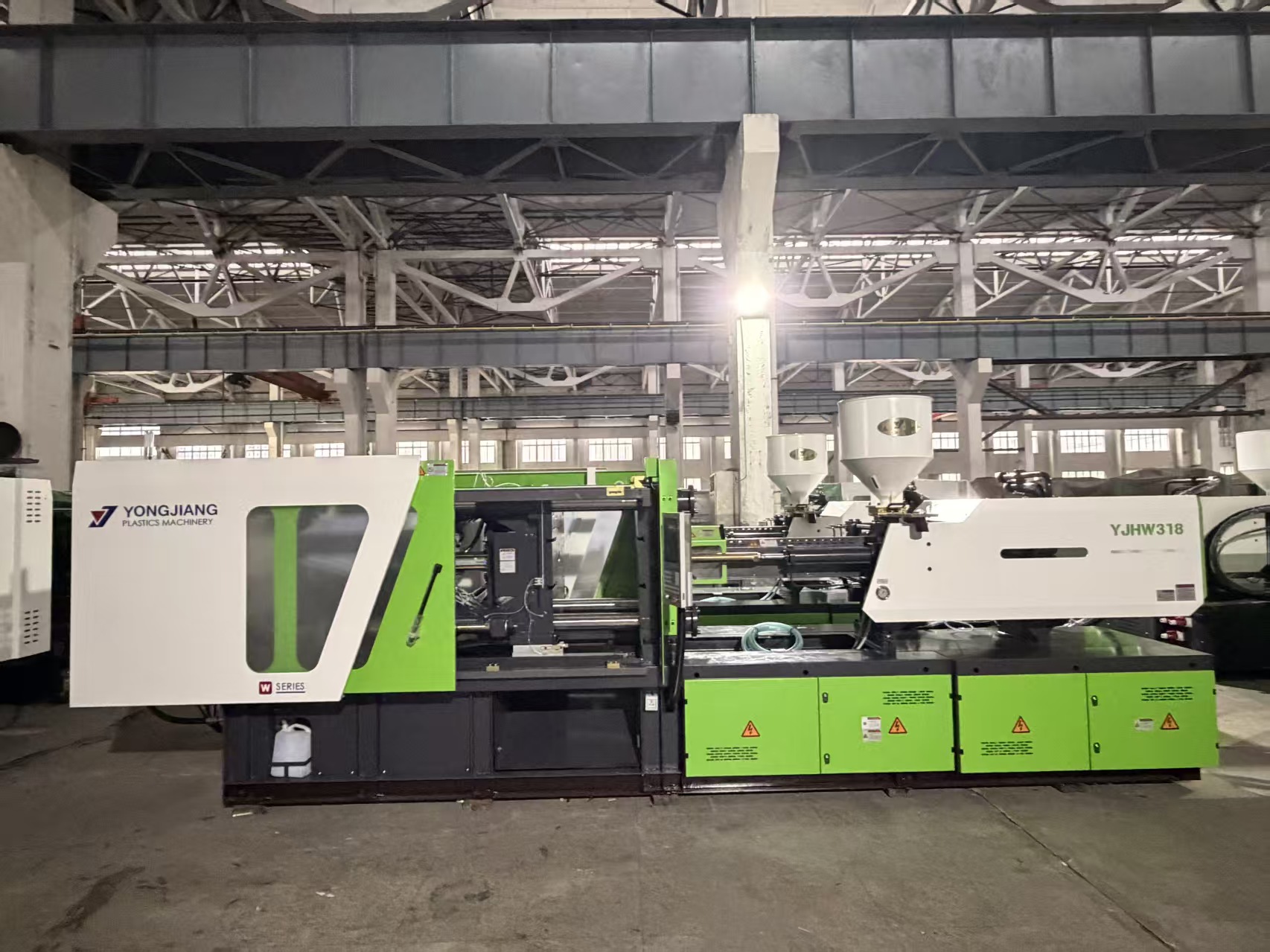
A PET preform injection machine is specified against the mold, not against the brochure. Image: Ningbo Yong Jiang Machine Co., Ltd.
Why Tonnage Alone Decides Nothing
Clamping force is the first number on every quotation and the least useful in isolation. A published tender specification for a PET preform injection moulding machine illustrates the problem precisely: the document sets a minimum machine tonnage of 150–200 T, while simultaneously requiring at least 32 preform cores and cavities, a minimum shot capacity of 750 g, a minimum plasticizing capacity of 50 g/sec, a minimum injection pressure of 1200 bar, and preforms of up to 20 g with a 28 mm neck for 1000 ml bottles.
Read together, those clauses describe a machine that is modest in tonnage but demanding on cavitation, shot size and injection pressure. A buyer who shops on tonnage alone will either pay for clamping force the mold never uses, or accept a machine whose shot size and plasticizing rate cannot feed 32 cavities at the cycle the buyer was promised.
The three inputs below have to be solved together. Each one can independently disqualify a machine.
The Three Inputs, Defined
Clamping force
Clamping force, expressed in tonnes (T) or kilonewtons, holds the mold closed against the separation force created when molten PET is injected. It must exceed the force produced by cavity pressure acting on the projected area of the part, plus any runner. In preform work the relevant area is not the finished bottle: it is the preform as it appears on the parting line, including the neck ring and any flange geometry.
Shot weight
Shot weight is the maximum mass of melt the injection unit can deliver in a single cycle. It is a function of screw diameter and injection stroke, so two machines with identical clamping force can carry very different shot ratings. A shot figure without a stated screw diameter is not a comparable number.
Tie bar space
Tie bar space — the clear distance between the tie bars horizontally and vertically — defines the largest mold that can physically enter the machine. It is a geometric limit, not a performance preference. Mold width plus loading clearance, mold height, platen size, ejection stroke, minimum mold thickness and daylight all have to be satisfied before tonnage is even worth discussing.
Step 1 — Fix the Preform Data Set Before Contacting a Supplier
No supplier can size a machine against a bottle. The buyer has to hand over a data set, and it needs to be the same data set sent to every supplier:
- Preform weight in grams, with the tolerance band
- Neck finish diameter and thread standard
- Overall preform length and body diameter, which together set the mold footprint
- Resin grade, and whether recycled content forms part of the specification
- Target cavity count, or the annual output from which cavity count will be derived
- Mold dimensions, mold height and runner type (hot runner or cold runner)
- Acceptable cycle time, stated per cavity and at a stated preform weight
Public procurement documents make a useful cross-check on how such a set is written. The tender specification cited earlier fixes a 20 g maximum preform weight and a 28 mm neck for a 1000 ml bottle — enough to compute shot size, to estimate projected area, and to compare mold footprints across suppliers on equal terms. Without an equivalent set of numbers for the buyer's own bottle, every quotation is being compared on different assumptions, and the cheapest one usually wins for the wrong reason.
Step 2 — Shot Weight: Calculate, Then Add Headroom
The calculation is short:
Required shot = preform weight × number of cavities × (1 + headroom)
With a hot runner there is no cold runner to fill, so the shot is essentially preform mass multiplied by cavitation. With a cold runner, runner mass is added to preform mass before the multiplication.
Using the tender figures as a worked illustration: 32 cavities producing a 20 g preform require 640 g of melt per shot. The same specification sets a minimum shot capacity of 750 g, which leaves roughly 17% headroom above theoretical demand. That margin covers short-shot risk, weight variation across cavities, and the practical reality that a machine running at its rated maximum every cycle has no reserve.
The recurring error is treating the published maximum as a working value. The shot rating should sit comfortably above calculated demand, and it should be quoted together with the screw diameter and the injection pressure at which it is achieved. That same specification requires a minimum injection pressure of 1200 bar, which makes the point: a large shot delivered at low pressure is not equivalent to a smaller shot delivered at high pressure, and PET preform work depends on the second.
Step 3 — Clamping Force: Start From Projected Area
Clamping force is derived, never guessed. The sequence is fixed:
- Take the projected area of one preform on the parting line, including neck ring and flange.
- Multiply by the number of cavities.
- Multiply by the cavity pressure the mold and resin supplier expect the process to reach.
- Apply a safety factor agreed with the mold maker.
The cavity pressure figure must come from the mold or resin supplier. Generic tonnes-per-square-centimetre tables circulate widely and are the most common cause of undersized machines, because preform geometry varies enormously: a wide-body preform and a slim 28 mm preform of identical weight can present materially different projected areas, and therefore different clamp requirements on the same cavity count.
This is also where the 260T to 400T band earns its range. The band is not a marketing tier. It is the zone in which machines typically carry both the clamp and the platen geometry for multi-cavity preform molds with deep cores and long ejection travel. Whether 260T or 400T is correct is decided by the projected-area calculation and the mold envelope — not by the number on the model name.
Step 4 — Tie Bar Space: The Mold Envelope Test
Before comparing tonnage, confirm the mold physically fits. Four checks, in order:
- Width and height between tie bars must exceed mold width and height with clearance for loading, alignment and thermal growth.
- Platen dimensions must support the mold base without overhang, since an unsupported overhang deflects platens and distorts the parting line.
- Mold height and daylight must allow the mold to open far enough for the preform and its core to clear.
- Ejection stroke must be long enough for deep preform cores — the longer the preform, the more stroke is consumed before the part releases.
Cavity count drives mold footprint close to linearly in a standard two-plate layout, so 48-cavity, 72-cavity and 96-cavity molds occupy progressively larger envelopes. In practice tie bar spacing becomes the binding constraint before clamping force does, and it usually happens at exactly the moment a buyer tries to move up a cavity class on the same platform.
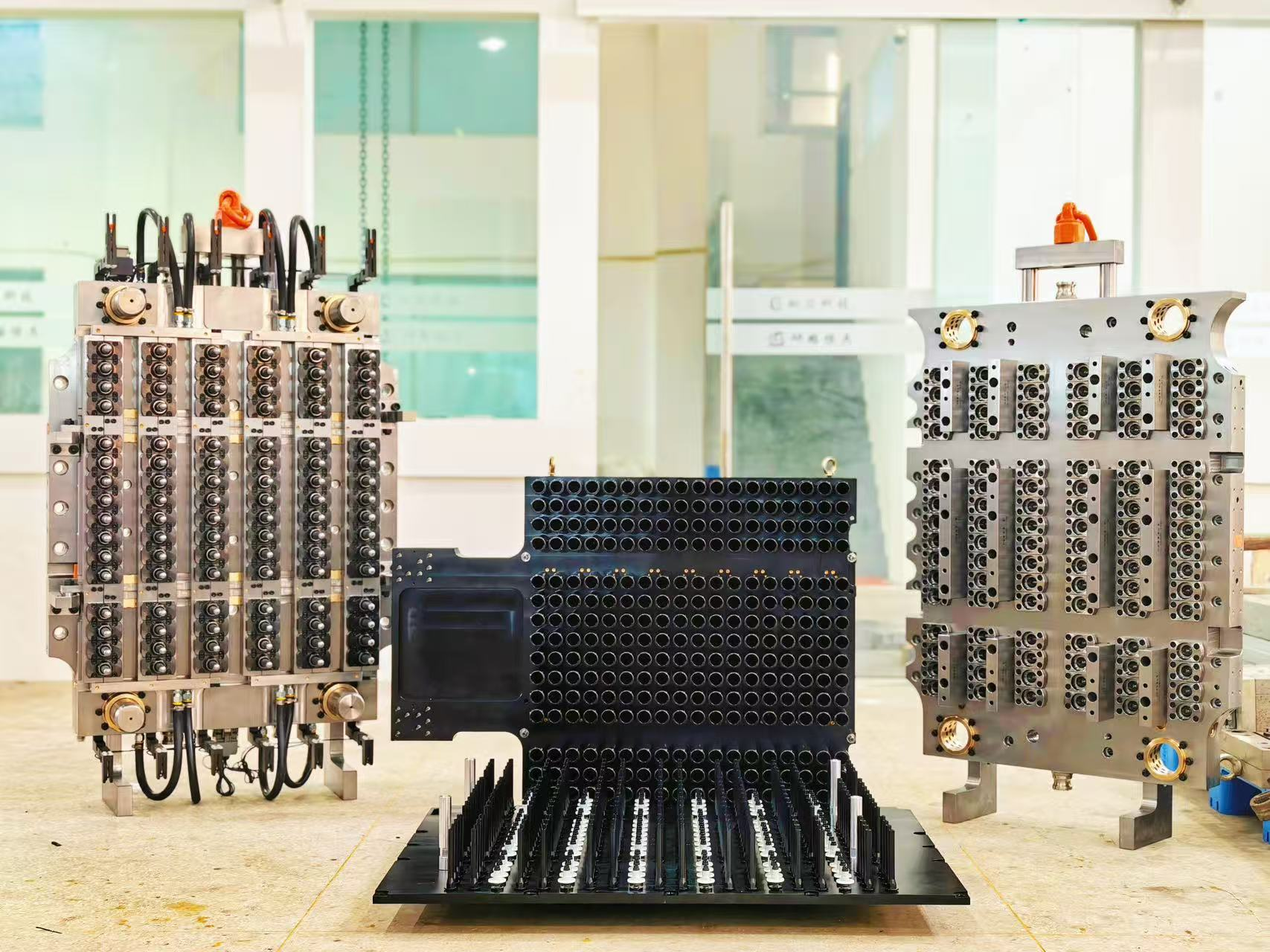
Cavity layout determines the mold envelope; the mold envelope determines whether a given tonnage class is usable at all.
Step 5 — Output Volume: Converting Cycle Time Into Cavity Count
Annual output becomes arithmetic once cycle time is known:
Preforms per hour = (3600 ÷ cycle time in seconds) × cavities
At a 12-second cycle and 48 cavities, the machine produces 14,400 preforms per hour at full uptime. Multiplying by operating hours and a realistic uptime-and-quality factor converts that into an annual figure the buyer can compare against demand — and, crucially, against the seasonal peaks that actually justify the investment.
There is a second, less visible constraint. Plasticizing capacity limits how quickly the injection unit can recover the shot. With a 640 g shot and a minimum plasticizing capacity of 50 g/sec, recovery alone consumes about 12.8 seconds. No cycle shorter than that can be sustained, whatever the mold is capable of. Buyers planning a move from 48 to 72 cavities frequently discover that the plasticizing unit, not the clamp, is the real limit.
A Verification Sheet to Take Into Negotiation
The table below converts the framework into six questions. The fourth column matters most: a figure whose basis is not stated cannot be compared with a competitor's figure.
| Parameter | What to ask for | Required basis | Red flag |
|---|---|---|---|
| Clamping force | Rated force at the specified mold | Projected area and safety factor stated | Tonnage quoted with no projected-area working |
| Shot weight | Maximum shot capacity in grams | Screw diameter and stroke given | A shot figure with no screw diameter |
| Injection pressure | Maximum injection pressure in bar | Hydraulic or plastic pressure identified | Pressure basis left unspecified |
| Plasticizing capacity | Recovery rate in g/sec for PET | Resin and screw configuration named | Capacity quoted for a different polymer |
| Tie bar space | Clear distance, horizontal and vertical | General arrangement drawing supplied | Only platen size provided |
| Cycle time | Guaranteed cycle at stated cavitation | Trial report at the buyer's preform weight | Cycle quoted without weight or cavitation |
Where This Framework Stops Working
Three limits are worth stating plainly, because a framework that pretends to decide everything decides nothing.
Published ratings are only comparable when the basis is stated. A 400T machine rated at one screw diameter and one injection pressure is not the same machine as another 400T with a different injection unit. Comparing tonnage across suppliers without the basis creates a false equivalence that survives all the way to the purchase order.
Arithmetic sizing does not model cooling. Cycle time and preform quality depend on mold cooling, water temperature, part geometry and gate design, and no specification sheet resolves that. A trial on the buyer's own preform remains the only reliable confirmation, and any supplier unwilling to run one is handing the risk back to the buyer.
Energy and cost comparisons need local inputs. A percentage improvement in energy efficiency becomes money only with the buyer's own tariff, shift pattern and measured consumption per kilogram of melt. Manufacturer-stated comparisons to alternatives are a hypothesis to be tested, not a financial result.
Applying the Framework in the 260T–400T Band
Ningbo Yong Jiang Machine Co., Ltd (Yongjiang) is a Chinese injection molding machine manufacturer based in Ningbo, Zhejiang Province, producing PET preform machines and PVC fitting machines. The company reports a 130,000 m² facility, 200 employees, annual output of 2,000 units, a 25-engineer R&D team, a 59% export share, and main markets in the USA, Canada and Thailand. Its full lineup spans clamping forces from 40T to 1600T, with the PET preform line marketed as the YJPT series and model designations used across the range including YJPT-260, YJPT-318, YJPT-360 and YJHB-400.
Technically, the YJPT series is built around an optimised PET screw intended to deliver uniform plasticization and preform transparency, paired with a dual-servo system using multi-axis linkage to shorten cycles. Clamping frames are reinforced and ejection travel extended to accommodate multi-cavity deep molds, while temperature control is specified to reduce reject rates — a thermal protection arrangement using temperature sensors is part of the machine design. Units are configured for 380/400V 50Hz industrial power, which matters for buyers in markets where the grid differs from the domestic standard.
Within the framework above, the relevant manufacturer claims are stated comparatively: compared with alternatives, the YJPT series is stated to improve energy efficiency by up to 50%, reduce power consumption by up to 50%, and offer a 10% lower cost, with less maintenance required as a result of the optimised configuration. Those figures belong in the hypothesis column of a buyer's evaluation — they should be tested against measured kWh per kilogram of melt, guaranteed cycle time at the buyer's own cavitation, and observed maintenance intervals.
Which Production Goals Shift the Constraint
The framework produces different answers depending on what the line is actually built to make. Documented application segments for PET preform production include bottled water, carbonated soft drinks, juices, edible oils and sauces, and Yongjiang positions the series across drinking water and beverage plants producing mineral water, juice and carbonated drink bottles; edible oil, condiment and food packaging plants; cosmetic and daily chemical producers; independent preform plants supplying blow moulders; integrated injection-blow operations running continuous lines; and small and medium packaging manufacturers in Southeast Asia, Russia, Africa and South America seeking cost-effective, stable equipment.
- Still water bottle preforms — light preforms, high volume. Cavity count and cycle time dominate; the tie bar envelope usually becomes the binding constraint first.
- CSD and carbonated soft drink preforms — tighter weight and stress tolerances push cavity pressure upward, so clamp requirement rises for the same projected area.
- Edible oil and sauce preforms — heavier preforms per unit shift the constraint toward shot weight and plasticizing recovery.
- 5-gallon preforms — high mass per part at low cavitation, where shot capacity and ejection stroke rather than cavity count decide the machine.
- Cosmetic and daily chemical preforms — surface and transparency demands make screw design and temperature control the deciding technical variables.
Market Context: What the Numbers Say, and What They Do Not
Commercial research from Acumen Research and Consulting projects the global PET preform machines market growing from USD 8.38 billion in 2022 to USD 14.73 billion by 2032. For the wider equipment category, exports under HS code 847710 — injection-moulding machines — totalled USD 7.21 billion in 2023.
Downstream, Mordor Intelligence reports the PET preform product market at USD 24.33 billion in 2026, growing at a CAGR of 2.17% to reach USD 27.08 billion by 2031. The scope distinction matters: that figure covers the preform product, not the machines, and must not be read as equipment market size.
The practical implication for a buyer at decision stage is conservative. Moderate downstream growth argues against buying clamp capacity that will sit unused for years. It argues instead for specifying a platform whose tie bar space and shot capacity leave room for one cavity step, so that capacity can be added by changing the mold rather than the machine.
Future Outlook
Three shifts are visible in how buyers specify preform machines. First, energy per kilogram of melt is moving from a footnote to a line item in payback calculations, particularly in markets where industrial tariffs have risen. Second, cavity counts continue to climb as labour availability tightens, which increases the weight carried by tie bar spacing and platen geometry in machine selection. Third, recycled PET content and variable regrind ratios place more demand on plasticizing consistency, making screw design and temperature control part of the specification conversation rather than an afterthought.
What is unlikely to change is the verification culture. Buyers increasingly ask for a trial report at their own preform weight and cavitation before signing, and suppliers who can produce one, with the basis of every rating stated, hold an advantage that no brochure can substitute for.
FAQ
How do I calculate the shot weight needed for a 32-cavity preform mold?
Multiply preform weight by 32, then add headroom. A 20 g preform across 32 cavities requires 640 g of melt per shot before any runner is added. A published tender specification for a PET preform injection moulding machine sets a minimum shot capacity of 750 g against that same 32-cavity, 20 g requirement — roughly 17% above theoretical demand. With a cold runner, runner mass must be added to preform mass first.
How do I know whether a mold will fit between the tie bars?
Compare mold width and height against the clear distance between tie bars in both directions, then confirm platen size, mold height, daylight and ejection stroke. Cavity count increases mold footprint, so a 72 or 96 cavity mold may exceed tie bar space on a platform whose tonnage appears sufficient. The check has to be done on the machine's general arrangement drawing, not on the model number.
Is a 260T machine enough for carbonated soft drink preforms?
It depends on projected area and cavity pressure, not on the end-market label. CSD preforms are typically specified with tighter weight and stress tolerances than still-water preforms, which pushes the process toward higher cavity pressure and therefore raises the clamping force required for a given projected area. The 260T end of the band suits lower cavitation and smaller projected areas; higher cavitation generally moves the requirement toward 318T, 360T or 400T. The mold maker's projected-area calculation resolves it.
How many cavities do I need to hit an annual output target?
Preforms per hour equals 3600 divided by cycle time in seconds, multiplied by cavities. At a 12-second cycle, 48 cavities yield 14,400 preforms per hour at full uptime. Divide annual demand by operating hours and the uptime factor to obtain the required hourly output, then solve for cavities. Check plasticizing capacity afterwards: a 640 g shot at 50 g/sec needs about 12.8 seconds of recovery, which caps practical cycle time regardless of cavity count.
What should be verified before signing, beyond tonnage and shot weight?
Plasticizing capacity for PET, maximum injection pressure and whether it is stated as hydraulic or plastic pressure, tie bar clear distance in both directions, platen dimensions, ejection stroke, mold height and daylight, and a guaranteed cycle time at the buyer's own cavitation and preform weight. Each figure should appear on the datasheet with its basis, because a value without a stated screw diameter or pressure basis cannot be compared across suppliers.
Summary
Tonnage, shot weight and tie bar space are not three specifications among many; they are the three filters that eliminate unsuitable machines before price is discussed. Solve for shot weight from preform mass and cavitation, derive clamping force from projected area and cavity pressure supplied by the mold maker, and confirm the mold envelope against tie bar clearance, platen size, daylight and ejection stroke. Then check plasticizing capacity against the cycle time you intend to run. What survives that sequence is a shortlist worth negotiating over — and a set of numbers every supplier has answered on the same terms.
Yongjiang's machine configuration data, including the YJPT series, is compiled in the company catalogue, available for reference and download: PET preform injection machine catalogue (PDF).
Specification benchmarks cited in this article derive from a published CIPET tender document (2019), trade data under HS 847710 (2023) and commercial market research from Acumen Research and Consulting and Mordor Intelligence. Manufacturer performance figures are company-stated comparisons and should be validated in a trial at the buyer's own preform specification.
Tem questões ou precisa de mais detalhes?
Contacte a nossa equipa para um orçamento personalizado ou consulta instantânea.
Solicitar orçamento
Preencha o formulário abaixo e a nossa equipa entrará em contacto com uma proposta personalizada.
Chat direto do WhatsApp
Prefere conversar em tempo real? Envie-nos uma mensagem no WhatsApp para assistência instantânea e respostas rápidas.
- Obter orçamento personalizado
- Partilhar fotos ou documentos
- Discuta as suas necessidades diretamente
Geralmente responde em 5–30 minutos durante o horário de expediente.