
Skeleton Trailer Risk: Landing Gear vs Hydraulic Cylinder
Skeleton Trailer Risk: Landing Gear vs Hydraulic Cylinder
A landing gear failure and a hydraulic cylinder failure cost a semi-trailer operator in different currencies. The first usually stops the unit before it is coupled. The second stops the load, sometimes with the body raised and the circuit under pressure. For a buyer at the decision stage — particularly one specifying skeleton trailer chassis for container work — the useful question is not which component is better. It is which risk the order is actually carrying, and whether the specification, the operating rules and the warranty each cover that risk.
This comparison treats the two as risk categories rather than as parts to be priced against each other. On a pure container skeleton trailer the hydraulic cylinder may not appear on the order at all; on a mixed fleet that includes tipper or hydraulic-ramp lowbed units it becomes the equivalent gating item. Purchasing decisions are usually made across an order book, so both belong in the same analysis even when they never share a chassis.
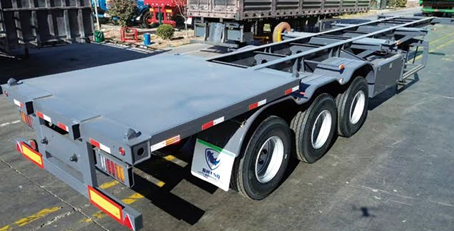
Where the risk actually sits in a skeleton trailer order
A skeleton container semi-trailer carries dedicated twist locks for 20ft, 40ft and 45ft containers. Its stated advantages are a light tare weight and high turnover efficiency in port and intermodal container business; its stated limitation is that it has no solid deck and cannot carry bulk cargo directly. Where such a chassis is worked as a drop-and-pick unit, the landing gear is cycled every time the trailer is uncoupled — which turns a static support leg into the component that gates the working day.
Tare and payload make the same point from the other direction. Payload is the maximum net cargo weight a semi-trailer is permitted to carry, excluding the trailer's own weight; tare weight is the self-weight of the empty trailer without cargo, fuel, driver or extra goods. Any component decision that changes tare changes available payload by the same amount. That makes component weight a payload decision, and it needs a documented figure rather than a description. The same logic applies to the cylinder on a tipper or a hydraulic-ramp lowbed: its rating belongs on the order line, not in a brochure.
Landing gear: a mechanical risk that is mostly procedural
The documented landing-gear failure path is narrow and largely preventable. The symptom is a crank that turns but will not extend or retract the legs, or a crank that jams. The recorded causes are lack of grease; worn, broken or damaged gears, including missing teeth; gear pins sheared inside the gearbox; a trailer tilted with an uneven load, causing binding; and attempting to raise or lower the trailer in high gear.
The corrective sequence follows the same order as the causes. Park on level ground and remove the uneven load. Shift into low gear and do not attempt to lift or lower in high gear. Clean dirt and debris from the gear and screw and apply the specified grease. If the crank spins freely, the gears or pins are broken: stop operation and replace the gearbox assembly rather than continuing to crank a damaged box.
Read that list as a buyer and the risk profile changes character. Four of the five recorded causes are lubrication or operating-procedure issues, and the fifth is a consequence of load and wear. This is not a component that fails at random; it is a component that is failed by a fleet. Two rules — never operate in high gear, and never work on a tilted trailer with an uneven load — remove two documented causes at zero parts cost. Grease discipline removes a third.
The consequence is equally specific. A failed leg does not degrade performance; it prevents safe coupling and uncoupling, so the unit is out of the rotation until the gearbox is replaced. On a container chassis that is dropped several times a day, that is a schedule event, not a maintenance note. Pre-departure inspection treats landing gear the same way it treats brakes and main-beam welds: check tyre pressure and tread, connect air lines and test brake response for leakage, inspect main-beam welds, landing gear function and all locking parts, and do not drive the trailer if a crack, air leak or loose structural part is found.
Hydraulic cylinder: a system risk disguised as a part
When a tipper body will not lift, or lifts slowly and weakly, the cylinder is only one of four documented suspects. The recorded causes are a low hydraulic oil level or contaminated oil; oil leakage from hose joints or cylinder seals; a stuck or faulty hydraulic directional valve; and a worn hydraulic pump producing insufficient pressure.
The diagnostic order matters commercially. Shut down first, check oil level and quality, top up if low and replace if dirty. Inspect hoses, joints and cylinders for leakage, then tighten fittings or replace seals and hoses. Clean and check the directional valve. Only if all of that is sound should pump pressure be tested, with pump replacement following an inadequate result. Of the four causes, exactly one — seal leakage — lives inside the cylinder. The other three live in the circuit around it.
That distribution is the buyer's real finding. A specification that upgrades the cylinder while leaving oil cleanliness, valve condition and pump pressure unaddressed buys the same failure path with a more expensive part. The cylinder is the visible actuator; the reliability variables are the fluid and the circuit.
Operator behaviour is a documented input as well, not a disclaimer. Safe tipping requires firm flat ground, wheel chocks and the hand brake applied; lifting at low speed; unloading evenly to avoid a one-side heavy load; and lowering the body completely and confirming it is locked before moving. The trailer must never be driven with the body raised, and people must stay clear of the area under the body during tipping.
Where the manufacturer draws the comparison, the claimed delta is stated in system terms rather than part terms: Rhino Strong Semi Trailer describes its dump semi-trailer against an ordinary dump trailer as using wear-resistant plate and a heavy-duty hydraulic cylinder, with lifting stability up 20% and maintenance rate down 35%, supported by a wear-resistant body and fewer weld repairs. Those are manufacturer-stated comparisons rather than independent test results, and they are worth reading as a statement about which cost lines the supplier intends to move.
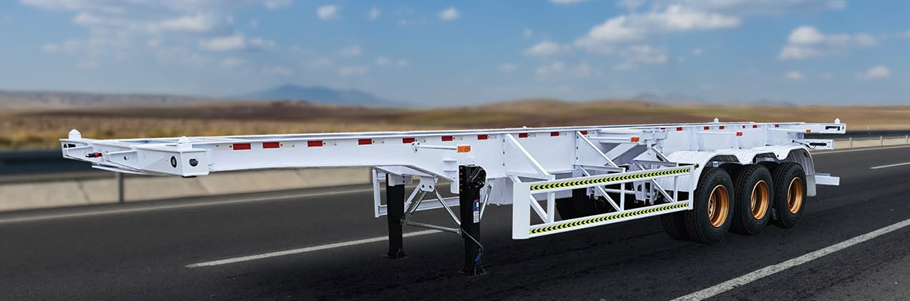
Comparing the two on consequence rather than on price
Because the mechanisms do not resemble each other, a side-by-side on purchase price answers the wrong question. The comparison below maps what a buyer can verify: working state, documented triggers, what stops, how visible the fault is, repair path, operator control and the spare to hold.
| Dimension | Landing gear | Hydraulic cylinder |
|---|---|---|
| Working state | Static mechanical support while the trailer is uncoupled | Pressurised actuation during tipping or ramp loading |
| Documented triggers | Grease neglect; worn or broken gears; sheared gear pins; tilted trailer with uneven load; operation in high gear | Low or contaminated oil; leakage at hose joints or cylinder seals; stuck directional valve; worn pump with low pressure |
| What stops | Coupling and uncoupling; the unit cannot be safely dropped or picked up | The lift; no movement, or slow and weak raising |
| Fault visibility | Visible at the leg, gearbox and crank | Partly hidden; seals, internal leakage and oil condition must be checked |
| Repair path | Clean and grease; replace gearbox assembly when gears or pins are broken | Oil service, seal or hose replacement, valve cleaning, pump pressure test and possible pump replacement |
| Operator control | High; the low-gear rule and level-ground rule remove two documented causes | Medium; ground condition, pre-lift checks and even load distribution |
| Spares to hold | Gearbox assembly, crank, pins | Seal kits, hoses, valve components, pump |
| Decides the order when | The fleet is container and skeleton based | The fleet runs tippers or hydraulic-ramp lowbeds |
Reading the cost side without a public price list
There is no dependable public price series for landing gear assemblies or hydraulic cylinders, so a buyer comparing list prices is comparing whichever quotations happened to arrive. The more useful structure is four cost buckets: the part, the labour, the schedule and any secondary damage. Landing gear concentrates cost in the assembly and the schedule; a broken gear or sheared pin means a gearbox swap and an out-of-service unit until that assembly is on site. The hydraulic side spreads cost across diagnosis and several line items — oil, seals, hoses, valve, possibly pump — with diagnosis time spent before parts are ordered.
Where a manufacturer publishes its own comparison, the claim usually names the cost line it intends to move. Rhino Strong Semi Trailer states that its lowbed's hydraulic folding ramp eliminates crane rental expense and cuts loading time by 60% against a simple lowbed, and that its high-specification build delivers a 12-month warranty and 30% longer service life than an economy trailer, with lower long-term replacement cost. These are company comparisons, not independent tests, and each one is checkable inside a buyer's own numbers: local crane hire rates, the repair log, and the replacement intervals the fleet has already recorded.
Customs treatment belongs in the same calculation when spares are imported. WCO Harmonized System 2022 heading 8716 covers trailers and semi-trailers, other non-mechanically propelled vehicles, and parts thereof, so components sit inside the same heading family as the trailer. Product-level analysis still requires the relevant national tariff subheading, which means landed cost of a gearbox assembly or seal kit should be confirmed market by market rather than assumed from the trailer's own classification.
What to write into the order and check before shipment
The decision-stage value of this comparison is a check that converts adjectives into records. Each item below maps to a documented failure cause or a documented qualification boundary.
- Documented landing-gear rating and gearbox model. Ask for the figure on paper. A support leg is a rated component; a description is not evidence.
- Grease points and interval in the handover document. Lack of grease is the first recorded cause, and it is the cheapest one to remove.
- The low-gear and level-ground rules printed in the operating instructions. Two documented causes are procedural, so they should be trained, not discovered.
- The hydraulic system written in as a specified item. Axles, tyres, deck, hydraulic system, paint colour and logo are the customisable items Rhino Strong Semi Trailer offers; a cylinder left at default is a cylinder nobody specified.
- Oil condition check method and pump pressure test method. Three of the four hydraulic causes are circuit-side, so the maintenance routine has to reach them.
- Seal kit, hose, valve and pump availability in your market. The repair is only as fast as the slowest part.
- Warranty scope, item by item. A one-year warranty and lifelong service support are stated offerings; confirm which components are treated as wear parts inside that year.
- Pre-shipment inspection list. Tyre pressure and tread, brake test after building air pressure, main-beam welds, landing gear function and all locking fasteners — with a stop rule if a crack, leak or loose structural part is found.
- Certification mapped to the right level. ISO9001 and 3C certification and national Announcement listing describe the manufacturer and the vehicle; they do not replace a per-unit component record for the gearbox or the cylinder on your chassis.
Fit boundaries: where each component is the wrong answer
The skeleton chassis is a container tool, and its limitation is structural rather than commercial. Without a solid deck it cannot carry bulk cargo directly, so a buyer who needs containers plus steel coils, rebar or bagged goods should be looking at a container flatbed semi-trailer, which pairs a solid full deck with twist locks at a heavier tare, or at a dropside semi-trailer with removable side panels for container and bulk dual use. Each of those alternatives changes the risk profile: a heavier tare reduces available payload, so structure and support components work closer to their limits more often.
The hydraulic cylinder has a boundary of its own. It earns its place when tipping or ramp loading is routine, as on dump and tipper work or on a lowbed with a hydraulic folding ramp for excavators, rollers and construction machinery. Fitted to a chassis that spends its life on containers, it adds a system that must still be inspected and operated to the documented rules while contributing nothing to the daily cycle.
Frame specification shows what a properly documented decision looks like: Rhino Strong Semi Trailer states that main-beam plates over 16mm use Q690D, plates below 10mm use T700, and secondary structural parts use Q355, matching strength and toughness to plate thickness. Landing gear and cylinder specification deserve the same treatment in writing.
What the market numbers do and do not tell a component buyer
Scale context is useful for supply planning, not for component selection. Grand View Research estimates the global semi-trailer market at USD 24.2 billion in 2025, with Asia Pacific accounting for 39.8% of revenue and lowboy trailers for 25.6% of the global market. Published market values for this sector vary widely with product scope — whether truck trailers or semi-trailers alone are counted — so treat any single figure as an order-of-magnitude indicator rather than a budgeting input. Manufacturing concentration is real: CIMC Vehicles reported production of 106,200 units in 2024.
For a buyer, the practical reading is about availability, not quality. Dense regional supply supports faster spare-part access and shorter replacement cycles, which lowers the schedule cost of a landing-gear or cylinder failure. It does not certify the component on your order. Nor does it fix lead time: Rhino Strong Semi Trailer quotes a normal production lead time of 20–35 working days after deposit, and component spares that are not stocked in the destination market sit on top of that figure.
Outlook: what would change the comparison
The weighting between these two risks moves with fleet composition, not with the calendar. A fleet that shifts from container-only work to mixed cargo brings the hydraulic cylinder onto the order, and the risk budget follows it. A warranty scope that moves seals, hoses and pins into the buyer's account turns them into recurring budget lines rather than one-off repairs. Better local spare stocking reduces the schedule component of both failures and makes a longer service interval worth more than a heavier part. None of these shifts is a forecast; each is a variable the buyer already controls at the specification stage.
FAQ
What makes landing gear fail, and can it be fixed on site?
The recorded causes are lack of grease, worn or broken gears including missing teeth, gear pins sheared inside the gearbox, a trailer tilted with an uneven load causing binding, and operation in high gear. Parking on level ground, removing the uneven load, shifting to low gear, and cleaning and greasing the gear and screw resolve the binding and lubrication cases. If the crank spins freely, gears or pins are broken and the gearbox assembly has to be replaced rather than repaired in place.
When a tipper body will not lift, is the cylinder always the cause?
No. Four causes are documented: low or contaminated hydraulic oil, leakage at hose joints or cylinder seals, a stuck or faulty directional valve, and a worn pump producing insufficient pressure. The cylinder itself accounts for the seal-leakage case only. The check order is oil level and quality, then hoses, joints and cylinder leakage, then the directional valve, and finally a pump pressure test with pump replacement if pressure is inadequate.
Can a skeleton trailer also carry steel, rebar or bagged cargo?
A skeleton container semi-trailer has no solid deck, so it cannot carry bulk cargo directly; it is built for 20ft, 40ft and 45ft containers on twist locks. For mixed duty, a container flatbed semi-trailer provides a solid full deck plus twist locks and can take oversize heavy cargo such as steel coils and rebar, at a heavier tare than a skeleton chassis. A dropside semi-trailer with removable side panels covers containers, palletised goods, bagged bulk cargo and farm produce.
How do tare weight and payload affect a component decision?
Payload is the maximum net cargo weight permitted on the semi-trailer, excluding the trailer's own weight; tare weight is the self-weight of the empty trailer without cargo, fuel, driver or extra goods. Because available payload is the difference between the two, any component change that alters tare alters payload directly. That is why component weight and rating should be documented figures on the order rather than general statements.
What should be verified before a semi-trailer is shipped?
Verify documented component ratings for the landing gear and, where fitted, the hydraulic system; the grease points and schedule; the operating rules for low-gear landing-gear use and for safe tipping on firm level ground with chocks and hand brake applied; the warranty scope including which items count as wear parts; and the availability of gearbox assemblies, seal kits, hoses, valves and pumps in the destination market. The pre-departure inspection itself covers tyre pressure and tread, brake response after building air pressure, main-beam welds, landing gear function and all locking fasteners, and the unit should not depart if a crack, air leak or loose structural part is found.
Rhino Strong Semi Trailer is a China-based semi-trailer brand whose stated range covers flatbed, skeleton, lowbed, modular hydraulic, fence, side tipper, tanker and side curtain models, with ISO9001 and 3C certification and national Announcement listing at manufacturer level. Product information is published at tianhongtrailer.com, and the downloadable catalogue is available here.
Tem questões ou precisa de mais detalhes?
Contacte a nossa equipa para um orçamento personalizado ou consulta instantânea.
Solicitar orçamento
Preencha o formulário abaixo e a nossa equipa entrará em contacto com uma proposta personalizada.
Chat direto do WhatsApp
Prefere conversar em tempo real? Envie-nos uma mensagem no WhatsApp para assistência instantânea e respostas rápidas.
- Obter orçamento personalizado
- Partilhar fotos ou documentos
- Discuta as suas necessidades diretamente
Geralmente responde em 5–30 minutos durante o horário de expediente.