
Sleeve Anchor Use Cases: Concrete and Masonry Selection Guide
Sleeve Anchor Use Cases: Choosing the Right Anchor for Concrete and Masonry Jobs
A sleeve anchor does not hold in a wall because it was tightened hard. It holds because the material around the drilled hole can resist the expansion force the sleeve generates. That single mechanical fact explains why the same sleeve anchor behaves very differently in cast concrete, solid brick and hollow block — and why the first decision an engineer or contractor makes is not the anchor diameter, but the identification of the load-bearing substrate.
For buyers at the research and evaluation stage, the practical question is narrower: given a specific base material and exposure condition, which sleeve anchor construction, material grade and coating are appropriate, and what documented evidence proves the product was made to the relevant standard? This article works through those selection criteria using verified product, certification and application data from HEBEI YUETONG FASTENERS MANUFACTURING CO.,LTD.
Why Sleeve Anchor Selection Starts With the Substrate, Not the Size
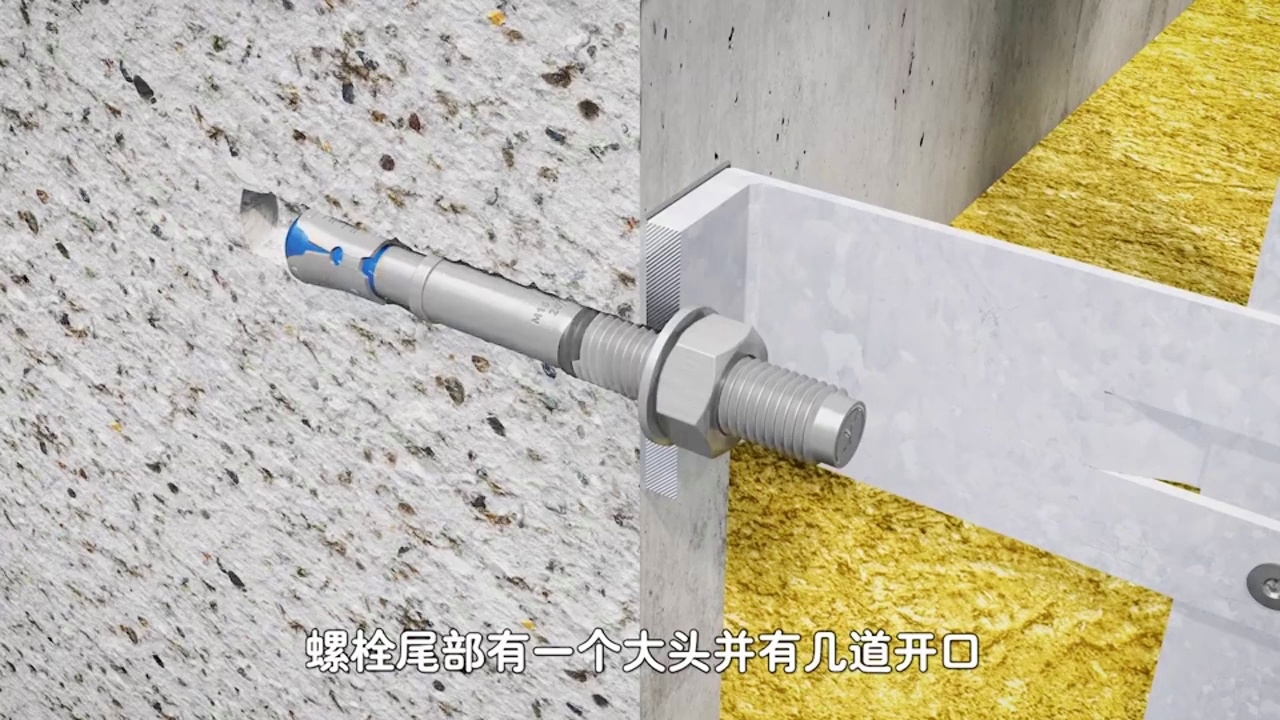
A sleeve anchor is a mechanical expansion anchor. The anchor is inserted into a pre-drilled hole, and as the nut is tightened the cone is drawn into the expansion sleeve. The sleeve opens radially and presses against the hole wall. Load transfer then depends on friction and interlock between the expanded sleeve and the surrounding material — not on adhesive bonding.
Because the substrate itself is the load-bearing component, the practical capacity of the anchor is bounded by the compressive strength and continuity of the material around the hole. In well-cured concrete, the wall of the hole is dense and strong, and the expansion force is transferred efficiently. In hollow brick or low-density masonry, there is less solid material for the sleeve to engage, and the same nominal anchor size will not deliver the same resistance.
Sleeve anchors are commonly used in concrete and solid masonry. Suitability depends on the specific anchor design, the condition of the base material and the load requirement — which is why catalogues that quote a single capacity figure without stating the substrate are of limited use to a specifier.
How a Sleeve Anchor Transfers Load
Understanding the mechanism makes the selection criteria obvious. During installation, a hole is drilled at a specified diameter and depth, cleaned, and the anchor is inserted. Tightening the nut pulls the cone into the sleeve, which expands. Three parameters then control whether the connection performs as intended:
- Embedment depth — how much of the expanded sleeve sits below the surface and engages intact substrate.
- Hole diameter tolerance — an oversized hole reduces the contact pressure the sleeve can generate; an undersized hole prevents the anchor from seating.
- Controlled tightening torque — insufficient torque means the sleeve never fully engages; excessive torque can crack brittle masonry or damage the anchor.
The sleeve anchor range supplied by HEBEI YUETONG FASTENERS MANUFACTURING CO.,LTD covers model sizes from Sleeve Anchor M5-M36, in standards including GB/T, DIN, ISO, ASTM and EN. Overall lengths run from 30 mm through 300 mm, with material grades of 4.8 carbon steel and A2-70 or A4-80 stainless steel, and surface treatments of zinc plating, yellow zinc plating and hot-dip galvanizing.
Matching Sleeve Anchor Types to Base Materials
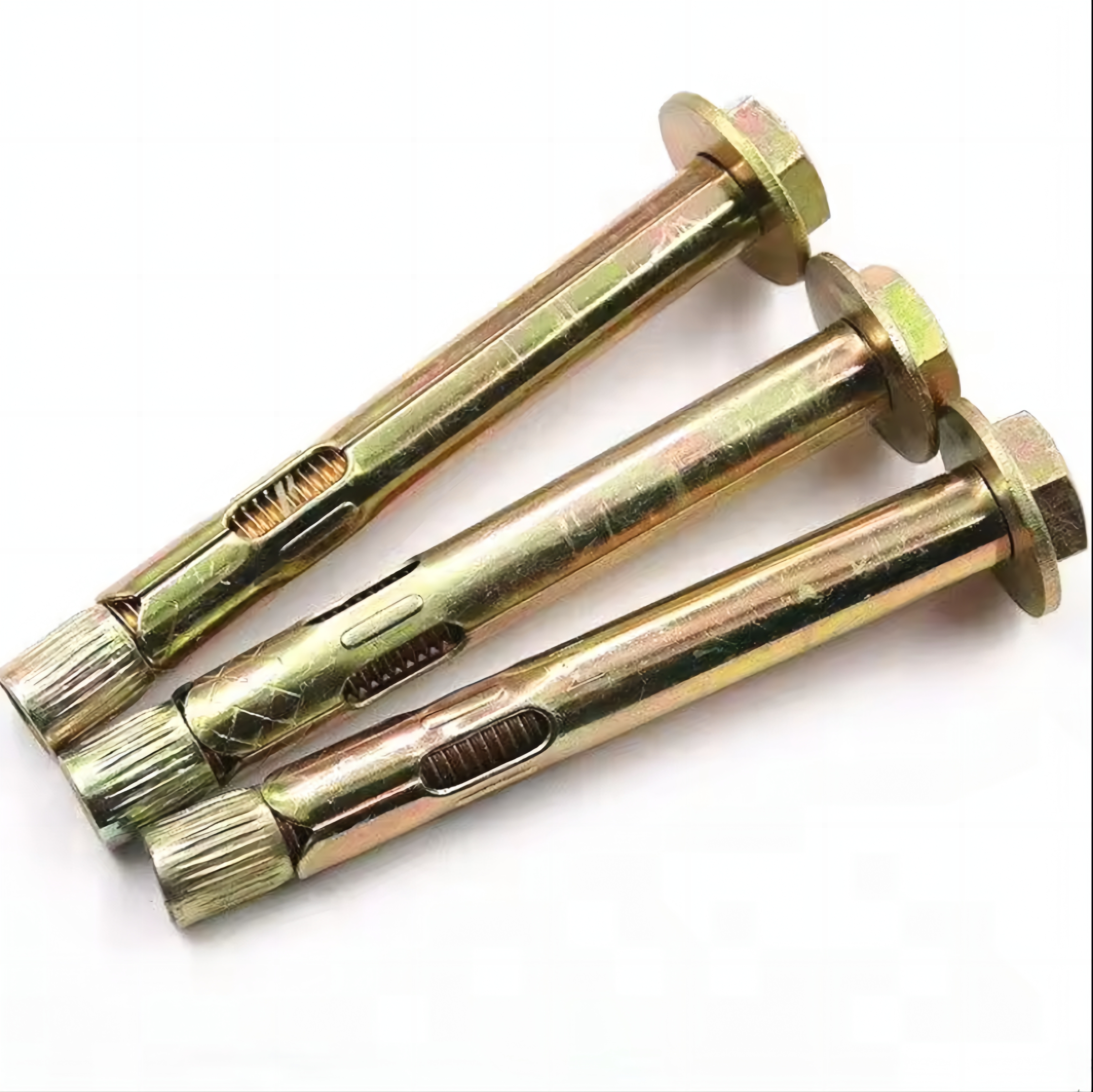
The anchor head style and the sleeve geometry should be chosen together with the substrate. The table below summarises how the product types in the Yuetong sleeve anchor family map to typical job conditions.
| Base material | Sleeve anchor types typically specified | What drives the choice |
|---|---|---|
| Cast concrete in good condition | Hex nut sleeve anchor, Hex bolt sleeve anchor, Flange nut sleeve anchor, Wedge anchor | High compressive strength allows full sleeve expansion; embedment depth and edge distance govern capacity |
| Solid brick and dense masonry | Hex bolt sleeve anchor, L-Hook bolt sleeve anchor, G-Hook bolt sleeve anchor, Hook bolt sleeve anchor | Lower tensile strength than concrete; drilling method matters as much as anchor size — avoid cracking the unit |
| Hollow block and cavity walls | Hollow Wall Anchors, Drop in anchor, Ceiling anchor, 4PCS Fix bolt | Expansion requires a different engagement principle; general-purpose sleeve anchors are not the default answer |
| Overhead and thin-section fixing | Ceiling anchor, Metal frame anchor, Anti-skid Shark Fin Anchor Bolt | Restricted embedment and dead load direction; pull-out rather than shear usually controls |
| General-purpose industrial fixing and light suspension | Eye Bolt sleeve anchor, Hook bolt sleeve anchor | Head geometry is dictated by the attachment, not the substrate — for example lifting points or cable routing |
The range also includes Drop in anchor, hammer anchor, Shark Fin Anchors and Metal frame anchor variants, each aimed at a specific fixing geometry rather than a specific load class. The distinction matters because buyers frequently compare anchors on diameter alone and then discover that the head style does not match the fixture detail.
Working Conditions That Change the Specification
Substrate type is the first filter, but it is rarely the last. The application data behind the Yuetong sleeve anchor range identifies the working conditions that repeatedly force a specification change:
- Indoor normal environment
- Outdoor open-air exposure
- Humid climate
- Coastal salt-spray corrosion
- High and low temperature cycling
- Explosion-hazardous areas
- Vibration load conditions
Two of these deserve separate treatment. Coastal salt-spray exposure is the condition most likely to invalidate an otherwise correct anchor choice, because a mechanically sound anchor can still fail through corrosion of the sleeve or cone. Vibration load is the second, because alternating load can work a marginally tightened expansion anchor loose over time.
For these conditions, the material and coating decision becomes structural rather than cosmetic. Electro-zinc plating, hot-dip galvanizing and stainless steel are the three routes available in the range, and for heavily corrosive environments A4 stainless steel is the option that removes the corrosion risk at source rather than slowing it.
Why EN ISO 10683 Matters More Than a Coating Label
Buyers routinely specify "galvanized" or "zinc plated" without defining what that means in measurable terms. Coating thickness, adhesion and corrosion performance vary widely, and the difference only becomes visible after several years of service — usually in a coastal or humid installation where replacement is expensive.
This is where a recognised standard closes the gap. The sleeve anchor (product code 7338) is certified to EN ISO 10683:2018 for corrosion protection, EN ISO 16047:2005+A1:2012 for fastening torque, and EN ISO 4753:2011. The certification is issued by Ente Certificazione Macchine Srl under certificate number No. 3N230331.HYFUC49 and applies to the EU market.
The practical reading for a specifier is straightforward. EN ISO 10683 addresses the corrosion-protection performance of the coating system. EN ISO 16047 addresses the torque/tension relationship — the property that determines whether a specified tightening torque actually produces the intended preload. Buying against these standards means the coating and the tightening behaviour are defined by a testable method rather than by an adjective on a datasheet.
What the Certification Set Actually Covers
Sleeve anchor buyers are frequently handed a stack of certificates that are real but only partly relevant. Reading the scope statement is the difference between evidence and decoration. The relevant certifications held for the sleeve anchor product are:
| Certification | Issuing body / number | What it addresses | Market |
|---|---|---|---|
| EN ISO 10683:2018 / EN ISO 16047:2005+A1:2012 / EN ISO 4753:2011 | Ente Certificazione Macchine Srl, No. 3N230331.HYFUC49 | Corrosion protection, fastening torque behaviour, fastener geometry | EU |
| ISO 9001:2015 | ZhongTai Union Certification Co., LTD, 29024Q12949-09R1M | Quality management system covering fastener production and export sales | Global |
| ISO 14001:2015 | ZhongTai Union Certification Co., LTD, 29025E12097-12R0M | Environmental management system | Global |
| ISO 45001:2018 | ZhongTai Union Certification Co., LTD, 29025S12024-12R0M | Occupational health and safety management in production | Global |
| IATF 16949:2016 | Beijing Zhong An Zhi Huan Certification Center Co., Ltd, 2600920/R0M | Automotive-sector quality management discipline applied to fasteners | Global |
| ISO 14067 | ZQHX CERTIFICATION CENTER CO., LTD, 33925CFMS00020R0S | Carbon footprint assessment of the sleeve anchor | Global |
An additional supplier assessment is documented through the Alibaba Gold Plus Supplier on-site assessment, certificate number 491647039 P+T, with the on-site assessment carried out by SGS and covering factory supplier capability for fasteners including sleeve anchors.
For a buyer building a qualification file, these certificates answer four different questions: whether the coating meets a defined corrosion standard, whether the factory operates a controlled quality system, whether the environmental and occupational systems are managed, and whether the declared carbon footprint has been assessed. None of them substitutes for project-specific load verification.
Applications Where Sleeve Anchors Are the Preferred Answer
Sleeve anchors are specified across construction engineering, road infrastructure, municipal landscape, factory equipment installation, PV bracket anchoring, bridge and curtain wall work, and home decoration. Within those sectors, the recurring use cases are:
- Equipment anchoring — fixing machinery bases, skids and frames to concrete floors where vibration is present and detachable reassembly is expected.
- PV bracket anchoring — securing ground-mounted support columns to concrete foundations in open-air and high-temperature-cycling conditions.
- Road and municipal furniture — street light bases, signage frames and billboard fixing, where anchors are exposed to rain and temperature change for the life of the installation.
- Curtain wall and bridge connections — where the anchor acts as part of a structural load path and edge distance must be respected.
- Factory and workshop fit-out — general-purpose fixing where standard-load and heavy-duty configurations are selected according to the fixture mass.
One documented project illustrates the outdoor case. An engineering contractor and construction company specified 15,000 pieces for road facilities, billboard fixing, street light bases and PV bracket anchoring. The reported service outcome over a 10–15 year horizon was stable performance under outdoor humid and temperature-changing conditions, with no rust or failure and zero customer complaints. The anchor features behind that outcome were multiple anti-corrosion treatments, customisable specifications and stable delivery — not a single superior parameter.
Market Context: Why Anchor Specification Is Getting More Scrutiny
The global anchoring fasteners market was estimated at USD 3.12 billion in 2024, according to Grand View Research. Within that total, the mechanical anchors segment — the category that includes sleeve anchors — led with 58.3% revenue share in 2024. At a regional level, China's industrial fasteners market is projected to reach USD 22.78 billion by 2032, up from USD 12.23 billion in 2024, based on Credence Research figures.
Two structural trends sit behind those numbers. First, mechanical anchoring continues to dominate the category, which means specification decisions over sleeve anchors affect the majority of anchoring spend rather than a niche. Second, growth in construction, PV and infrastructure programmes increases the number of installations in coastal, humid and high-temperature environments — precisely the conditions where coating compliance and material grade stop being administrative details.
For classification and trade purposes, sleeve anchors are commonly classified under HS Code 7318.15 (other screws and bolts, with nuts or washers), per the US International Trade Commission. For testing methodology, ASTM E488 is the primary standard test method for measuring the strength of anchors in concrete elements, as published by ASTM International.
Comparison With Traditional Fixing Approaches — and Where Sleeve Anchors Stop
Sleeve anchors are often compared with two alternatives: through-bolting with a nut on the far side, and chemical anchors using injected resin.
| Criterion | Sleeve anchor | Through-bolt | Chemical anchor |
|---|---|---|---|
| Installation dependency | Hole diameter, depth, cleaning and torque | Access to the rear face of the member | Resin mixing, cure time and temperature |
| Substrate suitability | Concrete and solid masonry | Any material that can be drilled through | Concrete and solid masonry, including closer edge distances |
| Removability | Detachable and re-usable in repeated assembly | Fully removable | Effectively permanent |
| Vibration behaviour | Designed for vibration load, dependent on correct torque | Depends on the bolted joint | Cured resin resists vibration well |
The limits deserve stating plainly, because they are the reason anchor selection is not a single-answer exercise:
- Hollow and cavity substrates. A general-purpose expansion sleeve anchor is generally not the correct choice in hollow block, because there is insufficient solid material for the sleeve to engage. Dedicated hollow wall anchors or cavity fixings are the appropriate products in that condition.
- Coating certification is not load certification. EN ISO 10683 documents corrosion protection performance. It does not certify load capacity in a specific substrate. Capacity has to be established against the actual base material, embedment depth and edge distance — and for critical connections, verified by anchor testing such as ASTM E488 rather than assumed from a catalogue table.
- Exposure class constrains coating choice. Standard zinc plating is a reasonable choice for indoor and sheltered service. In coastal salt-spray, humid chemical or continuously wet conditions it degrades faster, and hot-dip galvanizing or A4 stainless steel becomes the more defensible specification.
- Order economics favour planned procurement. Standard products are supplied at a minimum order quantity of 500 sets, and non-standard customised products at 3,000 sets. Lead time is 3–7 days for in-stock items and 12–20 days for customised orders, with expedited delivery negotiable. Projects with small, irregular anchor quantities are better served by consolidating specifications than by issuing fragmented orders.
What the Manufacturer Side Contributes to Suitability
For buyers at the evaluation stage, supplier capability is part of the suitability question rather than a separate commercial topic. HEBEI YUETONG FASTENERS MANUFACTURING CO.,LTD operates a 26,666.67 ㎡ facility in Yongnian District, Hebei, with 100 employees, a 12-engineer R&D team and annual output of 150,000 tons. Monthly capacity for the anchor line is 1,500 tons. Export share is 80%, with principal markets in the EU, North America, Latin America, and the Middle East and Africa.
Quality control is structured around raw material incoming inspection, in-process patrol inspection, finished-product tensile load testing and pre-shipment inspection, with third-party SGS testing available. This matters for anchor suitability because the properties that determine field performance — material grade, sleeve geometry and coating thickness — are process-controlled characteristics, not attributes that can be verified by visual inspection at the port.
Commercial flexibility also affects fit: OEM, ODM, non-standard customisation and bulk stock supply are supported, covering size and specification, material selection, anti-corrosion surface treatment, product style, printed logo on packaging and matched assembly kits.
Future Outlook
Three directions appear likely to shape sleeve anchor specification over the next several years. The first is documentation-driven procurement: buyers increasingly ask for the certification scope and number rather than a product adjective, which shifts competition toward verifiable coating and torque standards such as EN ISO 10683 and EN ISO 16047. The second is environment-specific material selection, as more anchoring volume moves into PV, coastal and infrastructure projects where standard zinc plating is a poor match. The third is carbon transparency, signalled by certifications such as ISO 14067, which suggests that footprint documentation will become part of the standard supplier file for construction fasteners rather than an optional extra.
Frequently Asked Questions
Q1. What base materials are suitable for sleeve anchors?
Sleeve anchors are commonly used in concrete and solid masonry. Suitability depends on the specific anchor design, the condition of the base material and the load requirements. Hollow block and cavity substrates typically require a different anchor construction rather than a standard expansion sleeve.
Q2. How should the correct sleeve anchor size be selected?
Selection should consider the fixture thickness, the required load, the base material, the anchor diameter, the embedment depth and the installation environment. The available range covers sizes from Sleeve Anchor M5-M36 with overall lengths from 30 mm to 300 mm, so the constraint is usually the base material and embedment depth rather than the catalogue range.
Q3. What affects the load capacity of a sleeve anchor?
The load capacity depends on the anchor size, embedment depth, base-material strength, hole diameter, edge distance, spacing and installation quality. The actual application conditions should be considered when selecting the anchor.
Q4. Is tightening torque important for sleeve anchors?
Yes. Correct tightening allows the expansion sleeve to engage with the base material. Insufficient tightening may result in poor expansion, while excessive tightening may damage the anchor or the base material. The torque/tension behaviour of the sleeve anchor is addressed by the EN ISO 16047:2005+A1:2012 certification held for this product.
Q5. Can sleeve anchors be used outdoors?
Yes, but the appropriate surface finish or material should be selected according to the environment. Zinc plating, hot-dip galvanizing or stainless steel may be considered depending on the required corrosion resistance. Where the installation is exposed to coastal salt spray or prolonged humidity, A4 stainless steel eliminates corrosion risk at source rather than slowing it.
Q6. Can sleeve anchors loosen after installation?
Yes. Improper hole size, insufficient embedment, an unsuitable base material or incorrect tightening torque may reduce anchoring performance and cause loosening. Alternating vibration load is an additional factor, which is why vibration load conditions are treated as a distinct working condition in anchor selection.
Q7. Why can a sleeve anchor pull out of concrete?
Pull-out may occur when the anchor is installed in weak or damaged concrete, the hole is oversized, the embedment depth is insufficient, or the anchor is overloaded.
Q8. How can sleeve anchor failure be reduced?
Use the correct anchor size, drill the specified hole diameter, maintain sufficient embedment depth, clean the hole and tighten the anchor according to the installation requirements. For critical connections, anchor performance in the specific substrate should be verified rather than assumed.
Closing Note
Sleeve anchor selection is a substrate-first decision. Identify the base material, define the exposure class, then choose the head style, material grade and coating — and confirm that the coating and torque behaviour are documented against a recognised standard such as EN ISO 10683. Product and certification documentation for the sleeve anchor range is available from HEBEI YUETONG FASTENERS MANUFACTURING CO.,LTD at www.ytfasteners.com, and the product brochure can be downloaded here: Yuetong Fastener product brochure (PDF).